
Small Business Phone Answering Guide
At its core, a small business phone answering solution is simply a way to make sure you never miss a customer call. Whether it’s a team of live receptionists, a smart AI, or a combination of both, the goal is always the same: turn every incoming ring into a real business opportunity.
The True Cost Of A Ringing Phone

For any small business owner, a ringing phone is the sound of money. But what happens when that call comes while you’re busy with a client, driving between jobs, or finally sitting down for dinner? Each unanswered call is more than just a minor inconvenience—it’s often a customer taking their money straight to your competition.
Think of it like a leaky pipe. One missed call might seem like a single drop, but those drops add up fast. Before you know it, you're looking at a serious, and often hidden, drain on your revenue. This isn't just about being busy; it's a direct threat to your profitability and growth.
The Financial Drain of Unanswered Calls
The hard truth is that modern customers expect an immediate answer. When they don’t get one, they don’t wait around. They just move on to the next name on Google, and your chance to earn their business is gone in a flash.
The numbers behind missed calls are often much worse than business owners assume. Here’s a look at the industry averages and what they really mean for your bottom line.
The Hidden Cost of Missed Calls
| Metric | Industry Average Reality | What This Means for You |
|---|---|---|
| Callers Sent to Voicemail | A staggering 37.8% of inbound calls | Nearly 4 in 10 potential customers are sent to a system they increasingly ignore. |
| Customers Expecting Instant Response | 77% | The vast majority of people calling you want help now, not later. |
| Customers Who Won't Call Back | 60% won't try again if they hit voicemail | Most of your missed opportunities are gone forever after just one unanswered call. |
These statistics paint a clear picture: relying on your own availability or a voicemail system is a losing game. The full impact of these figures, detailed in comprehensive business phone statistics, shows just how much is at stake.
This isn't just theoretical, either. It plays out every single day.
- For a plumber: Missing just a few emergency calls over a holiday weekend could mean losing thousands in high-value, urgent work. That caller isn’t leaving a message; they're dialing the next plumber who actually picks up.
- For a law firm: An unanswered call from a potential client facing a legal deadline isn't just one missed consultation. It's the loss of a case and a relationship that could have been worth tens of thousands.
- For a real estate agent: A missed call from a motivated buyer wanting to see a new listing could mean losing out on a significant commission. That buyer will simply call the next agent who answers their phone.
In all scenarios, the loss goes far beyond the initial job. You also lose out on future referrals, positive online reviews, and the long-term loyalty that builds a truly stable business.
Why Voicemail Is No Longer A Safety Net
There was a time when voicemail was a perfectly good backup. But customer habits have changed dramatically. Today, being asked to leave a message feels like a chore, and waiting for a callback is filled with uncertainty.
Someone with an urgent problem—a flooded basement, a computer virus, or a last-minute catering need—simply won't wait. They need immediate assurance that someone is on the case. Your automated "we'll get back to you" greeting is an open invitation for them to hang up and dial your competitor.
Practical Example: Imagine a customer's website just crashed. They search for "emergency IT support" and call your company. They hit your voicemail. Frustrated, they hang up and immediately call the next business on the list, which answers on the second ring. You just lost a potentially long-term client worth thousands per year because your voicemail couldn't provide the instant reassurance they needed.
This is why having a solid small business phone answering strategy is no longer a luxury. It's a fundamental part of customer service and, ultimately, a tool for survival.
Exploring Your Phone Answering Options
So, you’ve realized that missed calls are missed opportunities. What now? The next step is figuring out the best way to handle your inbound calls.
Choosing the right small business phone answering strategy isn’t a one-size-fits-all deal. It's about finding the perfect match for your budget, your team's workflow, and the kind of experience you want to give your customers. Think of it as deciding who greets people at your front door—you have a few distinct choices, each with its own pros and cons.
Let's break down the three main paths you can take: keeping it in-house, outsourcing to a traditional service, or blending AI with a human touch.
The In-House Approach
The classic solution is to hire a dedicated in-house receptionist or assign phone duties to an existing employee. This person is more than just a voice; they're fully embedded in your company culture and day-to-day operations.
This route gives you the most control. Your employee knows your team, understands the nuances of your business, and can handle complex questions right on the spot. They are a consistent, familiar presence for your clients during business hours.
Practical Example: A small law firm hires a full-time receptionist. She's the one greeting clients, booking appointments directly in the partners' calendars, and routing calls with a personal touch because she knows exactly which paralegal is handling which case file.
The downside? This level of control comes at a steep price. You're not just paying a salary; you're covering benefits, payroll taxes, sick days, and vacation time. Plus, what happens during lunch breaks, after 5 PM, or on weekends? Your phones go unanswered.
Traditional Answering Services
Another popular option is to outsource your calls to a traditional answering service. You're essentially hiring a remote team of agents to answer calls on your behalf, 24/7. They work from a call center, following a script you provide to take messages and screen callers.
This immediately solves the problem of after-hours coverage. You can rest easy knowing you'll never miss another call just because it came in at 2 AM. It's often more affordable than a full-time hire because you're paying for a service, not a whole employee with benefits.
A traditional service excels at one core task: taking a message. Agents capture the caller's information and pass it along to you. While this stops the call from being missed, the interaction itself can feel impersonal and is often limited to basic information gathering.
Practical Example: A plumbing company uses this for emergencies. A customer calls with a burst pipe at 3 AM. An agent at the answering service follows a script, takes down the customer's name, address, and the nature of the emergency, then immediately pages the on-call plumber. It's a simple, reliable switchboard that keeps the business running around the clock.
The AI and Human Hybrid Model
The most modern approach combines the lightning-fast efficiency of artificial intelligence with the empathy and critical thinking of a human expert. This hybrid model uses an AI receptionist as the first line of defense.
The AI can instantly handle all the common, repetitive tasks—answering FAQs, booking appointments, and gathering initial information from new leads, 24/7. But its real strength lies in knowing its own limits. When a caller is upset, has a complex problem, or simply needs to talk to a person, the AI seamlessly transfers the call to a live agent.
This gives you the best of both worlds. For more on the technology that powers this, check out our guide on choosing the right small business phone system.
Practical Example: A dental clinic uses a hybrid service. The AI books routine cleanings and confirms appointments all day long, even when the front desk is busy with patients. But when a caller says, "I'm in a lot of pain and my tooth is broken," the AI detects the urgency and emotion in their voice. It instantly routes them to a live agent who can offer a reassuring voice, find an immediate emergency slot, and provide pre-appointment instructions. You get ultimate efficiency without ever sacrificing the human touch when it matters most.
Comparing Phone Answering Services Head To Head
Deciding how to handle your business calls is a lot like choosing the right tool for a job. You wouldn't use a hammer to turn a screw, right? Similarly, the three main ways to manage your phone lines—hiring someone in-house, outsourcing to a traditional service, or using a modern AI-hybrid—are all built for very different needs.
Let's break down each approach so you can see which one truly fits your business.
This diagram lays out the three main paths you can take.
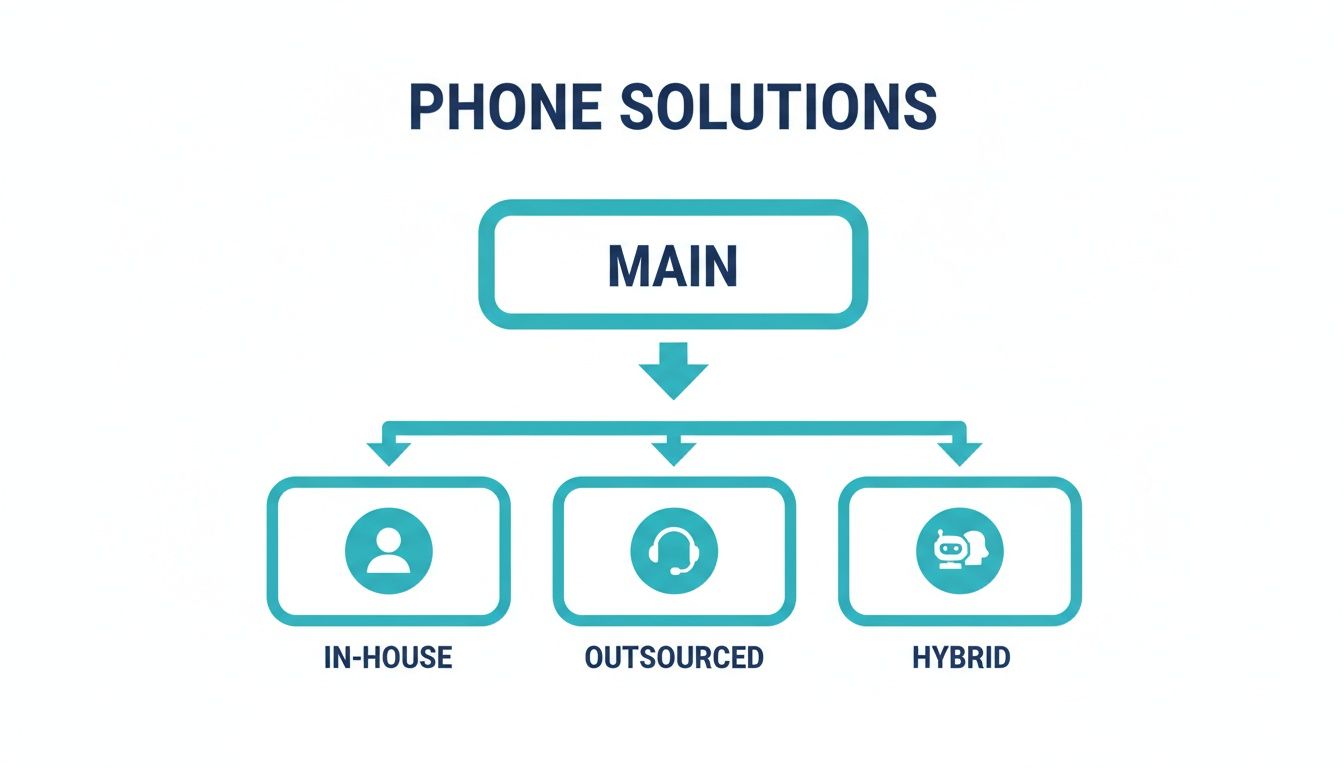
As you can see, each option offers a fundamentally different way to staff your "front desk," whether it's a person down the hall, a remote team, or a smart blend of technology and people.
Beyond The Salary: The Real Cost and Coverage
The most immediate difference people see is cost, but the sticker price is just the beginning. An in-house receptionist involves far more than just a salary. You have to account for benefits, payroll taxes, training days, and paid time off. All in, you're easily looking at over $50,000 per year for one person who only covers your phones from 9 to 5.
On the other hand, a traditional answering service gives you 24/7 coverage for a predictable, and much lower, monthly fee. The AI-hybrid model also provides around-the-clock availability, but it’s often even more cost-effective because smart AI handles the straightforward calls, saving human agents for when they're truly needed.
The core trade-off becomes clear: an in-house receptionist offers deep company knowledge during business hours for a high cost, while outsourced and hybrid solutions provide constant availability for a fraction of the price.
Practical Example: An HVAC company with an in-house receptionist is guaranteed to miss the lucrative emergency call that comes in at 9 PM on a Friday. With an outsourced or hybrid service, that call is always answered. Even if it's just a message taken by a traditional service, it's a captured lead. With a hybrid service, the AI could even schedule the emergency visit for Saturday morning, turning a missed opportunity into a new, profitable job.
What Can They Actually Do? A Look at Capabilities
Answering the phone is one thing. Doing something useful with the call is another. This is where the models really start to diverge.
A traditional answering service is built to do one thing exceptionally well: take a message. A polite agent will gather the caller's name, number, and a quick note, then pass it along to you. It's a reliable way to capture leads, but that's where the functionality ends.
The AI-human hybrid, however, is designed to be an active part of your team. It goes beyond simple message-taking to actually resolve the caller's needs on the spot.
- Direct Appointment Booking: The system can sync with your calendar and book appointments automatically, no back-and-forth required.
- Smart Lead Qualification: It asks the right questions to figure out if a caller is a hot lead, just browsing, or an existing customer who needs help.
- Seamless CRM Integration: Every call—including the summary and what happened—gets logged directly in your CRM, creating a perfect record of every customer touchpoint.
Practical Example: A potential client calls a law firm. A traditional service would just take a message: "John Smith called about a contract issue." A hybrid system, however, can qualify the caller by asking about their business size and the type of contract, schedule a paid 30-minute consultation directly in the partner's calendar, and create a new client profile in the firm's software—all before the attorney even gets the notification.
Choosing the right fit is a big decision, and our guide on the best virtual receptionist for small business can provide even more detail.
In-House vs. Traditional Service vs. AI-Hybrid Platform
To make the comparison even clearer, let's put these three models side-by-side and look at them feature by feature.
| Feature | In-House Receptionist | Traditional Answering Service | AI-Human Hybrid |
|---|---|---|---|
| Availability | 8 hours/day, 5 days/week | 24/7/365 | 24/7/365 |
| Typical Cost | $50,000+ per year | $200 - $1,500+ per month | $150 - $2,000+ per month |
| Appointment Booking | Manual | Message taking only | Automated, direct to calendar |
| Lead Qualification | Manual (if trained) | Basic contact info only | Automated & customizable |
| CRM Integration | Manual data entry | None or very limited | Automatic & deep integration |
| Primary Function | Greet visitors, answer phones | Take and forward messages | Resolve issues, book, qualify |
This table shows a clear evolution. The in-house model gives you total control but comes with a high price and limited hours. The traditional service offers great availability but with basic functions. Finally, the hybrid model delivers intelligent, automated action around the clock, giving you the best of both worlds.
And of course, none of these services work without a solid phone system behind them. To get started, you might want to explore the 7 best VoIP providers UK for businesses to understand the technology that powers modern business communication.
How The AI And Human Hybrid Model Works
The hybrid model is where phone answering gets really smart, blending the best of both worlds: automation and a genuine human touch. It’s a partnership that pairs the 24/7 speed and power of AI with the empathy, critical thinking, and deep knowledge of a trained professional.
Think of the AI as your ultimate front-line operator. It flawlessly handles the high volume of routine calls—things like answering basic questions, booking appointments, or qualifying new leads—at any hour of the day. This simple but powerful step frees up your human team to focus on what they do best: managing high-value conversations and solving complex customer problems.
The AI-First Approach
So, how does this actually work in practice? It all starts with the AI answering every single call. This is your first line of defense, ensuring a caller never hits voicemail or gets a frustrating busy signal. Using natural language, the AI immediately gets to work understanding why the person is calling.
This isn't just a passive recording. The AI is an active part of your team, programmed to follow your specific business rules and get things done.
Let's walk through a real-world scenario. A potential customer calls your HVAC company on a scorching Saturday afternoon.
- AI Greets and Gathers: An AI receptionist answers instantly with your company's branded greeting: "Thank you for calling Reliable Air. How can I help you today?" It then asks a few smart qualifying questions to get the key details: name, address, and the specific issue (e.g., "My A/C unit won't turn on").
- AI Takes Action: The AI recognizes this is a hot lead. It checks your integrated calendar for the next available technician and offers to book a diagnostic appointment right then and there: "I see we have a technician available between 2 and 4 PM this afternoon. Would you like me to book that for you?"
- AI Captures Data: Once the caller confirms the time, the AI automatically creates a new customer profile in your CRM, logs all the call details, and fires off a calendar invite to both the customer and the dispatched technician.
The entire exchange takes just a few minutes, with zero human effort required. You just turned a weekend phone call into a scheduled job and a happy new customer.
When To Escalate To A Human
The real magic of the hybrid model is that the AI knows its own limits. It’s programmed with specific triggers that signal it's time for a seamless handoff to a live agent. You can customize these triggers, but they typically include:
- Emotional Cues: The AI is trained to detect tones or keywords that signal a caller is frustrated, angry, or in distress (e.g., "I'm so upset," "this is unacceptable").
- Complex Questions: When a caller asks a tricky question that isn't in the script—like a highly technical product question or a sensitive billing dispute.
- Direct Requests: Sometimes a caller just wants to talk to a person. If they say, "Let me speak to a human," the system transfers them instantly.
A key advantage of integrating AI is its ability to help you efficiently capture every interaction, enabling you to learn how to take better phone call notes and create summaries. This provides a perfect record for both the AI and any human agent who may join the call.
Practical Example: After the AI books the HVAC appointment, the customer asks, "I have a child with severe asthma. Is the coolant you use safe for my family?" This is exactly the kind of sensitive, high-stakes question that needs a human expert's reassurance.
The AI immediately identifies this as an escalation trigger. It gracefully transfers the call—along with all the notes it just took—to a live agent. The agent sees the customer's name, address, and issue pop up on their screen and can pick up the conversation right where the AI left off: "Hi, this is Sarah. I see our system just booked you an appointment, and I understand you have a question about our coolants and asthma concerns. I can absolutely help with that." They provide an expert, reassuring answer that builds trust and locks in the new business.
Curious about how this could work for you? You can learn more about what an AI receptionist for small business can really do.
Your Implementation Success Checklist
Bringing a new small business phone answering service on board should feel like a relief, not a headache. With a bit of prep work, you can make sure the switch is smooth and that the system works exactly the way you need it to from the very first call.
Think of it like drawing up a blueprint before you start building. It helps you get the foundation right and avoid a lot of frustration down the road. Let’s walk through a simple checklist to get you from planning to launch.
Define Your Primary Goals
Before you touch a single setting, you need to be crystal clear about what a "win" looks like for your business. What are the specific, measurable results you're after? A vague goal like "better call handling" isn't going to cut it.
Honestly, this is the most critical part of the whole process. It’s the difference between just buying another piece of software and making a smart investment. Your goals will shape every other decision you make, from the scripts you write to the tools you connect.
Actionable Goals Examples:
- Capture 100% of new sales leads by ensuring a potential customer never hits voicemail between 8 AM and 8 PM.
- Book 15% more service appointments by allowing the AI to schedule appointments directly into your Google Calendar.
- Reduce your own involvement in routine phone calls by 80%, freeing you up to focus on client work and business development.
- Improve first-call resolution for billing questions by 25% by creating a workflow that routes callers directly to your bookkeeper.
Develop Your Call Scripts and Workflows
Your script is the playbook. It's what ensures every call is handled consistently, professionally, and in a way that guides the caller toward the outcome you want. Don't just write a simple greeting; map out the entire conversation for different kinds of calls.
Practical Example: A Pest Control Company
Let's imagine a local pest control business. They'd likely have two main types of callers: new leads and existing customers. Their workflows might look something like this:
New Lead Workflow:
- Greeting: "Thanks for calling Apex Pest Solutions! Are you a new or existing customer?"
- Qualify: "We can definitely help with that. To get you the most accurate quote, I just need a little information. What's your zip code and what kind of pest are you dealing with?"
- Action: "Great, we service that area. We have a technician available tomorrow afternoon between 1 and 3 PM. I can book that for you now. What's the best number to send a confirmation text to?"
Existing Customer Workflow:
- Greeting: "Thanks for calling Apex Pest Solutions! Are you calling about an existing service appointment?"
- Identify: "Sure. Can I get your name or the service address?"
- Route: "Thank you. I see your appointment is scheduled for tomorrow. Let me connect you with our scheduling team who can help you with your request."
- List Your Tools: Jot down the software that runs your business (e.g., Salesforce for CRM, Google Calendar, QuickBooks).
- Identify Connection Points: Figure out what needs to happen. For example, "When the service captures a new lead, a contact should automatically be created in Salesforce and tagged as 'Hot Lead'."
- Define Escalation Triggers: What words or phrases are a signal to get you or an employee on the line immediately? Think about things like "billing dispute," "legal question," "I want to cancel my service," or specific competitor names.
- The "Hot Lead" Call: Call in as a brand-new customer ready to buy. Did the system get your information and schedule you without a hitch? Did the calendar invite arrive correctly?
- The "Confused Customer" Call: Try asking a weird or off-topic question, like "Do you also fix washing machines?" Does the system handle it gracefully ("I can only help with pest control issues, but I can connect you to our office staff if you'd like."), or does it get stuck and frustrate you?
- The "Escalation" Call: Use one of your trigger words like "cancel". Did the call get transferred to the right person quickly and seamlessly? Did that person receive the call notes?
- New Leads Captured: How many potential new customers did the service connect with this month?
- Your Conversion Rate: What percentage of your qualified leads typically become paying customers?
- Average Customer Value: On average, how much is a new customer worth to your business in revenue?
- The service successfully captures five new, high-value client leads each month—people who called on a Saturday and would have hung up and called the next firm on their list.
- Historically, the firm converts about 20% of its qualified leads into clients. That's one out of every five. So, 5 new leads x 20% conversion rate = 1 new client.
- The average value of a single new case for this firm is $5,000.
- Less Founder Burnout: The peace of mind you get from knowing every call is handled professionally is priceless. You can finally switch off without worrying about what you're missing. Practical Example: A solo consultant can finally take a real vacation, knowing their AI receptionist is booking initial consultations into their calendar for the week they return.
- A More Professional Image: When every single call is met with a prompt, professional voice, it builds immediate trust. Your business instantly feels more established and reliable, no matter its size. Practical Example: A new freelance web developer sounds like a full-service agency because their calls are answered 24/7 with a custom greeting and lead qualification process.
- Time to Be the CEO: By offloading the constant interruption of the phone, you get back your most valuable asset: time. You can finally focus on strategy, marketing, and the big-picture thinking that actually grows the business. Practical Example: The owner of a cleaning service spends her afternoons preparing quotes and marketing instead of answering calls about scheduling changes, which the system now handles automatically.
- Custom Scripts: Tell us exactly how you want your phone answered and what you want said. It's your brand's voice, every time.
- Information Gathering: You choose precisely what information needs to be collected from every type of caller.
- Escalation Rules: You set the triggers for when a call needs to be transferred directly to you or someone on your team.
Plan Your Integrations And Escalations
This is where a modern answering service really starts to work for you—when it talks to the other software you already use. It's also crucial to have a clear plan for when a call needs to be escalated from an automated system or a general receptionist to a real person on your team.
Actionable Integration Steps:
Test, Refine, and Launch
Never go live without kicking the tires first. Make several test calls yourself to see what the experience is like from the customer's side. This is your chance to catch any awkward wording, confusing prompts, or technical glitches before they affect a paying customer.
Recommended Test Scenarios:
By following this checklist, you’re not just setting up a phone service—you’re building a strategic tool that will pay for itself over and over again.
Is It an Expense or an Investment? Let’s Do the Math
So, is a phone answering service just another monthly bill? Or is it something that actually makes you money? The answer really comes into focus when you look at the return on your investment (ROI). It’s easy to get hung up on the monthly fee, but when you zoom out, you often find a powerful tool for cutting costs and bringing in new revenue.
It’s a common mistake to see a small business phone answering service as a simple expense line on your budget. A better way to think about it is like hiring an incredibly efficient team member who works 24/7—capturing leads and delighting customers—for a tiny fraction of a full-time salary.
The real ROI isn't just about what you spend. It's about what you gain and what you stop losing.
The Simple ROI Formula
To get a true sense of the financial impact, we need to look beyond the service fee. The math itself is surprisingly simple: you just weigh the new revenue you’ve gained against what the service costs. This changes the entire conversation from "How much does this cost me?" to "How much is this making me?"
Here’s a basic way to frame it:
ROI = (New Revenue Gained + Costs Saved) - Service Cost
Plugging your own numbers into this equation is the quickest way to see the service's true financial value.
Tallying Up the New Revenue
This is the exciting part—seeing the actual new business your answering service is reeling in. This isn’t just some fuzzy estimate; it's tangible money that would have otherwise vanished into your voicemail box or, worse, gone straight to a competitor.
To figure this out, you just need three numbers:
A Real-World Example: The Law Firm
Let's imagine a small law firm that spends $800/month on a hybrid answering service to handle calls after hours and on weekends.
With the service, the firm lands one extra client per month, which brings in $5,000 in new revenue. After you subtract the $800 service cost, that's a net gain of $4,200 every single month. That works out to an ROI of over 500%.
(If you want to get more granular on tracking lead costs, our guide on how to calculate cost per lead is a great resource.)
The Benefits You Can't Put on a Spreadsheet
Of course, the true value isn't just about dollars and cents. Some of the biggest returns are the intangible benefits that dramatically improve your business—and your sanity.
Frequently Asked Questions
It's completely normal to have a few questions when you're exploring phone answering services for the first time. Getting the right answers is key to finding a solution that actually helps your business, rather than just adding another expense.
Let’s tackle some of the most common things we hear from business owners just like you.
Will My Customers Know They’re Talking to an AI?
This is probably the number one question we get, and for good reason. The short answer is: sometimes, but it’s by design. Today's conversational AI is incredibly good at handling routine requests—like booking appointments or taking down basic info—so smoothly that most callers won't even notice. The interaction just feels quick and efficient.
The real magic of a hybrid system is its built-in safety net. The very moment a caller gets frustrated, asks a tricky question the AI can't handle, or simply says, "I need to talk to a person," the call is instantly handed off to a live agent. This ensures your customers always feel heard and supported.
How Much Control Do I Have Over the Call Process?
You're in the driver's seat, completely. During setup, you're the one who lays down the ground rules for every call. You get to decide:
Practical Example: You could set up a rule that any caller who mentions "refund" or "billing error" is immediately transferred to your personal cell phone between 9 AM and 5 PM, but a message is taken after hours. Meanwhile, any caller who says "new project quote" is asked three qualifying questions before an appointment is booked in your calendar.
Is This Really Affordable for a Very Small Business?
Absolutely. In fact, it’s one of the smartest financial moves a small business can make. When you stack up the monthly cost of a hybrid service against the true cost of hiring an in-house receptionist, it’s not even a fair fight. A full-time employee comes with a salary, benefits, and payroll taxes that can easily top over $50,000 a year.
A hybrid service costs just a tiny fraction of that. Think about it: by saving just a couple of valuable leads from going to voicemail each month and freeing up your own time to focus on your work, the service pays for itself almost immediately. It’s a high-return investment, even if you’re a one-person shop.
Practical Example: A solo massage therapist pays $200 a month for an answering service. The service books just one new client for her—a $120 value. It also saves her an average of 5 hours a month by not having to answer the phone while with clients. If she values her time at $50/hour, that's $250 in saved time. The service has already provided more value than its cost.
Ready to capture every lead and give your customers the flawless experience they deserve? Recepta.ai blends the smart efficiency of AI with the warm touch of human support, so you never miss an opportunity. See how our 24/7 phone answering service can help you grow by visiting https://recepta.ai.