
The Ultimate Guide to an Answering Service for Dentists in 2026

It’s 7 PM on a Friday. A potential new patient, dealing with a throbbing toothache, finds your practice on Google and calls, desperate for help. The phone rings a few times and then… voicemail. Frustrated and in pain, they hang up and immediately call the next dentist on the list.
This isn’t just a hypothetical scenario. We see it happen every single day. That one missed call is more than a minor inconvenience; it's a lost opportunity that directly impacts your revenue and your reputation.
The Hidden Cost of Your Voicemail
When a patient is in distress, especially after hours, their patience is paper-thin. A voicemail greeting doesn't feel like a solution; it feels like a dead end. They aren't going to wait for a callback on Monday morning. They need help now, and they will find a practice that can provide it.
The numbers are pretty staggering. Over 60% of after-hours calls to healthcare providers are never answered. For a dental practice, that can translate to a 25-30% loss in potential new appointments. Think about that—a quarter of your growth, gone, simply because no one was there to pick up the phone.
To truly grasp the damage, you have to look beyond just one missed appointment fee. The real loss is far greater.
The True Cost of a Single Missed Call
The table below breaks down the cascading effect of that one unanswered call. It’s not just about the immediate loss; it’s about the long-term patient relationship that never even had a chance to begin.
That initial call wasn't just for a toothache. It was the potential start of a long-term relationship. It could have led to years of routine check-ups, high-value cosmetic procedures, and glowing referrals to their friends and family.
When a new patient can’t reach a real person, they don’t just move on. They often form a lasting negative impression that your practice isn't accessible or truly focused on patient care. This is where an answering service for dentists becomes your most valuable asset, ensuring every single caller is greeted by a helpful, professional voice. It's a foundational step to improve the patient experience.
Having that constant, reliable coverage transforms your practice by:
- Securing High-Value Patients: New patients looking for urgent care or inquiring about cosmetic treatments are often your most profitable leads. An answering service makes sure you never miss out on these critical calls. For example, when a patient calls at 8 PM on a Tuesday to ask about Invisalign pricing, a live agent can capture their information and book a consultation, securing a potential $5,000 case that would have otherwise gone to voicemail.
- Building Instant Trust: Hearing a calm, reassuring voice during a stressful moment builds immediate loyalty and confirms to the patient that they’ve made the right choice.
- Protecting Your Online Reputation: In the age of Google reviews, a single negative comment about being unreachable can deter dozens of other potential patients. A professional service prevents those frustrating experiences from ever happening.
What a Modern Dental Answering Service Actually Does
Let's be honest, when most people hear "answering service," they picture someone in a call center simply taking a message. But for a modern dental practice, that’s an outdated idea. The new standard isn't just about taking messages—it's about having a skilled, virtual extension of your front desk team working around the clock.
Think of it less as a message pad and more as a proactive partner. These services combine trained, professional agents with smart technology to manage the entire flow of patient communication. They aren't just a backup; they become a key part of how your practice operates, making sure no new patient or urgent call ever gets lost to voicemail.

Beyond Just Answering Calls
A top-tier service doesn't just answer the phone; it handles the complex, revenue-generating tasks that can overwhelm a busy front desk. This support frees up your in-house team to give their full attention to the patients right there in your office.
Here’s what that looks like on a typical day:
- Appointment Management: A potential new patient calls at 9 PM on a Saturday after seeing your ad. Instead of a machine, they reach a live agent who accesses your practice's calendar, finds an open new-patient slot for Monday at 10 AM, and books the appointment right into your system.
- New Patient Intake: Someone interested in a high-value service like dental implants calls with a few questions. The agent can follow your custom script to qualify them ("Have you had a consultation for implants before?"), collect their details, and schedule a formal consultation, creating a seamless and professional first impression.
- Payment and Billing Questions: A patient calls after hours with a question about a recent bill. An agent can provide basic answers from your provided FAQ ("Yes, we do offer payment plans. I can schedule a call for you with our billing manager tomorrow."), securely process a payment over the phone, or schedule a callback for more complex issues.
A specialized dental service knows the difference between a patient asking about teeth whitening and one describing the symptoms of a dry socket. That distinction is everything. It allows them to provide the right guidance, escalate true emergencies, and give both you and your patients peace of mind.
Handling Critical Dental Scenarios
Where a dedicated answering service for dentists really proves its worth is in those critical moments. They are specifically trained to manage the urgent and unique situations that pop up in a dental practice. While a general medical answering service can be useful, one that lives and breathes dentistry understands the nuances. You can dive deeper into this by reading our guide on selecting a medical office answering service.
They operate based on your specific instructions for any situation. For example, a call about severe post-operative bleeding is immediately patched through to the on-call dentist. On the other hand, a simple request to reschedule a six-month cleaning from Thursday to Friday is handled quickly and efficiently without ever interrupting your dinner. It's about protecting your work-life balance while making sure every single patient feels heard and cared for.
The Non-Negotiable Features of a Great Dental Answering Service
When you're looking for a dental answering service, you’re not just outsourcing calls. You’re hiring a remote team member who will be the first point of contact for new patients and a lifeline for existing ones after hours. This isn't a decision to take lightly.
To make sure you get it right, your service needs to be more than just a friendly voice on the other end of the line. There are a few core features that are absolutely non-negotiable. These are the things that separate a basic call center from a true partner in your practice's growth and patient care.
24/7 Live Answering and New Patient Intake
Dental emergencies and patient questions don’t clock out at 5 PM. A real person needs to be available around the clock, because a voicemail greeting simply doesn’t cut it when a patient is in pain or a potential new patient is ready to book.
Actionable Example: A parent calls at midnight because their teenager chipped a tooth playing sports. A live agent can reassure the parent, ask clarifying questions ("Is there any bleeding or severe pain?"), and book an appointment for the very next morning. The patient is secured, and the parent feels cared for.
It’s a staggering fact that 70% of dental inquiries happen outside of typical 9-5 hours. Yet, only a mere 15% of solo practices have any kind of after-hours coverage. This disconnect is costly, leading to a 35% drop in new patient conversion rates. In sharp contrast, practices that use a professional answering service see booking rates that are 45% higher. The data on this is compelling, as you can see from market growth trends reported by EIN Presswire.
Guaranteed HIPAA Compliance
This one is simple: protecting patient privacy is a legal and ethical requirement. Any service you consider must be fully HIPAA compliant, meaning they have ironclad, documented processes for handling Protected Health Information (PHI). Don't just take their word for it—ask for their Business Associate Agreement (BAA) and proof of training.
Here’s what that looks like in practice: A patient calls after hours to ask about their recent implant surgery and mentions a pre-existing condition. A HIPAA-compliant agent handles that call on a secure, encrypted line. They are trained to manage sensitive information, and any notes they take are stored securely in a portal that requires two-factor authentication, shielding both the patient and your practice from a devastating data breach.
For any service that records calls or takes digital notes, it's essential that they use HIPAA-compliant transcription software to ensure every piece of patient communication is protected by law.
Seamless Appointment Scheduling
A top-tier answering service should function as a seamless extension of your front office. That means they need direct, secure access to your practice’s schedule. True integration with your Practice Management Software (PMS), like Dentrix or Eaglesoft, is the gold standard here.
This integration allows the remote agents to do what matters most:
- Book Confirmed Appointments: They can see your real-time availability and schedule a new patient directly into an open slot. No more phone tag or missed opportunities.
- Update Patient Notes: Important details from the call, such as "Patient is very anxious about dental visits," can be added straight into the patient's record for your team to see in the morning.
- Avoid Double-Bookings: Because they work from the exact same live calendar as your in-office staff, you never have to worry about scheduling conflicts.
Customized Emergency Escalation Protocols
Finally, a great service protects your personal time by acting as an intelligent filter. You get to define what constitutes a true emergency that requires your immediate attention versus a routine query that can wait until morning.
You work with the service to create custom escalation protocols.
- Non-Emergency: A patient calls at 10 PM wanting to move a cleaning appointment. The agent professionally handles the request, books a new time for next week, and leaves a clear note for your front desk team. You sleep soundly.
- True Emergency: A patient calls with uncontrolled bleeding following an extraction. The agent immediately follows your protocol, patching the call directly through to the on-call dentist or sending an urgent, pre-approved text message that says: "URGENT: Patient [Name] at [Phone Number] reports post-op bleeding."
This system ensures you’re always there for your patients in a crisis, but you're not being woken up for administrative tasks.
Calculating the ROI for Your Dental Practice
Thinking about an answering service for your practice? The first question is always about the bottom line: "Is it worth the money?" It's a fair question. But viewing it as just another monthly expense misses the point entirely. A good answering service is an investment, one that can pay for itself many times over.
The math behind calculating the return on investment (ROI) is surprisingly straightforward. You simply weigh the monthly cost of the service against the new revenue it brings in and the operational costs it saves you. On one side, you have a predictable fee. On the other, you have the tangible value of new patients and the often-overlooked savings from a more efficient front office.
A huge part of this value comes from smart call handling. An effective service doesn't just answer the phone; it acts as a filter, routing calls based on their nature and urgency.
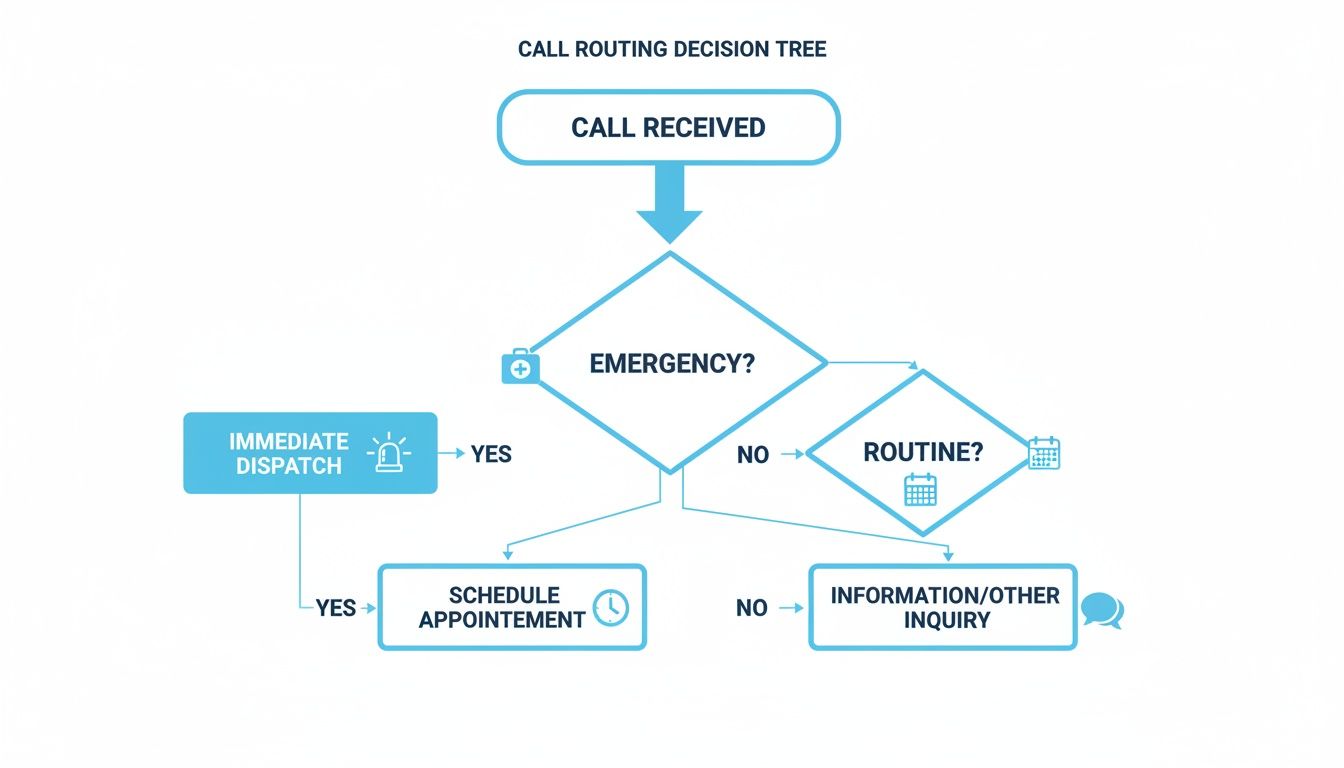
This kind of intelligent routing is what turns a simple after-hours inquiry into a scheduled, high-value appointment, all while protecting your team from unnecessary interruptions.
A Simple ROI Calculation Example
So, what does this look like in real dollars? Let's run the numbers for a typical dental practice.
Imagine you partner with an answering service for $500 per month. Now, think about the lifetime value of a new patient. Between regular cleanings, potential fillings, and cosmetic procedures, that figure often averages around $1,500.
In this scenario, if the service captures just one new patient in a month who would have otherwise hung up and called a competitor, you’ve already generated a 3x return on your investment. If it books two new patients for you, your practice sees $2,500 in net revenue ($3,000 in patient value minus the $500 service fee). It adds up fast.
Industry data shows that many practices lose around $2,500 every month from missed calls alone. This makes sense when you consider that after-hours calls can account for up to 65% of total call volume. A service that captures even a fraction of those leads delivers a powerful return. You can dig deeper into these trends in a comprehensive market report from GrandView Research.
Uncovering the Hidden Savings
The financial upside isn't just about booking new patients. Some of the most significant gains come from the "hidden savings" created by freeing your in-office team from the tyranny of a constantly ringing phone.
When your front desk staff isn't tethered to answering calls, they can finally dedicate their full attention to higher-value tasks, like:
- Elevating the In-Person Experience: Greeting patients warmly by name and offering them a beverage, instead of rushing them through check-in while juggling a ringing phone.
- Discussing Treatment Plans: Taking the time to sit with a patient in a consultation room to help them understand complex treatment options and walk them through financing without being interrupted.
- Managing Insurance: Spending an uninterrupted 30 minutes on the phone with an insurance company to follow up on an unpaid claim, a task that’s nearly impossible with constant call interruptions.
This shift does more than just improve efficiency; it reduces staff burnout and boosts morale. By letting a specialized service handle the phones, you empower your team to focus on what they do best: caring for the patients right in front of them. To really get a handle on your call patterns, it helps to understand your phone system's metrics, which is covered in our guide to call detail reporting.
How to Choose and Implement the Right Service
Picking the right answering service for dentists is about much more than just outsourcing phone calls. You're choosing a partner who will become the voice of your practice. Once you’ve found that partner, a smooth rollout is what really unlocks the benefits. Let’s walk through how to handle both the selection and the launch.
Your Vendor Evaluation Checklist
Before you even think about signing a contract, you need to ask the tough questions. Think of it like you're interviewing a new, crucial member of your front-office team. A solid partner will welcome these questions and have clear, confident answers ready to go.
Here’s a checklist to use during your evaluation calls:
- HIPAA & Security: "Could you walk me through your HIPAA compliance protocols? I'd also like to see a copy of your Business Associate Agreement (BAA). How do you train your agents to handle sensitive patient information securely?"
- Dental-Specific Training: "What kind of dental-specific training do your agents go through? How do they know the difference between a simple cleaning request and a true dental emergency, like a suspected abscess or dry socket?"
- Software Integration: "We use Dentrix. Can you show me a demo of how your system integrates in real-time with our practice management software? I need to understand how your system prevents any chance of double-booking appointments."
- Performance & Reporting: "What kind of analytics can I expect to see? I'm interested in metrics like call volume, average answer speed, and appointment booking rates. Can I get a sample report?"
If you're also considering automated tools, the process of implementing a chatbot for healthcare shares some similar challenges around technology integration and patient communication that can be good to think about.
A Simple 4-Step Launch Plan
Once you've made your choice, a structured launch plan makes all the difference. It ensures a seamless transition from day one. Follow these four steps to get your new service up and running without a hitch.
Step 1: Define Your Call Protocols
This is, without a doubt, the most important step. You need to map out exactly how you want different types of calls to be handled. Sit down with your new service provider and build out custom scripts and clear instructions for their agents.
Actionable Example: Create a simple decision tree. "If a patient mentions 'severe pain' and 'swelling' after an extraction, patch the call directly to the on-call dentist's cell. If they call to cancel an appointment with less than 24 hours' notice, inform them of the cancellation policy and offer to reschedule. If they just want to reschedule a cleaning, book it in the calendar and leave a note for the front desk."
Step 2: Integrate Your Technology
Next, it’s time to get the systems talking to each other. The main goal here is to sync your calendar and practice management software with the answering service's platform. This is what allows their agents to book real, confirmed appointments and add new patient details right into your system, which saves your team from doing a ton of manual data entry.
Step 3: Onboard Your In-Office Team
Your own front desk staff are absolutely key to making this work. It's crucial to explain how this service is there to support them, especially with after-hours and overflow calls, not replace them.
Hold a quick team meeting to review:
- How overflow and after-hours calls will now be handled.
- The process for checking call notes and new appointment details in the system each morning.
- Who their point of contact is at the answering service if an issue comes up.
Step 4: Launch and Refine
Time to go live! But the job isn't finished. During the first few weeks, make it a priority to review the call analytics your service provides. Listen to a few call recordings, look for patterns, and see if any scripts or protocols need tweaking. For example, if you notice many callers are asking about a specific insurance plan, you can update your script to include that information upfront.
Choosing the right answering service is a big decision for any practice, and the principles apply to small businesses outside of dentistry, too. For more on that topic, you might find our guide on the best answering service for small business helpful.
Common Questions About Dental Answering Services
Even after seeing all the benefits, it's completely normal to have some questions. You’re talking about trusting an outside partner with your patients, after all. Let's walk through the most common concerns we hear from practice owners, so you can get a clear picture of how this really works.
Will My Patients Know They’re Talking to a Service?
With a good service, absolutely not. The agents essentially become a remote part of your front office team. When they pick up the phone, they don’t say, "Answering service." They greet callers exactly as your own staff would.
For instance, the call will be answered with, "Thank you for calling Bright Smiles Dental, this is Sarah speaking. How can I help you today?" From the patient's point of view, they're simply talking to a helpful receptionist who’s available whenever they call. This creates a consistent, professional experience that builds patient trust around the clock.
How Are True Dental Emergencies Handled?
This is where you have total control. A huge part of the setup process is defining what you consider an emergency. You’ll work with the service to create smart escalation protocols that act as a filter, protecting your personal time while making sure genuine emergencies get through immediately.
Here’s how that plays out in the real world:
- Scenario 1 (Not an Emergency): A patient calls at 10 PM with a chipped molar that isn't causing any pain. The agent reassures them, gathers their details, and schedules them for the first opening the next morning. You'll see a notification in your email, but your phone won't ring.
- Scenario 2 (A Real Emergency): Another patient calls at 2 AM with severe swelling and bleeding after an extraction. The agent instantly identifies this as urgent based on your rules. They immediately connect the call directly to the on-call dentist's personal phone, so the patient gets the guidance they need right away.
This system ensures you’re only ever interrupted for situations that truly demand your expertise.
A well-trained agent knows that "my tooth hurts" can mean anything from minor sensitivity to a serious abscess. Your protocols give them the framework to ask the right follow-up questions ("Is the pain constant or does it come and go? Is there any swelling in your face or jaw?") to distinguish between the two, providing both you and your patients with total peace of mind.
Is This Affordable for a Small Dental Practice?
Yes, and it’s almost always more cost-effective than hiring another full-time employee. When you hire, you’re not just paying a salary; you’re also covering benefits, payroll taxes, training, and paid time off. An answering service for dentists bypasses all of that.
Most providers have flexible plans based on call volume or total minutes used, so you only pay for what you actually need. More importantly, the return on investment can be incredibly fast. For example, a basic plan might cost $300/month. If the service helps you capture just one new patient for a high-value treatment like veneers or implants (often a $5,000+ case), it has paid for itself for over a year. It's less of an expense and more of an investment in your practice's growth.
How Does It Integrate with My Dental Software?
Top-tier answering services are built to plug right into the major dental Practice Management Software (PMS) systems, including Dentrix, Eaglesoft, and Open Dental. This integration is what elevates the service from a simple message-taker to a true operational arm of your practice.
When the service is connected to your software, agents can see your live calendar availability and book confirmed appointments directly. For example, an agent can book a "New Patient Exam" directly into an open slot on Dr. Smith's calendar for Tuesday at 3 PM. They can also create new patient charts and update existing records with call notes. This completely eliminates double-bookings and saves your in-house team hours of tedious data entry every single week.
At Recepta.ai, we blend advanced AI with professional human support to ensure your dental practice never misses an opportunity. Our 24/7 service handles calls, schedules appointments, and qualifies new patients, all while integrating seamlessly with your existing software. Learn how Recepta.ai can help you capture more patients and grow your practice.