
Optimize Your Onboarding Timeline: Service Business Guide

The sale is signed, the kickoff call is on the calendar, and your team is already behind. Sales dropped a handoff in Slack, ops is waiting on finance, the customer expects a welcome packet by Tuesday, and no one can say who owns the next move. That's usually where a bad onboarding timeline starts, not with a missing checklist, but with a missing operating model.
A service business doesn't lose accounts because it forgot one form. It loses them because the first few interactions feel improvised, slow, or disconnected. The fix is a staged timeline with named owners, testing checkpoints, and clear proof that each phase is working before the next one starts.
Why Most Service Business Onboarding Timelines Fall Apart
A new client signs, the team celebrates, and then the work scatters. Sales assumes ops will send the welcome packet. Ops assumes the account manager will confirm intake details. The customer sits there waiting for a call that never comes, and the first week starts with confusion instead of momentum.
That breakdown happens because many teams treat onboarding like a checklist instead of a control system. A checklist says tasks exist. A timeline says who owns each task, when it's due, what has to be true before the next step, and how you'll know the customer is moving toward value. In service work, that difference matters more than the document itself.
Practical rule: if a step doesn't have an owner, a due date, and a visible success signal, it isn't part of the onboarding timeline. It's just wishful thinking.
The hidden cost is not just internal friction. It's lost trust, slower time to value, and a higher chance that the customer reconsiders the deal before the service is fully live. Modern onboarding thinking has already moved in this direction. Statista notes that some employers support new hires only in the first week, while others extend onboarding for a year or more, and the common window now often runs 1 to 6 weeks or one to three months depending on the role and structure (Statista onboarding overview). Service businesses are following the same pattern because the handoff doesn't end when the contract is signed.
A useful way to think about it is simple. The timeline protects the customer experience, but it also protects the internal team from making promises the systems can't keep. If you want a good parallel, the process standardization thinking at process standardization for service teams is a strong complement to this approach, because repeatable onboarding is really just standardized execution under pressure.
The best small-business operators already know this instinctively. If you want a practical external lens on what keeps early handoffs from collapsing, small business onboarding insights is worth reading alongside your own playbook, because the core lesson is the same, clarity beats improvisation every time.
The Core Phases of a Service Business Onboarding Timeline
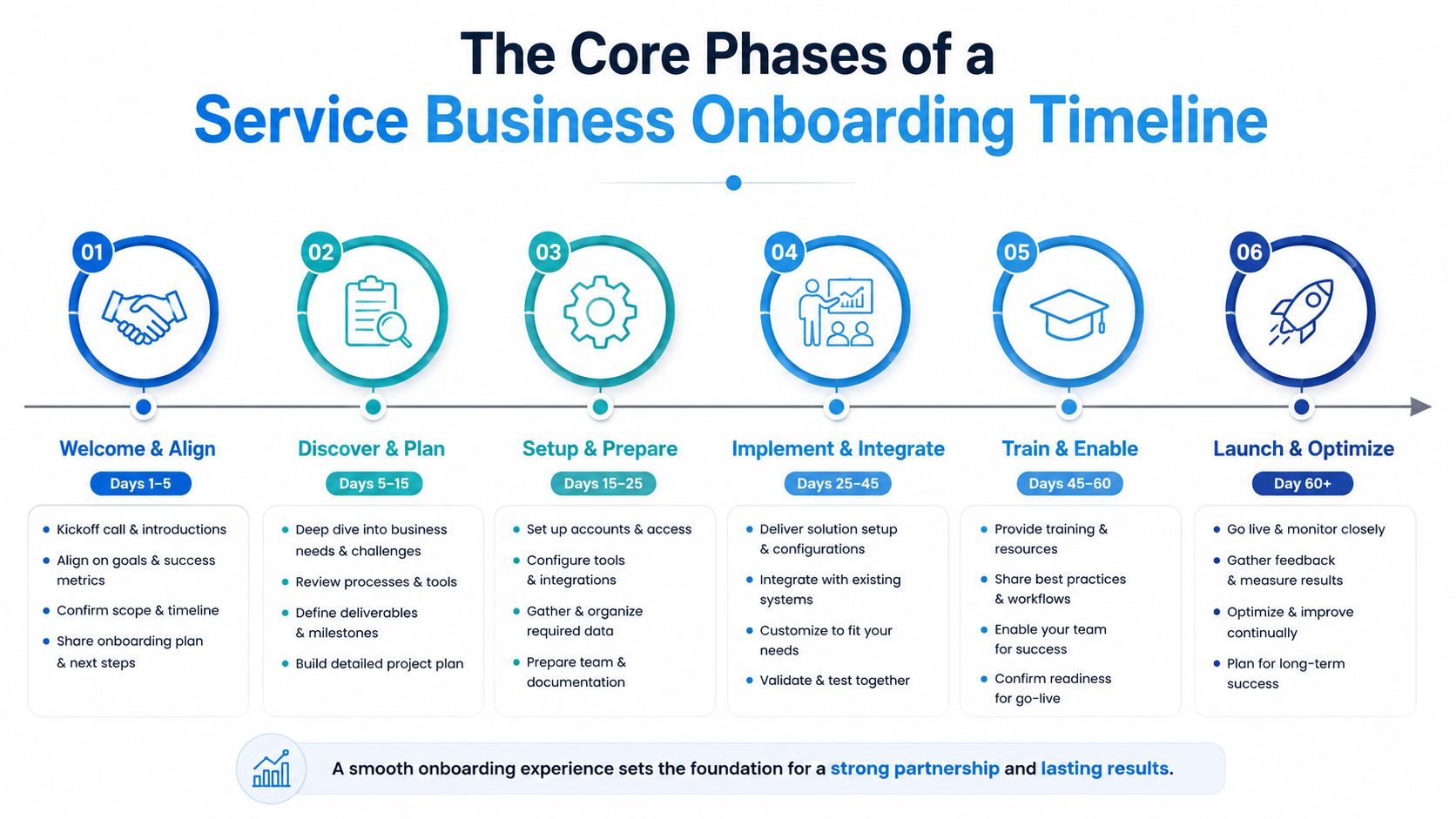
A good service-business onboarding timeline is easiest to manage when it's broken into six phases. The phases stay the same across verticals, even if the content changes. What changes is the duration, the owner, and the exact success signal you use to advance.
Preboarding through day one
Preboarding starts after the deal closes and ends when the customer is ready for kickoff. The owner is usually the account lead or implementation lead, because that person needs the widest view of expectations, dependencies, and risks. The deliverable is a confirmed setup plan, with contacts, system access needs, scope boundaries, and the first meeting already scheduled.
Day one should not be overloaded. It should establish trust, confirm the goal, and show the customer that the team knows what happens next. If you need a practical reference for the kind of first-day structure that keeps people oriented, Safety Space's workplace induction guide is useful because it reinforces the idea that early clarity matters more than long explanations.
Week one through month one
Week one is about environment and access. The customer should know where to send questions, what tools are live, and what “good” looks like in the first short window. The internal owner here is usually operations, with support from whoever owns the customer's front door, whether that's dispatch, scheduling, intake, or a client success lead.
Weeks two through four are when process habits start to form. This is the right time to lock in the recurring workflow, confirm integration behavior, and make sure the customer is using the service the way the team designed it. A useful internal companion for refining those steps is workflow optimization for teams, because many service teams discover the difference between a polished plan and a workable one.
The clearest way to structure the phases is with a simple phase table:
| Phase | Window | Owner | Success Signal |
|---|---|---|---|
| Preboarding | Deal close to kickoff | Account lead | Scope, contacts, and access confirmed |
| Day one | First active day | Implementation lead | First live interaction completed cleanly |
| Week one | Days 1 to 7 | Operations | Customer knows the process and key contacts |
| Weeks two to four | Days 8 to 30 | Service owner | Core workflow repeats without escalation |
| Months two and three | Days 31 to 90 | Manager or account owner | Customer is using the service independently |
| Ongoing success | After day 90 | Customer success or account management | Review cadence and growth path are active |
Here's the part that many teams miss. The day 90 handoff is not the end of onboarding, it's the moment when onboarding proves whether it worked. A structured timeline is only useful if the customer can operate smoothly once the training energy drops.
The video below is a helpful visual reminder of how the moving pieces connect.
Owners, Handoffs, and Integration Checkpoints
A timeline without owners is just a calendar. The fastest way to break onboarding is to assign three people to “help” and nobody to decide. Each phase needs one accountable owner, even if several teams contribute.
Single owner, clean handoff
The owner is not the only person involved. The owner is the person who makes sure the phase finishes. In practice, sales hands off the deal summary, operations owns setup, the service lead owns delivery, and the customer owns timely responses and approvals. If the customer's side is unclear, the process stalls no matter how disciplined your team is.
A quick RACI-style snapshot works well here. The account lead is Responsible for preboarding details, the operations lead is Accountable for live setup, finance is Consulted on billing or contract issues, and the customer is Informed at every milestone. That structure keeps the work visible without drowning the team in meetings.
The best handoff is the one that doesn't require a follow-up email to explain the handoff.
Checkpoints that catch real defects
The three checkpoints worth protecting are the system test, the live acceptance check, and the first review call. The system test happens before the customer touches the workflow. The live acceptance check happens when the customer first uses the service. The review call happens after enough activity to spot drift, confusion, or broken expectations.
That's also where integration matters. If your CRM, scheduling tool, and intake system don't agree, the customer feels it immediately. For teams evaluating front-end automation and tool connectivity, third-party integrations guidance is relevant because these handoffs often fail at the interface, not in the process map.
An AI receptionist can fit naturally. In service businesses, it can absorb routine call handling, route scheduling requests, and log customer details into connected systems, then escalate to a human when context or empathy matters. Recepta.ai is one example of a tool that does this while syncing with calendars and CRMs, so the front desk doesn't become the bottleneck during ramp.
A simple checkpoint rhythm keeps the team honest:
- Pre-live test: verify forms, routing, and confirmations before customer contact.
- Day-one acceptance: confirm the customer got what was promised.
- Early escalation review: inspect the first exceptions before they become patterns.
The point isn't to add bureaucracy. It's to catch the failure modes that usually surface only after the customer starts noticing them.
KPIs That Tell You the Onboarding Timeline Is Working
A healthy onboarding timeline should show progress long before renewal time or a complaint. If the dashboard only tells you who completed training, you'll miss the primary signal. The metrics need to show whether the customer is genuinely receiving value and whether the team can sustain the workflow.
Track the signal, not the noise
The cleanest early metric is time-to-first-value, which is the moment the customer gets a meaningful result from the service. For a home service company, that might be the first completed booking or first resolved request. For a legal or healthcare practice, it could be the first clean intake or first compliant handoff. The exact definition changes, but the principle doesn't.
You also need an integration error rate. If scheduling, CRM, or intake data is failing, the onboarding process is not stable yet. That metric belongs close to the operations owner, because it tells you whether the tech stack is helping or creating extra work.
The earliest customer-facing health checks should be simple:
- First-week task completion: did the customer finish the actions needed to go live?
- 30-day satisfaction check: did the customer feel informed, supported, and ready?
- 90-day retention or expansion signal: is the account stable enough to grow?
Use the dashboard to intervene early
The goal is not to build a huge reporting stack. It's to create a Monday-morning view that tells you where to step in. If first-week completion is low, the issue is usually clarity or access. If the 30-day check is weak, the issue is usually fit, communication, or workflow friction. If the 90-day signal is soft, the problem is often that the team mistook compliance for adoption.
For teams that want a sharper way to monitor operational health, performance monitoring systems are worth studying because the same logic applies, measure what predicts failure early enough to act on it.
A good dashboard doesn't impress people. It tells the account owner which customer needs a call, which workflow needs a fix, and which handoff needs to be rebuilt before the next onboarding cycle starts.
Adapting the Timeline to Home Services, Healthcare, Legal, and Franchises
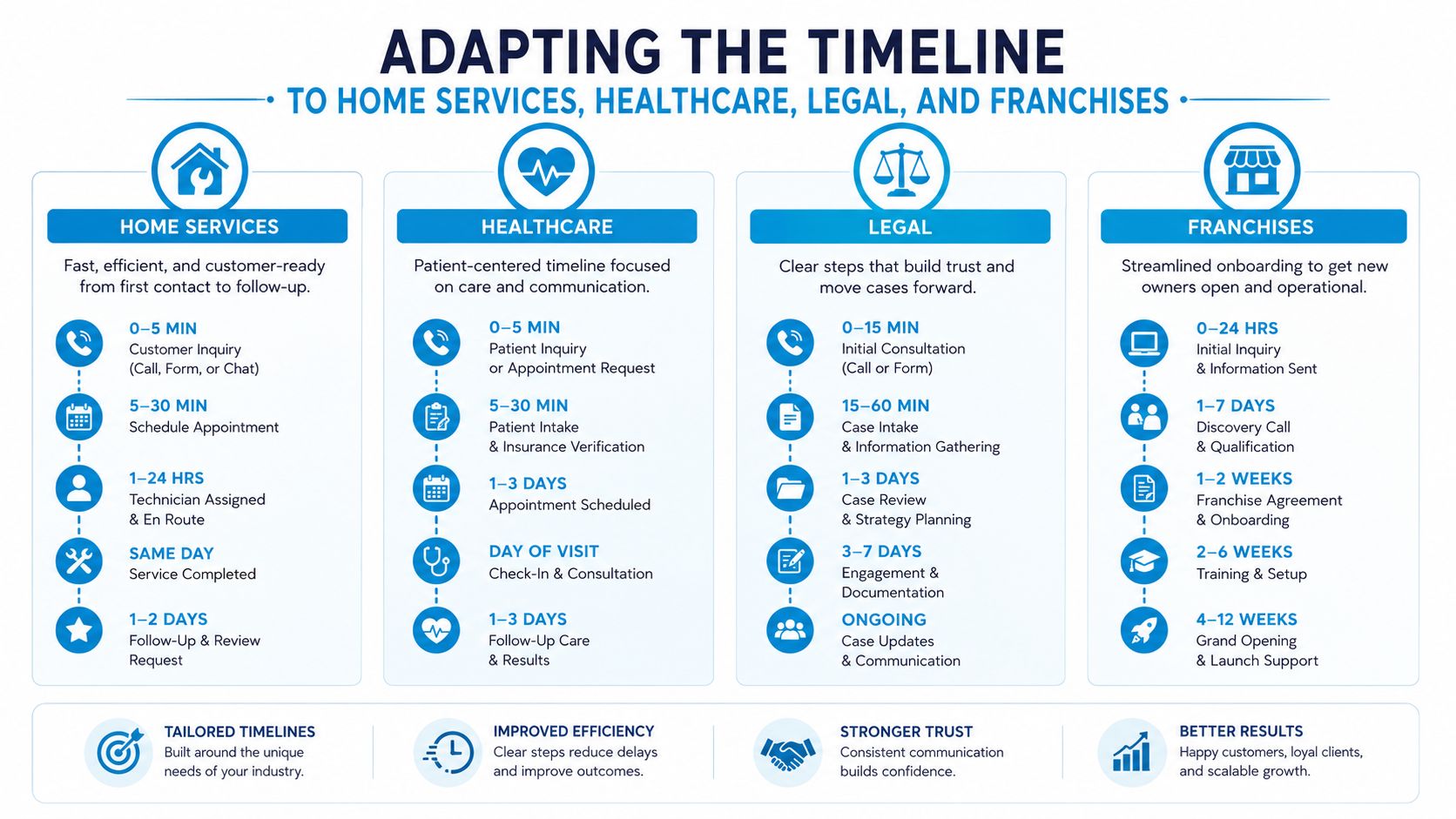
The backbone stays the same across service verticals. The pressure points don't. Each industry asks the timeline to solve a different problem, so the phase that matters most changes from one business model to the next.
What shifts by vertical
Home services live or die on speed and scheduling accuracy. If dispatch isn't connected, the customer experience falls apart quickly, especially when seasonal demand spikes. Healthcare is more controlled, because compliance, credentialing, and patient coordination all have to line up before the workflow can run cleanly.
Legal firms need precision at intake. A single missed conflict check or a sloppy document handoff can slow everything else down. Franchise and multi-location operators have a different challenge, they need one playbook that is consistent enough to replicate, but flexible enough for local staffing, local demand, and local systems.
Here's a side-by-side view:
| Vertical | Highest-Risk Phase | Key Integration | Compliance Note |
|---|---|---|---|
| Home services | Week one | Dispatch and calendar sync | Fast response and accurate handoff matter most |
| Healthcare | Preboarding and month one | Scheduling, HR, and patient intake systems | Credentialing and privacy controls must be aligned |
| Legal | Day one and week one | Intake forms and matter management tools | Conflict handling and document accuracy are critical |
| Franchise | Weeks two through four | Multi-location reporting and scheduling | Standardization must coexist with local rules |
Why the timeline changes by context
The same operating backbone works in all four verticals because each one needs owners, checkpoints, and a proof-of-readiness moment. What changes is the sequence. In healthcare, the early phase is dominated by readiness and compliance. In home services, the early phase is dominated by responsiveness. In legal, the early phase is dominated by intake quality. In franchise systems, the early phase is dominated by consistency across locations.
This is also where a connected front desk matters. An AI receptionist with broad tool coverage can keep coverage tight during ramp, route requests into the right system, and avoid the lost-call problem that often shows up when a new account goes live. For businesses that juggle calendars, CRMs, and service workflows across multiple locations, that kind of connection is often the difference between a smooth launch and an overloaded office manager.
The practical takeaway is simple. Don't rebuild the onboarding plan for every customer. Reuse the same timeline backbone, then swap in the phase that carries the most risk for that vertical.
A Worked Example of an Onboarding Timeline in Action
A small HVAC company lands a commercial maintenance client with multiple locations. The owner wants the account live fast, but not sloppy, because one missed dispatch or one bad confirmation can create immediate frustration. The team uses the onboarding timeline as a live control system, not a spreadsheet.
On day one, the AI receptionist goes live to capture inbound calls, route the first requests, and log the account details into the CRM. The implementation lead confirms the customer knows who to contact and what counts as a routine request versus an escalation. That first live day matters because it gives the client a visible sign that the service is already operating.
By day seven, the dispatch integration gets tested against real appointments. A KPI review shows a missed confirmation-call pattern, not a dramatic failure, but enough to suggest the customer isn't hearing the right follow-up message every time. The owner checks the workflow, sees the gap, and changes the confirmation logic before the issue turns into a complaint.
At day 30, the team runs a performance review with the account contact. The service is working, the calls are being logged, and the customer understands the process. The review is calm because the earlier checkpoint caught the problem when it was still small.
By day 60, the account turns from setup into expansion. The owner opens the conversation about additional locations and whether the same dispatch rhythm can scale. The timing works because the account has already shown stable usage and the customer has had enough experience to trust the process.
That's what a strong onboarding timeline does in the wild. It turns a new account from a risky guess into a managed sequence of proof points.
Onboarding Timeline Checklist and Final Recommendations

Use this checklist for the next customer kickoff or internal rollout:
- Preboarding, account lead, setup brief completed: scope, contacts, access needs, and kickoff date confirmed.
- Day one, implementation lead, live launch verified: the first real interaction works and the customer knows the path forward.
- Week one, operations owner, first-week tasks completed: access, routing, or scheduling works without confusion.
- Weeks two to four, service owner, workflow repeated cleanly: the core process runs with minimal escalation.
- Month two, manager or account owner, integration stability confirmed: systems are talking to each other and exceptions are rare.
- Month three, customer success or account management, independence check passed: the customer can use the service without heavy handholding.
- Post-day 90, account team, growth path documented: onboarding ends only after the next operating rhythm is clear.
Two decisions usually determine whether the timeline survives real life. First, which systems must be integrated before day one. If that answer is fuzzy, the launch is too risky. Second, which roles need a longer ramp than 90 days. Complex, regulated, or multi-site accounts often need a deeper handoff even when the basics are live.
The strongest teams don't celebrate the kickoff. They measure how calmly the account moves through the first 90 days, who owns the next move, and whether the customer can work independently without a rescue call.
If you want a cleaner way to run this process, Recepta.ai handles calls, scheduling, lead capture, and follow-ups while syncing with the tools your team already uses. Visit Recepta.ai if you want to see how a connected front desk can support a tighter onboarding timeline without adding more manual handoffs.