
Crafting the Perfect Business Telephone Greeting

You only get one chance to make a first impression, and more often than not, it happens over the phone. A professional business telephone greeting isn't just a courtesy; it's the very first touchpoint a potential customer has with your brand. That single moment can determine whether they feel confident enough to move forward or hang up and dial your competitor.
Your Phone Greeting Is Your Brand's Handshake

Think of that initial 'hello' as your company’s digital handshake. It immediately communicates your level of professionalism, how efficient you are, and even the personality of your brand. A clumsy, confusing, or rushed greeting plants a seed of doubt and frustration, damaging your reputation before you've even had a chance to help.
Let’s put this in a real-world context. A homeowner has a burst pipe and is frantically calling local plumbers.
- Company A picks up: "Hello?" The voice sounds annoyed, and there's a lot of noise in the background. The homeowner immediately feels like they're an interruption.
- Company B picks up: "Thank you for calling Apex Plumbing. This is Sarah. How can I help you today?" The tone is calm, clear, and ready to assist.
Who are they going to trust with an emergency? The choice is a no-brainer. That homeowner, already stressed, will feel an immediate sense of relief with Company B. The entire decision was made in under ten seconds, all because of the greeting.
The Core Components of a Great Greeting
A powerful greeting isn't complex. It just needs to do three things exceptionally well to create a positive experience for every caller.
- Clarity: The caller needs to know they’ve reached the right company instantly. Always state your business name clearly. For example, instead of a quick "Plumbing," say "You've reached Apex Plumbing."
- Professionalism: A friendly, competent tone and clear language show respect for the caller's time and builds immediate trust. A simple change from "Yeah?" to "This is Sarah speaking" makes all the difference.
- Brand Personality: Your greeting should sound like you. A creative agency can be more upbeat and energetic ("Hey, you've reached Pixel Perfect!"), while a law firm will aim for a more formal, authoritative tone ("Good morning, Smith and Jones Law Offices.").
Your phone greeting is a critical business asset, not an afterthought. It's the frontline of your customer service, capable of stopping hang-ups in their tracks and turning hesitant callers into paying customers.
Why Voice Still Matters
Even with texts, emails, and chatbots, the phone is still king for important conversations. When the stakes are high, people want to talk to a person.
In fact, recent data shows a massive 71.4% of businesses still turn to the phone or in-person meetings for sensitive matters like customer retention or sorting out disputes. This just goes to show the lasting power of a human (or human-like) connection in building and keeping trust. You can find more insights on this by exploring current business communication trends.
This is where modern tools like an AI receptionist from Recepta.ai can make a huge difference. They are designed specifically to perfect that first impression, ensuring every single call is answered with a flawless, professional welcome—24/7. This guarantees your business always sounds polished, helping you capture every lead and reinforcing the quality of your customer service on the telephone.
Breaking Down the Perfect Phone Greeting

It’s easy to overlook the simple phone greeting, but getting it right is a game-changer. A truly professional greeting isn't complicated; it's built from just a few key components that work together to make a powerful first impression.
Think about it from your customer's perspective. Calling a home services company and hearing a rushed, mumbled "Hello?" immediately creates friction. Contrast that with a clear, confident greeting—it builds instant trust and gets the conversation started on the right foot.
The Three Must-Have Building Blocks
Every great phone greeting, whether from a live person or a recording, needs to deliver three pieces of information right away. These are the non-negotiables that orient your caller and set a professional tone from the very first second.
- Your Company Name: This is the most critical part. Callers need to know they’ve reached the right place. Practical example: "Thank you for calling Summit Mechanical."
- The Speaker’s Name: Adding a simple "This is David" makes the interaction feel human. It’s a small touch that reminds the caller they're talking to a real person, not a faceless company. Practical example: "...this is David speaking."
- An Offer of Help: A simple question like "How can I help you?" or "How can I direct your call?" proactively opens the door for the caller to explain why they're calling. Practical example: "...how can I help you today?"
When you put these together, a generic "Hello?" becomes a polished and professional "Thanks for calling Summit Mechanical. This is David, how can I help you?" In just a few seconds, you've confirmed your identity, established a human connection, and invited a productive conversation.
It's Not Just What You Say, But How You Say It
Your script is only half the story. The subtle cues in your tone, pacing, and word choice can either reinforce your brand’s professionalism or completely undermine it. A warm, confident voice suggests competence, while a rushed or monotone delivery can make your business sound disorganized or, even worse, like you just don't care.
Pacing is just as important. If you speak too quickly, the caller might miss your company name entirely. Speak too slowly, and you risk sounding lethargic. You're aiming for that sweet spot: a natural, measured pace that’s easy to understand. A practical tip is to record yourself and listen back. Does it sound rushed? Practice taking a breath before you speak.
The 10-Second Rule: Your live greeting should be done in under 10 seconds. This is all about respecting the caller's time. It gets straight to the point and avoids the kind of fluffy intro that makes people want to hang up.
The words you choose should also feel authentic to your brand. A friendly local bakery doesn't need to sound like a stuffy corporate law firm. Matching your language to your customers' expectations is crucial. For a deeper dive into managing calls effectively, check out our guide on call handling best practices.
Matching Your Greeting Style to Your Business
The "perfect" greeting looks different for everyone. A law firm needs to project authority and seriousness, while a creative agency can get away with a much more energetic and casual vibe. Finding the right style is key to making sure your greeting feels genuine.
To help you find the right fit, let's look at how different greeting styles work for different types of businesses.
Greeting Styles and Their Business Impact
Choosing the right style ensures your first impression aligns perfectly with what customers expect from your brand, starting every interaction on the right foot.
Greeting Scripts for Any Business Scenario
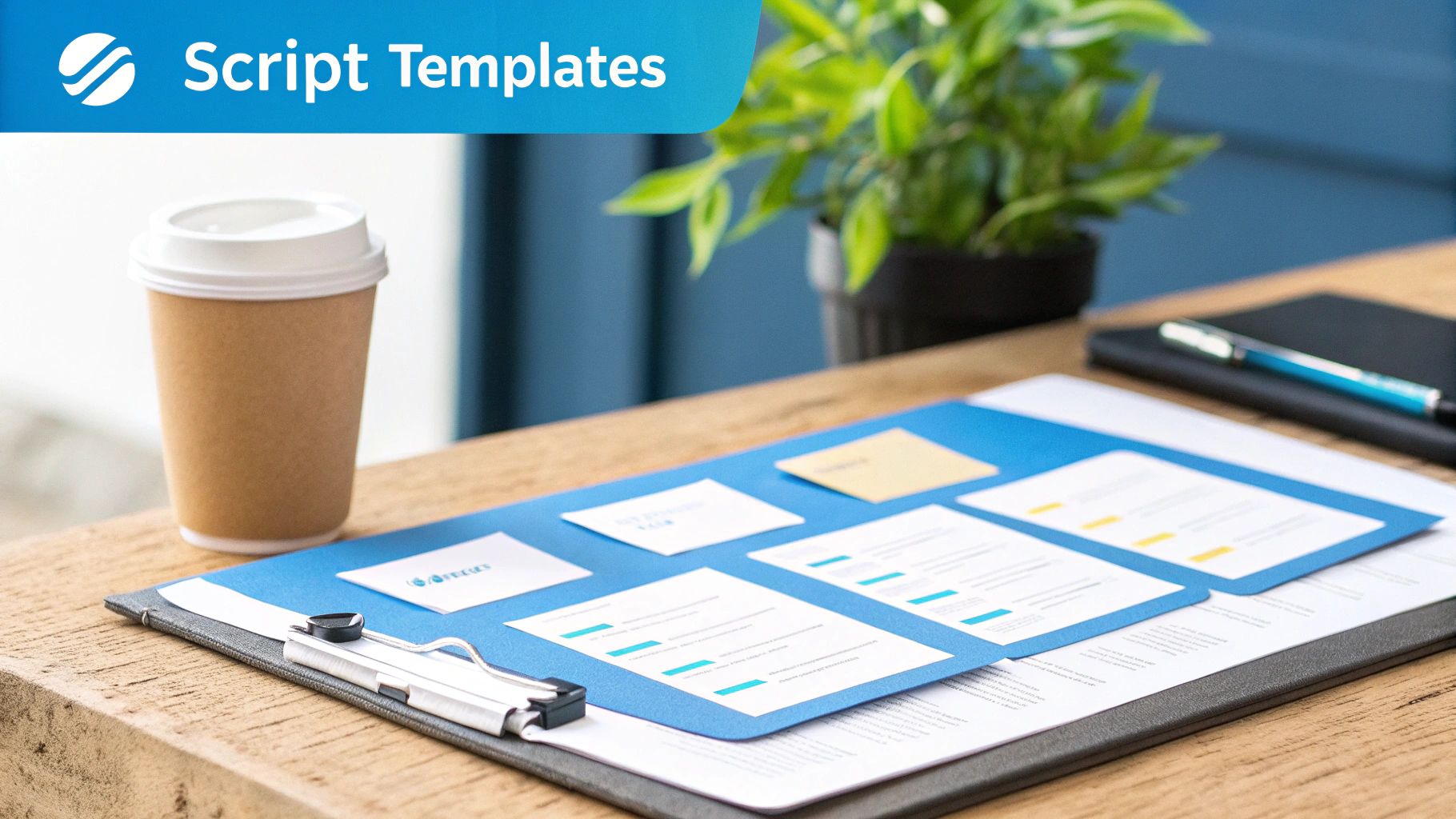
The secret to a great business telephone greeting isn't finding a single "perfect" script; it's about matching your message to your industry and your caller's mindset. A generic, one-size-fits-all approach just doesn't cut it. Think about it: a medical clinic needs to radiate empathy, while an HVAC company with a customer’s AC on the fritz needs to be all about speed and solutions.
This is why having a playbook of field-tested templates is so powerful. These scripts are more than just words—they're your first chance to set the right tone. For a law firm, that means projecting immediate competence. For an insurance agency, it’s about building trust from the very first second. Every industry has a unique customer journey, and that journey starts the moment the phone rings.
Greetings for Home Service Professionals
If you’re in a trade like HVAC, plumbing, or electrical, your callers are usually dealing with an urgent problem. They don't want fluff; they want a solution. Your greeting needs to be efficient, reassuring, and completely focused on taking action.
Here are a few actionable examples:
- Standard Greeting: "Thank you for calling Precision HVAC. This is Mark. How can I help you today?"
- Emergency Focus: "You've reached Apex Plumbing, your 24/7 emergency service. This is Maria. How can we help you right away?"
- Scheduling Focus: "Thanks for calling Bright Spark Electric. This is Tom. Are you calling to schedule a new service or for an existing appointment?"
These scripts tell the customer with a burst pipe or a dead furnace that they’ve found the right person to solve their problem, fast. If you're looking for more ways to optimize your front-line communications, our guide on a call answering service for small business has some great pointers.
Scripts for Healthcare and Wellness Clinics
In any healthcare setting—from a doctor's office to a dental clinic—a calm, reassuring tone is absolutely essential. Patients are often feeling anxious or vulnerable, and your greeting has to communicate professionalism, empathy, and a commitment to their privacy.
Try one of these practical approaches:
- Medical Office: "Good morning, you've reached Lakeside Medical Clinic. This is Sarah speaking. How may I assist you?"
- Dental Clinic (New Patient Focus): "Thank you for calling Serene Smiles Dental. This is Emily. Are you a new or existing patient?"
- Wellness Center: "Welcome to Harmony Wellness Center. You're speaking with David. How can I help you find some balance today?"
The language here is intentionally gentle. It immediately helps callers feel they're in a safe and professional environment.
Templates for Legal and Financial Services
For law firms, insurance agencies, and financial advisors, the game is all about establishing credibility from the jump. Callers are reaching out for expert guidance on serious, often sensitive, matters. Your phone presence must reflect that.
A polished and authoritative greeting reassures clients that they are placing their trust in capable hands. It's the first signal of your firm's competence and attention to detail.
Here’s how to craft that powerful first impression with actionable examples:
- Law Firm: "You've reached the law offices of Miller & Cruz. This is Rebecca. How may I direct your call?"
- Insurance Agency: "Thank you for calling Thompson Family Insurance. This is Michael. How can I help protect what matters most to you?"
- Financial Advisor: "Good afternoon, you've reached the office of Jane Davis at Crestview Financial. This is Daniel. How can I assist you?"
The shift to modern phone systems has really changed how businesses in these fields handle calls. It's no surprise that 31% of businesses globally now use VoIP, a trend that took off with the rise of remote work. Maintaining that professional image over the phone is more important than ever.
Handling Common Scenarios and Variations
Of course, not every call is a straightforward new inquiry. You need a plan for the everyday situations that pop up, like after-hours calls or holiday closures. Having these scripts ready keeps your communication consistent and professional, no matter what.
1. After-Hours and Voicemail Greetings
Be crystal clear about when they can expect a callback. A practical script is:
- "You've reached [Company Name] outside of our business hours. We are open Monday through Friday, 9 AM to 5 PM. Please leave your name, number, and a brief message, and we will return your call on the next business day."
2. Holiday Closure Greetings
Let callers know when you'll be back and provide an emergency contact if you have one.
- "Happy Holidays from the team at [Company Name]. Our office is currently closed and will reopen on [Date]. For urgent matters, please email emergency@yourcompany.com. Otherwise, please leave a message, and we will get back to you upon our return."
3. When You're With Another Client
Acknowledge them immediately while politely managing expectations. This is great for solopreneurs.
- "Thank you for calling [Your Name] at [Company Name]. I'm currently with another client, but your call is important to me. Please leave your details, and I will call you back as soon as I am available."
To get even more ideas for refining your scripts, checking out different sales phone call scripts can offer some great inspiration. Planning for these common scenarios shows every caller they’re valued and keeps your business looking sharp.
Scripting Greetings for AI vs. Human Receptionists
The person—or thing—answering your phone drastically changes how you should write your greeting script. While the core goal is always a professional and helpful first impression, the road to get there looks very different for an AI receptionist versus a human one.
When you're scripting for an AI, clarity is king. An AI can't read between the lines or pick up on a caller's tone of voice. It needs crystal-clear, direct instructions to do its job right. This means building your script around a simple, logical flow that guides callers exactly where they need to go.
Crafting a Flawless AI Greeting
The secret to a great AI greeting is making it feel helpful, not cold and robotic. Your script has to be short and to the point. Ditch the industry jargon and lay out the options in a simple, numbered list. Most importantly, you absolutely must give callers an "escape hatch"—an easy way to reach a real person if they get confused or frustrated.
Here are the non-negotiables for an effective AI script, with a practical example for a local auto shop:
- Immediate Identification: Start by clearly stating your company's name. Example: "Thank you for calling Precision Auto Repair."
- Simple Menu Options: Keep it tight. Offer just 3-4 choices that cover the vast majority of your calls. Example: "For new appointments, press one. To check on the status of your vehicle, press two. For billing questions, press three."
- Direct Language: Use action-oriented phrases. Think "For appointments, press one," not long, winding sentences.
- A Human Escape Route: Always, always have an option like, "To speak with a member of our team, press zero." This prevents caller frustration.
As you're setting up these automated menus, it helps to have a basic grasp of the technology behind them. Understanding how a VoIP phone system works gives you the context you need to configure call routing and other features effectively.
Empowering Your Human Receptionists
While AI scripts are all about rigid structure, scripts for your human team should be about empowerment. Your front-line staff has a superpower that AI lacks: empathy. A person can hear the stress in a caller's voice, offer a reassuring word, and pivot the conversation on a dime.
So, instead of handing them a word-for-word script, give them flexible talking points and key information. This allows their personality to shine through while still ensuring every caller gets consistent, accurate information. For example, provide a core greeting like, "Thanks for calling, this is [Name]," and then empower them to add a personal touch like, "How can I make your day easier?"
The real magic of a human receptionist is their ability to connect. They can turn a simple question into a positive, memorable experience that builds real loyalty. That personal touch is still incredibly valuable to callers.
Side-by-Side Greeting Comparison
Let's look at how these two approaches play out in a real-world situation. Imagine a brand-new customer calling a busy plumbing company with a leaky pipe.
Scenario: New Client Calling a Plumbing Company
Both greetings get the job done, but they serve different purposes. The AI acts as a 24/7 filter, handling volume with ease, while the human provides a high-touch, personalized experience. The best solution for most businesses is a smart blend of both. You can dive deeper into how this works in our guide on using an AI receptionist for small business.
At the end of the day, customers just want a smooth experience, whether they're talking to a person or an AI. The data is pretty clear on this: 87% of consumers prefer brands that remember their interaction history across channels. Yet, a shocking 84% say they "often" have to repeat themselves. At the same time, 62% of customers would still rather talk to a person to resolve a problem. This is exactly where a hybrid solution shines—using AI for efficiency while keeping a human ready to step in when it matters most.
How to Implement and Test Your New Greeting
You've put in the work and crafted the perfect script. That's a huge step, but a brilliant business telephone greeting sitting in a document doesn't do you any good. Now, it's time to bring it to life—getting it loaded into your phone system and, most importantly, making sure it’s actually working for you and your callers.
The good news? You don’t need a professional recording studio. I've found that the microphone on a decent headset or even your smartphone can produce surprisingly clear audio. Just make sure you record in a quiet room, away from any background chatter or echo. A practical tip: a closet full of clothes is a great sound-dampening space.
From Script to System
Once you've got a clean audio file (usually an MP3 or WAV), you need to get it into your phone system. Most modern phone systems, especially VoIP platforms, make this pretty painless. You'll typically find a section in your admin panel for "Greetings," "Auto-Attendant," or "Call Routing" where you can just upload the file.
If you’re working with a system like Recepta.ai, it’s even easier. Our team helps make sure your new greeting is implemented correctly, weaving it seamlessly into your existing call flows. The goal is to give every single caller a consistent and professional experience from the moment they dial.
Keep in mind that scripting for an AI receptionist and a human one are two different ballgames. AI requires a very clear, structured path for the caller, while a human can rely on empathy and conversational cues to guide the interaction.
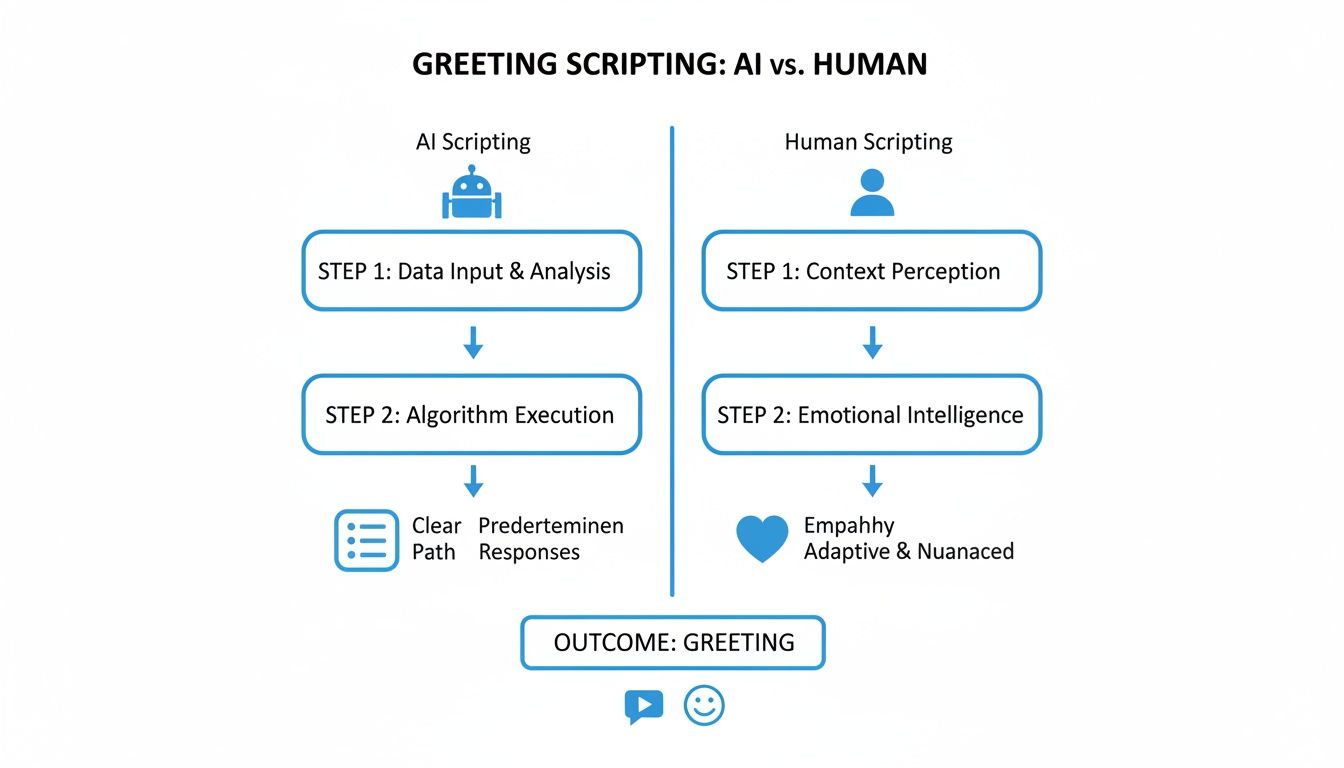
This flowchart really highlights the difference in priorities. With an AI, it’s all about logic and efficiency; with a person, it’s about connection and understanding.
Is Your New Greeting Actually Working?
Just flipping the switch on a new greeting and hoping for the best is a massive missed opportunity. How do you really know if it's improving your customer experience? You need to measure its impact, and thankfully, this doesn't require a data science degree.
Start by tracking a few key performance indicators (KPIs). These are just straightforward numbers that tell you if you're moving in the right direction.
- Call Abandonment Rate: What percentage of people are hanging up before they even talk to someone? If this number drops after you launch the new greeting, that’s a fantastic sign that callers feel engaged and are willing to wait.
- Time to Resolution: Are your team members getting to the root of the issue faster? A great greeting sets the stage for a much more efficient conversation by getting the caller to the right place quickly.
- Conversion Rate: For most of us, the end goal is to book that appointment or capture that lead. Keep an eye on whether you see an uptick in these conversions after your new script goes live.
Your phone greeting isn't a "set it and forget it" task. Think of it as an active part of your customer service strategy—something you should review and tweak over time to keep it performing at its best.
Simple and Effective Testing Methods
You don't need a massive, complicated A/B testing campaign to get valuable feedback. There are some really simple, low-effort ways to see how your greeting is landing with real people. The aim here is continuous improvement, not getting it perfect on the very first try.
Here are a few practical methods I've used with clients:
Ask for Honest Feedback: Pick a few trusted, long-term clients and just ask them to call in. Let them know you've updated your greeting and that you'd love their candid thoughts. Ask them direct questions like, "Was it immediately clear who you reached?" or "Did it sound professional and helpful?" Their gut reactions are priceless.
Internal Role-Playing: Get your own team members to call the main line and pretend they're a customer. They're often the first to spot awkward phrasing or confusing menu options that you might have missed. It's also a great way to make sure everyone on your team understands the exact experience your callers are having.
Run a Simple Split Test: If you're stuck between two great greeting options, try running one for a week and the other for the following week. At the end of that two-week period, compare your key metrics—like appointments booked or dropped calls—and see if one clearly outperformed the other.
By actively testing and really listening to the feedback, you can turn a good greeting into a fantastic one. This small, iterative process ensures that your business’s first impression always reflects your brand and meets your customers right where they are.
Answering Your Top Phone Greeting Questions
Even with the best scripts in hand, a few practical questions always seem to pop up when you're getting everything just right. Nailing these final details is what separates a good greeting from a great one, ensuring every caller has a seamless, professional experience.
Let's walk through some of the most common questions I hear from business owners. Think of this as your quick-reference guide for handling those last-minute uncertainties with confidence.
How Long Is Too Long for a Greeting?
This is, without a doubt, the number one question I get. The answer is simple: shorter is always better. When a person is answering the phone live, you want to get straight to the point. Aim to deliver the entire greeting in under 10 seconds. That's just enough time to state your company name, your name, and offer help without making the caller feel like they're on hold.
For recorded messages, like your voicemail or an auto-attendant menu, you have a little more breathing room, but not much.
Your main recorded greeting or voicemail message should wrap up in under 30 seconds. Anything longer and you'll start to see a drop-off. People get antsy and will hang up before they hear all the options or figure out how to leave a message.
Remember, you're on their time. A concise, professional message shows you respect that.
Should I Mention Business Hours in My Main Greeting?
It's tempting to cram every useful bit of information into your main greeting, but adding business hours is usually a mistake for the script your team uses during the day. If someone has reached you while you're open, they don't need to hear your hours—it just slows down the conversation.
Instead, save that information for where it’s most valuable: your after-hours or voicemail greeting.
- Practical Example for After-Hours: "You've reached Apex Plumbing outside of our business hours. We're open Monday through Friday, 8 AM to 5 PM. Please leave your name, number, and a brief message, and we'll get back to you first thing on the next business day."
This way, the information is delivered at the exact moment the caller needs it, keeping your live-answer greeting snappy and efficient.
What's the Biggest Greeting Mistake to Avoid?
The single most damaging mistake you can make is ambiguity. That mumbled "Hello?" or a flat "Summit Mechanical" leaves the caller totally lost. They're left wondering, "Did I even dial the right number?"
That tiny moment of confusion instantly chips away at your credibility. It puts the burden on the caller to figure out who they're talking to and what to do next.
Just look at the practical difference a clear offer makes:
- Vague (Bad): "Summit Mechanical." (The caller now has to ask, "Hi, am I able to schedule a service?")
- Clear (Good): "Thank you for calling Summit Mechanical. This is David. How can I help you?" (The caller knows exactly where they are and is immediately invited to state their need.)
Always be clear. State your name, your company, and ask how you can help. That simple formula eliminates all confusion and kicks off every call on a professional, helpful note.
Do I Really Need a Professional Voice Actor?
While a professional voice-over can add a certain polish to your recorded messages, it's honestly overkill for most small businesses. The most important qualities of a good greeting are warmth, clarity, and authenticity—all things you or someone on your team can absolutely deliver.
If you decide to record it yourself, just follow a few simple, practical tips for a great-sounding result:
- Find a Quiet Spot: Record in a small room with soft surfaces to kill echo. A walk-in closet or even your car works surprisingly well.
- Use a Decent Mic: Your smartphone's built-in microphone or a basic headset is usually more than enough.
- Smile When You Speak: It sounds a little silly, but physically smiling actually changes the tone of your voice, making you sound friendlier and more approachable.
- Do a Few Takes: Nobody nails it on the first try. Record it a few times until you have one that feels natural and confident.
At the end of the day, a genuine, clear voice from someone inside the company can be just as effective—and often more relatable—than a hired professional.
Ready to ensure every call is answered with a flawless, professional greeting 24/7? With Recepta.ai, you can capture more leads, reduce costs, and deliver an exceptional customer experience from the first ring. See how our blend of AI and human support can work for your business with a 30-day risk-free trial.