
How to Buy a 1800 Number: A Small Business Guide

You're probably here because your current phone setup feels patched together. Calls hit a cell phone when someone remembers to forward them. After-hours leads go to voicemail. Marketing is sending traffic to one main number, but nobody can tell which ad, van wrap, or directory listing made the phone ring.
That's usually the moment a business decides to buy a 1800 number.
A toll-free number can make a small company look more established, but its true value isn't image alone. Its core value is control. You can route calls by time of day, separate campaign traffic, log conversations in your CRM, and make sure new inquiries don't die in a voicemail box. Most guides stop at the purchase. That's where the easy part ends.
Choosing the Right Number and Provider
A service business usually gets one chance to pick a number customers will see on trucks, invoices, yard signs, and local ads. Changing it later is possible, but it creates cleanup work across marketing, call routing, and reporting. Choose with operations in mind, not just branding.
In the U.S. and Canada, 800 was the original toll-free prefix, and it still carries the most recognition. Other toll-free prefixes such as 888, 877, 866, 855, 844, and 833 work the same way for callers. The practical question is not whether the prefix is prestigious. The practical question is whether the number is available, easy to use, and supported by a provider that gives you proper routing, reporting, and ownership controls.
Vanity number or standard number
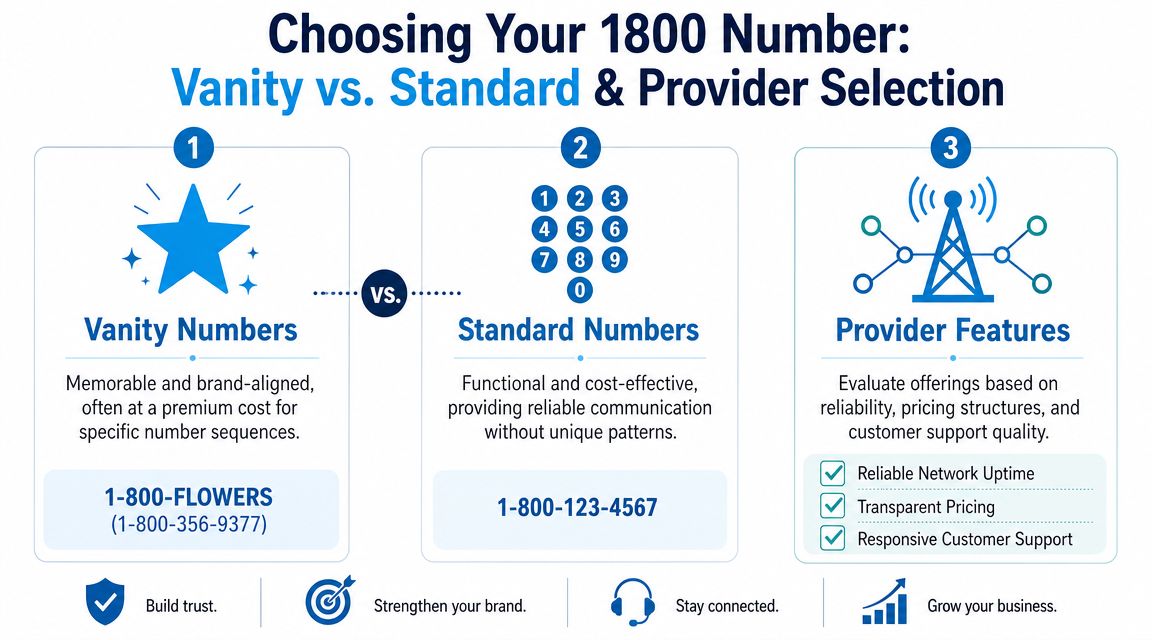
A vanity number makes sense if your business relies on offline recall. HVAC, legal, restoration, and home services often get value from a number people can remember after hearing it once on the radio or seeing it on the side of a van. If the number has to do branding work, memorability matters.
A standard number is often the better buy for companies that get calls from Google Business Profile, paid search, website click-to-call buttons, and saved contacts. In those cases, callers are not memorizing the number. They are tapping it. I usually advise small operators to spend less time hunting for the perfect phrase and more time setting up call flows, missed-call handling, and lead capture.
One more constraint matters. Toll-free numbers are first-come, first-served. If your preferred pattern is gone, that is a supply problem, not a strategy problem.
What to compare in providers
The wrong provider creates problems that do not show up on the pricing page. A low monthly rate looks fine until calls start forwarding in circles, after-hours leads vanish into a generic mailbox, or nobody can tell which campaign produced the call.
Compare providers on the pieces below:
| Feature | What to Look For | Why It Matters for Service Businesses |
|---|---|---|
| Call routing | Business hours, simultaneous ring, round-robin, overflow paths | Sends calls to the front desk, dispatcher, field staff, or answering service without manual forwarding |
| Voicemail handling | Custom greetings, voicemail-to-email, separate mailboxes | Keeps missed calls organized by location, department, or shift |
| Call analytics | Answered vs missed calls, source tracking, basic reporting | Shows where calls are being lost and which marketing channels deserve budget |
| Recording and logs | Easy access to recordings and call history | Helps with training, quality checks, and dispute review |
| SMS support | Business texting from the same number, if supported | Useful for appointment reminders and quick follow-up |
| CRM integrations | Native integrations or automation hooks | Cuts manual entry and turns calls into trackable leads |
| Porting rules | Clear ownership, export options, and transfer support | Protects you if you switch vendors later |
| Admin usability | Simple desktop and mobile management | Makes daily changes possible without support tickets |
CRM access deserves more weight than many buyers give it. If a provider cannot push call records into your CRM, trigger follow-up tasks, or pass call details into tools such as Recepta.ai for intake and qualification, your 1800 number stays a phone line instead of becoming a measurable lead source. That operational gap is where small businesses lose value after the purchase.
If you want a broader view of cloud calling options before settling on toll-free, this guide to virtual US phone numbers gives useful background.
Cost needs context
Monthly price is only part of the decision. Providers may charge a base fee, usage fees, extra numbers, call recording, texting, or advanced routing features. A plan that looks cheap can become expensive if your staff spends time fixing missed-call issues or manually logging every inquiry.
The more important cost question is this: what happens when a new lead calls? If the answer is “it depends who is available,” keep shopping.
A provider that handles routing cleanly, logs calls properly, and connects with your CRM will usually save more than it costs. That is especially true for service businesses with high-value inbound calls, long estimate conversations, or after-hours demand.
The Purchase and Registration Process
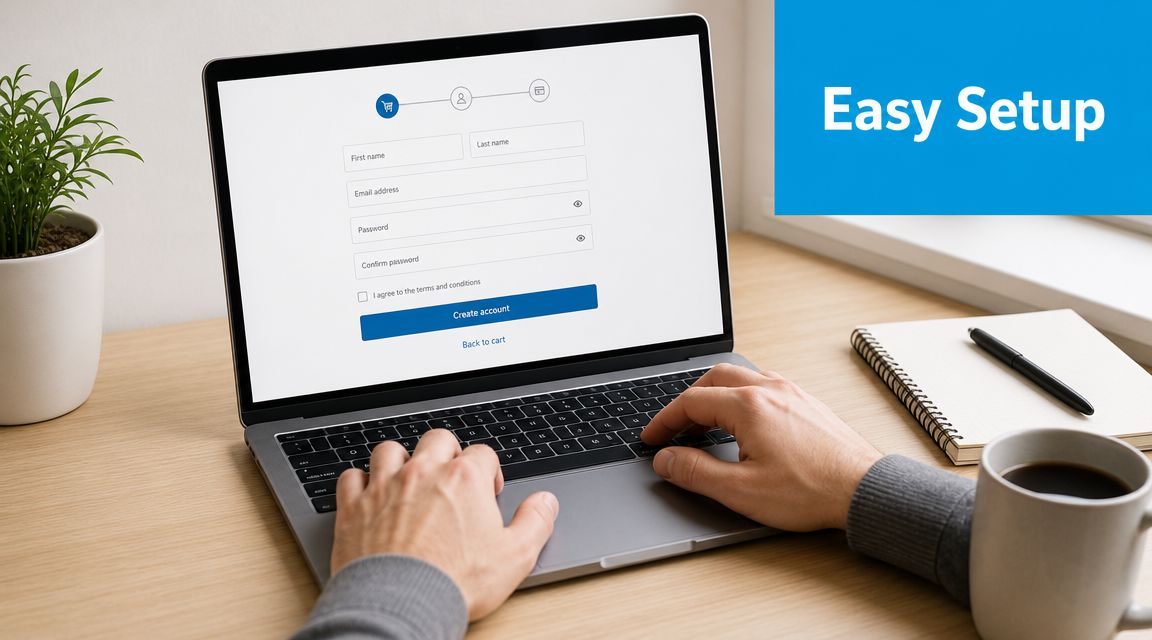
Buying the number itself is usually straightforward. What slows people down is not having the right details ready, or assuming the setup ends once the checkout screen says “active.”
What you'll need before checkout
Have these ready before you start:
- Business identity details such as your legal business name, address, and primary contact information.
- An admin owner who'll control the account, billing, and future changes.
- A short list of backup numbers in case your first choice is gone.
- Your call destinations such as office line, owner cell, front desk, or answering service.
- Your greeting plan for open hours, closed hours, and voicemail.
If you're still deciding whether to start with a fresh number or another type of business line, this overview on how to get a business phone number free can help frame the options.
How the process usually works
For a business buying a 1-800 number, the important steps are to choose a RespOrg and provider, select an available toll-free prefix and vanity number, then configure routing, voicemail, and tracking before launch. Toll-free numbers are sold on a first-come, first-served basis, so number selection is partly a sourcing issue, not just a branding one, as noted in Podium's guide to toll-free business numbers.
RespOrg stands for Responsible Organization. In practical terms, it's the entity that manages the toll-free record and helps determine how portable and manageable your number will be later. If a provider is vague about ownership and transfers, that's a warning sign.
A typical buying flow looks like this:
- Search available toll-free numbers.
- Reserve your preferred choice.
- Enter business and billing details.
- Assign where inbound calls should ring.
- Record or upload greetings.
- Test from multiple phones before publishing the number.
Keep three acceptable alternatives ready before you start searching. That single habit saves more setup time than any dashboard feature.
Where buyers trip up
The most common mistake is treating activation as the finish line. It isn't. A newly purchased number with no forwarding logic, no voicemail plan, and no test calls is just a dormant asset.
The second mistake is giving account ownership to the wrong person. If the office manager leaves and everything is tied to their email, cleanup gets messy fast. Use a company-owned admin login from day one.
Configuring Call Routing for Business Hours
A toll-free number only works if it knows where to send calls under real operating conditions. That means business hours, lunch gaps, field crews, overflow handling, and after-hours coverage all need a plan.
A dental office is a good example. During open hours, calls should ring the front desk first. If no one answers because staff are helping patients, the call should spill to a backup person or service. After hours, the caller should hear a clear message and have a useful next step instead of a dead end.
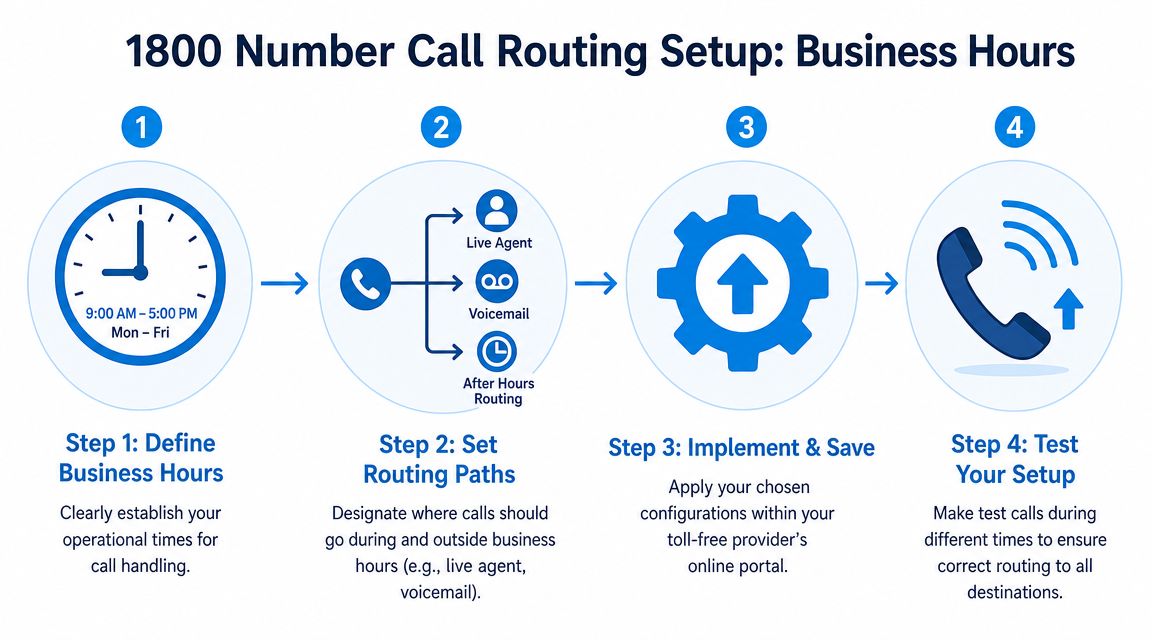
Build the daytime path first
Start with the hours when your team is available to answer. Keep the first version simple.
A reliable daytime flow might look like this:
- Primary destination goes to the front desk, office admin, or dispatcher.
- Simultaneous or backup ring sends the same call to a second person if the first line isn't answered.
- Overflow route catches unanswered calls and sends them to another staffed destination.
- Fallback voicemail plays only after you've exhausted live options.
For a home services company, that could mean the office phone and dispatcher cell ring together from morning to late afternoon. If both miss it, the call goes to an after-hours intake line that still captures the job type and callback number.
Here's a useful walkthrough if you want examples of practical setups for different teams: call forwarding options for business numbers.
If your owner's cell phone is the default answer for every branch, ad, and time slot, you don't have a phone system. You have a bottleneck.
Set closed-hours behavior on purpose
A lot of businesses leave after-hours calls to default voicemail. That usually sounds generic, gives callers no confidence, and creates morning callback piles.
You want a different experience after hours. The closed-hours flow should match what your business can do. For example:
- Urgent service business routes to an emergency line or on-call tech.
- Dental or medical practice sends routine callers to voicemail but gives urgent patients a defined option.
- Law firm captures intake details and schedules a callback.
- Multi-location business sends callers to the correct site or central answering team.
This is also where an AI receptionist can fit. Some businesses route after-hours calls to a platform that captures lead details, qualifies the inquiry, and books the next available appointment instead of just taking a message.
Before you publish the number broadly, watch this quick explainer on setup logic and then test your own version:
Test like a customer, not like an admin
Don't trust the call flow because the dashboard says it's enabled. Test it from different phones, at different times, and with different outcomes.
Run this checklist:
- Call during open hours and confirm the right people ring.
- Let it go unanswered and confirm the overflow path works.
- Call after hours and listen to the full greeting.
- Leave a voicemail and check that the right person receives it.
- Repeat from a mobile and a landline if possible, because inbound behavior can vary by carrier path.
If the test call feels clumsy to you, it will feel worse to a prospect who already has three competitors open in another tab.
Integrating Your 1800 Number to Capture Leads
Most businesses think buying the number is the project. It isn't. It's the starting point.
A major gap in typical buying guides is that they stop at setup and pricing instead of answering the operational question businesses really face, which is how to use toll-free numbers for lead attribution and routing across multiple channels, as pointed out in 800.com's discussion of getting a 1-800 number. That gap matters because the number only becomes valuable when it feeds your systems.
Before and after integration
Before integration, a call comes in, someone answers, scribbles a name on paper, and maybe remembers to enter it into the CRM later. Maybe they don't. Maybe the source gets logged as “website” even though the caller came from a Google Ads campaign or a truck wrap.
After integration, the number does real work:
- The call creates or updates a contact record.
- The source gets attached to the lead record.
- Notes, recordings, or summaries get stored where the team already works.
- Missed calls trigger a callback task.
- Qualified callers move into scheduling or intake automatically.
That's the difference between a phone bill and a lead capture system.
What to connect
At minimum, connect your toll-free line to these operational layers:
| System | What the integration should do | Why it matters |
|---|---|---|
| CRM | Create contacts, log calls, store notes | Keeps the pipeline accurate without manual re-entry |
| Calendar or scheduling | Book consultations, estimates, or appointments | Reduces back-and-forth after the first call |
| Call tracking layer | Assign numbers by campaign or source | Tells you which channels produce phone leads |
| Follow-up automation | Trigger texts, emails, or callback tasks | Prevents warm leads from going cold |
| Intake workflow | Capture service type, location, urgency | Helps routing and prioritization |
If you're evaluating tools, this best call tracking software guide is a practical place to compare what different setups support. For a broader vendor view beyond one provider's site, UPQODE also published a complete call tracker app comparison that's useful when you're sorting through reporting and attribution options.
A practical workflow that works
Take a small law firm. A prospect calls the toll-free intake number after seeing a search ad. The call should not end with “Please leave a message.”
A better flow is this:
- The number identifies the campaign source.
- The intake system captures name, matter type, and urgency.
- The lead is written into the CRM.
- A consultation slot is offered if the matter fits the firm.
- A follow-up confirmation is sent automatically.
- The attorney sees a complete intake trail instead of a vague voicemail.
One option in this category is Recepta.ai, which handles inbound calls, appointment scheduling, lead capture, follow-ups, and CRM syncing. For businesses that miss calls during jobs, after hours, or lunch coverage gaps, that kind of setup can turn a toll-free number into an intake channel instead of a passive line.
The number itself doesn't create accountability. The integration does.
Strategic Tips for Maximizing Your Toll-Free Number
A toll-free number starts losing value the moment it becomes one more phone line no one manages with intent. I see this often with small service businesses. They buy the number, forward it to a cell phone or front desk, then assume the job is done. What they created is a blind spot.

Use separate numbers where the source matters
One number across every channel makes reporting weak. If you care which marketing spend produces booked jobs, assign numbers with a purpose.
A practical setup looks like this:
- Fleet and vehicle wraps get one dedicated toll-free number.
- Google Business Profile gets a second number.
- Paid ads and landing pages use tracking numbers tied to campaign traffic.
- Offline print or direct mail gets its own number for cleaner attribution.
That structure helps with more than marketing reports. It shows where calls are missed, which sources bring qualified prospects, and which campaigns create noise. If the number is connected to your CRM or an intake tool such as Recepta.ai, each call source can be logged against the lead record instead of disappearing into a call log.
Review cost in operational terms
The monthly plan is only part of the expense. The larger cost usually comes from weak handling after the call arrives.
A cheap plan stops looking cheap if calls roll to voicemail during lunch, after-hours follow-up is inconsistent, or staff have to call back the same prospect twice to collect missing details. That is the mistake many owners make. They compare providers on line cost and minutes, but ignore whether the setup helps the team answer, capture, and route calls cleanly.
Check these points every month:
- Answered versus missed calls to spot coverage gaps
- Voicemail volume to catch routing problems early
- Peak call windows so staffing matches demand
- Call outcome by source so you know which channels produce real leads
- Lead-to-appointment or lead-to-estimate rate if your CRM tracks next steps
Those last two matter most. A toll-free number should produce measurable pipeline activity, not just ring volume.
A good setup reduces missed revenue, not just phone friction.
Promote the number where trust and response speed matter
Placement still affects conversion. Put the number in the website header, footer, contact page, and high-intent service pages. Use it in email signatures for staff who handle estimates, consultations, or intake. Add it to invoices, quote sheets, yard signs, and print materials if customers often call before they buy.
The message around the number matters too. “Call now for a same-day quote” sets a different expectation than a generic contact prompt. Use language that matches your actual response process. If someone calls and your system captures the lead, sends a confirmation, and creates a follow-up task, say that clearly.
Your greeting needs the same discipline. Keep it short and specific. “Thanks for calling. Please leave your name, service address, and the best callback number” gives your team something useful to work with. A default mailbox greeting creates cleanup work later.
Treat the number like a tracked sales asset
This is the part many guides skip. The number should be reviewed the same way you review form fills, ad leads, and booked appointments.
For a plumber, HVAC company, law firm, or clinic, that means checking whether inbound calls are getting into the CRM, whether missed calls trigger follow-up, and whether someone owns the lead after first contact. If no one can answer those questions, the business does not have a phone strategy. It has a phone bill.
The businesses that get the most from a 1800 number build a simple operating rhythm around it. They review source performance, listen to a sample of missed or lost calls, fix routing gaps, and adjust scripts when low-quality calls keep showing up. That is how a toll-free number becomes a lead generation asset instead of a static line.
Common Questions About 1800 Numbers Answered
Is a 1800 number different from an 800 number
No. They refer to the same toll-free format. Businesses often say “1800 number” in conversation, but the toll-free code is the 800 prefix.
Are 800 numbers the only toll-free option
No. 800 is the best-known toll-free prefix, but it is not the only one. Businesses can also use other toll-free prefixes such as 888, 877, 866, 855, 844, and 833.
For day-to-day operations, the difference is usually availability and brand preference. Call routing, tracking, CRM logging, and follow-up workflows matter more than whether the prefix is 800 or 888. If a clean 800 number is unavailable, it is often smarter to buy a memorable alternative and set up your lead handling properly than to keep waiting for a perfect number.
Can I port a toll-free number to another provider
Usually, yes.
Porting lets you move the number to a new provider, but small businesses often get trapped by bad setup decisions. Before you buy, confirm who owns the number, how port-out requests work, whether there is a contract term, and whether your call records, recordings, and text history can be exported. A cheap provider can get expensive fast if moving the number later disrupts your CRM, call tracking, or missed-call follow-up process.
How fast can I activate a new number
Basic activation can be quick. Useful activation takes longer.
Buying the number is often the easy part. The actual work is assigning routing rules, testing after-hours behavior, connecting call data to your CRM, and making sure missed calls create a task, text, or callback workflow. Businesses that skip that work end up with a toll-free number that rings, but does not produce clean lead data.
Should my 1800 number be my main line or a campaign line
Both approaches can work. The right choice depends on how you measure calls and how your team follows up.
Use it as your main line if you want one public number across ads, vehicles, printed materials, and your website. Use it as a campaign line if you want tighter attribution by channel. I usually recommend that service businesses decide this based on reporting discipline, not branding alone. If no one reviews source tags, call outcomes, and booked jobs, a dedicated campaign number will not help much.
Do I need CRM integration for a toll-free number
If inbound calls matter to revenue, yes.
A toll-free number without integration creates manual work and missed opportunities. The better setup logs the call, identifies whether it was answered or missed, creates or updates the contact record, and triggers the next step. That might be a callback task, an appointment request, or a follow-up text. Recepta.ai can connect the number to appointment scheduling, lead capture, follow-ups, and CRM workflows so missed calls do not disappear into a voicemail inbox.