

Virtual US Phone Numbers A Complete Guide for 2026

So, what exactly is a virtual US phone number? Think of it less like a traditional phone line and more like a smart, cloud-based number for your business. It isn't tied to a specific SIM card or physical office phone. Instead, it uses the internet, allowing you to make and receive calls and texts from anywhere, on any device you choose—be it your laptop, tablet, or personal smartphone.
For example, a real estate agent based in Miami can have a virtual number with a New York (212) area code. When a potential client in Manhattan calls that number, the call is seamlessly forwarded to the agent's personal cell phone in Florida, making the business appear local and established, no matter where the agent is physically located.
Why Your Business Needs a Virtual US Phone Number
Every missed call is a missed opportunity. For most businesses, that's not just a saying; it's a painful reality that chips away at revenue and your reputation. When you're juggling calls on your personal cell or chained to an old office landline, you’re bound to drop the ball. This is where a virtual US number changes the game.
It acts as an intelligent command center for all your business communications. Instead of being stuck on one device, the number lives in the cloud, ready to route calls, texts, and voicemails exactly where they need to go, 24/7. It gives you a polished, professional presence, whether you’re in the office, on the road, or working from home.
Keeping Up With How Customers Communicate
The move away from traditional phone systems isn't just a fleeting trend. It’s a permanent shift in how people expect to connect with businesses. The data tells a clear story about the rapid decline of old-school landlines.
By the end of 2022, an incredible 73% of American adults lived in households with no landline phone at all—a number that has tripled since 2010. Reflecting this change, 36% of software buyers are now actively choosing modern VoIP services over traditional options.
These numbers don't lie. Sticking with an outdated phone system means you're not meeting your customers where they are.
For businesses in hands-on industries like home services, healthcare, and law, a virtual number is more than just a convenience. It's a cornerstone for building client trust and scaling operations without chaos. In fact, for many, it’s a far better option than other popular choices, as we explore in our guide on using Google Voice for a business number. This simple piece of tech solves major headaches, from capturing every single lead to establishing a local presence in a new city, making it an indispensable asset for any business in 2026.
How Virtual Phone Numbers Actually Work
So, how does a virtual US phone number work in practice? The easiest way to think about it is like a smart mail-forwarding service, but for your phone calls. Your number isn't physically tied to a specific phone line or SIM card. Instead, it lives in the cloud, giving you total control over where your calls end up.
At its core, this is all made possible by Voice over Internet Protocol (VoIP), which converts your voice into digital data that zips across the internet. Understanding the basics of what a VoIP phone is helps paint a clearer picture of the technology. This digital approach is what lets you route calls to any device you want—your personal cell, an office desk phone, or even a softphone app on your laptop.
This flexibility is a game-changer for solving some of the most frustrating communication problems modern businesses face.
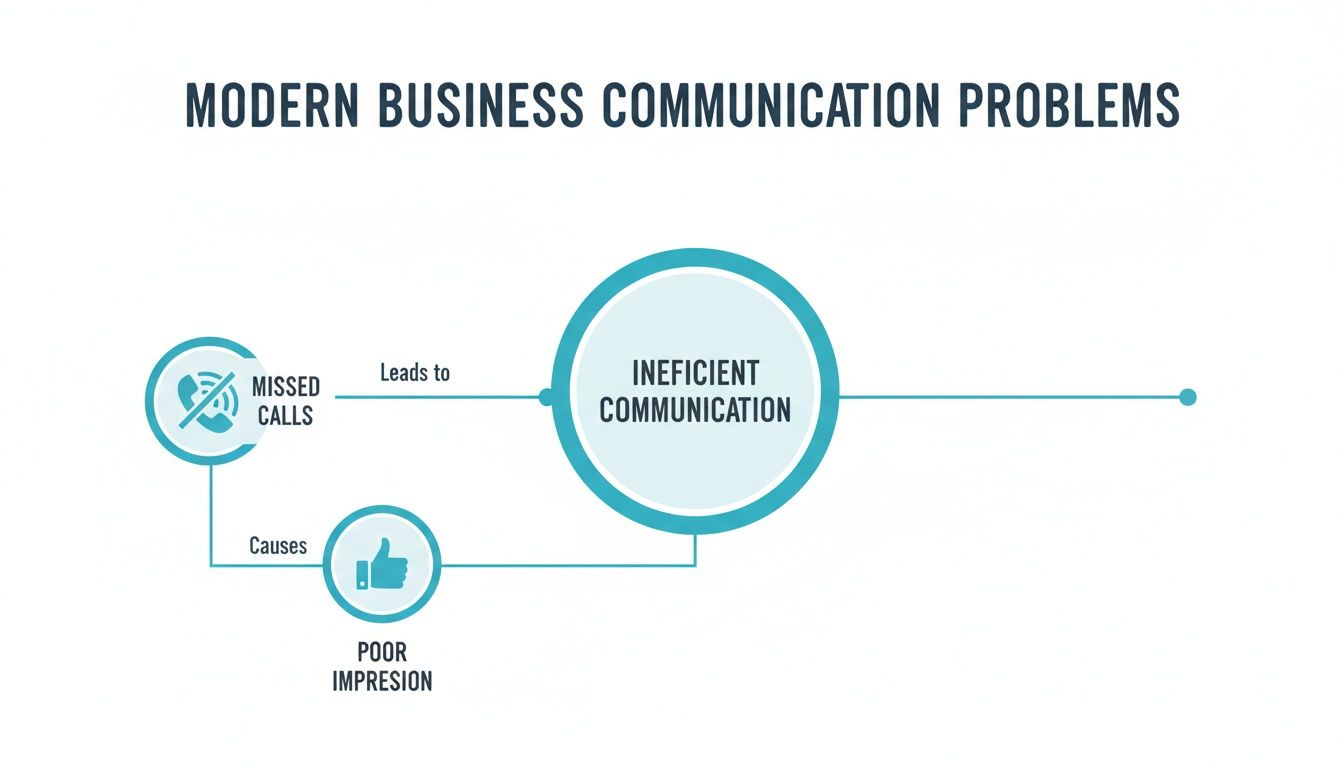
As you can see, the frustration of missed calls and the poor impression it leaves are directly solved by a more adaptable, virtual system.
Choosing Your Number Type
Not all virtual numbers are created equal. The type you choose is a strategic decision that shapes how customers see your business. There are three main options, each with a distinct advantage.
Local Numbers: These numbers come with area codes for specific cities, like (212) for New York or (310) for Los Angeles. They're fantastic for home service businesses—think plumbers, electricians, or landscapers—that want to establish instant credibility and a local presence. For example, a roofer based in a suburb can get a virtual number with the downtown city's area code to attract higher-value urban clients who prefer to hire "local" companies.
Toll-Free Numbers: With familiar prefixes like (800), (888), or (877), these numbers let customers from anywhere in the US call you for free. If you're a national e-commerce brand or a law firm with clients across state lines, a toll-free number projects a professional, nationwide presence and removes any barrier for a potential customer to reach out.
Vanity Numbers: You know these instantly—they're the memorable numbers that spell out a word, like 1-800-FLOWERS. A vanity number isn't just a contact detail; it's a powerful branding asset that sticks in your customers' minds and makes your marketing more effective. A local pizza shop, for instance, could use (555) EAT-PIZZA to make their number unforgettable.
The Power of Smart Routing
What really sets virtual numbers apart is call forwarding. This is your ability to direct incoming calls to different people or devices based on rules you create. It’s a simple concept with powerful implications. To dive deeper, you can check out our guide to what call forwarding is and how it works.
This technology puts you in the driver's seat of your communications. It’s the difference between a static, inflexible phone line and a dynamic system that adapts to how you run your business, ensuring every call reaches the right person at the right time.
Think of a real estate agency with agents in different states. With smart routing, a call from a Florida area code can automatically be sent to their agent based in Miami. And when the office closes? All calls can be forwarded to a voicemail-to-email service or an AI receptionist, so you never miss another lead. This level of control makes virtual US phone numbers an indispensable tool for any modern business.
Putting Your Virtual Number to Work in the Real World
Alright, let's move past the theory. A virtual US phone number is a fantastic tool, but its real magic shines when you put it to work solving actual business problems, tracking what works, and making your operations run smoother.
Here are a few practical playbooks I’ve seen work wonders across different industries.

Home Services: Finally Nail Your Marketing ROI
If you're a plumber, HVAC tech, or roofer, you know the frustration. Your phone rings, but where are the calls really coming from? A virtual number system is the simplest way to get a clear answer using call tracking.
Imagine a plumbing company running a few local ads: some flyers in a new neighborhood, a magnet on the work truck, and a small ad in the local paper. The phone rings, but they're flying blind, unsure which ad spend is paying off.
Instead of plastering their main number everywhere, they assign a different local virtual number to each campaign:
- Number A goes only on the flyers for the 'Westwood' neighborhood.
- Number B is printed on the truck magnet.
- Number C is used exclusively in the newspaper ad.
All three numbers automatically forward to the owner’s main line, so nothing changes for the customer. But here’s the game-changer: at the end of the month, the owner logs into their analytics dashboard.
The data is crystal clear. Number A (the flyers) brought in 45 calls that turned into 20 jobs. Meanwhile, Number C (the newspaper) only generated five calls and one job. Just like that, they know exactly where to double down on their budget and what to cut. No more guesswork.
Law Firms: Streamline Your Client Intake
For law firms, every call is sensitive and needs to get to the right person quickly. By assigning virtual numbers to different practice areas, you can instantly organize your client intake and route callers to the correct legal team without a receptionist playing traffic cop.
Think of a mid-sized firm that handles personal injury, family law, and estate planning. Originally, all calls hit a single front desk. The receptionist had to screen every caller to figure out their needs, creating a bottleneck and leaving room for error.
The fix is surprisingly simple. The firm gets a unique virtual number for each department:
- The website and ads for personal injury cases now feature a vanity number ending in "HURT".
- All family law marketing materials use a second, distinct local number.
- Estate planning brochures have their own dedicated number.
These numbers are then set up with smart routing rules. A call to the "HURT" number rings the personal injury paralegals directly. The family law number goes straight to that team's intake specialist. This small change completely removes the front-desk bottleneck, getting potential clients the help they need on the very first try.
Healthcare: Automate 24/7 Appointment Booking
In a busy clinic, the phone never stops ringing with appointment requests, tying up staff who are needed for in-person patient care. A dedicated virtual number, especially when paired with an AI receptionist, can handle this entire process automatically.
For example, a dental clinic can set up its virtual number with an IVR menu: "Press 1 to book a new appointment, Press 2 for billing questions, Press 3 for clinic hours." Callers who press 1 are routed to an AI that can access the schedule and book appointments automatically, even at 2 AM. This frees up the front desk staff to manage check-ins and patient care during business hours.
Simply using a local number in your advertising can give you a serious edge. Studies have shown that a local number can increase response rates by up to 30% compared to a toll-free one because it builds immediate trust and a community feel. You can find more details about these marketing effectiveness findings on Callin.io.
That local touch is just the beginning. Virtual numbers are incredibly versatile—they even make modern tasks like receiving faxes on an iPhone with a virtual number possible, which is a lifesaver for clinics still dealing with paper records. When you add automation into the mix, you free up your skilled staff to focus on what matters most: patient care.
What to Look For: Key Features of a Virtual Number
A virtual number is so much more than a new way to answer the phone—it’s the engine for your entire customer communication strategy. When you start looking at different providers, it’s easy to get lost in a sea of features. But the goal isn’t to find the longest list; it’s to pinpoint the right tools for your specific business.
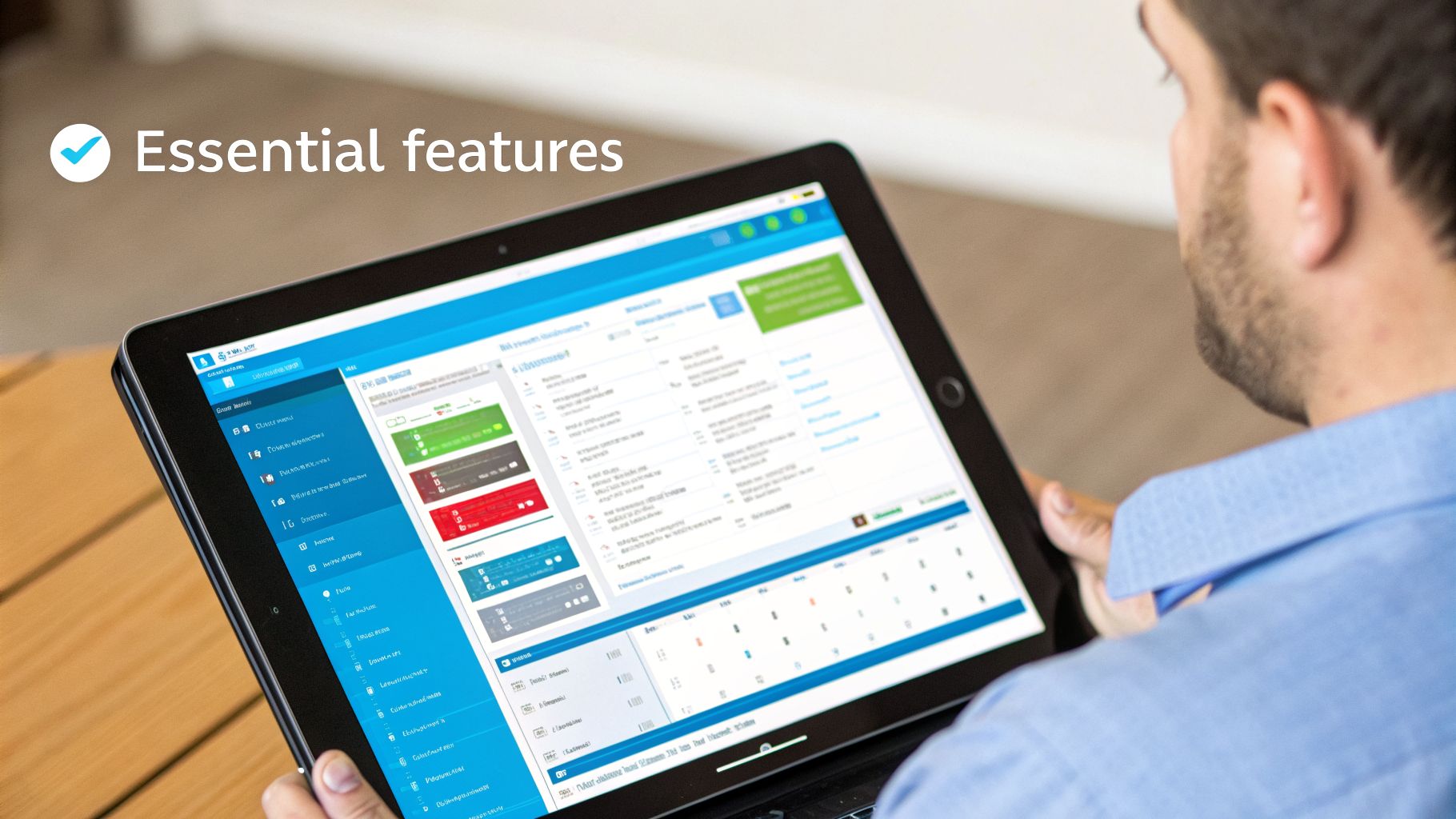
Think of it like buying a work truck. You wouldn’t get a two-door sports car if you need to haul lumber and tools every day. In the same way, the features you pick for your virtual US phone numbers need to directly support how you operate and make your life easier.
To help you sort through the noise, we've broken down the essential features every modern business should look for. The following table gives you a quick overview of what each feature does and, more importantly, what it means for your day-to-day operations.
Essential Virtual Number Features at a Glance
| Feature | What It Does | Why It Matters for Your Business |
|---|---|---|
| Smart Call Routing | Automatically directs calls based on preset rules (e.g., time of day, caller's location, or menu selection). | Ensures calls always reach the right person or department without manual transfers, saving time and improving first-contact resolution. Example: Route calls from 9-5 to the office, and after hours to an AI receptionist. |
| SMS/MMS Capabilities | Enables sending and receiving text and picture messages from your business number. | Lets you communicate with customers on their preferred channel for appointments, updates, and quick questions. Example: A roofer can text a picture of the completed work to the client for approval. |
| Voicemail-to-Text | Transcribes voicemails into text and sends them to your email or an app. | Allows you to quickly read and prioritize messages without having to listen to them one by one, speeding up your workflow. Example: Read a voicemail from a lead while you’re in a meeting and forward it to a colleague to handle. |
| Shared Inbox | Gives your team shared access to a single inbox for calls, texts, and voicemails. | Promotes teamwork and accountability. Anyone on the team can see communication history and step in to help a customer. Example: A support team can see a customer's entire message history and provide help without asking them to repeat themselves. |
| IVR (Auto-Attendant) | Greets callers with a menu of options ("Press 1 for Sales...") to guide them to the right place. | Empowers customers to self-serve and reduces the burden on your front desk. Example: "Press 1 for hours and location" can answer a common question without using any staff time. |
| Integrations | Connects your phone system with other software you use, like your CRM or scheduling tools. | Automates workflows by logging calls, creating contacts, and triggering actions in other apps. Example: Automatically create a new lead in your CRM every time a new number calls your sales line. |
This table covers the fundamentals, but let's take a closer look at a few of these features and how they can really change the game for your business.
Tools That Give You Back Your Time
Some features are just non-negotiable in 2026. They're the baseline for any business that wants to look professional and operate efficiently.
- Smart Call Routing: This is a must. A home services franchise can use it to automatically forward calls from a Miami area code directly to their lead technician in South Florida. No more playing telephone tag at the main office.
- Voicemail-to-Text Transcription: Forget scribbling down messages while trying to listen to a crackly voicemail. This feature turns voice messages into readable text, so you can quickly scan them for urgency and reply in seconds.
- SMS/MMS Capabilities: Let's be honest, people prefer texting. Being able to send appointment reminders, pictures of a finished job, or quick follow-ups via text is now an expectation. For a deeper dive, check out our guide on the essentials of VoIP text messaging.
- Shared Inboxes: This is a lifesaver for teams. It puts all calls and texts from a single number into one place where multiple people can manage them. Nothing falls through the cracks, and customers get faster, more consistent support.
Features That Actively Grow Your Business
Once you have the basics covered, you can look at features that don't just save time—they actually help you make more money.
An Interactive Voice Response (IVR), or auto-attendant, is a perfect example. It's the friendly, automated voice that says, "Press 1 for Sales, Press 2 for Support." It instantly routes callers where they need to go, making your business feel larger and more organized while freeing up your team.
But the real magic happens with integrations. When your phone system talks to your other business software, it stops being a simple phone and becomes an automated part of your team.
Imagine your virtual number is connected to your CRM. A new client calls, and a contact record is automatically created in HubSpot. Or better yet, when connected to an AI receptionist like Recepta.ai, that same phone call can trigger lead qualification, appointment booking, and automated follow-ups without a human ever touching a keyboard. That's how you turn every call into a real opportunity.
Your Step-By-Step Setup Guide
Getting a virtual phone number up and running is surprisingly quick—you can honestly do it in just a few minutes. Think of this as your roadmap, taking you from a rough idea to a fully integrated communication system.
Don't let the tech talk intimidate you. We'll break it down into five simple stages. You don't need a background in IT to get a professional-grade system working for you.
1. Figure Out Your "Why"
Before you even glance at a provider or pick a number, stop and ask yourself: what problem am I actually trying to solve? The answer will point you straight to the right type of number and the features you’ll need.
Practical Example: A solo consultant wants to stop giving out her personal cell number to clients. Her "why" is "professionalism and work-life separation." This means she needs a provider with a solid mobile app so she can manage business calls and texts from her personal phone, but through a separate business number.
2. Pick the Right Provider
Once you know what you need, it's time to shop for a provider. And please, don't just sort by price. Dig into the features that will actually make a difference, like call recording for quality control, SMS for sending appointment reminders, and shared inboxes that let your whole team see and respond to messages.
A solo entrepreneur might be perfectly fine with a basic plan. But if you're managing a team, you’ll want to look for features like ring groups (which call multiple people simultaneously) and integrations with your CRM to keep everything running smoothly.
3. Choose Your Virtual US Phone Number
Okay, this is the fun part. Picking your number is a huge part of your brand identity, so give it some thought.
- Local Number: A plumber expanding into the next town over should grab a number with that city’s area code. It instantly tells people you’re local.
- Toll-Free Number: A national consulting firm needs an 800 or 888 number. It makes you seem accessible and professional to clients, no matter where they are.
- Vanity Number: A law firm that handles car accidents could get a huge boost from a memorable number like 1-800-CAR-CRASH. It just sticks in your head.
4. Set Up Your Call Routing
You've got the number. Now, you need to tell it where to send the calls. This is where you set up your call forwarding rules. Think of it like programming your own personal switchboard operator who never takes a break.
Actionable Example: Set up a "sequential ring" rule for your sales team. A new call will ring Agent 1's phone for 20 seconds. If there's no answer, it automatically moves to Agent 2, then Agent 3. This ensures someone on the team answers quickly, reducing missed opportunities.
5. Connect It to Your Business Tools
This is the final, and most powerful, step. Your virtual US phone number truly comes alive when you connect it to the software you use every day. This is how you automate your work and get a ton of time back.
The single most valuable integration you can make is connecting your number to an AI receptionist like Recepta.ai. With this one connection, every single call gets answered, 24/7. The AI can qualify new leads, book appointments right into your calendar, and make sure you never miss an opportunity again. It immediately transforms your phone from a simple tool into an automated lead-generating machine.
The Future Is An AI-Powered Phone System
Getting a virtual US phone number is a great first step, but it's only the beginning. The real magic happens when you connect that number to conversational AI. Think of it as upgrading your phone from a simple tool into an intelligent, 24/7 digital receptionist that never misses a call or an opportunity. This isn't just a tech upgrade; it’s a fundamental change in how you can run your business.
With remote teams and online service now being the norm, having a smart, flexible communication system is no longer just a nice-to-have. It's how you stay ahead. The market trends tell the same story: what was a USD 5.2 billion global market for virtual phone numbers in 2024 is on track to become a USD 17.2 billion industry by 2033. That massive jump, which you can read more about in this market growth analysis from DataIntelo.com, shows just how many businesses are moving their communications to the cloud.
The core benefits are clear: enhanced professionalism, greater operational efficiency, and superior lead capture. Modernizing your phone system with a service like Recepta.ai is the most direct path to securing these advantages.
By pairing your virtual number with smart automation, you guarantee that every single caller gets a fast, professional response. This is how you future-proof your communications, ensuring you're ready for whatever comes next. To see what this looks like day-to-day, check out our guide on building effective AI customer service solutions.
Got Questions? We've Got Answers
Even after exploring all the benefits, a few practical questions usually come up. It's completely normal. Let's walk through the most common ones we hear from business owners so you can make your decision with total confidence.
Can I Keep My Existing Business Number?
Absolutely. This is probably the number one question people ask, and the answer is a definite yes.
The process is called porting, and it’s a standard, regulated procedure that lets you take your number with you to a new provider. You won't lose the brand recognition you've built, and your customers won't have to update their contact lists.
Think about a local contractor who has had the same number on their truck for years. They can switch to a virtual system and start getting texts and routed calls without having to repaint their vehicle or print new business cards. It's the best of both worlds.
Are Virtual Phone Numbers Secure?
The security of your virtual number really comes down to the provider you choose. Reputable services build their platforms with enterprise-grade security from the ground up, because they know your communications are sensitive.
When you're comparing options, look for providers who are transparent about their security practices. Key features to ask about include AES-256 encryption, two-factor authentication, and SOC 2 compliance. If you're in a field like healthcare or law, confirming HIPAA compliance isn't just a good idea—it's essential for protecting client data.
How Does Pricing Typically Work?
Most virtual phone systems charge on a per-user, per-month basis. You can generally expect starting plans to fall somewhere in the $15 to $25 per user per month range.
This subscription model is a major reason why it’s so much more affordable than a traditional landline system, which often comes with hefty setup fees and hardware costs. Just be sure to read the fine print—some plans include unlimited calling and texting in the US and Canada, while others might have caps on toll-free minutes or messages that could result in overage fees.
Will It Work With My Cell Phone?
Yes, and that's one of the biggest advantages. A virtual number is designed to work seamlessly with the devices you already own.
You simply download the provider's app onto your iOS or Android smartphone. From that app, you can make and receive calls and texts that all show up as your business number. It's a clean, simple way to keep your personal and professional lives separate without the hassle of carrying a second phone.
Ready to see how a virtual number, powered by a 24/7 AI Receptionist, can make sure you never miss a call again? Recepta.ai captures every lead and books appointments for you, day or night. See how it works at Recepta.ai.