
Call Handling Services: Maximize Leads & Efficiency
You finish a long day, check voicemail, and hear half a name, a muffled phone number, and a sentence that sounds urgent. It might be a homeowner with a burst pipe. It might be a parent trying to book a pediatric appointment. It might be a potential client who finally decided to call your law office after putting it off for weeks.
By the next morning, that person may already be talking to a competitor.
That's the problem most small businesses are trying to solve when they look at call handling services. Not “phone coverage” in the abstract. Not a nicer voicemail. They want a reliable way to catch revenue, protect service quality, and stop letting busy periods break the customer experience.
The High Cost of a Missed Call
A missed call rarely looks dramatic in the moment. It looks ordinary. You're on a job site. Your front desk is helping an in-person customer. Your office closes at 5, but your customers keep calling at 6:30. One more ring goes to voicemail. Then another.
The damage shows up later.
A plumbing company loses an after-hours emergency because nobody picked up. A dental office gets a frustrated patient review because the caller couldn't confirm an urgent change. A small law firm misses a weekend intake from someone who was ready to book a consultation but didn't want to leave sensitive details on voicemail.
That's why I tell owners to stop thinking about call handling as “someone to answer the phone.” Its primary function is to capture the opportunity while the caller is still engaged. In practice, the highest-value use case often isn't replacing your receptionist. It's handling overflow, after-hours calls, and repeat inquiries so your team can stay focused on the conversations that need in-house attention, as noted in this guidance on preventing lost opportunities during peak-volume periods.
Where small businesses usually lose leads
Most missed-call problems come from a short list of operational gaps:
- Busy-hour bottlenecks: Two staff members are available, but both are already speaking with customers.
- After-hours silence: Calls outside business hours land in voicemail with no triage.
- Interrupt-driven offices: Front desk staff answer phones, greet walk-ins, and handle admin at the same time.
- No clear escalation path: Urgent callers sound like routine callers until it's too late.
Practical rule: If your best leads often arrive when your team is busiest, you don't have a staffing problem alone. You have a call-flow problem.
Technology matters here too. If you're reviewing your phone setup at the same time, this guide to Networking2000 small business VoIP advice is useful because it shows how the phone system itself affects routing, availability, and handoff quality.
If your current fallback is voicemail, it's also worth looking at why callers often disengage before leaving useful details. This breakdown of the missed call message problem gets into the operational side of that failure.
What a Call Handling Service Actually Does
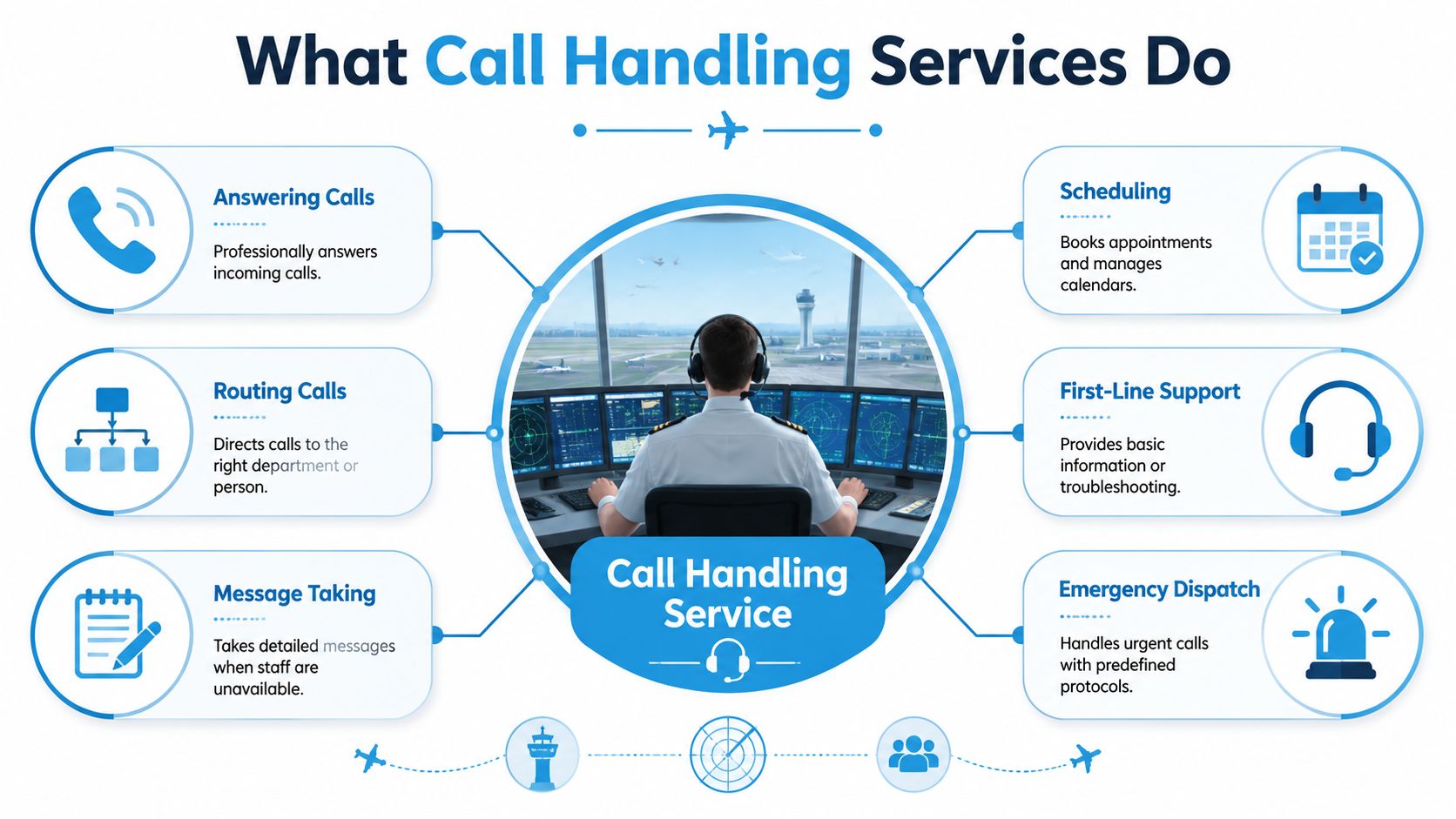
A good call handling service works like an air traffic controller for your business communications. Calls come in from different directions, with different levels of urgency, and they can't all land in the same place. Someone, or something, has to identify the situation, route it properly, and keep the flow from turning into chaos.
That need for structure isn't theoretical. The average call center handles about 4,400 calls per month, and common service benchmarks aim to answer 80% of calls within 20 seconds, with average handle time around 6 minutes and 10 seconds, according to Xima's call center statistics roundup. Those numbers explain why ad hoc call coverage fails so often. There's too much volume, too little time, and no room for repeated transfers.
The core functions that matter
A practical call handling service usually does six jobs well:
- Answering calls professionally: The caller hears a live, consistent greeting instead of endless ringing or generic voicemail.
- Identifying intent quickly: Is this a sales inquiry, a patient question, a service emergency, or a billing issue?
- Routing to the right destination: Calls go to the correct person, queue, or workflow.
- Taking usable messages: Not “Please call back.” Actual context, callback details, and next-step notes.
- Booking and confirming appointments: Calendar access matters if your business depends on scheduling.
- Handling simple first-line support: Routine questions get resolved without interrupting your core team.
For some industries, that overlap starts to look a lot like role-based delegation. Real estate is a good example, where firms often split lead intake, scheduling, and follow-up across specialized support roles. This overview of real estate virtual assistant services is useful because it shows how communication tasks become operational workflows, not just admin tasks.
What good call handling sounds like in practice
Here's the difference between basic phone coverage and actual call handling:
| Situation | Weak setup | Strong setup |
|---|---|---|
| New lead calls after hours | Voicemail | Live answer, lead details captured, follow-up queued |
| Existing customer calls with simple question | Caller waits for office hours | Scripted first-line answer or callback commitment |
| Urgent service issue | Caller repeats details multiple times | Triage notes passed with context to the right person |
| Schedule request | Message taken on paper | Appointment booked directly in calendar |
A service that only “takes messages” is often too limited. The real value starts when calls trigger action.
If you're comparing categories, it helps to distinguish a basic answering service from a more operationally involved model. This explanation of an answering services company is a useful reference point because it shows where message-taking ends and workflow support begins.
Comparing the Three Types of Call Handling
Small businesses usually choose between three models. They hire an in-house receptionist, outsource to a traditional answering service, or use a modern AI-hybrid setup. None is perfect for every business. The right choice depends on your call mix, your hours, and how often callers need judgment rather than simple script-following.
The biggest mistake is choosing based on habit. Owners often default to the model they already understand, not the one that fits their operation.
Call Handling models compared
Modern call handling increasingly uses a hybrid approach where AI or IVR resolves routine, low-complexity interactions and live agents step in for sensitive or ambiguous cases, according to Weave's overview of call handling services. That split matters because many businesses don't need a person to answer every repetitive question, but they absolutely need a capable human when nuance enters the call.
| Feature | In-House Receptionist | Traditional Answering Service | Modern AI-Hybrid Service |
|---|---|---|---|
| Coverage | Usually limited to staffed hours | Often available after hours and during overflow | Can provide round-the-clock front-line coverage |
| Brand familiarity | High, if trained well | Varies widely | Can be strong if scripts, workflows, and escalation are configured well |
| Handling routine calls | Good | Good | Strong when automation handles repetitive requests cleanly |
| Handling sensitive calls | Good if experienced | Mixed, depends on training depth | Strong if escalation to trained humans is immediate |
| Scalability | Limited by staffing | Better for surges | Strong for both volume spikes and repetitive traffic |
| Cost structure | Highest overhead burden | Flexible but may feel transactional | Flexible, with more workflow automation |
| Best fit | Businesses with heavy in-person traffic and consistent hours | Businesses that need overflow or basic after-hours cover | Businesses that want availability plus smarter triage |
In-house receptionist
This model gives you the most direct control. Your receptionist learns your clients, your tone, and your quirks. In a medical office or law firm, that familiarity can be valuable.
The trade-off is fragility. One person can only answer one call at a time. Lunch breaks, holidays, sick days, and high-volume windows expose the limits fast. If your business gets bursts of calls rather than evenly spaced calls, a single front-desk hire often becomes a bottleneck.
Traditional answering service
This model solves availability first. If your phones ring after hours or during busy periods, someone picks up. For many home service companies, that alone is a major improvement.
The downside is generic handling. If agents don't know your workflows, they can misclassify calls, collect incomplete information, or sound detached when callers need reassurance. That's especially risky in legal, healthcare, and emotionally charged situations.
Don't judge an outsourced service only by whether it answers. Judge it by whether your staff can act on the message without calling the customer back to ask basic questions again.
Modern AI-hybrid service
This model is often the most practical for small businesses with inconsistent call patterns. Routine calls can be handled immediately. Appointment requests, office hours, location questions, and repeat-status inquiries don't have to interrupt your team. When a caller is distressed, unclear, or high-stakes, the call moves to a human.
That hybrid line is what makes the model viable. Pure automation breaks when callers go off-script. Pure human handling gets expensive and hard to scale. The middle ground works when the escalation path is fast and the context passes through cleanly.
If you're weighing whether to outsource at all, this guide to outsourced call center solutions is a practical place to compare operating models before you commit.
Key Benefits and Real World Examples
Features are easy to list. What matters is what changes on a Tuesday afternoon when your office is overloaded, or on a Saturday when a prospect finally decides to call.
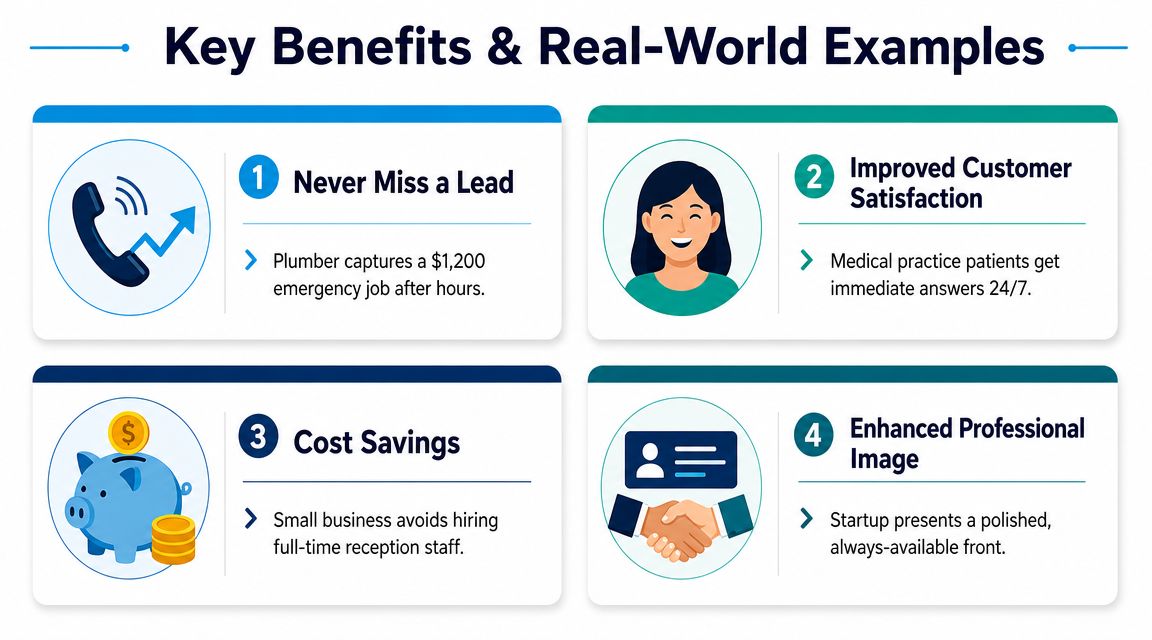
The best call handling services create value in three places at once. They save opportunities, reduce interruptions, and protect the caller experience when the conversation turns sensitive.
Home services example
A plumbing company gets an evening call from a homeowner with no hot water and water pooling around the tank. The caller isn't looking for a detailed diagnosis. They want to know whether someone can help, how soon, and what to do next.
A weak setup sends that call to voicemail.
A better setup answers immediately, confirms whether it's an emergency, captures the address, notes the symptoms, and follows the business's dispatch rules. If the caller sounds panicked, the script can't just say “we'll pass on a message.” It needs to move the issue to a person who can make a judgment call.
Healthcare and wellness example
A dental or medical practice has a different problem. The front desk gets buried in constant calls while trying to check patients in, manage schedule changes, and answer insurance questions.
In call handling, empathy and escalation matter as much as speed. Best-practice guidance for inbound call handling emphasizes empathy, active listening, and intelligent escalation, especially in healthcare, law, and home services where missed context can create lost business or compliance risk, as discussed in Nextiva's inbound call handling guidance.
That means a caller who says, “I'm in pain and I don't know if this can wait,” should not be treated the same way as a routine cleaning request.
Legal example
Law firms often receive calls from people who are anxious, embarrassed, angry, or overwhelmed. The caller may be evaluating whether they can trust you at all.
A strong call handling process does four things well:
- Sets the tone immediately: Calm, professional intake matters when the caller is under stress.
- Screens without sounding cold: You need enough detail to qualify the inquiry without interrogating the caller.
- Escalates when stakes are high: Urgent legal timelines, safety concerns, or emotionally charged facts need human review fast.
- Documents the context clearly: The attorney or intake specialist should receive a usable summary, not scattered fragments.
Sensitive calls don't just need politeness. They need judgment, clear thresholds, and a record of what was said.
What works and what doesn't
Here's what tends to work across industries:
- Clear call types: Separate routine, urgent, and sensitive scenarios before launch.
- Defined escalation rules: Staff should know exactly when a human must take over.
- Context capture: Every transfer or callback should include the caller's reason, urgency, and next step.
- Tone training: Scripts should sound steady and human, not robotic.
What fails is just as predictable. Generic scripts. Slow handoffs. Vague messages. No audit trail. In sensitive industries, those aren't minor issues. They shape trust from the first interaction.
Integration Security and Compliance Explained
A call handling service becomes much more useful when it connects to the systems you already use. Without integration, agents answer calls and then someone on your team still has to retype notes, update the CRM, send the callback, and fix calendar mistakes later.
With integration, the call can trigger the workflow.
What integration should do
A robust setup usually combines automatic call distribution, interactive voice response, and skills-based routing so calls are directed by intent and agent capability rather than simple round-robin assignment, which helps reduce transfers and improve customer experience, as described in RingCentral's call management overview.
For a small business owner, that technical stack should translate into simple outcomes:
- CRM updates: New lead details land in the right record.
- Calendar actions: Appointments are booked in the actual schedule, not written in a side note.
- Team routing: Calls move to the right location, role, or on-call contact.
- Call summaries: Staff get context before they return the call.
If you want a plain-English overview of how these connections work, this guide to CRM integration is worth reading.
Security questions to ask before you sign
Many owners get uneasy, especially in healthcare, legal, insurance, and finance. That concern is justified. If callers share personal information, your provider becomes part of your risk surface.
Ask direct questions:
- How is call data stored? You want clear answers on storage practices and access controls.
- Who can access recordings and transcripts? If everyone can see everything, that's a red flag.
- How are sensitive calls flagged? High-stakes interactions need tighter handling.
- What industry requirements can they support? Healthcare practices, for example, need to think carefully about HIPAA-related workflows.
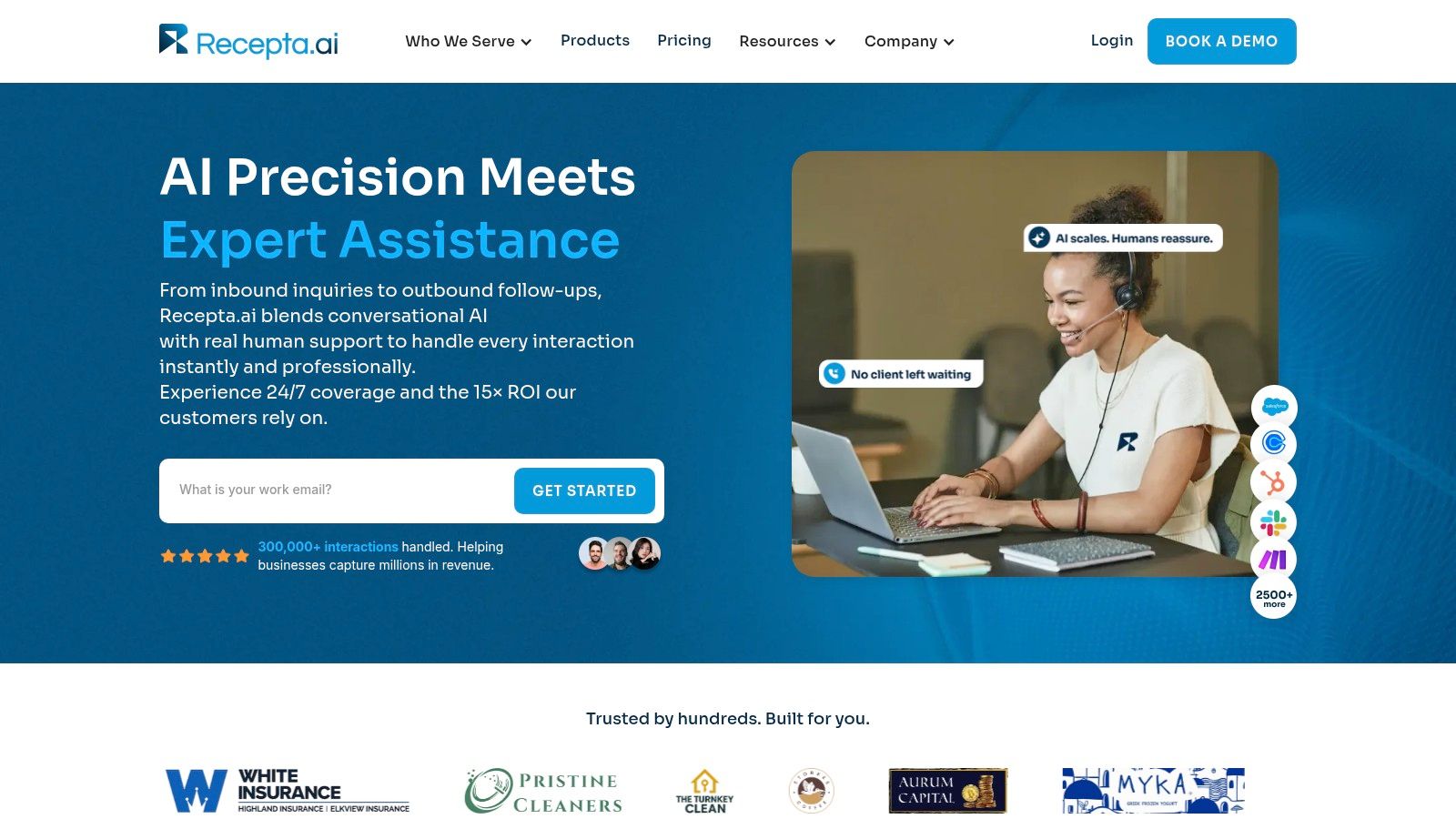
One modern option in this category is Recepta.ai, which combines AI receptionist workflows with human escalation and connects with 2,500+ tools across CRM, calendar, and business systems. The value of a setup like that isn't novelty. It's reducing manual handoffs while keeping a path to human review when the call requires discretion.
Security isn't a separate buying criterion. It's part of call quality. If private information moves through a weak process, the service is failing even if the phone gets answered.
How to Evaluate a Call Handling Service
Most demos sound good. That's the trap. Every provider says they answer professionally, support your team, and improve responsiveness. The decision gets clearer when you test for operational fit instead of sales language.
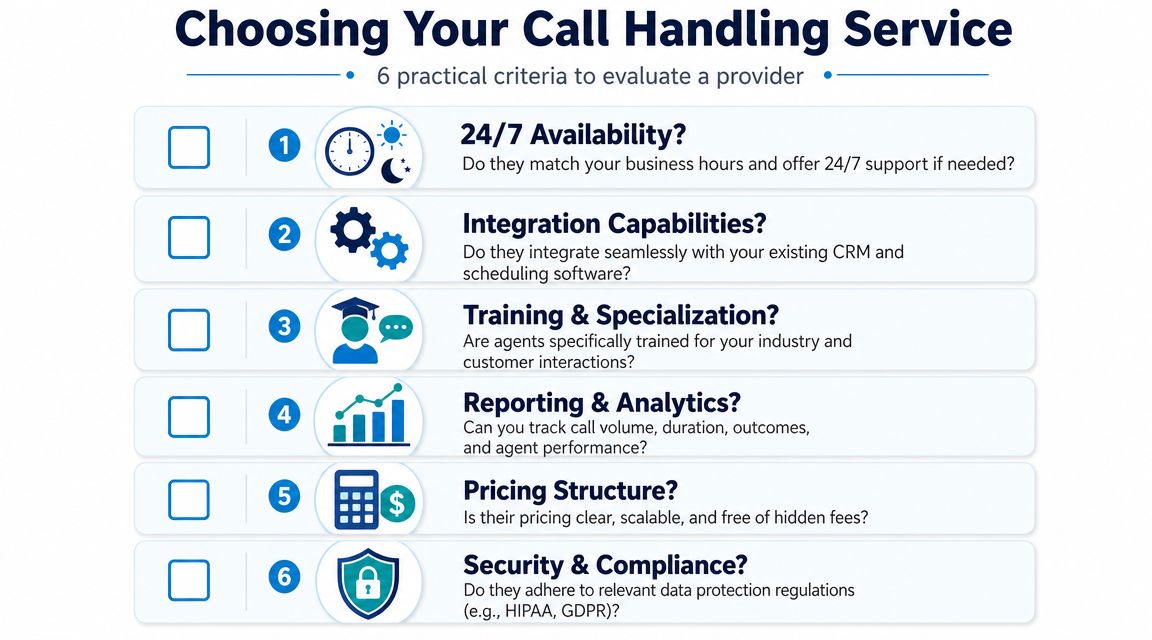
The shortlist questions that matter
Use this as a working checklist when you compare providers:
- Coverage fit: Do they only answer after hours, or can they support overflow, peak periods, and full-time routing?
- Workflow depth: Can they book appointments, qualify leads, and follow branching instructions, or do they only take messages?
- Sensitive-call handling: What happens when a caller is upset, confused, or discussing medical or legal details?
- Escalation design: How does a call move from automation to a human, and how much context survives the handoff?
- Reporting quality: Can you review call outcomes, missed opportunities, and common inquiry types?
- Pricing clarity: Is the model easy to understand, and can it scale without surprise charges?
A simple ROI lens
You don't need a complicated spreadsheet to assess value.
Start with your current missed-call pattern. Look at after-hours inquiries, lunch-hour overflow, and busy-day voicemail traffic. Then ask one practical question: if this service helped you save even a small number of important conversations each month, would that change revenue or service quality enough to justify the cost?
For some businesses, the answer comes from one extra emergency job. For others, it comes from freeing the front desk to handle patients, clients, or walk-ins properly. In law, healthcare, and high-trust services, ROI also includes fewer dropped inquiries and fewer poor first impressions.
Run a live test, not a hypothetical one
Before you commit long term, test the service with real scenarios:
- Call after hours as a new prospect.
- Call during your busiest window.
- Present a routine question.
- Present a sensitive or urgent situation.
- Review what gets logged, how fast the handoff happens, and whether the summary is useful.
The gap between a polished demo and a real caller interaction is where bad providers get exposed.
Your Next Steps to Never Miss a Lead
If your phones are still relying on voicemail, ad hoc forwarding, or an overloaded front desk, the fix doesn't have to be complicated.
Start with a short audit. Check when calls are missed, which types of calls create the most disruption, and where sensitive conversations currently break down. Most owners already know the weak spots. They just haven't mapped them.
Then choose one primary goal. Maybe you need after-hours lead capture. Maybe you need overflow support during the day. Perhaps the underlying problem is that your staff shouldn't be triaging distressed callers while also handling in-person work.
Finally, test a service against your real workflows, not generic promises. Ask how it handles urgency, how it escalates, what gets logged, and how quickly your team can act on the result. The right setup gives you control. It doesn't just give you coverage.
Modern call handling services work best when they're treated as an operational system, not a backup answering line. If you configure them around the calls that cost you the most when missed, they stop being an expense line and start acting like a growth and service-quality tool.
If you want to try a modern AI-plus-human approach without changing your whole front desk at once, Recepta.ai is one option to explore. It handles inbound calls, scheduling, lead capture, and escalation to trained agents when a conversation needs empathy or judgment, which makes it a practical fit for overflow, after-hours coverage, and sensitive-call workflows.