
Billing Third Party: Guide to Compliance & Pitfalls

You're probably dealing with this right now. Jobs are getting done, calls are coming in, and customers expect quick answers about balances, claims, invoices, or payment plans. But the money side keeps piling up. Someone on your team is chasing documents, fixing invoice errors, answering billing questions, and trying to figure out why cash hasn't landed yet.
That's where third-party billing enters the picture.
For a small business owner, billing third party usually isn't about finance jargon. It's about getting paid without turning your office into a collections department. It also affects three things owners care about every week: cash flow, compliance, and customer experience. If you hand billing to the wrong partner, you can lose money and trust. If you set it up well, you can create a much smoother operation.
What Is Third-Party Billing
Third-party billing means an outside company or payer handles some or all of the billing process between you and the customer. Sometimes that outside party sends invoices. Sometimes it submits claims. Sometimes it collects payments, posts them, and follows up on unpaid balances.
A simple analogy helps. Think about a landlord who hires a property manager to collect rent, track late payments, and handle tenant billing questions. The landlord still owns the property, but the property manager runs the payment workflow. Third-party billing works the same way. You still deliver the service. Someone else helps manage the financial transaction.
This model shows up in very different industries. A dental office may outsource claims and denial follow-up. A law firm may use a billing service to generate invoices and payment reminders. A plumbing company may work with an outside finance or payment partner so customers can spread large repair costs over time.
Practical rule: If your team spends too much time translating completed work into money received, you don't have just an admin problem. You have a billing system problem.
The reason businesses choose third-party billing is usually practical, not theoretical:
- More time back: Staff can focus on patients, clients, and service delivery instead of constant billing cleanup.
- Better consistency: Specialists often catch documentation gaps and process issues faster than a general office team.
- Faster cash movement: Cleaner submissions and more organized follow-up can reduce delays.
- Less owner involvement: You don't have to personally untangle every invoice dispute.
Third-party billing can be a smart move. It can also create risk if you don't know who owns each step, who talks to the customer, and who is accountable when something goes wrong. That's why the business model matters just as much as the idea itself.
Common Third-Party Billing Models Explained
Not all third-party billing arrangements work the same way. The easiest way to understand them is to look at the three players involved:
- Your business: The company that performs the service
- The customer or payer: The person, insurer, organization, or entity that owes payment
- The billing third party: The outside company that manages some part of charging, collecting, or reconciling payment
Here's the comparison at a glance.
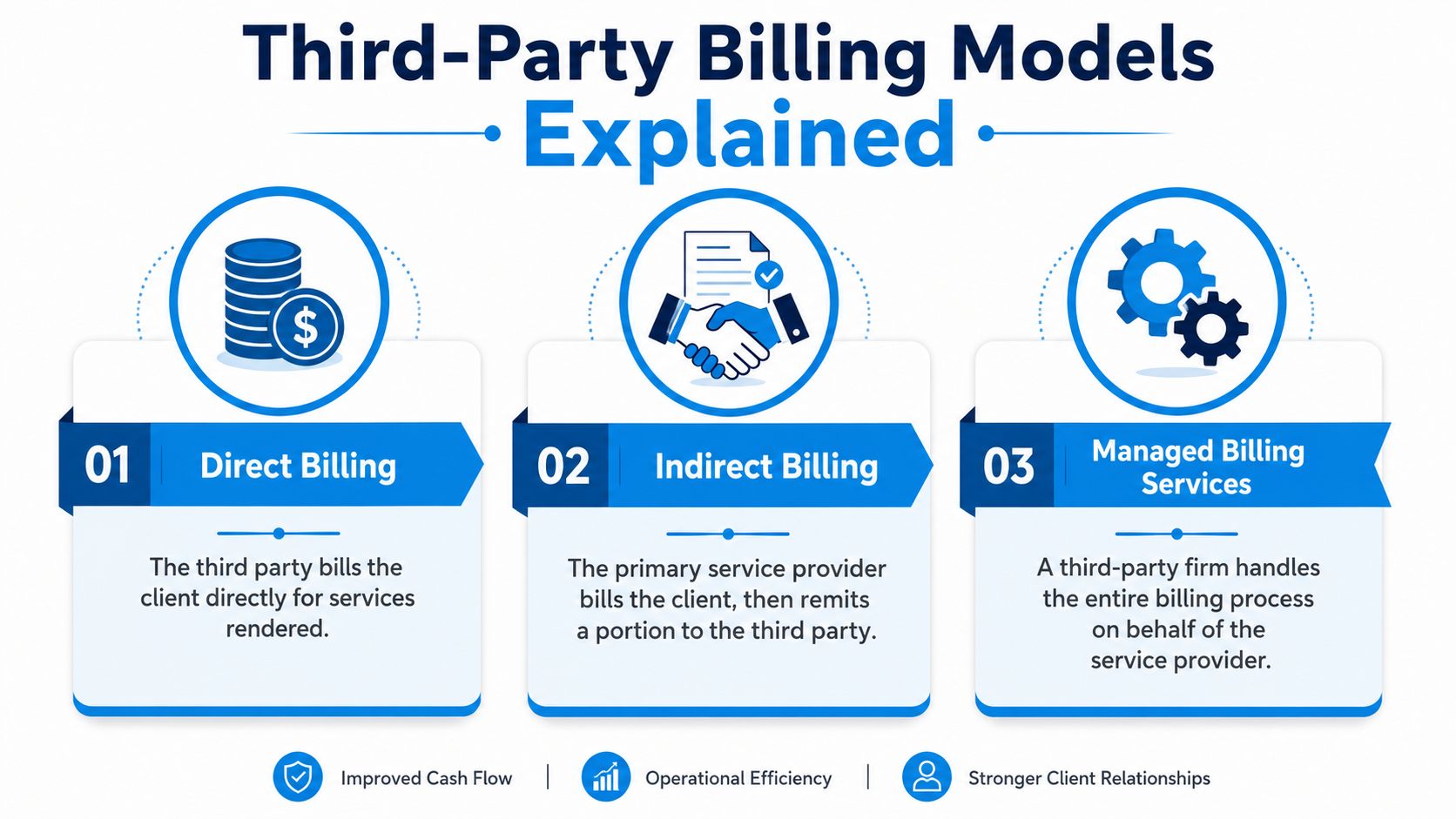
Three common models
| Model | How it works | Best fit | Main watchout |
|---|---|---|---|
| Direct billing | The third party bills the customer or payer directly | Insurance, telecom, financing, some healthcare claims | Less control over the customer touchpoint |
| Indirect billing | You bill the customer, then pay the third party its share or fee | Referral-based services, partnerships, some legal and finance arrangements | Fee structure can create compliance questions |
| Managed billing services | A billing firm runs the workflow on your behalf | Healthcare practices, firms with steady volume, multi-location operators | You need clear reporting and service standards |
Direct billing
In direct billing, the outside party sends the bill to the person or entity responsible for payment. This is common when the payer isn't dealing with your team in a simple one-to-one transaction.
Telecommunications is a cautionary example of how large and risky this model can become when controls are weak. In the United States, third-party billing in telecom generated over $10 billion in charges on landline telephone bills over a five-year period, with approximately 300 million third-party charges annually totaling more than $2 billion per year. The same Senate record notes that a substantial percentage of those charges were unauthorized, making billing fraud and consent issues major complaints in premium rate and direct carrier billing arrangements (U.S. Senate Commerce Committee record on third-party billing).
That example matters even if you don't work in telecom. It shows what happens when a business allows charges to flow through a third party without strong consent controls and customer visibility.
Indirect billing
In indirect billing, you still invoice the customer, but an outside party gets paid based on the arrangement behind the scenes. This can be useful when another provider supports fulfillment, financing, or administration.
A familiar example is premium financing. If you're in insurance or adjacent services, reviewing how an insurance premium finance company works can help you think through who advances funds, who collects repayment, and how payment responsibility gets split across parties. The lesson for any business owner is simple: when more than one company touches the money, contract language has to be painfully clear.
Managed billing services
This is the model most small businesses picture first. You hire a billing company to handle the process for you. In healthcare, this approach is now standard operating practice in many settings. The global medical billing outsourcing market was valued at USD 3.07 billion in 2024 and is projected to reach USD 7.77 billion by 2032 at a 12.3% CAGR, driven by billing complexity and the needs of over 120,000 healthcare institutions (medical billing service market analysis).
That scale tells you something important. Businesses outsource billing because it has become specialized work.
How owners should choose
A small decision framework helps:
- Choose direct billing if an outside payer structure already exists and the customer expects that model.
- Choose indirect billing if you want to keep the client relationship in-house but need a partner behind the scenes.
- Choose managed billing services if your team is losing time on repetitive billing tasks and follow-up.
The best model is usually the one that makes payment responsibility obvious to the customer and accountability obvious to you.
How the Third-Party Billing Process Works
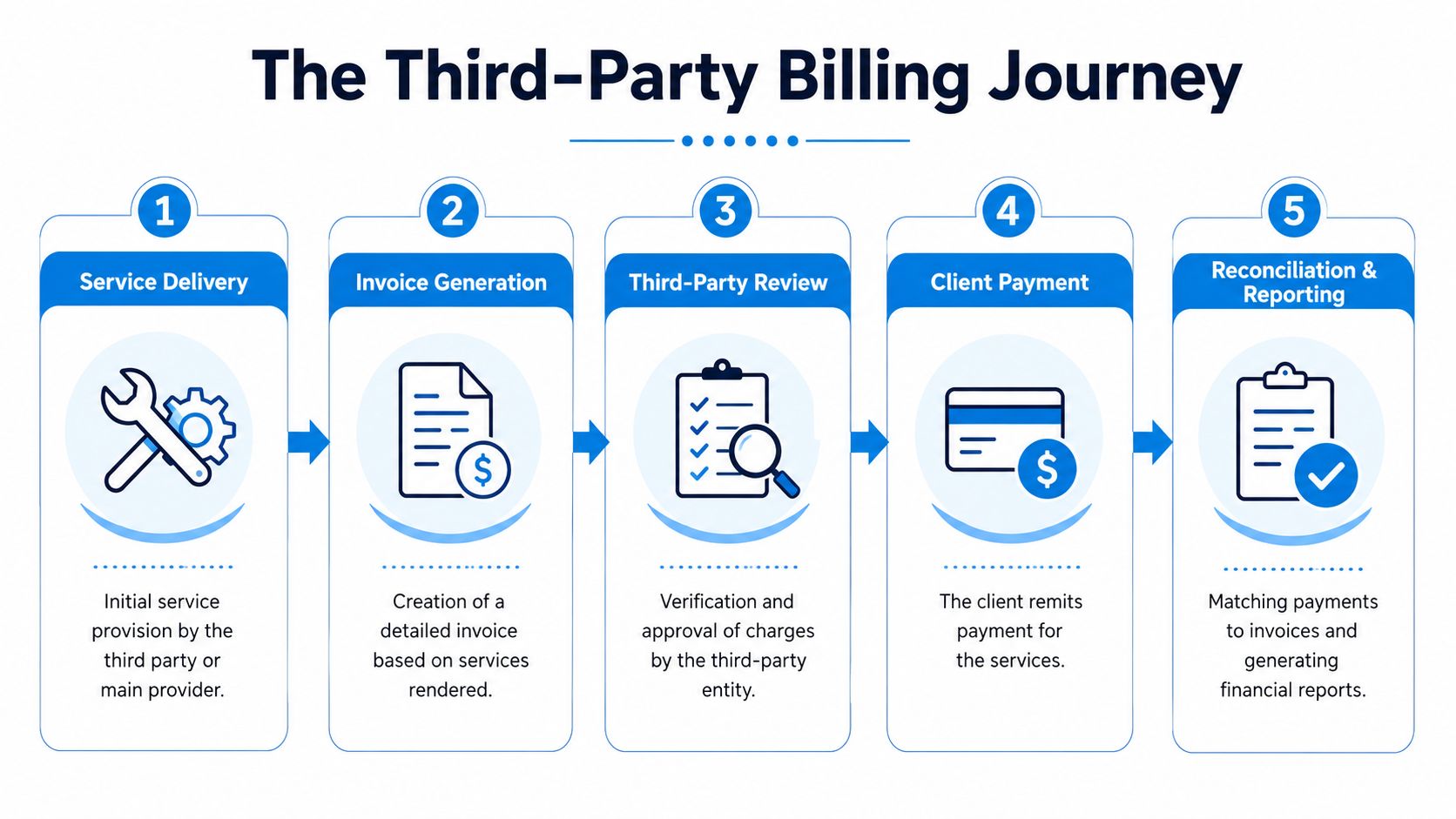
Most billing third party workflows follow the same basic path. The details change by industry, but the handoffs are remarkably similar. If you understand the handoffs, you'll know where errors begin.
To make the flow easier to see, here's a visual.
Step 1. Capture what actually happened
Everything starts with service delivery. An HVAC technician finishes a repair and notes labor, parts, and customer approval. A therapist completes a session and records the service details and authorization status. A law office logs time entries and expenses tied to a matter.
If this step is sloppy, every later step gets harder.
Step 2. Transfer the information cleanly
Your team then passes the service data to the billing partner or billing system. This can happen through software integrations, shared portals, or manual upload. The method matters less than the quality of the data.
For businesses that reimburse field teams or process mixed service costs, a practical guide for managing UK expenses can help clarify how supporting records should move through approval and reimbursement workflows. Even if you're outside the UK, the same operational lesson applies: billing fails when supporting documents arrive late, incomplete, or in the wrong format.
A lot of owners treat this handoff as admin work. It isn't. It's a control point.
Step 3. Create the invoice or claim
Now the third party converts service records into a billable document. In healthcare that may mean a claim. In home services it may mean an invoice with labor and material line items. In legal, it may mean a detailed statement that matches engagement terms.
This is also where coding, pricing, payer rules, and contract terms start to matter.
Clean billing starts upstream. The biller can't fix work that was never documented correctly.
Step 4. Submit and track
The document goes out to the customer, insurer, or responsible payer. Then the waiting begins, along with status tracking. Some bills get paid right away. Others need clarification, corrections, or follow-up.
Owners who want fewer bottlenecks usually benefit from stronger intake and handoff design before they ever hire a billing firm. Good workflow optimization practices help teams reduce duplicate entry, missed fields, and rework that slows payment.
Here's a useful training aid for teams that need to picture the workflow in motion:
Step 5. Post payment and reconcile
When payment arrives, someone has to match it to the correct invoice or claim, record adjustments, and flag short pays or denials. This step sounds simple until you have partial payments, disputed charges, credits, or multiple payers involved.
A contractor might receive a deposit, a final payment, and a finance partner disbursement. A clinic might get insurer payment plus patient responsibility. If the reconciliation process is weak, your books may say you're paid while your bank account says otherwise.
Step 6. Follow up on what didn't pay
The final stage is follow-up. That means chasing unpaid invoices, correcting denials, answering customer questions, and escalating disputed items. At this stage, many businesses realize the billing company isn't just a processor. It's part of the customer experience.
Navigating Critical Compliance and Documentation Rules
Third-party billing can improve operations. It can also create legal exposure fast. The key issue isn't just whether money gets collected. It's whether the billing method, documentation, and compensation arrangement follow the rules of your industry.
Healthcare rules that aren't optional
Healthcare has the clearest examples because the paperwork is unforgiving. For commercial payers, Medicaid, and Medicare, providers must use standardized forms. CMS 1500, also called HCFA 1500, is used for outpatient services, and UB-04 is used for institutional services. The same guidance says that failure to use the required forms or failure to fully document authorization limits, including date, authorizer name, authorization number, units authorized, and review date, leads to claim denial and lost revenue. It also states that 30% to 40% of initial denials stem from incomplete documentation or non-standard form usage (NIATx third-party billing guide).
That means outsourced billing doesn't remove your responsibility. It increases the need for discipline.
A small practice should verify at least these items:
- Form control: Your vendor knows when CMS 1500 or UB-04 applies.
- Authorization tracking: Required fields are captured before service or claim submission.
- Denial ownership: The contract says who fixes rejected claims and on what timeline.
- Privacy safeguards: Protected health information is handled under documented controls.
If you're evaluating communications tools around patient billing or intake, a HIPAA-compliant answering service guide is useful for understanding how front-desk conversations and protected information intersect.
Fee structures can create legal trouble
One of the most confusing topics in billing third party arrangements is compensation. Owners often assume any percentage-based arrangement is fine as long as it seems common. That's risky.
A review of third-party billing agreements from the American Medical Billing Association notes that some states allow collection-based arrangements under specific conditions, while others impose stricter limits, and 10 states require disclosure of offshoring in bids (AMBA third-party billing agreements overview). The practical lesson isn't that percentage fees are always prohibited. It's that you can't assume a contract that works in one state or sector automatically works in another.
For law firms, this issue intersects with trust accounting, client funds, and nonlawyer fee-sharing concerns. For home service companies, it can show up in referral relationships, finance partner agreements, or collection terms.
If a vendor gets paid based on money collected, ask your lawyer or compliance advisor whether that fee structure creates fee-splitting, kickback, or state licensing concerns.
ERP and finance controls matter too
Large companies face a different version of the same problem. In SAP S/4HANA third-party order processing, billing behavior depends on the item category's billing relevance setting. If it is set to B, meaning order-quantity-based, the order enters the billing due list immediately. If it is set to F, meaning invoice-quantity-based, it is excluded until the vendor invoice is received and processed. SAP notes that the standard third-party item category TAS is preconfigured to F to enforce invoice matching before billing (SAP S/4HANA third-party order processing documentation).
Small businesses may never touch SAP, but the control principle still applies. Don't bill ahead of verified documentation. If your process allows charges before support exists, reconciliation problems and disputes are almost guaranteed.
A practical compliance checklist
Use this list before signing any third-party billing agreement:
- Ask who owns documentation quality. Don't accept vague language like “client provides records as needed.”
- Verify required forms and workflows. This matters most in healthcare, legal, and regulated finance.
- Review compensation language carefully. Especially if the vendor is paid from collections.
- Define who communicates with customers. Compliance failures often start in informal phone or email exchanges.
- Document escalation rules. Denials, disputes, refunds, and suspected fraud need named owners.
Compliance isn't busywork. It's what keeps a billing problem from turning into a legal problem.
Common Pitfalls and Best Practices for Success
The biggest mistake owners make is assuming outsourced billing can be set up once and ignored. It can't. A third-party billing relationship needs active management, just like any vendor that touches customers and cash.
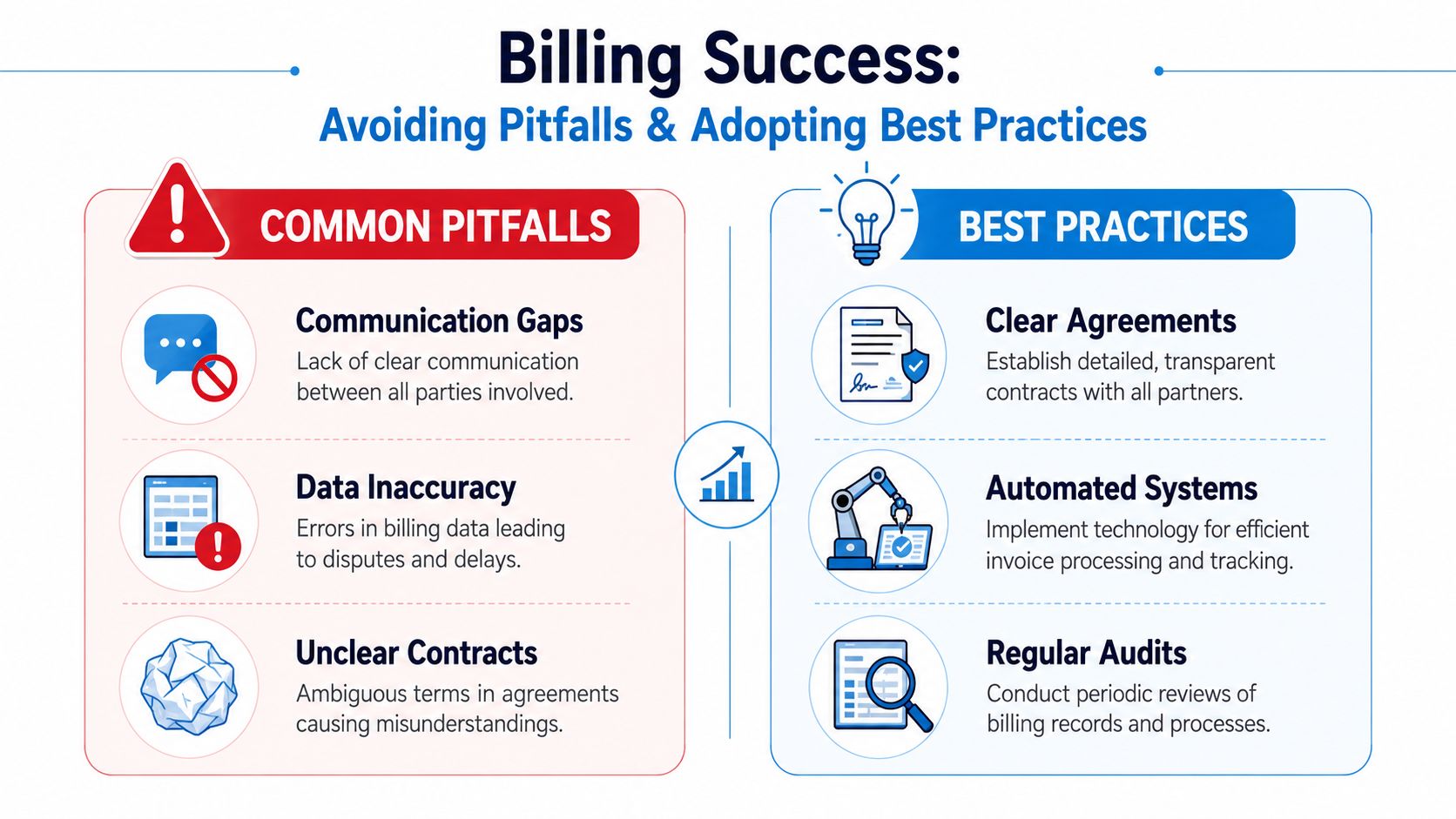
Pitfall one: communication gaps
A customer calls with a simple question, but your office says, “That's handled by our billing company.” Then the billing company says, “We're waiting on your office.” The customer hears confusion, not process.
Best practice: define scripts, escalation rules, and response ownership in writing. Decide which questions your team answers, which questions the vendor answers, and how handoffs happen.
Pitfall two: weak data quality
If technicians, receptionists, or providers enter incomplete details, the biller is stuck cleaning up bad input. That creates delays, resubmissions, and arguments over who caused the error.
Best practice: audit source data, not just final invoices. If you're vetting vendors and operational partners, a practical guide on how to check if a company is legitimate can help you tighten your review process before sensitive financial and customer information starts moving through a third party.
Pitfall three: vague contracts
A contract that says the vendor will “handle billing” doesn't answer the questions that matter. Who posts payments? Who handles refunds? Who owns denial resubmission? Who responds if a customer disputes consent?
The telecom example shows why this matters. Large-scale third-party charging can become a fraud and consent problem when businesses don't control authorization and oversight, as reflected in the Senate record cited earlier.
Pitfall four: treating security like paperwork
Many healthcare practices stop at signing a Business Associate Agreement. That's necessary, but it isn't enough. A critical gap in vendor management is breach response planning. Public guidance often mentions getting a BAA but doesn't provide practical frameworks for auditing vendor readiness, even though 40% of healthcare data breaches involve third parties according to the cited industry discussion (vendor breach response discussion).
What should you ask instead?
- Notification timing: How quickly must the vendor notify you after a suspected breach?
- Operational steps: Who isolates systems, preserves logs, and contacts affected parties?
- Testing cadence: Has the vendor practiced the response plan?
- Evidence: Can they show role assignments and escalation paths?
A signed agreement proves intent. A tested response plan proves readiness.
Pitfall five: ignoring payment disputes until they snowball
Some businesses focus so heavily on billing speed that they ignore downstream dispute patterns. If customers don't recognize charges, can't reach support, or feel boxed into a confusing payment process, disputes rise. In card-heavy businesses, that can contribute to a high chargeback rate, which creates a separate set of operational and payment-processing headaches.
Best practice: review dispute reasons monthly. Don't just count unpaid invoices. Look for patterns in communication failures, surprise fees, or slow responses.
The operating habits that usually work
The strongest third-party billing setups share a few habits:
- Monthly review calls: Look at open balances, denials, disputes, and turnaround bottlenecks.
- Clear customer language: Bills and reminders should sound like your business, not an anonymous processor.
- Documented exception handling: Credits, refunds, split payments, and edge cases need playbooks.
- Limited system access: Vendors should get the access they need, not broad unrestricted access.
Outsourcing billing should reduce chaos. If it's creating more mystery, the structure is wrong.
How Technology Can Streamline Your Billing Workflow
The most effective billing third party setups don't rely on the billing company alone. They connect the front office and the back office so the data starts clean and stays consistent.
That matters because many billing problems begin before billing starts. A caller gives the wrong insurance detail. A receptionist forgets to log authorization notes. A field service team closes a job without attaching customer approval. By the time the biller sees the file, the problem is already baked in.
Front-office tools affect back-office cash flow
An AI receptionist can improve billing operations even though it isn't a billing platform. It can answer routine questions, collect missing details, route disputes correctly, and log conversations into connected systems.
In a dental clinic, an AI receptionist can instantly answer a patient calling at 10 PM to ask about their account balance by querying the practice management system, providing 24/7 support for routine billing inquiries and preventing lost or delayed communication (dental billing inquiry automation example).
That kind of response changes more than convenience. It reduces front-desk backlog and prevents simple billing questions from turning into frustration or delayed payment.

Integration beats manual relay
If your call handling, scheduling, CRM, and billing records all live in separate systems, someone has to bridge the gaps manually. That's where missed notes, duplicate entry, and outdated balances creep in.
Businesses get more control when intake and communication tools connect directly with the systems their billing teams rely on. Reviewing how third-party integrations work can help you think through what should sync automatically, what needs human approval, and where audit trails matter most.
What to automate first
A practical rollout usually starts with three areas:
- Inbound billing questions: Route routine balance, payment-plan, or invoice-status questions automatically.
- Data capture at intake: Collect names, dates, service details, and supporting notes in structured fields.
- Follow-up triggers: Send reminders or route unresolved issues without waiting for staff to notice them.
Technology doesn't replace compliance or vendor oversight. It supports them. The ultimate win is that your billing partner receives cleaner inputs, your staff answers fewer repetitive questions, and customers get faster responses without feeling bounced around.
If you want a simpler way to connect calls, scheduling, customer questions, and billing-related workflows, Recepta.ai helps businesses capture cleaner information from the first interaction and route it into the systems that keep operations moving. It's a practical option for teams that want fewer missed calls, fewer manual handoffs, and a smoother path from customer conversation to payment.