
Unlock Success: Emotional Intelligence Improve Your Business
The phone rings at 8:07 a.m. A client is already upset. Your technician is late, the last email thread was unclear, and now the customer wants to cancel. If you run a plumbing company, a law office, or a medical practice, you know this kind of interaction can hijack the rest of your day.
Most owners treat moments like this as a staffing issue, a process issue, or a customer issue. Sometimes they are. But just as often, the deciding factor is whether someone on your team can stay calm, read the room, respond with empathy, and move the conversation toward a solution. That's emotional intelligence in action.
If you've been searching for how emotional intelligence improve results in a real business, not just in personal development language, start there. EQ shows up when a lawyer handles an anxious client without sounding defensive, when a front desk coordinator de-escalates a billing complaint, and when a service manager delivers bad news without losing trust. Those moments affect conversion, retention, reviews, and profit.
Why Emotional Intelligence Is Your New Business Superpower
A tense client conversation rarely starts as a crisis. It becomes one when the business owner gets reactive, the office manager gets curt, or the technician goes silent. In service businesses, revenue leaks through interactions like these every week.

That's why I don't treat emotional intelligence as a “nice to have.” I treat it like an operating capability. It affects whether a prospect books, whether a frustrated client stays, and whether a team member creates calm or spreads stress.
One widely cited workplace study found that emotional intelligence explained 58% of success across all job types, and talent research reports that every 1-point increase in EQ is associated with about $1,300 more in annual salary, with high-EQ workers earning about $29,000 more per year than low-EQ workers, according to Niagara Institute's summary of emotional intelligence statistics. Those numbers matter because they move EQ out of the self-help category and into business performance.
EQ shows up where small businesses win or lose
In a home service business, EQ affects the first call after a leak damages a kitchen. In a law firm, it affects intake conversations when a prospect is stressed and suspicious. In healthcare, it affects whether a patient feels dismissed or supported.
Practical rule: Clients often remember how you made them feel more clearly than they remember the exact explanation you gave.
Here's what high EQ usually looks like in practice:
- Lead conversion: The person answering the phone notices fear, urgency, or hesitation and adjusts tone instead of reading a script.
- Client retention: A provider acknowledges frustration before explaining policy, timeline, or price.
- Team performance: Managers regulate their own stress so one difficult customer doesn't poison the next three interactions.
If you want a broader view of leadership habits that sit alongside EQ, understanding leadership beyond EI is a useful read. And if your pain point is customer-facing communication specifically, this guide on empathy in customer service fits right into the day-to-day reality of service teams.
Understanding the Four Pillars of Emotional Intelligence
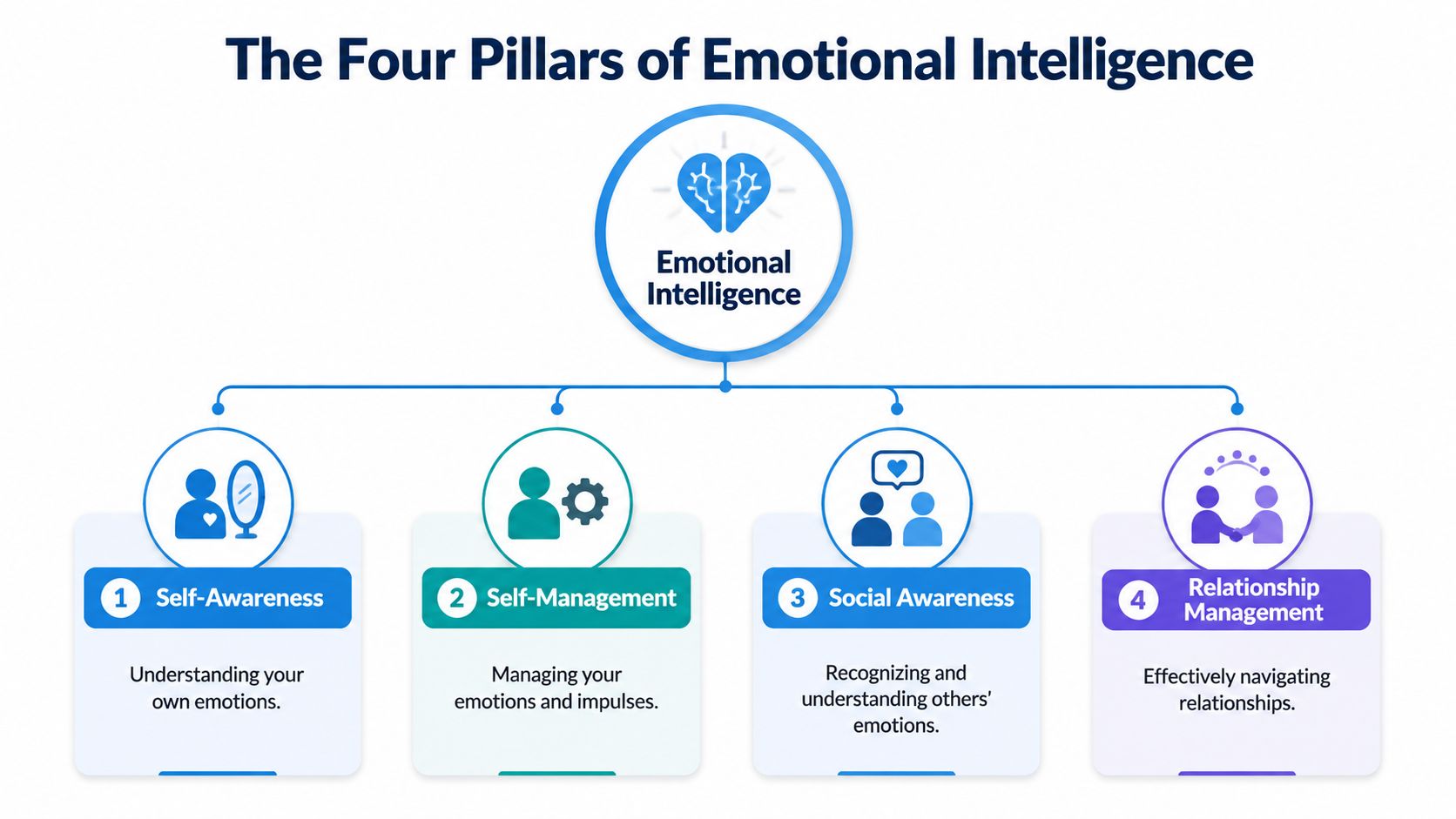
Many individuals say they want better emotional intelligence when what they really want is fewer avoidable blowups, smoother conversations, and stronger trust. That becomes easier once you stop treating EQ as one vague trait and start seeing it as four trainable capabilities.
Research confirms emotional intelligence is not fixed and can be improved. A 2024 review in Cureus explains that repeated emotionally intelligent behaviors can strengthen neural pathways, meaning EQ can be trained like a habit, and that same review notes that 71% of employers report valuing EQ over IQ in the material summarized there through the Cureus review on emotional intelligence.
Self-awareness
Self-awareness is your ability to notice what you're feeling before that feeling starts driving your behavior.
A plumber owner with self-awareness notices the knot in his stomach when dispatch gets backed up. A law firm partner notices she's getting impatient before she cuts off a junior associate. A clinic manager notices she's embarrassed about a scheduling error and tempted to sound overly firm to cover it.
This pillar matters because you can't manage what you haven't identified.
Self-management
Self-management is what happens next. You still feel pressure, irritation, or defensiveness. You just don't hand the microphone to those emotions.
A concrete service example is simple. A delayed contractor can send a rushed text blaming traffic, or can call, own the delay, give the revised window, and explain the next step calmly. Same problem. Different outcome.
Social awareness
Social awareness is reading other people accurately. It includes empathy, but it also includes context.
A healthcare provider may hear “I'm fine” from a patient whose face, posture, and short answers say otherwise. A legal intake specialist may hear anger when the issue is fear. A sales rep may think a prospect is price shopping when the person is confused.
If your team struggles here, conversation training helps. This practical piece on keeping a conversation going is useful because many service failures start when staff stop being curious too early.
Relationship management
Relationship management is the visible result of the first three pillars working together. It's how you repair tension, build trust, deliver hard messages, and keep conversations productive.
A one-sentence example: a dental office manager explains a reschedule in a way that protects the relationship instead of making the patient feel bumped aside.
Emotional intelligence improve work starts to feel practical when you realize each pillar maps to a business behavior you can watch, coach, and repeat.
Here's the simplest way to remember the four pillars:
- Self-awareness: What am I feeling right now?
- Self-management: What response will help, not just relieve me?
- Social awareness: What is this other person likely feeling?
- Relationship management: What do I say or do next to move this interaction forward?
Mastering Your Inner World with Self-Awareness and Regulation
The hardest EQ work isn't dealing with difficult people. It's dealing with your own reaction before it leaks into your voice, face, or decisions.
In small businesses, that reaction usually shows up fast. A no-show client. A negative review. A staff member who forgot a basic step. A prospect who says your price is too high after your team spent time preparing an estimate. The mistake isn't feeling frustrated. The mistake is pretending you're fine when your behavior says otherwise.
Harvard's professional development guidance emphasizes that improvement starts by naming emotions in the moment, then adding feedback loops from peers and managers to correct blind spots. That behavioral calibration process reduces the mismatch between intended and observed behavior, as explained in Harvard's guidance on improving emotional intelligence.
Use the pause and label method
When you feel yourself speeding up, don't jump straight to problem-solving. Pause long enough to label the emotion precisely.
Not “I'm stressed.” Try “I'm embarrassed,” “I'm resentful,” “I'm worried this client will leave,” or “I feel disrespected.” The more precise the label, the more control you get back.
Here's how that sounds in real business moments:
- Plumbing owner: “I'm angry because the customer accused us of not caring.”
- Attorney: “I'm defensive because the client questioned my preparation.”
- Office manager: “I'm anxious because the schedule is collapsing and I don't want the team to see it.”
That short naming step often prevents the next bad sentence.
Run a mental replay after hard conversations
After a difficult interaction, don't just move on. Replay it while the details are still fresh. Ask four questions:
- What triggered me
- What emotion I felt first
- How that emotion shaped my tone or words
- What I should say next time instead
This works especially well after client escalations. A lawyer who sounded cold may realize she was trying to protect authority. A medical receptionist who sounded abrupt may realize he was overwhelmed, not uncaring. A contractor who argued over a complaint may realize he heard criticism where the customer was asking for reassurance.
Most people don't need more communication tips first. They need more awareness of what happens in the three seconds before they speak.
Build one daily regulation habit
Don't create a full personal-development routine you won't keep. Pick one habit that fits your workday and tie it to a recurring event.
Good examples include:
- Before opening email: Name your current emotional state in one word.
- Before returning a complaint call: Write the client's likely concern in one sentence.
- After a tense meeting: Note what you felt, what you showed, and what you hid.
- Before giving feedback: Decide whether your goal is correction, clarity, or control.
A simple paper note, CRM note, or team worksheet is enough. The point is repetition.
Daily EQ Exercises for Self-Regulation
| Triggering Event | Initial Emotion Felt | How I Reacted | A Better Reaction |
|---|---|---|---|
| Client complained about a delay | Frustrated | Spoke too quickly and sounded defensive | Acknowledge frustration first, then explain revised timing |
| Team member missed a key detail | Irritated | Corrected them sharply in front of others | Pause, move private, address behavior and impact |
| Prospect said the price was too high | Insecure | Overexplained and discounted too early | Ask what they were comparing and clarify value calmly |
| Negative review came in after hours | Angry | Drafted a reactive reply | Wait, review facts, respond with empathy and next steps |
Ask for feedback on behavior, not personality
Most leaders ask vague questions like “How do you think that went?” That won't surface blind spots. Ask for observable feedback.
Try these instead:
- From a manager or peer: “Did I sound calm or rushed?”
- From a team member: “At what point did I seem defensive?”
- From a trusted colleague: “What part of my message was clear, and what part felt off?”
That's how emotional intelligence improve efforts become visible. You stop guessing. You start calibrating.
Building Stronger Client Bonds with Empathy and Social Skills
Empathy in business doesn't mean agreeing with everything a client says. It means proving you understand what the moment feels like for them, then guiding the conversation with skill.
That's where many service teams struggle. They jump straight to facts. Facts matter, but timing matters too. A customer with a flooded basement, a patient worried about a bill, or a client confused by legal fees usually needs acknowledgment before explanation.

A study on project success found that a one-point increase in a leader's EQ was associated with a 0.2801 increase in project success, according to the Harrisburg University project success study. In service businesses, that usually shows up through cleaner communication, stronger team cohesion, and fewer avoidable client ruptures.
A billing dispute handled two ways
A patient calls a clinic and says, “Your office billed me wrong again. I'm tired of this.”
Low-EQ response: “That's what your insurance returned to us. There's nothing we can do until they process it.”
Higher-EQ response: “I can hear how frustrating this is, especially if you've already had to deal with it more than once. Let me walk through what happened and what we can do next.”
The second response doesn't concede fault. It lowers threat. That creates room to solve the actual problem.
Useful empathy phrases help here. This collection of phrases of empathy gives teams language they can adapt without sounding robotic.
Read what clients are telling you without saying it
On video calls and in person, clients often reveal more through pace, silence, posture, and facial tension than through words. A prospect who keeps nodding politely may still be unconvinced. A homeowner who repeats the same question about timing may really be asking whether your company is reliable.
Watch for these cues:
- Short clipped answers: The person may feel rushed, skeptical, or irritated.
- Repeated clarification questions: They may not trust the explanation yet.
- Sudden silence after a price discussion: They may feel surprised or embarrassed.
- Fast agreement with no questions: They may want the call to end, not move forward.
When you notice a cue, name the concern gently. “I may be off, but it sounds like timeline is the bigger worry here.” That one sentence can rescue a conversation.
Here's a short training resource worth using with staff during role-play sessions:
Deliver bad news without damaging trust
You will need to give bad news. Parts are delayed. A case will take longer. A provider is unavailable. Fees changed. Insurance won't cover a service. EQ matters most here because people judge your character when the answer isn't what they hoped for.
Use this sequence:
- Acknowledge the impact
- State the reality clearly
- Offer the next available path
- Check for reaction before ending the conversation
Examples:
- Plumber: “I know this delay puts pressure on your day. The part didn't arrive when expected. We can come tomorrow morning, or I can give you the earliest alternative today.”
- Law firm: “I understand this timeline is disappointing. The court process is moving slower than expected. Here's what we can control right now.”
- Healthcare practice: “I know surprise costs are stressful. This service isn't being covered the way we hoped. Let's go through your options together.”
Clients don't expect perfect news. They expect clear communication, emotional steadiness, and evidence that you're still with them.
Coaching Your Team to Improve Collective Emotional Intelligence
A calm owner with a reactive team still has a customer experience problem. EQ has to spread beyond the person in charge.
The businesses that improve fastest don't treat emotional intelligence as a one-time workshop. Evidence shows EI development is most effective when treated as a longitudinal skill-building process involving self-reflection, peer feedback, simulation, and increasing challenge over time, as described in the long-term EI development review on PubMed Central. That fits service work because real improvement happens through repeated reps in live situations.
Build EQ into normal operations
You don't need a formal training department. You need structure.
Start with short EQ huddles once or twice a week. Keep them brief and practical. Review one hard interaction, identify the emotional trigger, discuss what the employee did well, and name one better response for next time.
Good coaching prompts include:
- Before the day starts: “What kind of customer interaction is most likely to test us today?”
- After a complaint: “What was the customer probably feeling before they raised their voice?”
- After a team conflict: “Which part was about the issue, and which part was about tone?”
Correct behavior without attacking identity
Owners often sabotage EQ culture by giving feedback that sounds personal. “You're too sensitive.” “You get flustered.” “You're bad with upset people.” That creates shame, not growth.
Use behavior-based coaching instead:
- Say what happened: “When the client pushed back, you started talking faster.”
- Name the impact: “That made the customer feel unheard.”
- Coach the replacement: “Next time, slow down and reflect the concern before explaining policy.”
That kind of specificity helps staff improve without becoming defensive.
A related lens that some coaches use for reframing patterns is recoding reality with NLP. It's useful when a team member keeps attaching the wrong meaning to customer behavior, such as hearing every question as criticism.
Use tools where they fit
If your team handles high call volume, it helps to support human coaching with systems that surface emotional patterns early. One option is customer service best practices, especially for teams trying to standardize tone, escalation, and follow-up. Recepta.ai is another operational option in this space. It handles inbound and outbound interactions, scheduling, lead capture, and escalation to trained agents when empathy or expertise is needed, which can help service businesses keep communication consistent when staff are stretched.
The point isn't to automate empathy. It's to protect it.
Measuring and Sustaining Your EQ Growth for the Long Term
A lot of owners assume EQ work is too soft to measure. That's usually an excuse to avoid building the habit.
Don't measure emotional intelligence only by how you feel. Measure it by what changes in the business. Are angry calls getting de-escalated faster. Are fewer prospects going dark after the first conversation. Are reviews mentioning patience, clarity, and professionalism. Are internal conflicts getting resolved without lingering resentment.
What to track monthly
Use a short monthly review with business-facing indicators:
- Client retention: Did fewer shaky relationships end after difficult conversations?
- Escalations: Are fewer issues reaching the owner because staff resolved them well?
- Reviews and feedback: Are clients mentioning communication, empathy, or responsiveness?
- Team stability: Do people recover from stressful days better, with less friction?
A simple self-coaching checklist
Once a month, ask yourself:
- Awareness: What situations still trigger my worst reactions?
- Regulation: Where did I stay composed under pressure?
- Empathy: Which client or employee did I misunderstand at first?
- Repair: Which conversation needs a better follow-up from me?
If you can't point to changed behavior, improved conversations, or stronger client trust, you haven't finished the work. You've only talked about it.
Emotional intelligence improve work never really ends. That's good news. In service businesses, the gains compound. Every calmer call, clearer explanation, and better recovery from conflict strengthens the reputation clients buy from.
If your business wants more consistent communication without losing the human touch, Recepta.ai is worth a look. It helps service teams manage calls, scheduling, lead capture, and follow-up around the clock, while escalating conversations when empathy and judgment matter most. That makes it easier to support the kind of emotionally intelligent customer experience that keeps prospects engaged and clients loyal.