

Financial Answering Service: Boost ROI and Compliance for Your Firm (2026)
In the fast-paced world of finance, a missed phone call is never just a missed call. It’s a potential mortgage application walking out the door, a critical investment decision put on hold, or a high-net-worth client turning to a competitor for advice. This is where a financial answering service comes in—it's a specialized communication partner designed to handle these crucial interactions with the security, compliance, and expertise your industry demands.
The High Cost of a Single Missed Call in Finance

Trust and immediate response are the real currencies in finance. Today’s clients are used to getting what they need instantly, and they expect the same level of access from their financial advisors, mortgage brokers, and wealth managers. When they call with an urgent question, they don't want to talk to a machine. They want answers.
This puts a huge strain on in-house teams who are already juggling client meetings, analyzing markets, and managing paperwork. Every call that goes unanswered during a meeting or after business hours isn't just a missed connection; it's a potential hit to your reputation and your bottom line. Frankly, it's a risk most firms can't afford to take.
Why Standard Solutions Fall Short
You might think a generic answering service is the answer, but they often create more problems than they solve. Here’s a good way to think about it: a standard service is like a general family doctor, but a financial answering service is a cardiac surgeon. Both are professionals, but you’d only trust the surgeon with a complex, high-stakes procedure.
A generic service can take a message, but it can't understand the urgency behind a client’s call about a market dip or the compliance rules for discussing investment products. This gap in expertise can erode client confidence and put your firm at risk.
The financial services landscape is changing fast, and client communication is at the heart of it. We're seeing AI shift from an experiment to a core business tool. Research shows that nearly one in three consumers gets frustrated when they can't immediately respond to a business message. Looking ahead, by 2026, 42% of customer experience leaders expect generative AI to play a massive role in voice interactions, signaling a huge shift in what clients will demand.
A Strategic Asset for Growth
This is why a dedicated financial answering service is a strategic asset, not just a call-forwarding number. It’s built specifically to handle the unique challenges of your industry, combining secure technology with expert human oversight. A specialized service ensures:
- 24/7 Availability: You capture every opportunity, whether it's a new lead calling after hours or an existing client with an urgent question on a weekend.
- Compliance and Security: Your clients’ sensitive information is protected with protocols designed to meet strict financial regulations.
- Expert Handling: Every caller is greeted with the professionalism and industry-specific knowledge they expect from a top-tier firm.
By focusing on these key areas, the right service helps you deliver the immediate, expert response that modern clients demand. Take a look at how Recepta.ai provides tailored solutions for financial advisors and planners.
What a Modern Financial Answering Service Actually Does
So, what’s the real difference between a specialized financial answering service and any other call center? It all comes down to a handful of core capabilities built specifically for the high-stakes, high-compliance world of finance. These aren't just nice-to-haves; they're the absolute foundation for protecting your clients, your reputation, and your firm’s profitability.
A generic service might take a message. A true financial partner, on the other hand, acts as a secure, intelligent extension of your team. Let's break down what that really means in practice.
Secure Call Handling and Built-In Compliance
In finance, there's no such thing as a "casual" conversation. Every call has the potential to involve incredibly sensitive information. That's why a top-tier service puts security and compliance above everything else. This is more than just being polite; it’s about having ironclad protocols to safeguard client data.
Imagine a client calling to discuss their portfolio. That discussion can quickly touch on account numbers, personal identifiers, or private financial details. A specialized service is built from the ground up to handle these calls in an environment that meets strict regulations like FINRA and SEC guidelines.
Practical Example: A mortgage applicant calls your office after hours, needing to provide their social security number to move their application forward. A compliant service uses encrypted systems and has agents follow strict verification scripts. The data is captured securely and transmitted only through protected channels, completely sidestepping the risk of a breach and reinforcing client trust.
Intelligent Call Routing
Let's be honest: not all calls carry the same weight. A simple question about your office address doesn't need the same immediate attention as a frantic call from a high-net-worth client watching the market dip. Intelligent call routing is what tells the difference and gets each call where it needs to go—instantly.
Think of it as the perfect gatekeeper for your firm. It uses pre-set rules to figure out why someone is calling, making sure urgent issues are escalated immediately while routine questions are handled without ever bothering your team. For instance, powerful digital receptionist capabilities can manage and direct a high volume of calls, so your human experts can focus on what they do best.
See It In Action:
- Urgent Call: A client calls and says, "I need to execute a trade right now." The system picks up on the keyword "trade" and the urgent tone, immediately patching the call through to a licensed broker’s cell phone.
- Routine Question: A prospect calls asking, "What are your business hours?" The AI-powered service gives them the answer directly, no human intervention needed. It’s professional, efficient, and works 24/7.
To give you a clearer picture, here’s a quick-reference guide to the key capabilities of a top-tier financial answering service and what each one actually delivers for your firm.
Essential Features and Their Practical Benefits
These features work together to create a system that doesn't just answer calls, but actively contributes to your firm's growth and security.
Appointment Scheduling and Lead Capture
Every missed call is a potential missed opportunity. A modern financial answering service doesn't just prevent missed calls; it turns inbound interest into scheduled appointments and qualified leads. By integrating directly with your team's calendars, it can book consultations in real-time, killing the frustrating game of phone tag.
But it goes a step further. It doesn’t just take a name and number. It acts as a first-pass qualification tool, asking the right questions to ensure your advisors’ valuable time is spent with prospects who are a genuine fit. You can dive deeper into managing these communications by exploring strategies for after-hours answering services.
Practical Example: A person visiting your website sees an ad for retirement planning and calls. The service asks a few scripted questions, like, "Are you currently working with a financial advisor?" and "What is the approximate portfolio size you'd like to discuss?" Based on their responses, it schedules a meeting with the right advisor and automatically creates a new lead in your CRM, complete with all the notes.
Seamless CRM and Tool Integrations
Nothing kills productivity faster than manual data entry. It’s tedious, and it’s where errors happen. That’s why a defining feature of any truly effective financial answering service is its ability to plug directly into the tools you already use, especially your CRM.
This integration is what turns every phone call into a clean, actionable data point—automatically. Call summaries, client notes, and required follow-ups are instantly pushed to the correct record in your CRM. This means your data is always current, and your team doesn’t have to lift a finger to make it happen. Your advisors can walk into their next meeting with a complete, up-to-the-minute history of every client interaction, making them better prepared and far more effective.
Comparing Your Options: In-House Versus Outsourced Services
Deciding how to handle your firm’s phones is a much bigger decision than it seems. It's a choice that directly impacts client trust, your firm's reputation, and ultimately, your bottom line. Get it right, and you build a seamless client experience that fuels growth. Get it wrong, and you could be leaking opportunities and exposing your firm to unnecessary risk.
You really have three paths to choose from: hiring an in-house receptionist, signing up with a generic answering service, or partnering with a specialized financial answering service. Each looks very different when you dig past the surface-level costs and look at the real-world trade-offs.
The True Cost of an In-House Receptionist
Hiring a dedicated receptionist feels like the most straightforward approach. You get a consistent presence, someone who knows your team and can build a personal rapport with your clients. But the real cost of that one person is often a shock.
Once you add up benefits, payroll taxes, paid time off, and training, the total expense can easily be 50% or more above their salary. More importantly, you've just created a single point of failure. What's your plan for when they take a vacation, call in sick, or find another job? Every one of those instances creates a gap in coverage, which means missed calls and lost business.
The "You Get What You Pay For" Generic Service
At the other end of the spectrum is the cheap, one-size-fits-all answering service. The low price tag is tempting, but for a financial firm, it's a disaster waiting to happen. These services are built for volume, not value, and their agents are generalists with zero training in the nuances of finance.
Imagine a panicked client calling about a trade, only to be met by an operator who doesn't understand the urgency and can only take a message. It’s not just frustrating for the client; it’s a huge liability for you. These services simply don't have the security protocols for handling sensitive information, putting you at risk of serious compliance violations. When you're vetting any third party, confirming their SOC 1 compliance for financial data handling isn't just a good idea—it's essential for protecting your clients and your firm.
This exact issue is playing out across the entire telephone answering service industry. The market hit $2.5 billion in 2024, but it’s barely growing. Many old-school, generic providers are actually losing money because they can't compete with smarter, specialized solutions that deliver real value.
A specialized service, for example, doesn't just answer a call; it knows what kind of call it is and what to do next.
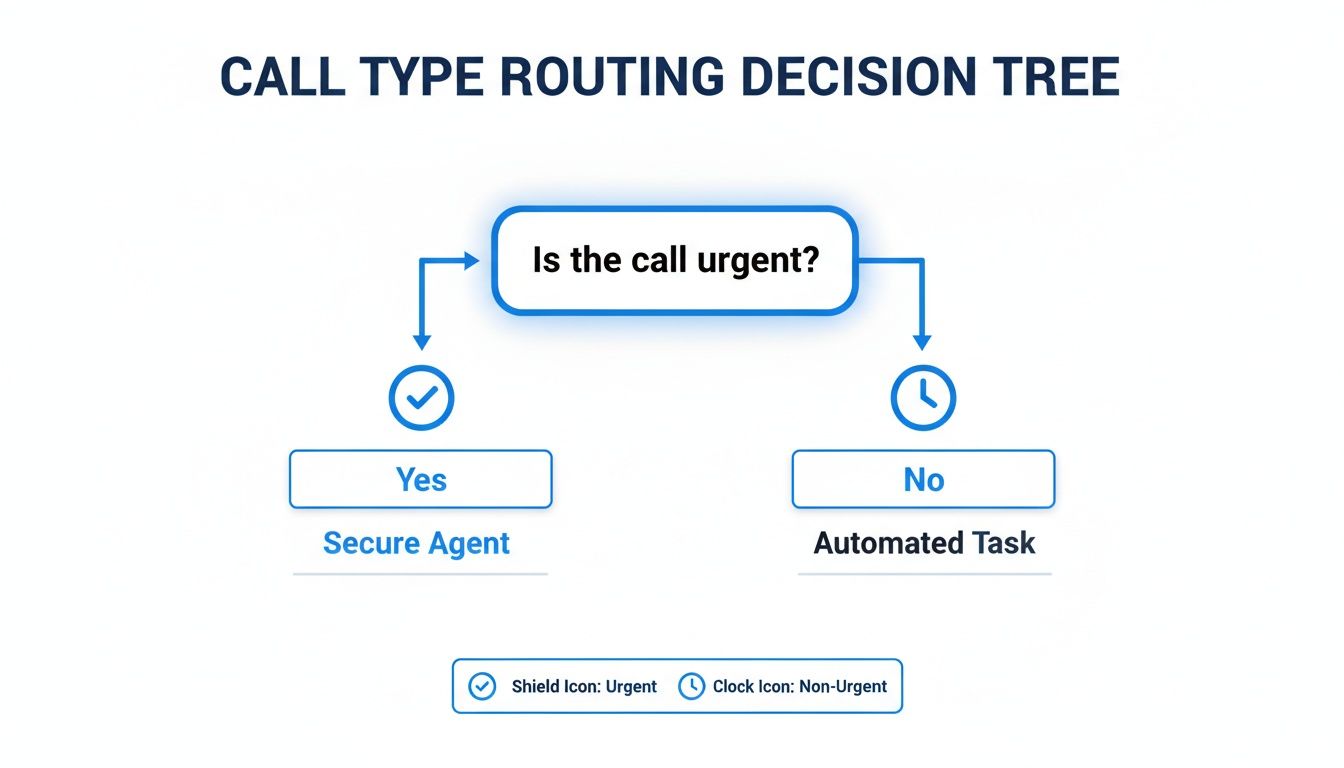
This intelligent routing is the key. A specialist service instantly identifies an urgent client need and gets it to a trained agent, while routine inquiries can be handled automatically. A generic service treats every call the same.
The Specialist Approach: Blending Expertise with Technology
This is where a specialized financial answering service comes in. It combines the 24/7 availability and cost savings of an outsourced model with the deep industry knowledge you'd expect from a top-tier in-house team member.
Think of it as the best of both worlds. You get a team of professionals who are already trained in financial terminology and compliance, backed by technology that ensures no call is ever missed and every lead is properly qualified. It's the only model designed from the ground up to both protect your firm and help it grow.
To help you see the differences clearly, here’s a direct comparison of your options.
Answering Service Options Compared for Financial Firms
This table breaks down the key attributes of each model to help guide your decision.
When it's all laid out, the choice becomes clearer. Opting for a financial answering service isn't just about finding someone to pick up the phone. It's an investment in a system that protects your firm, elevates your client service, and actively contributes to your bottom line.
The Tangible ROI of a Specialized Answering Service

It’s easy to get lost in features, but when it comes to any business decision, there's only one question that really matters: what’s the return on investment? With a financial answering service, the ROI isn't just a number on a spreadsheet. It’s a direct, measurable boost to your firm's revenue, efficiency, and ability to grow. This is where the conversation stops being about cost and starts being about opportunity.
Forget abstract benefits. Let’s talk about the real dollars and cents. The value you get from a specialized service boils down to three powerful outcomes: capturing high-value leads you’re currently missing, slashing major operational costs, and radically improving the quality of prospects your advisors spend their time on.
Capture More High-Value Leads
Every single call that hits your voicemail is a gamble. In the world of finance, where timing and trust are everything, most potential clients won’t leave a message and wait. They’ll just hang up and call the next firm on their list. A specialized answering service makes sure that never happens, turning what would have been a missed call into captured revenue.
Practical Example: The Lost Mortgage Applicant
Let's say your firm makes an average commission of $5,000 from a new mortgage. If a specialized service helps you land just one extra mortgage client per month—someone who would have otherwise been lost to a competitor after hours—that’s an immediate $60,000 in new annual revenue.
This isn't about simply having someone pick up the phone. It's about securing high-stakes opportunities the second they appear. For a wealth management firm, where a single new client might bring in hundreds of thousands in assets, the ROI from capturing just one of those calls is enormous.
Achieve Significant Cost Savings
Hiring a full-time, in-house receptionist carries a surprisingly hefty price tag. It's not just the salary. Once you add in benefits, payroll taxes, training, and paid time off, that one hire can easily cost you over $60,000 a year. A specialized service, particularly one with a hybrid AI model, gives you far better coverage for a fraction of that cost.
Here's how it works: A hybrid service uses automation for routine tasks and call routing, which it does flawlessly, while human agents handle more complex conversations. This setup makes a hybrid financial answering service up to 80% more cost-effective than a full-time employee. You get 24/7/365 coverage without paying for sick days, vacation time, or the headaches of employee turnover.
This efficiency is why the market for Contact Center as a Service (CCaaS) is projected to reach $30.15 billion by 2034, and why conversational AI is on track to become a nearly $50 billion industry by 2031. Companies are trying to manage more calls without letting costs spiral out of control, especially when the average call costs between $2.70 and $5.60.
Improve Lead Quality and Advisor Efficiency
Your advisors' time is their most precious resource. You want them focused on what they do best: building relationships and closing deals with qualified prospects. They shouldn't be wasting their days chasing down vague voicemails or talking to people who aren’t a good fit for your firm. This is where an intelligent service delivers its most strategic value.
A generic answering service might scribble down, "John Smith called." A specialized financial service, on the other hand, delivers a fully qualified lead right to your desk.
See the Difference in Action:
- Generic Message: "Call from Sarah. Wants to talk about investments."
- Qualified Lead: "Sarah Jones, new prospect. Confirmed she has over $250,000 in investable assets and is specifically interested in retirement planning. She has been booked for a consultation on Thursday at 2 PM."
That level of detail is a game-changer. It means your advisors only spend time with high-intent, high-value prospects. This shortens the sales cycle, skyrockets conversion rates, and frankly, makes your team’s job a lot more rewarding. By filtering out the noise, a financial answering service directly improves your cost per lead. To dive deeper into that metric, check out our guide on how to calculate cost per lead.
Your Practical Implementation Checklist
Picking the right financial answering service is a great start, but how you bring it on board is what really makes the difference. A smooth rollout isn't about navigating a technical maze; it's all about smart, upfront planning.
Think of this as your roadmap. We've broken down the process into four straightforward stages to help you integrate your new service without disrupting your firm. Getting this right from the start means less headache later and a much faster return on your investment.
Stage 1: Define Your Primary Goals
Before you touch any settings or write a single script, you need to know what "success" looks like. What problem are you actually trying to solve? Are you trying to stop leads from slipping through the cracks after hours? Or maybe you need to free up your administrative team from a constant barrage of calls.
Your specific goals will guide every other decision you make.
Practical Examples of Goals:
- For a mortgage brokerage: "Capture and qualify at least 5 new mortgage inquiries per week that come in after 6 PM or on weekends."
- For a wealth management firm: "Ensure all inbound calls from prospects with over $250k in investable assets are booked directly into a senior advisor's calendar."
- For an accounting firm during tax season: "Automate appointment booking for tax prep services to reduce administrative call time by 75%."
Having these clear, measurable targets gives you a yardstick for success and ensures the service is set up to solve your biggest challenges first.
Stage 2: Script Key Scenarios and Call Flows
Your answering service acts as the front door to your business, so the agents need a playbook. This means thinking through your most common calls and scripting the ideal conversation from start to finish. What questions do people ask? What information do you need to collect? What's the next step?
This isn't just about feeding them lines; it's about creating a consistent, professional experience that builds immediate trust with every single caller.
Actionable Tip: Map out detailed scripts for at least three core scenarios: a brand-new prospect, a current client with a standard question, and a current client with an urgent problem. For instance, a script for a "rollover inquiry" should guide the agent to get the caller's contact details, ask what type of account they're looking to move, and then schedule a discovery call directly on an advisor's calendar.
Stage 3: Map Out Compliance and Technology Needs
With your goals and scripts ready, it’s time to tackle the technical and regulatory details. First, make a definitive list of all the compliance standards you operate under, whether it’s FINRA, SEC, or specific data privacy laws. This list is non-negotiable and your provider must be able to meet every requirement.
At the same time, identify every piece of software the service needs to talk to. We're talking about your CRM, calendar apps, or any other tool that's part of your daily grind. This is what turns an answering service from a simple message-taker into a true automation powerhouse. If you're new to the concept, our guide explains what CRM integration is and why it's so vital for financial firms.
Stage 4: Onboard and Train Both Teams
The final piece of the puzzle is getting everyone on the same page. First, prep your internal staff. Walk them through how the new service will work, who gets the escalated calls, and how leads will be passed along. A smooth launch hinges on your team understanding the new workflow.
But it goes both ways. You also need to train the answering service agents on what makes your firm unique. They need to understand your value proposition so they can communicate it effectively. This is what elevates them from being a generic operator to a knowledgeable ambassador for your brand.
Frequently Asked Questions
It’s smart to have questions when you're thinking about bringing on a new service, especially in finance. You need to be certain any partner you work with can handle your clients' needs with the right mix of security, skill, and professionalism. Let’s tackle some of the most common questions we hear from firms just like yours.
How Is My Clients' Sensitive Financial Data Kept Secure?
This is, without a doubt, the most important question on the table. Real security isn't just a promise; it's built into every single action the service takes. It starts with things like end-to-end encryption, which scrambles all call data from the moment it’s picked up until it lands securely in your system.
But it goes much deeper than that. The best services train their agents on strict, finance-specific data protocols.
Practical Example: An agent is helping a client update their information. Instead of the agent asking for the full account number, the secure system asks the client to verify themselves by entering the last 4 digits of their SSN on their keypad. The data is encrypted and verified without the agent ever seeing or hearing the sensitive information, dramatically reducing risk.
Can An AI Really Handle Complex Financial Conversations?
That's a fair question, but it’s based on a common misunderstanding of the AI's role. A modern financial answering service uses a hybrid approach. The AI is not there to give financial advice—it’s there to clear the decks so your human experts can shine.
Think of the AI as a brilliant front-desk coordinator. It expertly handles the routine stuff, like booking appointments or answering basic questions about your location or services.
Here's a practical example:
A caller says, "I have a question about my 401(k) rollover." The AI immediately flags this as a complex issue needing a licensed professional. It then instantly routes the call to a trained human agent and provides them with all the context, so the client never has to repeat themselves. The system ensures simple tasks are automated flawlessly, while serious conversations get the human expertise they deserve.
How Difficult Is The Setup Process?
Getting up and running is much easier and faster than most people think. A good provider won't just hand you a login and wish you luck. The entire process is guided, designed to take the technical burden off your shoulders.
You’ll typically work with an onboarding specialist who walks you through everything.
- Crafting call scripts that sound like you.
- Defining how to escalate urgent matters.
- Connecting the service directly to your CRM and calendars.
Because these services are built to integrate, appointments can get booked into your calendar automatically from day one. Call summaries will pop up in your client records without anyone on your team lifting a finger. The goal is to get you seeing a return in days, not weeks.
Ready to see how an AI-powered service can protect your firm and capture more opportunities? Recepta.ai combines 24/7 AI efficiency with expert human oversight to deliver a secure, compliant, and cost-effective solution for financial professionals. Start your 30-day risk-free trial today.