
HIPAA Compliant Answering Service: A Complete Guide 2026
The practice manager usually notices the problem first. The phones spike at lunch, staff are rooming patients, a late caller needs to reschedule, and an after-hours voicemail includes medication details that never should have sat in an unsecured inbox. At that moment, the question isn't whether your office needs help answering calls. It's whether the help you choose can handle protected health information without creating a compliance mess.
A HIPAA compliant answering service has to do more than sound professional. It has to fit your workflow, protect patient trust, and stand up to scrutiny when a vendor says, “Yes, we're compliant.” In real evaluations, that's where many practices get into trouble. They buy on friendliness, price, or availability, then discover the vendor won't sign a BAA, can't explain access controls, or treats training as a one-time onboarding video.
The safer approach is to verify every claim. That means checking the legal foundation, the technical safeguards, the human protocols, and the service agreement language before any call is routed. If you're comparing vendors for a clinic, specialty group, dental office, or medical practice, this is the standard that keeps call coverage from becoming a liability.
Why Your Practice Needs a HIPAA Compliant Answering Service
A busy clinic can experience a subtle loss of communication control. One front-desk employee leaves for the day. Another is tied up with check-ins. The physician is still seeing patients. Calls start rolling to voicemail, and callers leave details about symptoms, prescriptions, referrals, and insurance issues. Operationally, that's frustrating. From a privacy perspective, it can be dangerous.
The urgency is higher now because the breach environment keeps getting worse. Data compromise in the U.S. reached a historic record in 2025, with the number of reported incidents rising 4% from the total recorded in 2024, according to the HIPAA Journal, as cited by Nextiva's overview of HIPAA-compliant answering services. That's why secure call handling isn't just a convenience purchase. It's a risk-control decision.
Consider a common after-hours scenario. A pediatric practice forwards evening calls to a generic answering line. The operator writes messages in a basic dashboard, texts a provider from a personal phone, and leaves enough detail in plain language for anyone with access to read. Nothing about that workflow feels unusual until you ask where the PHI traveled, who could see it, and whether anyone can prove what happened later.
Practical rule: If an answering service touches patient details, it has to be treated as part of your compliance perimeter, not as a simple overflow vendor.
A properly structured service helps in two directions at once. It reduces missed calls and gives patients a live response when your team is unavailable. It also creates a safer path for appointment requests, message taking, and urgent escalations that shouldn't move through consumer tools.
For many practices, the first step is recognizing that “someone answering the phone” and “a compliant communications partner” are not the same thing. If you're reviewing options for medical office answering workflows, look at the service through the same lens you'd use for any other vendor with access to patient information. The call flow matters. The compliance posture matters more.
Core Legal and Technical Requirements Explained
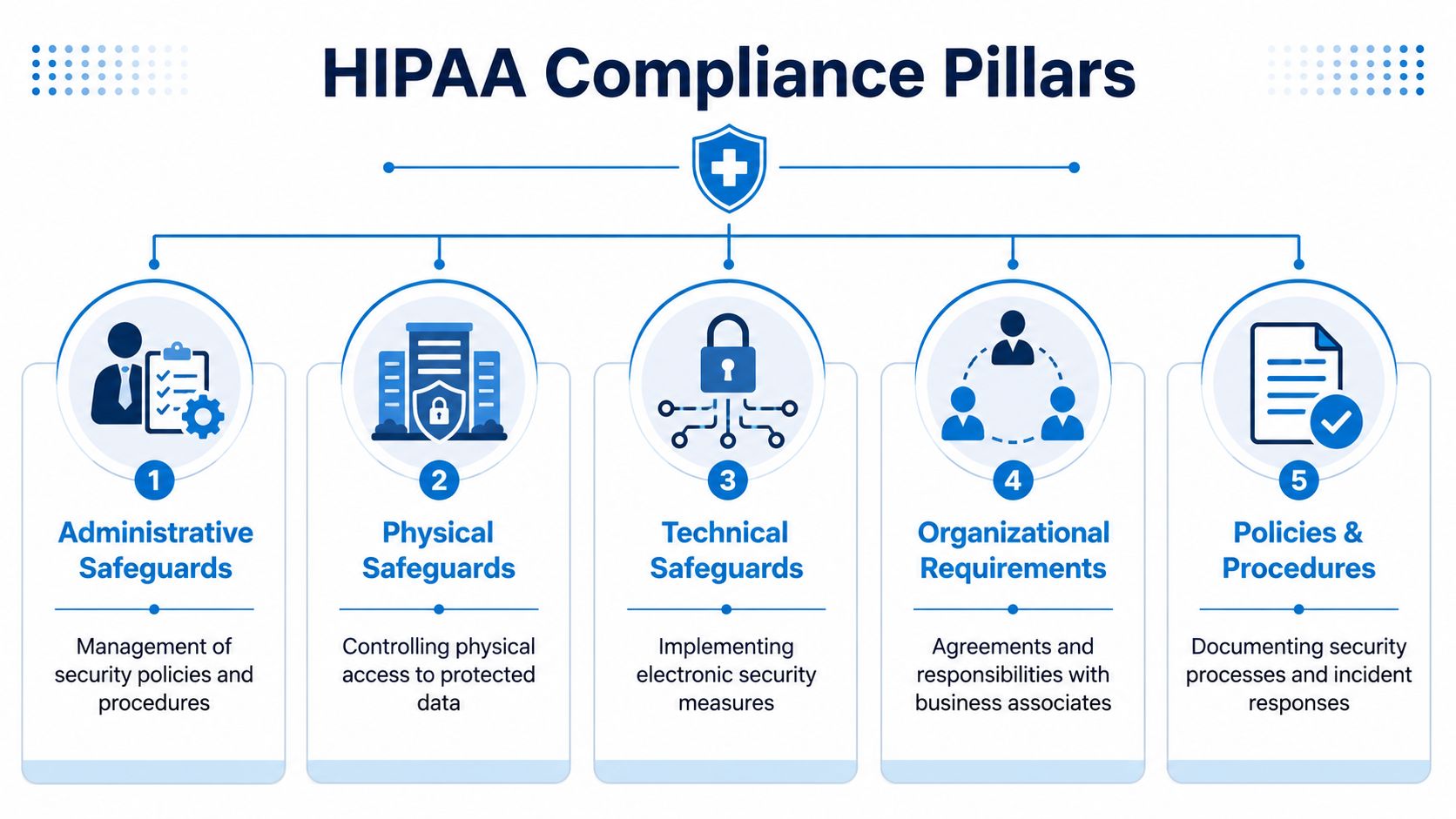
Most vendors make compliance sound simple. It isn't. A HIPAA compliant answering service needs a legal framework, a secure technical stack, and documented controls that match how patient information moves through the service.
Start with the BAA
The Business Associate Agreement, or BAA, is the mandatory foundation. A HIPAA-compliant answering service must execute a signed BAA that legally binds the vendor to protect PHI across creation, receipt, maintenance, and transmission. It's a core regulatory requirement, not an optional badge, as explained in Accountable's guide to HIPAA-compliant phone answering for healthcare practices.
Without that signed agreement, the rest of the vendor's pitch doesn't solve the legal problem. They can talk about secure systems all day. If they won't sign the contract that defines their responsibilities, your practice should stop the conversation there.
Think of the BAA as the blueprint for a secure facility. If the blueprint doesn't exist, you don't know who's responsible for locks, alarms, visitor logs, or incident handling.
The technical controls that matter
Once the BAA is in place, ask how the system protects PHI in practice. The strongest answers are specific and operational.
- Encryption in transit and at rest: Compliant services must use end-to-end encryption to protect PHI during transmission and storage.
- Access controls: Staff shouldn't be able to see everything by default. The vendor should restrict access based on role.
- Audit trails: The system should track interactions so your practice can review who accessed information and when.
- Secure messaging paths: Message relay to your team should happen inside controlled, protected tools rather than personal texting apps.
The secure facility analogy works well here. Encryption is the vault door. Access controls are the badge readers. Audit logs are the camera footage that lets you reconstruct exactly what happened.
If a vendor answers technical questions with “our platform is secure” but can't describe how access is restricted or logged, treat that as a weak answer.
Don't ignore organizational controls
A compliant service also needs operational discipline behind the software. The staff handling calls need HIPAA knowledge, the company needs documented policies, and incident handling can't be improvised.
A quick review table helps separate strong vendors from weak ones:
| Area | Strong answer | Weak answer |
|---|---|---|
| BAA | Signed before go-live, covers PHI handling responsibilities | “We can discuss that later” |
| Encryption | Explains protected transmission and storage clearly | “Our vendor handles security” |
| Access | Role-based access with managed permissions | “Our team is small, so everyone's trusted” |
| Auditability | Logs user actions and message handling | “We can usually look things up” |
Practices that operate across jurisdictions or maintain strict retention policies may also benefit from comparing the vendor's documentation against broader governance standards such as AITS' Saskatchewan HIPA guidelines. The legal framework is different, but the discipline around retention, responsibility, and controlled data handling is useful when reviewing a vendor's maturity.
If your service includes recorded calls or stored voice data, review your call recording compliance obligations at the same time. Recording introduces another layer of risk if the storage, access, or disclosure rules aren't handled carefully.
Training and Protocols Your Answering Service Must Have
Technology doesn't stop most bad call-handling decisions. People do. That's why staff training is one of the clearest dividing lines between a real HIPAA compliant answering service and a generic call center using healthcare marketing language.
Every receptionist on a HIPAA-compliant virtual answering service team must be trained and certified in HIPAA protocols, with training that is regular, clearly documented, and up-to-date to ensure they understand common breach scenarios and how to avoid them. This training is a mandatory safeguard that distinguishes a compliant service from a standard one, according to WellReceived's discussion of HIPAA-compliant answering services.

What good training looks like
Ask the vendor to describe the actual scenarios they train for. Good programs go beyond policy summaries and cover live call behavior.
For example, an agent should know how to:
- Verify identity before discussing PHI: The script should require approved verification steps before any medical detail is disclosed.
- Limit the conversation: The operator should collect only what is necessary for the message or task.
- Handle urgency correctly: Calls involving symptoms, on-call escalation, or medication concerns need predefined routing rules.
- Avoid side-channel disclosures: Agents shouldn't leave overly detailed voicemails or send sensitive information through unsecured messaging.
A practical example: a caller says, “I'm checking on my spouse's biopsy result.” A trained agent doesn't improvise. The agent follows the script, verifies authority using approved steps, and routes the request according to the practice's rules. An untrained agent may try to be helpful and create a reportable problem.
What to ask for during review
You don't need a lecture from the vendor. You need proof.
Ask for:
- Training records: Documented completion dates and refresh cycles.
- Script samples: Identity verification and message-taking scripts.
- Escalation protocols: How after-hours urgent calls are classified and routed.
- Incident response steps: What an agent must do if they suspect an improper disclosure.
A vendor's agents represent your office to patients. If they can't verify identity consistently, they can't safely function as an extension of your front desk.
Some practices compare these services against a virtual medical receptionist model because the workflows overlap. That's useful, but the compliance test should stay stricter. In healthcare, warmth and efficiency matter. Script discipline matters more when protected information is involved.
How to Vet and Choose a Compliant Vendor
Most practices ask vendors the wrong questions. They ask whether the service is HIPAA compliant, whether it's available after hours, and whether it integrates with the calendar. Those questions are fine, but they're too easy to answer with polished sales language.
A better process forces the vendor to prove compliance.
The six questions that surface real risk
Use these in live vendor meetings and ask for written follow-up.
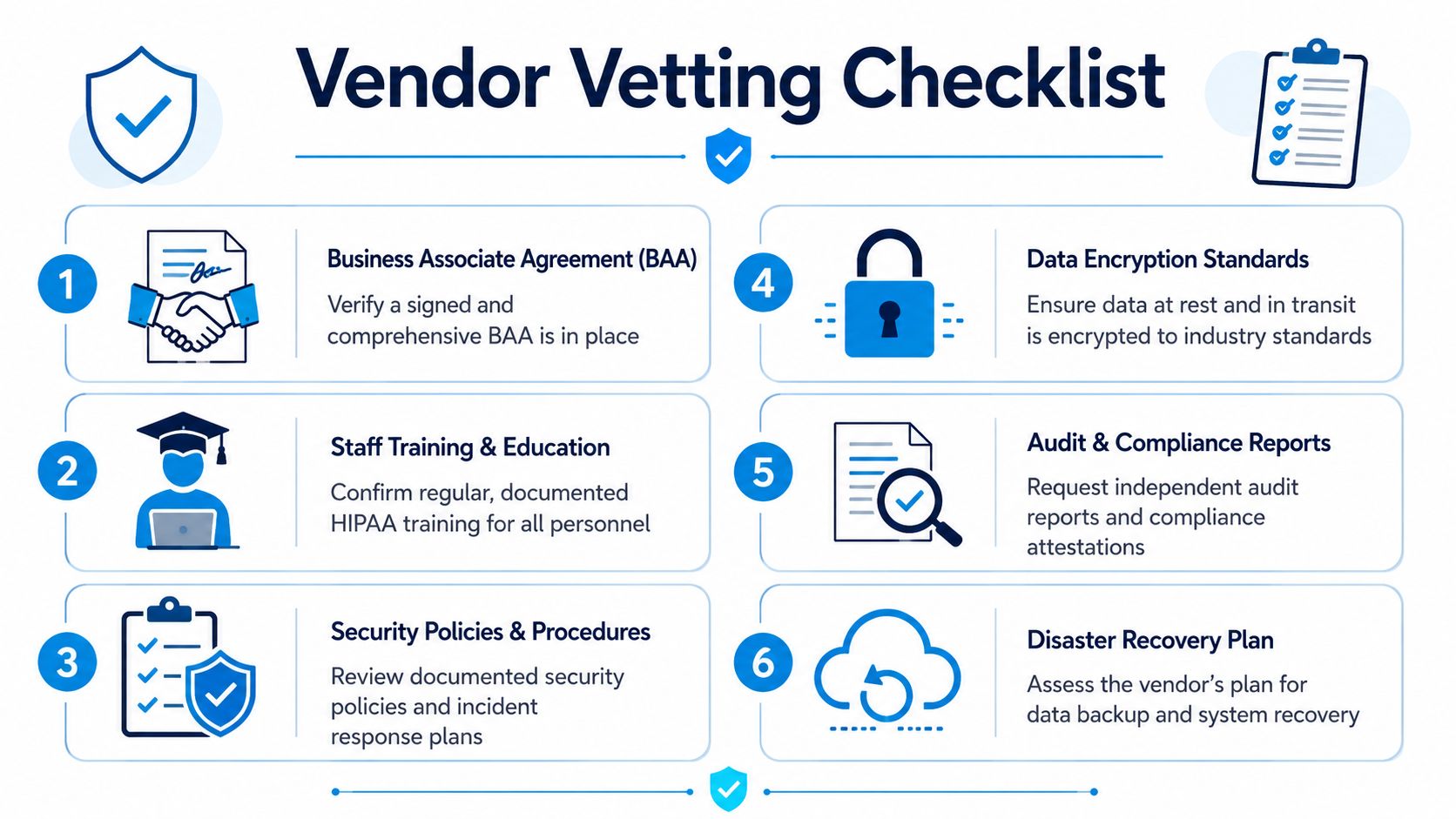
Will you sign a BAA before implementation begins?
Strong answer: yes, and they provide a draft early.
Weak answer: they delay, deflect, or treat the BAA as optional paperwork.How is PHI protected while messages are sent, stored, and accessed?
Strong answer: they describe controlled systems, encryption, and restricted workflows.
Weak answer: “our software is secure” with no detail.Who can access our patient messages, and how is that access controlled?
Strong answer: role-based permissions, managed access, documented review.
Weak answer: all supervisors or all agents can see the same information.How do you train agents to verify caller identity and avoid improper disclosures?
Strong answer: documented scripts, recurring training, supervisory review.
Weak answer: “our staff knows HIPAA.”What happens if there's a suspected privacy incident?
Strong answer: written escalation path, internal investigation process, client notification procedure.
Weak answer: no defined workflow.How do you handle service continuity during outages, staffing disruptions, or emergencies?
Strong answer: backup procedures, message continuity, documented recovery planning.
Weak answer: they haven't thought through failure scenarios.
Compare proof, not promises
A lot of practices create a simple scorecard. That works well if you keep it practical.
| Review point | Ask for | Red flag |
|---|---|---|
| BAA readiness | Draft agreement | “Legal will decide later” |
| Staff training | Dates, records, scripts | Vague verbal assurance |
| Security controls | Written description of access and message handling | Marketing brochure only |
| Incident handling | Escalation workflow | No named process |
| Recovery planning | Backup and continuity summary | “We haven't needed it” |
This is also the right stage to assess vendors beyond healthcare-specific branding. A company may have polished call flows and good integration options, but if it can't support your legal and security review, the fit isn't there. In broader evaluations of virtual receptionist companies, some platforms may offer scheduling, message capture, and escalation features that look attractive operationally. Recepta.ai, for example, offers AI receptionist workflows with human escalation and healthcare-relevant messaging capabilities. That may suit some practices, but the same standard still applies. Ask for the BAA, security documentation, and training proof before you treat any platform as a serious option.
A practical vetting workflow
Use a staged review instead of one demo call.
- Stage one: Eliminate any vendor that won't sign a BAA or won't answer security questions.
- Stage two: Review scripts, escalation logic, and after-hours workflows with your operations lead.
- Stage three: Send contract language to legal and confirm notification, return-of-data, and access terms.
- Stage four: Test with real scenarios such as appointment cancellation, urgent symptom escalation, and spouse-calling-on-behalf-of-patient.
The vendors worth hiring usually welcome this process. The ones that resist it often reveal why.
Key Contract Clauses to Request from Your Vendor
A compliant service agreement shouldn't rely on assumptions. If a vendor says the right things on a demo call, get those promises into the contract. Failing to do so leaves many practices exposed. They sign the BAA, accept the master service agreement as-is, and assume the rest will sort itself out.
It often doesn't.
Clause areas worth negotiating
Three areas deserve close attention: incident notification, data control, and responsibility after termination. If those terms are vague, your practice may learn about a problem too late or struggle to retrieve patient-related records cleanly.
If you want a useful reference point for service agreement structure before sending edits to counsel, this guide to a secure IT service agreement is a helpful comparison. It isn't healthcare-specific legal advice, but it shows the level of clarity practices should expect when a vendor handles sensitive information.
Copy-ready language to send to the vendor
You can email language like this to start the conversation with the vendor and your attorney.
Incident notice clause
Vendor will notify Client without unreasonable delay upon discovery of any suspected or confirmed unauthorized access, use, or disclosure involving Client data or Protected Health Information. Such notice will include the known facts, affected systems or workflows, immediate containment actions taken, and the Vendor point of contact for ongoing coordination.
Data return and deletion clause
Upon termination of services, Vendor will return Client data in a reasonably usable format and will discontinue access by Vendor personnel except as required to complete return, secure deletion, or legal retention obligations set forth in the agreement and applicable law.
Access and subcontractor clause
Vendor will restrict access to Client data to workforce members and authorized service providers with a legitimate business need, documented security obligations, and training appropriate to their role. Vendor will remain responsible for ensuring that any approved subcontractor handling Client data is bound by written obligations consistent with the agreement and applicable privacy requirements.
What good contract language does in practice
These clauses solve real operational problems. If the relationship ends, your practice knows how data comes back. If a privacy issue occurs, the vendor can't sit on it while figuring out internal communications. If they use outside providers, responsibility stays visible instead of disappearing into subcontractor chains.
One practical move that pays off is asking the vendor to mark up your requested language in writing rather than discussing it only on calls. Their edits tell you a lot. Vendors with mature compliance operations usually respond precisely. Vendors with weak controls tend to retreat into generalities.
Avoiding Common HIPAA Answering Service Pitfalls
The most expensive mistakes usually start with language that sounds reassuring. “HIPAA-friendly.” “HIPAA-ready.” “Built with compliance in mind.” None of that is a substitute for documented safeguards and a signed BAA.
The first myth to drop is the idea that a vendor is safe because it markets itself as certified or compliant in broad terms. What matters is whether the service can prove the legal, technical, and operational controls your practice needs. If the evidence isn't there, the label doesn't help.
The mistakes I see most often
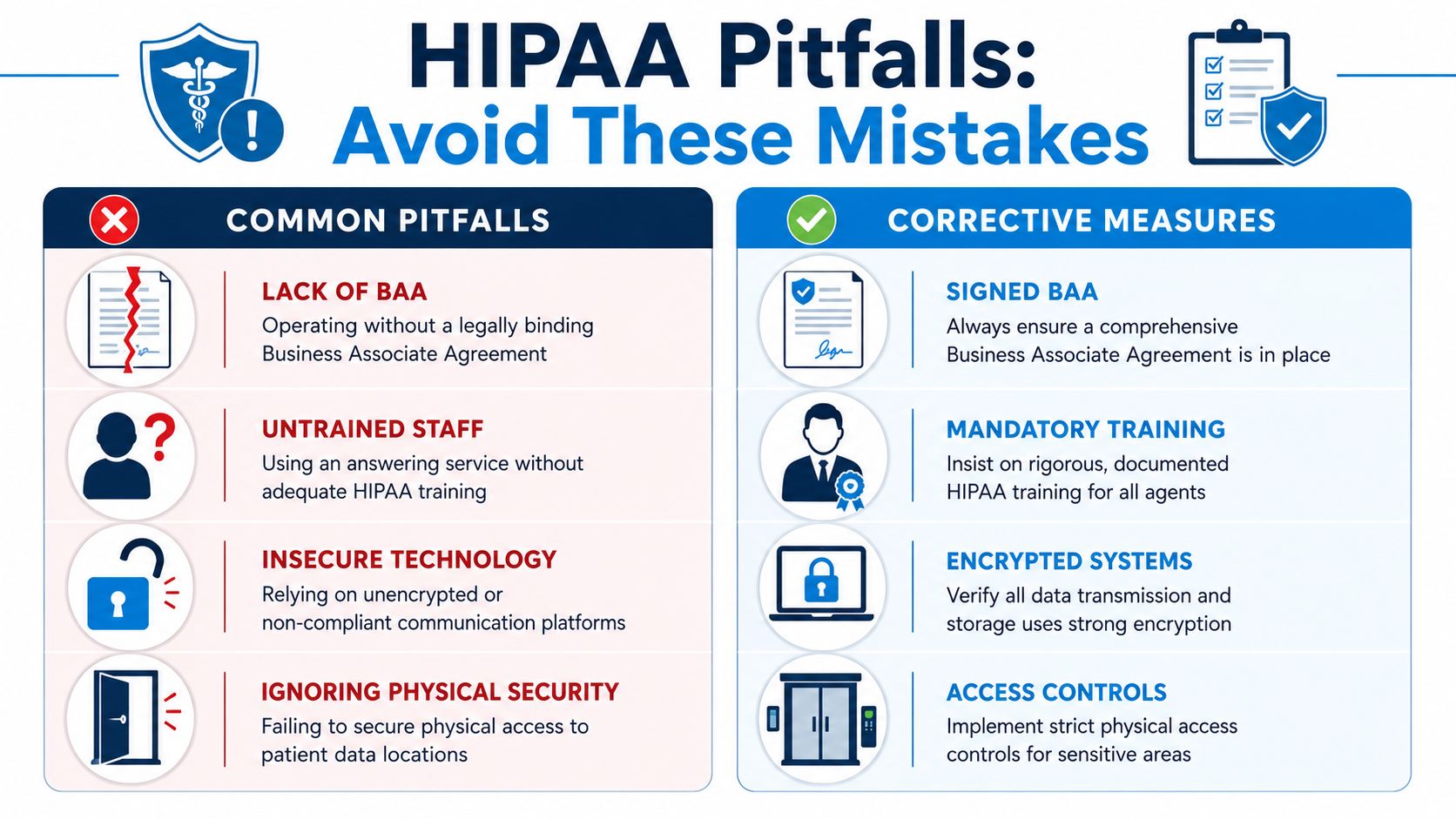
- Choosing a vendor without a signed BAA: This is the fastest way to turn outsourced call handling into a compliance problem.
- Assuming good software means good process: Secure tools don't fix weak scripts, poor identity verification, or sloppy escalation.
- Ignoring physical security: Ask where agents work and how access to systems and workspaces is controlled.
- Allowing unsecured side channels: Personal phones, consumer texting apps, and informal workarounds create unnecessary exposure.
- Never testing incident handling: If the vendor has a response plan, run a tabletop scenario and see whether it proves effective.
What to do instead
Challenge every vague claim. Ask the vendor to show exactly how calls are documented, messages are relayed, and access is restricted. Ask what an agent does when a family member requests information. Ask how a lost device, misdirected message, or suspicious login is handled.
The safest vendors don't rely on marketing phrases. They rely on documented procedures, limited access, and repeatable staff behavior.
A practical example helps here. If a vendor says, “We can text your on-call provider directly,” ask whether that text contains PHI, what platform carries it, and who can access it later. That one follow-up question often exposes whether the workflow is disciplined or improvised.
Securing Your Communications and Your Practice
A HIPAA compliant answering service is not just a scheduling convenience with nicer scripts. It's part of the system your practice uses to protect patient information, maintain continuity, and respond reliably when the front desk can't.
The standard is clear. To qualify as HIPAA-compliant, an answering service must legally execute a Business Associate Agreement that outlines the creation, receipt, maintenance, and transmission of PHI. Compliant services must also use end-to-end encryption, access controls, audit trails, and trained staff with specific knowledge of HIPAA privacy and security rules, as described in OnPage's guide to HIPAA-compliant answering services.
That combination matters because security failures rarely stay in one lane. A weak contract leads to unclear responsibility. Weak controls lead to avoidable exposure. Weak training leads to the wrong person hearing the wrong thing at the wrong time.
The practices that choose well usually do three things consistently:
- They verify the BAA before onboarding
- They test workflows instead of trusting demos
- They negotiate service terms that define notice, access, and data handling clearly
They also think beyond live calls. Device disposal, archived recordings, and hardware turnover can all touch the same compliance ecosystem. If your office is updating workstations, phones, or storage media, resources such as Beyond Surplus for compliant electronics can help frame the end-of-life side of protecting sensitive information.
A careful vendor choice does more than reduce liability. It gives patients a dependable point of contact, supports staff during peak call periods, and protects the reputation your practice has worked hard to build.
If you're evaluating a HIPAA compliant answering service and want a platform that combines AI call handling with human escalation, Recepta.ai is one option to review. Ask for the BAA, inspect the workflows, and make sure the system fits your practice's privacy requirements before you route a single patient call.