
The Ultimate Guide to Virtual Medical Receptionist Services

So, what exactly is a virtual medical receptionist? Think of it as a smart, remote front-desk service that blends conversational AI with skilled human support. It becomes a seamless extension of your team, ready to handle calls, book appointments, and gather patient details 24/7, long after your physical office has closed for the day. For example, when a parent needs to book a sick child visit at 10 PM, they're not met with a voicemail box but can schedule a real appointment for the next morning.
How a Virtual Medical Receptionist Modernizes Your Front Desk
Picture your front desk not as a physical counter, but as a digital hub that’s always online. This hub is smart enough to manage hundreds of patient conversations at once, and no one ever gets put on hold. That’s the real power of a virtual medical receptionist. It's far more than a simple answering service that just jots down messages; it’s a fully integrated system built to be a true partner to your practice.
This approach breaks free from the old "one person, one call" bottleneck. It pairs the speed of advanced AI with the empathy and critical thinking that only a human can provide. With this hybrid model, routine stuff gets handled in seconds, while more complex or sensitive patient issues get the personal attention they deserve. For instance, a call to confirm an appointment time is handled by AI in under a minute, while a call from an anxious patient discussing symptoms is seamlessly routed to a live agent.
Beyond a Traditional Answering Service
The biggest difference comes down to two things: integration and capability. A standard answering service is basically a silo—it can take a message, but it can't actually book an appointment into your schedule or pull up a patient's record. A virtual medical receptionist, on the other hand, plugs directly into the software you already use.
- Direct System Integration: It syncs right up with your Practice Management (PM) or Electronic Health Record (EHR) system. This means it sees real-time availability and can book appointments with total accuracy. A practical example: it knows Dr. Smith doesn't see new patients on Fridays and will only offer slots on Monday to Thursday.
- Proactive Communication: It’s not just reactive. It can send out automated appointment reminders by text or phone, which is a proven way to cut down on no-shows—a huge drain on any practice's revenue. For instance, sending an SMS reminder 48 hours prior with a simple "Reply C to confirm" option.
- Intelligent Call Routing: It follows your specific rules to know the difference between a simple question and an urgent medical situation, making sure critical calls get to the right person, right away.
For example, a dental practice could have its virtual receptionist route an after-hours call about a cracked tooth straight to the on-call dentist’s cell. At the same time, a patient calling to book a routine cleaning can get it scheduled automatically, with the appointment popping up in the clinic’s calendar just moments later.
An Extension of Your Patient Experience
At the end of the day, this is all about making healthcare easier to access and creating a smooth journey for your patients, starting from that very first call. When every call is answered quickly and professionally, you're building trust and keeping patients happy. This focus on great communication is key in modern healthcare. In fact, learning how to improve the patient experience often begins by fixing these initial points of contact.
By making sure no call ever hits voicemail, a virtual receptionist guarantees that every single patient—whether new or returning—feels heard and taken care of. It turns a potential frustration into a positive first impression.
To get a better sense of how these communication tools work together, check out this ultimate guide to health care SMS. It explains how text messaging can work hand-in-hand with a virtual receptionist service. This kind of integrated approach helps your practice run at peak efficiency while delivering the responsive, accessible care that patients now expect.
What a Virtual Medical Receptionist Actually Does for Your Practice
Think of a virtual medical receptionist not just as a replacement for a person, but as a complete upgrade to how your front desk operates. It's a smart system designed to handle the core administrative work that often bogs down your staff, freeing them up for what really matters: patient care. The goal is to make sure every patient call is answered, every appointment opportunity is captured, and the daily workflow runs without a hitch.
A huge advantage here is that these systems are on the clock 24/7. This means your practice effectively never closes. You can catch those early-morning appointment requests, help the night-shift worker who can only call after midnight, or assist a parent with a late-night question. Calls that would have gone to a frustrating, full voicemail box are instead converted into scheduled, revenue-generating appointments.
Smart Scheduling That Syncs With Your Clinic
This is where a virtual medical receptionist really shines. It's not just a fancy answering service that takes a message. A true virtual receptionist plugs directly into your Practice Management Software (PMS) or Electronic Health Record (EHR) system. This live connection gives it real-time access to your doctors' calendars.
So, when a new patient calls to book their first check-up, the system knows that’s a 45-minute slot and books it accordingly, based on your clinic's rules. A few minutes later, a returning patient calls for a "quick follow-up." The AI understands this is a shorter visit and schedules a 15-minute slot. This kind of intelligence prevents the classic scheduling nightmare of mismatched appointment times, which can throw an entire day off schedule.
By getting the appointment length right every single time, a virtual receptionist keeps your clinical workflow predictable and efficient. No more frantic reshuffling by your staff.
Getting this right depends on having the right tools in place. To get a better feel for how these platforms operate, you can explore our complete guide on medical appointment scheduling software and see how they are the engine behind a great virtual reception setup.
Sorting Patient Calls: Triage and Smart Routing
Let's be honest: not all patient calls carry the same weight. A virtual medical receptionist is brilliant at telling the difference between a routine question and a genuine medical concern. You set the triage rules based on your practice's protocols, and the system follows them perfectly every single time. This ensures urgent calls get escalated instantly, while routine stuff is handled automatically.
This is a great visual of how a smart system routes patient calls—separating simple scheduling from urgent needs that require a human touch.
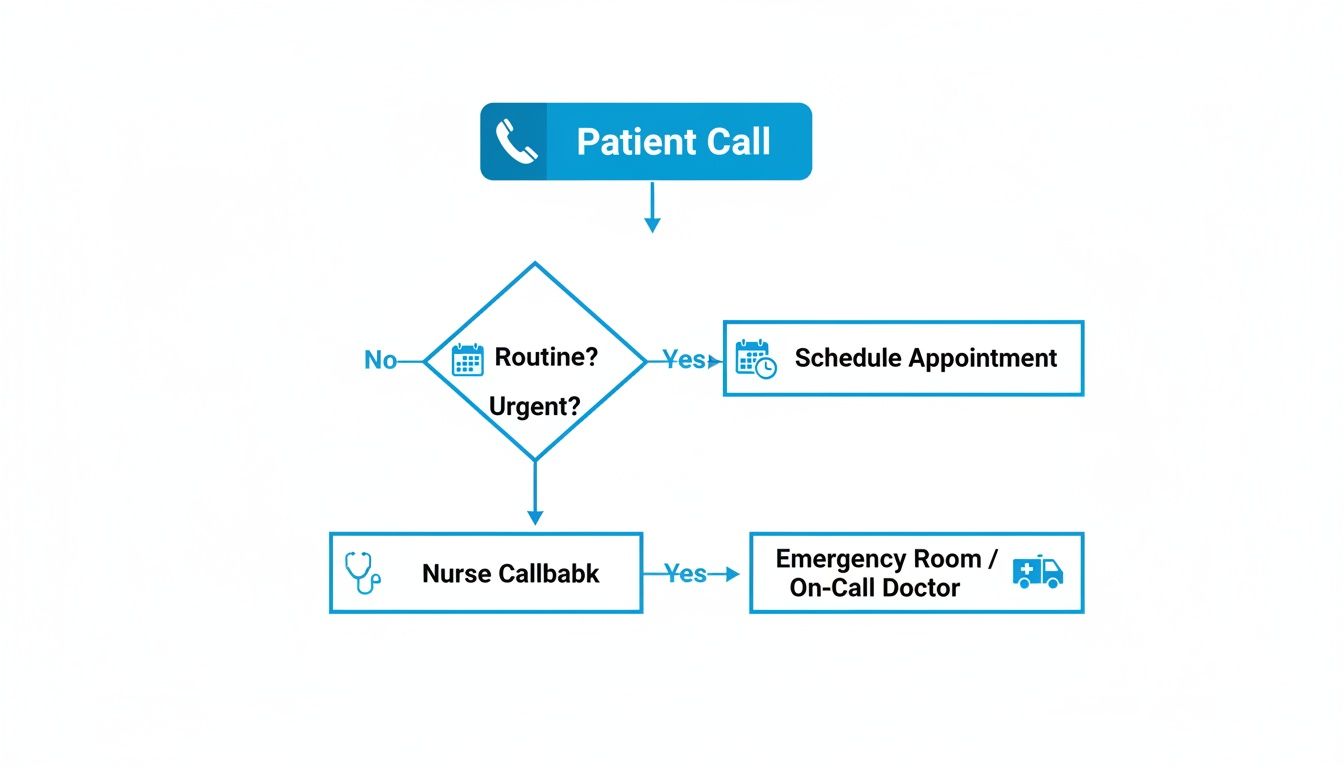
The flowchart really shows how automation can manage the standard requests, which frees up your staff to focus on patients who need them most.
Here’s how that works in the real world. Say a patient calls with, "I'm having severe pain and my jaw is swollen."
The AI is trained to pick up on those keywords. Instead of trying to book an appointment, it follows the urgent care protocol you've established:
- It calmly tells the patient, "I understand this is urgent. Please hold for a moment while I connect you with our clinical staff."
- The call is then immediately routed to the on-call nurse or dentist's direct line.
This isn't just efficient; it’s a critical patient safety feature. It shows your practice is responsive and professional from the very first interaction.
Cutting Down No-Shows with Automated Reminders and Digital Forms
We all know that no-shows are a major drain on revenue. A virtual receptionist tackles this head-on by sending automated appointment reminders via text or a friendly phone call. You can set these to go out at specific times, like 72 hours and 24 hours before the appointment, which dramatically reduces missed visits.
It also helps get rid of the pre-appointment paperwork jam. When a new patient books, the system can automatically send them a secure link to your digital intake forms. They fill out their medical history and insurance details on their own time, from their own phone or computer.
This simple step alone can save 10-15 minutes per new patient on check-in day. The result? No more lines at the front desk, your schedule stays on track, and the visit can be about healthcare, not filling out forms.
Maintaining HIPAA Compliance and Patient Data Security
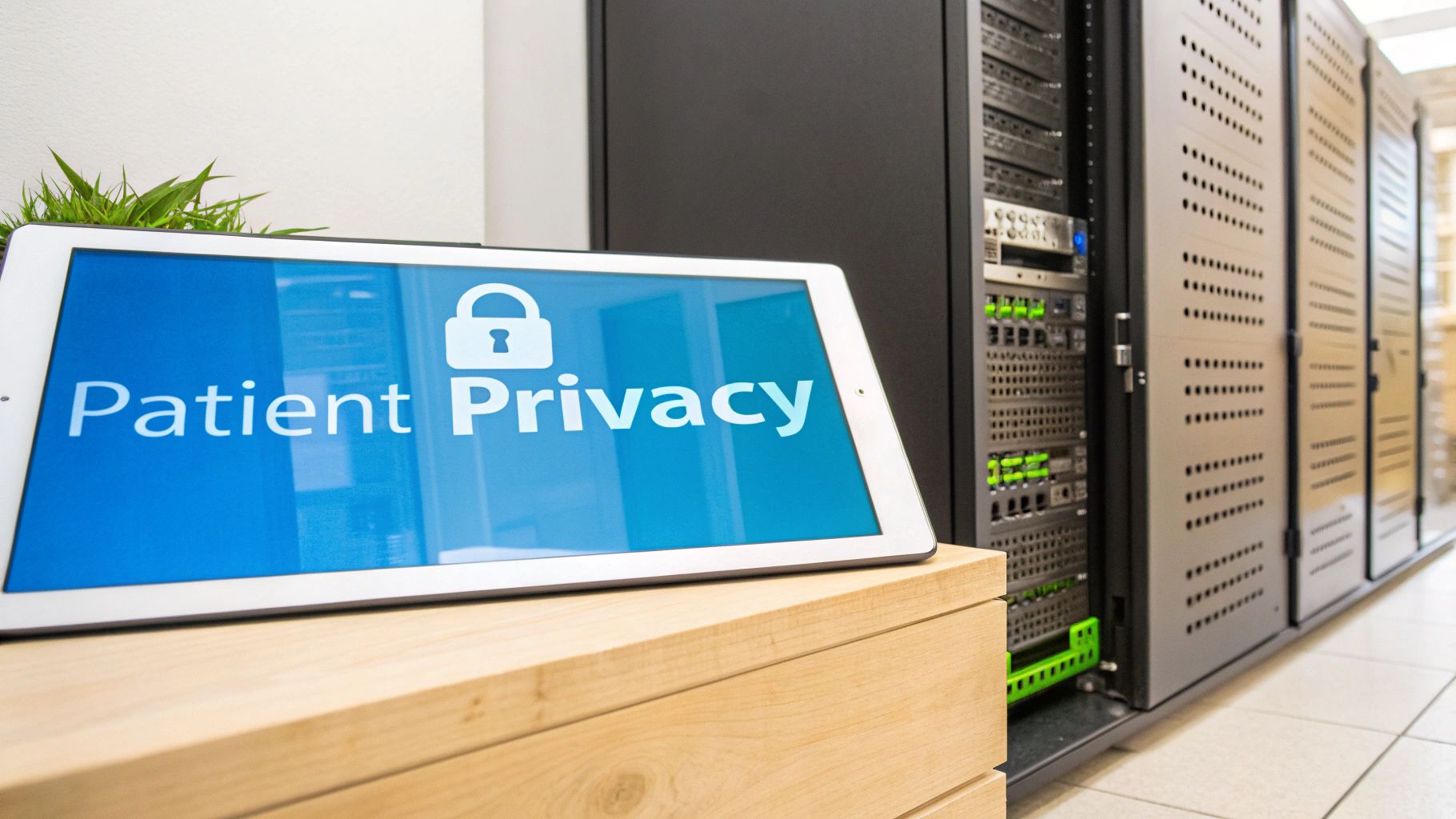
Bringing any new technology into a healthcare practice always starts with one big question: what about patient privacy? It's a valid concern, and when the technology handles patient calls and data, the stakes get even higher. A top-tier virtual medical receptionist service isn't just an add-on; it's built from the ground up with security at its core.
Think of it less like a simple software and more like a digital fortress designed specifically for healthcare. It’s not about having one lock on the door. It’s about layers upon layers of protection, all working in concert to safeguard Protected Health Information (PHI) and uphold the trust you’ve built with your patients.
The Role of Business Associate Agreements
One of the most crucial layers in that fortress is the Business Associate Agreement (BAA). This is a legally required contract under HIPAA that makes it crystal clear what a vendor's responsibility is when it comes to protecting PHI. Any virtual receptionist service worth its salt will have no problem signing a BAA with your practice. For example, the BAA ensures that the vendor is legally obligated to use encrypted servers and report any potential data breach, just as your own practice would be.
This agreement is your practice's documented proof that your vendor is just as committed to following HIPAA rules as you are. It's a non-negotiable step for any outside service that will ever come into contact with your patients' sensitive data.
Encryption: The Digital Armor for Patient Data
With a BAA signed and sealed, the next line of defense is end-to-end encryption. This is what acts like a sealed, armored truck for data as it moves between a patient, the virtual receptionist, and your internal systems. It essentially scrambles the information, making it completely unreadable to anyone who doesn't have the key.
Here’s how encryption works for you in the real world:
- During a Call: A patient calls to confirm an appointment and gives their date of birth. That voice data is encrypted both during the live conversation and when it's stored as a recording.
- Transmitting Data: A new patient gives their insurance information over the phone. When the virtual receptionist enters it, the data is sent to your EHR through a secure, encrypted connection, blocking any chance of it being intercepted.
- At Rest: Even when data isn't being actively used, all patient information—from call notes to appointment details—is kept in encrypted databases, protecting it from would-be intruders.
Creating a Secure Audit Trail
Security isn't just about preventing breaches; it's also about accountability. A truly secure virtual receptionist platform automatically creates an unchangeable audit trail for every single interaction. This is a meticulous log that tracks every action taken with patient data.
Think of the audit trail as a 24/7 security camera system for your data. It records who accessed what information, what they did with it, and exactly when they did it, giving you a transparent and defensible record.
For instance, if a patient's appointment gets rescheduled, the audit log will show the precise time of the call, the details of the request, and how the appointment was updated in your calendar. This kind of detailed logging is invaluable for resolving disputes, demonstrating compliance, and ensuring total peace of mind. To learn more about protecting patient data, check out this comprehensive guide to HIPAA compliance for healthcare providers.
How Different Medical Practices Win with Virtual Receptionists
It’s one thing to read about the features of a virtual medical receptionist, but it’s another to see how they actually work in a real clinic. This isn't a one-size-fits-all gadget; it's a flexible tool that adapts to solve the specific headaches that different practices face every single day.
Whether you're running a large group practice or you're a solo practitioner just starting out, the benefits are real and measurable. Let's walk through a few scenarios where a virtual receptionist becomes an absolute game-changer.
The Multi-Location Dental Group
Imagine a dental group that's expanded to five locations. Before, each office was an island, handling its own calls. The patient experience was a roll of the dice—sometimes a quick answer, other times straight to voicemail during a rush. New patient opportunities were definitely falling through the cracks.
By bringing in a centralized virtual medical receptionist, they created one unified front desk for the entire organization.
- Consistent Patient Experience: Now, every single call is answered with the same professional greeting, building a strong, reliable brand identity. A practical example: all calls are answered with "Thank you for calling BrightSmile Dental Group, how can I help you today?" regardless of which location the patient intended to reach.
- Centralized Scheduling: The virtual receptionist syncs with the group's practice management software, giving it a real-time view of appointment slots across all five offices. When a patient calls with a dental emergency, the system can instantly offer the very next opening at any location, making it far more likely they’ll keep that patient in their network.
- Streamlined Operations: This change frees up the in-office staff to focus completely on the patients right in front of them—handling check-ins, taking payments, and coordinating care without constantly being interrupted by a ringing phone.
The result? A big organization suddenly feels personal and incredibly responsive, all while capturing revenue that used to just disappear.
The Solo Mental Health Therapist
For a solo therapist, time is everything. Your focus should be on providing care, but administrative busywork can easily hijack the day. Every minute spent on the phone scheduling a new client or chasing down intake forms is a minute you can't bill.
This is where a virtual receptionist makes a profound difference. It can automate the entire new client onboarding process. A potential client calls, the virtual receptionist answers their basic questions about services or insurance, and then books that initial consultation right into the therapist's calendar.
For a solo practitioner, a virtual receptionist isn't just a tool for convenience—it's a business partner that directly enables growth. It handles the administrative workload, allowing the therapist to focus exclusively on clinical care.
As soon as the appointment is booked, the system automatically sends a secure link to the client's digital intake forms. They can fill out their personal history and sign consents from the comfort of their own home, on their own time. That means the therapist walks into that first session with all the background information they need, making the meeting more focused and productive from the start.
The Busy Pediatric and Urgent Care Clinic
Pediatric and urgent care clinics operate in a state of organized chaos. They're dealing with a constant, high volume of calls, many from worried parents after hours. A virtual medical receptionist is built for this kind of demanding environment. You can learn more about how these systems support urgent care and walk-in clinics in our detailed guide.
During the day, it expertly juggles the flood of appointment requests and symptom questions, letting the front desk team manage a packed waiting room. After hours, it becomes a calm, reliable first point of contact. The system can process routine requests like prescription refills or follow physician-approved protocols to triage more serious calls.
For instance, a parent calling about a child's low-grade fever might get an automated text with pre-approved care instructions. But if a caller uses keywords like "difficulty breathing," the system knows to immediately escalate that call to the on-call pediatrician. Critical needs get addressed instantly, without delay.
This kind of adoption is part of a much larger trend in healthcare. The virtual receptionist market is on track to hit $9 billion by 2033, growing at a compound annual rate of 9.8%. You can dig deeper into these market trends and AI receptionist statistics on ResonateApp.com.
Calculating the Real ROI for Your Medical Practice
Bringing a virtual medical receptionist into your practice isn't just about modernizing your front desk—it’s a serious financial move. So, how does this actually affect your bottom line? To see the real return on your investment (ROI), you have to look past the monthly fee and focus on three crucial areas: direct cost savings, new revenue, and smarter, more efficient operations.
When you start to break down the numbers, you can build a solid business case and see how this technology doesn't just pay for itself, but often becomes a profit center. Let's walk through a simple way to calculate the true financial impact.

Direct Cost Savings
The easiest place to start is by comparing the cost of a virtual receptionist service to hiring a full-time, in-house employee. The average salary is just the tip of the iceberg. You also have to account for all the overhead that comes with having a person on staff.
- Payroll Taxes and Benefits: Think Social Security, Medicare, health insurance, and retirement plans. These can easily add 20-30% on top of a base salary.
- Paid Time Off: You're also paying for vacation days, sick leave, and holidays when the desk might not be fully covered.
- Recruitment and Training: Don't forget the time and money it takes to find, hire, and train a new team member.
When you stack up all those expenses against a predictable monthly subscription, the savings become obvious. Many clinics find they can get 24/7 phone coverage for a fraction of what it costs to staff the front desk for a standard eight-hour shift. For example, if a full-time receptionist costs $45,000 annually with benefits, a virtual service might cost $10,000 for even better coverage, resulting in a direct saving of $35,000.
Increased Revenue from Captured Opportunities
What happens when a potential new patient calls your office at 7 PM on a Tuesday? If that call goes to voicemail, it's usually a lost opportunity. A virtual medical receptionist is always on, making sure you capture every single inquiry, especially those that come in after hours or on weekends.
The ability to convert after-hours calls into booked appointments is one of the most powerful ROI drivers. Each new patient captured represents direct, measurable revenue that was previously being lost.
Imagine a small specialty clinic where the average new patient visit brings in $350. If a virtual receptionist books just three new appointments after hours each month, that’s an extra $1,050 in monthly revenue. For many practices, that alone is enough to cover the entire cost of the service.
This isn't a niche trend. The market for healthcare virtual assistants was valued at $1.7 billion in 2025 and is expected to skyrocket to $19.5 billion by 2035. You can discover more insights about this market growth on Research Nester.
Gains in Operational Efficiency
Finally, what's the value of giving your skilled staff their time back? When a virtual receptionist takes over routine calls, scheduling, and appointment reminders, your in-house team is free from the grind of repetitive administrative tasks. That reclaimed time can be put to much better use.
- Improved Patient Focus: Your team can give more personal attention to the patients right in front of them and handle complex billing or insurance questions without being interrupted by a constantly ringing phone.
- Reduced Staff Burnout: Taking mundane tasks off their plate is a huge step in reducing the administrative burden that leads to burnout in so many healthcare roles.
- Fewer No-Shows: Automated reminders are a simple but effective way to protect your revenue stream. If missed appointments are a problem, you can learn how to reduce no-show appointments in our detailed guide and see the immediate financial benefit.
By adding up the hours saved and multiplying that by your staff's hourly wages, you can put a real dollar value on these efficiency gains. It's the final piece of the ROI puzzle.
Your Step-By-Step Guide to Choosing and Implementing a Virtual Receptionist
Bringing a virtual medical receptionist into your practice is a big move, but it doesn't have to be complicated. When you break it down, the process is all about finding a true partner—one that gets the tech right and understands your deep commitment to patient care. A thoughtful approach from the beginning ensures you’ll see the benefits right away.
The first real task is to size up the vendors. Let's be honest, not all virtual receptionist services are built for the unique demands of a medical office, where security and precision are everything. A simple checklist can help you quickly separate the serious contenders from the rest.
What to Look For in a Vendor
Before you even glance at a price tag, make sure any potential partner can tick these essential boxes. This is your first line of defense, ensuring you only spend time on services that can genuinely handle the gravity of a healthcare setting.
- Ironclad Compliance: The vendor must be HIPAA-compliant and ready to sign a Business Associate Agreement (BAA). This is non-negotiable and the absolute bedrock of protecting patient privacy.
- Plays Well with Your EHR/PMS: Can they connect directly with your existing Electronic Health Record or Practice Management Software? Without this smooth integration, you'll be stuck with scheduling errors and manual data entry.
- No-Surprise Pricing: You need a pricing model that's clear and predictable, without confusing add-ons or hidden costs. Get a straight answer on what's included, like the number of calls or available minutes.
- The Human Touch: Don't underestimate the importance of their human agents. The best services offer a hybrid model, using AI for efficiency but having skilled, empathetic people ready to step in for complex or sensitive calls. That’s how you guarantee a great patient experience.
A Simple 5-Step Rollout Plan
After you've picked your partner, getting them up and running should be a smooth, organized process. A structured rollout helps your team adjust without missing a beat and keeps your practice running like a well-oiled machine.
- Pinpoint Your #1 Goal: Start by asking: what's the biggest headache we're trying to solve? Maybe it's slashing patient hold times, finally capturing all those after-hours calls, or cutting down on no-shows. A specific goal gives you a clear benchmark for success.
- Map Out Your Call Handling: Work directly with the provider to design your call flows. You get to decide the rules. For example, you can set it up so keywords like "chest pain" or "allergic reaction" immediately escalate the call to your on-site clinical staff.
- Sync Your Systems: This is the magic step. Connect the virtual receptionist service to your scheduling software. This is what empowers it to book appointments directly into your calendar with complete accuracy.
- Get Your Team On Board: A quick huddle is all it takes. Show your staff how the new system operates and where they can find call logs and reports. When they feel in the loop, they’ll embrace the change.
- Go Live and Watch the Data: Flip the switch and start monitoring the performance analytics. You'll get instant insights into how many calls are being handled, your busiest times, and—most importantly—how many new appointments are getting booked.
Your Questions About Virtual Receptionists, Answered
It's completely normal to have questions before bringing a new system into your practice. Thinking through how this works on a day-to-day basis is key. Let's tackle some of the most common questions we hear from healthcare professionals.
Will It Sound Robotic to My Patients?
Absolutely not. The old, clunky automated systems are a thing of the past. Today's conversational AI is incredibly sophisticated, designed to sound natural and understand the nuances of a real conversation. For example, it can understand "I need to see Dr. Smith about my back," just as easily as "I'd like to book an appointment with Dr. Smith for back pain."
But here's the most important part: the best services use a hybrid approach. If a patient's issue is complex or requires a truly human touch, the system instantly and smoothly transfers the call to a highly trained human agent. This guarantees your patients always feel heard and supported, never stuck talking to a machine.
How Does It Integrate with My Practice Management Software?
This is where the magic really happens. Reputable virtual receptionist services are built from the ground up to integrate with the tools you already use, like your Electronic Health Record (EHR) and Practice Management Software (PMS).
Through a secure API connection, the virtual receptionist can see your calendar's availability in real-time. It books appointments directly into the right time slot and automatically adds new patient information to your system. No more manual data entry and zero risk of double-booking. For example, when a patient books, their name, phone number, and appointment time instantly appear in your EHR schedule, just as if your front desk staff had entered it themselves.
The core value of integration is creating a single source of truth. When your receptionist service and your practice software speak the same language, your front office runs with precision and fewer errors.
Is This Affordable for a Small or Solo Practice?
Yes, and this is one of the biggest reasons smaller clinics love it. Think about the real cost of a full-time employee: salary, benefits, payroll taxes, sick days, and vacation time all add up. A virtual receptionist service replaces that huge, variable expense with a predictable, flat monthly fee that's just a fraction of the cost.
This model opens the door for solo and small practices to get 24/7 coverage and access powerful scheduling technology that used to be reserved for large hospital systems. You can finally stop missing calls and start filling your schedule, all without the heavy financial burden of a traditional front desk. For a solo practitioner, this could mean an investment of a few hundred dollars a month instead of a few thousand for a part-time employee.
Ready to see how an always-on, intelligent front desk can transform your practice? Recepta.ai combines advanced AI with expert human support to capture every opportunity, streamline your scheduling, and deliver an exceptional patient experience. Stop losing patients to voicemail and start growing your practice today. Learn more about Recepta.ai.