
How Should a Receptionist Answer the Phone Scripts That Work
The phone rings while your receptionist is checking in a walk-in, answering a question from a technician, and trying to confirm tomorrow's appointments. By the fourth ring, nobody's sure who should grab it. By the fifth, the caller is already deciding whether to hang up.
That's the setting behind the question how should a receptionist answer the phone. It isn't a neat etiquette exercise. It's a front-desk operating problem. If the greeting is slow, vague, or inconsistent, callers lose confidence fast. If the handoff is sloppy, your team creates phone tag that could have been avoided on the first call.
A good phone answer does three jobs at once. It reassures the caller they reached the right business, it gets control of the conversation quickly, and it sets up the next step without friction. The strongest receptionists don't improvise that under pressure. They use a simple system that works on calm days, busy mornings, and after-hours overflow.
Why Your Phone Greeting Decides Whether Callers Stay
A caller gives you very little time.
The line connects, they hear uncertainty, and they start looking for an easier option. At the front desk, I see this pattern all the time. A flat "Hello?", a rushed "Hold please," or a greeting that skips the company name makes the caller work to figure out whether they reached the right place and whether anyone is in control.
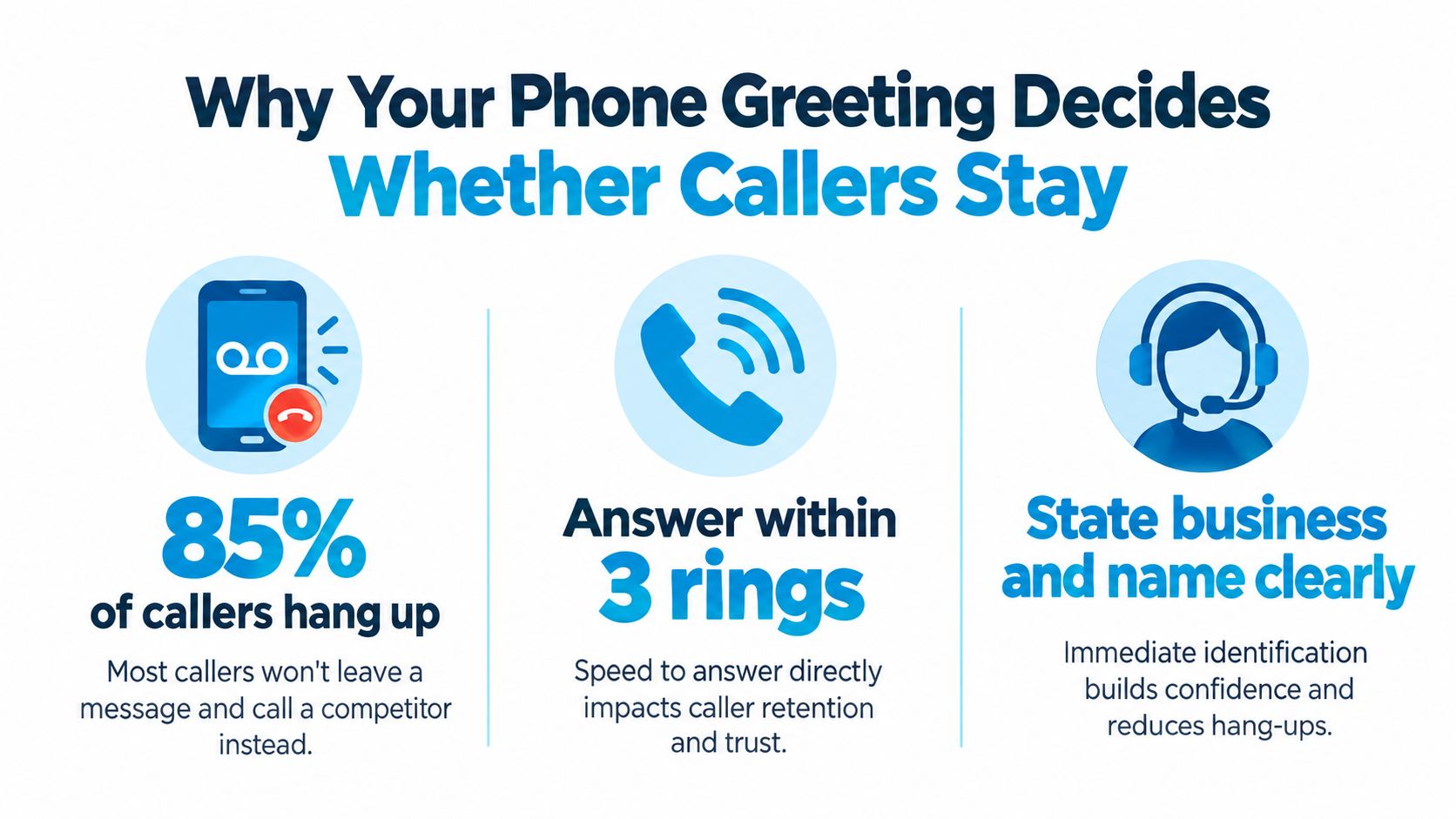
What callers decide in the first few seconds
Before they explain why they called, callers are making three quick judgments:
- Did I reach the right business
- Is the person answering ready to help
- Will I get a clear next step or get bounced around
Those judgments affect revenue more than many teams admit. A strong greeting reduces hang-ups, cuts repeat explanations, and gives the receptionist enough control to route the call correctly on the first try. A weak one creates avoidable transfers, missed opportunities, and more callbacks later in the day.
Historical telephone etiquette pointed to the same basic rule: answer promptly and identify the business clearly, not with a bare hello. That still aligns with current service benchmarks that commonly target answering most calls within 20 seconds, as discussed in this piece on historical telephone etiquette and modern benchmarks.
A greeting is not just manners. It is call control.
Reception teams often treat the opening line as a script problem. On live calls, it is an operating system problem. The greeting sets up everything that follows: whether the caller trusts you enough to stay on the line, whether you can capture the right details the first time, and whether the call should be handled now, put on hold, or moved to a callback queue.
That is why I train receptionists to use the greeting as the first step in a measurable call-handling system. If the intended person is unavailable, the receptionist should already know the rescue path. Take a brief message and warm-transfer if possible. Offer a callback window if the expected wait is too long. Avoid defaulting to hold just because the phone was answered. Good teams measure these choices later against missed-call recovery, booked appointments, and lead conversion.
Friendly tone still matters. Reliability matters more.
If you want new staff to hear examples of natural pacing and tone, the Intonetic guide to phone conversations is a useful training aid. For script examples and phrasing options, this collection of business phone greetings gives a solid reference point.
How to Open Every Call With Confidence and Clarity
Receptionists need an opening they can say the same way on the first call of the day and the fiftieth. The best formula is short enough to remember and structured enough to sound consistent.
A practical standard is to answer within 1 to 3 rings and use a greeting that includes the business name and your own name, such as: “Good morning, Smith Dental, this is Maria. How may I help you?” (telephone etiquette reference for medical administrative staff).
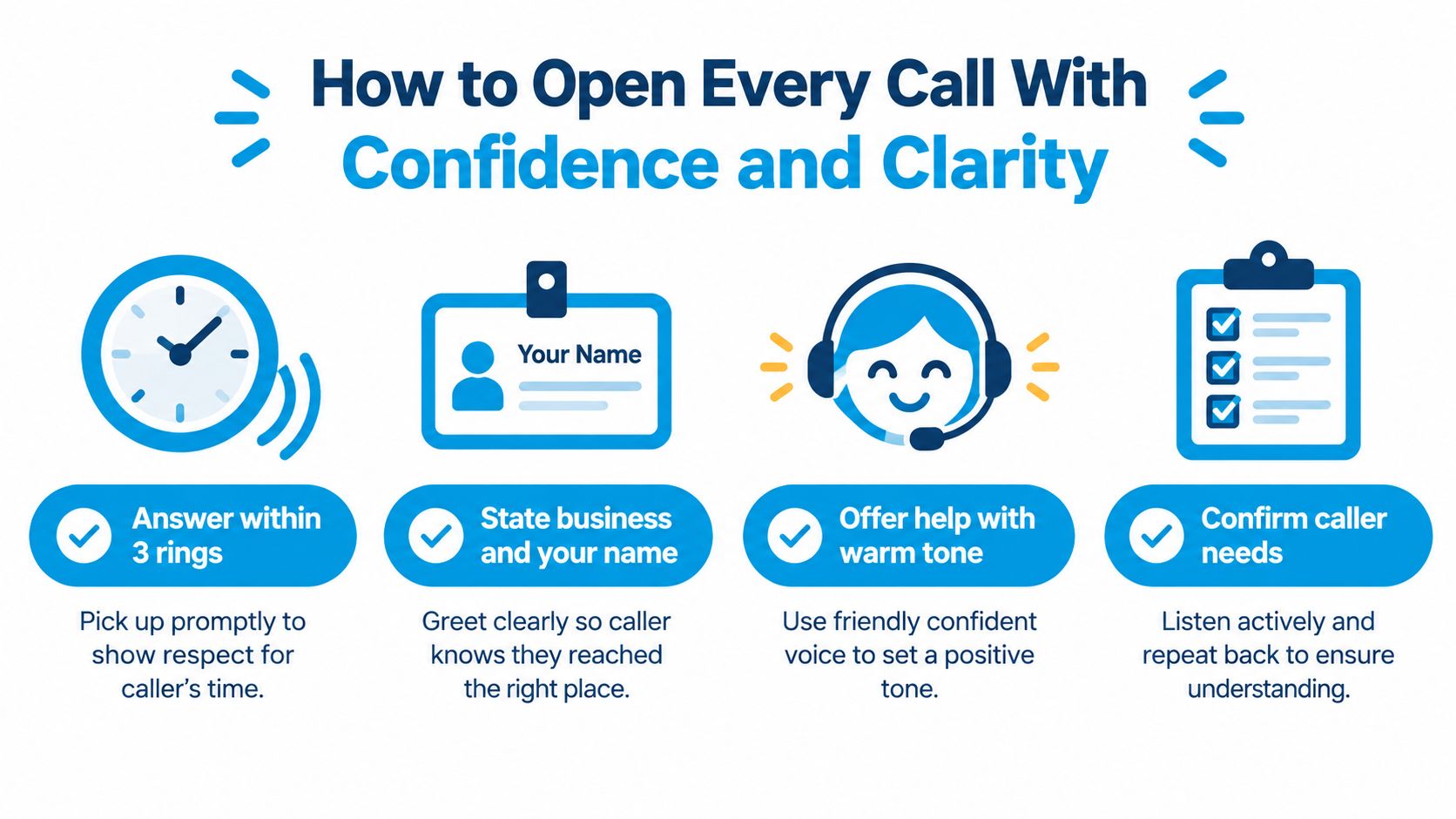
The opening formula that actually works
Use this structure:
- Time-based greeting if it fits your brand
- Business name so the caller knows they reached the right place
- Your name so the conversation feels accountable
- Offer of help that moves the call forward
Here are scripts worth copying:
Good morning, Smith Dental, this is Maria. How may I help you?
Thanks for calling ClearFlow Plumbing, this is James. How can I help today?
Good afternoon, Northside Family Law, this is Tasha. How may I direct your call?
Those work because they answer the caller's first two concerns immediately. Right place. Real person.
Small delivery choices that change the outcome
The wording matters, but delivery does just as much work.
- Sit up before you answer: Your voice tightens when you're hunched over a keyboard.
- Slow the business name slightly: That's the part callers need most.
- Keep your volume steady: Speaking louder isn't the same as sounding confident.
- Smile lightly, don't overperform: A warm tone helps. A forced customer-service voice can sound fake.
- Avoid trailing upward at the end: It can make a standard greeting sound uncertain.
For low-bandwidth calls or strong accent differences, tighten the script instead of adding more words. “Good morning, Apex Roofing, this is Nina” lands more clearly than a long, rushed sentence.
A lot of home service teams benefit from studying how calls turn into booked jobs, not just answered calls. This overview of phone call marketing for home services is useful because it connects call handling to real intake behavior rather than generic etiquette.
Here's a short training video you can use with new hires:
What not to say when you pick up
Some greetings make callers work harder right away.
| Weak opening | Why it fails | Better version |
|---|---|---|
| “Hello?” | Sounds personal, not professional | “Good morning, Greenline HVAC, this is Andre. How may I help?” |
| “Please hold.” | Removes control before understanding the need | “I can help with that. May I place you on a brief hold, or would you prefer a callback?” |
| “Yeah?” | Casual to the point of dismissive | “Thanks for calling Harbor Insurance, this is Leah.” |
A receptionist should sound ready before the caller says a single word.
Capturing Information and Routing Calls Without Friction
The middle of the call is where good receptionists save the rest of the team time. If the greeting was clean but the details are wrong, the call still failed.
Routine questions should be solved on the first call whenever possible. Benchmarks for phone support place average first-call resolution around 70% to 79%, while strong systems often reach 85% to 95% for simple information requests and 90% to 97% for callback capture (Ringly phone support benchmarks). For receptionists, that means the goal is simple: resolve what you can, and if you can't, capture the callback cleanly the first time.
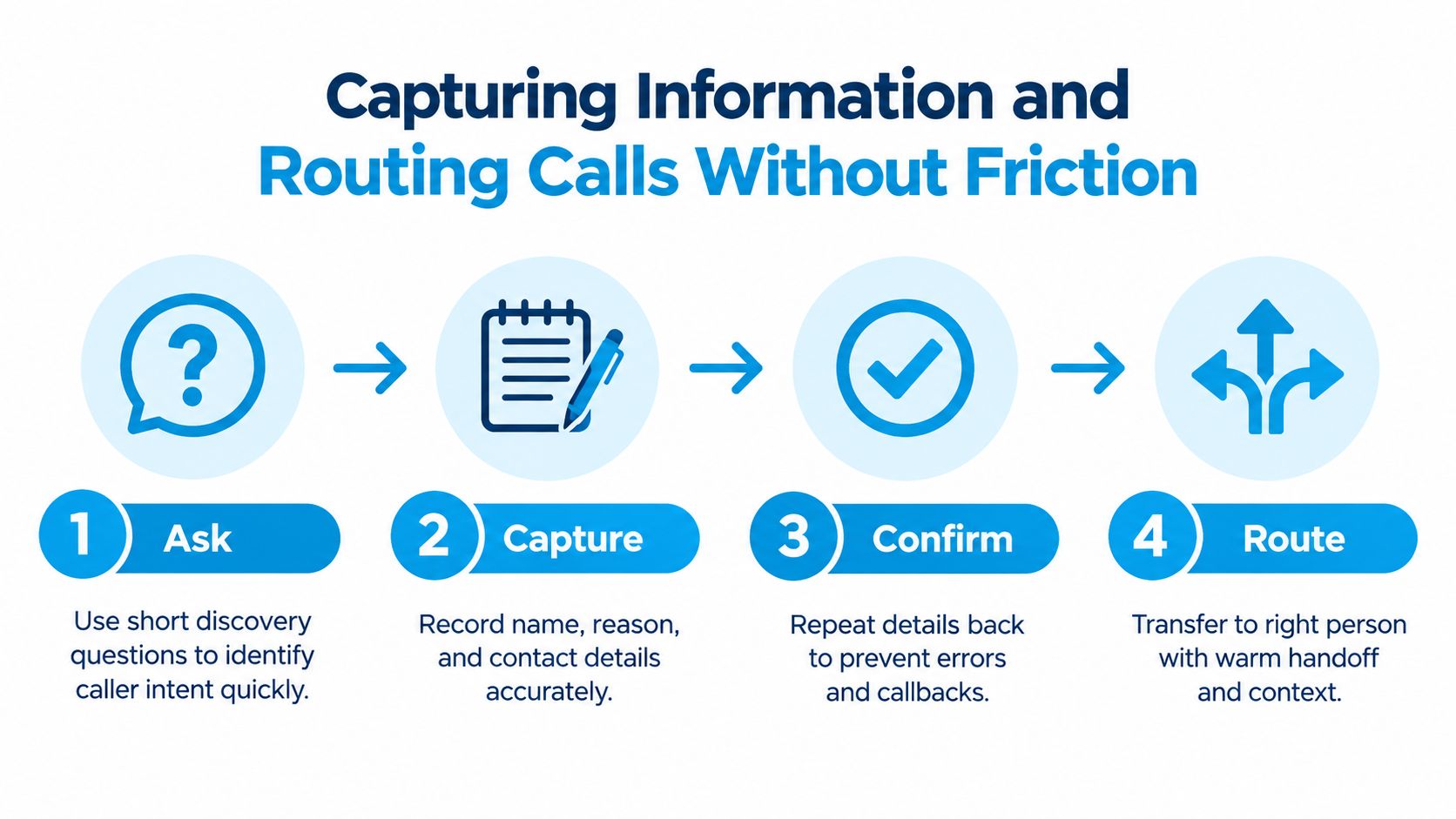
Use a short discovery flow
Receptionists don't need an interrogation script. They need three or four questions that sort the call quickly.
A simple flow looks like this:
- Start with intent: “How can I help today?”
- Narrow the request: “Is this about scheduling, billing, service, or an existing job?”
- Capture ownership details: “Can I get your name and the best callback number?”
- Confirm urgency: “Does this need attention today, or are you looking for the next available opening?”
That keeps the conversation moving without sounding robotic.
What to capture every single time
If a call may need transfer, follow-up, or callback, write the details while the caller is still on the line. Don't trust memory.
| Detail to capture | Why it matters | Example |
|---|---|---|
| Caller name | Prevents awkward handoffs | “Patricia Gomez” |
| Best callback number | Gives your team one clear route back | “Ending in 4421, correct?” |
| Reason for call | Lets the next person prepare | “Estimate request for water heater replacement” |
| Urgency or deadline | Helps triage | “Needs same-day service if possible” |
| Preferred next step | Cuts phone tag | “Text first, then callback” |
If your team handles enough volume that routing gets messy, use a structured system instead of sticky notes and memory. A practical overview of intelligent call routing shows how businesses standardize these decisions so callers don't bounce between people.
Warm transfer, cold transfer, or callback
Not every call should be transferred immediately.
Warm transfer works best when the caller is anxious, the issue is valuable, or context matters.
Example: “I'm connecting you to Rachel in billing now. She'll help with your invoice question. You're calling about the payment posted this morning.”
Cold transfer is fine for clean, obvious destinations.
Example: “I'm transferring you to our scheduling desk now.”
Callback capture is better when the right person is unavailable or when a hold will drag on.
Example: “Michael is with a client right now. I can have him call you back this afternoon. Let me confirm the best number and what you need from him.”
Front-desk standard: Never transfer a caller without telling them where they're going and why.
A lot of friction disappears when the receptionist repeats the request back in one sentence before routing it. That single habit catches wrong numbers, wrong names, and wrong assumptions before they create a second call.
Handling Difficult Callers Holds and Callbacks Gracefully
At 11:40 on a Monday, the phone is ringing, one caller is already on hold, a technician wants a message relayed, and the next person who picks up gets someone angry about a missed appointment. That moment tests the system, not the greeting.
As noted earlier, once a call is not answered live, the rescue path matters more than the opening line. Receptionists need a simple decision tree for three choices: hold, callback, or written follow-up. If that choice is inconsistent, callers feel it immediately.

What to say when the caller is already frustrated
An upset caller is listening for two things first. Did you understand the problem, and what happens next?
Use short, controlled language:
- Acknowledge the issue: “I can hear why that's frustrating.”
- State the next action: “I'm going to check the fastest way to fix this.”
- Offer a clear choice: “I can place you on a brief hold while I confirm that, or I can arrange a callback within a set time.”
That last part matters. A vague promise to “have someone call later” usually creates a second angry call.
Keep apologies brief. One sincere apology is fine. Repeating it without giving a next step makes the desk sound stuck instead of helpful.
If you are training staff on de-escalation, this guide on handling difficult customers on calls and at the front desk is a useful reference.
When to use hold versus callback
Good receptionists do not send every uncertain call into a hold queue. They make a time-based decision.
Use hold when the answer should take a minute or two, the caller is close to booking or approving something, or repeating the story to a second person would create more friction than waiting briefly.
Use callback when the right person is in a meeting, with a patient, on a job, or already behind. It is also the better choice when the issue needs research, account review, or coordination between departments.
Use SMS or another written follow-up when accuracy matters more than speed. Phone numbers, names, appointment links, addresses, claim numbers, and spelling corrections are all safer in writing.
A practical script sounds like this:
“I can check that now and place you on a brief hold, or I can have Sarah call you by 3 p.m. Which do you prefer?”
That gives the caller control, but it also gives the team a measurable commitment.
Set a hold rule your team can actually follow
Front desks get into trouble when “brief hold” means different things to different people. Set a clear standard. In practice, I train teams to do three things every time:
- Ask before placing the caller on hold
- Give a reason
- Return with an update if the wait is stretching
For example: “May I place you on hold for up to two minutes while I check with billing?” If the answer is not ready, come back and convert the hold into a callback with a promised window.
That protects the caller experience and the schedule. It also keeps one long call from clogging the whole desk.
Turn callbacks into a tracked process
A callback is not a courtesy if nobody owns it. It is a task with a clock on it.
Capture the caller's name, best number, reason for the call, preferred contact method, and promised callback window. Then assign it to one person, not a vague department inbox. If your office uses a call log or CRM, callbacks should have the same status discipline as appointments and leads.
The revenue angle shows up. New-patient calls, estimate requests, intake calls, and reschedule opportunities should never sit in the same pile as routine message traffic. If the receptionist cannot solve the issue live, the callback queue should still reflect business value and urgency.
Measure whether your rescue path is working
You do not need a complicated dashboard to spot problems. Track a few numbers consistently:
- Average hold time
- Hold abandonment rate
- Callback completion within the promised window
- First-call resolution for front-desk issues
- Lead callback speed for revenue-related calls
- Repeat-call rate on the same issue
If those numbers drift, the script is not the only thing to review. Staffing, routing rules, and escalation ownership usually need attention too.
The best phone teams sound calm because the process behind them is clear. Callers can forgive a short wait. They rarely forgive confusion, silence, or a callback that never comes.
Adapting Your Phone Approach for Different Industries
The core answer to how should a receptionist answer the phone stays stable across industries. Answer fast. identify clearly. guide the caller. confirm the next step. What changes is the emphasis.
Home services and field teams
Home service callers usually care about three things first: availability, urgency, and whether you handle the job type. A plumbing or HVAC script should move to dispatch logic quickly.
A strong opening sounds like this: “Thanks for calling Summit Plumbing, this is Erica. Is this an emergency, or are you looking to schedule service?” That question helps the receptionist sort leaks, estimates, and general inquiries without wasting time.
If the team is mobile, make sure the receptionist doesn't promise exact arrival times unless dispatch has confirmed them. “I can request same-day service and have dispatch confirm your window” is safer than guessing.
Healthcare and wellness
Healthcare receptionists need warmth, structure, and discretion. The caller may be anxious, embarrassed, or trying to fit care into a rushed schedule.
Use a calm opening, then move into practical intake. “Good morning, Oakview Dental, this is Carla. How may I help you?” works better than a chatty style. Once the need is clear, gather essentials, avoid discussing anything beyond your role, and route sensitive or clinical matters according to office policy.
Legal, insurance, finance, and professional services
These callers often want confidence more than speed alone. They need to know the office handles matters carefully.
Law firms should confirm whether the call is for a current matter, a new consultation, or document follow-up. Insurance and finance teams should verify the caller's purpose before moving into account-specific discussion. The tone should be measured and organized, not overly casual.
A legal receptionist might say, “Thank you for calling Harper & Cole, this is Denise. Are you calling about an existing matter or a new consultation?” That single line helps with intake, routing, and conflict-screening workflow.
Multi-location and hybrid reception teams
Multi-location businesses need script consistency without making every receptionist sound identical. The fix is to standardize the parts that callers rely on and allow light personalization around them.
Keep these elements fixed across locations:
- Business identification: location or department if needed
- Role clarity: who answered
- Opening help question: short and direct
- Routing categories: the same language for the same call types
- Wrap-up language: the same expectation-setting
Allow flexibility in greeting style, as long as the essentials stay intact. That balance matters even more when some calls are handled by in-house staff and others by overflow or remote support.
Measuring Quality and Keeping Every Call Consistent
At 8:07 on a Monday, the phones stack up fast. One caller wants to book, another is checking on an estimate, and a third hangs up after too much ringing. By 8:20, the front desk feels busy, but busy is not the same as controlled. If the team is not working from the same call-handling standard, missed revenue hides inside what looks like a normal morning.
Consistency starts with a defined system, not a vague goal to “sound professional.” Set the answer standard, decide which call types the receptionist should handle without transfer, and make hold versus callback a real decision instead of a habit. If a transfer will take too long, capture the details and commit to a callback window. If the answer is routine and documented, resolve it on the first call.
The KPIs worth tracking
Track the numbers that show whether the phone line is protecting revenue or leaking it.
| KPI | What it tells you | What good coaching sounds like |
|---|---|---|
| Speed to answer | Whether callers are waiting long enough to drop off | “What is happening between 8 and 10 a.m., and who is covering first-ring pickup?” |
| Service level | Whether the team is meeting the answer standard across the day | “Are we hitting our target during lunch, open, and late afternoon, or only when staffing is full?” |
| First-call resolution | Whether routine issues are getting solved without repeat contact | “Which call types should the receptionist be authorized to resolve directly?” |
| Callback capture quality | Whether unresolved calls have enough detail for a clean handoff | “Did we confirm the number, reason for calling, urgency, and promised callback window?” |
| Missed-call recovery rate | Whether lost calls are actually being worked back | “How many missed calls got a same-day return, and how many turned into appointments or sales?” |
A front desk that answers quickly but fails to recover missed calls still loses business. A team that keeps callers on hold too long instead of offering a callback loses business more politely. Measure both.
If you review recordings or summaries, tie them to booked appointments, retained clients, and saved sales opportunities. This article on revenue attribution with call recordings is useful for teams that want to connect phone performance to actual revenue.
For a broader review process, this guide to quality assurance in call center operations is a practical reference for scorecards, calibration, and coaching.
A simple quality checklist for every receptionist
Use this in training, spot checks, and weekly reviews.
- Answered within the team standard: the call did not drift while staff assumed someone else would pick up
- Opened clearly: business name, personal name, and help question were easy to understand
- Identified the call type fast: booking, billing, support, sales, existing client, or new lead
- Captured details correctly: name, callback number, reason for calling, and urgency were confirmed
- Made the right next-step decision: resolve now, transfer now, place on brief hold, or schedule a callback
- Set a clear expectation: the caller knew who would respond and by when
- Closed the loop: the end of the call confirmed the outcome, not just “okay” or “someone will call you back”
One coaching point matters more than people think. A weak close creates repeat calls. If the receptionist says, “I'll pass this along,” callers often dial back because they do not know what happens next. “Our estimator will call you today by 3 p.m. at the number ending in 4421” is much stronger, and it is easy to audit later.
Recepta.ai is one tool teams use to keep that standard consistent across busy periods, after-hours coverage, and multi-location routing. It handles inbound calls, lead capture, scheduling, and escalation based on configured business rules. In practice, that helps if you want the same opening, routing logic, and callback documentation every time, even when the person answering changes.
Phone quality improves fastest when managers review a small sample every week and coach to one or two behaviors at a time. Fix the process first. Then fix delivery. That is how reception teams stay consistent under real call volume, not just during training.