
Intelligent Call Routing: A 2026 Guide
A homeowner calls a plumbing company at 8 p.m. with water spreading across the floor. They press the emergency option, explain the problem, get transferred to another queue, wait again, and finally reach voicemail. By the time they hang up, the company has lost more than a conversation. It has lost the opportunity to dispatch help, protect the customer relationship, and earn the job.
That failure usually comes from a routing system built around menus and queue order instead of caller context. Intelligent call routing changes the decision from “who's next?” to “which resource can resolve this caller's need most effectively?” The difference affects customers, agents, supervisors, and the revenue line.
The Moment Every Caller Has Lived Through
The plumbing caller's experience is easy to recognize because the same pattern appears across industries. A patient calls a healthcare provider and reaches the wrong department. A customer with an open billing dispute explains the issue to one agent, then repeats it to another. A prospective client calls a law firm after hours and hears a generic voicemail instead of a useful escalation path.
Traditional IVR systems can collect keypad selections and send callers toward predefined departments. Round-robin queues can distribute calls fairly. Neither approach necessarily understands that a burst pipe requires an on-call technician, that the caller lives within a particular service area, or that the customer already has an open case with a specialist.
The result is a predictable set of operational problems:
- Longer handle times: Agents spend part of the call identifying the issue, checking account history, or correcting the previous routing decision.
- Wrong-agent transfers: The first agent can't resolve the request and must send the caller elsewhere.
- Abandoned calls: Callers leave before reaching someone who can help, even when the organization has the right resource available.
Practical rule: Treat every transfer as a routing question before treating it as an agent-performance question.
Intelligent call routing is designed to recognize intent, caller context, agent capability, and current availability before making the connection. In the plumbing example, it could identify an emergency request, use the caller's location, check the live status of technicians, and route the call to the appropriate on-call resource. If no technician is available, the system can follow a defined fallback, such as a specialist queue, self-service guidance, or a human escalation that preserves the information already collected.
That doesn't mean AI should replace every menu or every agent. It means the call path should make a better decision with the information the business already has. The following framework starts with that decision pipeline, then applies it to routing strategies, performance measurement, technical design, governance, and rollout planning.
What Intelligent Call Routing Means
A caller reports a service outage, selects a broad menu option, and reaches an agent who handles billing. The agent must identify the issue, review the account, and transfer the call. Intelligent routing is designed to make that decision earlier.
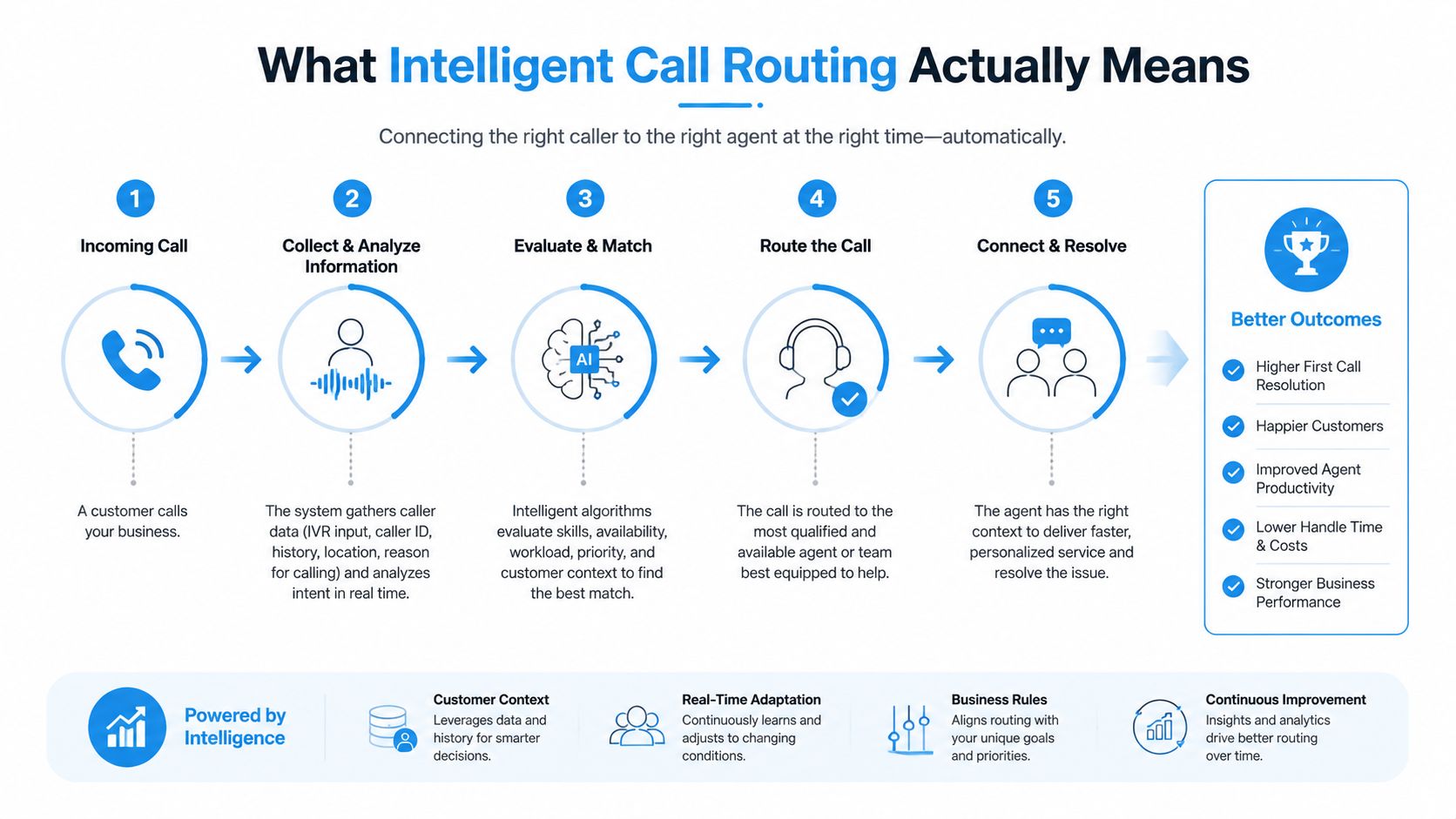
Intelligent call routing works like a triage nurse. The nurse checks symptoms, reviews the patient's chart, considers available clinicians, and chooses the right care path. The system applies similar reasoning to a contact center. It gathers caller and operating data, evaluates that information against business rules and agent capabilities, then selects a suitable destination through a three-stage decision pipeline.
Stage one gathers the signals
The system collects information from the call and connected business systems. Typical inputs include the caller's phone number, location, IVR selections, CRM history, previous interactions, speech-to-text intent, and the current state of queues and agents. Integration quality determines how much context the router can use. Without current account or availability data, it behaves more like a traditional queue.
Stage two analyzes the situation
The analysis layer compares the caller's need with routing rules, agent skills, priorities, and available capacity. For example, it may identify an emergency, a language requirement, an open support ticket, or a regulated call type. AI models can classify intent when a caller describes a problem in natural language instead of choosing a precise menu option.
This stage is the decision point. A caller asking why service stopped may need technical support, while another caller using similar words may need an account specialist. The router combines signals rather than relying on one menu selection.
Stage three routes and prepares the handoff
The call moves to the highest-scoring agent, skill group, queue, self-service path, or escalation option. A useful handoff includes context, allowing the agent to begin with the likely reason for the call instead of asking the caller to repeat it. If confidence is low, the system can request confirmation or send the interaction to a human.
How IVR and ACD fit into the picture
An IVR presents menus and collects caller input. An automatic call distributor, or ACD, places calls in queues and distributes them according to configured logic. Intelligent routing can work with both, adding a decision layer that considers more context than a fixed menu or first-available queue.
For teams documenting current call flows, the Premier Broadband call guides provide a reference for caller prompts, routing choices, and escalation paths. The practical test is whether the system identifies the caller's need, selects a capable resource, and preserves context throughout the handoff.
The Four Routing Strategies Worth Knowing
No single routing strategy fits every queue. The right choice depends on whether the business values equal distribution, specialist resolution, urgency, or intent recognition.
| Strategy | Best For | Key Trade-off |
|---|---|---|
| Round-robin | Uniform queues with broadly interchangeable agents | Fair distribution, but limited awareness of caller complexity or agent expertise |
| Skill-based routing | Technical support, insurance claims, and specialist service | Better fit and fewer unnecessary handoffs, but requires accurate skill profiles and setup |
| Priority routing | VIP customers, urgent healthcare matters, and time-sensitive requests | Protects critical calls, but can leave standard callers waiting if priority rules are too broad |
| AI-driven intent routing | Inbound sales and mixed-intent contact centers | Recognizes natural-language needs, but depends on model quality, confidence handling, and governance |
Round-robin routing
Round-robin sends calls through agents in an ordered rotation. It's easy to understand and can distribute work evenly when every caller has a similar request and every agent can provide the same service. A basic customer service queue may benefit from this simplicity.
Its blind spot is context. A caller with a technical problem may reach a generalist who can't resolve it, while an experienced specialist waits for a call that matches their expertise. The business gains procedural fairness but may lose resolution quality.
Skill-based routing
Skill-based routing uses the caller's reason for calling, IVR choices, identifying information, and other available context to select an agent with relevant proficiency. A technical support caller can reach a technical specialist, while a billing caller can go to a billing-skilled agent.
The trade-off is operational maintenance. Supervisors need meaningful skill definitions, current proficiency information, and rules for situations where the ideal skill group has no available agent. Poorly maintained profiles can create the same misroutes the system was meant to prevent.
Priority routing
Priority routing gives selected calls faster access based on urgency, service commitments, customer type, or business rules. It can help a healthcare organization respond to urgent cases or a service company protect emergency dispatches.
Leaders should place limits around priority categories. If too many calls qualify, the priority queue stops representing urgency and begins starving ordinary work.
AI-driven intent routing
AI-driven routing listens for the caller's purpose and uses natural language understanding to classify the interaction early. A caller saying “my payment was declined” may be more accurately identified than one who chooses a broad “account” menu option.
The investment is higher because the business must test intent categories, handle uncertain classifications, and monitor outcomes. Teams should also distinguish routing from handoff design. A comparison of cold and warm transfers helps clarify whether the receiving agent gets context before the caller is connected.
The KPIs That Tell You Routing Is Working
Routing can look impressive in a demo and still produce weak operational results. Supervisors need a KPI set that connects each result to a routing decision.
Average speed of answer, or ASA, shows how quickly callers reach an agent. If skill-based routing creates narrow queues with insufficient coverage, ASA can worsen even when the match quality improves. A sound adjustment should protect answer speed while preserving the specialist match.
Abandonment rate shows where callers leave before connection. Rising abandonment can indicate long queues, excessive IVR navigation, or priority logic that pushes ordinary callers too far behind. It's a caller-path signal, not just a staffing signal.
First-contact resolution, or FCR, tests whether the chosen destination can solve the issue. If FCR doesn't improve after intent or skill routing changes, the system may be classifying the need correctly but matching it to the wrong capability.
Reading transfer and queue metrics together
Transfer rate is one of the clearest measures of routing quality. A high rate suggests the initial decision is failing, the skill taxonomy is too broad, or the receiving agent lacks the permissions and tools needed to finish the work.
Service level gives leaders a broader view of queue health. Teams often express it through a target such as 80/20, but the target itself should reflect the operation's service promise. Occupancy and utilization add a workforce perspective. If AI routing consistently sends complex calls to senior agents, those agents may carry uneven pressure even while aggregate service levels look healthy.
| KPI | What It Signals | Watch When You Adjust |
|---|---|---|
| ASA | Speed of access to a live agent | Check after adding skills or narrowing queues |
| Abandonment rate | Friction before connection | Watch after changing IVR prompts or priority rules |
| FCR | Quality of the initial match | Monitor after intent and skill model changes |
| Transfer rate | Accuracy of the first routing decision | Review when agents report repeated misroutes |
| Service level | Overall queue performance | Compare across priority bands and departments |
| Occupancy and utilization | Distribution of workload | Check whether senior agents receive disproportionate complexity |
For deeper diagnosis, call detail reporting can help operations teams connect individual call paths with transfers, queue movement, outcomes, and agent handling patterns. The important discipline is to compare KPIs by intent and queue, not only as a single contact-center average.
How Routing Plays Out in Real Call Scenarios
The pipeline becomes easier to manage when leaders can trace one call from its inputs to its outcome. These examples show the logic without reducing routing to a vendor feature list.
A pediatric health call during the night
A parent calls a health system at 2 a.m. and says that their child has a fever and is under two years old. The inputs include speech recognition, the child's age, the stated symptom, the time of day, and the health system's escalation rules.
The decision layer identifies a potentially urgent clinical request, applies priority handling, and looks for a triage-trained nurse. The caller reaches an appropriate clinical resource before completing the second IVR prompt, rather than navigating several department menus. The system should also record the reason for the escalation and pass the captured context to the nurse.
An emergency plumbing request
A homeowner calls about a leaking water heater. The system receives the caller's number, location information, stated need, current technician availability, and dispatch rules.
Instead of sending the call through a generic round-robin queue, a geographic rule identifies the relevant service area and checks for a dispatch-ready technician nearby. The call reaches the resource most likely to act on the emergency, while the dispatch team receives the location and issue details before answering.
A personal injury inquiry after hours
A potential client reaches a law firm outside normal office hours. Speech analysis identifies a personal injury intent, the business rules flag the inquiry for priority handling, and the skills profile shows that a Spanish-speaking paralegal is on duty.
The routing decision combines intent, timing, priority, language capability, and availability. The caller reaches the right intake resource instead of a general voicemail path, and the paralegal receives the information needed to continue the conversation efficiently.
A business scaling its coverage may also evaluate options to hire remote customer service reps, but added coverage works best when the routing rules clearly define which calls those representatives can handle and when they must escalate.
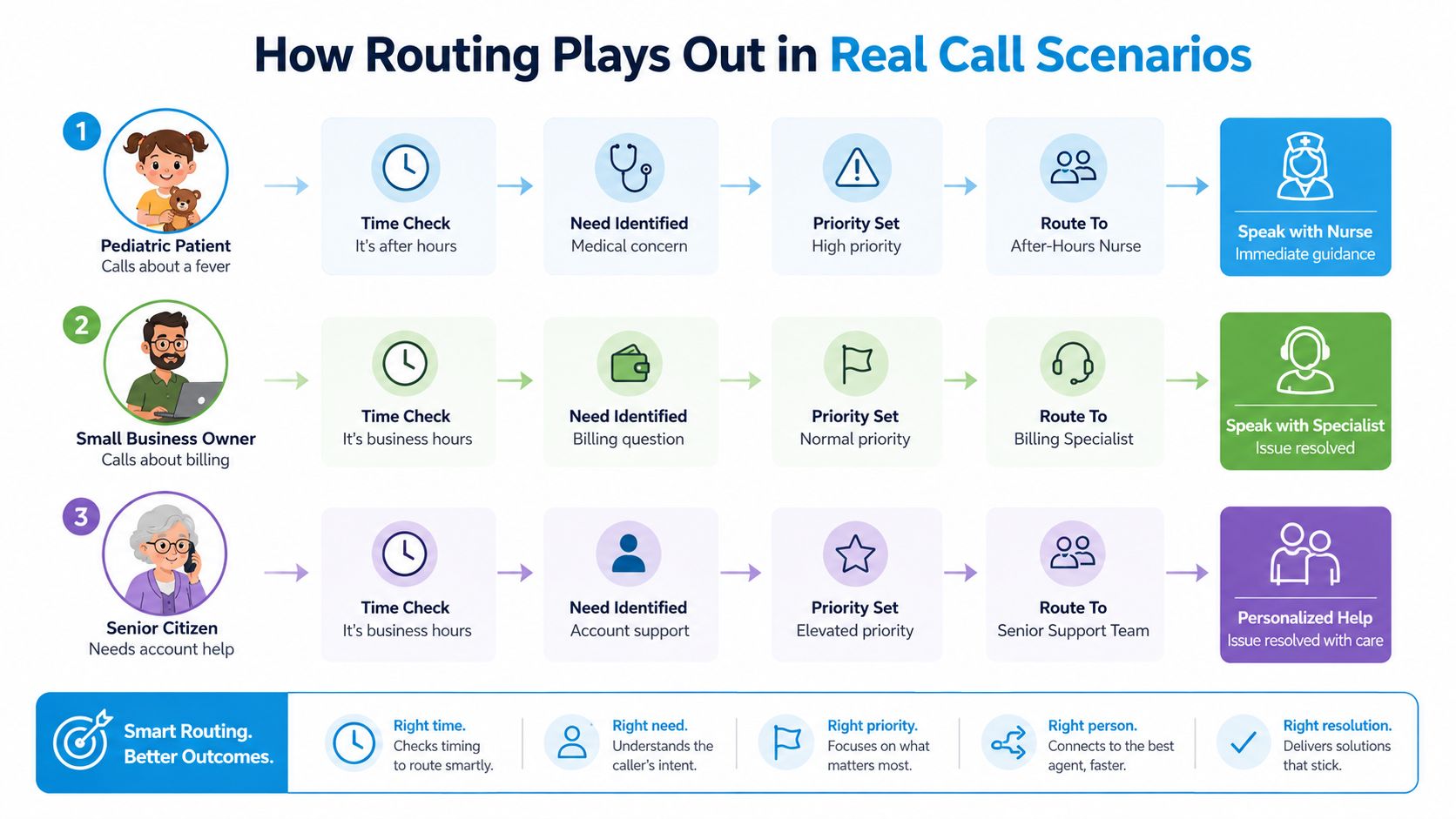
The same principle applies in each scenario: gather the signals, analyze the need against capability and availability, then route with a fallback. The caller experiences one useful path, even though several systems may support it behind the scenes.
The Technical Requirements Behind the Scenes
Intelligent routing depends on a small set of technical decisions that operations leaders should own before launch. The platform matters, but a purchased tool can't compensate for stale data, unclear fallbacks, or a queue system that can't handle the decision path.
Start with a latency budget
Routing must feel immediate inside the caller's interaction. IBM's architecture guidance describes a real-time decisioning layer that supports sub-200 ms inference latency, using historical CRM, ACD, and workforce data to create a match-score matrix. The same IBM research on intelligent call routing also emphasizes the importance of rapid API responses for conversational flow.
Measure the time required for intent classification, CRM retrieval, agent ranking, and call connection as one path. A fast model won't help if a slow integration delays the decision.
Validate the data path
CRM and help-desk integration determines whether the router can use account status, open tickets, prior interactions, or other approved context. Confirm that each endpoint returns the fields the routing rules need and that missing data triggers a safe fallback rather than a false priority.
For teams reviewing integration design, API connectivity planning provides a useful way to frame endpoint reliability, data exchange, and system dependencies.
Protect continuity during failure
SIP capacity, failover topology, and queue configuration determine whether a routing failure becomes a caller-visible outage. Define what happens if the CRM is unavailable, the speech service fails, or the agent-state feed stops updating. A fallback to a known queue is often safer than allowing the call to stall.
Use a practical pre-launch checklist
- Confirm integration endpoints: Verify that CRM, help desk, workforce, and telephony data arrive with the required fields.
- Test failover: Simulate unavailable services and confirm that calls reach a defined fallback.
- Validate latency: Measure the complete decision path, not only model inference.
- Audit retention rules: Confirm where recordings, transcripts, and extracted data are stored and how long they remain available.
- Verify state feeds: Check that ready, away, busy, and non-routing states update reliably.
Hard Decisions Leaders Get Wrong in Implementation
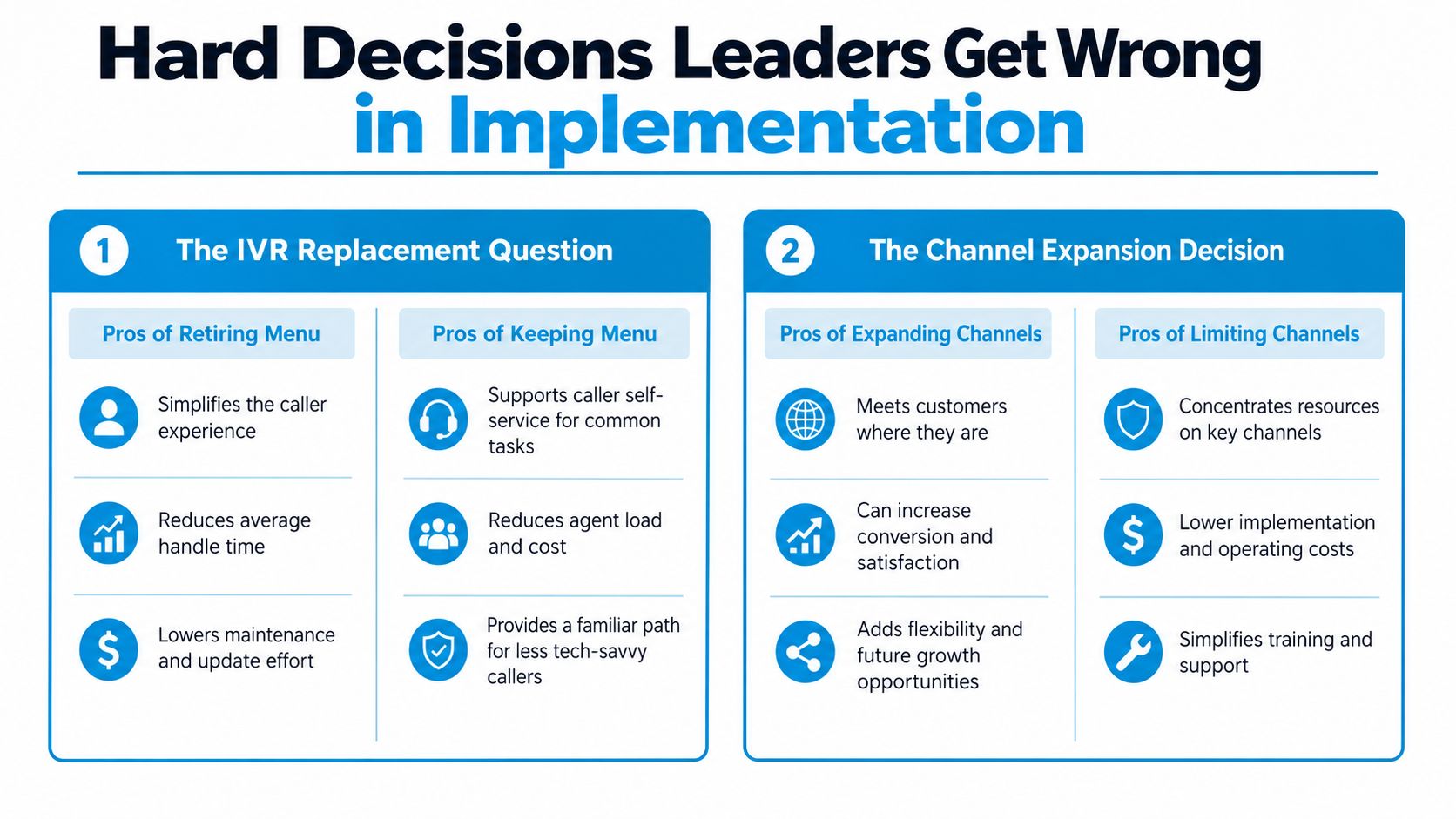
Two implementation choices deserve executive attention because they shape customer experience and operational risk.
The first is whether to replace the static IVR. Retiring the menu can make common requests feel more natural, especially when callers describe their needs clearly. Keeping the menu provides a predictable keypad path for callers whose speech is difficult to recognize, whose request falls outside the model, or who prefer structured prompts.
A hybrid model often offers the most practical starting point. Speech recognition can handle common intents, while keypad options and deterministic rules remain available for edge cases, regulated flows, or low-confidence calls. Industry coverage describes this blended direction, and one cited 2025 study reported that 37.6% of companies planned to fully replace IVRs with AI triage agents, while 62.5% of a research subgroup planned to do so (No Jitter analysis). These figures indicate momentum, not proof that every business is ready for a full replacement.
Decide which signals deserve trust
The second choice concerns voice-derived signals. Speech systems can transcribe language and infer intent, sentiment, or other characteristics, but businesses must define which signals are appropriate for routing and which should be restricted. Voice-related inference can create privacy, consent, bias, and compliance concerns, particularly in healthcare, finance, insurance, and legal services (Forbes coverage of predictive CX).
Before production use, assign owners for consent capture, PII redaction, transcription quality, retention, access controls, and model review. Test performance across accents, dialects, languages, and call conditions. A caller shouldn't receive worse service because a model misunderstood how they speak.
Governance principle: Use the least sensitive signal that can support the routing decision, and require a human path when confidence or fairness is uncertain.
A 90-Day Rollout Pattern You Can Follow
A measured rollout gives the team evidence before it changes the caller's path. It also creates a decision record that makes later tuning easier.
Days 1 to 30 focus on discovery
Pull six months of call recordings and tag intent, outcome, transfer path, and resolution. Establish the current transfer rate and FCR, then identify the queue where routing is causing the clearest operational problem. Pick one strategy that addresses that weakness rather than deploying every routing method at once.
Days 31 to 60 build the decision layer
Connect the CRM and relevant help-desk systems. Define agent skills, priority rules, fallback queues, escalation thresholds, and approved data signals. Run the system in shadow mode so it scores calls without controlling the live route. Compare its decisions with the paths agents took, and document why the two differ.
Teams can use an onboarding timeline to organize ownership, dependencies, training, and launch checks. The schedule matters less than making each step observable and reversible.
Days 61 to 90 manage a controlled cutover
Start with one traffic segment, such as a single intent, geography, or after-hours queue. Review latency and abandonment daily, then examine FCR, transfers, occupancy, and agent overrides by call type. Lock down transcript and recording retention policies before expanding coverage.
At the end of the period, the team should have a measured baseline, tested fallbacks, documented governance, and a clear list of tuning actions. Recepta.ai provides intelligent call routing alongside conversational AI and human escalation, so teams evaluating inbound call handling can review how calls, scheduling, lead capture, and handoffs fit into one operating workflow.
Recepta.ai can help businesses route inbound calls by caller type and need, capture information, schedule appointments, and escalate to trained human support when a situation requires it. Visit Recepta.ai to evaluate an AI receptionist workflow that fits your CRM, call queues, and escalation rules.