
How to Handle Inbound Calls Without Missing Opportunities

A U.S. government telephone-service benchmarking report found that approximately 25% of callers to government agencies may give up without receiving a response, while fewer than 2% abandon calls in the best-performing companies, according to the U.S. government telephone-service benchmarking report. That gap is the whole argument for treating how to handle inbound calls as an operating system, not a greeting script. I judge a line by what happens after the first ring. Did the promised callback happen? Did the next person start with context, or did the caller have to tell the story again? Those are the quality tests that separate a fast pickup from a finished job.
Inbound Call Benchmarks and KPI Targets
Start with that abandonment contrast, then set a target your team can realistically staff to. The common 80/20 service level means answering 80% of offered calls within 20 seconds, which GetMacha's customer service response-time benchmarks describe as an operating target rather than a universal law. Treat it that way. A two-person plumbing shop and a multi-location clinic don't have the same peaks, so the target is useful only when you staff by hour and measure by intent.
First-call resolution is the sharpest signal on this scorecard. The cross-industry average sits near 70%, 80% or higher is commonly categorized as world-class, and complaint calls can fall near 47% [in the figures GetMacha cites above]. A fast connection doesn't prove the problem is solved, either. It only proves someone picked up.
The scorecard to run weekly
| Metric | Benchmark or target | What it tells you |
|---|---|---|
| Service level | 80% of offered calls answered within 20 seconds (operating target) | Whether coverage matches demand |
| Abandonment rate | Under 2% at best performers; about 25% at weaker government benchmarks | Callers lost before anyone answers |
| Average speed to answer | Under 15 to 20 seconds | How long the queue holds a waiting caller |
| Average handle time | No universal target; track by intent and never optimize alone | Efficiency, read alongside repeat contacts |
| Transfer rate | No published benchmark; set a baseline and aim for a falling trend | Whether routing sends callers to the right person first time |
| First-call resolution | About 70% average; 80%+ world-class; near 47% for complaint calls | Whether the issue closed on the first contact |
| Callback completion | No published benchmark; track the share of promised callbacks made | Whether promised callbacks actually happen |
| Repeat contacts | No published benchmark; set a defined window per intent | Whether a completed call stayed resolved |
Don't chase handle time on its own. Cutting a call short by transferring the caller early looks efficient and usually creates a repeat contact. Read how average handle time interacts with repeat contacts before you set any team target on duration, and always report it by intent, because a billing dispute and a reschedule shouldn't share a clock.
How to Handle an Inbound Call Step by Step
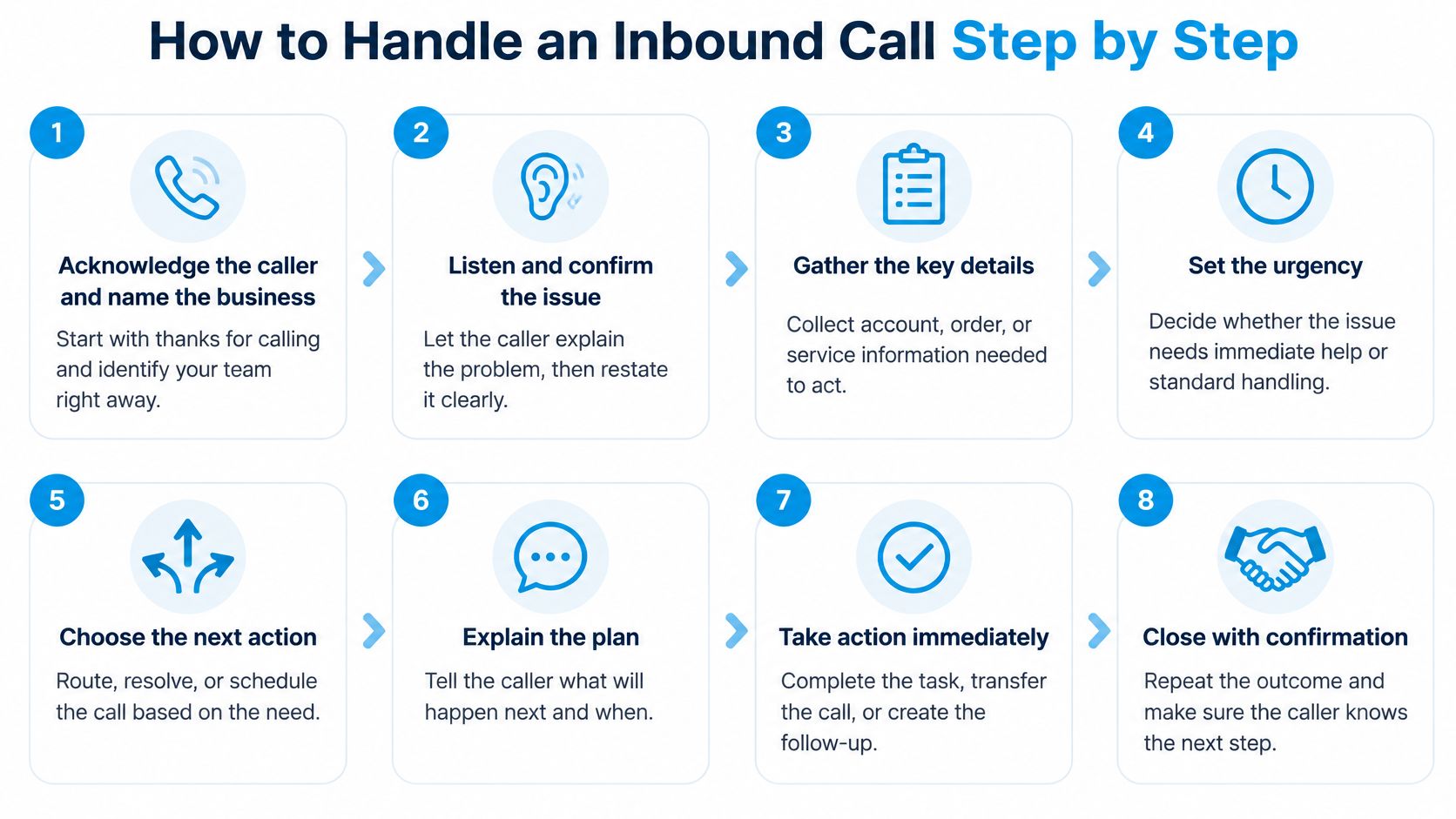
The protocol below is discovery to action, in that order. It works because each step earns the next one, and it ends with a record someone else can use. Research on knowledge management and CRM in a survey of 168 call-center managers published in Database Marketing and Customer Strategy Management reports that first-call resolution positively mediates the relationship between knowledge management, technology-enabled CRM, and caller satisfaction, which is why the record matters as much as the conversation.
The eight steps
- Acknowledge the caller and name the business. "Thanks for calling Bright Plumbing, this is Sam, how can I help?" The caller knows they've reached the right place in the first five seconds.
- Confirm identity and the preferred callback channel. A caller you can't reach again is a lost job, so capture the mobile number or preferred channel before anything can go wrong.
- Determine the primary outcome sought. One outcome, stated plainly. A leak repair today, or a cleaning rescheduled to Thursday.
- Ask only decision-relevant questions. A homeowner describing an active leak gives the address and whether the water's shut off, not five details about the fixture. Urgency outranks completeness.
- Restate the issue in one sentence. The caller corrects you now, while it's cheap. Read back any confirmed time too. A dental patient hears "Tuesday at 9:40 with Dr. Rao" before hanging up.
- Execute the next action or schedule it. Book the visit, create the ticket, or send the form while the caller is still on the line. Don't promise to do it after.
- Confirm timing and ownership. Name who owns the follow-up and by when. "Our dispatcher, Mara, will confirm your window by 4 p.m." beats "someone will be in touch."
- Close with a concise recap. Outcome, timing, owner, and what the caller should do if something changes. Then stop.
Sync the transcript or summary into the CRM, calendar, or job record immediately after the call. I'd make this a priority in healthcare, finance, insurance, legal, and home-service settings, where one missing detail carries compliance, safety, or revenue risk. A summary sitting in a voicemail inbox helps nobody.
Audit every record for six fields: caller intent, required fields, promised action, owner, deadline, and escalation reason. If one is blank, the call isn't finished.
The pitfalls are predictable. Teams collect too much before addressing urgency, lean on generic scripts, transfer without context, skip confirming appointment details, and treat voicemail as completion. Every one of those produces a second call.
Routing Calls by Urgency and Staffing Coverage
Say an HVAC company gets two calls at 8:05 a.m. One caller has no heat and a baby in the house. The other wants a spring tune-up. Arrival order says the tune-up goes first if it rang first. That's the wrong rule, and it's where most small-team routing fails.
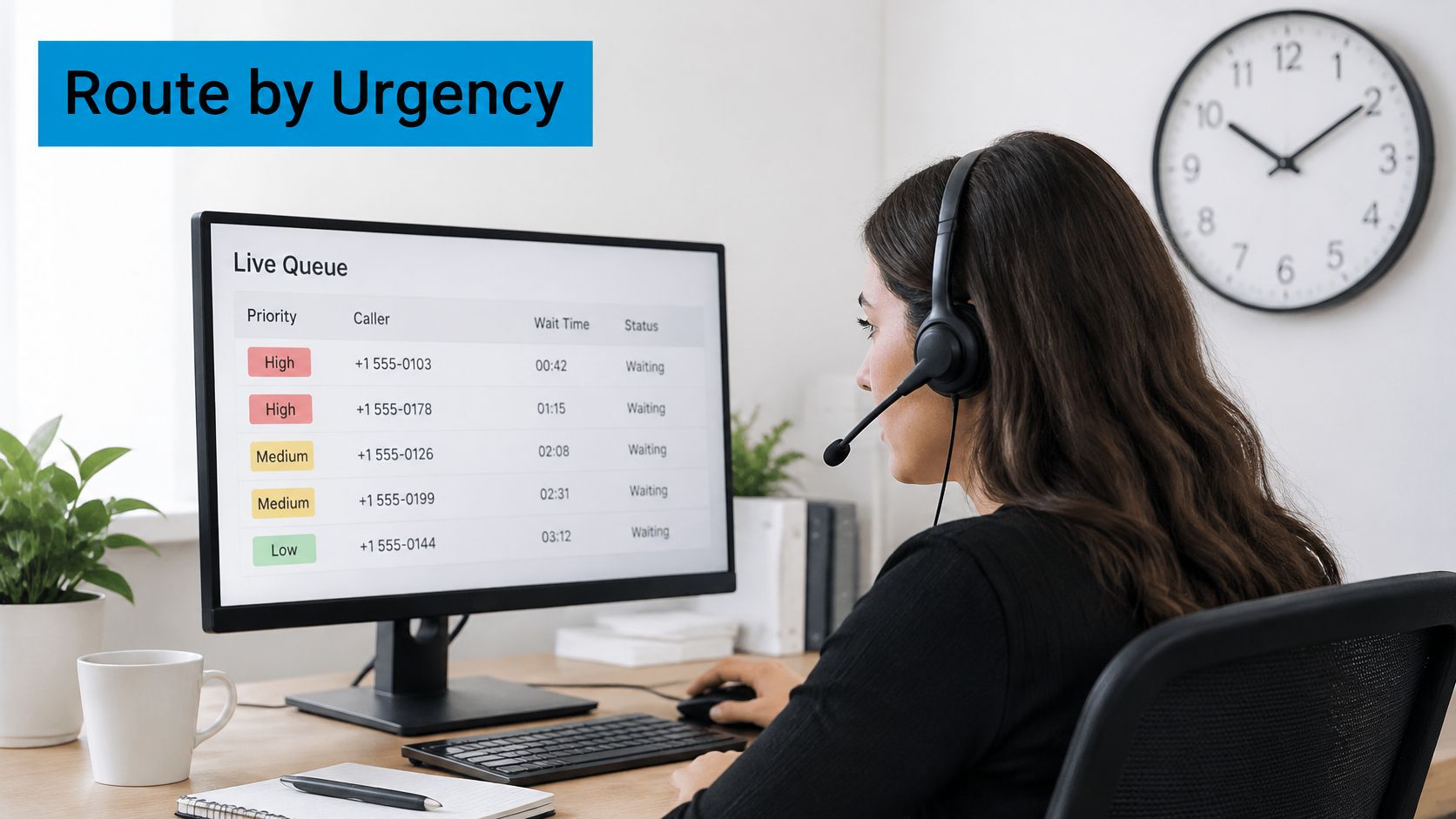
Routing is a queue problem. A University of Chicago Booth study of 1.3 million calls to an Israeli bank's customer-service center found that caller patience changes with operational conditions such as call priority, staffing, routing, and service speed, and that models built on fixed patience assumptions could substantially misestimate abandonment. So measure before you route. Pull one week of call logs, calculate arrivals per hour and average call duration, and staff to the peaks those numbers reveal. Our guide to call routing for small businesses covers the setup steps once you have that baseline.
| Call type | Example | Route to | Target answer time |
|---|---|---|---|
| Emergency | No heat in winter, active water leak | Priority queue and on-call technician | Under 15 seconds |
| Revenue-critical | New patient booking, insurance quote | Live agent, with automated booking as backup | Under 20 seconds |
| Routine request | Maintenance tune-up, appointment reschedule | Automated intake and scheduling | Immediate acknowledgment |
| Sensitive or complex | Legal consultation, billing dispute | Trained specialist with a case summary | Set from your baseline; no research benchmark |
| After hours | Burst pipe at 2 a.m. | On-call route or emergency intake | Set per on-call rota; no research benchmark |
If you're evaluating phone systems to support this, it's worth taking time to compare business phone features against your routing table, because queue priority and overflow rules are the features that matter here, not handset specs.
Practical rule: a routing rule is working only if transfers fall as first-call resolution rises. If one moves without the other, you've moved the wait, not solved it.
Review the rules monthly against the call log. Monitor abandonment by queue and time of day, and add overflow coverage when emergency callers start hanging up at higher rates. The short walkthrough below shows what a live queue view should surface for that review.
Callbacks and Fair Fallbacks When Every Line Is Busy
"Answer faster" isn't a complete plan for a busy Tuesday. Recent customer-experience research in Shep Hyken's ACA State of CX 2025 report found that the average caller becomes frustrated after 11 minutes and 21 seconds on hold, and that callback is preferred over remaining on the line. UK communications data in the same body of research shows average broadband and landline wait time rose 13 seconds year over year, reaching 2 minutes and 1 second in 2024. Queues drift, and callers feel it before your reports do.
I'd argue a transparent callback promise often beats a live queue that leaves callers trapped and guessing. Reducing perceived effort can matter more than shaving seconds off a wait nobody understands. A caller who hangs up knowing they'll be called at 2:30 by someone holding their details is better served than one who spent nine minutes listening to hold music.
When to offer the callback
Announce an estimated wait as soon as the caller joins the queue. Offer a callback once that estimate passes roughly two minutes, and offer it immediately for revenue-critical calls like a new patient booking or an insurance quote. That two-minute threshold is a starting point, not a law. Test it against your own abandonment data by queue, because patience shifts with priority and staffing.
Before the caller hangs up, capture five things.
- Callback number: read it back digit by digit, don't trust caller ID alone.
- Intent: one line, such as "furnace short-cycling since last night."
- Urgency: emergency, revenue-critical, or routine, so the queue can sort itself.
- Preferred time window: a slot the caller chooses beats a surprise call during dinner.
- Address or booking reference: whatever the returning agent needs to act without a second discovery round.
Fairness is the rest of the design. Confirm the callback time out loud. Pass the structured summary to the agent who calls back, so the caller never repeats the issue. Treat voicemail as a capture step, never as completion. Say an after-hours HVAC caller reaches a full line on a Friday night. The fair outcome is a confirmed Saturday morning callback slot with the fault already logged, not a voicemail somebody opens on Monday. A structured missed call recovery system turns these near-misses into a tracked queue instead of a pile of messages nobody owns.
Measure callback completion the way you'd measure answer rate. A promise made and kept late is still a broken promise, and callers remember it that way.
Escalating to Humans, AI and Specialists Without Losing Context
The clearest case is the emergency. A caller mentions a gas smell or chest pain, and there's no script to finish. You move now, you take the location and callback number, and you get a human or emergency guidance on the line. Escalation should work like that for every trigger, fired by a signal in the call, not by the caller asking twice.
That discipline matters because resolution alone doesn't build trust. The State of Customer Experience report from WeConnect reports that more than 45% of surveyed consumers were dissatisfied with the individual they spoke with, despite over 82% saying their issues were resolved the same day, and only 13% of consumers globally waited less than five minutes to interact with a service agent during the previous year. How the hand-off feels is part of the outcome.
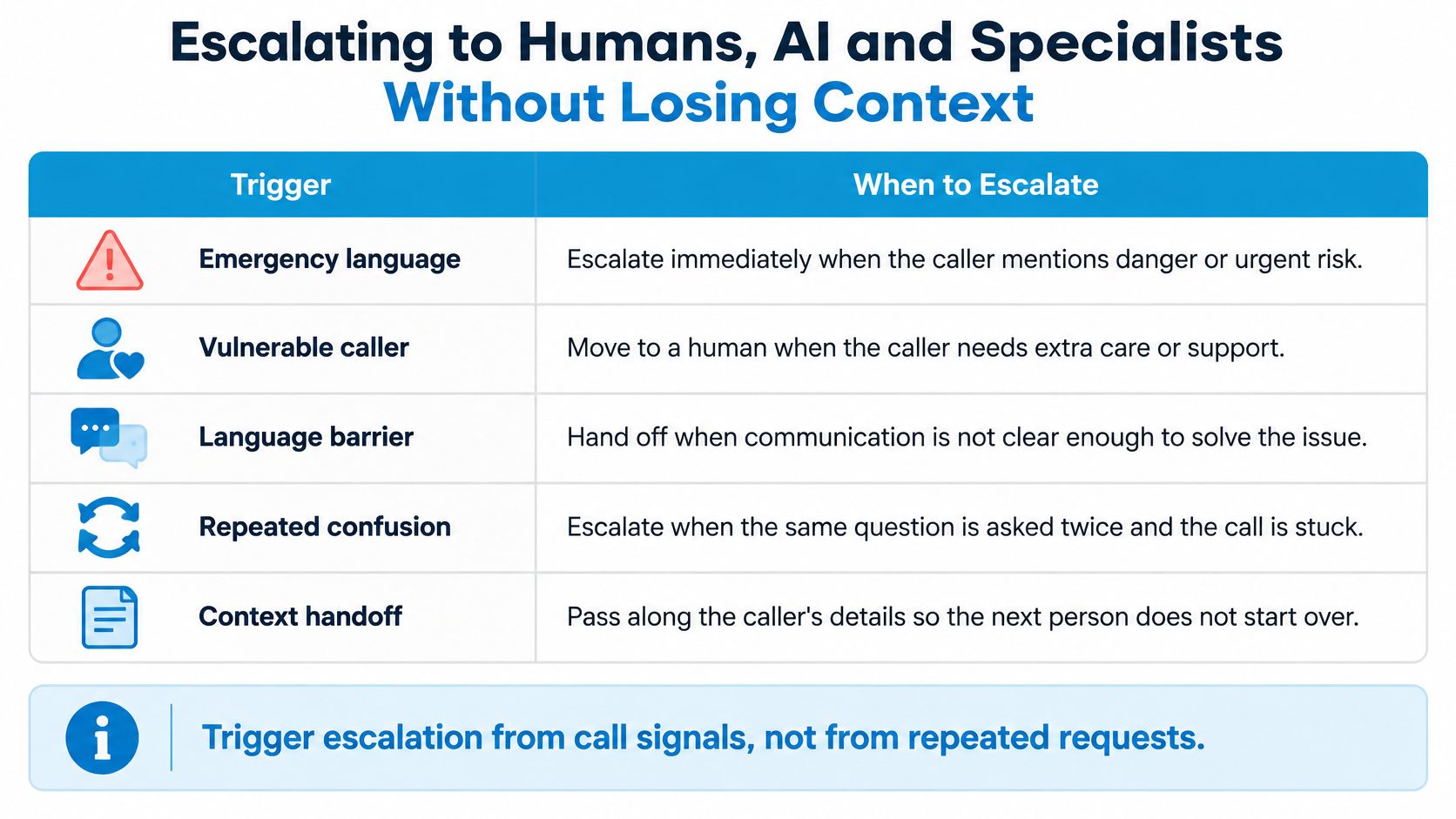
| Signal | Example | Route | Context to pass |
|---|---|---|---|
| Emergency language | Gas smell or chest pain mentioned | Emergency guidance or on-call human now | Location, nature of emergency, callback number |
| Vulnerable caller | Caller confused about an appointment | Trained human using a patience protocol | Stated need, confirmed identity, consent to continue |
| Language or accessibility need | Caller asks for an interpreter | Interpreter or relay workflow | Language, preferred callback channel |
| Regulated advice | Asks whether a medication dose is safe | Licensed staff; no automated judgment | Question verbatim, no diagnosis given |
| Payment dispute or threat | Refund demand with threats | Supervisor | Invoice, prior contacts, promised action |
Automated intake handles the routine majority well. Bookings, hours, directions, and status checks don't need a human, and teams evaluating broader automation can look at how AI agents for enterprise automation handle structured tasks at scale. The limits are the point. The first handler, human or automated, never makes medical or legal judgments, never guesses at a dosage or a filing deadline, and confirms consent before transferring a caller who has shared something sensitive.
The warm hand-off standard
The receiving person hears a short summary before the caller speaks. The caller does not repeat sensitive details. The transfer is logged with a reason, so you can audit patterns later. Our breakdown of cold transfer versus warm transfer outcomes shows why the blind transfer is where trust and first-call resolution go to die. A hybrid setup, AI intake for routine calls with trained human agents taking the exceptions and both writing to the same CRM and calendar record, is one practical way to run this in home-service, clinic, and legal settings.
Accessibility and Relay Calls Done Right
A caller dials 711, and a communications assistant joins the line. The assistant voices the caller's typed message and types your reply back. Under the ADA Title III primer on telephone relay services, staff must accept relay calls and handle them like any other call, and a business must not reject one because communication happens through an intermediary.
Say a plumbing company takes a relay call about a leaking water heater. The receptionist doesn't ask the caller to use another channel. She runs the normal intake through the assistant: service address, emergency status, requested appointment window, and callback number. The pace is slower. The fields are identical. That's the whole adjustment, and teams that treat relay calls as suspicious or inconvenient are both breaking the rule and turning away a customer mid-booking.
The five-point checklist for this week
- Treat a relay call as a standard inbound call. Same intake fields, same booking authority, same confirmation steps.
- Speak directly to the caller, not to the assistant. Say "What's the service address?" rather than "Ask her for the address." The assistant is a channel, not the customer.
- Confirm the callback number and channel out loud. Read back the appointment window too, since typed exchanges leave more room for a transposed digit.
- Offer an interpreter or alternative channel when a language barrier appears. Log the request even if you can't fulfill it on that call, so the gap is visible.
- Record the accommodation in the CRM. The next employee should see "prefers relay, confirm by text" on the record instead of asking the caller to explain their setup again.
Build this into new-hire training rather than leaving it to whoever answers. One ten-minute walkthrough with a practice relay scenario costs almost nothing, and it prevents the most common failure I see, which is a well-meaning receptionist freezing because the call format is unfamiliar.
Run a One-Week Missed-Call Audit Before You Change Anything
Don't buy coverage before you know where calls die. Start by exporting one week of call logs from your phone system or CRM. You need six fields per call: timestamp, call type, answered or abandoned, transfer flag, callback status, and disposition code. Add your voicemails for the same week, because an abandoned call that left a message is a different problem from one that vanished.
From that export, calculate three numbers by call type and by hour: abandonment, first-call resolution, and repeat contacts. Then sample about 20 recordings across the week and compare what your team logged against what the caller got. A completed call is not a resolved issue, and this listening pass is where that gap shows up. I'd weight the sample toward your busiest two hours and your after-hours window, since that's where the honest data lives.
The decision rule
- Gaps cluster after hours or at peaks: add overflow coverage or an AI receptionist for intake and scheduling. The problem is capacity, not skill.
- Gaps cluster on complex or sensitive calls: fix escalation and warm transfers first. More coverage just means more people handing off badly.
- Callbacks are promised but not completed: fix ownership and the callback queue before anything else. That's a process failure, and it's usually the cheapest one to repair.
Once the audit tells you which problem you have, test the fix against the same numbers. Recepta.ai offers 24/7 call handling with escalation to trained agents and a 30-day risk-free trial, so a team can run it against its own audit baseline for a month and compare abandonment and callback completion before committing. Keep the trial honest. Use the same export, the same call types, and the same hours, or you'll talk yourself into a result that isn't there.
If your audit shows calls slipping away after hours or callbacks going unmade, Recepta.ai answers every inbound call around the clock, books appointments, captures intake details, and escalates sensitive conversations to trained human agents with full context. Start the 30-day risk-free trial, point it at the gaps your audit found, and let your own abandonment and callback numbers make the decision.