
Answering a Business Phone: A Step-by-Step Guide for 2026
A pipe bursts at 6:40 p.m. The homeowner calls the plumber whose magnet is still on the fridge. Four rings, a generic greeting, then voicemail. By the time anyone listens, another company has the job on the calendar.
That is the ordinary version of answering a business phone. The caller is not waiting for a brand moment. They want someone, or a clear system, that can take the problem, keep the details, and finish the next step.
Pickup speed is only the start. The name, address, issue, and promised action have to survive a transfer, a callback, and any automated handoff. If the next person asks the caller to start over, the first answer did not count.
Why Missed Calls Cost More Than You Think
A dental office locks the door at five. At 5:12 a new patient calls about a cracked tooth. The desk is empty, and the mailbox is full. There is no name, no number, and no chart to call back.
Silence is not a neutral result. A published business number is an access point. If nobody captures the caller, the business never learns who needed help, or what that visit was worth.
In a 30-day study of 85 small businesses across 58 industries, only 37.8% of incoming calls were answered by a person. Another 37.8% reached voicemail, and 24.3% received no response at all. Roughly 62.1% of calls never connected directly with a human. The sample is not national, but it covers many local operators, including home services and practices.
Voicemail is not an answer
A voicemail can still hold a name and a callback number. A dead line often holds nothing. For an after-hours pipe burst or a same-day dental slot, the caller usually dials the next provider instead of waiting.
Four numbers to track this week
Do not start with a new phone system. Start with a score you can read on Friday.
- Live-answer rate: the share of calls a person picks up.
- Voicemail rate: the share that lands in a mailbox.
- No-response rate: the share that ends with no message and no contact data.
- Callback completion: the share of those messages that get a real return call.
Magnitude Marketing's front desk automation guide is a useful map when the desk is already overloaded and you need to decide what a person should still own. Pair that judgment with a missed-call recovery system so an unanswered ring becomes a logged follow-up instead of a blank row.
Opening Scripts and Tone That Build Trust
The first thirty seconds set whether the caller stays. Name the business, name yourself, then stop talking long enough to hear them. A short pause sounds like attention. A rushed greeting sounds like a queue.
Three openings you can adapt
A plumbing dispatcher on a leak call can say:
"Thanks for calling Northline Plumbing, this is Maya. Is water actively leaking right now?"
That one question sorts emergency from routine before you ask for an address.
A law office screening a new client sounds different:
"Good afternoon, Hale and Ortiz, this is Jordan. May I have your name, and is this about a new matter or an existing case?"
You are not giving legal advice. You are labeling the call so the right person gets it.
A multi-location franchise needs a branch choice early:
"Thanks for calling BrightClean, this is Alex. Which location are you trying to reach, or should I book this from the main office?"
If you guess the branch, you create a second call.
Pace, and what to do when they are already upset
Read the greeting at the speed you would use with a neighbor, not a slogan. Smile if you want, but do not perform. Drop filler such as "absolutely" and "no problem" until you know the problem.
When a caller arrives angry, lower your volume and slow the next sentence. Acknowledge the inconvenience in one line, then ask for the fact you need.
Practical rule: Name the feeling once, then move to a fact. "I hear this has already taken too long. What is happening at the property right now?"
Do not argue about who dropped the last call. You cannot fix tone by winning the first minute. You fix it by proving you wrote down the right details.
Building Call Routing and Escalation Rules That Hold Up
Words get the caller to stay. Rules decide who owns the next minute. High-performing teams do not transfer on a hunch. They run a short sequence and only then move the call.
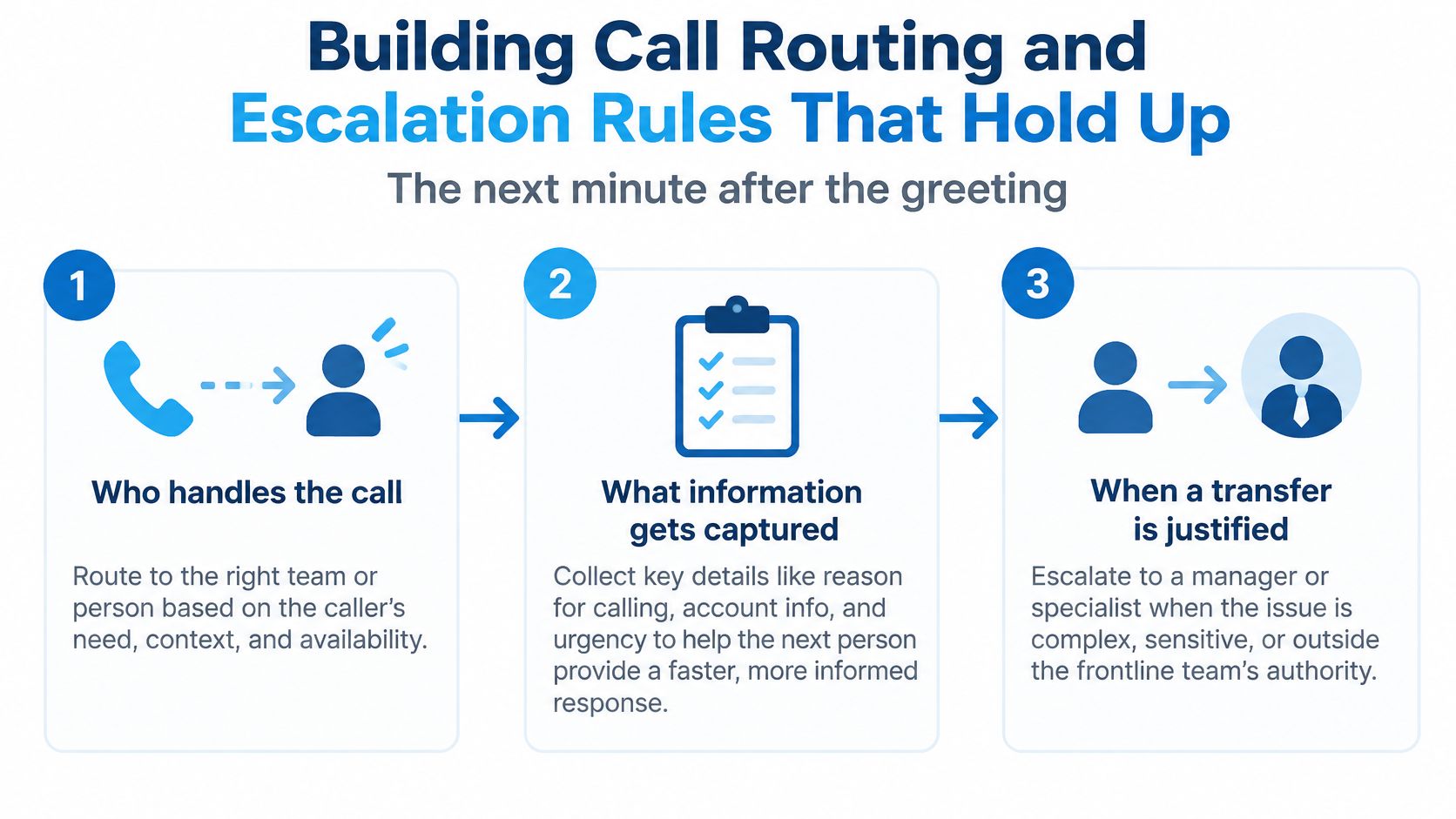
The sequence that holds context
- Answer with identity. Business name, then your name.
- Verify three facts. Caller name, callback number, and purpose.
- Classify the request. New lead, existing customer, scheduling, billing, emergency, or escalation.
- Restate the outcome. "You need a tech before 8 p.m.," or "You need the invoice resent."
- Resolve or book now. Finish it on this call when you can.
- Confirm owner and deadline. Who does what, by when.
- Document before you hang up. If it is not written, the next person does not have it.
First-contact resolution is the share of contacts closed without a repeat interaction. SQM Group benchmarks more than 500 North American contact centers and reports an all-industry rate around 69% as typical, 70–79% as good, and 80% or higher as world-class. Only about 5% of centers reach that top band. Chasing a world-class number with sloppy transfers will not get you there.
When a transfer is earned
The common failure in home services, healthcare, legal, and finance is a premature transfer. The caller is moved before anyone has the problem, the urgency, the location, eligibility, and the outcome they want.
Escalate when you hit a safety issue, clinical or legal uncertainty, a complaint, a payment dispute, or a request that needs a licensed person. Routine scheduling should not bounce.
A plumbing tree can stay this small:
- Active leak, gas smell, or no water: capture address and shutoff status, then page the on-call tech. Do not park them in billing.
- Estimate for a non-leaking job: capture address, fixture, and preferred window, then book or queue a quote.
- Existing job status: pull the work order before you transfer to dispatch.
- "I was already billed": stay on the line, note the invoice number, and send it to billing with the dispute in one sentence.
A deeper look at intelligent call routing helps if your menu currently asks callers to pick a department they do not understand.
The same idea shows up in how teams coach the handoff itself.
Handling Appointments, Complaints, Sales Calls, and Emergencies
Four call types look different on the surface. They use the same intake fields. What changes is who owns the next step, and what the caller hears before you hang up.
An Accenture survey of 13,168 consumers across 33 countries found that 91% were frustrated by contacting a company multiple times for the same reason, 90% disliked long hold times, and 89% were frustrated by repeating their issue to multiple representatives. Passing the story forward is the whole job.
Four calls, one intake
Dental appointment. Priya calls for a cleaning and mentions a sensitive molar. Before any transfer, capture name, callback number, preferred days, new or existing patient, and the sensitivity note. The scheduler owns the slot. Before you end, read back the day, time, and what to bring. Practices that improve digital scheduling adoption still need the phone for callers who will not book themselves, especially when the reason is urgent or unclear.
Insurance complaint, second call. Marcus has already called twice about a claim. Capture the policy number, incident date, and the outcome he wants, such as a status or a supervisor. Route to the claims owner, not a general queue. Tell him, "I am sending the policy number, the March 2 incident date, and your request for a written status, so you do not have to retell it."
Cleaning quote. A property manager wants a price for a 2,400-square-foot office, twice a week. Capture address, square footage, frequency, and access hours before anyone talks price. Sales owns the quote, with a same-day callback window if you cannot price it live.
Pest control emergency. The caller reports standing water and a gas smell after a treatment. This is not a reschedule. Capture address, whether anyone is still inside, and whether they have called emergency services. Page the on-call lead. Say who is coming and when you will call back if the tech is more than ten minutes out.
For callers who are already angry, the tone work in a guide to handling difficult customers pairs with this intake. Empathy without the policy number still makes them repeat the story.
| Call type | Capture before transfer | Route to | Response expectation |
|---|---|---|---|
| Dental appointment | Name, number, preferred days, new or existing, clinical note | Scheduler | Slot read back before hang-up |
| Insurance complaint | Policy number, incident date, requested outcome | Claims owner | No full retell on the next call |
| Cleaning quote | Address, size, frequency, access hours | Sales | Price or a timed quote callback |
| Pest emergency | Address, occupancy, safety status | On-call lead | Immediate page, not a mailbox |
Voicemail, Callbacks, and Follow-Up Discipline
A mailbox is a holding pen. It is not a plan. The leads you already had disappear when "we will call you back" has no owner, no clock, and no proof that anyone dialed.
A documented callback queue beats voicemail alone. Voicemail depends on someone remembering to listen. A queue has a priority, a name, and a due time. Nonurgent work can wait in tiers. Urgent work should not.
Lead-response research summarized from the MIT and InsideSales study found that moving from a five-minute response to a 30-minute response was associated with a 100-fold decline in contact odds and a 21-fold decline in qualification odds. That is why a callback promise is not a resolution. For urgent service, route now, capture the address and the issue before any transfer, and let SMS or the CRM log the call automatically. For everything else, a tiered queue is safer than a greeting that says "leave a message."
A legal intake greeting that names the window
"You have reached Hale and Ortiz intake. We are with another caller. Leave your name, number, and whether this is urgent. We return intake calls within two business hours, and sooner if you say the matter is time-sensitive. If this is an emergency, hang up and call emergency services."
Do not promise "as soon as possible." That phrase cannot be audited.
What a complete callback record contains
Review the log every week. A usable row has:
- Named owner: a person, not "front desk."
- Due time: a clock time, not "later."
- Preferred channel: phone, SMS, or email, in the caller's words.
- Reason and urgency: one line a stranger could act on.
- Proof of contact: a timestamp that the attempt happened, including no-answer.
If any field is blank, the loop is open. Fire the CRM note at the moment of the call, not at the end of the shift, or the queue lies about what is still waiting.
Choosing Tools and Training Staff for Phone Coverage
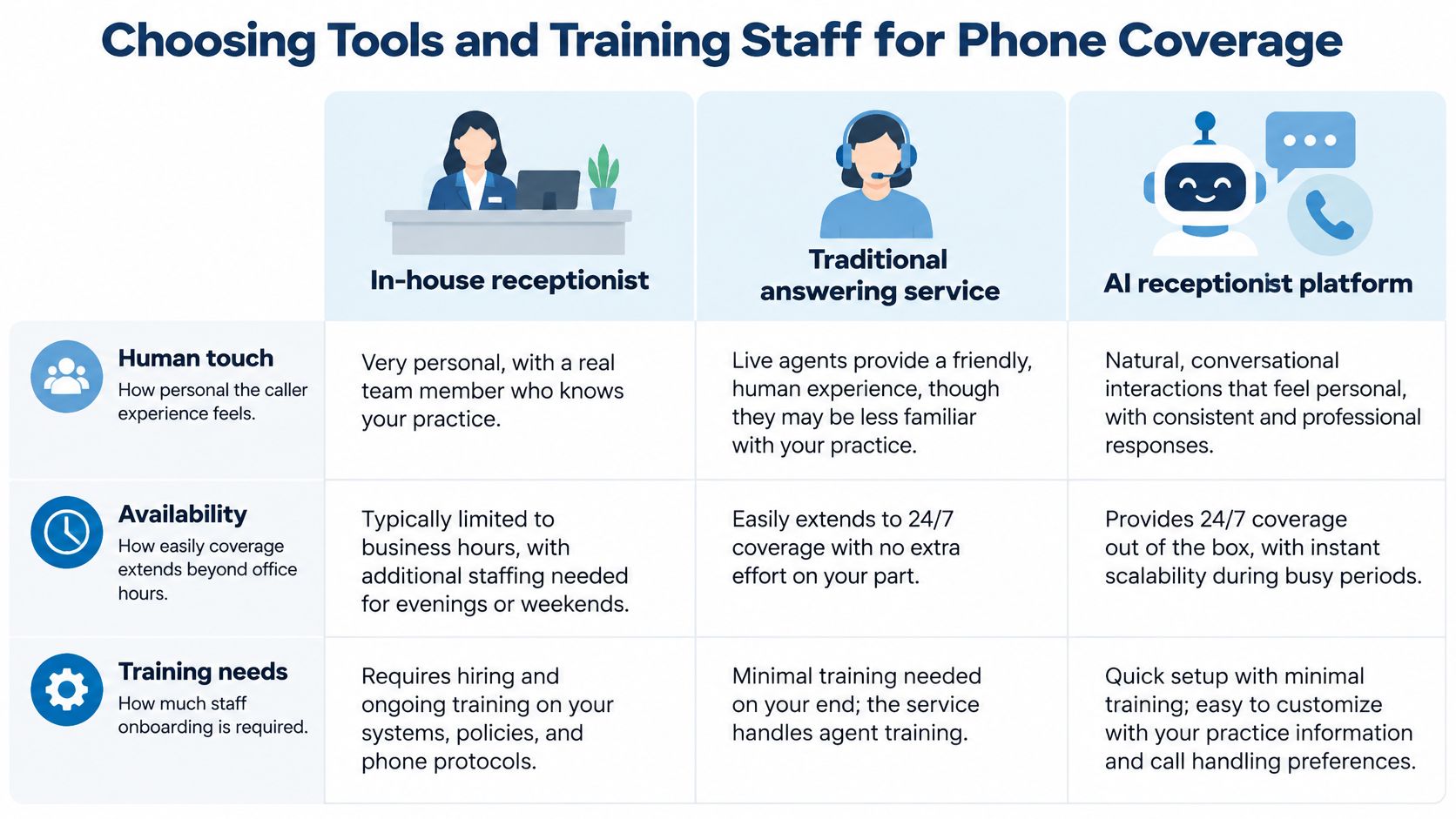
Coverage is a design choice, not a personality test. Judge an in-house receptionist, a traditional answering service, and an AI receptionist platform on the same criteria. Hours covered, cost per answered call, escalation quality, and whether the record looks the same on Tuesday and Saturday.
Three models, no single winner
In-house reception wins on local knowledge. The person knows which tech hates attics and which attorney is in court. It loses when one person takes lunch, PTO, or a walk-in at the same time the phones spike. Training stays on you, and the record quality swings with who is on the desk.
A traditional answering service extends hours without hiring a night shift. Quality depends on the script you give them and how fast they reach your on-call. The weak spot is a message that arrives without the fields your team needs, so the morning still starts with guesswork.
An AI receptionist platform covers nights and spikes without adding seats, and it can log every call the same way. It is a poor fit when the caller is distressed, the facts are ambiguous, or a licensed judgment is required, unless a human takes over fast. Recepta.ai is one option in this category. It handles inbound and outbound calls, books appointments, captures leads, sends follow-ups, and escalates to trained agents when judgment is needed. It connects with more than 2,500 tools, including CRMs and calendars, and it logs calls with summaries and real-time analytics.
Teams spread across sites often pair any of these models with VoIP for distributed business teams so a call can land on the right desk without a hardware shuffle.
Disclosure and what staff still practice
A November 2025 survey of 1,000 U.S. adults found that only 22% said companies always clearly disclosed when AI was being used, while 69% believed brands should always reveal it. Tell callers when they are speaking with an automated system, how to reach a person, and what may be recorded. Scheduling and basic lead capture can stay automated. Complaints, clinical concerns, disputes, and unclear requests need a fast human path.
Train people on the script, the escalation list, and a weekly listen of two calls each. Tools do not replace that habit.
Measuring Quality and Taking Your Next Step
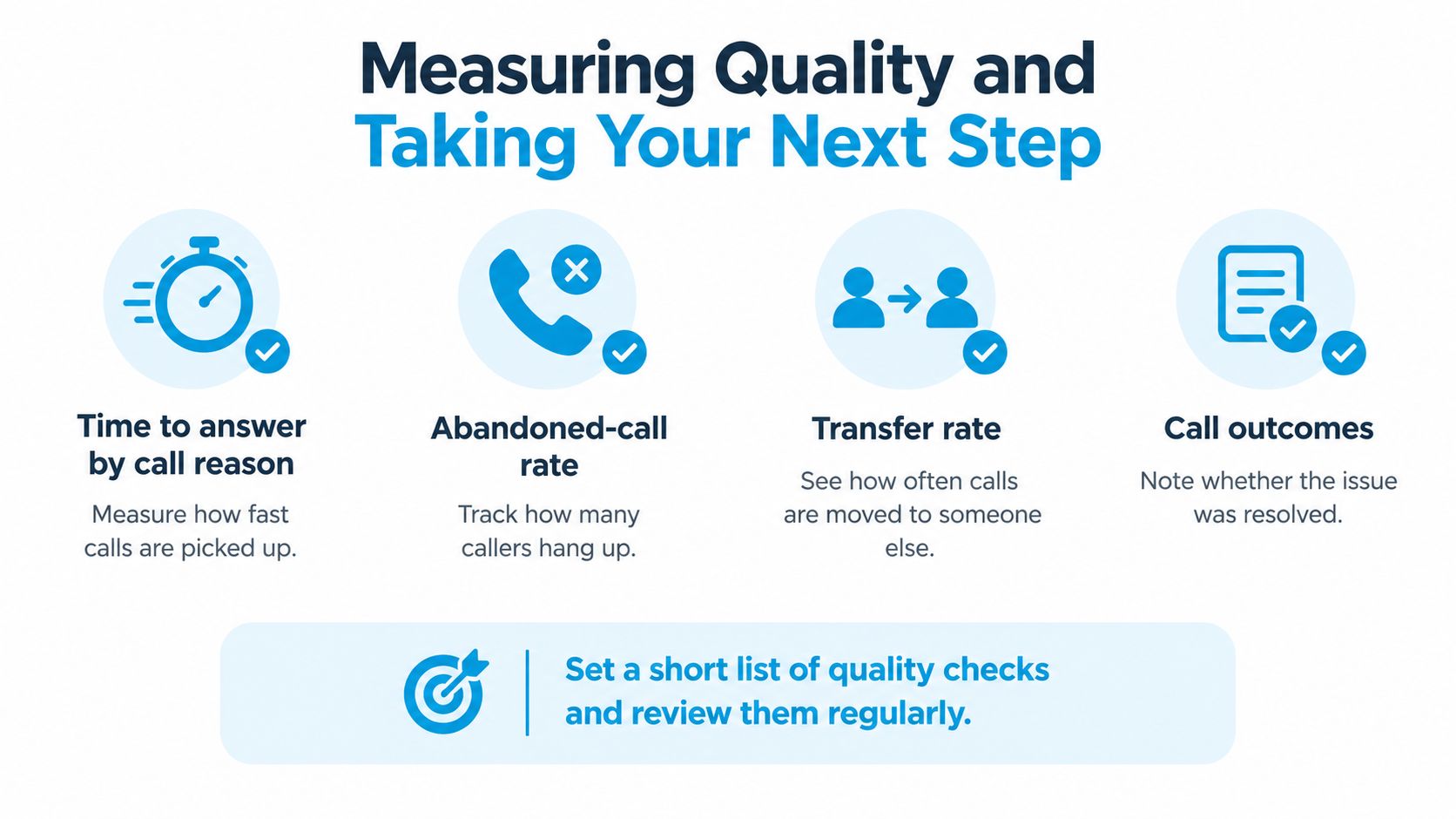
Answer rate and a single average speed hide the calls that hurt. Split the score by reason. A billing question that waits four minutes is not the same failure as an emergency that waits four minutes.
A weekly scorecard
Keep the list short enough that a supervisor will open it.
- Time to answer by call reason: not one blended average.
- Abandoned-call rate: who hung up before a person or a completed handoff.
- Transfer rate: how often the call moved, and how often it moved twice.
- Callback completion: promised returns that were completed.
- First-contact resolution: closed on the first interaction, by reason.
Each week, pull the slowest calls and any call transferred twice. Listen with a simple card. Did we capture name, number, and purpose before the move? Did we restate the outcome? Did the record match what was said? Call monitoring software makes that listen faster, but the questions stay the same if you are still on a basic recording.
One action this week
Export the last 30 days of missed and voicemail calls. Count how many never received a callback. If that pile is mostly process, fix the queue, the script, and the owner field before you buy anything. If the pile is mostly hours you cannot staff, test coverage you do not have to hire.
A 30-day risk-free trial at Recepta.ai, which sets up in minutes, is one low-risk way to run that test on nights and overflow while you keep your escalation rules. Judge it on callback completion and repeat contacts, not on how fast the greeting plays.
Recepta.ai answers inbound and outbound calls, books appointments, captures leads, and hands complex calls to trained agents so the details do not die in a transfer or a mailbox. If missed calls and repeat explanations are already costing you jobs, see how the workflow fits your desk at Recepta.ai.