
Average Handle Time: Strategies for 2026 Success

Your phones are lighting up, the team is already juggling callbacks, and you're trying to figure out why a day that started with good intentions is ending in a backlog. In that moment, average handle time can look like the one number that will finally bring order to the chaos. It does matter, because it shows how long each customer interaction really ties up your operation, but it can also become a trap if you treat speed as the only scoreboard.
That's the mistake many businesses make. They chase a shorter handle time like a pit crew racing the clock, then wonder why customers call back, agents sound rushed, and the work just shows up somewhere else. The better move is to treat average handle time as a balance point, not a trophy. You want calls handled efficiently, yes, but you also want the issue resolved, the customer to feel heard, and the next interaction to start with clean notes and the right context.
For business owners, that balance is where profitability lives. A lower handle time can help staffing and throughput, but pushing it too hard can subtly damage first contact resolution, customer satisfaction, and team morale. The smartest operators don't ask, “How do I make every call shorter?” They ask, “When is a shorter call better, and when is it just masking a problem?”
Introduction The Double-Edged Sword of Call Efficiency
A service business can look busy and still be leaking money. Agents are answering calls, customers are being placed on hold, notes are getting entered, and the queue never seems to empty. In that environment, average handle time becomes tempting because it feels concrete, measurable, and controllable.
That appeal is real, but it's also why the metric gets misused. Zendesk notes that a “good” AHT is around six minutes and also recommends call listening and customer feedback instead of speed alone, while Zoom warns that the lowest time isn't always the best if agents rush and quality falls. Freshworks frames AHT as something to balance with other outcomes, not treat as the only goal. The practical lesson is simple, a call that ends quickly but creates a callback isn't efficient, it's deferred work.
Why operators get seduced by the number
AHT is easy to put on a dashboard, easy to compare, and easy to turn into a target. That's useful, until managers start rewarding the wrong behavior. Agents begin cutting explanations short, skipping context, or avoiding the extra minute needed to fully resolve the issue.
Practical rule: if reducing handle time makes your team less certain, less thorough, or less helpful, you're not improving efficiency. You're just moving labor into the next contact.
The right way to think about AHT is like a pit stop in a race. A fast stop matters, but only if the car leaves the pit ready to win the next lap. The same goes for service. If the customer leaves confused or incomplete, the next “lap” is another call, another ticket, or another frustrated review.
What better looks like in practice
In a plumbing or HVAC office, a well-run call might take a little longer because the agent confirms the problem, books the right tech, and logs everything cleanly. That's a good use of time if it prevents a second call or a wasted truck roll. In a billing inquiry, the same logic applies. A slightly longer call that resolves the issue and updates the account can be far more profitable than a short call that leaves the customer uncertain.
The point isn't to defend long calls for their own sake. It's to make sure the time spent is creating resolution, not waste. That's the core business test behind average handle time.
What Is Average Handle Time and How to Calculate It
Average handle time is the total time your team spends handling a customer interaction, divided by the number of interactions handled. This metric can be compared to a pit stop in a race. The car is off the track, the crew is doing all the work needed to get it back out, and the clock keeps running until the service is done.

The three parts that make up AHT
The metric has three core components:
- Talk Time: the actual conversation between the customer and the agent.
- Hold Time: the time the customer spends waiting while the agent looks something up or checks on the issue.
- After-Call Work, or ACW: notes, CRM updates, appointment scheduling, follow-up tasks, and anything else the agent does right after the call.
The formula is straightforward: (Talk Time + Hold Time + After-Call Work) / Total Number of Calls = AHT. The tricky part isn't the math, it's keeping your definitions consistent across reports. If one dashboard folds hold time into talk time and another doesn't, the number stops meaning anything useful.
A clean way to audit this is to compare calls of the same type. A scheduling call, a billing correction, and a technical troubleshooting call should not be judged against the same internal expectation. That kind of blended view hides the actual operational dynamics of the work.
The number matters less than the story behind it. High hold time points to lookup friction. High ACW points to documentation friction. High talk time often points to issue complexity or weak knowledge transfer.
A simple service-business example
Take a fictional HVAC company handling a day's worth of inbound calls. Suppose the team's total talk time, hold time, and ACW all add up to a combined handle time pool for the day. If that total is divided across all calls handled, the result is the company's AHT for that period.
The value of the calculation isn't just the answer, it's the diagnosis. If the hold time is the biggest chunk, the team probably needs faster access to information. If ACW is dragging the metric down, the notes process or ticketing workflow may be too manual. If talk time is high because customers keep asking the same questions, the front end of the operation, FAQs, self-service, or intake, needs work.
For a deeper quality-control angle, it's worth pairing AHT tracking with call review processes like those used in quality assurance in call centers. That's where the hidden friction usually shows up.
Why AHT Matters for Your Business KPIs
AHT matters because it touches several business outcomes at once. It affects staffing, service levels, customer experience, and the pressure your agents carry during the day. If you only watch the handle-time number, you miss the chain reaction that follows it.

The cost side of the equation
Longer calls consume more labor time. That means fewer interactions handled per shift and more pressure on staffing. It does not mean every call should be cut short, because some contacts deserve more time. It does mean handle time is tied to productivity, and productivity is tied to cost control.
Operations teams see the same pattern on a production line. If each unit takes longer to process, the queue builds behind it. In service, that queue is a customer waiting for help. So AHT affects more than one call, it shapes the pace of the whole day.
The customer experience side
A short wait helps. A rushed call that ends without a real solution does not. When an agent is forced to speed through verification, skip explanations, or end the conversation before the issue is settled, customers often come back with the same problem. That creates frustration and makes the business look disorganized.
AHT is most useful when you view it alongside outcomes like first contact resolution, satisfaction, and the practical quality of the conversation. That balance is part of what first call resolution measures in the first place. The metric can show efficiency, but it can also reveal where your process is forcing the agent to choose between speed and completeness.
The team side
Unrealistic handle-time pressure wears on agents quickly. People know when they are being pushed to move faster than the workflow allows. That pressure leads to hurried notes, weak customer explanations, and avoidable mistakes that show up later as rework.
Internal performance measures should help the team do better work, not just move faster. AHT works best as one part of a broader scorecard, alongside resolution quality, customer feedback, and coaching signals that show where the process is slowing people down.
AHT Benchmarks Across Different Industries
Context matters more than the raw number. A “good” average handle time for a simple home-service booking is not the same as a legal intake call or a finance verification call. Businesses that sell a personal, consultative service should expect a different pattern from businesses handling simpler transactional requests.
| Industry | Typical AHT Range (Minutes) |
|---|---|
| Home Services | Varies by call complexity |
| Healthcare | Varies by appointment or triage complexity |
| Legal | Varies by intake and case complexity |
| Finance | Varies by verification and compliance needs |
The useful question isn't “How do I hit the same number as someone else?” It's “What should my number look like for my call mix?” A dispatch-heavy HVAC office, for example, may spend more time on routing and scheduling. A small law firm may spend more time qualifying the caller and collecting enough detail to route the right attorney or intake specialist.
Some call types deserve more time because the cost of rushing is higher. A customer who needs a same-day service appointment wants speed, but a caller with a billing dispute or a medical intake question may need careful questioning and clear explanations. That extra time is not wasted if it prevents a callback, a misroute, or a second conversation that drains both labor and trust.
How to use benchmarks without misusing them
A benchmark should start the conversation, not end it. If your calls are more complex than average, a higher AHT may be perfectly normal. If your calls are simple but the handle time keeps climbing, that's a sign the process needs work.
Compare calls that belong in the same bucket. New lead intake shouldn't be measured the same way as a service complaint. Appointment booking shouldn't be weighed against an escalation that requires multiple handoffs. The cleaner your segmentation, the more honest your analysis.
A benchmark is a compass, not a handcuff. Use it to see direction, then use your own call types to decide where “good” really is.
The Pitfalls of Chasing an Aggressively Low AHT
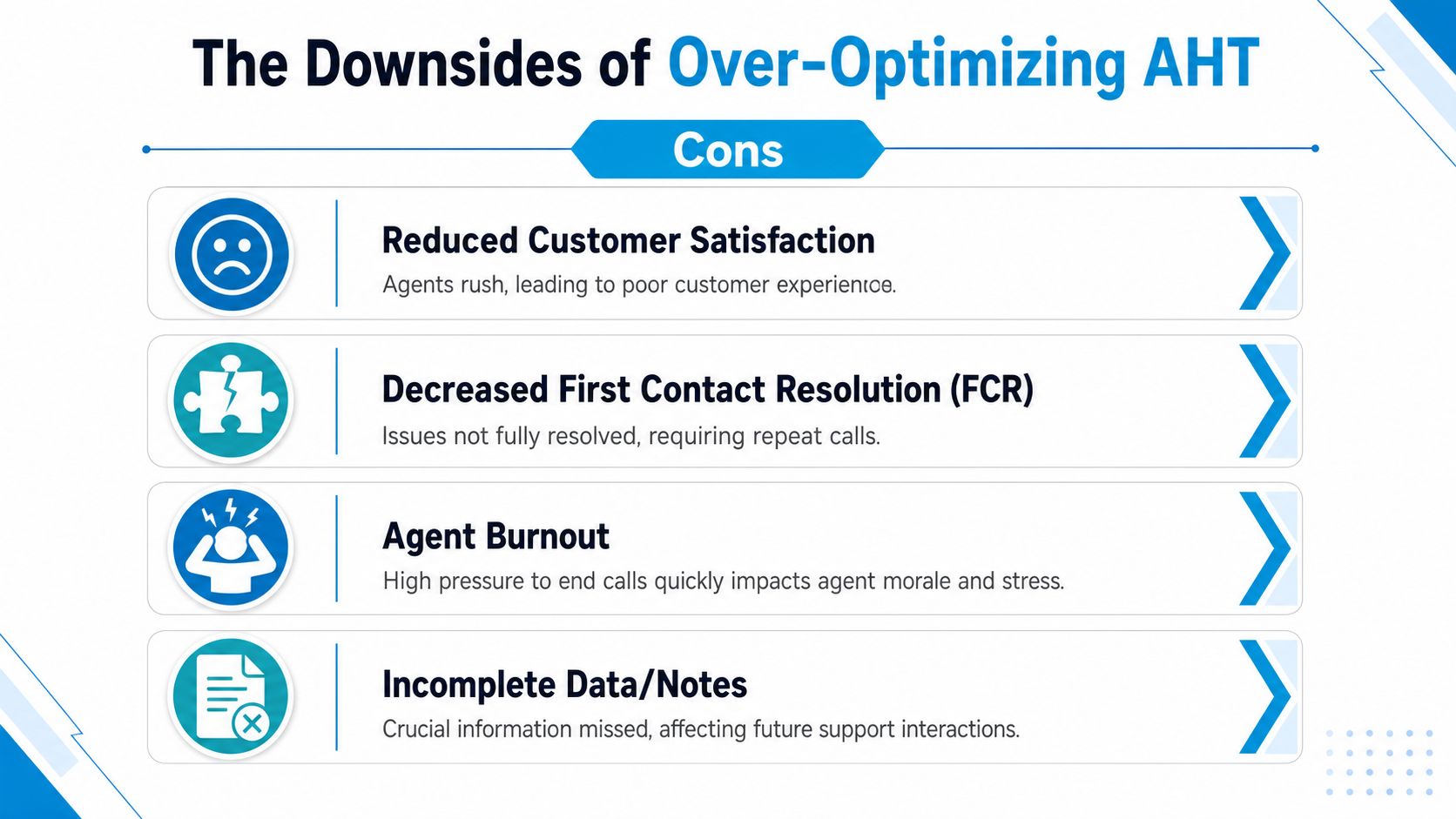
The pursuit of the lowest possible AHT can be misleading. According to analysis from Zendesk, while a “good” AHT is around six minutes, focusing on speed alone can cause service quality to drop. True performance is a balance between AHT and other outcomes like first contact resolution and customer satisfaction.
What gets worse when speed becomes the only goal
Agents start trimming the conversation instead of improving it. They may rush through verification, avoid deeper diagnosis, or end the interaction before the customer is confident the issue is fixed. That kind of call looks efficient on paper and expensive in reality.
The hidden cost is usually repeat work. A customer who wasn't fully helped calls back. A teammate has to reopen the issue. A supervisor spends time on an escalation that could have been prevented. You saved a minute, then spent ten.
Why first contact resolution is the real check
First contact resolution acts like a reality test for AHT. If handle time falls but repeat contacts rise, the number isn't proving efficiency, it's hiding incomplete work. That's why the best managers don't celebrate a shorter call in isolation.
Customer rapport also plays a significant role. A rushed interaction can make the customer feel dismissed, even if the agent meant well. That feeling shows up later in reviews, complaint emails, and retention decisions. People remember whether they felt helped, not whether the agent hit a clock target.
AHT is also a coaching problem when it gets too low. If agents believe they're being punished for taking the time to solve the issue, they'll start optimizing for appearances instead of outcomes. That's a bad trade for any service business.
If you want a practical lens on balancing speed and completeness, the advice in call handling best practices is most valuable when you use it to define what a complete call looks like, not just a fast one.
Actionable Strategies to Optimize Average Handle Time
The fastest way to improve average handle time is not to tell agents to talk faster. It's to remove friction from the call before, during, and after the conversation. That usually means cleaning up routing, documentation, access to information, and repetitive tasks.

Start with the work around the call
A lot of handle time is hidden outside the conversation itself. If agents have to bounce between systems, search for policy details, or retype customer information, the process is doing damage before the customer ever hears it.
The first fix is usually a knowledge base that's usable. Not a giant document graveyard, but a search-friendly library with the answers agents need most often. Pair that with clear documentation templates so ACW doesn't turn into guesswork.
Improve the path to resolution
Routing matters more than many teams admit. If the wrong person answers, the call gets transferred. If the agent doesn't have the right authorization or skill set, the customer gets placed on hold while somebody else is consulted. That creates more handle time and a worse experience.
A good routing setup is like sending the right mechanic to the right car. It saves time because it avoids detours. For a home-service business, that might mean separate flows for emergencies, estimates, and existing-service questions. For a professional services office, it might mean different intake paths for new leads versus active clients.
Use automation where the work is repetitive
Repetitive intake, booking, and note capture are prime candidates for automation. Recepta.ai is one option in this category, because it handles inbound calls, appointment scheduling, lead capture, and follow-ups while escalating when a human is needed. Used well, that kind of support reduces the amount of manual work that lands on your team in the first place.
If you're deciding where automation will help, the resource to discover your automation potential can help you spot the parts of the workflow that are still eating time. The point isn't to automate everything. It's to automate the parts that don't need a human brain attached to them.
Keep coaching tied to outcomes
Agent training should cover product knowledge, call control, system fluency, and clean wrap-up habits. The goal is not scripted sameness. The goal is fewer dead ends and less rework. When agents know what to ask, where to find answers, and how to close the loop cleanly, handle time comes down for the right reasons.
For teams comparing workflow options, the guidance in automated customer service solutions is most useful when you're deciding which tasks should stay human and which should be handled by software.
The video below is useful for leaders who want to see how automation can be applied without turning the customer experience robotic.
Conclusion Finding Your AHT Sweet Spot
Average handle time is not a trophy metric. It's a signal. Used well, it tells you where calls are getting slowed down by poor routing, manual work, weak knowledge access, or process gaps. Used badly, it pushes the team to rush, create repeat contacts, and erode trust.
The sweet spot is the number that keeps customers helped, not just handled. It's the handle time that supports first contact resolution, protects satisfaction, and keeps the team from burning out on preventable work. That usually means measuring AHT alongside resolution quality, customer feedback, and agent experience, instead of obsessing over one isolated target.
The most durable operations are balanced ones. They answer quickly, solve fully, and document cleanly. They use automation where it saves time and keep humans where judgment and empathy matter. That combination is what turns handle time from a cost to a capability.
A CTA for Recepta.ai.