
Cold Transfer vs Warm Transfer: A Complete Guide (2026)

A caller reaches your office after finding you on Google, referral list, or insurance directory. They explain the problem once, get placed on hold, then land with someone new who asks, “Can you start from the beginning?” If you run a plumbing company, that can cost you an emergency job. If you run a law firm, it can shake trust before the consultation even starts. If you manage a dental practice, it can push an anxious patient to call the next clinic on the list.
That’s why cold transfer vs warm transfer isn’t just a phone-system setting. It’s an operating decision that affects customer satisfaction, lead conversion, staff workload, and whether your team spends the day resolving issues or cleaning up preventable confusion.
A cold transfer moves the caller to another person or department with little or no context. A warm transfer includes a brief handoff, so the next person knows who’s calling and why. On paper, that sounds simple. In practice, the wrong choice creates repeat calls, frustrated staff, abandoned calls, and lost revenue.
Small businesses feel this harder than large enterprises. You don’t have layers of backup staff to absorb poor handoffs. One broken transfer can waste a technician’s dispatch slot, a scheduler’s time, and a sales opportunity all at once. It also changes the economics of your front desk or answering setup, which is why many owners start by reviewing how business answering service costs compare to in-house coverage before tightening their transfer process.
The High Cost of a Fumbled Handoff
The most expensive transfer mistake usually looks small in the moment.
A homeowner calls an HVAC company because the system stopped working. The first person answers, gathers the address, hears “no cooling,” and sends the call to dispatch. Dispatch picks up with no context and asks for the name, problem, and location again. The caller is already irritated. While dispatch is confirming details, another company answers their second call and books the job.
That loss didn’t happen because the team was rude. It happened because the handoff added friction at the exact point where the customer wanted certainty.
Where businesses feel it first
In smaller operations, a weak transfer process shows up in familiar ways:
- Leads cool off: New callers don’t want to repeat basic details when they’re trying to book quickly.
- Existing clients lose confidence: Repeat customers expect your team to know who they are and what happened last time.
- Staff get blamed for system problems: The second person on the line sounds unprepared, even when the process failed them.
- Managers chase symptoms: They coach tone, speed, and scripts when the issue is the handoff model itself.
A cold transfer can work fine for a simple routing task. A warm transfer can feel excessive for a basic directory question. The damage starts when teams use one method for everything.
A bad transfer doesn’t just lengthen one call. It creates doubt, and doubt sends people elsewhere.
The real decision
Most owners frame this as speed versus service. That’s too narrow.
The better question is this: What does this call become if the handoff goes wrong?
A missed estimate request, a no-show intake, a billing complaint that turns into churn, or a patient who never books again.
That’s the lens to use throughout the rest of the article. Not “which transfer type is better in general,” but “which one protects the value of this specific call?”
Defining the Two Types of Call Transfers
The mechanics matter because callers feel the difference immediately.
Here’s a quick side-by-side view.
| Transfer type | What the first person does | What the next person receives | Caller experience | Best fit |
|---|---|---|---|---|
| Cold transfer | Routes the call with minimal explanation | Little or no context | Abrupt, efficient when simple, frustrating when complex | Basic routing, low-context requests |
| Warm transfer | Briefs the next person before connecting | Caller name, issue, urgency, relevant notes | Guided, professional, lower repetition | High-value, urgent, emotional, or multi-step calls |
What a cold transfer actually feels like
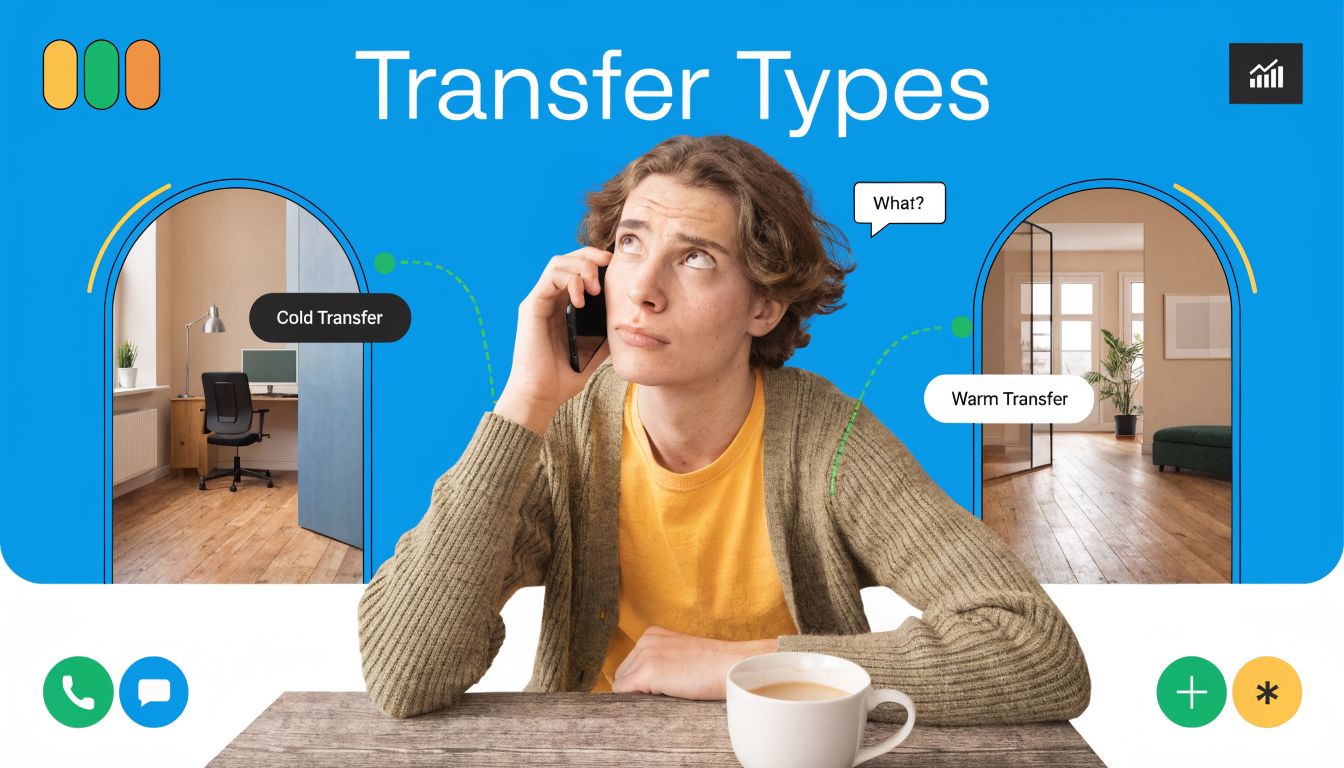
A cold transfer is also called a blind transfer. The first person decides they’re not the right destination, then sends the call onward without briefing the next person first.
For the caller, it usually sounds like this: “Let me transfer you.” Then they hear hold music, ringing, or a new voice with no awareness of what just happened.
A plumbing office might use this when a caller only needs the billing department extension. A legal receptionist might use it when the caller asks for a specific attorney by name. In those cases, speed matters more than narration.
Cold transfers also pair naturally with routing setups inside modern phone systems. If you’re reviewing your phone tree, hunt groups, or line routing logic, these call forwarding options for small businesses are worth comparing before you lock in a workflow.
What a warm transfer actually feels like
A warm transfer adds a human bridge between the first person and the second. The first person gets the reason for the call, contacts the right colleague, gives a short summary, then connects the customer with an introduction.
The caller feels guided instead of dumped into a queue.
In a dental office, that might sound like this: “I’m going to bring in our scheduling coordinator. She already has your name and knows you’re calling about a crown follow-up.” In an insurance agency, it might be: “I’ve let Mark know this is about a policy change tied to a recent claim.”
The key difference isn’t technical
Both methods move a call from one person to another. The difference is whether context travels with the caller.
That’s what separates a transaction from a handoff.
Operational test: If the second person opens with “How can I help you today?” after the first person already asked that, you probably didn’t transfer the context, only the line.
Why teams confuse the two
A lot of businesses think they’re doing warm transfers because the caller is placed on hold for a moment first. That’s not enough.
A real warm transfer requires three things:
- The first person identifies the reason for the call
- The second person receives that summary before pickup
- The caller is introduced, not restarted
If one of those steps is missing, the customer still experiences the handoff as cold, even if your team uses a “transfer” button that says otherwise.
The Business Impact on Key Performance Indicators
Most owners don’t notice transfer problems by listening to one bad call. They notice them in performance drift. More repeat calls. More abandoned calls. Lower review sentiment. More front-desk stress. Fewer booked jobs from inbound leads.
The numbers around cold transfer vs warm transfer explain why.
The headline trade-off
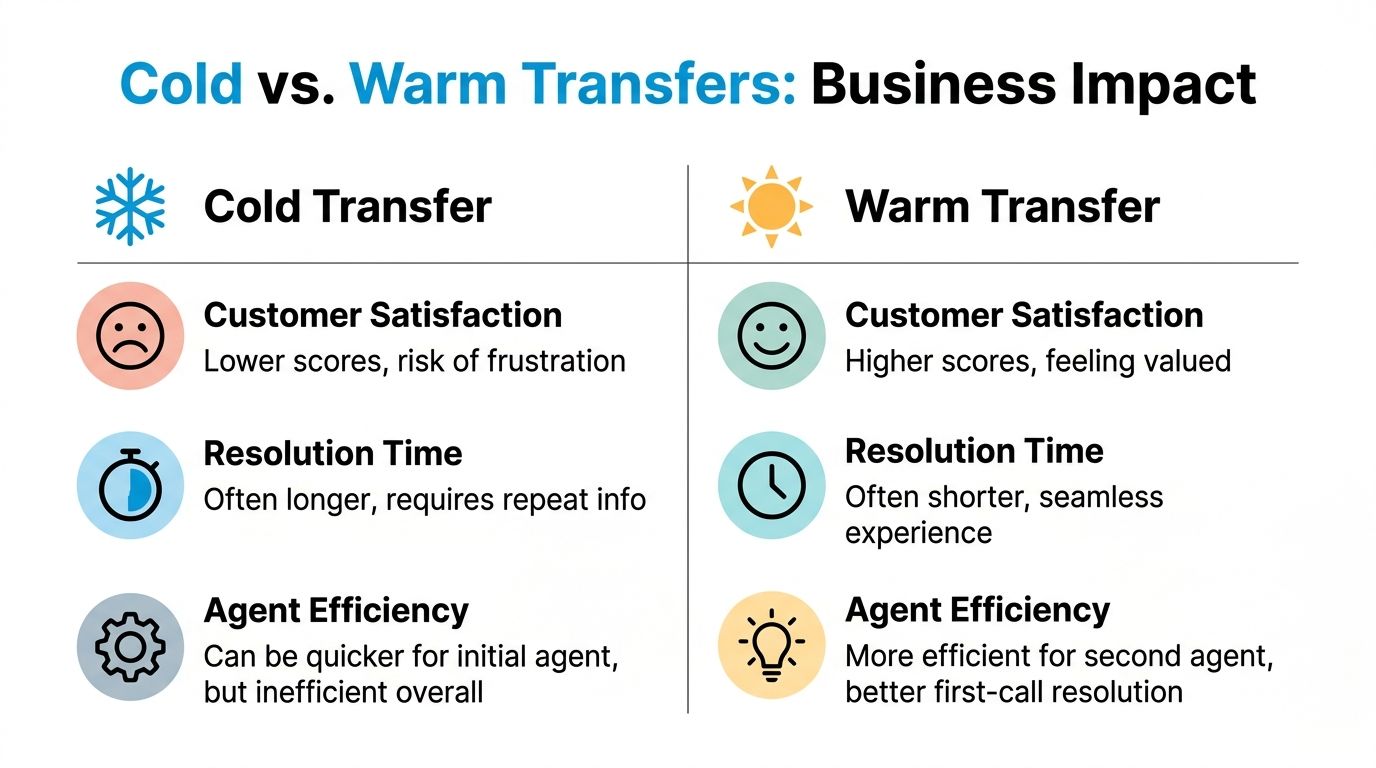
Cold transfers reduce Average Handle Time for the initial agent by 10-15%, but they drive a 30% spike in repeat calls. Warm transfers increase AHT by 5-10%, yet they cut repeat calls by up to 20% and are linked to a 15% higher Net Promoter Score plus a 20-30% rise in customer satisfaction scores, according to this call transfer benchmark summary.
That trade-off matters because many small businesses measure the wrong thing first. They look at how quickly the first employee gets off the phone. The caller judges whether the issue gets solved without friction.
Practical rule: If your team celebrates shorter first-touch calls while customers keep calling back, your transfer model is creating hidden work.
KPI comparison that matters in the field
| KPI | Cold transfer | Warm transfer | What it means operationally |
|---|---|---|---|
| Average Handle Time | Lower for the first agent | Slightly higher upfront | Cold looks faster locally, not always across the full journey |
| Repeat calls | Higher | Lower | Repetition creates extra workload and missed opportunities |
| Customer satisfaction | More frustration risk | Stronger experience | Better handoffs reduce the need to re-explain |
| Net Promoter Score | Weaker relative performance | Stronger relative performance | Customers are more likely to remember the interaction positively |
| Call abandonment | More exposed | Lower risk when well run | Bad handoffs often break trust while the caller is waiting |
The same benchmark summary reports that cold transfers correlate with up to a 25% higher call abandonment rate in high-volume settings, while warm-transfer programs report 15% higher NPS and stronger satisfaction outcomes in service-heavy businesses using more contextual handoffs.
What this looks like by industry
A home service business feels the cost in dispatch and bookings. If the caller has to explain an urgent plumbing issue twice, the transfer didn’t save time. It just shifted the burden to the customer, and maybe to a competitor.
A medical or dental office feels it in reassurance. Patients call with insurance questions, appointment concerns, treatment anxiety, and scheduling conflicts. A cold transfer can make the office sound fragmented, even when the staff is trying to help.
A law firm feels it during intake. Prospective clients are often calling under stress. If the receptionist transfers them into a second conversation with no context, the firm sounds less prepared than it is.
Why local efficiency can hurt total efficiency
Owners often find themselves in this predicament. Cold transfers can make one person’s queue move faster. But if those callers repeat themselves, abandon, or call back later, the business still pays.
That broader view is what separates a cost center from a conversion engine. If you’re trying to rethink your service desk as a revenue-protecting function, this roundup of strategies to turn customer support into a profit center is a useful companion read.
Teams don’t win by ending calls quickly. They win by ending the customer’s problem with as little effort as possible.
When to Use Each Transfer Strategy
The right answer isn’t “always warm” or “always cold.” It depends on the call type, the value of the caller, and what happens downstream if the handoff fails.
That means you need a decision framework, not a slogan.

Use cold transfers for low-context, low-risk routing
Cold transfers work best when the first person doesn’t need to build understanding. They just need to get the caller to the right destination fast.
Good fits include:
- Directory-style requests: “Can you connect me to accounts payable?”
- Known contact routing: “I need to speak with Attorney Chen.”
- Simple internal handoffs: A franchise caller asking for a specific local location.
- Basic operational questions: Hours, address, fax line, or standard extension routing.
- After-hours system routing: Sending callers to voicemail, emergency line, or on-call service path.
A cold transfer also makes sense when the first person lacks the expertise to discuss the issue and any attempt to “summarize” would create confusion. Some legal, accounting, and specialist medical questions fall into that category. The front desk should identify the topic, urgency, and destination, then route cleanly rather than pretending to interpret the issue.
Use warm transfers when the customer has already invested effort
Warm transfers are the better choice when the caller has shared details that would be frustrating, risky, or costly to repeat.
That usually includes:
- New lead inquiries: Estimate requests, consultation requests, treatment inquiries
- Urgent service calls: Burst pipe, lockout, restoration issue, emergency appointment
- Emotionally charged situations: Complaint calls, claim disputes, post-procedure concerns
- Multi-step service issues: Rescheduling tied to records, billing disputes, authorizations
- High-value opportunities: Commercial accounts, recurring contracts, larger-ticket projects
The question to ask is simple: if this caller repeats themselves, does conversion, trust, or resolution get worse? If yes, warm the transfer.
If the call carries urgency, emotion, or revenue potential, context should travel with the customer.
Industry examples that hold up in practice
Home services
A caller says their basement is flooding. Don’t cold transfer that to dispatch with no note. The dispatcher should know the service type, urgency, address status, and whether the customer is new or existing before they pick up.
On the other hand, a caller asking whether you service a nearby town can be routed quickly to the office line or service area desk without a full briefing.
Dental and medical practices
A patient calling to book a routine cleaning can often be routed directly to scheduling if your process is consistent. But a patient calling about post-treatment pain, a billing issue tied to insurance, or a same-day schedule conflict needs a warm handoff. The second person should know what the patient is dealing with before they answer.
Law firms
If someone asks for a paralegal by name, cold transfer is fine. If a new prospect starts describing an employment dispute, injury case, or custody concern, the intake specialist or attorney should receive a brief summary first. It protects professionalism and reduces the awkwardness of making the caller retell a sensitive story.
Insurance and finance
Routine servicing can often be routed directly. But policy changes after a loss, billing disputes, claim-related questions, or time-sensitive financing discussions benefit from a warm transfer because the context shapes what happens next.
A practical decision screen for managers
Use this quick screen when setting your default rules:
| Question | If yes | If no |
|---|---|---|
| Has the caller already explained a detailed situation? | Warm transfer | Cold transfer may be fine |
| Is the issue urgent or emotional? | Warm transfer | Either may work |
| Is this a high-value lead or client relationship? | Warm transfer | Use judgment |
| Is the first person only doing simple routing? | Cold transfer | Consider warming it |
| Could a bad handoff cause a lost booking or complaint? | Warm transfer | Cold transfer is lower risk |
What usually doesn’t work
Businesses get into trouble when they use warm transfers performatively. The first agent talks too long, repeats the whole story, puts the caller on hold too long, or transfers to someone who still isn’t ready. That creates all the drag of a warm transfer without the benefit.
The opposite mistake is using cold transfers because they feel operationally neat. They’re neat for the first person. They’re often messy for everyone else.
Build rules by call category, not by preference
A strong setup assigns transfer type by category:
- Service emergency
- New lead
- Existing customer support
- Billing
- General admin
- Known extension or person
- After-hours routing
That gives your team something concrete to follow. It also keeps your receptionist, answering service, or scheduler from improvising on every call.
Scripts and Workflows for Perfect Handoffs
The difference between a professional transfer and a clumsy one usually comes down to wording, timing, and what information moves before the line changes hands.
Many teams don’t need longer scripts. They need tighter ones.
Warm transfer script that works
Use a three-part sequence.
Step 1. Tell the caller what’s happening
“Thanks for explaining that. The best person to help is our scheduling coordinator. I’m going to bring her in and give her a quick summary so you don’t have to repeat everything.”
That sentence does three jobs. It reassures the caller, signals competence, and sets expectations.
Step 2. Brief the receiving teammate
Keep this part short.
“Hi Sarah, I have Maria on the line. She’s an existing patient calling about a crown follow-up and wants the earliest available appointment. She mentioned discomfort and asked whether she should be seen today.”
That’s enough. Name, status, reason, urgency, and desired outcome.
Step 3. Make the introduction live
“Maria, I have Sarah here. She handles follow-up scheduling and already has the basics. Sarah, Maria is ready to talk through appointment options.”
Then the first person leaves the call.
“The best warm transfers sound calm and brief. The customer hears continuity, not a performance.”
Polite cold transfer script for unavoidable situations
Sometimes a cold transfer is still the right move. When that happens, reduce surprise.
Try this:
“I’m going to connect you directly to our billing line. They’re the right team for this and can help you faster. If for any reason you get disconnected, call us back and we’ll reconnect you.”
That language is simple, but it matters. It tells the caller where they’re going and why.
For front-desk teams that need polishing on tone before they ever transfer a call, this guide on how to answer the phone professionally is useful training material.
What information to capture before any transfer
Don’t over-collect. Capture what the next person needs to act.
A simple checklist works well:
- Caller identity: Name and callback number
- Reason for the call: One sentence, not a transcript
- Urgency: Routine, same-day, escalated, sensitive
- Relationship: New lead, existing customer, patient, client, vendor
- Desired outcome: Book, reschedule, resolve billing, speak with specialist
A workflow managers can implement this week
Map your transfer workflow like this:
- Classify the call
- Decide transfer type
- Capture the minimum required context
- Check recipient availability
- Transfer with introduction or route directly
- Log the result
- Review failed handoffs weekly
That last step is typically where improvement accelerates. Pull a few examples where callers were transferred twice, called back angry, or abandoned the interaction. Then listen for the same root causes. Missing notes, wrong destination, long hold, weak intro, or no ownership.
Common script mistakes to remove
- Overexplaining: The first person retells every detail instead of summarizing.
- Vague transitions: “Let me send you over there” doesn’t build confidence.
- No callback safety net: If the call drops, the customer starts over.
- No ownership language: The transfer sounds like passing the problem away.
Good handoffs sound like guidance. Bad handoffs sound like escape.
Optimizing Transfers with AI and Human Collaboration
The old trade-off was simple. If you wanted speed, you used a cold transfer. If you wanted context, you accepted the slower mechanics of a warm transfer.
That trade-off is getting weaker because AI can gather, summarize, and pass context before a human ever joins the line.
Where the hybrid model helps
In a strong AI-human workflow, the system handles the first layer of triage. It answers routine questions, identifies the reason for the call, captures callback details, checks urgency, and decides whether the issue should stay automated, route instantly, or move to a person with context attached.
That changes the shape of the transfer itself.
A plumbing business can let AI handle overnight calls, capture “no heat,” “leak,” or “estimate request,” and pass the urgent ones with notes. A dental office can gather the patient’s concern and appointment preference before the scheduling coordinator steps in. A law firm can sort intake from existing-client support before someone from the legal team joins.
What better context-sharing changes
Warm transfers improve agent preparedness, cutting the second agent’s ramp-up time by an estimated 25-40%. The same benchmarks note that AI tools such as Retell, used in platforms like Recepta.ai-style workflows, automate context-sharing and can contribute to a 25% increase in positive experience reports while reducing agent errors by 15-20% during complex handoffs, as outlined in RingCentral’s analysis of warm transfer and cold transfer performance impacts.
That matters most in calls where details can easily get lost. Medical scheduling escalations, insurance servicing, franchise coordination, and legal intake all benefit when the second person receives a structured summary instead of reconstructing the call from scratch.
The best use of AI in transfers isn’t replacing people. It’s making sure the human joins the call already oriented.
What an effective setup looks like
A practical hybrid workflow usually has three layers:
- AI handles repeatable front-end tasks: identity capture, basic qualification, FAQs, scheduling checks
- Rules determine when a human should take over: urgency, emotional tone, complexity, revenue value
- The human receives a summary, not just a ringing phone: name, issue, relevant notes, and next likely action
This works especially well in small businesses because it protects staff time without making the customer feel pushed away. The receptionist or coordinator doesn’t spend the day on every simple inquiry, but they also don’t pick up blind on the calls that matter most.
If you’re evaluating how these workflows fit into service operations, this overview of conversational AI for customer support gives a practical lens for implementation.
Where teams still need discipline
Technology won’t fix a messy routing strategy by itself.
If your categories are vague, your ownership rules are unclear, or your team hasn’t defined what counts as urgent, AI will move confusion faster. The best results come when the business has already decided:
- which calls can be resolved automatically,
- which can be routed directly,
- and which deserve a fully contextual handoff.
That’s when speed and experience stop competing with each other.
Measuring Success and Refining Your Strategy
A lot of businesses still manage transfers by instinct. A manager listens to a few calls, hears one awkward handoff, and tells the team to “be warmer” or “move faster.” That’s not a strategy. It’s guesswork with a headset on.
You need a short list of signals that tell you whether your transfer rules are helping or hurting.
What to track every month
Start with outcomes that reflect customer effort and operational drag:
- Repeat calls from transferred interactions
- Booked appointments or consultations from transferred leads
- Abandoned calls after transfer
- First-contact resolution on routed calls
- Call notes quality and transfer accuracy
- Complaints that mention repetition, hold time, or confusion
These metrics tell you more than raw call volume ever will. If transferred calls keep reappearing in the queue, the process is leaking value.
What to listen for in call reviews
Pick a sample of successful and failed handoffs. Then review them against a consistent checklist.
Use questions like these:
| Review question | What good sounds like | Warning sign |
|---|---|---|
| Did the first person identify the issue clearly? | Short, accurate summary | Rambling or vague explanation |
| Did the caller know what would happen next? | Clear expectation-setting | Surprise transfer |
| Was the receiving person prepared? | Specific opening | “How can I help you?” restart |
| Did the transfer move toward resolution? | Next step happens quickly | Caller repeats details |
| Was the right method used? | Transfer matches call type | Warm for trivial issue or cold for complex issue |
Turn patterns into policy
Once you’ve reviewed enough calls, the patterns become obvious. Maybe billing calls are fine with direct routing, but new legal intakes need a live intro. Maybe your after-hours service line works well for emergencies, but not for high-value estimate requests. Maybe one office location consistently handles transfers better because the team uses tighter summaries.
If you work in healthcare, it also helps to study how others are approaching AI-assisted triage and routing. This roundup of call center AI solutions for healthcare offers useful examples of where automation can support better handoffs without stripping away the human layer.
Don’t ask whether your transfers feel efficient internally. Ask whether customers reach the right person with enough continuity to move forward.
The improvement loop that actually sticks
Keep it simple:
- Set transfer rules by call category
- Train to one script standard
- Review transferred calls regularly
- Fix recurring friction points
- Update routing rules when patterns change
Businesses that do this consistently stop treating transfers as a minor phone task. They treat them as part of lead management, service delivery, and retention.
If you want a system that handles routine calls automatically, escalates complex conversations gracefully, and gives your team cleaner handoffs around the clock, Recepta.ai is built for exactly that. It combines conversational AI with human support so your business can capture leads, book appointments, and route calls with context instead of confusion.