
How to Increase Qualified Leads: A Step-by-Step Playbook
It's 8:40 on a Monday, and eleven web inquiries from the weekend are sitting in a shared inbox. Two of them needed someone at 7pm on Saturday. One is a landlord with a burst pipe who has already called the next name on the search results, and the rest are a mix of price shoppers and genuine jobs that nothing in the inbox helps you separate.
By the time you start dialing, the weekend jobs have booked elsewhere and the landlord has stopped answering numbers he doesn't recognize. That's the ordinary way a business loses qualified demand without ever seeing it in a report. Most advice on how to increase qualified leads begins with traffic. The bigger return usually sits in the gap between an inquiry arriving and a real person replying to it.
The Qualified Lead Playbook at a Glance
Say a plumbing company brings in 40 web inquiries a week. Half land after 6pm and sit in an unassigned inbox until someone opens a laptop the next morning, so the homeowner who wanted a quote at nine at night has signed with a competitor by eight.
Fix the sequence before the ad budget. Five connected steps turn that pile into booked work, and every one of them carries a metric you can watch weekly.
Five-step qualified lead playbook with metrics and reference points
| Step | Action | Metric to track | Reference point |
|---|---|---|---|
| 1. Respond fast | Acknowledge every inquiry and attempt contact within five minutes | Percent contacted within five minutes | 21 times higher qualification odds than a 30-minute wait (MIT/InsideSales) |
| 2. Qualify on criteria | Score each lead on fit, need, authority, timing and economic potential | Lead-to-MQL rate | About 31% average across B2B industries (directional) |
| 3. Shorten capture | Limit the initial form to the fields that decide priority | Form conversion rate | 13.4% with five fields versus 10% with nine (Marketing Experiments, reported by Adobe) |
| 4. Follow up with value | Add a useful touch at each planned step, not a repeat pitch | Reply rate by touch number | First follow-up raised replies by 49% |
| 5. Fix leaks | Compare funnel stages and landing-page conversion each month | Qualified-lead rate and landing-page conversion | 6.6% median landing-page conversion across industries |
Treat the reference column as context rather than a target. Averages compiled across industries describe a median company you don't run, and every firm defines "lead" differently, so your own history by channel is the honest comparison. The figures flagged as directional, the cross-industry lead-to-MQL average in particular, exist to tell you when a funnel is behaving abnormally. They aren't a number to promise a board.
The operational gap is measured, not anecdotal. A 2025 study of 939 B2B companies found an average lead-response time of 47 hours, with only 23% of companies replying within five minutes, while a field test of 114 companies recorded average personalized response times of 11 hours 54 minutes by email and 14 hours 29 minutes by phone (Spara).
Start here: Steps one and two change results fastest. Steps three to five only compound once response time is reliable, because a shorter form feeding a slow queue just delivers bad news faster.
Respond to Every Lead Within Five Minutes
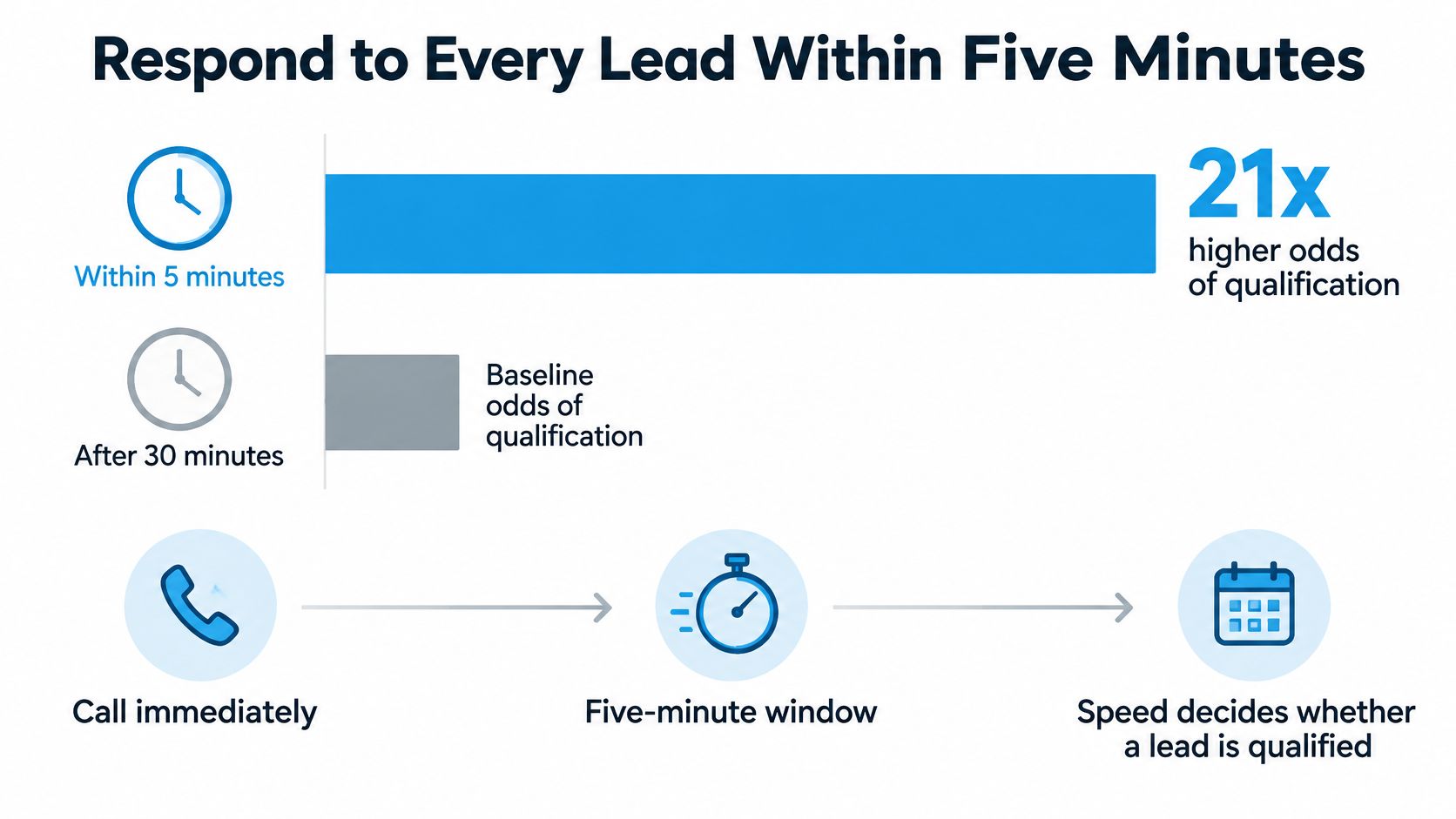
Response time moves qualification more than any headline, script or offer you'll test this quarter. InsideSales reviewed more than 55 million sales activities involving 5.7 million inbound leads across more than 400 companies and found that 57.1% of first call attempts came more than a week after the inquiry. Its earlier MIT collaboration found that calling a web-generated lead within five minutes made the odds of qualification 21 times higher than waiting 30 minutes (InsideSales).
The comparison is worth seeing rather than reading.
The gap widens fast with time. An analysis of roughly 1.25 million leads from 29 business-to-consumer and 13 business-to-business companies, summarized alongside the 2011 Harvard Business Review study, found that organizations contacting a prospect within one hour were nearly seven times more likely to reach a qualifying conversation with a decision-maker than organizations waiting an additional hour, and more than 60 times more likely than those waiting 24 hours or longer (InsideSales). The audit behind those ratios covered 2,241 U.S. companies (Vida).
How first-contact timing changes qualification odds
| First contact timing | Qualification odds compared | Source |
|---|---|---|
| Within 5 minutes | 21 times higher than a 30-minute wait | MIT/InsideSales |
| Within 1 hour | Nearly 7 times more likely to qualify than a contact an hour later | HBR-linked study |
| Within 1 hour | More than 60 times more likely than 24 hours or longer | HBR-linked study |
| 24 hours or longer | Lowest odds in the comparison | HBR-linked study |
The five-minute routine
- Acknowledge immediately. An automatic confirmation inside a minute tells the prospect the message landed, and it gives you the timestamp you'll measure against.
- Ask the two or three questions that decide the job. Service needed, location, urgency. Budget and scope come later, once you know the person is worth a callback.
- Verify you can serve it. Check the address against your service area, the request against your operating hours, and the job against your capacity this week.
- Put the next action on the calendar or in the CRM while you're still on the call. A promised callback without a scheduled time is a maybe.
- Escalate the exceptions. Distressed, high-value or ambiguous cases go to a trained person inside the window, not into a queue.
A fast reply that ignores what the person asked is worse than a slower useful one, because it proves nobody read the message. The first response has to answer something the prospect raised. Businesses without overnight staff meet the standard with automated acknowledgement, structured intake questions and an alert that escalates anything urgent to a human.
That's the shape of the intake flow we build for new leads. The prospect is invited to book a consultation, request a quote or connect with the sales team, the opportunity is captured, qualified and routed, and confirmed appointments land directly on the calendar with follow-ups attached. Recepta.ai's stats show a 30% increase in qualified leads with 24/7 answering.
The discipline applies to slower sales too. A golf club that takes a membership inquiry on Friday and replies on Wednesday has lost the mood that produced it, which is why faster follow-up on membership leads is worth reading even if you never touch a trade van. And the cost of the missed call is its own subject, laid out in what happens when nobody picks up.
The operating principle, in about two minutes:
This week, make one decision: apply the five-minute standard to the single lead source that brings you the most inquiries. Pull the last 30 days, count what percentage was answered inside five minutes, assign a named owner and an alert for every out-of-hours inquiry, and track median first-response time, percent answered within five minutes and booked-appointment rate. Check the qualified-lead rate after 30 days, then set the target monthly.
Set Qualification Criteria That Filter Without Screening Out
Two questions decide whether a lead deserves your team's time, and most intake scripts blur them. Eligibility asks whether you can serve the person at all: service area, service type, insurance or regulatory constraints, urgency. Readiness asks whether they're in a position to act: preferred timing, budget range, who makes the decision, willingness to book. A lead that fails eligibility is out however keen they sound. A lead that passes eligibility with no readiness belongs in nurture, not in a callback queue.
Write the checklist before you write the script, because the questions you ask decide who reaches your calendar.

Qualification criteria by vertical
| Vertical | Eligibility checks | Readiness signals | Disqualifier |
|---|---|---|---|
| Home services | Inside service area, covered service type | Preferred window, urgency, property owner | Outside service area |
| Healthcare (dental) | Covered treatment, lives in service area | Feasible appointment window, decision-maker | Treatment not offered |
| Law | Matter category, jurisdiction the firm handles | Short description, urgency, deadline | Matter or jurisdiction the firm does not handle |
| Insurance | Policy type, location | Renewal date, coverage goal, decision-maker | Policy type not written |
| Franchises | Location inside an open territory | Budget range, timing to open, decision-maker | Territory already awarded |
Eligibility first, then a weighted score
Points should reflect what closes business for you, not what looks tidy on a slide. High urgency and service-area fit can outweigh a long engagement history, and one disqualifying condition should override the total no matter how high it climbs. Compiled benchmarks put the average lead-to-MQL rate around 31% across B2B industries, with one cited dataset showing 13% MQL-to-SQL, and a qualification-focused benchmark reports 40% conversion for thoroughly qualified leads against 11% for unqualified prospects (Shno). Use those to sanity-check your stage conversion, never to set a quota.
Three ways a qualification process loses good business
- Asking too much before delivering anything. Ten questions before a single piece of advice reads as an application form. Answer the person's question first, then qualify.
- Treating demographic fields as intent. Postcode and job title tell you who someone is. They don't tell you whether the roof is leaking tonight.
- Setting a threshold nobody can explain. If the number 60 came from a template rather than from your own closed deals, it will route badly and nobody will know why.
Then check the criteria against attended appointments and closed revenue rather than against how the sales team feels about a lead. Verizon's 2025 small business survey found buyers weigh trust and clarity heavily, with 93% naming trusted vendors and 90% naming clear terms as important in their reported purchasing decisions (Verizon). Intake that feels like a credit check costs you exactly those buyers.
Recalibrate monthly on real opportunity and revenue data, and keep separate models by vertical and channel so a strong referral source isn't judged by the same threshold as a paid ad. If you're building the weighting from scratch, LeadBeast's lead scoring explainer covers how points, thresholds and score decay fit together.
Capture Leads With Shorter Forms and Chat
Every field you add is a place someone gives up. A Marketing Experiments test reported by Adobe found a five-field lead-generation form converted at 13.4%, against 12% for seven fields and 10% for nine (Adobe). Two extra fields cost roughly a quarter of your conversions, and most businesses add them for the comfort of their own reporting rather than for anything the prospect needs to answer.
Keep the fields that decide priority and nothing else. A home-services form needs name, phone or email, service type, property location and preferred timing. A law firm needs contact details, matter category, jurisdiction and a short description. Budget, exact scope and documents belong in the qualification call or a message after submission, once the person has shown intent by raising a hand.
Chat is the second capture channel, and it beats the static page it sits on. A 2025 field experiment with more than 16,000 participants found chatbots generated significantly more leads, and leads of higher quality, than conventional landing pages (Journal of Business Research).
- One question at a time. A wall of form fields disguised as a chat still reads as a form.
- Confirm contact details before the conversation ends, not after, so an abandoned chat still leaves you a number.
- Offer a booking slot inside the chat. Availability is the most persuasive thing you can show someone who is ready to buy.
- Hand off when the script runs out. Anything legal, clinical, distressed or outside the bot's answers goes to a person in the same session.
Whatever captures the lead, the interaction should follow your written script, be logged in a structured way and trigger the follow-up that was promised. Worked examples of forms and chat prompts that do this are collected in these lead capture examples, and if you're rebuilding the form itself, these mobile-friendly lead capture form tips cover the layout details that decide whether someone finishes on a phone.
One check settles the argument. If form completions are healthy but booked appointments aren't, cut fields before you buy more traffic.
Follow Up on a Cadence That Adds Value
Persistence has a shape, and it isn't a daily "just checking in". A reported follow-up analysis found the first follow-up increased replies by 49%, the second added 9%, while a third follow-up reduced replies by 20%, and waiting longer than five days cut the chance of a response by 24% (Marketsplash).
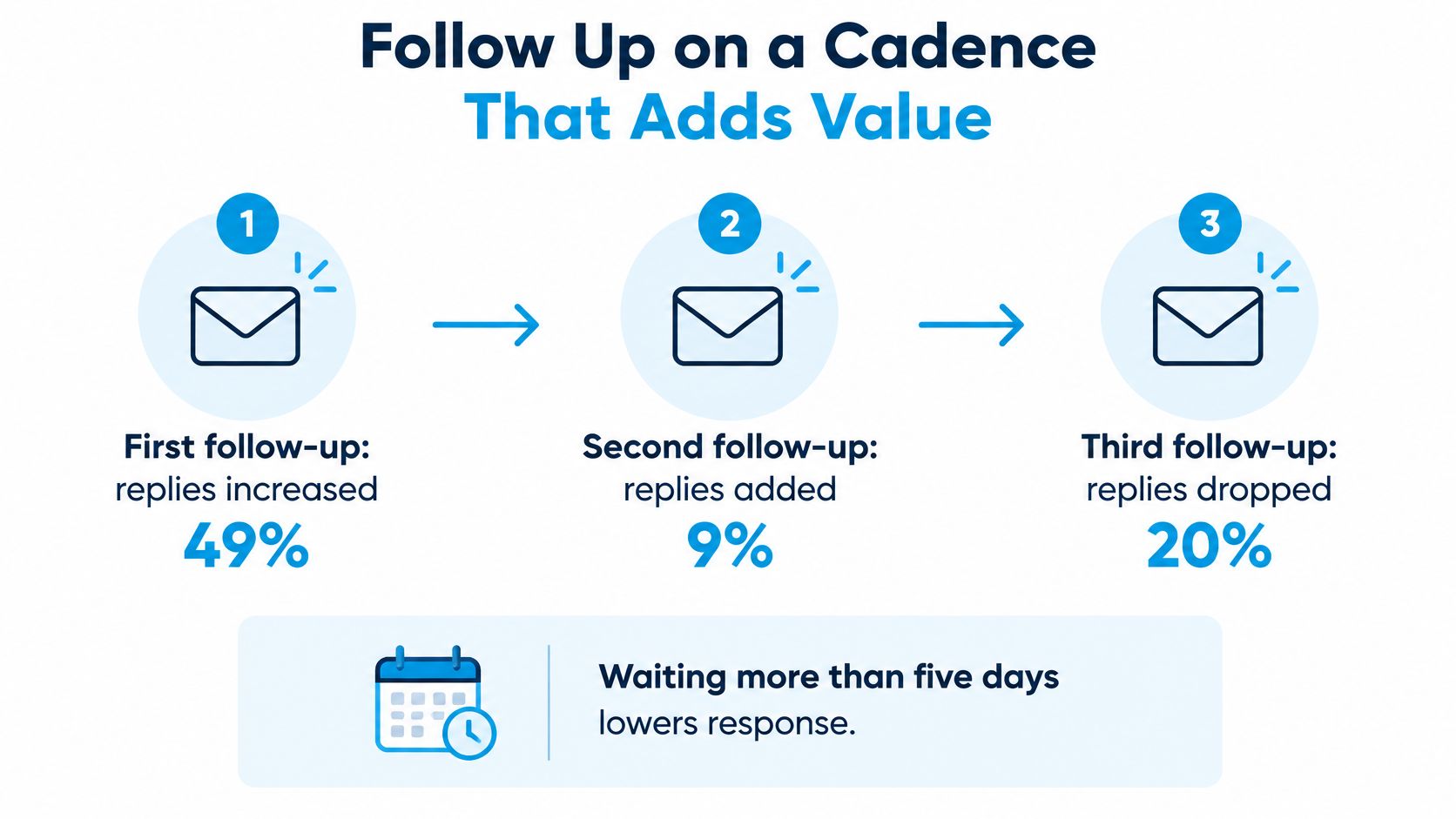
The four-step cadence
- Confirm at once, with what happens next. Not "we received your request", but "we can be there Thursday between 9 and 11, does that work?"
- On day two, add something usable. Available slots, an estimate range, what to have ready before the technician arrives. The follow-up earns its place by being useful.
- On day five, change channel. If email hasn't moved them, a call or a text reaches a different person than an inbox does. Offer one specific next step rather than a menu.
- Stop at three attempts. Suppress the record from further outreach and let nurture take over. A fourth message reads as pressure and damages the brand more than it recovers the job.
Personalization is the difference between three touches and three interruptions. A 2025 lead-generation report found highly personalized outreach achieved response rates of 15% to 30%, against 1% to 3% for minimally personalized messages (Lureon). Personal here means referencing the address, the job, the insurance policy or the date they mentioned, not inserting a first name into a template.
The value test for each touch
Every message has to add something the last one didn't: availability, an estimate range, preparation instructions, or an answer to a question the prospect actually raised. A follow-up that repeats the original pitch is a reminder that you're still there, not a reason to reply.
Run the cadence by source. A web inquiry that arrived at 11pm on a Sunday behaves differently from a referral that came through a receptionist, and treating them identically wastes the fastest-moving lead you'll get all week. The full sequence design, including what to do with unsold quotes, is set out in these lead follow-up best practices.
Route Leads and Log Outcomes in Your CRM
Routing decides whether speed survives volume. Give every inbound source a named owner by service area, service type and urgency, and send urgent or high-intent inquiries to a person with a response deadline attached rather than to a shared queue. A queue is a promise nobody made.
Build CRM stages that mirror the funnel exactly: new, contacted within five minutes, qualified, booked, showed, closed. Log an outcome for every lead with a reason code such as outside area, not ready, no budget or chose a competitor, so a rejected lead returns to nurture instead of vanishing into a note field. Record the four details that tend to predict revenue: service type, urgency, preferred window and decision-maker status.
The dashboard to review every Monday
- Median first-response time, in minutes, by source.
- Lead-to-qualified rate, by vertical and channel.
- Qualified-to-booked rate, which shows whether intake is asking the right questions.
- Show rate, which shows whether booking confirmed the right person.
Scoring tools earn their place only if the score matches closed revenue. In a 2025 survey of more than 500 B2B marketers, 78% named improving lead quality as their top priority and more than 62% reported using AI-powered lead scoring to identify high-potential prospects (PublishMeWorld). Test any score against closed deals before you let it route real work, and keep a human override for the accounts that pay the bills.
Then automate the stall. Any lead sitting past its last scheduled touch should trigger a reminder to the named owner, and after a second interval, a task for someone else. Phone, chat and CRM records need to sit in one place for this to work, which is what a proper CRM telephony integration is for. Without it, your routing rules describe an intention rather than a process.
Diagnose Lead Leaks From Your Funnel Rates
A 2024 analysis of 41,000 landing pages and 464 million visitors found a median landing-page conversion rate of 6.6% across industries. Use that figure as a reference for the top of the funnel, not as a diagnosis of what happens after an inquiry (landing-page conversion rate analysis). Many losses occur between the first contact and a booked appointment.
Lead leak symptoms, causes and fixes
| Symptom | Likely cause | Fix |
|---|---|---|
| Traffic rising, qualified leads flat | Slow first response or weak qualification | Measure response time and review criteria before increasing spend |
| Form fills high, booked appointments low | Too many fields or vague intake questions | Keep fields decision-useful and ask follow-up questions during intake |
| Leads answered but never qualified | Scripts ask for the wrong details | Ask about eligibility and readiness |
| Calls going to voicemail after hours | No coverage outside office hours | Provide round-the-clock intake with escalation rules for urgent inquiries |
| Appointments booked, high no-show rate | Readiness not confirmed before booking | Confirm timing and decision-maker, then send reminders |
| Early replies, no conversation | Follow-ups repeat the original pitch | Make each touch useful with availability, an estimate range or an answer |
Reading the symptom against the stage
Find the earliest stage where performance drops, then fix that part of the process. If response is slow, adding spend sends more inquiries into a queue that already misses opportunities. If the qualified-lead rate is weak, check whether the criteria ask too much too soon or rely on a threshold that does not fit your business. If qualified leads rarely book, make sure intake addresses what the prospect contacted you about.
A weak show rate points to a booking problem. Confirm that the decision-maker can attend, then send a reminder the day before and the morning of the appointment. Give the prospect a concrete reason to keep the slot, such as the question or project detail the appointment will address.
Use call summaries and CRM outcomes to compare intake answers with closed revenue. Review the criteria monthly. If a question does not help distinguish viable opportunities, remove it or ask it later, when the prospect has already engaged.
Recepta.ai handles inquiries 24/7, captures and qualifies each opportunity using your criteria, and routes it to your sales team. It can book confirmed appointments on your calendar and trigger follow-ups. For home services, healthcare, legal, finance and insurance teams, round-the-clock coverage can help maintain prompt first contact without adding an overnight shift. Visit Recepta.ai to see how it handles your call volume.