
Outcome Based Pricing AI: How It Works and What to Pay For

“Only pay for results” sounds like the safest way to buy AI. It isn't safe until buyer and vendor agree on what a result is, who caused it, and which record proves it happened. Without that agreement, outcome-based pricing can replace the risk of paying for unused software with the risk of disputed invoices.
The right starting point isn't a performance fee or an ROI calculator. It's a measurement contract that separates useful activity from a billable business event.
What Outcome Based Pricing Means for AI Products
A taxi meter charges for time on the road, while a flat fare charges for the trip. Outcome pricing adds a completion condition: payment becomes due only when the agreed trip is completed. For AI products, the equivalent might be an accepted lead, a confirmed appointment, or a resolved service request.
Outcome-based pricing ties payment to a verifiable business result, rather than seats, minutes, or API calls. The important distinction isn't whether an invoice changes each month. It's whether the vendor can charge when the AI hasn't delivered the agreed result.
Pricing models compared for AI products
| Model | What the customer pays for | Who carries performance risk | Best fit |
|---|---|---|---|
| Seat-based | Each user with access | Customer | Teams with predictable staff use |
| Usage-based | Minutes, API calls or tokens | Customer | Variable volume with known unit costs |
| Hybrid | Platform fee plus usage or outcome charges | Shared when charges include outcomes; otherwise mainly customer | Budget-sensitive buyers who need predictability |
| Outcome-based | A verified business result, such as a booked appointment | Vendor for the defined result | Measurable, discrete events with reliable data |
The distinction matters because hybrid doesn't necessarily mean performance-linked. In a 2026 analysis of 65 major SaaS companies and AI-native competitors, only 4 had fully adopted outcome-based pricing, 8 shared risk, and the remaining 53, approximately 82%, placed most performance risk on customers; 72% had introduced hybrid mechanisms such as credits or usage metering, according to Legal 500's pricing analysis.
The broader indicators measure different things. In 2025, 5% of companies monetizing AI used pure outcome-based pricing, according to High Alpha, as reported by Orb. Meanwhile, HFS Research reported that 68% of enterprises in 2026 expected to sign outcome-linked AI contracts within the following 12 months, an expectation rather than evidence of completed adoption.
Buyer rule: Classify the billing trigger before comparing the quoted rate.
For a useful parallel, Clipatra's explanation of measuring results without counting delivery helps frame the difference between delivering activity and achieving an agreed result. Two AI quotes with similar headline prices can allocate performance risk in opposite directions.
Outcomes and KPIs Worth Pricing by Industry
“More leads” is too vague to invoice against. A contact record, a qualified prospect, and a customer who pays for a completed job aren't interchangeable.
For a service business, the value ladder runs from lead → qualified lead → booked appointment → attended appointment → completed job → collected revenue. Moving toward revenue can bring the measure closer to financial value, but it also introduces dependencies on staff availability, clinical or professional judgment, sales execution, and collections.
Wharton's analysis of AI capability pricing identifies the strongest candidates as outcomes that are discrete, objectively attributable to the AI, and measurable in near real time. Use those tests before choosing the event closest to revenue.
Billable outcomes and KPIs by industry
These are proposed contract designs, not universal billing standards.
| Industry | Billable outcome | Verification signal | Intermediate KPI |
|---|---|---|---|
| Home services | Qualified lead or booked job | Contact details, service-area fit, calendar slot | Answer rate and capture accuracy |
| Dental and medical clinics | Attended appointment | Calendar confirmation and check-in record | Transfer rate and reschedule rate |
| Law firms | Qualified intake | Matter type fit and conflict check passed | Intake completion rate |
| Insurance and finance | Accepted lead or quote request | Policy type and recorded consent | Follow-up completion rate |
| Franchises and multi-location | Booked appointment per location | Location ID matched in CRM | Missed-call recovery rate |
For each workflow, select a primary billable event. A clinic choosing attended appointments should recognize that the receptionist can arrange the booking but can't control whether the patient arrives. A law firm should specify whether intake remains pending until staff complete the conflict check.
Keep operational reporting separate from billing
Build the event trail before calculating the invoice. Log each call, classify its intent, record any booking, deduplicate repeat callers, and apply the agreed attribution window. Retain the relationship between the original interaction and the final CRM or calendar record.
A qualified lead should require corroboration: captured contact details, service-area fit, consent to follow up, and no duplicate record. A booking should require calendar confirmation, not merely a caller saying they'd like an appointment. Use a performance dashboard to review intermediate measures without automatically treating them as billable successes.
For example, a plumbing business could define its outcome as an accepted request for an offered service, at an eligible address, with valid contact details, excluding repeat requests for the same unresolved job. Write your own definition in a sentence, including what doesn't count. If operations and finance interpret it differently, it isn't ready for pricing.
Benefits and Risks of Paying Only for Results
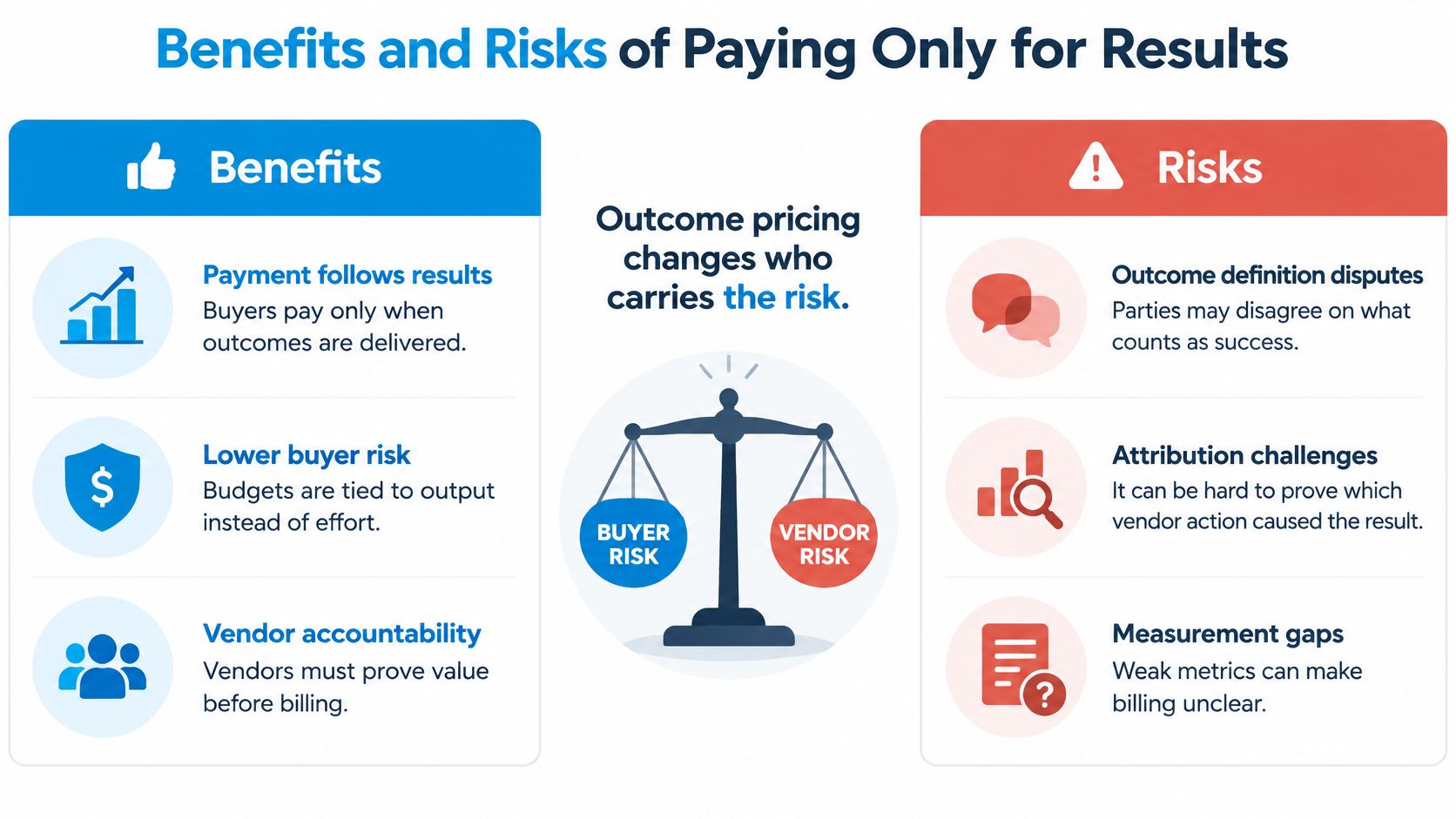
Outcome pricing changes incentives, but it doesn't eliminate uncertainty. The buyer avoids paying the variable performance charge for a failed result, while the vendor takes responsibility for proving that a qualifying result occurred.
The economic case is conditional. An economic model of AI agents published through the Association for Information Systems finds that outcome pricing outperforms usage pricing when revenue gained from heterogeneous performance exceeds the cost of verifying genuine results; permissive verification can increase billable outcomes while weakening their connection to real performance.
What buyers gain and what they still carry
The attraction is straightforward: payment follows results, budgets track output, and vendors must substantiate performance before billing. A provider paid for accepted appointments has a reason to improve booking accuracy, not just shorten calls.
But the contract can still expose the buyer to these risks:
- Inflated success counts: A vendor may classify every completed automated call as successful, even when the caller's request remains unresolved.
- Loose verification: Easily satisfied criteria can produce a larger invoice without a corresponding improvement in business value.
- Attribution disagreements: Changes in advertising, seasonality, staffing, or dispatch capacity can overlap with the AI rollout.
- Measurement failures: CRM sync errors or calendar outages can obscure whether the workflow succeeded and who was responsible.
- Cash-flow volatility: Stronger outcome volume can increase the invoice, even before the customer collects the associated revenue.
Make verification proportionate
Use human audits of sampled events, an exception queue for uncertain cases, duplicate and fraud detection, and customer-visible event logs. Apply the industry-specific verification signals rather than relying on the AI's own success label.
Confidence tiers can distinguish a basic lead from a confirmed booking or completed visit. However, don't use confidence as a substitute for an observable event: an AI prediction that someone will attend isn't attendance.
The buyer needs evidence that the outcome happened, not confidence that the conversation went well.
The least protective arrangements combine subjective results with expensive verification. Low-value events create another problem: if reviewing an uncertain charge costs more than the event is worth, a simpler billing model may be more practical.
Worked Pricing Examples You Can Adapt
Worked pricing examples by structure
| Structure | Example terms | Monthly math | Check before signing |
|---|---|---|---|
| Per-conversation | Pilot's example uses $0.99 per AI-resolved conversation, replacing a $39 per-agent price, with reported adoption 40% higher within six months | Verified monthly resolutions × the per-resolution rate | Resolution must be verified before billing |
| Hybrid base plus per outcome | G Squared CFO's example uses $2.00 per resolved ticket, a $10,000 monthly minimum, and a 30-day dispute window | If the minimum is an offsetting floor, invoice equals the greater of the minimum or eligible ticket charges | Whether the minimum offsets variable charges |
| Gainsharing | Cognizant's example uses a $110 baseline cost, $22 AI-enabled cost, and 40% provider share | $88 saving × 40% = $35.20 per activation; 680 activations = $23,936 monthly | Baseline records and eligible cost definitions |
| Success-rate tier | Deloitte's contract example pays $18,000 at 80% or more, $15,000 at 70–79%, $12,000 at 60–69%, and $0 below 60% of eligible cases resolved | Monthly fee set by the share of eligible cases resolved end-to-end without human escalation | Only completed cases meeting quality criteria count |
These examples illustrate billing mechanics, not market prices for reception services. Don't transfer a support-resolution rate directly to a dental booking or legal intake.
Adapt the structure, not just the rate
Per-conversation pricing multiplies verified resolutions by a unit rate. For a dental clinic, substitute eligible appointment bookings and remove duplicate bookings, cancellations inside the agreed window, and appointments created by staff. The adoption result in the software example isn't evidence of what a clinic will earn.
Hybrid pricing needs an explicit formula. A monthly minimum can be a floor against which outcome charges are offset, or a base charge added to them. For a plumbing company, the latter might fund software, integrations, analytics, and support, with booked-job charges added separately. Those structures produce different totals.
Gainsharing calculates eligible baseline cost minus eligible post-AI cost, then applies the provider's share. An HVAC operator could adapt this to booking administration, provided both periods include comparable work and exclude unrelated staffing changes.
Success-rate tiers make the denominator commercially important. Specify which calls are eligible before calculating the success rate, particularly abandoned calls and out-of-scope requests. Otherwise, removing difficult cases can improve the reported rate without improving service.
For adjacent sales workflows, Fypion Marketing's pricing guide for SaaS sales teams offers a useful comparison point when distinguishing lead delivery from appointment-setting work. Our AI receptionist pricing guide helps frame the reception-specific comparison.
Check overages before comparing totals. If usage exceeds our plan limits, we may charge overage or usage-based fees at the rates on the pricing page or in your order. Those fees may be billed at period end, plan change, or termination. Run each structure against your own monthly volume and distinguish an offsetting minimum from an additive fee.
How to Write an Outcome Pricing Contract
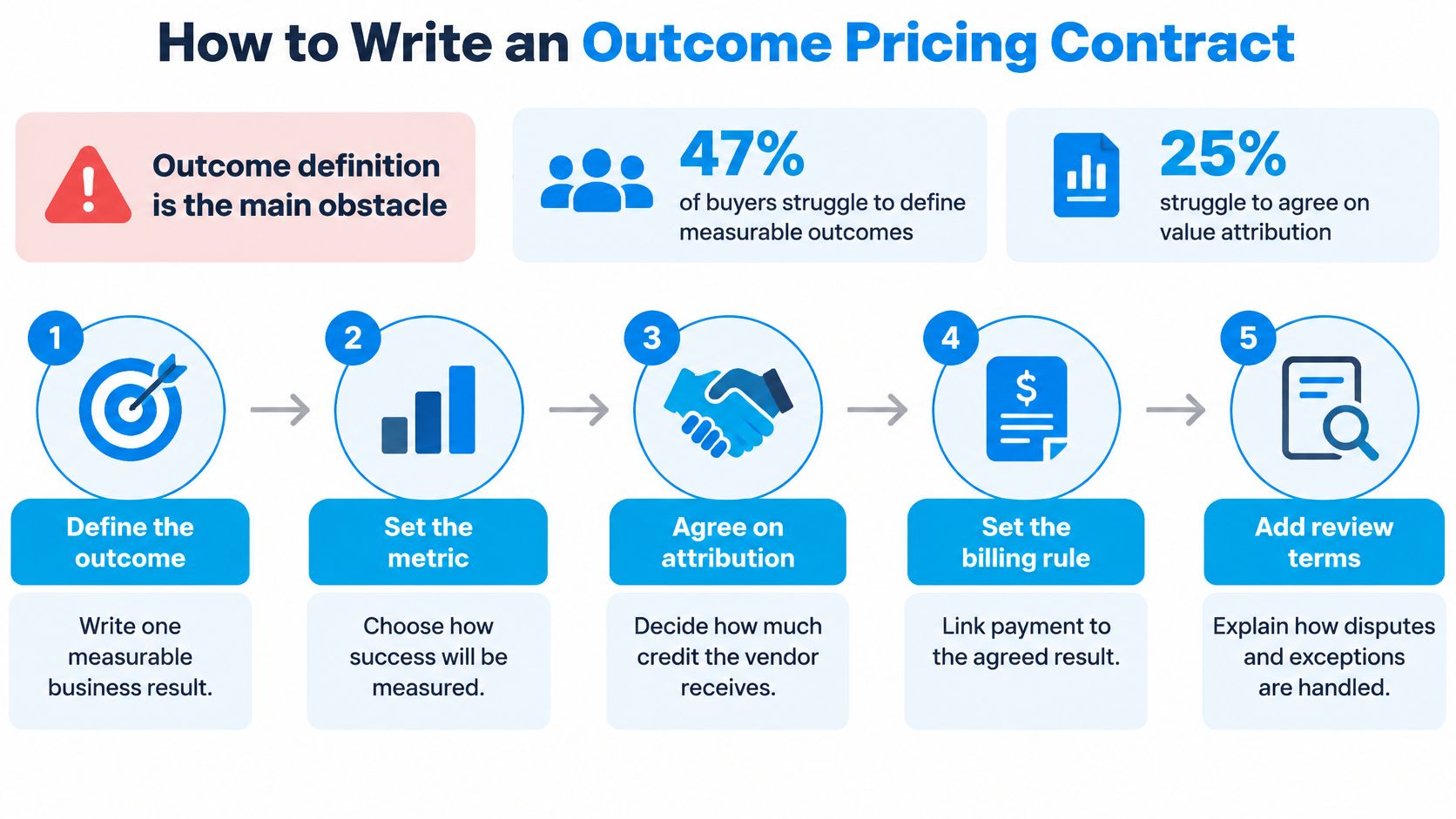
Outcome definition is a commercial obstacle, not a wording exercise. Campbell Robertson's Results-as-a-Service analysis reports that 47% of buyers struggle to define measurable outcomes, while 25% have difficulty agreeing with vendors on value attribution.
Agree on the measurement terms before negotiating the performance rate. Otherwise, each side may price a different interpretation of success.
Build the measurement agreement
Name the billable event and value tier. Specify whether payment follows an accepted lead, booking, attended visit, or completed job. The common slip is giving unlike outcomes the same label and price.
Record a representative pre-AI baseline. For savings or improvement claims, retain the records needed to compare equivalent workloads. Avoid selecting an unusually weak operating period that makes subsequent performance look better.
Write eligibility rules and exclusions. Address spam, duplicates, out-of-scope requests, cancellations, and reopened cases. Don't leave exclusions to a reviewer deciding what feels fair after the invoice arrives.
Choose the system of record and attribution window. Name the authoritative CRM, calendar, or job-management record and explain how it connects to the AI interaction. A common failure is allowing several systems to count the same customer event independently.
Set reporting frequency and audit rights. Specify who can inspect supporting records, how corrections are documented, and when reconciliation occurs. A dashboard total without accessible supporting events isn't enough for an audit.
Agree on dispute handling. State how disputed outcomes are paused, investigated, corrected, or credited. Identify the escalation owner and distinguish disputed charges from undisputed amounts.
Set a measurement-outage fallback. Decide what happens when required data is unavailable. Do not convert missing evidence into billable success or introduce a replacement price after the outage.
Assign responsibility for failures
The agreement should state the billing period, quality standard, and escalation path. Distinguish service commitments from invoice triggers; our guide to service-level agreements is useful when documenting those separate obligations.
Assign ownership for incorrect CRM data, unavailable calendar capacity, failed transfers, and downstream sales execution. For example, an AI receptionist that accurately offers the only available slot shouldn't automatically bear responsibility when the business hasn't staffed that appointment.
Disputely's pricing guide for ecommerce merchants provides an adjacent commercial comparison when reviewing upfront charges. An absence of setup fees doesn't settle the more consequential question of what becomes payable later.
Contract deliverable: Attach a measurement sheet listing the outcome, formula, data source, attribution window, exclusions, and owner of each integration or handoff failure.
Keep that sheet readable by finance and operations, not just legal counsel. Both teams should be able to use it to reach the same billing decision on a contested event.
How to Choose an Outcome Based AI Vendor
Evaluate the evidence a vendor will provide, not just its willingness to say “pay for performance.” A low headline rate isn't attractive if the vendor controls the definition, verification, and dispute decision.
Use a common scorecard for every proposal. Mark each answer as documented, incomplete, or unavailable, and treat a sales assurance as incomplete until it appears in the agreement.
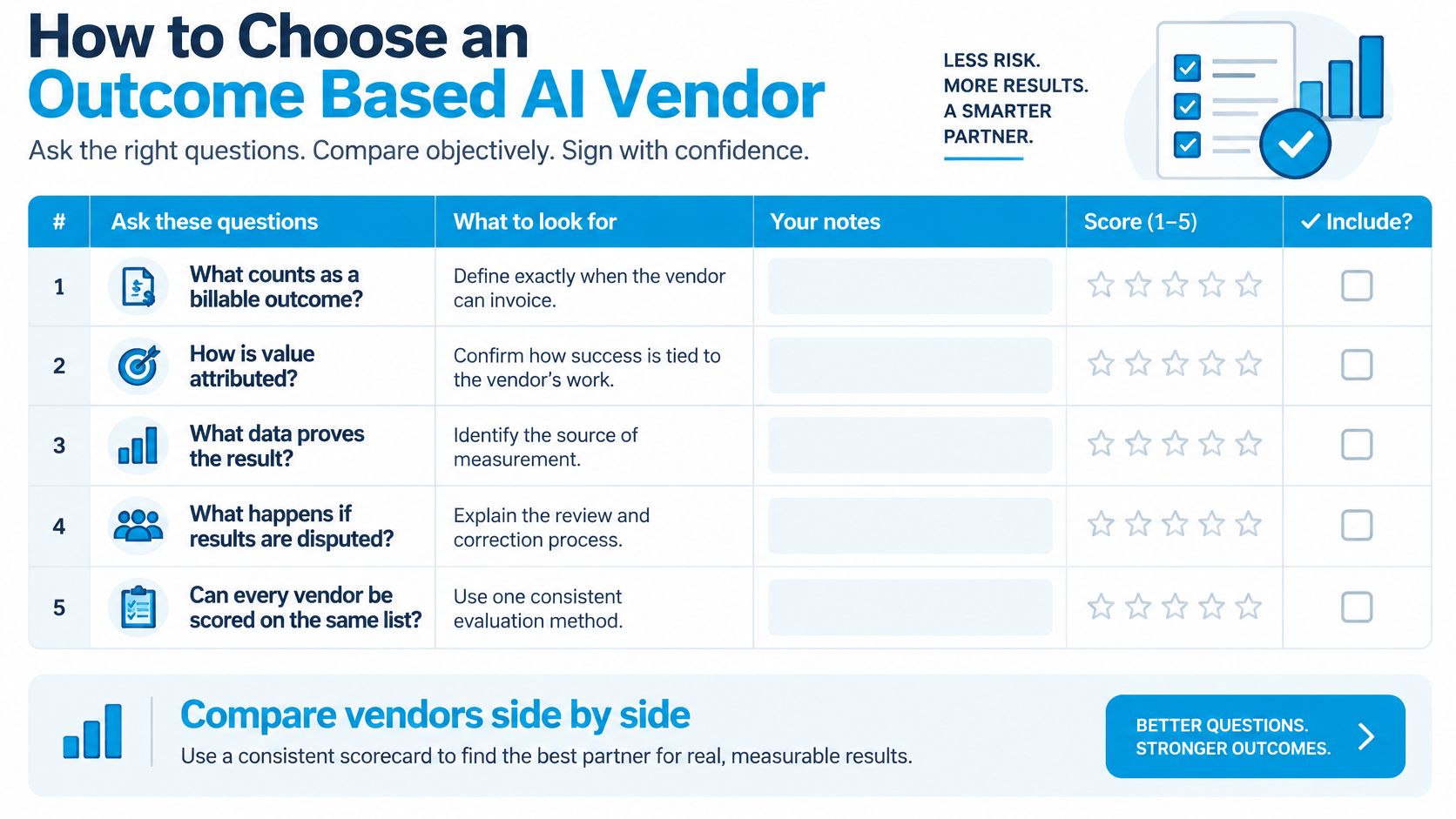
Questions that expose the real offer
- Billing evidence: What event permits invoicing, and does the vendor retain every underlying event needed to reproduce the count?
- Independent review: Who verifies outcomes, and can your team inspect event logs, corrections, and the audit trail?
- ROI calculation: Which costs, baseline, and customer assumptions support the claim? Our performance figures and ROI references, including 15× ROI, are illustrative; actual results vary by customer and use case.
- Commercial commitment: Does a setup fee, annual term, or minimum apply? At Recepta.ai, we have no setup fees and no annual contracts. Record any minimum separately and establish whether variable charges offset it.
- Usage exposure: Obtain the applicable overage schedule and billing triggers in writing, rather than comparing only the included allowance.
- Integration dependency: Which CRM and calendar connections supply billing evidence? Put those dependencies and their owners on the measurement sheet.
- Refunds and liability: Identify the remedies available when something goes wrong. Our paid fees are non-refundable except under an applicable money-back guarantee, and our terms limit liability, including exclusions for indirect and consequential losses.
A live AI receptionist demo should test a difficult workflow, not just a clean booking. Try a repeat caller, an unavailable appointment, or a request requiring human escalation.
Compare the written answers side by side. A vendor's ability to demonstrate the billing trail matters more than a polished success-rate slide.
Decide Whether Outcome Pricing Fits Your Business
Outcome pricing fits when the result is discrete, your systems record it reliably, demand fluctuates, and both parties can agree on measurement rules in writing. The strongest candidate isn't necessarily the outcome closest to revenue. It's the valuable event the vendor can influence and both sides can verify economically.
Hold off when success is subjective, records are scattered across tools, or events are so low-value and frequent that verification becomes disproportionate. A flat fee or usage model may be simpler and easier to administer.
Make the decision with a pilot
- Define: Write the billable outcome and exclusions in a sentence.
- Establish: Record a representative baseline before changing the workflow.
- Protect: Draft the dispute rule before accepting performance-linked billing.
During a pilot, reconcile logged outcomes against your own records. Negotiate a pause on disputed outcome charges when event logic produces mismatches, correct the cause, and retest before making a longer commitment.
Reject a performance-linked proposal if the vendor can't provide event logs or state what happens when measurement fails. Don't pay a premium for transferred risk that the contract returns to you.
Our pricing process starts with a 15-minute call about your call volume, hours, and ideal customer experience, during which you'll hear the AI live. We then shape a plan around your actual volume and workflows and quote it on the spot.
Recepta.ai offers an AI receptionist service with a 30-day risk-free trial backed by a money-back guarantee, subject to the applicable offer terms. Visit Recepta.ai to discuss your workflows, hear the AI live, and evaluate a quoted plan against the outcomes and measurement rules your business needs.