
No One Answered the Phone: A Missed Call Playbook
You're under a sink, between patients, or driving to the next job when your phone lights up. By the time you wipe your hands and call back, the person has already tried the next business on Google. That moment, when no one answered the phone, isn't one problem. An emergency, a new lead, and a routine reschedule need completely different responses, and treating them the same wastes your fastest attention on the calls that could've waited.
What to Do First for Each Missed Call
Sort every missed call by urgency before you decide who responds. This table gives each type a first action, a target, and a channel, so your team doesn't debate priorities under pressure.
| Call type | First action | Target response | Channel |
|---|---|---|---|
| Active emergency (flooding, gas smell, chest pain) | Transfer to on-call person or direct caller to emergency services | Live answer, under 1 minute | Phone |
| New quote request or lead | Immediate callback, then acknowledgment text with address and problem | Within 5 minutes, second attempt within 1 hour | Phone then text |
| Same-day service request | Capture address, problem and callback window | Within 5 minutes | Text plus callback |
| Existing client change (reschedule, status) | Log the message and confirm next business-hour callback | Within 4 business hours | Voicemail or text |
| Routine question or information request | Send FAQ link or short written answer | Next business day | Text or email |
| Spam or solicitation | Let filter or voicemail handle it | No response needed | None |
Why five minutes is the dividing line
Speed matters most while the caller is still comparing options. The lead-response timing analysis of more than 15,000 leads and 100,000 call attempts found contacting a prospect within five minutes produced 100 times higher odds of making contact and 21 times higher odds of qualifying the lead compared with waiting 30 minutes. That's why a general queue fails new leads.
Say a plumber's on an active job and a new homeowner calls about a leak. The office doesn't need a full quote in five minutes. It sends a text that captures the service address and problem, then offers a callback window. The caller stops shopping, and the technician stays focused.
Apply the rows to real calls
A dental office with a same-day cancellation slot treats a new-patient call as a five-minute lead, because that open chair loses value by the hour. A reschedule from an existing patient gets logged, confirmed by text, and handled within four business hours without interrupting the front desk mid-check-in.
A law firm taking an intake call after 6 p.m. should not let it sit with routine messages. Capture the matter type, any deadline, and a safe callback number, then call back fast enough that the caller doesn't book a consult elsewhere. If the message mentions an arrest, a court date tomorrow, or immediate danger, it moves to the emergency row and a person.
Practical rule: If delay could cause harm, property damage, or a lost deadline, the call belongs to a person now, not to a queue later.
Give every row one owner. Write the target next to that person's name, post it where calls are handled, and review missed targets after the first two weeks. I would start with emergencies and new leads, because fixing those two rows prevents the most expensive failures first.
Measure What Counts as a Missed Call
Two calls can both go unanswered and still need different fixes. One caller may leave a voicemail that someone can return; another may have no way to reach the business at all.
In a 30-day observational study of 85 small businesses across 58 industries, the DialNote summary of the three-outcome split reports 37.8% of inbound calls reached a person, 37.8% reached voicemail, and 24.3% received neither an answer nor a voicemail option. A small cross-industry study is not a reliable benchmark for your own calls. Its value is in distinguishing the outcomes.
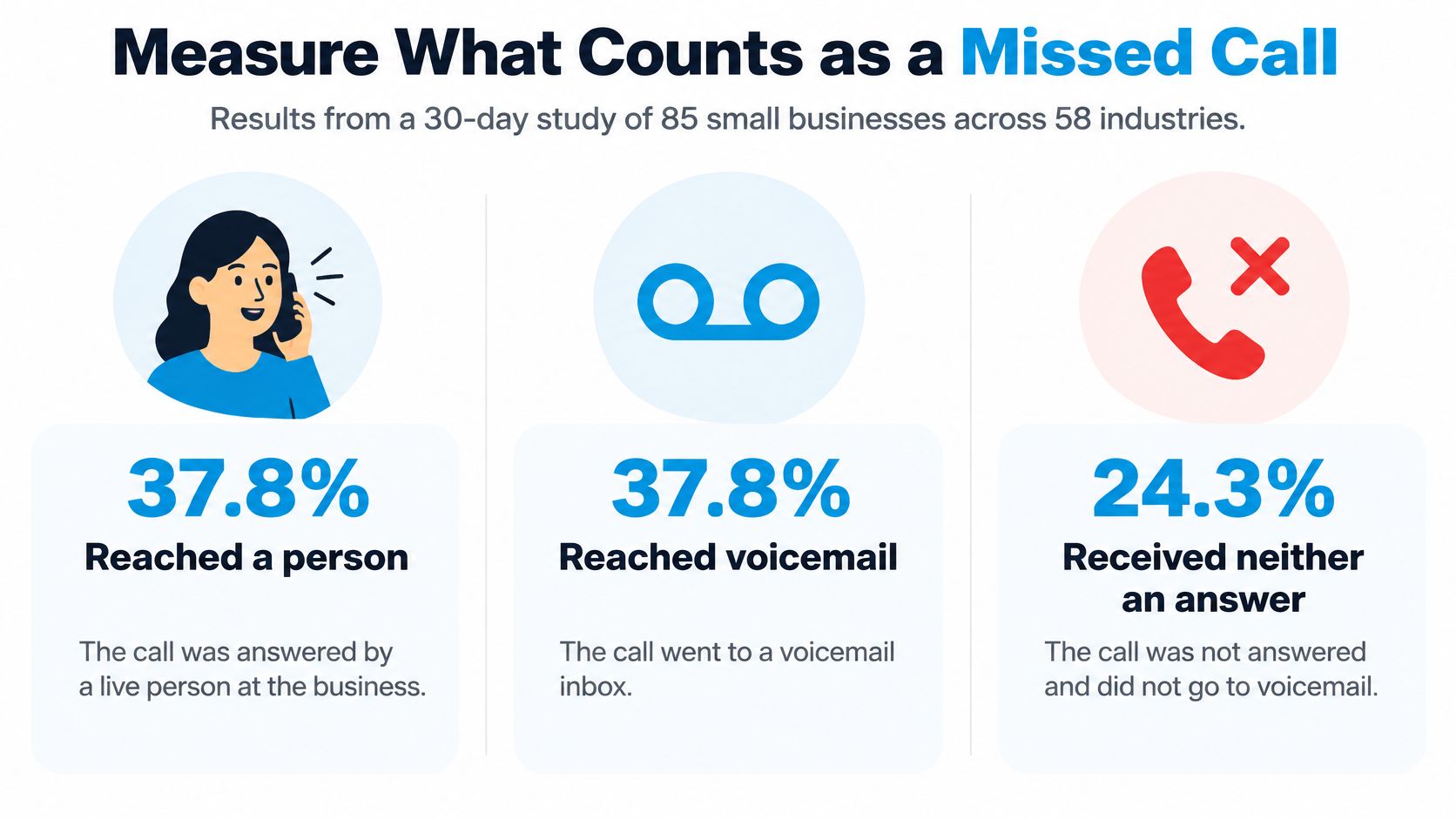
| Outcome | Share in study | What it means | Metric to track |
|---|---|---|---|
| Live person answered | 37.8% | Caller reached a human | Live-answer rate = answered calls / total inbound attempts |
| Voicemail left | 37.8% | Caller reached a recording, not a person | Callback rate from voicemail |
| No answer and no voicemail | 24.3% | No human answer and no capture path | Hard-miss rate, the first number to shrink |
Pull records you can actually act on
Export call-detail records by location, hour, caller ID, disposition, ring duration, and callback outcome. Call detail reporting can help segment calls by business hours, marketing source, service line, and day of week before you change staffing.
Calculate live-answer rate as answered calls divided by total inbound attempts. Calculate hard-miss rate as calls with no human answer and no usable capture path divided by total attempts. Track both: a higher live-answer rate does not solve the problem if callers still have no way to leave a message or get a callback.
A two-person HVAC shop might assume mornings are the problem. Segmenting by hour could show that most hard misses happen Friday between 5 and 7 p.m., while the owner is driving between jobs. That points to a specific coverage gap, not a need to hire for the full week.
Set Up Routing and Overflow Coverage
Choose overflow by urgency fit, not feature count. Emergencies need a person, new leads need speed, and routine changes need reliable capture.
| Overflow option | Best for | Catches after-hours calls | Main trade-off |
|---|---|---|---|
| Ring group to backup staff | Teams with two or more people who can pick up | Partly | Interrupts active work |
| Voicemail with callback queue | Small offices run by one owner | No live answer | Many callers hang up before leaving a message |
| Answering service | Overflow at peak hours | Yes | Limited job knowledge unless scripted |
| AI answering with human handoff | Businesses with steady inbound volume | Yes | Needs a written escalation playbook |
| Automated phone menu (IVR) | Routing to several departments | Partly | Callers abandon long menus |
Set a time based trigger
Call centres commonly use an 80/20 service-level benchmark, and the Nextiva service response time benchmarks describe it as answering 80% of calls within 20 seconds. The same benchmark research cites a customer-patience survey where 77% of respondents considered the urgency of an issue the single biggest factor affecting how patient they were.
Use that as your routing logic. Let the primary phone ring for about 20 seconds, then overflow. A homeowner with active flooding won't wait through a long ring cycle and a menu, while someone asking about office hours will.
Structured call routing for small business works best when the first choice is simple. Pressing one option for emergencies and another for everything else beats five department choices. If you're reviewing your phone system setup, you can explore PBX features for business to confirm your system supports ring groups, timed overflow, and after-hours rules.
Route by job, not by availability alone
Say a home-services company sends emergency plumbing calls to the on-call technician first. Estimate requests go to the office, and when everyone's busy, the system captures the address, problem, and callback number automatically. The technician isn't interrupted for price shopping, and the office isn't first in line for a burst pipe.
AI answering fits steady volume when it has clear limits. It can book, capture intake details, and answer routine questions. When the AI detects a caller needs something more nuanced, it hands off to a human receptionist following the business's playbook. Without that playbook, you've only bought a faster way to give vague answers.
Before you pick an option, settle one question in writing. Who is allowed to be interrupted during working hours, for which call types, and who is explicitly protected from interruptions? If you can't answer that, a ring group will punish your most helpful employee and still miss calls when that person is busy.
Voicemail with a callback queue is the cheapest starting point for a solo owner, but it's capture, not coverage. An answering service adds a live voice at peaks, though you'll need tight scripts for pricing boundaries, service areas, and emergency definitions. I would rank options by how reliably they handle your top two call types, not by how many channels they claim to cover.
Voicemail and Text Follow-Ups That Get Callbacks
A voicemail greeting should tell callers exactly what happens next and what to leave. Vague greetings produce hang-ups and messages you can't act on.
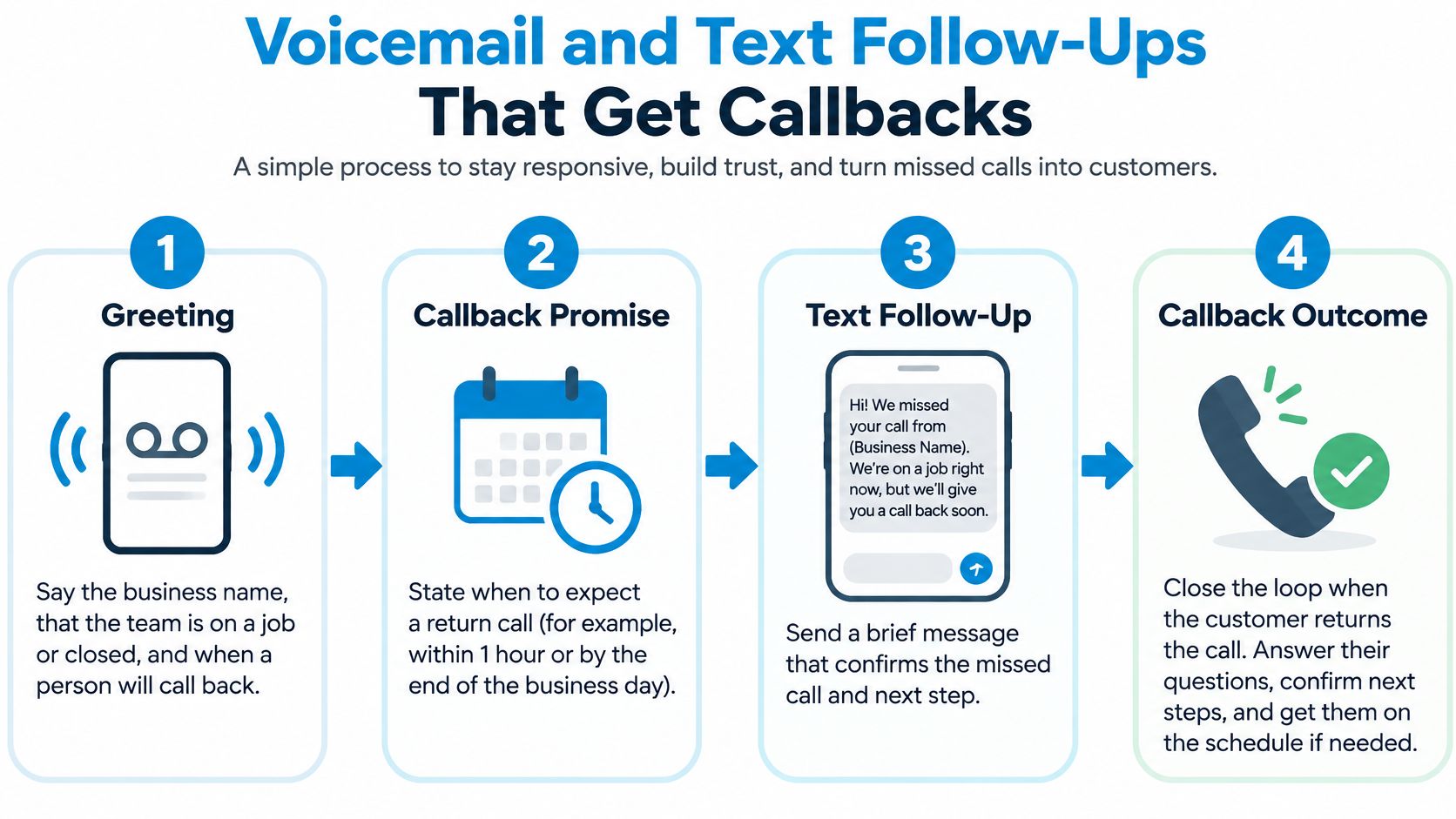
- Greeting: Say the business name, explain you're on a job or closed, and promise a response time. For example, "You've reached Patel Plumbing. We're on a job right now. Leave your name, address and the problem, and we'll text you within five minutes."
- Prompt: Ask for name, callback number, address if relevant, and a one-line reason. A recording without a callback number wastes everyone's effort, even if caller ID looks right.
- Text within five minutes: Name the business, reference the missed call, and give one easy reply path. Try, "Hi, this is Patel Plumbing returning your call from 2:14 p.m. Reply YES for a callback today or send a better time."
- Second attempt: If there's no reply, call back within one hour during working hours. Reference what the voicemail said, so the caller knows you listened.
- Stop rule: After three attempts over two business days, mark the lead closed and log the outcome. Don't keep nudging someone who has gone silent.
Callers screen unknown numbers, so identification does real work. Put your business name in the first few words, keep the message short, and use the same wording across the team. Strong lead follow-up best practices depend on that consistency, because callers trust a message that clearly connects to the call they just made.
The short walkthrough below shows how the greeting, text, and callback fit together as one sequence rather than separate chores.
Respect permission and check your capture
Only text people in line with your permission rules, identify your business every time, and stop when someone opts out. Don't send sensitive details by text. For clinics and law firms, confirm a safe contact method before discussing the matter itself.
Pull three recent voicemails today. If any one lacks a name, a usable number, or a reason, your greeting is asking for too little.
Say a pest control caller leaves, "Call me back about ants." You've got no address, no property type, and no urgency. A better prompt gets "Sarah, 14 Oak Street, ants in the kitchen, toddler at home, please call after 3." Your callback can quote accurately and route the right technician the first time.
When a Human Must Take the Call
Answering every call instantly can create risk. A fast but wrong automated answer on safety, money, or a sensitive complaint costs more than a short delay followed by a qualified human callback.
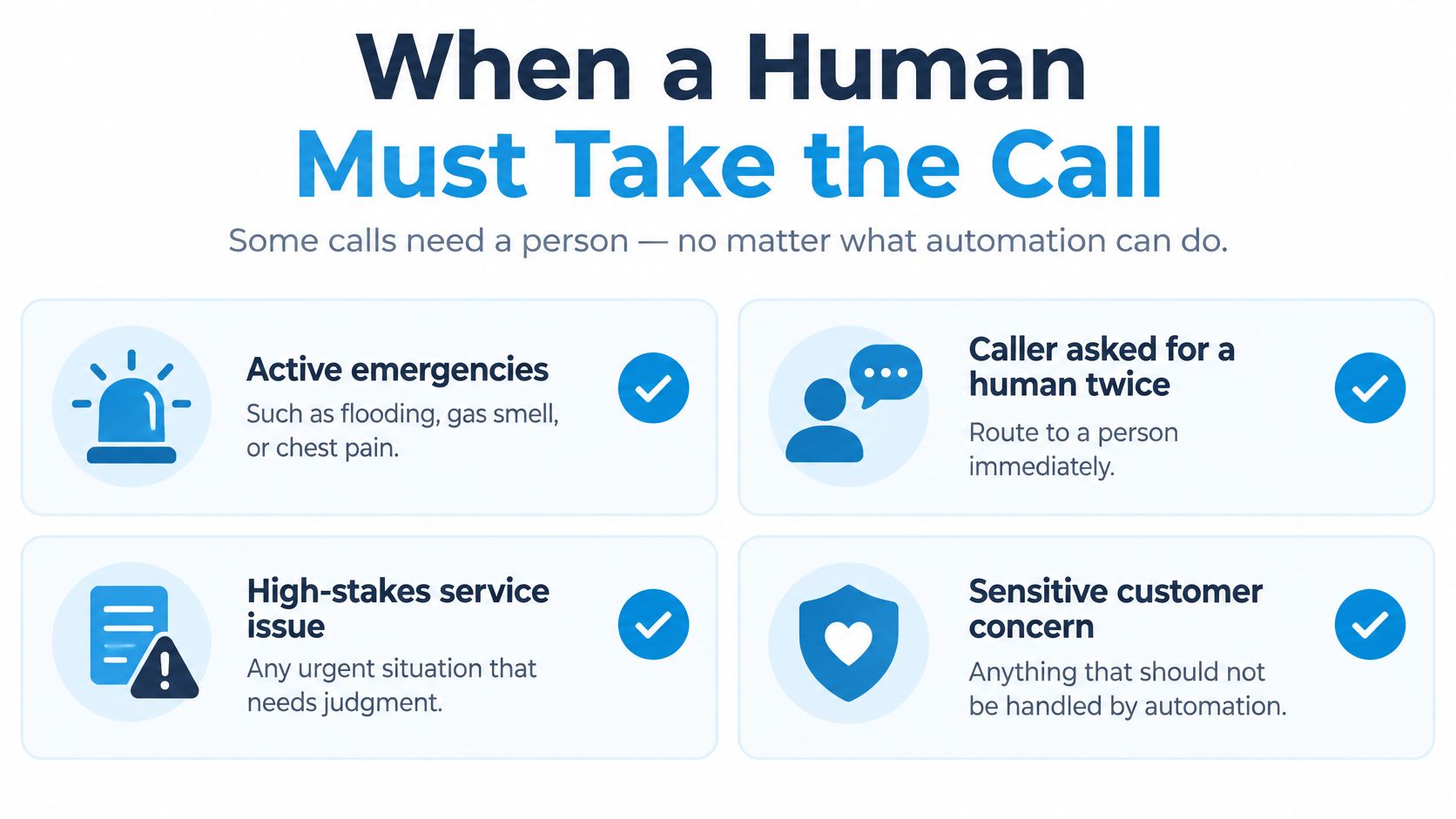
Use this human-required checklist. Automation stops and a person takes over when the call involves:
- Active emergencies: Flooding, gas smell, chest pain, or any immediate safety risk. Direct urgent medical callers to emergency services.
- A caller who asked for a human twice: Don't make them argue with a menu or script a third time.
- An upset or distressed caller: Tone and judgment matter more than intake speed.
- Urgent medical, legal, or financial questions: These need qualified judgment, identity checks, and careful wording.
- A complaint about completed work: The caller needs ownership, not a booking flow.
- A payment dispute: Money disagreements need records, authority, and a calm person.
- An unclear request: If the caller can't describe the need clearly, a person should clarify it instead of forcing categories.
Set the escalation threshold in advance
Let automation handle scheduling, status checks, directions, and structured intake. Anything touching safety, money, vulnerability, or a complaint goes to a person or the on-call line. That boundary protects callers and protects staff from discovering too late that a serious call was booked like a routine appointment.
For legal intake, that threshold is especially sharp. Firms that need trained front-line judgement can hire legal receptionists who recognise deadlines, conflicts, and distress without giving legal advice. Whether you staff internally or externally, the rule is the same. Capture facts, don't assess the case.
How the transfer happens matters too. A warm handoff with context beats dropping the caller into another queue, which is why your team should agree on cold transfer vs warm transfer rules for sensitive calls before launch.
Say a dental clinic's automated line receives a call about severe facial swelling after a procedure. The correct response isn't the next hygiene slot. It's an immediate transfer to clinical staff or clear emergency instruction, with the attempt logged.
Log every handoff with time, reason, and who took the call. Review failures weekly and look for repeated triggers your playbook missed. Then name one person who can override an automated answer, in writing, so staff never hesitate during a live problem.
Run a Two-Week Pilot Before Changing Staffing
Don't hire, switch systems, and rewrite voicemail in the same week. You'll improve or worsen your numbers without knowing why. A short pilot gives you evidence before you commit payroll.
Five steps, one change
- Record a two-week baseline: Track live-answer rate, hard-miss rate, median time to first callback, and booked appointments by day and hour.
- Pick one intervention: Choose overflow coverage, a new voicemail script, or automated text intake. Not all three.
- Run it for two weeks: Keep hours, ads, and channels as steady as you can, and tell staff what counts as a successful capture.
- Compare outcomes: Judge qualified leads, booked appointments, and completed callbacks against baseline. Raw call volume alone doesn't prove value.
- Decide and document: Keep, adjust, or revert. Write down the decision, the reason, and the owner for the next review.
One change at a time matters because attribution disappears fast. If overflow starts on Monday and the voicemail script changes on Wednesday, a lift in bookings could belong to either. You'll keep paying for both even if only one works.
Say a franchise location tests AI answering only on Saturday afternoons. It compares booked appointments, completed callbacks, and complaints with the same Saturdays from the month before. Weekday operations stay untouched, so staff can learn the handoff process on a smaller slice of volume.
Watch for weak signals and side effects
A small location may need four weeks before a clear difference appears. Low call volume swings wildly, so don't declare victory after three good days. Extend the pilot rather than widening it.
Check quality alongside speed. Read a sample of transcripts or messages, confirm emergency calls reached a person, and ask whether callers repeated information after a handoff. A higher answer rate that produces wrong bookings isn't progress.
A pilot succeeds when hard misses fall and booked, qualified work rises. If only answered calls rise, you've measured activity, not recovery.
End with a monthly review on the calendar. Check whether the hard-miss rate moved, whether median callback time held, and whether any callers complained about the new process. Bring three example calls, one success, one failure, and one borderline escalation, and adjust the playbook from those specifics.
Choose Your First Missed-Call Fix This Week
Pick one fix, not a rebuild. Find your largest hard-miss source in your call records, then apply the matching playbook row with its first action, target time, and channel.
Choose one overflow option and set its trigger, such as overflow after about 20 seconds of ringing. Use a simple checklist for the change:
- One owner: Name who checks the queue.
- One target time: Write it next to the call type.
- One measured metric: Track hard misses or booked appointments.
- One review date: Put it two weeks out.
Say a home-services office finds most hard misses on Friday evenings. It sets a 5 p.m. rule that sends unanswered calls to the text-back sequence within five minutes, names the queue owner, and reviews the Friday hard-miss rate on the review date.
Today's first step is smaller. Write your escalation list from the human-required triggers and send it to the team. If you need coverage quickly, a receptionist is created in 15 minutes, calls can be received immediately after setup, each customer gets a dedicated local or toll-free number, and calls are answered within seconds at any hour.
If no one answered the phone is costing you emergencies, leads, and repeat bookings, Recepta.ai can answer within seconds at any hour, capture the details your playbook requires, and hand nuanced calls to a trained human receptionist. Set up your dedicated local or toll-free number, define your escalation rules, and start recovering missed calls this week by visiting Recepta.ai.