
Explore hvac answering service: Boost Leads Today
Think of an HVAC answering service as your frontline defense against lost business. It’s a specialized service designed to make sure every single phone call to your heating and air conditioning company gets answered by a real, professional person, no matter the time of day. This means no more missed opportunities and no more lost revenue just because you were on another job or it was after hours.
The True Cost of a Missed Call for Your HVAC Business
Every time your phone rings and goes to voicemail, it’s not just a missed call. It's a customer you’ve handed directly to your competition. Let’s be honest—when someone's AC dies in the middle of a heatwave, or their furnace quits on a freezing night, they aren't going to leave a message and wait patiently. They're going to hang up and immediately call the next HVAC company on Google until someone picks up the phone.
That simple action turns every unanswered call into a serious financial leak. For many owners, this reality hits hardest during peak season. Picture a scorching July weekend. Your phone is ringing off the hook with emergency repair calls. While your techs are out on jobs, more calls pour in, all going straight to voicemail. Each one of those is a job—and a customer—you'll likely never get back.
Calculating the Financial Damage
Let's break down what this actually looks like in dollars and cents. Say your company misses just three calls a day during the busy season. If your average repair job brings in $400 in revenue, you’re losing $1,200 every single day.
Over a standard five-day workweek, that's $6,000 down the drain. Annually, those few missed calls can easily add up to over $300,000 in revenue you never had a chance to earn.
This isn't just a worst-case scenario; it's the industry standard. Shockingly, only 27% of HVAC businesses manage to respond to new customer inquiries within 15 minutes. This lag is costing companies dearly. On average, HVAC businesses miss 27% of their inbound calls, which translates to between $45,000 and $120,000 in lost jobs every year for an individual business.
A missed call isn't just a dropped connection; it's a direct transfer of revenue from your business to your nearest competitor. Answering the phone is the first and most critical step in customer acquisition.
Beyond Revenue Loss: The Hidden Costs
The damage goes much deeper than just the initial lost job. When a potential customer's call goes unanswered, it chips away at your reputation. It leaves them with the impression that your business is either unreliable or simply too busy to handle their problem. That negative experience pushes them to your competitors and can even lead them to leave a bad review online.
Even with flawless local listings management, a single missed call negates all the marketing work you did to get that customer to find and dial your number in the first place. The real costs stack up quickly:
- Lost Customer Lifetime Value: That one-time emergency repair could have blossomed into a long-term maintenance contract or even a full system replacement years later. For example, a $450 emergency repair today could turn into a $1,500/year maintenance plan and an $8,000 system replacement five years from now.
- Wasted Marketing Spend: Every dollar you spent on Google Ads, SEO, and mailers is thrown away the moment the call you paid for goes to voicemail. If you spend $3,000 on a radio campaign and miss 10 resulting calls, you've wasted a significant portion of that budget.
- Damaged Reputation: A frustrated caller is far more likely to share their negative experience online or with neighbors, tarnishing your brand in the local community. A simple post in a neighborhood Facebook group like, "Tried calling Apex HVAC, no answer. Who else is good?" can steer dozens of potential jobs to your competition.
This is why looking at an answering service as a simple "expense" is a fundamental mistake. It’s a strategic investment in capturing revenue, protecting your brand, and securing your market share. For businesses like yours, a dedicated https://www.recepta.ai/blog/contractor-answering-service is the key to growing your company without the chaos, ensuring you capture every lead and turn every call into a booked job.
How an HVAC Answering Service Actually Works
Let’s get one thing straight: an HVAC answering service is much more than a glorified voicemail or a simple call center. Think of it as the brain of your customer communication—a smart, always-on system that makes sure every single person who calls you gets a professional, helpful, and immediate response. It doesn't just answer the phone; it becomes a seamless part of your team.
The goal is simple but incredibly important: capture every call professionally. When a customer's AC dies in the middle of a heatwave, they're not going to leave a voicemail and patiently wait for a callback. They're going to hang up and call the next name on the list. An answering service stops that from happening.
Every time your phone rings and no one picks up, money is walking out the door. It's a direct line from a missed call to lost revenue.
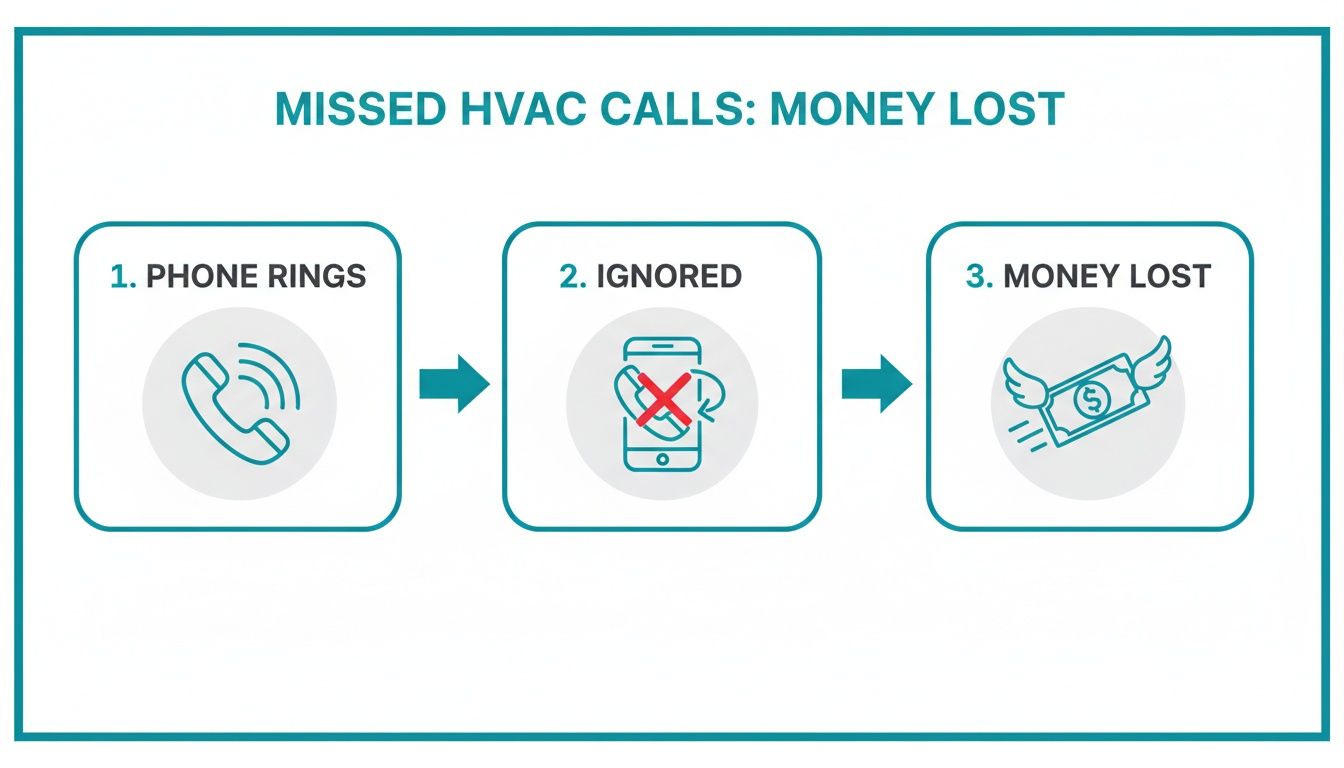
This is the expensive cycle that a good answering service is built to break, ensuring you're always open for business, even when you're not in the office.
The Modern AI-Hybrid Model
The best services today aren't just human operators or just robotic voices. They use a smart AI-hybrid approach that gives you the best of both worlds. It combines the lightning-fast efficiency of AI with the empathy and problem-solving skills of a real human being.
For example, a customer calls asking a common question like, "Do you offer financing?" The AI can instantly provide your pre-approved answer, like "Yes, we offer 12-month and 24-month financing options through Greensky. Would you like a link to apply?" But when a panicked homeowner calls with a busted furnace in the dead of winter, the system knows to immediately escalate the call to a live agent who can provide that crucial human touch.
A Practical Call Flow Example
So, how does this look in the real world? Let’s paint a picture. It’s 10 PM on a Friday, and a family's air conditioner just gave out.
- The Call: The homeowner frantically Googles "emergency HVAC near me" and finds your number. They call, expecting to hit a voicemail. Instead, they're greeted instantly by your answering service.
- Information Capture: Following a script you helped create, the service asks the right questions: "I understand your AC isn't working. To best help you, can you tell me if it’s making any unusual noises?" followed by, "And can I get the best address and phone number for our technician?"
- Action and Dispatch: The service automatically checks the on-call schedule you provided. It sees your technician, Mark, is on duty for weekend emergencies and knows he's the right person for the job.
- Integration and Booking: From there, it taps directly into your company’s scheduling software, finds an open emergency slot, and books the appointment right on the spot.
Within minutes, the customer goes from stressed-out to relieved with a confirmed appointment. At the same time, Mark gets an automatic notification on his phone with all the job details. Your business just captured a high-value emergency job that would have been lost forever.
This whole sequence runs on autopilot based on the rules you set up. You get to decide what counts as an emergency, who gets the call, and how everything is logged in your system. The service simply executes your game plan, 24/7/365.
Of course, today’s platforms can do far more than just answer calls. You can dig deeper into how an automated phone answering service can manage all sorts of communication tasks for your business.
Ultimately, this turns your phone line from a point of failure into your most powerful tool for capturing leads and growing your revenue. No matter when a customer needs you, your business is ready to answer the call.
The Real-World Benefits for Your HVAC Business
Let's be honest—an hvac answering service isn't just about having someone pick up the phone. It's about turning missed calls into money and building a brand that customers trust.
For any serious HVAC contractor, the advantages are concrete. They show up directly in your lead count, your bottom line, and the reputation you build in your community. This is where you stop losing opportunities and start creating them.
Capture Every Emergency and After-Hours Call
We all know the high-value calls rarely come between 9 and 5 on a Tuesday. They happen when a family's AC dies on a blistering holiday weekend or a furnace quits in the middle of a cold snap. Sending these urgent calls to voicemail is like handing a paying customer directly to your competition.
Think about how this plays out in the real world:
Without an answering service: A family's furnace fails on a Saturday. They call you, get voicemail, hang up, and immediately call the next contractor on Google. Your competitor just landed a $500 emergency repair job that you never even knew about.
With an answering service: That same call comes in, but this time, a live agent answers instantly. They follow your custom script, identify it as an emergency, and dispatch your on-call tech. You just secured a profitable job that would have been lost forever.
This 24/7 coverage is a game-changer for maximizing revenue. You can dig deeper into why this works so well in our guide to after-hours answering services.
Stop Fumbling Leads and Start Booking Jobs
A voicemail message isn't a lead; it's a gamble. A name and a number with a vague "call me back" request is a weak starting point, and by the time you call back, that potential customer has likely moved on.
A professionally handled call, on the other hand, is a qualified opportunity teed up and ready for your team.
This is especially critical right now. The U.S. HVAC market is set to explode from $120 billion in 2024 to $165 billion by 2026. On top of that, an estimated 3.5 million HVAC units will need replacement in 2026 alone. You can't afford to miss out on your piece of that pie. You can get more details on these HVAC industry trends and their impact on your business.
The goal isn't just to answer the phone. It's to move the customer to the next step—turning a simple question into a scheduled, billable appointment.
Here's how that simple shift transforms your sales process:
Before: Your office manager gets a voicemail: "Hi, it's Sarah, I need a quote." She calls back an hour later, but Sarah's in a meeting. The lead quickly goes cold.
After: The answering service agent speaks with Sarah live. The agent asks your pre-set questions ("Is this for your home or a business? Are you looking for a repair or a full system replacement?"). With that info, they book a consultation directly into your calendar. Your sales team walks into a scheduled meeting with a pre-qualified customer.
Look Like the Pro You Are, on Every Single Call
Your company's first impression happens the moment a customer dials your number. What do they hear? A harried technician shouting over the noise of a compressor, or a calm, professional voice ready to help?
How your phone is answered tells a customer everything they need to know about your business. It's the difference between projecting chaos and projecting competence.
This table really drives the point home:
Call Handling Methods Head-to-Head Comparison
By ensuring every caller gets the same polished, professional treatment, an answering service solidifies your reputation as a top-tier operation. It’s that consistent, trustworthy brand image that doesn't just win you a job—it wins you a customer for life.
Essential Features Your Answering Service Needs
When you're shopping for an HVAC answering service, it’s easy to get bogged down in promises of just "answering calls." But let's be real—your goal isn't just to stop the phone from ringing. It's to book more jobs and make more money.
A truly valuable service does far more than take messages. It needs to have the right tools baked in to function as a genuine part of your growth engine. Think of it less as an operator and more as a remote, super-efficient front office. Here are the non-negotiables I tell every HVAC owner to look for.
CRM and FSM Integration
Your business lives inside your Customer Relationship Management (CRM) or Field Service Management (FSM) software. If an answering service can't plug directly into it, you're signing up for a world of pain. Manually typing lead information from an email into your system is a massive time-waster and a breeding ground for costly mistakes.
Proper integration means the answering service talks directly to your software. When an agent fields a call from a new customer, their information—name, number, service issue—is automatically pushed into your FSM, creating a new lead or customer record on the spot. No delays, no typos.
Picture this: It's 9 PM on a Tuesday. A homeowner calls about a broken AC unit. The answering service agent gathers the details, and instantly, a new job lead appears in your ServiceTitan or Jobber dashboard. It's already tagged as an "emergency repair," and all the notes are there. When your dispatcher logs in the next morning, the lead is ready to be assigned—no data entry required.
This isn’t just a "nice-to-have" anymore. With 61% of HVAC companies now using FSM software, the industry has turned a corner. The proof is in the numbers: tech-savvy shops are seeing 20-60% higher revenue. You simply can’t keep up with manual processes. For a deeper dive into how these connections work, check out our guide on what CRM integration is. And if you're curious about where the industry is headed, it's clear that technology adoption is shaping customer expectations in 2026.
Customized Call Scripting
Your company has a specific way of talking to customers. You have your own process, your own brand voice. A generic, one-size-fits-all call script will make you sound just like your competition and, worse, might fail to get the critical details your team needs.
A top-tier answering service will build customized call scripts with you. This isn't just about a friendly greeting; it's about designing a conversation that works for your business.
A custom script doesn't just guide a conversation; it pre-qualifies your leads. It sorts high-value opportunities from routine inquiries, saving your team valuable time and effort.
A smart script can immediately start segmenting callers. For example:
- Initial Greeting: "Thanks for calling Apex Climate Control. How can we make you comfortable today?"
- Service Type Qualifier: "Are you looking for a repair, scheduling annual maintenance, or are you interested in a quote for a new system?"
- Property Type Qualifier: "Great. And is this for your home or a commercial building?"
- Urgency Assessment (if repair): "To get you the right help, is the system completely down, or is it just not keeping up?"
This kind of guided questioning means the call summary that lands in your inbox tells you exactly what the customer needs, how urgent it is, and whether it should go to a repair tech or a comfort advisor for a sales call.
Direct Appointment Booking
Let's face it: the real goal of answering the phone is to get a tech on the schedule. The biggest game-changer is an answering service that can book appointments directly into your calendar. This single feature eliminates the frustrating back-and-forth of phone tag that kills so many promising leads.
For this to work, the service needs secure, real-time access to your dispatch board or technicians' calendars. By syncing directly with your scheduling software, agents can see who is available and when, booking jobs right on the call without ever double-booking a technician.
- Scenario: A customer calls wanting to schedule a furnace tune-up for next week.
- Action: The agent pulls up your team's schedule, sees that your technician John has an open slot on Tuesday at 2 PM, and confirms it with the customer right then and there.
- Result: The job is on the books. The customer gets an instant confirmation email, and John's calendar is updated automatically. All of this happened without you or your office manager having to do a thing.
This is how an answering service pays for itself. It stops being a passive message-taker and becomes an active partner that turns inbound calls into confirmed revenue.
Bringing an Answering Service Onboard: A 5-Step Game Plan
Thinking about adding an HVAC answering service might feel like a huge undertaking, but getting it right is simpler than you might imagine. The best providers have this down to a science, guiding you through a clear, organized process that gets you running without throwing your daily operations into chaos.
Let's walk through a realistic, five-step roadmap that can take you from making the decision to having live agents handling your calls in about a week. To make this real, we'll follow a fictional company, ‘Apex Climate Control,’ and see how they get it done. This isn't a month-long project; a focused, one-week setup is totally achievable.
Step 1: Define Your Mission and Map Your Calls
First things first: what do you need this service to do for you? Before you dive into the technical details, you need a clear mission. Is your number one goal to stop missing those middle-of-the-night emergency calls? Or are you more focused on qualifying new leads and booking more estimates during the day?
Knowing your primary goal shapes every other decision.
For our example, Apex Climate Control decides their main objective is twofold: capture every single after-hours emergency and book appointments for any non-urgent requests that come in. With that clarity, they map out two simple call workflows:
- Emergency Workflow: If a caller reports a total system failure (e.g., "no heat in winter" or "AC is dead in July"), the agent gathers essential details and immediately dispatches the on-call technician via text message with the address and problem description. No delays.
- Non-Urgent Workflow: For someone wanting a quote or to schedule routine maintenance, the agent books an appointment directly into the company calendar for the next available business day, filling a slot on Tuesday at 10 AM.
Step 2: Connect Your Calendar and CRM
This is where the real power comes in. For an answering service to be more than just a glorified voicemail, it has to plug directly into your business tools. This means giving the service secure access to your scheduling software (like Jobber or ServiceTitan) and your customer database.
Apex Climate Control uses a cloud-based calendar to manage its technicians' schedules. During setup, they grant the answering service "view and add" permissions. This simple integration is a game-changer. When an agent books a job at 10 PM, it instantly populates the technician's schedule, eliminating any risk of double-booking or missed messages.
A seamless integration is the difference between a simple message-taking service and a true operational partner. It’s what allows your service to take action, not just notes.
Step 3: Set Up Call Forwarding and Prep Your Team
Getting your calls routed to the service is straightforward. You’ll work with your phone provider to set up conditional call forwarding, which lets you automatically send calls to the answering service based on rules you define.
A few common setups include forwarding calls that:
- Ring more than three times without an answer (handling overflow during peak hours).
- Come in after 5 PM, on weekends, or on holidays (capturing all after-hours leads).
- Arrive when your main line is already busy (ensuring no one ever gets a busy signal).
Once the tech is handled, it's time to prep your people. Give your technicians a heads-up that they'll start receiving job details directly from the service, usually via text or an app notification. For example: "Hey team, starting Monday, all after-hours dispatch alerts will come from this number. Please save it in your contacts." This small bit of internal communication ensures everyone is on the same page and ready for the new workflow from day one.
Step 4: Go Live and Monitor Like a Hawk
With your call scripts finalized and systems connected, you're ready for launch. A good provider will suggest a "soft launch," maybe by only forwarding your after-hours calls for the first few days. This lets you watch how everything works in a controlled environment.
Apex Climate Control decides to go live on a Thursday evening. The owner pays close attention to the call summaries and appointment notifications as they come in. This immediate feedback loop is crucial—it helps them spot a minor hiccup where the script wasn't asking for the customer's email. They call their account manager at the service, and the script is updated in under 15 minutes.
Step 5: Review, Refine, and Optimize
After the first week of live service, it’s time for a debrief. Take a look at the key metrics. How fast are calls being answered? How accurate are the appointments being booked? Is the information gathered from emergencies exactly what your techs need?
A strong partnership isn't "set it and forget it." It involves regular check-ins with your provider to review performance, celebrate what's working, and identify areas for improvement. For example, after a month, Apex realizes many callers ask about maintenance plans. They work with the service to add a line to the script: "By the way, we have a Comfort Club that includes two tune-ups a year and gives you 15% off repairs. Would you like to hear more?" This turns a simple call into an upsell opportunity.
Figuring Out the Real Return on Your Answering Service
It’s easy to look at a new service and just see another monthly bill. But an hvac answering service isn't a cost center—it's a money-maker. When you start tracking the right numbers, you'll quickly see how the service pays for itself and then some, giving you a solid return on investment (ROI).

The trick is to stop thinking about the monthly fee and start focusing on the actual value it brings to your business. Let's get into how you can calculate that return in real, tangible dollars.
How to Calculate the Hard Numbers
The most straightforward way to see your ROI is to measure the net profit from jobs the answering service books for you. This boils down to two simple things: the money you gained versus the money you spent.
Here’s the basic math to get you started:
(Total Profit from New Jobs - Cost of Answering Service) / Cost of Answering Service = ROI
To find your "Total Profit from New Jobs," you just need to keep an eye on a couple of things:
- The number of new jobs booked only by the answering service (ask your provider for a report showing which calls resulted in a booked appointment).
- Your average profit on each job—not the total revenue, but the actual profit after parts, labor, and overhead.
A Real-World ROI Example
Let's see what this looks like in practice. Say your answering service costs $500 a month. At the end of the month, you check the call reports and find they snagged four emergency jobs that came in late at night. You know for a fact you would have missed those.
- Average Profit Per Job: You figure that an average emergency call nets you about $350 in profit.
- Total New Profit: That’s 4 jobs x $350 per job, which equals $1,400 in new profit.
- Monthly Net Gain: Take that $1,400 in new profit and subtract the $500 service cost. You're left with $900.
In this case, you didn't just break even. You put an extra $900 of pure profit in your pocket. That's an ROI of 180% for the month ($900 / $500).
A positive ROI is all the proof you need. It shows the service isn't a drain on your resources; it's an engine for growth.
Getting comfortable with ROI calculations is a great skill for any business owner. For more on this topic, you can see how others calculate the ROI for managed IT services and apply the same logic here.
Don't Overlook the "Soft" Returns
Crunching the numbers is great, but that’s only part of the story. An answering service delivers a ton of value that won't show up on a spreadsheet but is just as critical for your long-term success.
These intangible benefits are game-changers:
- Happier Customers: When a homeowner's AC dies at 10 PM and a real person answers their call, you've immediately earned their trust. That great first impression often turns into a 5-star Google review like, "Called them late on a Friday and they actually answered! Had a tech out the next morning. Lifesavers!"
- A Stronger Reputation: Being the company that always answers makes you look far more professional and reliable than the competition that lets calls roll to a generic voicemail. You become known as the dependable choice in your area.
- Less Burnout for Your Team: Taking after-hours and weekend calls off your staff's shoulders prevents burnout. Your lead technician no longer has to be a part-time dispatcher on his days off, allowing him to rest and be more effective during work hours.
These benefits create a positive feedback loop, strengthening your brand and driving growth in ways that go far beyond the jobs you can count this month.
Common Questions About HVAC Answering Services
If you're an HVAC owner, you've probably got a few questions running through your mind about how an hvac answering service would actually work for your business. It's smart to dig into the details—cost, capabilities, and what the experience is like for your customers. Let’s tackle the most common ones I hear.
How Much Does a Service Typically Cost?
Let's get right to it: the price. Most answering service plans will start at a few hundred dollars a month. The final cost usually depends on one of two things: the total number of calls they handle for you or the total minutes their agents spend on the phone.
But don't just look at the cost; think about the return. Imagine your plan is $400 a month. If the service catches just one after-hours emergency call that turns into a $500 repair job, you've already made your money back and then some. It’s less of an expense and more of an investment in capturing work you'd otherwise miss.
Can the Service Handle Technical Questions?
Nope, and that's actually a good thing. Think of an answering service agent as an expert dispatcher, not a substitute technician. Their job is to follow the custom script and escalation rules you set up.
This is a feature, not a bug. It keeps your highly-paid technicians focused on technical work, while the answering service excels at what they do best: customer intake and scheduling.
So when a frantic customer calls about a loud banging noise coming from their AC unit, the agent isn't going to guess what it is. Their script will prompt them to ask, "Okay, a loud banging noise. I'm noting that for our technician," and then they'll calmly gather the rest of the details and route it straight to your on-call tech. This prevents misinformation and keeps your whole operation running efficiently.
Will It Feel Impersonal to My Customers?
This is a huge worry for most owners, but what usually happens is the complete opposite. A good answering service uses scripts customized to your business, so every caller is greeted with your company's name and a consistent, professional tone.
Honestly, which sounds better? A rushed, "I'm on a roof, can I call you back?" from a distracted tech, or a calm, helpful agent who can schedule their appointment on the spot? The goal is to make every single caller feel heard and taken care of, and a dedicated service is often the best way to do that.
How Fast Can I Get Set Up?
Getting started is surprisingly quick. Most HVAC businesses are up and running in less than a week. The setup process is straightforward: the provider will work with you to nail down your scripts, connect to your scheduling software, and make sure calls are forwarded seamlessly. There’s no downtime for your business at all.
Ready to capture every lead and book more jobs? Recepta.ai provides a 24/7 AI-hybrid answering service that ensures you never miss a call. Learn more and start your 30-day risk-free trial.
.webp)