
Inbound Call vs Outbound Call: Master the inbound call vs outbound call approach
At its heart, the difference between an inbound call vs an outbound call comes down to one simple question: who picked up the phone first? An inbound call is reactive; a customer is calling you for help or information. An outbound call, on the other hand, is proactive; your team is reaching out to start a conversation, generate a lead, or make a follow-up.
Essentially, inbound calling is about capturing demand that already exists. Outbound is about creating new opportunities from scratch.
Defining Inbound and Outbound Calls

Getting a firm grip on the inbound vs. outbound distinction is the foundation of any solid customer communication plan. They might both happen over the phone, but they serve completely different purposes, are kicked off by different events, and aim for entirely separate outcomes.
The Reactive Nature of Inbound Calls
An inbound call is simple: a customer or potential customer initiates contact with your business. These calls are almost always driven by a specific, immediate need. The person on the other end has hit a point where they need an answer, a solution, or a service right now.
Practical Example: A homeowner’s AC unit stops working on a sweltering July afternoon. They search for "AC repair near me" and call the first company that looks promising. This is a classic inbound call—urgent, high-intent, and representing a lead that is ready to buy. The main goal here is quick, effective problem-solving.
Success with inbound calls all comes down to being available, efficient, and knowledgeable. The person or system answering that call has to get to the heart of the matter and provide a clear path forward, fast. This is exactly why many companies hire a dedicated inbound sales representative who specializes in turning these hot leads into paying customers.
The Proactive Nature of Outbound Calls
On the flip side, an outbound call is when your business initiates contact with a prospect or existing customer. These calls are purely proactive and are designed to drum up new business, check in with clients, or conduct research. The person you’re calling wasn't necessarily thinking about you, so the goal is to create a reason for them to engage.
Practical Example: A dental office reviews its patient records and identifies everyone who is more than six months overdue for a cleaning. The front desk staff then makes outbound calls to these specific patients, reminding them of the importance of regular check-ups and offering to book their next appointment. This is an actionable outbound strategy to fill the schedule and promote patient health.
You might see outbound calls used for a few common reasons:
- Lead Generation: Calling a targeted list of potential clients who fit your ideal customer profile.
- Customer Follow-Up: Reaching out to a past customer to schedule their annual furnace inspection.
- Market Research: Phoning people in a specific area to ask about their interest in a new service you plan to offer.
To make the distinction even clearer, this table breaks down the key operational and strategic differences between inbound and outbound calling across several critical business dimensions.
Inbound vs Outbound A Head-to-Head Comparison
| Dimension | Inbound Calls | Outbound Calls |
|---|---|---|
| Initiator | Customer or Prospect | Your Business or Agent |
| Primary Goal | Resolve Issues, Answer Questions | Generate Leads, Nurture Prospects |
| Customer Intent | High (customer has a specific need) | Low (often an interruption) |
| Nature | Reactive (responding to a request) | Proactive (creating a conversation) |
As you can see, the core mechanics are polar opposites. One is about managing incoming interest, while the other is about creating it.
A Nuanced Comparison of Call Strategies

Sure, the easiest way to tell the difference between an inbound and an outbound call is who dialed the number. But if you stop there, you're missing the bigger picture. In reality, these are two completely different worlds. Understanding their distinct purposes, the skills they require, and how you measure success is what separates a truly effective call strategy from a disjointed one.
At its core, an inbound call is all about problem resolution. A customer is reaching out because they need something, and the agent's job is to deliver a solution. It’s a reactive role. On the flip side, an outbound call is about demand creation. The agent is proactively making contact to stir up interest, qualify a lead, or close a deal. It's a proactive mission.
This fundamental split has a massive impact on the kind of people you need on your team.
Contrasting Agent Skill Sets: Empathy vs. Persuasion
Your best inbound agents are masters of empathy and problem-solving. Their real value comes from their ability to listen, understand a customer's frustration or need, and find a resolution as quickly as possible. They are trained to listen first, calm tense situations, and provide clear, reassuring answers.
Think of a great inbound agent as an ER doctor for your business. They have to stay cool under pressure, diagnose the issue with precision, and administer a fix that restores the customer's faith in your company. This takes deep product knowledge and stellar active listening skills.
In stark contrast, a top-performing outbound agent is driven by persuasion and resilience. Their job is to politely interrupt someone’s day, grab their attention in just a few seconds, and make a compelling case for why they should listen. This role isn't for everyone—it requires a thick skin to handle constant rejection and the persuasive finesse to turn a "no" into a real conversation.
Let’s look at how this plays out with a practical example:
- Healthcare Clinic (Inbound): A patient calls in with severe tooth pain. The agent needs to convey empathy ("That sounds incredibly painful, let's get you seen right away"), quickly find an emergency appointment slot, and clearly explain the next steps ("Dr. Smith has an opening at 2 PM. Please bring your insurance card."), all while keeping the caller calm.
- Healthcare Clinic (Outbound): An agent calls a patient who is two years overdue for a check-up. The agent must persuasively articulate the importance of preventative care ("We're calling because regular check-ups are key to catching issues early") and skillfully handle objections like "I'm busy" ("I understand. We have early morning and evening slots to fit your schedule. How about 7 AM next Tuesday?") to get that appointment booked.
These two roles require entirely different personalities and training. Putting the wrong person in either role is a surefire way to cause burnout and get poor results.
The core difference lies in lead temperature. An inbound caller is a "hot lead"—they have actively sought you out with a problem to solve or a purchase to make. An outbound prospect is a "cold lead"—they may not even be aware of their need until you create it, requiring a far greater effort to convert.
How Success Metrics Diverge
Since the goals and skills are so different, it only makes sense that the Key Performance Indicators (KPIs) you use to track success would be, too. Judging both teams by the same metrics will give you misleading data and send you down the wrong strategic path. An automated phone answering service can be a huge help here, accurately tracking and reporting on the right metrics for each team.
For inbound teams, you’re measuring efficiency and the quality of the customer experience. The metrics that matter are:
- First Call Resolution (FCR): What percentage of issues are completely solved in a single phone call? A high FCR is a sign of well-trained agents and smooth internal processes.
- Average Handle Time (AHT): How long does the average interaction take, from start to finish? The goal is to keep this low without making customers feel rushed.
- Customer Satisfaction (CSAT): Are customers actually happy with the help they received? This is often measured with a quick post-call survey.
For outbound teams, it's all about driving growth and creating new business. You’re judging their performance based on:
- Conversion Rate: Of all the calls made, what percentage led to a sale, a booked appointment, or a qualified lead for the sales team?
- Calls Per Agent: This is a simple activity metric. How many dials is each agent making? It’s a measure of effort and hustle.
- Contact Rate: Out of all the dials, how many actually resulted in a conversation with the right person?
When you lay it all out—the goals, the skills, the metrics—it's clear that inbound and outbound calling aren't just two sides of the same coin. They are distinct disciplines, each demanding its own unique strategy, people, and management to get right.
The Economic Case for Mastering Inbound Calls
Outbound strategies have their place, but when we talk about the bottom line, the financial argument for perfecting your inbound call strategy is impossible to ignore. For any business in a high-intent industry, every inbound call is a potential sale that has literally come to you.
Think about it: when a customer picks up the phone to call your business, they've already done the heavy lifting. They’ve identified a problem, researched solutions, and decided you might be the right fit. Your only job is to be there to catch that opportunity. This completely changes the financial picture. Instead of spending money to find and persuade cold prospects, you’re investing in serving warm, motivated buyers.
The Superior ROI of Inbound Leads
The numbers don't lie. Inbound calls consistently win out against outbound efforts on cost efficiency and lead volume. This makes them a financial cornerstone for businesses like home service providers and healthcare practices that need to grow without sending their marketing budgets through the roof.
Recent data shows that inbound marketing methods cost 62% less per lead than outbound tactics. After just five months, the savings get even better, with those inbound leads becoming 80% less expensive to acquire. On top of that, these strategies can generate 54% more leads than traditional outbound, filling your pipeline with prospects who are already halfway to a decision.
This cost difference is huge. Learning how to reduce customer acquisition cost is critical when you're deciding where to put your dollars. For businesses where a single booked appointment is worth hundreds or even thousands of dollars, that efficiency is a game-changer.
Practical Examples of Inbound ROI
Let's look at a couple of real-world scenarios where the financial benefits are crystal clear.
For a Law Firm: An outbound campaign might involve an agent making hundreds of cold calls to find one semi-interested lead. Now, picture a single inbound call from someone just in a car accident. That's a high-value, urgent case potentially worth tens of thousands. The cost to acquire that inbound lead (e.g., the marketing spend on the blog post they found) is a tiny fraction of its potential return.
For a Home Services Company: An HVAC business runs an outbound campaign offering a discounted tune-up, yielding a 1-2% conversion rate. Contrast this with an inbound call from a homeowner whose furnace just died in winter. This is an almost guaranteed sale for an emergency repair or a new system, with a near 100% conversion rate on the spot.
The economic power of inbound calls is all about intent. You're not interrupting someone's day to create a need; you are fulfilling a need that already exists at the precise moment the customer is ready to act.
Turning Missed Calls into Revenue
The single biggest financial risk with inbound calls is simply not answering the phone. Every time a call from a high-intent prospect goes to voicemail, you’re watching revenue walk out the door. This is where the right tools can completely change a business's financial health.
Platforms like Recepta.ai ensure no inbound lead ever gets lost, no matter when they call. By offering 24/7 AI-powered call handling, it captures every single opportunity. What would have been a missed call—and a lost customer—is instantly turned into a booked appointment or a qualified lead, directly boosting your revenue.
Even better, this approach can deliver up to 80% cost savings compared to staffing a traditional, around-the-clock reception team. You cut down your operational costs while simultaneously increasing top-line revenue. For any business focused on financial performance, it’s a clear win. To get a better handle on your own metrics, check out our guide on how to calculate cost per lead.
When to Deploy a Strategic Outbound Approach
Relying only on inbound calls is like running a fishing boat with the engines off—you’re just waiting for something to bite. A smart outbound strategy, on the other hand, lets you steer directly toward the best fishing spots. We're not talking about aimless cold calling here. This is about creating your own opportunities with purpose, which is a key difference when you look at an inbound call vs outbound call.
Outbound is your go-to move when you need to break into a new market, warm up leads that have gone quiet, or bring past customers back into the fold. It’s how you take control when you know exactly who your ideal customer is and you can't afford to wait for them to find you.
Moving Beyond Cold Calling with Targeted Tactics
Forget the old image of a boiler room with people dialing for dollars. Modern outbound is far more surgical. The goal is to call the right person with the right message at the right time, turning what could be an interruption into a genuinely helpful conversation.
Think about these high-impact scenarios:
- Account-Based Marketing (ABM): Your team has a list of high-value commercial clients you’d love to land. Instead of waiting for a call, you reach out with an offer designed specifically for their needs. A construction firm might do this by contacting local property developers with a custom bid package.
- Nurturing Lukewarm Event Leads: You’ve just come back from a trade show with a pocketful of business cards. A well-timed outbound call can turn that brief handshake into a real sales conversation before the lead forgets who you are.
- Proactive Customer Re-engagement: You can track customer service cycles and reach out with timely offers. This works incredibly well in industries with predictable repeat business.
Practical Example: An insurance agent sees in their CRM that several local businesses are hitting their five-year anniversary. This is a common time for companies to review their policies. The agent makes a targeted outbound call to offer a complimentary policy review, turning a simple data point into a warm sales opportunity.
The Power of Persistence and Multichannel Outreach
Let's be clear: a solid outbound program takes work. But for service businesses trying to connect with specific customers, that effort pays off in precision that inbound methods often miss. The data backs this up. Top-quartile sales reps generate 12–15 qualified meetings per month through outbound efforts.
But how you do it matters. Cold calls on their own have a notoriously low conversion rate, typically around 2.0–3.5%. However, when you weave those calls into a multi-touch sequence that also includes email and social media, response rates can jump to 4.0–7.0%. You can dig deeper into what the latest data says about this by exploring findings on outbound effectiveness from MarketBetter.ai.
The lesson here is that persistence, when spread intelligently across different channels, really works. The phone call becomes one strong link in a much larger chain.
Automating Routine Outbound for Higher Impact
Not every outbound call needs a live person on the other end. Many of the routine, but necessary, communications can and should be automated. This frees up your skilled team members to focus on the conversations that actually require a human touch—building relationships and closing deals.
Practical Example: A physiotherapy clinic automates outbound appointment reminder calls for the following day. This simple action cuts no-shows by 30%, frees up the receptionist to handle incoming patient calls, and directly protects practice revenue without any manual effort.
Automation can handle these kinds of repetitive tasks flawlessly:
- Appointment Reminders: An automated call the day before a service appointment is a simple way to drastically cut down on no-shows.
- Payment Reminders: A polite, automated message can prompt clients about overdue invoices, which helps your cash flow without tying up your staff.
- Post-Service Follow-ups: Automatically calling a customer after a job to check on their satisfaction and ask for a review is a powerful tool for building loyalty.
When you automate the routine work, your team can pour their energy into the high-value conversations that need a personal connection. This two-pronged approach—automating the simple and personalizing the critical—makes your outbound strategy both efficient and incredibly effective, helping you drive growth without burning out your team.
Choosing Your Strategy: A Look at Industry-Specific Playbooks
The debate over inbound vs. outbound calls isn't about finding a single winner. It's about building a smart, flexible strategy that aligns with how your specific industry operates. The best approach almost always involves a mix of both, but the emphasis shifts depending on your business goals, your customers, and the nature of their needs.
Let's move past the theory and look at what this means on the ground for different types of businesses. For any company that relies on phone calls for revenue, having a clear playbook is the difference between stagnation and strategic growth.
This simple decision tree can help you frame your initial thinking.
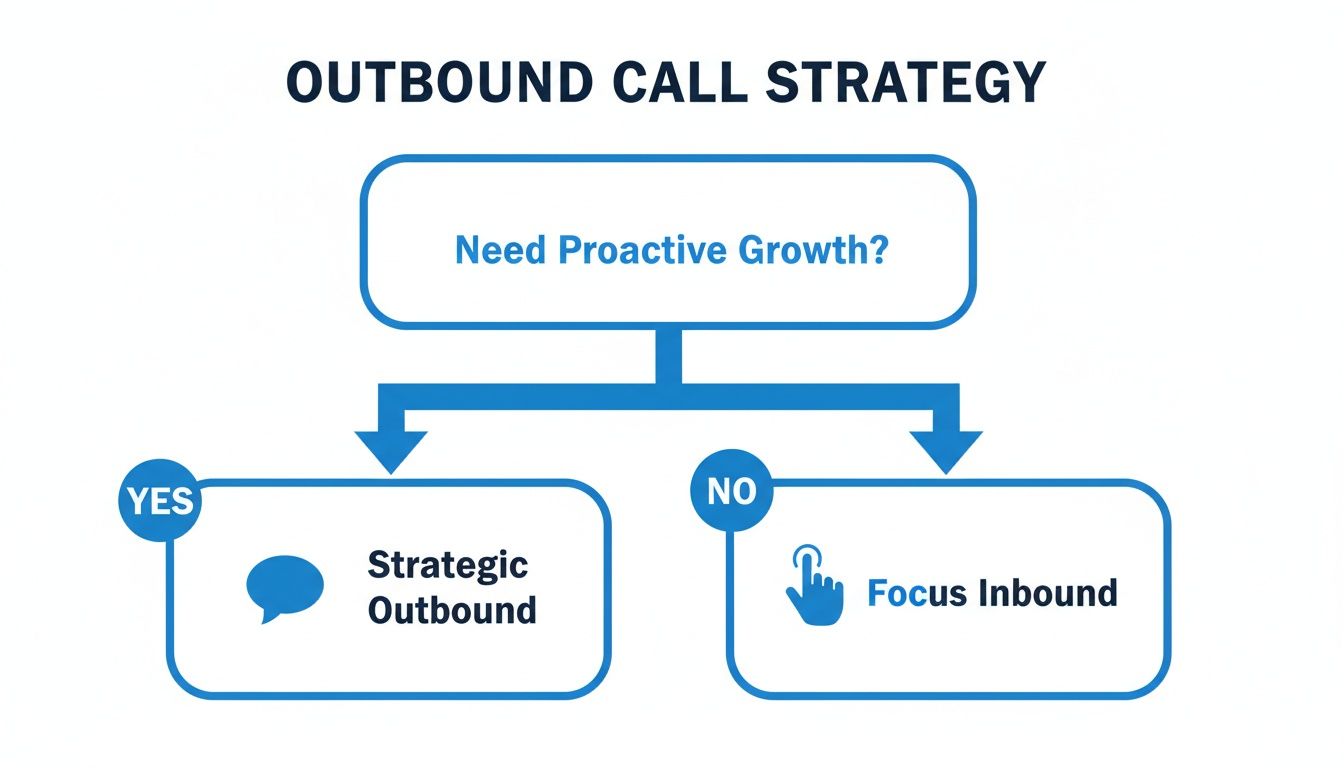
If you're looking to actively create new opportunities and drive growth, you need an outbound plan. If your main challenge is keeping up with existing customer demand, your priority should be perfecting the inbound experience.
The Home Services Playbook
For trades like HVAC, plumbing, and electrical, your phone rings for two very different reasons: emergencies and opportunities. Your call strategy has to be just as dynamic.
Inbound Focus: Capturing Urgent, High-Intent Jobs
When a pipe bursts or the AC gives out on a 95-degree day, the customer isn't shopping around—they're calling for a rescue. These inbound calls are your lifeblood. The goal isn't just to answer, it's to capture the lead, book the job, and get a truck rolling in one swift motion. A missed call is a job handed directly to your competitor.
- Practical Example: A homeowner’s water heater fails, flooding their garage. They find your plumbing company online and call. Your system, whether a person or an AI receptionist, must be available 24/7. The actionable process is: greet caller, confirm emergency, capture address, check technician availability, and schedule dispatch—all in under two minutes to secure the high-value job.
Outbound Focus: Creating Off-Season Work and Retaining Customers
Outbound is your tool for smoothing out the seasonal lulls. Instead of waiting for the phone to ring, you make it ring by proactively reaching out to your existing customer base with maintenance reminders and special offers.
- Practical Example: In early fall, your HVAC company pulls a list from its CRM of all customers who had AC units installed over two years ago. An agent calls with a targeted script: "Hi [Customer Name], this is [Agent] from [Company]. We're calling our valued customers to schedule annual furnace inspections before the winter rush. We have a 15% discount for bookings this week. Would Tuesday or Thursday work for you?"
The Healthcare and Wellness Playbook
In any healthcare setting, from a dental clinic to a physical therapy practice, trust and clear communication are everything. Here, the inbound vs. outbound dynamic is all about balancing exceptional patient care with operational efficiency.
Inbound Focus: Managing Patient Needs and Booking Appointments
Patients call for all sorts of reasons—scheduling first-time appointments, asking about symptoms, or clarifying a bill. A responsive, empathetic, and highly efficient inbound process is absolutely non-negotiable for creating a positive patient experience from the very first touchpoint.
- Practical Example: A new patient calls your practice to book their first check-up. The person or system handling the call must be able to quickly find an open slot that works for the patient, efficiently gather necessary insurance information, and immediately send a calendar invitation and new patient forms via text or email. This makes the process actionable and reduces friction.
Outbound Focus: Reducing No-Shows and Proactive Care
Automated outbound reminders are a powerful tool for tackling no-shows, one of the biggest and most frustrating sources of lost revenue for any clinic. These calls are also great for proactive wellness check-ins, showing patients you care about their long-term health.
- Practical Example: Your office's automated system places a quick, friendly reminder call to a patient two days before their appointment. The message is actionable: "This is a reminder of your appointment with Dr. Evans on Wednesday at 10 AM. Please press 1 to confirm, or press 2 to speak with our staff to reschedule." This simple interactive call can cut your no-show rate by over 25%.
The Legal and Professional Services Playbook
For law firms, accounting practices, and consultants, incoming calls often represent urgent, high-value opportunities. Outbound, on the other hand, is typically reserved for more strategic, relationship-based business development.
The data speaks for itself. Inbound leads come with built-in intent, making them far easier and faster to close.
Inbound leads convert far more readily than outbound ones due to inherent buyer intent, a game-changer for healthcare practices, law firms, and small businesses where speed and quality seal deals faster. Recent data reveals inbound leads close at an average 14.6% rate, dwarfing outbound's meager 1.7%. This highlights why inbound dominates high-intent pipelines, especially since contacting an inbound lead within 5 minutes boosts conversions by up to 9×. You can explore more data on how inbound and outbound sales compare on martal.ca.
Inbound Focus: Capturing High-Stakes Client Cases
When someone needs an attorney, time is critical. Your firm has to be prepared to perform a swift, professional intake and set a consultation on that first call. If you can't, that prospect is already dialing the next firm on their Google search. This is especially true for a real estate answering service, where a single missed call could mean a lost property listing.
- Practical Example: A potential client, having just been served with a lawsuit, calls your firm in a panic. An effective inbound process ensures the receptionist follows a script to capture their name, contact info, the nature of the lawsuit, and the opposing party's name (to check for conflicts), then immediately schedules a paid consultation with a paralegal or attorney.
Outbound Focus: Targeted Business Development and Networking
Outbound in the professional services world isn't about cold calling the phone book. It's about highly targeted, strategic outreach to potential corporate clients, high-net-worth individuals, or key referral partners.
- Practical Example: A corporate law firm identifies a dozen local startups that just closed a round of funding. A partner makes personalized outbound calls to the founders, not to sell, but to offer a complimentary 30-minute consultation on protecting their intellectual property. The actionable goal is not to close a deal on the call, but to book the high-value meeting.
Unifying Your Call Strategy with AI and Automation
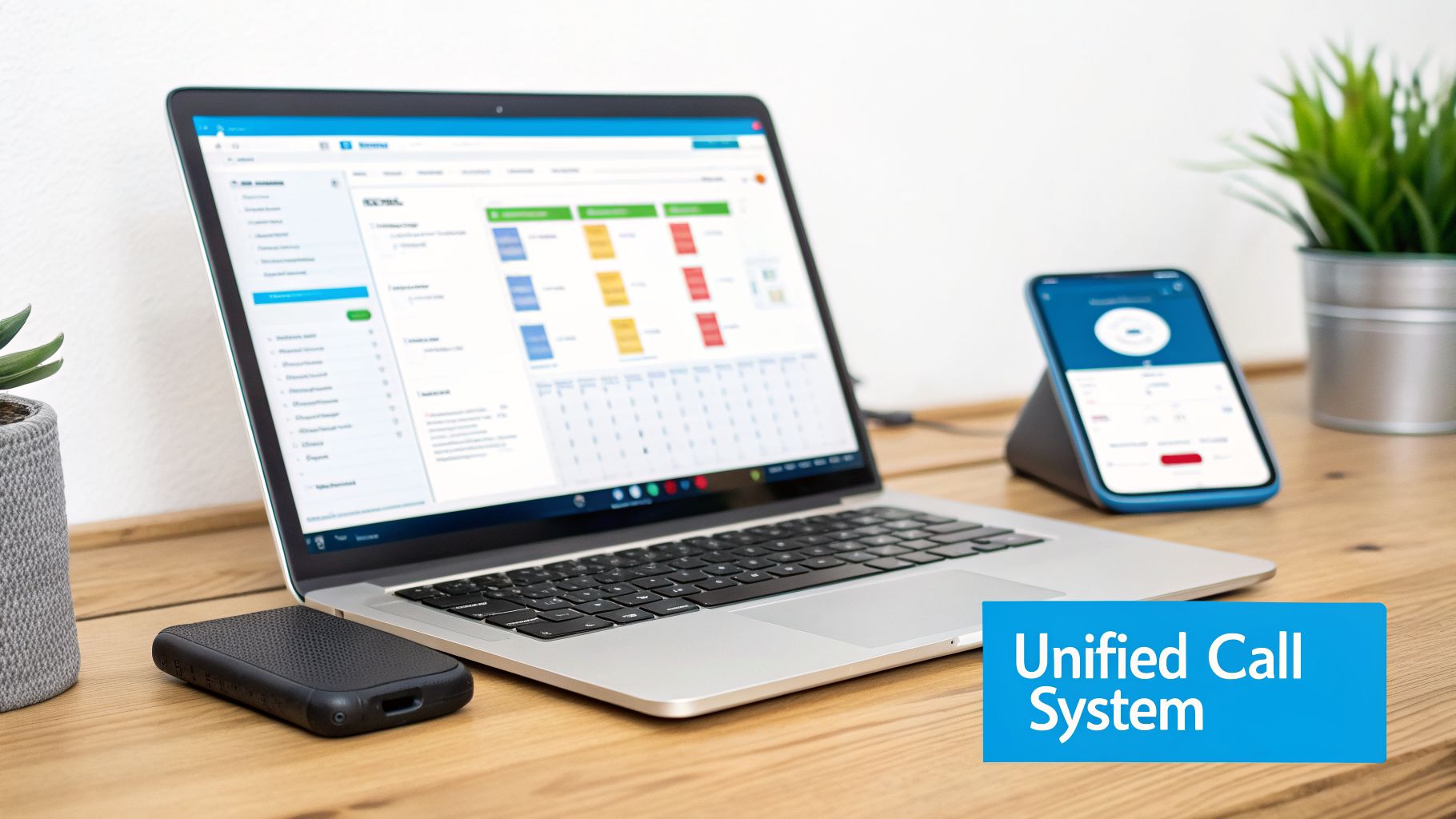
Thinking about an inbound call vs outbound call as a choice is a mistake. The real magic happens when you stop treating them as separate activities and start building a single, intelligent system where they work together. This is how you ensure no lead or opportunity ever gets lost.
When you use smart technology to unify these two functions, you’re not just making your team busier—you’re making your entire operation smarter. You break down the old-school walls between departments, creating a communication loop where every call, whether coming in or going out, has a purpose.
Creating a Seamless Communication Loop
So, what does this actually look like in practice? Picture a potential client finding your business online and calling after you’ve all gone home for the day. With a platform like Recepta.ai, that one inbound action can trigger a whole sequence of smart, automated follow-ups.
Here’s a simple, powerful workflow we see all the time:
- Inbound Action: A lead calls your main line at 9 PM. The AI receptionist answers, qualifies their interest ("Are you a new or existing customer?"), and schedules a consultation directly in your team’s calendar and CRM.
- Automated Outbound Confirmation: Moments later, the system automatically sends an outbound text or places a quick call to confirm the appointment, which drastically cuts down on no-shows.
- Human-Powered Outbound Follow-Up: The system also creates a task in your CRM for a sales rep to place a personal follow-up call the next morning to answer any initial questions and build some early rapport.
This is how you turn disconnected tasks into a well-oiled machine that drives revenue. The inbound spark of interest is immediately captured, confirmed, and then nurtured with a perfectly timed mix of automation and personal touch.
The Tangible Results of a Unified System
Bringing your call strategy together like this isn't just a neat concept; it delivers real, measurable results. When every inbound lead is captured and every outbound follow-up happens without fail, the impact on your bottom line is immediate. We've seen businesses using this model achieve a 30% increase in qualified leads and an incredible 15x return on investment.
To get this right, you'll need the right technology. Exploring various sales and automation tools is a great place to start building your tech stack. A unified system doesn't just make you more efficient—it actively finds and secures revenue that would otherwise have slipped through the cracks.
Frequently Asked Questions
When you're deciding between an inbound and outbound call strategy, a few key questions always come up. Let's tackle them head-on with some practical advice.
Which Is Better for a Small Business on a Tight Budget?
If you're a small business watching every penny, where should you put your focus? Hands down, start with inbound. It almost always delivers a higher ROI and a much lower cost-per-lead.
Practical Example: A solo plumber with a limited marketing budget should invest in local SEO and a great website to drive inbound calls. Every dollar spent makes the phone ring with customers who already need a plumber. This is far more cost-effective than spending time and money on outbound calls to people who may not have a plumbing issue. An AI receptionist like Recepta.ai can then ensure he never misses one of these valuable calls, even when he's on a job.
Can I Use the Same Team for Both Call Types?
It's a common question, but honestly, it’s like asking a defensive lineman to also be a star quarterback. The skill sets are fundamentally different. Inbound agents need to be masters of empathy and quick, effective problem-solving for customers with immediate needs. Outbound agents, on the other hand, must be resilient, persuasive, and comfortable generating interest from a cold start.
Practical Example: In a small business, you might have one person doing both. The actionable advice is to "time block." Dedicate mornings (9 AM - 11 AM) to proactive outbound calls when people are fresh. Leave the rest of the day open for handling reactive inbound calls as they come in. This separates the mindsets and improves focus for each task.
How Do I Measure the Success of My Call Strategy?
Your key performance indicators (KPIs) will look completely different depending on your focus. For an inbound strategy, you’re measuring efficiency and the quality of the customer experience.
- Inbound KPIs: Think First Call Resolution (FCR), Average Handle Time (AHT), and Customer Satisfaction (CSAT).
When you shift to outbound, the game changes. Success is all about sales outcomes and lead generation.
- Outbound KPIs: Here, you'll be tracking Conversion Rate, the number of Meetings Booked, and your Cost Per Acquisition (CPA).
Using a platform that integrates both call types and provides built-in analytics makes this much simpler. You get a clear, real-time dashboard showing exactly how your inbound and outbound efforts are performing side-by-side.
See how Recepta.ai can unify your call strategy, capture every lead, and deliver a 15x ROI. Get started with our 30-day risk-free trial at https://recepta.ai.
.webp)