
Your Guide to Hiring an Inbound Sales Representative in 2026
An inbound sales representative is the person who connects with potential customers after they’ve already shown interest in what you do. They aren't knocking on cold doors; they're welcoming warm leads who found you through your marketing efforts. This makes the entire sales conversation more natural, helpful, and effective from the very first "hello."
Why Your Business Needs an Inbound Sales Expert
Think of it this way: a door-to-door salesperson showing up unannounced during dinner is an interruption. That’s an outbound approach. Now, imagine you’ve decided to renovate your kitchen, so you walk into a showroom where a helpful expert is ready to answer your questions. That’s the inbound experience. Your inbound sales representative is that expert guide for your business.
This isn't just a subtle difference—it's a fundamental shift in how modern buyers make decisions. To get the full picture, it's worth exploring a practical guide to inbound vs outbound sales. The inbound method is built around responding to informed, proactive customers who have already done their homework and are actively looking for answers.
The Power of a Human Touchpoint
For many prospects, an inbound sales representative is the very first human interaction they'll have with your company. This person is the voice that calms an urgent situation, the mind that provides a detailed quote, and the friendly expert who builds the trust needed to turn a curious lead into a happy customer.
This human element is especially crucial in service-based businesses, where a fast, empathetic response can be the difference between winning a customer for life or losing them to a competitor.
Here’s what that looks like in the real world:
- Home Services: A frantic homeowner finds your plumbing company online after a pipe bursts. Your inbound rep calls them back within minutes, calmly asks the right questions ("Is the water shut off? Where is the leak located?"), and gets a technician on the way.
- Healthcare: Someone fills out a form on your clinic’s website, curious about a complex procedure like dental implants. Your inbound specialist follows up, not with a hard sell, but with genuinely helpful information ("Many of our patients ask about recovery time; it's typically just a few days of soreness.") and an offer to book a free consultation.
- Legal: A small business owner downloads your firm’s guide to contract law. An inbound rep reaches out a day later to see if they have any specific questions, positioning your firm as a valuable resource, not just a service provider. A practical opener could be: "I saw you downloaded our contract guide. Was there a particular section you found useful, or a question it didn't answer?"
In every scenario, the representative isn't pitching a product. They’re providing immediate value to someone who has already signaled they need help.
To help clarify these roles, let's break down the core differences in a simple table.
Inbound Sales vs Outbound Sales At a Glance
This table shows how an inbound rep’s work is fundamentally different. They are consultants and problem-solvers from the start.
The Data-Backed Case for Inbound Sales
But it's not just about a better customer experience; the numbers tell a clear story. The move to inbound is driven by massive gains in efficiency. In fact, research shows that inbound marketing activities bring in 59% of the highest quality leads for sales teams, while traditional outbound methods only account for 16%.
This focus on quality over quantity is where the inbound model truly shines. This infographic gives a great visual breakdown of the metrics.
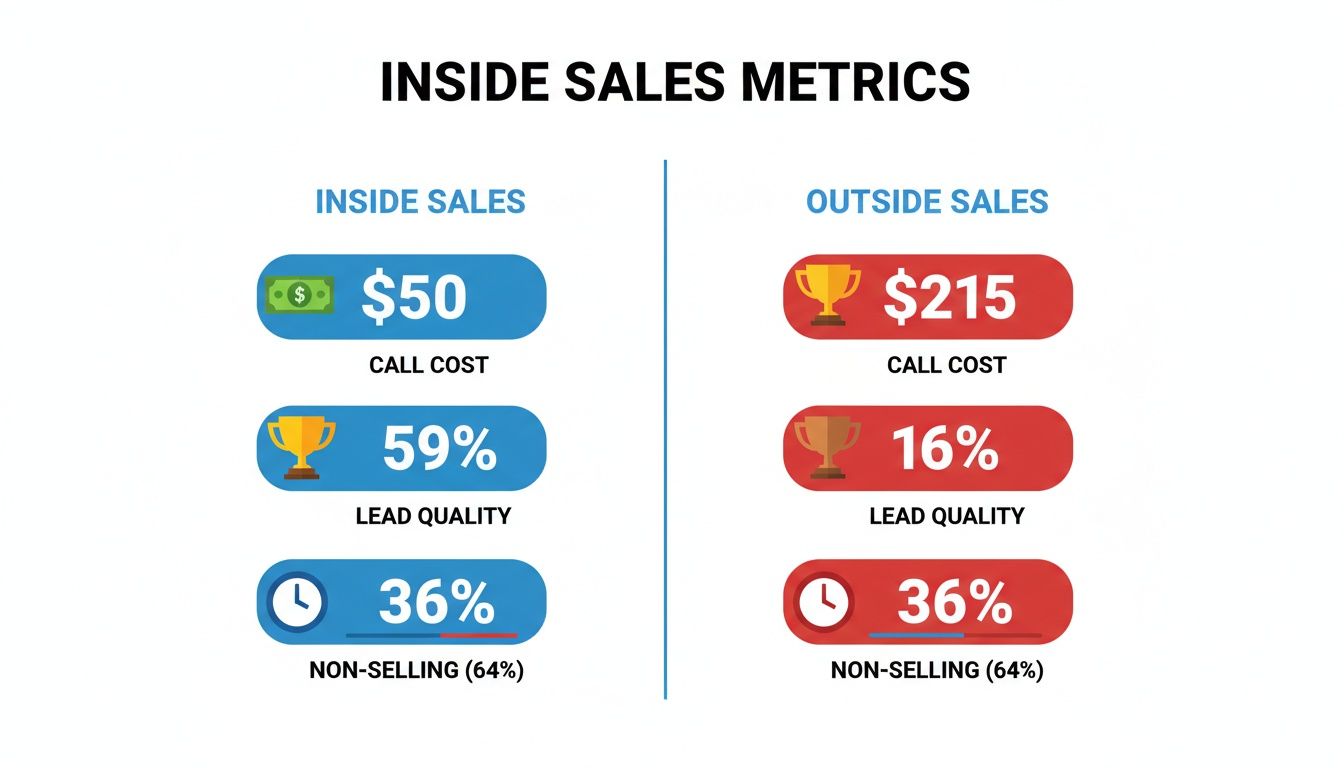
As you can see, the inbound approach doesn't just produce better leads—it does so far more cost-effectively. Building your team around an inbound sales representative lets you connect with a steady stream of interested prospects without the high costs and low success rates of old-school field sales. Of course, getting these leads is only half the battle. To turn them into revenue, you need to know how to qualify sales leads properly.
What a Top Inbound Rep Actually Does

An exceptional inbound sales rep is much more than just a person answering calls and emails. They are the strategic first point of contact, guiding a curious prospect toward a valuable, scheduled appointment with your team. Their day is a smart mix of quick responses and thoughtful follow-up, all built around where the customer is in their buying journey.
From the second a lead comes in—whether it's from a form on your website, a guide they downloaded, or a direct call—the rep’s mission is to qualify and connect. This isn't just about taking a message; it's about quickly figuring out if the person is a good fit for what you offer. It’s a job that demands both speed and accuracy, especially since 35-50% of sales often go to the very first company that responds.
After that initial contact comes the discovery phase. This is where a top-tier rep really shines. They dig in to understand the prospect’s frustrations, what they hope to achieve, and their timeline for making a decision. For instance, instead of asking "Are you the decision-maker?", they might ask, "Who else on your team will be involved in evaluating this solution?" The goal isn’t to push a sale. It’s to build trust and become a helpful resource who can genuinely solve their problem.
The Core Hard Skills You Cannot Ignore
While personality is huge, certain technical skills are simply non-negotiable in today's sales world. These are the foundational abilities that all great customer conversations are built on.
CRM Mastery: A Customer Relationship Management (CRM) system is the rep's command center. Being proficient means more than just entering data. It’s about using the CRM to track every touchpoint, schedule follow-ups, and understand a lead's behavior to make the next conversation more personal. For instance, a rep should be able to see that a prospect downloaded an ebook on "Small Business Cybersecurity," open the contact record, and start the call by saying, "Hi John, I'm calling from TechGuard. I noticed you grabbed our cybersecurity guide, and I wanted to see if you had any specific questions about protecting your data."
Product Knowledge: An inbound rep has to be a product expert, plain and simple. When a prospect asks a tough question like, "How does your software integrate with QuickBooks Online?" the rep needs to have a confident, correct answer on the spot. This is a massive credibility builder.
Lead Management and Prioritization: Not all leads are created equal. A skilled inbound rep knows how to use data like lead scores to focus their energy on the prospects showing the strongest intent to buy. For example, a lead who visited the pricing page three times is a higher priority than someone who only downloaded a general interest whitepaper.
These hard skills keep things running smoothly, allowing a rep to handle a high volume of inquiries without letting quality slip. The role itself is a response to a massive shift in buyer behavior—after all, a staggering 93% of B2B buying journeys now begin online. Successful inbound reps have mastered the art of turning that online interest into real business. Learn more about the key sales findings on thunderbit.com.
The Soft Skills That Build Real Connections
Soft skills are what separate a good inbound sales rep from a truly great one. These are the human abilities that forge trust and make potential customers feel seen and heard. They're especially crucial in sensitive fields like healthcare or legal services.
"An inbound sales representative is part problem-solver, part psychologist. They must diagnose a need and build a trusted relationship, often in the very first conversation."
Think about it in these real-world scenarios:
Active Listening: A nervous patient calls your dental clinic about a toothache. Instead of just booking the next available slot, the rep hears the anxiety in their voice. They might say, "I understand this can be a stressful situation. Let me see if we can get you in today. Dr. Smith is excellent with patients who feel anxious," and then explain how the dentist specializes in gentle care before scheduling the consultation.
Empathy: A potential client calls a law firm after a messy business dispute. The inbound rep doesn’t launch into a sales pitch. They start with, "It sounds like you're going through a really challenging time." This simple validation makes all the difference before they gather the details for an attorney to review.
Coachability: The sales world never sits still. The best reps are the ones who ask for feedback on their calls, embrace new scripts or techniques, and are always willing to adapt their approach based on what the data tells them is working. For example, after a call review, a coachable rep might say, "Okay, I see I jumped to the solution too fast. Next time, I'll ask one more follow-up question about their specific problem before I mention our services."
At the end of the day, these are the skills that allow a rep to build rapport with customers on a human level, turning a simple question into a long-term business relationship.
How to Hire Your First Inbound Sales Representative
Bringing on your first inbound sales rep is a huge milestone. This person becomes the voice of your company for anyone who raises their hand, making it a hire you absolutely have to get right. It all starts with a job description that speaks directly to the kind of person you need—someone who's not just skilled, but genuinely customer-focused.
Instead of just listing tasks, think about the purpose of the role. You're looking for a helpful guide who can steer interested people toward the right solution. And don't forget, the talent pool is bigger than ever. As you plan your search, consider people who want to find remote jobs. Opening up your search to remote candidates can bring in seasoned pros you wouldn't find otherwise.
Here’s a template you can tweak for your own business. It’s designed to attract people who care about results, not just checking boxes.
A Job Description Template That Works
Job Title: Inbound Sales Representative
About Us:
[This is your chance to shine. Briefly share what your company does, who you help, and what makes your team a great place to work. Give a real sense of your culture. For example: "At CleanSweep Pro, we help commercial property managers keep their facilities spotless with our innovative cleaning solutions. We're a tight-knit team that values speed, quality, and a can-do attitude." ]
The Role:
We're looking for a friendly and driven Inbound Sales Representative to be the first conversation many of our future customers will have. Your job is to field all inbound interest, figure out who we can truly help, and set them up for a deeper conversation with our account executives. If you love talking to people, have a knack for solving problems, and get a kick out of turning simple questions into real opportunities, this role is for you.
Key Responsibilities:
- Jump on all new leads from our website, calls, and downloads within 5-10 minutes.
- Qualify leads by understanding their needs, budget, and if the timing is right (using BANT, MEDDIC, or a similar framework).
- Educate prospects about what we offer and help them along until they’re ready for a full demo.
- Keep detailed and accurate notes of every conversation in our CRM [mention your CRM, e.g., HubSpot, Salesforce].
- Book qualified meetings and discovery calls for the sales team.
Qualifications:
- 1-2 years of experience in a role where you talked to customers (sales, support, or customer success).
- Fantastic communication skills, both on the phone and in writing.
- You’re a quick study when it comes to learning new software and products.
- You’re empathetic and genuinely want to help people find solutions.
- Experience with a CRM is a bonus.
This kind of description clearly lays out what's expected and targets the right personality for an inbound role: someone who’s quick, helpful, and organized.
The Interview Process Unpacked
A solid interview process lets you see a candidate from every angle. Don't just talk about their resume; you need to see their skills in the real world. I’ve found a three-step process works best: a quick phone screen, a practical role-play, and a final behavioral interview.
The goal here is to figure out what they can actually do.
1. The Phone Screen (15-20 minutes): This is a quick gut check. Does their experience line up? How do they communicate? Keep it short and sweet, focusing on their motivation and background. A good practical question here is, "What interests you about an inbound role specifically, as opposed to other sales roles?"
2. The Role-Play Scenario (30-45 minutes): This is where the magic happens. It shows you how a candidate thinks on their feet. Give them a simple, realistic scenario to prepare for beforehand.
- Scenario Example: "A prospect just filled out a form to download our pricing guide. Your job is to call them. Try to understand what they're looking for and decide if they’re a good fit for a follow-up meeting with an Account Executive." During the role-play, listen for how they open the call, the discovery questions they ask, and how they handle a question like "Can't you just email me the price?"
3. The Behavioral Interview (45-60 minutes): In the final round, you’ll dig into their past experiences with "tell me about a time..." questions. How someone acted in the past is the best indicator of how they'll perform in the future.
An interview should feel like a discovery call. Your goal isn't to grill the candidate, but to uncover whether their skills and mindset are the right solution for your company's need.
To get the most out of your interviews, it helps to have specific questions ready that test for the core skills you need.
Inbound Sales Representative Interview Questions and What to Look For
Here are a few of my go-to questions, broken down by the skill I'm trying to assess. The "Ideal Answer" column isn't about getting a perfect script, but about looking for the right thought process.
Using a structured process like this—from the job post all the way to the final interview—will give you the confidence that you’re hiring an inbound sales rep who will start making a difference from day one.
Onboarding and Training for Immediate Impact
Hiring a great inbound sales representative is a huge win, but it’s only the first step. Their real success—and your ROI—depends entirely on what you do next. A well-thought-out onboarding and training program is the one thing that will turn that promising new hire into a confident, pipeline-building machine.
Your goal shouldn't be to just teach them about your company. It's about getting them ready to contribute to the sales pipeline from their very first week. A solid 30-day plan gives them a clear roadmap, covering everything from your company’s culture and product value to mastering the tools and holding effective conversations. This ensures your new rep feels supported and starts making an impact fast.
The First 30 Days: Your Onboarding Checklist
Think of the first month as a series of sprints, each with its own finish line. This approach builds skills progressively without overwhelming your new hire with a mountain of information all at once.
Here’s a practical week-by-week breakdown to set your new inbound sales representative up for success.
Week 1: Culture and Foundation
The first week is all about immersion. The main goal here is to make your new hire feel like they're truly part of the team and give them the foundational knowledge to understand your business and, most importantly, your customers.
- Company Immersion: Schedule 30-minute introductory meetings with the head of marketing and a senior customer service agent. This gives them direct context on where leads come from and what happens after a sale.
- Product 101: Don't just have them memorize a feature list. Focus on the "why" behind your product. What core problems do you solve? What pain points do you eliminate for your customers? An actionable task is to have them write a one-paragraph summary of your product's value proposition for three different customer types.
- Shadowing Sessions: This is non-negotiable. Have them listen in on at least five live calls and two demos with your top reps. It’s the fastest way to absorb the company’s tone, learn the most common questions, and see how seasoned pros navigate conversations.
Week 2: Systems and Processes
In the second week, the focus shifts to the tools of the trade. This is where your rep learns the nuts and bolts of their daily workflow, moving from a passive observer to an active participant.
A new hire’s confidence is directly tied to their comfort with their tools. Mastering the CRM and communication platforms early on frees up their mental energy to focus on the customer, not the process.
This week should include a deep dive into your CRM. Give them practical exercises, like: "Create a test lead, log a call note, schedule a follow-up task for next Tuesday, and change the lead status to 'Qualified.'" Point them to internal knowledge bases and sales playbooks. Near the end of the week, let them handle a few low-stakes, pre-qualified leads while a manager listens in to provide immediate, helpful feedback.
Weeks 3 & 4: Practice and Performance
The final two weeks are all about application and refinement. Your new inbound rep should now be handling a steady flow of leads. The focus is on getting reps in, practicing conversations, navigating objections, and starting to hit key metrics.
This is also the time to review their performance and establish their initial goals. You can introduce key ideas from our guide on what is quality assurance in a call center to set a high standard for call quality from day one. By day 30, your rep should be managing their own queue, booking qualified appointments, and have a clear picture of their performance targets.
Flexible Script Frameworks That Empower Reps
Nobody wants to talk to a robot. Rigid, word-for-word scripts sound unnatural and fall apart the moment a customer asks an unexpected question. Instead, give your reps flexible frameworks that guide the conversation without killing their personality.
These frameworks act as a roadmap, making sure they gather the right information while still allowing the conversation to flow naturally.
Example Framework: Handling a Price Objection
- Acknowledge and Validate: "I understand, that’s a completely fair question. It’s important to know you’re getting the best value."
- Reframe to Value: "To make sure I'm giving you an accurate picture, could you tell me a bit more about what you’re trying to solve? Sometimes a lower price ends up costing more down the road if it doesn’t fix the real problem. For example, are you currently dealing with [mention a common pain point]?"
- Isolate the Objection: "If we were to set the price aside for a moment, does our solution seem like it would be the right fit for what you need?"
This simple framework empowers the inbound sales representative to turn a tricky price question into a productive value discussion—which is where great inbound selling happens.
The Right Tech to Supercharge Your Inbound Team
An incredible inbound sales rep can only do so much on their own. Their performance ultimately hinges on the tools they have at their disposal. Giving them the right tech is like handing a world-class chef a perfectly sharpened knife—it makes their work faster, more precise, and frankly, a lot more effective.
The modern tech stack isn't just about support; it's about actively making your reps better at connecting with and converting leads.
At the very heart of this tech stack is the Customer Relationship Management (CRM) platform. Think of it as the team’s shared brain. It’s the single place where every lead, every interaction, and every piece of customer data lives. Without it, your reps are essentially flying blind, trying to piece together a story from scattered notes and emails.
A sharp inbound rep uses the CRM to instantly see a prospect’s entire journey—which blog posts they’ve read, the guides they downloaded, and every past conversation. This is the context that turns a potentially awkward follow-up into a warm, relevant conversation. For example, seeing a prospect read three blog posts on "inventory management" lets the rep open with, "I see you've been looking into inventory management—what's the biggest challenge you're facing there?"
The Essential Tech Stack Components
While the CRM is the foundation, several other tools are needed to build a truly efficient inbound sales machine. Each piece of software is designed to fix a specific bottleneck, creating a smooth path from a lead's first question to a booked meeting.
- Communication Platforms: You need tools that bring phone, email, and live chat into one place. A unified inbox ensures reps can meet customers wherever they are without losing track of conversations buried in different apps. An example is a tool that allows a rep to see a chat history on the website right before making a follow-up call.
- Scheduling Software: The endless back-and-forth of booking a meeting ("Are you free Tuesday at 2? No? How about Wednesday at 10?") is a huge time-waster. Tools like Calendly or HubSpot Meetings let prospects pick a time right from your rep’s calendar. This simple fix removes friction and keeps the momentum going.
- Conversation Intelligence: What are your top performers saying that works so well? Software that records and analyzes sales calls can tell you. For example, it might reveal that calls where the rep mentions a specific customer success story have a 20% higher booking rate. This data is pure gold for coaching your whole team and improving how everyone handles common objections.
Putting these tools together means your inbound team can stop getting bogged down by manual admin work and focus on what they were hired to do: have great conversations.
The AI and Human Partnership
The real magic happens when you introduce technology that handles the repetitive, low-value tasks, freeing up your human experts for relationship-building. This is exactly where an AI receptionist like Recepta.ai forges a powerful partnership with your inbound sales reps.
Here’s what that looks like in the real world:
- A prospect sees an ad for your HVAC company and calls your business at 10 PM on a Tuesday.
- Instead of hitting a voicemail, the AI receptionist answers instantly, 24/7.
- The AI qualifies their needs. If the caller says, "I'd like to get a quote for a new AC unit," the AI can book it directly into your rep's calendar and CRM.
- But what if the caller says something like, "My AC just died and my house is 90 degrees," or "I have a quote for a large commercial project"? The AI recognizes these high-value cues and seamlessly transfers the call to your live inbound rep.
This system can also work right on your website, engaging visitors the moment they arrive.
This screenshot shows how an AI-powered chat can proactively offer help, ensuring no lead has to wait for a response. This hybrid model stops prospects from ever slipping through the cracks and makes sure your inbound sales representative spends their valuable time on conversations that actually generate revenue.
This partnership—AI for instant qualification and scheduling, a human for empathy and closing—creates an incredibly efficient system. Every lead gets a fast response, and your sales reps focus only on the highest-value opportunities.
Of course, none of this works if the tools don't talk to each other. To get a better feel for how these platforms connect, check out our guide that explains what CRM integration is and why it’s so critical for a modern sales process. When your tech works in harmony, your team can truly thrive.
Measuring Success: KPIs and Career Growth

Getting a great inbound sales rep hired and through training is a huge milestone. But the work doesn't stop there. If you want to keep them, you need to show them two things: how to win in their role and what their future looks like at your company.
Without clear goals, even the sharpest reps can start to feel like they're just spinning their wheels. Key Performance Indicators (KPIs) are the answer. They act as a scoreboard, turning a vague goal like "grow sales" into tangible targets they can hit every single day.
Key Metrics to Track for Inbound Reps
When it comes to inbound sales, you have to be careful not to track "vanity metrics"—numbers that look good but don't actually contribute to the bottom line. You need to focus on the specific actions that directly drive revenue.
Here are the core KPIs that will give you a true read on performance:
- Average Lead Response Time: In inbound, speed is the name of the game. This metric tracks exactly how long it takes for your rep to reach out to a new lead. The gold standard is under 5 minutes. A practical way to track this is with a dashboard in your CRM that shows the average time between lead creation and the first logged activity.
- Lead-to-Appointment Rate: This is a big one. It measures the percentage of qualified leads that your rep successfully books for a meeting or demo. For example, if they speak to 20 qualified leads in a week and book 10 appointments, their rate is 50%. This number tells you how effective they are at sparking interest and qualifying prospects.
- Activities Per Day: Think of this as a pulse check on effort. It tracks the raw output—calls, emails, follow-ups. While you don't want to micromanage, if a rep who normally makes 50 calls a day suddenly drops to 20, it's a good leading indicator to check in and see what's going on.
- Meeting Show Rate: A booked meeting means nothing if the prospect ghosts. This KPI tracks how many appointments actually take place. If show rates are low (e.g., below 75%), it may indicate the rep isn't setting clear expectations or confirming the meeting effectively.
A top-tier inbound sales rep doesn't just fill the calendar; they book high-quality meetings with the right people who are genuinely interested and ready to talk. Your KPIs should measure that impact, not just the effort.
Competitive Salaries and a Clear Career Path
To attract and retain the best people, you have to offer a competitive package. Looking at trends for 2026, the average base salary for an inbound sales representative is expected to be in the $50,000 to $65,000 range. With commission and bonuses, their on-target earnings (OTE) should climb to $75,000 to $90,000 or more.
But money is only part of the equation. Ambitious people need to see a path forward. By mapping out a clear career ladder, you're not just offering a job; you're offering a future. You're showing them that this role is a launchpad, not a dead end.
Here’s what a typical growth plan for an inbound sales rep might look like:
- Senior Inbound Specialist: After mastering the role, a rep can step up to handle the most valuable leads (e.g., enterprise-level inquiries), mentor new team members, or help refine the sales process.
- Account Executive (AE): This is the most natural next step. Reps who are brilliant at setting meetings often have the skills to run them. This move transitions them into managing the full sales cycle and closing their own deals.
- Sales Manager or Team Lead: For those who have a knack for leadership, a management track is a perfect fit. They can move into coaching the inbound team, setting strategy, and driving overall team performance.
Frequently Asked Questions
What Is the Main Difference Between an Inbound and an Outbound Sales Rep?
Think of it this way: an inbound sales rep is like a helpful guide in a store you've already decided to walk into. They work with people who have already raised their hand, showing interest by calling, filling out a form, or starting a chat. Their job is to nurture that existing interest and guide the prospect toward a solution.
An outbound rep, on the other hand, is the one knocking on new doors. They proactively reach out to people who likely haven't heard of your business, aiming to create awareness and generate new interest from scratch. One converts warm leads, the other finds cold ones.
Can a Small Business Afford a Dedicated Inbound Sales Representative?
Absolutely. In fact, for most small businesses, it's one of the most cost-effective sales roles you can create. An inbound or "inside" sales rep doesn't have the travel and overhead costs of a traditional field sales rep, making the role much more accessible.
The key is making sure their time is spent on what they do best: talking to qualified prospects and closing deals.
By pairing a human inbound rep with tools like an AI receptionist to handle initial lead qualification and scheduling, you ensure they spend their time on high-value tasks. For example, the AI handles the simple "I want to book an appointment" calls, freeing up the human rep to focus on a complex inquiry from a potentially large client. This delivers a strong return on investment for any size business.
How Long Does It Take to Fully Train an Inbound Sales Representative?
You can get a new hire productive faster than you might think. With a solid 30-day onboarding plan, a new rep can start handling leads (with some supervision, of course) by the end of their first month.
Generally, you can expect them to be working independently and hitting their initial performance goals within 90 days. That timeline gives them enough room to really learn your product, get comfortable with your CRM, and master the sales process.
Ready to ensure your inbound sales representative never misses a lead? Recepta.ai provides a 24/7 AI receptionist that qualifies leads, books appointments, and seamlessly hands off high-value conversations to your team. Discover how Recepta.ai can boost your lead conversion today.