
Your Lead Qualification Process: A Practical Guide for 2026

You're probably dealing with a familiar problem. Marketing launches a campaign, the phone rings, forms come in, and the CRM starts filling up. Everyone feels busy. Then a week later, sales says most of those “leads” were price shoppers, students, vendors, spam, or people who were never a fit in the first place.
That's not a lead volume problem. It's a filtering problem.
For most SMBs, a broken lead qualification process shows up in practical ways. Reps waste afternoons calling weak inquiries. Owners jump on “hot leads” that go nowhere. Front desk staff collect names but miss the questions that would tell you whether the person is serious, local, approved by the right decision-maker, or ready to buy.
Why Most Leads Never Become Customers
A plumbing company runs local ads for emergency replacements. The office gets a burst of calls. Some callers need help now. Some are renters who can't authorize work. Some just want a ballpark number and disappear. Some live outside the service area. By Friday, the team feels buried, but the calendar still isn't full of the right jobs.
The same pattern shows up in law firms, dental practices, insurance agencies, and B2B service businesses. Activity goes up. Revenue doesn't move the same way.
That's why lead qualification became a formal sales discipline instead of an informal “we'll know it when we see it” habit. A widely cited benchmark from CSO Insights says 68% of B2B organizations struggle with lead conversion because of poor qualification according to Crunchbase's overview of the lead qualification process. If your team keeps talking to the wrong people, the rest of the funnel never gets a fair chance.
A good lead qualification process answers basic but expensive questions early:
- Fit: Is this person or company in your target market?
- Need: Do they have a real problem you solve?
- Authority: Can they approve the purchase or strongly influence it?
- Timing: Are they evaluating now, or just browsing?
- Intent: Have their actions shown genuine buying interest?
For SMBs, this doesn't need to start with complex software. It starts with disciplined intake. If you already track patterns in customer behavior analysis, you know not every inquiry means the same thing. A pricing-page visitor who returns, fills out a form, and asks about implementation isn't equal to someone who downloaded one checklist and never came back.
Practical rule: Sales should never have to discover basic fit on the first serious call. Your process should catch that earlier.
The fastest-growing teams I've seen don't treat qualification as a script. They treat it as a control system. That shift changes who gets called, how quickly they get called, and what the rep already knows before the conversation starts.
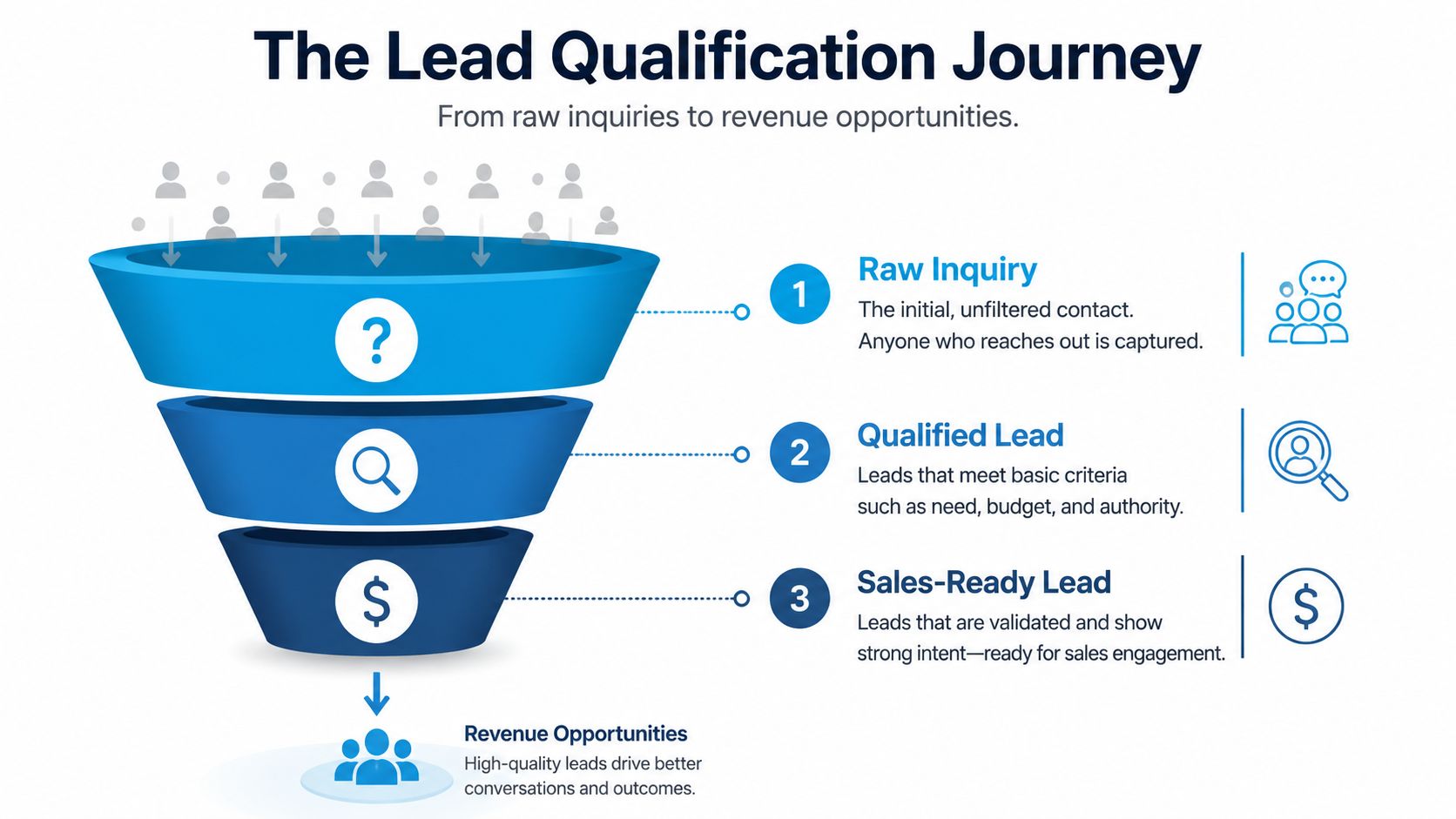
From Raw Inquiry to Sales-Ready Lead
Think of the lead qualification process like triage in a busy clinic. Everyone who walks in may need attention, but not everyone needs the same response, and not everyone needs the doctor first.
The same logic applies to inbound leads. A raw inquiry is just contact. It becomes valuable only when your team can place it in the right stage and decide the next action with confidence.
The three stages that matter
Most SMB teams benefit from a simple stage model:
| Stage | What it means | Example |
|---|---|---|
| MQL | Marketing Qualified Lead. Someone has shown enough interest to deserve review. | A clinic prospect downloads a treatment guide and books a callback. |
| SAL | Sales Accepted Lead. Sales agrees the lead is worth active follow-up. | A law firm intake specialist confirms the matter type matches the firm's practice area. |
| SQL | Sales Qualified Lead. The lead has enough fit and intent for a real sales conversation or consult. | An HVAC prospect owns the home, is in the service area, and wants a replacement quote soon. |
A lot of teams skip the middle step. That's usually a mistake.
Without a clear SAL stage, marketing tosses leads over the wall and sales either ignores them or complains about quality. A sales-accepted lead is where your business says, “Yes, this deserves rep time.” That single checkpoint prevents noise from flooding the calendar.
What promotion actually looks like
Here's a practical version for a small business:
- Raw inquiry to MQL: The person fills out a quote form, calls the office, requests pricing, or engages with high-intent content.
- MQL to SAL: Someone checks the basics. Service area, company size, matter type, property type, insurance accepted, or whatever matters in your model.
- SAL to SQL: A rep or trained intake workflow confirms real need, timing, buying role, and next-step readiness.
For example, a managed IT company might define an SQL as a lead that matches its target employee range, has an internal operations or technology stakeholder involved, and is discussing a current support gap instead of “just gathering information.”
A home services company might define an SQL differently. They may care less about organization chart questions and more about property ownership, ZIP code, urgency, and whether the customer wants repair or replacement.
If your team can't explain the difference between an MQL and an SQL in one sentence each, your handoff rules are too fuzzy.
Why simple stage definitions win
SMBs don't need enterprise complexity. They need consistency.
That means writing down what each stage requires, training everyone who touches inbound inquiries, and making sure even phone screening follows the same logic. If you're tightening front-end intake, this practical guide to screening phone calls is useful because many qualification failures happen before the CRM even gets clean information.
When stage definitions are clear, everyone works faster. Marketing knows what counts. Intake knows what to ask. Sales knows which leads deserve immediate attention.
Common Lead Qualification Frameworks
Frameworks help, but only when teams use them as operating guides instead of interrogation checklists. The goal isn't to force every buyer through a rigid script. The goal is to collect the minimum information needed to make a smart next move.
BANT still works, but not by itself
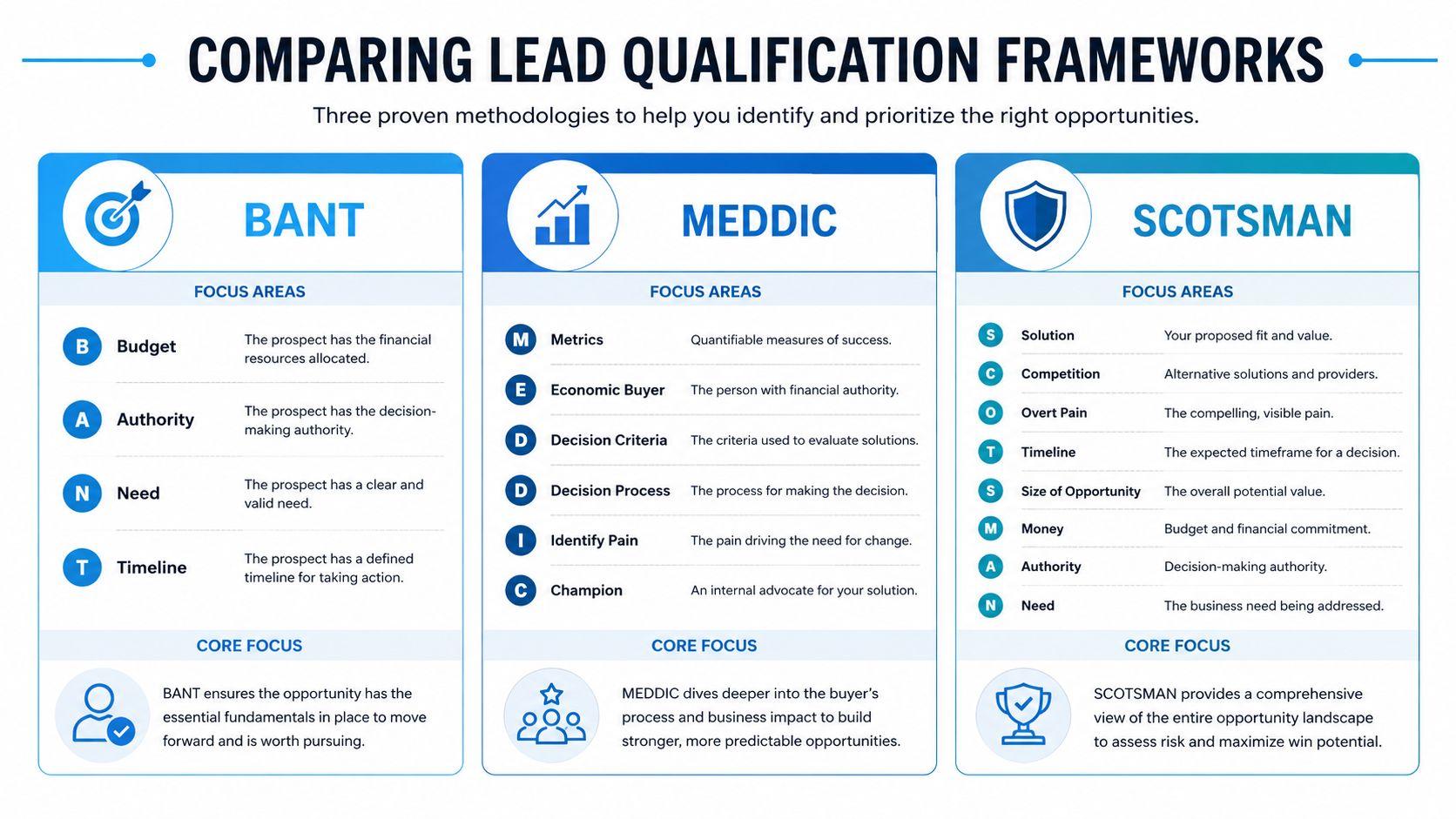
BANT stands for budget, authority, need, and timeline. It's still useful because it forces clarity quickly.
Take a simple home-service example. A homeowner calls about replacing a failing water heater.
- Budget: Are they looking for a replacement now, or only comparing rough prices?
- Authority: Do they own the property and approve the work?
- Need: Is the current unit failing, leaking, or unreliable?
- Timeline: Do they want service this week or sometime later?
That's solid qualification. It's fast, practical, and easy to train. For transactional or urgency-driven businesses, BANT often gets the job done.
The weakness is obvious, though. BANT can sound mechanical if reps use it like a checklist. Buyers don't enjoy feeling cross-examined.
CHAMP is often better for consultative teams
CHAMP shifts the conversation. It starts with challenges, then authority, money, and prioritization.
That order matters.
If you sell legal services, financial services, managed IT, or a higher-trust service with a longer decision cycle, leading with the problem is usually smarter than leading with budget. A prospect is more likely to tell you what's broken than volunteer what they can spend.
A dental group evaluating new software, for example, may not know the exact budget yet. But they usually know the pain: missed follow-ups, front-desk overload, or no-shows tied to weak communication. CHAMP gets that truth earlier.
Start with the customer's problem, not your qualification form. You'll usually get better information and a better conversation.
MEDDIC and heavier frameworks
For complex B2B deals, MEDDIC can be stronger because it goes beyond surface qualification. It looks at metrics, the economic buyer, decision criteria, decision process, identified pain, and a champion inside the account.
Most SMBs don't need the full version for every lead. But parts of it are useful when the sale has multiple stakeholders. If you sell to clinics, franchises, contractors with several locations, or regulated businesses, understanding the decision process matters more than a basic “who signs the contract?” question.
The real-world trade-off
Here's the mistake I see most often. Teams pick one framework and treat it like religion.
That doesn't hold up anymore. As noted in this discussion of modern qualification shifts from Outfunnel's lead qualification process guide, many teams are now asking which signals still hold up when AI-written inquiries, self-serve research, and multi-touch buyer journeys make intent harder to read. That's exactly the issue. A neat framework on paper doesn't solve messy inbound behavior.
A better approach is hybrid:
- Use BANT for speed and minimum viability
- Borrow CHAMP when discovery needs to feel consultative
- Use MEDDIC elements on bigger or more complex opportunities
- Add behavior signals before you route anything high priority
If you want another practical breakdown of how teams apply these models, this guide to qualifying sales leads is a useful reference because it shows how qualification questions can be adapted to real sales contexts instead of memorized.
A framework should fit the sale
Use the shortest framework that still protects rep time.
A roofer handling storm-damage calls doesn't need a layered enterprise methodology. A B2B software reseller probably does need more than BANT. A law firm intake team may need a blend: issue type, urgency, jurisdiction, fee fit, and conflict check, plus a human review.
Frameworks are tools. The process matters more than the acronym.
Building Your Lead Qualification Engine
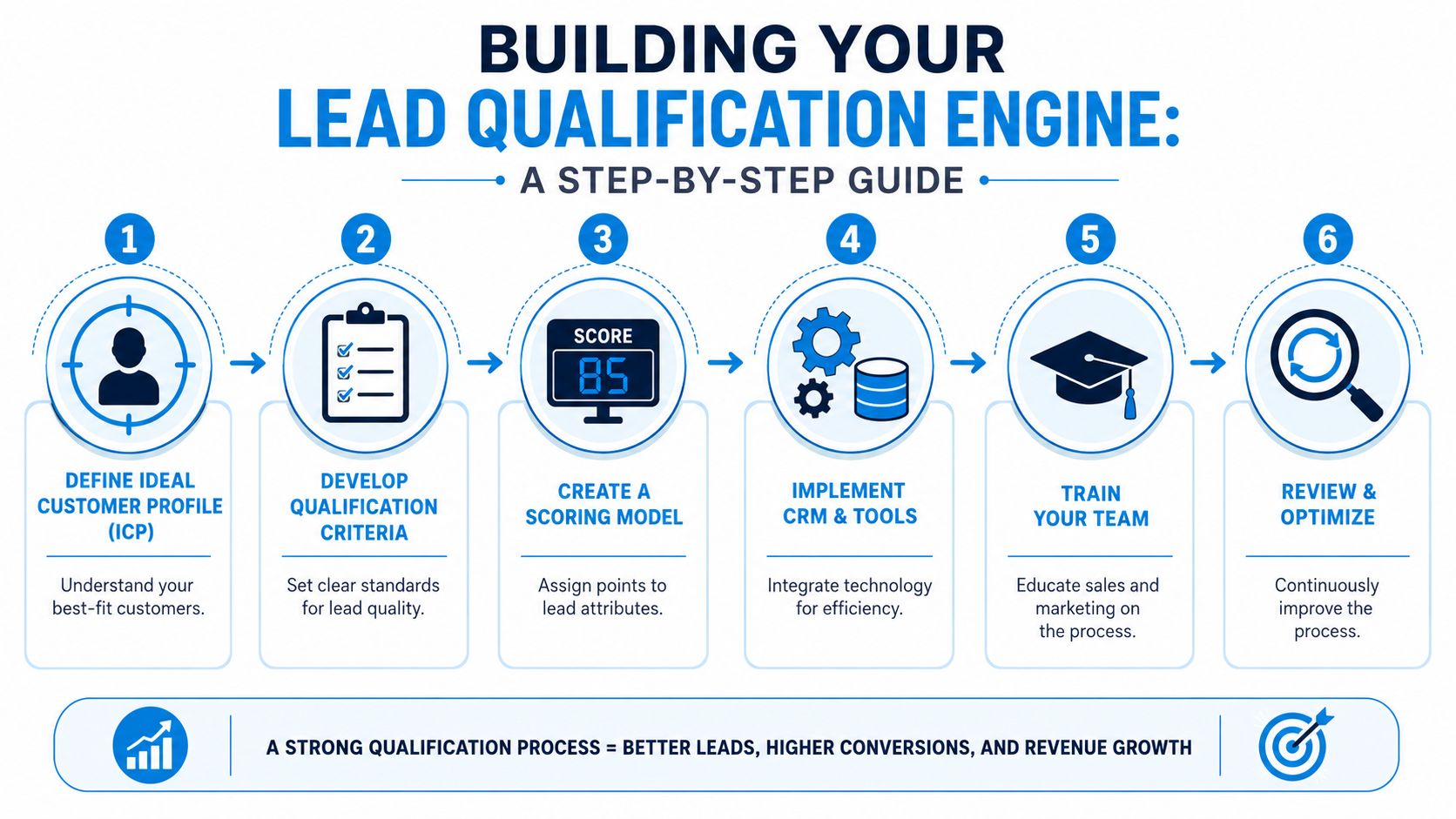
Most SMBs don't need a fancy revenue operations stack to build a working lead qualification process. They need a repeatable engine that sales, marketing, and intake can all follow without guessing.
Start with your ICP
Your Ideal Customer Profile should be painfully specific. “Small businesses” is not an ICP. Neither is “homeowners.”
Write down the traits that define a strong-fit customer:
- Firmographic fit: Industry, company size, geography, service area, or location type
- Role fit: Owner, office manager, operations lead, managing partner, practice administrator
- Problem fit: The issue you solve well and profitably
- Commercial fit: The kind of account your team can serve without custom chaos
A pest control company might define ideal leads as owner-occupied homes within a fixed service radius and commercial properties under active maintenance consideration. A B2B telecom reseller might focus on multi-site businesses with a visible need for coordinated communications.
Build a simple scoring model
A strong model combines fit with behavior. According to Highspot's lead qualification guidance, a technically sound process should combine firmographic fit with behavioral intent, then score leads against a defined threshold before handoff to sales. The recommended inputs include data such as industry, company size, and website engagement.
That matters because two leads can look similar on paper but behave very differently.
Use two kinds of inputs:
| Type | What it includes | Example |
|---|---|---|
| Explicit data | Facts the lead gives you or you verify | Job title, ZIP code, company size, service type needed |
| Behavioral data | Actions that suggest intent | Repeat visits, pricing-page views, booked consult, downloaded comparison guide |
For an SMB, a simple model is enough. Add points for target geography, relevant job title, repeat site visits, form completions, quote requests, or appointment requests. Deduct points for poor-fit areas, student inquiries, vendor submissions, or service requests you don't handle.
Set handoff thresholds that people can follow
At this stage, many teams get sloppy. They score leads, but no one knows what score changes the workflow.
Define thresholds in plain language:
- Below threshold: Nurture or hold
- Meets MQL threshold: Review by intake or marketing ops
- Meets SAL threshold: Sales accepts for follow-up
- Meets SQL threshold: Immediate rep assignment or booked consult
Don't hide this logic in someone's head. Put it in the CRM, your call scripts, and your form handling rules.
Operational note: If reps keep overriding the score manually, the model is either wrong or too vague.
Add the SLA that keeps the engine honest
A qualification engine breaks when handoffs are informal. You need a lightweight service-level agreement between sales and marketing, even if your “marketing team” is one person and an agency.
That agreement should answer:
- Who reviews inbound leads first
- What qualifies for same-day follow-up
- Which fields must be complete before handoff
- How sales rejects a lead
- How rejected leads get recycled or fixed
For small teams, this can live in one shared document and one CRM workflow. If you're sorting out the systems side, this overview of lead management software for small business is useful because software only helps if the process underneath is clear.
Keep the first version simple
A strong first version usually beats an elaborate version no one follows.
Start with one ICP, one scoring model, one threshold for active follow-up, and one rejection reason list. Once your team uses it consistently, then add nuance like different rules by service line, channel, or deal type.
How Automation and AI Supercharge Qualification
A prospect calls at 7:12 p.m. after finding your site on Google. They have a real problem, a rough budget, and enough urgency to talk now. If that call goes to voicemail, qualification stops before your team even gets a shot.
That is the gap automation closes for SMBs. It gives you a consistent first layer of intake and qualification, especially outside business hours, without asking you to build an enterprise scoring team.
What automation should handle
Automation works best on the work humans skip, rush, or do differently every time.
Use it to:
- Capture every inbound lead: Calls, forms, chat, SMS, and after-hours inquiries
- Ask the same frontline questions: Need, location, timeline, budget range, decision-maker role, and preferred next step
- Apply simple scoring rules: Fit, intent, urgency, and serviceability
- Route fast: Send high-priority leads to the right rep, queue, or calendar
- Write back to the CRM: Contact details, transcript, summary, source, and required follow-up
This is how traditional frameworks stay useful in real operations. BANT still matters. So do timeline and pain. But buyers rarely hand over clean answers in one neat sales call. An automated intake layer helps collect partial signals across channels, then passes a clearer record to sales.
CRM workflows do part of this job well. HubSpot, Salesforce, Zoho CRM, and vertical tools can assign ownership, trigger tasks, and enforce field completion. The weak spot for many small teams is still live conversation capture.
Where AI receptionists fit
Phone leads often carry the strongest intent and the worst process discipline.
A home services company gets a call on Saturday. A prospect wants to know whether you serve their ZIP code and how soon someone can come out. A law firm caller wants to confirm practice area fit before sharing details. A clinic prospect wants availability, insurance information, and a next step. In each case, the business needs more than a message. It needs structured intake.
That is where AI receptionists earn their place. They answer immediately, ask a fixed set of qualifying questions, handle common routing logic, and create a usable record for the team. Recepta.ai is one example of this category. It handles inbound conversations, captures qualification details, and passes summaries into connected systems.
For SMBs, that matters because modern qualification is messy by default. Buyers start on chat, switch to phone, go quiet, then return through a form two days later. An AI receptionist helps connect those fragments into something sales can act on, without hiring a larger admin team.
The same operating model shows up in niche industries too. Golf businesses use AI tools to streamline club membership inquiries when staff cannot answer every question live.
Automation helps most when buyer behavior is inconsistent
Buyers do not move in order. They ask one question, disappear, come back after hours, and expect context to carry over. Qualification systems break when they assume a clean funnel and a patient buyer.
A practical setup is usually simple:
- A prospect calls, chats, or submits a form.
- The system asks a short, channel-appropriate qualification set.
- Responses update the CRM with fit, urgency, and routing data.
- High-intent leads trigger immediate outreach or booking.
- Lower-priority leads enter nurture, callback review, or disqualification.
That approach gives SMBs a middle ground between manual intake and enterprise RevOps complexity. You do not need predictive modeling to improve response time and lead quality. You need consistent question capture, clear routing rules, and automation that works across the moments where human teams are slow or unavailable.
Teams evaluating this model can review examples of conversational AI workflows for customer support to see how structured conversations reduce friction while still leaving room for human judgment.
Later in the process, video can help your team see how modern intake and qualification workflows come together in practice:
Automation improves speed, coverage, and consistency. Human review still decides edge cases, complex deals, and situations where trust has to be earned in conversation, not scored in a workflow.
Why Lead Qualification Fails
Most lead qualification process failures don't happen because teams lack frameworks. They happen because the process breaks in ordinary operations.
Marketing and sales define quality differently
Marketing counts engagement. Sales cares about purchase likelihood. If those definitions never meet, the CRM fills with arguments instead of opportunities.
Fix it by writing one shared lead definition for each handoff stage and one clear rejection reason list. When sales rejects a lead, the reason should improve the model, not start another debate.
The scoring model goes stale
A lead scoring model can look smart for months while its alignment with reality fades. Buyer behavior changes. Campaigns change. Offer mix changes. Your score still rewards actions that no longer mean much.
That's why the process needs a review loop. Sales Label Consulting's guidance on lead qualification recommends auditing lead-source performance and closed-won outcomes, then adjusting scoring weights and disqualification criteria based on which combinations of fit and intent convert. That's the discipline that keeps the model tied to revenue instead of theory.
Review your model against real wins and losses. If you only review activity, you'll optimize for motion instead of outcomes.
Teams rely too much on one framework
BANT by itself can miss context. MEDDIC can be too heavy for smaller deals. A strict script can make intake worse if staff ask questions in the wrong order.
The fix is to standardize the data you need, not force every conversation into the same shape. A same-day emergency plumbing call and a managed services discovery call should not feel the same.
Response speed dies in the handoff
Many good leads disappear in situations like these. A form gets submitted late in the day. A voicemail sits overnight. The rep sees it the next morning after the prospect has already called someone else.
The practical remedy is operational, not philosophical:
- Route urgent lead types immediately
- Use call coverage after hours
- Auto-create tasks instead of relying on inboxes
- Require complete intake fields before assignment
Nobody owns re-qualification
Some leads aren't bad. They're just early. If your process only has “qualified” and “dead,” you'll lose future opportunities.
Create a middle path. Park leads with incomplete timing, weak urgency, or partial authority in a recycle queue with rules for follow-up. Then review those patterns regularly. If recycled leads often convert later, your original disqualification logic may be too aggressive.
Turning Qualification into Your Competitive Edge
A strong lead qualification process does more than protect rep time. It sharpens the whole business.
When your team knows who you serve, what signals matter, and when a lead becomes sales-ready, follow-up gets faster and cleaner. Reps have better first conversations. Intake stops guessing. Marketing sees what deserves budget. Customers get a smoother experience because they aren't bounced around or forced to repeat themselves.
The winning formula is simple, even if the execution takes discipline:
- Define your ideal customer clearly
- Use a framework that fits your sales motion
- Score fit and intent together
- Set hard handoff rules
- Use automation where speed and consistency matter
- Review the model against real outcomes
SMBs have an advantage here. They can usually fix qualification faster than large organizations because fewer people touch the process. You don't need a data science team to get this right. You need clear criteria, clean intake, and the willingness to refine what isn't working.
Lead qualification isn't a gate that turns people away. It's a routing system that gets the right prospects to the right conversation at the right time. Teams that build it well don't just save time. They close with less chaos.
If your business is missing calls, handling inconsistent intake, or struggling to turn inquiries into sales-ready conversations, Recepta.ai can help you operationalize qualification at the front door. It captures inbound leads, asks predefined qualifying questions, routes conversations, and logs summaries into your workflow so your team starts with better information instead of chasing incomplete inquiries.