
Omnichannel customer experience: Elevate Loyalty and ROI
An omnichannel customer experience delivers a truly seamless and unified journey for your customers, no matter how they decide to get in touch. Think of it as giving every customer their own personal concierge—someone who remembers every single conversation, preference, and past issue, whether it happened over the phone, on your website’s chat, or through a text message.
It’s all about making every interaction feel completely effortless and consistent.
The Power of a Connected Customer Journey

In a lot of businesses, the customer's journey is fragmented. They might call your office, speak to an agent, and then send a follow-up email later, only to find themselves explaining their entire situation from scratch. This is a classic multichannel approach—you have the channels, but they simply don’t talk to each other.
An omnichannel customer experience completely changes that dynamic. It weaves all your communication channels—phone, text, chat, email—into one continuous, flowing conversation. For example, the context from a web chat instantly carries over to the agent who answers their follow-up phone call. This connected approach isn't a luxury anymore; it's what customers expect.
The Frustration of a Disconnected Experience
Let’s put this into a real-world scenario. Imagine a homeowner needs an urgent plumbing repair. They find your website and start a chat to get a quick quote. The chatbot gathers their name, address, and the problem, but then they get pulled away from their computer. A little later, they call your office to finalize the booking.
Without an omnichannel system, the person answering the phone has zero record of that previous chat. The customer is forced to repeat their name, address, and all the details of the plumbing issue they just typed out. This kind of repetition is a huge point of friction, and research shows that a staggering 74% of customers find repeating information 'extremely frustrating'.
This is where the difference between simply having multiple channels and having a true omnichannel strategy really shines. For a deeper dive into this distinction, you might find our guide on what omnichannel customer service truly means helpful.
Omnichannel vs Multichannel at a Glance
To really nail down the concept, it helps to see the two approaches side-by-side. The difference is stark: one is just a collection of separate tools, while the other is a unified system designed entirely around the customer.
Here’s a quick comparison to make the distinction crystal clear.
Ultimately, this shift from separate channels to a connected experience isn't just about making customers happier—it's about driving real business results.
The numbers don't lie. Companies with strong omnichannel strategies retain an incredible 89% of their customers, a massive jump compared to just 33% for businesses with weak or disconnected channels. Considering customers use an average of nine different channels per interaction, providing that connected experience is absolutely critical for building loyalty and fueling growth.
The Business Case for Omnichannel ROI

While creating a seamless journey certainly makes for happier customers, let's talk about what really matters: the bottom line. Adopting a true omnichannel approach isn't just a feel-good strategy. It’s a direct path to measurable return on investment (ROI) that shows up as higher revenue, stronger customer loyalty, and some serious operational efficiencies.
The numbers don't lie. Businesses that get this right see 179% faster revenue growth and conversion rates that are a staggering 250-500% higher than their single-channel efforts. With global e-commerce set to hit $8.1 trillion by 2026, capturing a bigger piece of that pie is critical. And since omnichannel shoppers consistently spend more with every channel they use, the financial case becomes crystal clear. You can explore more statistics on the impact of omnichannel experiences to see just how powerful it is.
This boost comes from two places: getting customers to buy more often and increasing how much they're worth to your business over time. When every interaction is connected and easy, people come back.
Driving Revenue and Customer Lifetime Value
An omnichannel experience removes the friction that kills sales. Think about a home services company. A potential customer uses the chat on your website to ask about a new HVAC system. A few days later, they call to ask about financing. Because your system is connected, the agent who answers the phone has the entire chat history right in front of them and can pick up the conversation without missing a beat.
That's not just convenient; it's a powerful trust-builder. The customer feels seen and understood, which makes the sales process feel incredibly smooth and significantly raises the odds they'll book the job with you. Over time, that great experience leads to repeat business and referrals, directly boosting their lifetime value.
By unifying every touchpoint—from the first web chat to the final invoice—you plug the leaks where leads normally drop off. This not only drives up conversion rates but also gives you the data you need to personalize future offers and build lasting relationships.
Slashing Costs Through Operational Efficiency
It's not all about top-line growth. An omnichannel strategy also delivers major savings by cleaning up your internal operations and cutting down on costly mistakes. This is a game-changer for professional services like law firms, healthcare clinics, and insurance agencies, where accuracy isn't just important—it's everything.
Picture a busy law firm. Without a central system, a paralegal might waste hours trying to piece together a client's story from scattered phone call notes, email threads, and web form submissions. That administrative drag isn't just inefficient; it's a recipe for errors that can erode client trust and create real compliance headaches.
An omnichannel platform gets rid of that chaos. Here's a practical example of how it makes your team more efficient:
- Automated Data Entry: When a new client calls or fills out a form, their details are instantly captured and synced with your CRM. For example, a roofer gets a call for a quote. The system automatically creates a new contact in their CRM, logs the call recording, and sets a reminder for the estimator to follow up. No more manual entry.
- Centralized Communication: Every interaction—phone calls, text messages, emails—is logged in one place. Anyone on your team can get the full context of a case in seconds, eliminating the constant "let me check on that" delays.
- Reduced Administrative Overhead: Automating things like scheduling and follow-ups frees your team from repetitive tasks. They can spend more time on billable hours and high-value client work. A big piece of this puzzle is call management; our guide on the best call tracking software shows how this fits into the bigger picture.
By finally connecting all those siloed channels, you can cut administrative waste, stop opportunities from slipping through the cracks, and build a far more resilient and profitable business.
Building Your Omnichannel Technology Stack
A top-tier omnichannel experience doesn't materialize out of thin air. It’s built on a solid foundation of technology where every piece works together seamlessly. Think of it as the plumbing of your business—without the right connections, you end up with leaks, blockages, and isolated pockets of information.
The entire point is to create a system where data flows freely. When a customer calls, that information should instantly land in your CRM, which then might update a technician's schedule and trigger an automated confirmation text. That real-time flow is what makes an omnichannel strategy actually work.
This diagram shows how these core systems connect to create a single, unified data path.
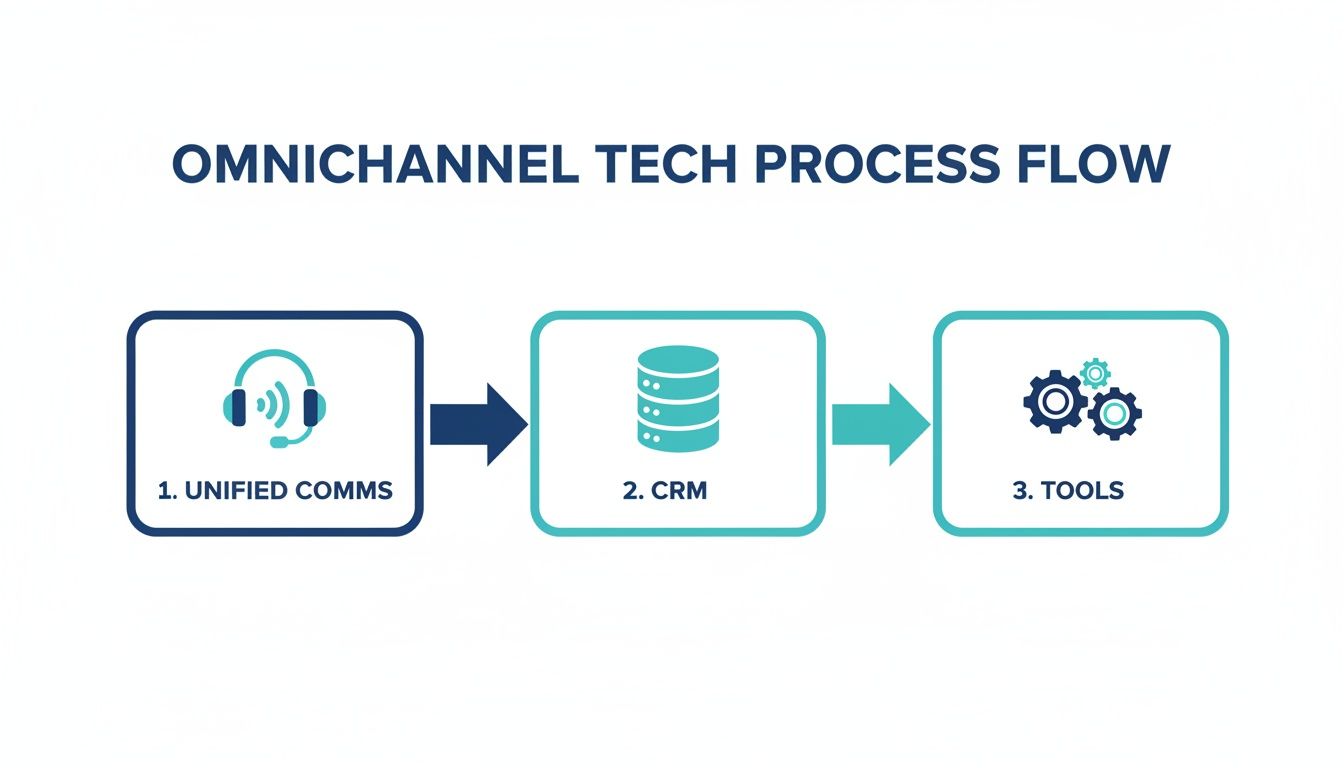
As you can see, unified communications act as the front door, feeding essential data into the CRM. From there, the CRM connects to all your other business tools, creating one central hub for customer knowledge.
Core Components of Your Tech Stack
To get this right, you need a few key pieces of software. Each has its own job, but they only become truly powerful when they’re integrated and communicating with one another.
- Unified Communications Platform: This is your central hub for every customer interaction. It brings all your channels—phone calls, text messages, web chats, and emails—into one place. A platform like Recepta.ai serves as this command center, making sure that no matter how someone reaches out, their conversation is captured with full context.
- Customer Relationship Management (CRM): Think of your CRM as the brain of the operation. It's the definitive system of record for every piece of customer data you have. For a pest control company, this means having a record of every treatment, call, and billing inquiry for a specific address, accessible to any team member instantly.
- Integration and Automation Tools: These are the essential bridges that let your different software programs talk to each other. They’re what ensure the data from your communications platform automatically creates a record in your CRM, books an appointment on your calendar, and updates your billing software without anyone lifting a finger.
The Power of Seamless Integration
The true advantage of an omnichannel tech stack is found in its integrations. When your systems are properly connected, you eliminate tedious manual data entry, slash human error, and create efficiencies that go straight to your bottom line.
A successful omnichannel customer experience depends entirely on your technology’s ability to share data in real-time. Without seamless integration, you're just managing multiple channels, not a unified strategy.
Here’s a practical example. Say a potential client for your law firm fills out a web form at 10 PM. With a fully integrated system, a beautiful, automated sequence kicks off.
- The form submission is instantly caught by your unified communications platform.
- Its AI then creates a new lead in your CRM, complete with all the case details from the form.
- Simultaneously, an automated email goes out to the client confirming receipt of their inquiry.
- The on-call paralegal gets a mobile notification with all the context needed for a follow-up call first thing in the morning.
This all happens in seconds, automatically. That’s a stark contrast to the alternative, where that lead sits in an inbox overnight—giving them more than enough time to find one of your competitors. To dig deeper into how these connections are made, check out our guide on what CRM integration is and why it's crucial.
Ultimately, your technology should be built around one simple goal: supporting a single, continuous conversation with your customer, no matter where or when it happens. This is how you transform your business from a group of siloed departments into one cohesive, customer-first organization.
Your Roadmap to Implementing an Omnichannel Strategy
Getting to a true omnichannel experience is a journey, not something you can just flip a switch on overnight. It takes a solid, intentional plan to get your technology, your processes, and your people all on the same page. Let's break this down into a few practical phases so you can build a connected system without getting bogged down.
Think of it like planning a big road trip. You wouldn't just hop in the car and start driving aimlessly. You'd map your route, check your tires, and figure out the most important stops along the way. Building an omnichannel system is no different—it all starts with knowing exactly where you are today and having a clear picture of where you want to end up.
This blueprint will walk you through the essential stages, from understanding your current state to getting all your systems talking to each other.
Phase 1: Map Your Customer Journey
Before you can fix the customer experience, you have to see it through their eyes. A customer journey map is exactly what it sounds like: a visual representation of every single time a person interacts with your business, from the moment they first hear about you to long after they’ve become a loyal client.
The goal here is simple: find every single touchpoint where a conversation could happen, both online and off.
- Discovery: How do people find you in the first place? (e.g., a Google search, seeing a post on social media, getting a referral from a friend)
- Consideration: Where do they go to get answers? (e.g., your website's live chat, calling for a quote, sending an email)
- Conversion: How do they actually book a service or buy from you? (e.g., filling out an online form, calling the office to schedule)
- Service: What happens during and after the actual service? (e.g., automated appointment reminders, follow-up texts, feedback surveys)
- Loyalty: How do you keep them coming back? (e.g., email newsletters with tips, special offers sent via SMS)
Practical Example: A dental clinic maps out its patient journey and finds a huge snag. A new patient fills out an online appointment request, but when the front desk calls them back, they have to ask for all the same information again—name, desired time, reason for the visit. That’s a classic communication gap and a perfect, actionable opportunity for an omnichannel solution to create a smooth handover by displaying the web form data when the call is made.
Phase 2: Audit Your Current Technology
Once you have that journey map, it's time to look under the hood at the tools and software you’re already using. You need to figure out what systems you have, whether they talk to each other, and where the most frustrating information gaps are.
Ask yourself these simple but revealing questions:
- Does our phone system have any connection to our CRM?
- When someone submits a web form, where does that information go? Does a human have to copy and paste it?
- Can we see a customer's entire history—calls, emails, texts, form submissions—all in one place?
The single biggest mistake we see is businesses buying new, shiny software without a real strategy. An audit forces you to figure out what you actually need, so you don't waste money on expensive tools that don't solve your real-world problems.
This audit will shine a bright light on all the data "silos" in your business—those disconnected islands of information that keep you from seeing the full customer picture.
Phase 3: Prioritize and Integrate Your Channels
Look, you don't need to be everywhere. You just need to be on the channels your customers prefer and expect. Use your journey map and what you know about your clients to pinpoint the most important touchpoints. For a home services company, that’s almost always phone calls and web chat. For a modern law firm, it might be email and a secure client portal.
After you've picked your priorities, the real work begins: integration. This is the technical core of your omnichannel strategy, where you connect your systems so that information can finally flow freely between them. This is where a platform like Recepta.ai becomes the glue, acting as the central hub that links your communication channels (phone, text, chat) with your CRM, calendars, and other essential business software.
Practical Example: An insurance agency decides to focus on phone calls and SMS for handling claims. They integrate their communications platform with their CRM. Now, when a client calls, their entire policy and communication history instantly pops up on the agent's screen. As soon as the call ends, an automated SMS is sent to confirm the claim status. The experience is seamless, professional, and completely connected.
By following this roadmap—mapping the journey, auditing your tech, and integrating with purpose—you lay the groundwork for a truly powerful omnichannel experience that builds loyalty and drives real growth.
Omnichannel Strategies in Action
It’s one thing to talk about omnichannel in theory, but the real "aha!" moment comes when you see it work in the wild. Let's move past the buzzwords and look at how a truly connected experience unfolds for real customers.
Think about it this way: a disjointed customer experience forces the customer to be the bridge between your departments. They have to repeat their story over and over. A great omnichannel strategy flips that, making your systems the bridge so the customer can have one continuous conversation.
To show you what I mean, let's walk through a few day-in-the-life scenarios for a plumbing company, a healthcare clinic, and a law firm.
Home Services: A Plumbing Company Example
Let's start with a classic home services scenario. Sarah's kitchen sink has sprung a serious leak, and she does what we all do: grabs her phone and searches for an "emergency plumber near me." She lands on your website.
- The First Touch (Web Chat): Instead of immediately having to call, she spots your web chat and starts typing. An automated assistant quickly gathers the essentials: her name, address, and what’s wrong. No waiting, no fuss.
- The Seamless Hand-off (AI Scheduling): The chat then asks if she'd like to book a technician. When Sarah says yes, the AI scans your company's actual calendar, finds an open slot that same afternoon, and books it right there in the chat window.
- Instant Confirmation (SMS): The moment the appointment is booked, her phone buzzes. It's an SMS from you, confirming the time and the technician's name. Behind the scenes, a new customer profile for Sarah has already been created in your CRM, complete with the chat transcript.
- A Helpful Nudge (SMS Reminder): An hour before the appointment, she gets one more text: "Hi Sarah, this is a reminder that your technician, Mike, will be arriving between 2-3 PM today."
This entire exchange felt like a single, smooth interaction. The alternative? Sarah would have used the chat, then been told to call the office, where she'd have to repeat her name, address, and problem all over again. That friction is exactly what omnichannel is designed to eliminate.
Healthcare: A Modern Clinic Example
Now, let's switch gears to a patient named David who needs his annual check-up. Like many people, he dreads the thought of navigating phone trees and sitting on hold.
- Convenient Online Booking: David logs into the clinic's patient portal and books his own appointment from the available slots. This automatically syncs with the clinic's main schedule and his personal Electronic Health Record (EHR).
- Smarter Intake Forms: A week before his visit, an email arrives with a secure link to his intake forms. He can fill them out on his own time, from his couch, saving him the usual 15 minutes of juggling a clipboard and pen in the waiting room.
- Connected Post-Visit Care: After the appointment, the doctor's notes trigger an automated follow-up. David gets an email with a summary of his visit, details on a new prescription, and a direct link to schedule the follow-up lab work his doctor recommended.
In healthcare, omnichannel is more than just a convenience—it's about ensuring continuity of care. When every touchpoint is connected and logged, the risk of miscommunication plummets, and the patient feels more in control of their health journey.
This connected system gives David the right information at the right time, across different channels. All the while, it’s drastically cutting down on the administrative workload for the clinic staff.
Legal: A Law Firm Example
Finally, picture Maria, who has just been in a minor car accident. She's shaken up, stressed, and looking for a law firm that sounds like they have their act together.
- The After-Hours Call: It’s late, but Maria calls your firm anyway. Instead of a generic voicemail box, an AI receptionist answers. It compassionately gathers her name, contact info, and the key details about her situation.
- From Call to CRM, Instantly: The second she hangs up, the system gets to work. It logs a recording and a full transcript of the call, then creates a brand new lead in the firm's CRM, automatically filling in all the information Maria just provided.
- The Warm, Informed Follow-Up: The next morning, a paralegal sees the new lead. They don't have to decipher a rushed voicemail or start from scratch. They simply open the CRM, review the transcript, and call Maria back with complete context. The conversation starts with, "Hi Maria, I'm following up on your call last night about the accident. I see you mentioned..."
That single, informed sentence immediately builds trust and conveys professionalism. It transforms a cold lead into a warm, productive conversation, dramatically increasing the chances that Maria will choose your firm.
How AI Powers Your Omnichannel Experience
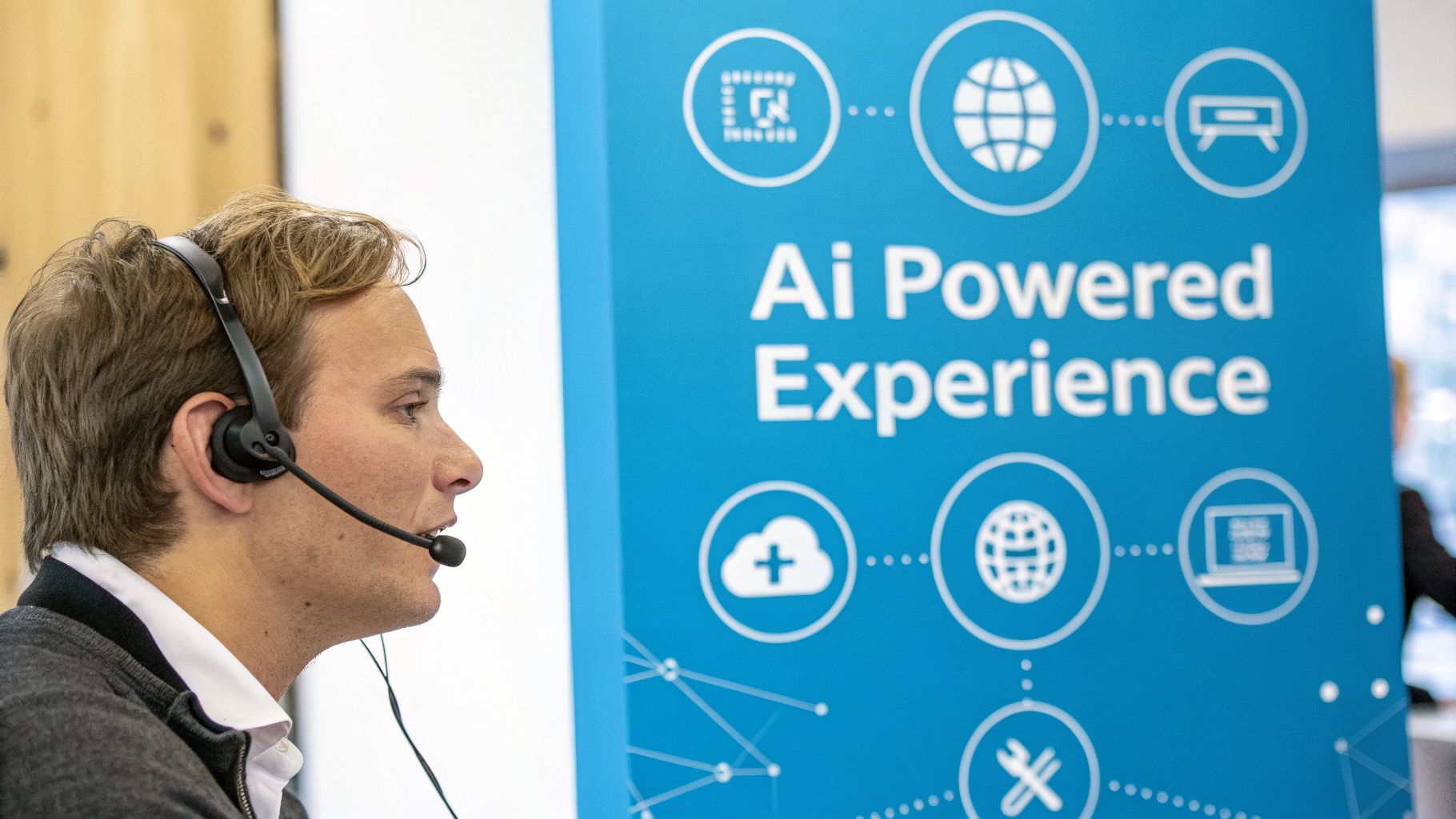
So, how do you actually pull off a true omnichannel experience? The secret sauce is artificial intelligence. Think of AI as the central nervous system connecting all your communication channels—phone, web chat, text, and email—into a single, smart system that’s always on, 24/7.
This isn't about firing your team and letting robots take over. Far from it. The goal is to blend the efficiency of conversational AI with the expertise of your human staff. AI is fantastic at handling the frontline: capturing lead details, answering routine questions, and routing inquiries to the right person on the first try.
Creating Seamless Handoffs with Full Context
We’ve all been there—stuck in a loop, repeating our story to three different people. That’s the exact moment a customer experience breaks down. This is where an AI-powered platform truly shines.
It works by capturing context from every single interaction. Whether someone calls your business late at night or fills out a form on your website during lunch, the AI is listening and logging the details.
When a conversation requires a human touch, the transfer is completely seamless. Your team member gets the entire backstory—call transcripts, chat logs, form data, and customer notes—before they even pick up the phone. The customer never has to say, "I already explained this to someone else."
An AI-driven system acts as a perfect memory for your business. It remembers every conversation and ensures your team is always equipped with the full story, turning every interaction into an opportunity to build trust.
A Practical Example of AI in Action
Let’s see what this looks like in the real world. Imagine a potential client for your insurance agency visits your website after hours and fills out a quote request form.
Here’s the AI-powered omnichannel follow-up:
- The AI instantly captures the lead’s information and creates a new profile in your CRM.
- Within minutes, it automatically sends a text or places a call to the prospect, asking if they have a moment to confirm a few details to speed up their quote.
- If the client agrees and then asks to speak with a live agent, the AI transfers the call instantly. Your agent receives a notification with the original form data and the transcript of the AI’s conversation, allowing them to start the call fully informed.
This kind of proactive, intelligent engagement is a game-changer for lead conversion. For a deeper dive into this subject, check out this guide on a strategic approach to enhancing customer experience with AI.
Unifying Systems with Built-In Integrations
The real magic happens when an AI platform like Recepta.ai connects all your other business tools. With thousands of built-in integrations, it acts as the glue between your CRM, calendar, billing software, and more, creating a single source of truth.
This is what allows for powerful automation that saves you time and prevents leads from slipping through the cracks. When your communication platform can talk directly to your calendar, the AI can book appointments on its own. When it’s synced with your CRM, every phone call, text, and email is logged automatically.
This goes way beyond a simple answering service. To see how these connections work, our guide on the AI phone answering service breaks it down further. The result is a consistently professional experience for every customer, every single time.
Frequently Asked Questions About Omnichannel Strategy
Thinking about an omnichannel strategy? You’re not alone. It’s a big shift, and it's natural to have questions before you dive in. Let's tackle the concerns that come up most often.
What Is the Best First Step to Becoming Omnichannel?
Before you look at a single piece of software, your first move is to map your customer's journey. Seriously, get a whiteboard and trace every single way a potential client interacts with your business, from their first Google search to how you handle a follow-up call weeks later.
This exercise is incredibly revealing. You'll quickly spot the friction points. For example, you might realize people who fill out a website form end up calling anyway because they don't get a fast enough response. That single discovery gives you a concrete, high-impact problem to solve first.
Can My Small Business Afford an Omnichannel Strategy?
Yes, and here's the kicker: you can probably afford not to. The right omnichannel platform often saves money right out of the gate by plugging leaks where you’re losing leads and cutting down on repetitive administrative work.
Think about it in simple terms. Instead of paying a full-time receptionist $40,000+ a year, a smart, AI-driven platform can answer calls, respond to chats, and schedule appointments around the clock for a fraction of that cost. The ROI isn’t just about saving money; it’s about making more of it by capturing every single opportunity.
How Is Omnichannel Truly Different from Multichannel?
The real difference comes down to data integration. Multichannel is like having a bunch of separate conversations. Your customer might email you, then call, then use web chat, but they have to start over and re-explain themselves every single time because those channels don't talk to each other.
An omnichannel experience, on the other hand, weaves all those channels into one continuous conversation. When that same customer calls after starting a web chat, your team (or the AI) sees the entire history instantly. It’s a smarter, smoother interaction that doesn't waste anyone's time.
How Long Does It Take to See Results?
You’ll see some wins almost immediately. The moment you integrate your main communication channels, you start catching calls you would have missed and stop wasting time on manual data entry. You can realistically expect to see a measurable increase in qualified leads and fewer customer frustrations within the first 30 days.
Ready to deliver a truly connected experience? Recepta.ai blends AI and human support to unify your communications, capture every lead, and delight your customers. Start your 30-day risk-free trial today.
.webp)