
Master Your Outbound Call Script: 2026 Guide

You're probably here because your team already has a script, and it still isn't getting consistent results. Reps sound fine on some calls, flat on others. One person books meetings with a loose outline. Another reads the “approved” script word for word and gets shut down in ten seconds. That usually means the script isn't built for the way outbound calling works.
A usable outbound call script isn't a speech. It's a call guide that helps a rep open cleanly, qualify fast, handle resistance without sounding defensive, and move the prospect to a sensible next step. In 2026, it also has to fit a wider workflow that includes CRM prompts, voicemail follow-up, text handoff, appointment booking, and sometimes AI-assisted call handling.
Why Most Outbound Call Scripts Fail
The failure usually happens in the first few seconds. A rep opens with a long introduction, asks “did I catch you at a bad time,” then launches into company background the prospect didn't ask for. The prospect hears a generic sales call and checks out.
That doesn't leave much margin for error. Current industry benchmarks suggest the average cold-calling success rate is only about 2.7%, while average connect rates typically fall in the 15% to 28% range, according to Salesgenie's cold-calling statistics for sales representatives. A script in that environment has one job. Improve a low-probability interaction enough that more of those calls turn into real conversations.
Static scripts break under real call conditions
Most scripts fail because they're written like a brochure. They assume the prospect will listen patiently from greeting to pitch to close. Real calls don't work like that.
Prospects interrupt. They challenge your timing. They ask if you're calling about the email they ignored. They say they're driving, between patients, walking into court, or handling a dispatch issue. A rigid script forces reps to either read through the interruption or abandon the structure entirely.
Practical rule: If your script only works when the prospect lets the rep finish every line, it isn't a working outbound call script.
The stronger approach is modular. Instead of one uninterrupted block of talk, reps need separate pieces they can use in sequence or swap based on what happens: opener, relevance statement, qualifying question, objection response, voicemail version, and follow-up handoff.
That same thinking shows up in operational call handling. Teams that want cleaner conversations and fewer dropped opportunities usually need stronger process discipline, not just better wording. Recepta's guide to call handling best practices is useful on that point because script quality and call handling quality are tightly connected.
The script now belongs to a system
A modern script also has to survive beyond the live call. If a prospect doesn't answer, what voicemail gets left? If they text back, what context carries over? If a rep books a consult, what gets logged so the next person isn't starting cold?
The old version of the script treated the phone call as the whole play. The current version treats the phone call as one moment inside a response system.
Building Your Script's Foundation
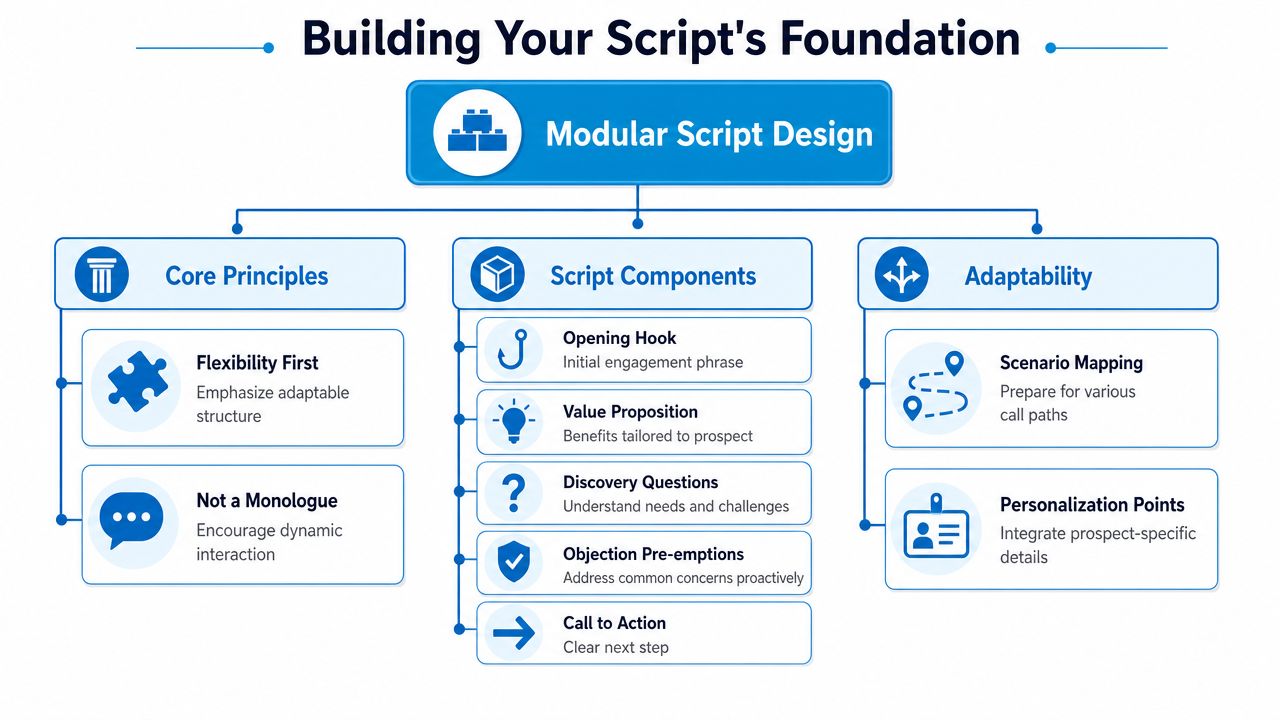
A strong outbound call script starts with architecture. Not wordsmithing. If the structure is wrong, polished lines won't save it.
High-performing teams tend to build scripts as a modular, step-by-step flow: define the target audience and objective, segment contacts, prepare the script, train callers, execute calls, then track conversion and iterate. That model is outlined in Yonyx's guide to outbound call flow scripts, and it matches what works on the floor. You want enough consistency that every rep covers the essentials, but enough flexibility that they can sound human.
Start with one objective
Most weak scripts try to do too much. They educate, persuade, qualify, close, and upsell in one call. That creates bloated openings and confused reps.
Pick one primary objective per call type.
- Home services: Book an inspection, estimate, or callback window.
- Dental practice: Re-engage a patient and secure a hygiene appointment.
- Law firm: Confirm interest and schedule a consultation.
- Insurance agency: Set a review call, not rewrite the whole policy on the spot.
An HVAC company, for example, shouldn't make the call objective “sell a full replacement system.” The script should aim for something lower friction, such as scheduling a system inspection or estimate.
Build a short value proposition
The value proposition is the part reps usually over-explain. It should answer one question fast: why should this person keep listening?
Hi, we're a full-service provider with years of experience helping businesses like yours optimize operations through complete solutions.
Better version:
“Hi Sarah, I'm calling because you asked for a pest control quote, and I can help get you scheduled.”
That works because it's specific, relevant, and easy to process.
A value proposition on an outbound call should sound like a reason for the call, not a mission statement.
Add qualifying questions that do real filtering
A script needs discovery, but not an interrogation. Early questions should help the rep sort fit, urgency, and next step.
Use practical questions such as:
- Timing: “Are you looking to handle this soon, or are you just gathering options?”
- Current setup: “Do you already have someone handling this?”
- Decision path: “Would you be the one booking this, or is someone else involved?”
- Need detail: “What prompted you to look into this now?”
Each question should help the rep decide where to take the call next. If a question doesn't change the path, cut it.
Create an objection map before reps need it
Don't leave objection handling to improvisation. Write short, natural responses to the objections your team hears every day. Not twenty. Start with the handful that show up constantly.
Your objection map should cover:
- Timing objections: “Not now,” “I'm busy,” “Call me later”
- Interest objections: “Not interested”
- Incumbent objections: “We already use someone”
- Deflection objections: “Just send me an email”
Keep the language simple. Reps should recognize the path at a glance, not hunt through a page of scripts.
End with a low-friction call to action
The close should match the stage of the conversation. A script fails when the CTA asks for too much too early.
A few workable examples:
- “Would tomorrow afternoon or Friday morning be better for a quick estimate call?”
- “If I text over two appointment windows, could you pick the one that works?”
- “Would it make sense to schedule a short consult and see if there's a fit?”
For teams running phone-heavy workflows, your script also needs to align with the tools around it. If you're mapping calls into CRM updates, missed-call routing, and follow-up tasks, this overview from Premier Broadband on unified communications is a useful operational reference. It helps explain why scripts work better when call data and next steps don't live in separate systems.
If your outreach process also spans phone, text, and email, Recepta's article on outreach and marketing gives helpful context for coordinating those touches without making the messaging feel disconnected.
Crafting Openings That Earn a Conversation
The opening decides whether the rest of the script matters. If the first line sounds generic, the prospect starts looking for the fastest exit.
The common mistake is making the opening about the rep. Name, company, vague pleasantry, then a permission question with no relevance behind it. Prospects hear that pattern all day.

Weak openings versus workable ones
Here's a version that usually dies fast:
“Hi, this is Mark from Apex Solutions. How are you today? I was hoping to get a few minutes to tell you about our services.”
Nothing in that opener tells the prospect why this call matters now.
A stronger version sounds like this:
“Hi Dana, this is Mark with Apex. You requested info on attic insulation, and I'm calling to help you get a quote scheduled. Did I catch you at a bad moment?”
That opener works better because it establishes relevance before it asks for time.
Three opening formulas worth testing
Recent activity opener
Use this when the prospect filled out a form, downloaded a guide, called earlier, or started a quote request.
Example for a law firm:
“Hi James, this is Alina from [Firm Name]. You downloaded our guide on handling a workplace injury claim, and I wanted to see what prompted the search.”
Example for a dental office:
“Hi Maria, this is Tasha from [Practice Name]. You were looking into booking a cleaning, and I wanted to help you find an appointment time.”
This style works because it starts with context the prospect already recognizes.
Problem-focused opener
Use this when your team is calling into a known issue common in the market you serve.
Example for plumbing:
“Hi Chris, this is Ben with [Company Name]. We've been talking with homeowners in your area who are dealing with recurring drain backups, and I wanted to ask if that's been an issue at your property too.”
Example for insurance:
“Hi Nicole, this is Aaron from [Agency Name]. I'm reaching out to business owners who want a second look at coverage changes before renewal. Is that something you're already reviewing?”
The key is restraint. Don't overstate the pain. Just name a credible issue and invite a response.
Referral opener
Use this when you have a real referral, internal handoff, or mutual relationship.
Example:
“Hi Kevin, this is Laura with [Company Name]. [Referrer Name] suggested I give you a call because you're reviewing vendors this quarter.”
That one buys attention because it lowers the “random call” feeling immediately.
If you can't answer “why this person, why now” in the opening, the prospect will answer it for you. Usually with a no.
Small opening changes that improve tone
A few changes make scripts sound more grounded:
- Lead with relevance: Mention the form, service request, referral, or issue first.
- Use shorter sentences: Long openers sound rehearsed.
- Ask easier questions: “Is now a bad time?” often works better than “Do you have a few minutes?”
- Drop filler: Skip “just touching base” and “wanted to reach out.”
Reps who struggle with openings usually also struggle with tone. If that's showing up on your calls, Recepta's piece on how to build rapport with customers is worth reading. It's especially useful for teams that sound polite but still don't sound natural.
Mastering Objection Handling and Closing
Once the conversation starts, resistance is normal. It doesn't mean the call is failing. It means the prospect is testing whether the rep can make this worth their attention.
What doesn't work is fighting the objection head-on. New reps hear “not interested” and answer with more pitch. They hear “send me an email” and start listing features. That usually makes the prospect want out even faster.
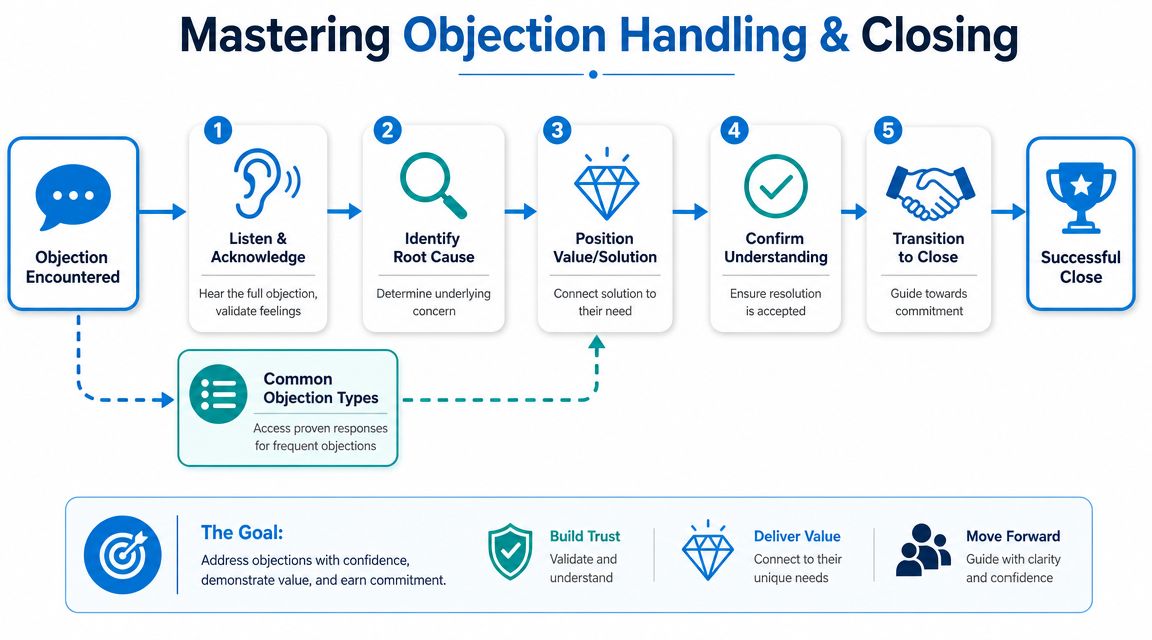
A simple framework keeps the conversation under control.
Use acknowledge isolate redirect
The three moves are straightforward:
- Acknowledge the objection without sounding defensive.
- Isolate what the objection means.
- Redirect toward a useful next step.
Most reps skip the middle step. That's where calls get sloppy. “Not interested” might mean bad timing, no authority, confusion, loyalty to a current vendor, or genuine lack of fit. If you don't isolate it, you're guessing.
Four objections and better responses
I'm not interested
Bad response:
“But let me tell you why you should be.”
Better response:
“I get that. Usually that means either the timing's off or it doesn't sound relevant yet. Which is it for you?”
If they say timing is off:
“Fair enough. When it is worth reviewing, is that usually around renewal, budgeting, or when a problem comes up?”
If they say it's not relevant:
“Understood. Before I let you go, can I ask one quick thing so I don't keep following up if this isn't a fit?”
That keeps the call respectful while still learning something.
Just send me an email
This one is often a brush-off, but not always.
Try:
“Happy to. So I send something useful, what would you want it to cover?”
If they answer, you have engagement. If they don't, you know the request was probably a soft rejection.
A more direct version:
“I can send that over. Usually it helps to tailor it. Are you comparing options, or just gathering information for later?”
We already use someone
New reps often panic here, but this objection can be a sign that the category matters.
Try:
“That makes sense. Most good businesses already have something in place. Out of curiosity, are you happy enough to stay put, or do you still review alternatives when service or pricing becomes an issue?”
That response does two things. It lowers pressure, and it opens the door to dissatisfaction without insulting the incumbent.
Field note: “We already use someone” is often easier to work with than “I don't care,” because it confirms the prospect already buys the type of service you offer.
I don't have time right now
Respect it, then tighten the ask.
“Understood. This may not be the right moment. Give me ten seconds. If it sounds irrelevant, I'll let you go.”
Or:
“No problem. Would it be easier if I texted two times for a quick callback instead of trying to catch you cold again?”
That second response is useful for busy service businesses, medical practices, and professional offices where timing is the main barrier.
A short training video can help reps hear this in live cadence rather than just read it on a page:
Hard closes and soft closes
Closing fails when the rep uses the wrong level of commitment.
A hard close asks directly for the meeting, appointment, or consultation:
- “Let's get this on the calendar. Is Thursday or Friday better?”
- “I've got an opening at 2:00 or 4:30. Which works better?”
Use that when the need is clear, the prospect is engaged, and the next step is obvious.
A soft close lowers the commitment:
- “Would it make sense to send over times and let you pick one?”
- “Would a brief review call be the easiest next step?”
- “Should we start with a quick screening conversation before booking the full consult?”
Use that when the prospect needs a little more control or the ask feels premature.
What good closers actually do
The strongest reps don't “push harder.” They reduce friction.
- They summarize clearly: “You're comparing providers, but timing matters.”
- They suggest one next step: Not three options, not a menu.
- They make logistics easy: Offer times, not vague promises to reconnect.
- They stop talking after the ask: Silence is part of the close.
That last one matters more than most training manuals admit.
Practical Outbound Script Templates for Your Industry
Templates work best when they're built to be edited. Don't treat the examples below as fixed scripts. Treat them as starting points with clear slots for your service, timing, and qualification questions.
Home services template
Use case: Web form follow-up for pest control, HVAC, plumbing, cleaning, roofing, or electrical services.
Script
“Hi [First Name], this is [Rep Name] from [Company Name]. You requested information about [service type], and I'm calling to help you get that scheduled.
Usually the first thing I need to confirm is the property address and what's going on. Are you dealing with [issue], or is this more of a routine service request?
Got it. And are you looking to handle this soon, or are you comparing a few options first?
Based on that, the best next step is [estimate visit / inspection / callback with technician]. I've got [time option 1] or [time option 2]. Which works better?”
Customization notes
- Replace “[issue]” with a problem customers say out loud.
- If your dispatch window is flexible, offer a callback confirmation instead of a firm slot.
- If the lead came in after hours, reference that context briefly.
Healthcare and wellness template
Use case: Re-engaging patients for cleanings, consultations, wellness visits, or follow-up booking.
Script
“Hi [First Name], this is [Rep Name] from [Practice Name]. I'm reaching out because it looks like you [asked about / were due for / started to book] a [service type], and I wanted to help with scheduling.
Before I look at times, are you still interested in coming in for that?
Great. Do you prefer [morning/afternoon], and is there a specific day that's usually easier for you?
We have [time option 1] and [time option 2] available. If neither works, I can note your preference and have the team follow up with the closest match.”
Customization notes
- Keep language simple and administrative.
- Don't add clinical claims to the script.
- Make sure booking language matches your practice workflow and privacy requirements.
Professional services template
Use case: Following up with a prospect who downloaded a guide or requested information from a law firm, insurance agency, accounting office, or consulting practice.
Script
“Hi [First Name], this is [Rep Name] from [Firm/Agency Name]. You recently [downloaded/requested] our [resource name], and I wanted to see what prompted you to look into that.
Thanks, that helps. Are you trying to solve this right away, or are you still gathering information?
Understood. In situations like this, the next useful step is usually a brief [consultation / review call / intake conversation] so we can understand whether there's a fit. Would [time option 1] or [time option 2] be easier?”
Customization notes
- Keep the opener tied to the actual action the prospect took.
- Use “fit” language for consultative services. It lowers pressure.
- If the matter is sensitive, offer a callback window instead of pushing for details live.
Here's a simple way to align templates with the right outcome:
| Industry | Primary Goal | Key Success Metric |
|---|---|---|
| Home services | Book an estimate, inspection, or service appointment | Appointments booked |
| Healthcare and wellness | Re-engage and schedule a visit | Confirmed bookings |
| Professional services | Secure a consultation or intake call | Consultations scheduled |
Testing Compliance and AI Integration
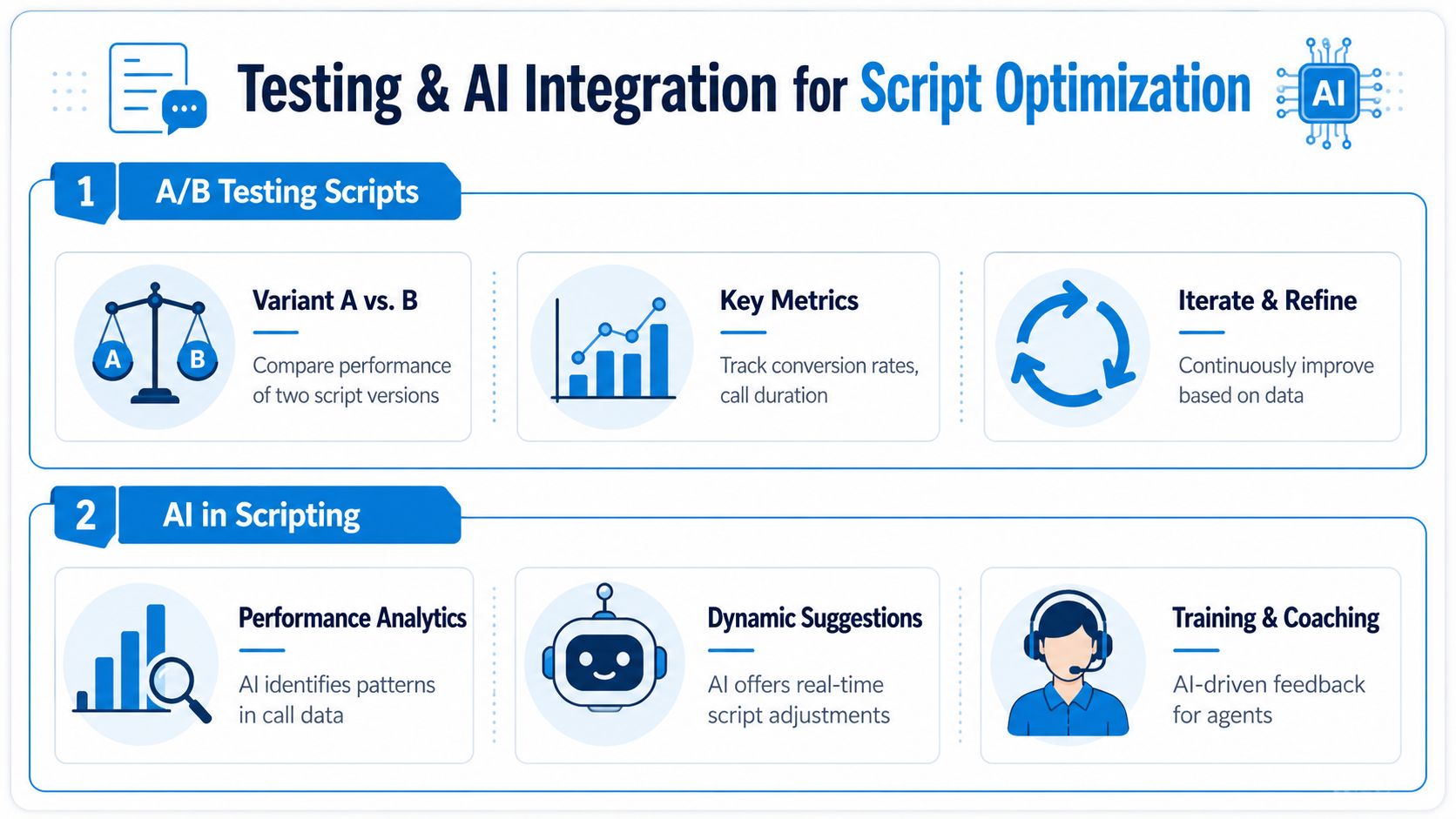
A script shouldn't stay frozen after you write it. Teams need to test it, pressure-check it for compliance, and make sure it works across phone, voicemail, text, CRM logging, and scheduling.
Most outbound advice still treats the script like a fixed talk track. The stronger model is broader. Recent guidance on AI-assisted selling argues that the best scripts now support an end-to-end response system, including clean handoffs to automation for instant follow-up and appointment booking. That's especially important in home services and healthcare where speed and continuity matter, as described in My AI Front Desk's outbound call script examples.
Test one variable at a time
Don't rewrite the whole script and call that testing. Change one thing you can learn from.
Good tests include:
- Opening line: recent-activity opener versus problem-focused opener
- CTA style: direct booking ask versus callback offer
- Question sequence: timing question first versus need question first
Watch practical outcomes such as connect quality, booked meetings, booked appointments, call duration, and how often reps reach the CTA cleanly. If you change three things at once, you won't know what caused the improvement or decline.
Compliance has to shape the script
This part gets ignored until it becomes a problem. Your outbound call script has to reflect consent requirements, contact preferences, and any industry-specific rules your team operates under.
A few basics matter:
- Respect contact permissions: Don't script outreach that ignores consent standards.
- Adjust by industry: Healthcare teams need workflows that support privacy-conscious communication.
- Control follow-up language: Voicemail, text, and email handoffs should match what the business is allowed to send and say.
The script isn't separate from compliance. It's one of the places compliance either shows up clearly or breaks down.
AI only helps if the script is structured
Modern tools change the job. If your script is modular, an AI system can use the same logic your reps use: identify call type, deliver the right opener, qualify, log the outcome, trigger follow-up, and escalate when the conversation needs a person.
That's also where a platform like Recepta's conversational AI for customer support fits. In practice, teams use structured scripts to define what happens on a new lead call, a missed callback, an appointment confirmation, or a reactivation campaign. The system can then support the workflow instead of forcing reps to rebuild context each time.
The critical shift is this: a modern outbound call script isn't just what a rep says. It's the operating logic behind the conversation.
If you want to turn your script into a working call workflow, Recepta.ai is one option to evaluate. It supports inbound and outbound calling, appointment scheduling, lead capture, follow-ups, summaries, and escalation to human agents, which makes it useful for teams that need their outbound call script to connect cleanly with booking, CRM updates, and after-hours coverage.