
Outbound Calling Strategy: Benchmarks and Consent Rules
By 1915, vacuum-tube technology had made long-distance telephone sales calls practical between New York and San Francisco, according to Selling Power's sales communication timeline. Businesses have had the ability to sell beyond their local market for generations. The harder problem is deciding whom to call, what permission allows, and who should handle the conversation.
A useful outbound calling strategy answers those questions before anyone raises dialing volume. For service businesses, the objective isn't more calls. It's more qualified bookings, with documented consent, enough staff to handle answers, and a clear boundary between automation and human judgment.
Build the Calling Funnel Before You Dial
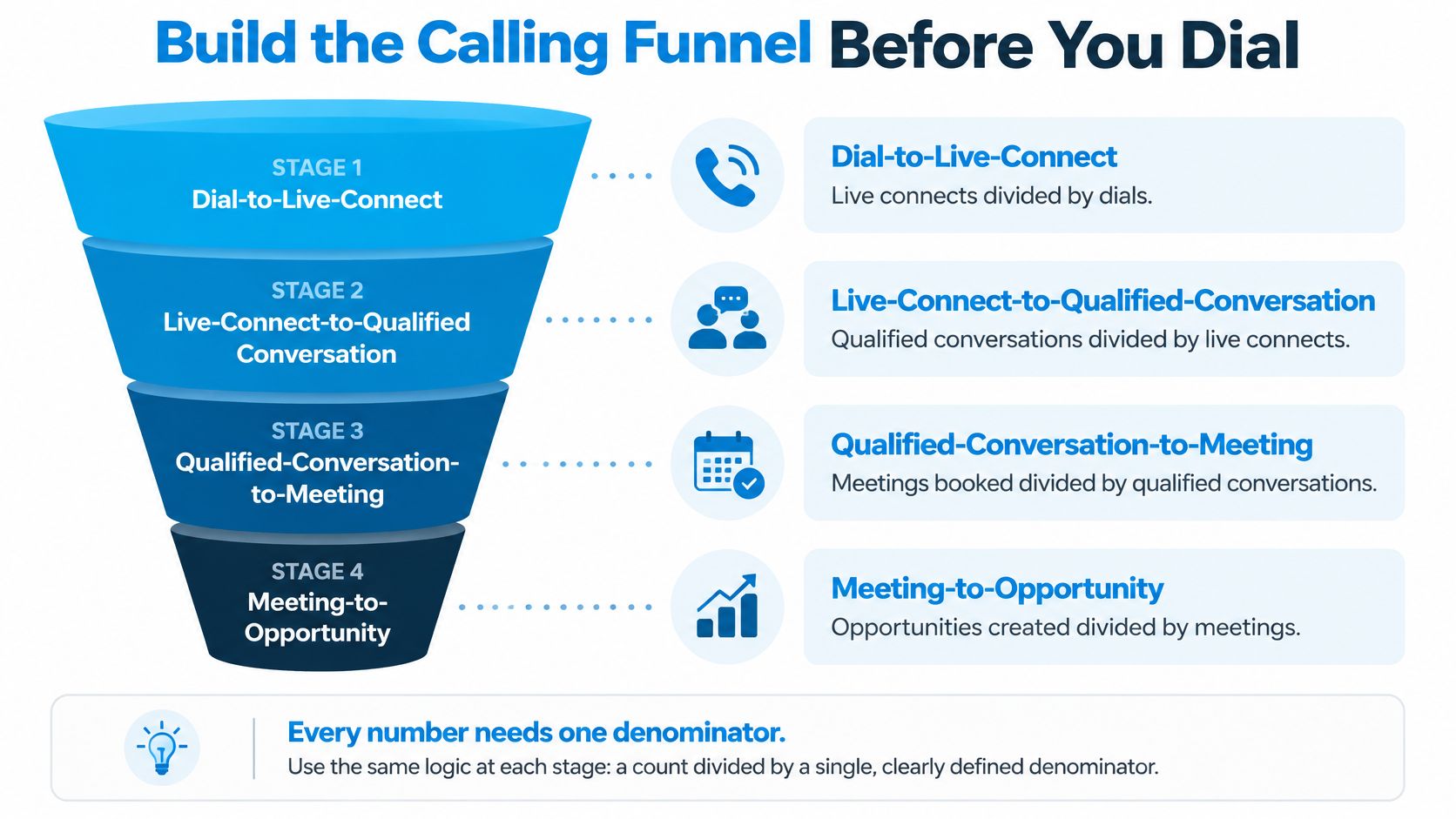
Define the funnel before opening the dialer. Each stage needs its own denominator, or your team will use the same conversion label for different outcomes.
- Dial-to-live-connect: Live connects divided by dials.
- Live-connect-to-qualified-conversation: Qualified conversations divided by live connects.
- Qualified-conversation-to-meeting: Meetings booked divided by qualified conversations.
- Meeting-to-opportunity: Opportunities created divided by meetings.
Decide what qualified means operationally. For a plumbing company, that might require a serviceable address, a relevant job, and someone authorized to approve the work. A polite conversation alone doesn't qualify.
Use this funnel diagram to keep those definitions visible during campaign reviews.
Compare rates without changing denominators
MarketSplash's sales statistics report cold-call connection rates of 5.4% for average representatives versus 13.3% for top performers, with 4.6% versus 16.7% of connected calls becoming meetings, respectively. The table applies those rates to a hypothetical campaign, not a forecast for your business.
Cold calling funnel benchmarks by stage
| Funnel stage | Average rep | Top performer | Denominator |
|---|---|---|---|
| Dial to live connect | 5.4% | 13.3% | Cold calls dialed |
| Live connect to meeting | 4.6% | 16.7% | Connected calls |
| Result per 1,000 dials | About 54 connects and 2 to 3 meetings | About 133 connects and 22 meetings | Implied from the rates above |
The meeting benchmark skips the qualification stage, so don't mistake it for qualified-conversation-to-meeting performance. List quality, market, offer, and compliance constraints can all change the result.
Diagnose the actual bottleneck
An unanswered dial is a timing or channel question to investigate, not proof of disinterest. Separate mobile, landline, and business-line results, test different calling windows, and verify the caller ID you present.
Avoid celebrating connections when the calendar stays empty. If your team is planning capacity beyond an initial pilot, the resource on scaling outbound with Yalc offers additional context for organizing lead generation.
Before the first dial, write a target for every funnel stage. Assign someone to investigate missed targets rather than requesting more activity.
Consent Rules to Check Before Every Call
Seller-specific permission is a sound operational standard, but don't confuse a proposed rule with current law. The FCC's one-to-one consent announcement described separate written permission for each seller and topical relevance to the website collecting consent. That rule was subsequently vacated before taking effect, so it shouldn't be presented as an operative requirement.
That correction doesn't make purchased leads automatically callable. Existing restrictions still require careful classification of the technology, message, recipient, and permission involved. An AI voice isn't a workaround: the FCC treats AI-generated voices as artificial or prerecorded voices.
Build a consent ledger that survives a CRM transfer
Keep a contact record containing the original source, exact disclosure shown, seller identified, permitted purpose and channel, timestamp, and revocation status. Retain the underlying form or evidence, not just a salesperson's consent checkbox.
The FCC's unwanted communications guidance explains that covered autodialed or prerecorded calls to mobile phones generally require prior express consent, with written consent required for advertising or telemarketing calls. Use the following as an operational checklist, with counsel confirming campaign-specific requirements.
Consent and records needed by call type
| Call type | Consent needed | Opt-out and records | Note |
|---|---|---|---|
| Marketing call to a mobile number using an autodialer or AI voice | Prior express written consent identifying the seller as applicable | Opt-out available during each call; consent record kept | Verify seller coverage, not a blanket lead-vendor assurance |
| Promotional offer, such as a whitening special | Written consent from the patient covering the practice's promotional calls | Consent stored in the CRM; withdrawal honored immediately | Check that form wording covers promotional calls |
| Appointment reminder for an existing booking | Classified separately from sales offers; applicable permission documented | Opt-out requests honored | Confirm classification for AI voice calls |
| Callback to a web-form lead who asked to be contacted | Form permission covering the requested callback and calling method | Timestamp and form record kept | Scope must match what the person requested |
| Number on the National Do Not Call Registry | Telemarketing calls restricted | Suppress unless an exemption applies | Check exemptions before any exception |
Make eligibility a pre-dial decision
Before releasing a record, confirm permission scope, apply do-not-call and revocation suppression, and enforce local calling hours. The call flow must identify the business and provide the required opt-out.
Say a franchise location receives a lead from another brand's website. Hold the call until someone verifies that the disclosure covers the actual seller and intended outreach; a CRM assignment doesn't establish permission.
Treat recording permission separately through a call-recording compliance workflow. This is an operational checklist, not legal advice, and requirements differ by jurisdiction.
Build Lists, Timing and Follow-Up Sequences
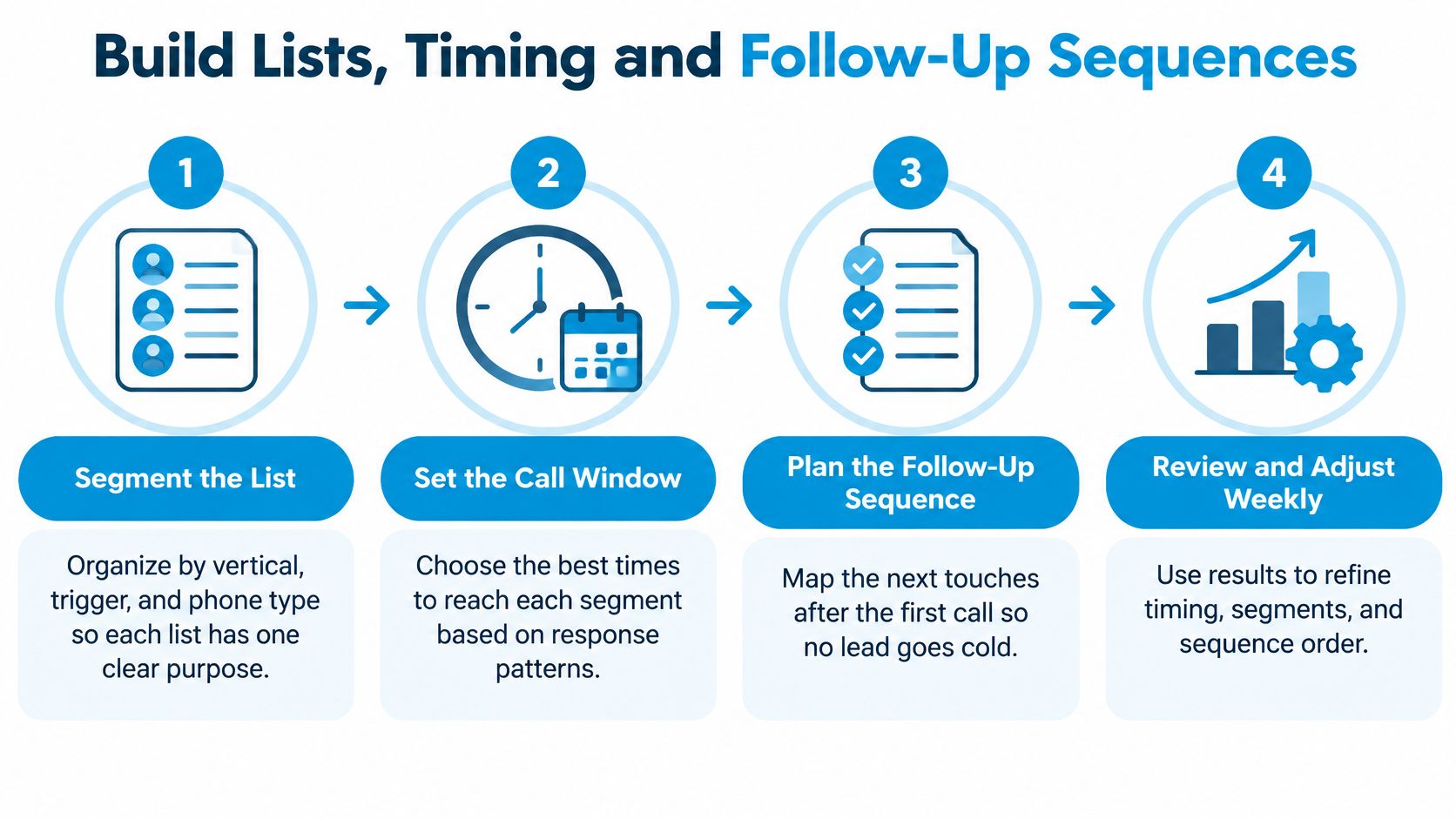
Start with a sequence your team can operate this week: a segmented list, an eligible callback trigger, planned retry windows, and explicit stopping conditions. Don't upload every contact and let the dialer decide the workload.
This process keeps list preparation, scheduling, and review connected.
Configure the sequence
Segment before scheduling. Separate contacts by vertical, trigger, and phone type. A dental recall, a new HVAC web inquiry, and an old insurance quote need different messages and reporting groups.
Trigger eligible web-form callbacks immediately. A lead-response study covering approximately 3.5 million leads reported a 391% conversion increase when calling within one minute, an average 49% conversion gain at recommended calling times, and that 93% of converted leads were first reached by the sixth attempt, versus 7% after seven or more attempts. These findings support fast, structured follow-up, not a guaranteed lift for your campaign.
Test windows deliberately. For an initial pilot, try the first attempt in one permitted window and a second attempt later that day in another, where appropriate. Review reach by window after the first week rather than assuming every customer answers during lunch.
Space later attempts. As a starting configuration, schedule attempts three through seven one to two business days apart. This is a test cadence, not a legal entitlement to keep calling.
Set a stopping point. A seven-attempt pilot cap is a reasonable configuration to evaluate against your own results. Stop sooner after an opt-out, wrong-number confirmation, completed booking, or clear refusal.
Record every disposition. Use distinct outcomes such as no answer, voicemail, wrong number, qualified, booked, declined, and opted out. Close exhausted records explicitly instead of leaving them indefinitely active.
Practical rule: Persistence means following a relevant plan. It doesn't mean continuing after someone has told you to stop.
Test a manageable batch
Say an HVAC company has 2,000 past-customer records sorted by last service date. In a hypothetical pilot, it could review the oldest 300 for eligibility, offer a seasonal check, and close each record after the final permitted attempt.
Keep the offer consistent within that batch. Otherwise, you won't know whether a different result came from timing, audience selection, or a changed message.
Use this video as a discussion prompt when reviewing how the sequence should operate.
For implementation details, use a lead follow-up checklist. Teams comparing sequencing software can also consult Docket's Outreach alternatives for B2B sales teams, focusing on suppression, dispositions, and scheduling rather than feature counts.
The weekly report should show attempts per lead, reach rate by attempt number, and leads closed at the cap.
Write Scripts That Fit Each Call Type
A usable script contains a short identification and purpose statement, a qualifying question, a next step, and a clean exit. It should assist the representative, not force them to read a paragraph while the customer waits.
The next step must fit the call's purpose. A requested quote callback can move toward booking; an appointment confirmation shouldn't turn into an unrelated sales pitch.
Match the opening to the trigger
| Call type | Example opening | Useful next step |
|---|---|---|
| Web-form callback | Hi, this is Alex from Northside HVAC, following up on your request about an AC replacement. Is this for your home or a rental property? | Book the appropriate assessment |
| Past-customer reactivation | Hi, this is Northside HVAC calling about the system we serviced last season. Would you like to arrange a maintenance check? | Offer a relevant service appointment |
| Appointment confirmation | Hi, this is Brightside Dental confirming your upcoming appointment. Can you attend, or would you prefer to reschedule or cancel? | Confirm or update the booking |
For a hypothetical dental recall, the opening could be: Hi, this is the team at Brightside Dental calling about your six-month cleaning. Are you free next Tuesday morning?
Use such wording only when the record supports that recall interval and the outreach is permitted. Don't imply that a patient is overdue when you haven't checked.
Edit for conversation, not completeness
As script-testing targets, aim to ask the first question within the first 20 seconds and keep a simple appointment confirmation under 30 seconds. Those are practical drafting constraints, not performance benchmarks.
- Handle an objection briefly. Give a relevant reply, then accept the answer. Don't build a ladder of rebuttals.
- Follow the customer's pace. Slow down when they need clarification, and stop reading when they ask a direct question.
- Offer an exit. Make declining or requesting no further contact straightforward.
- Finish the record. Save the disposition before moving to the next dial.
A script is useful when it makes the next decision easier. Extra wording that delays that decision should come out.
Grou's examples of call openings that earn attention can help compare opening approaches. Adapt the structure using an outbound call script matched to the actual trigger.
Read the finished version aloud, time it, and remove any line that doesn't support identification, qualification, action, or exit.
Pace Dialers and Staff to Stay Under Abandonment Limits
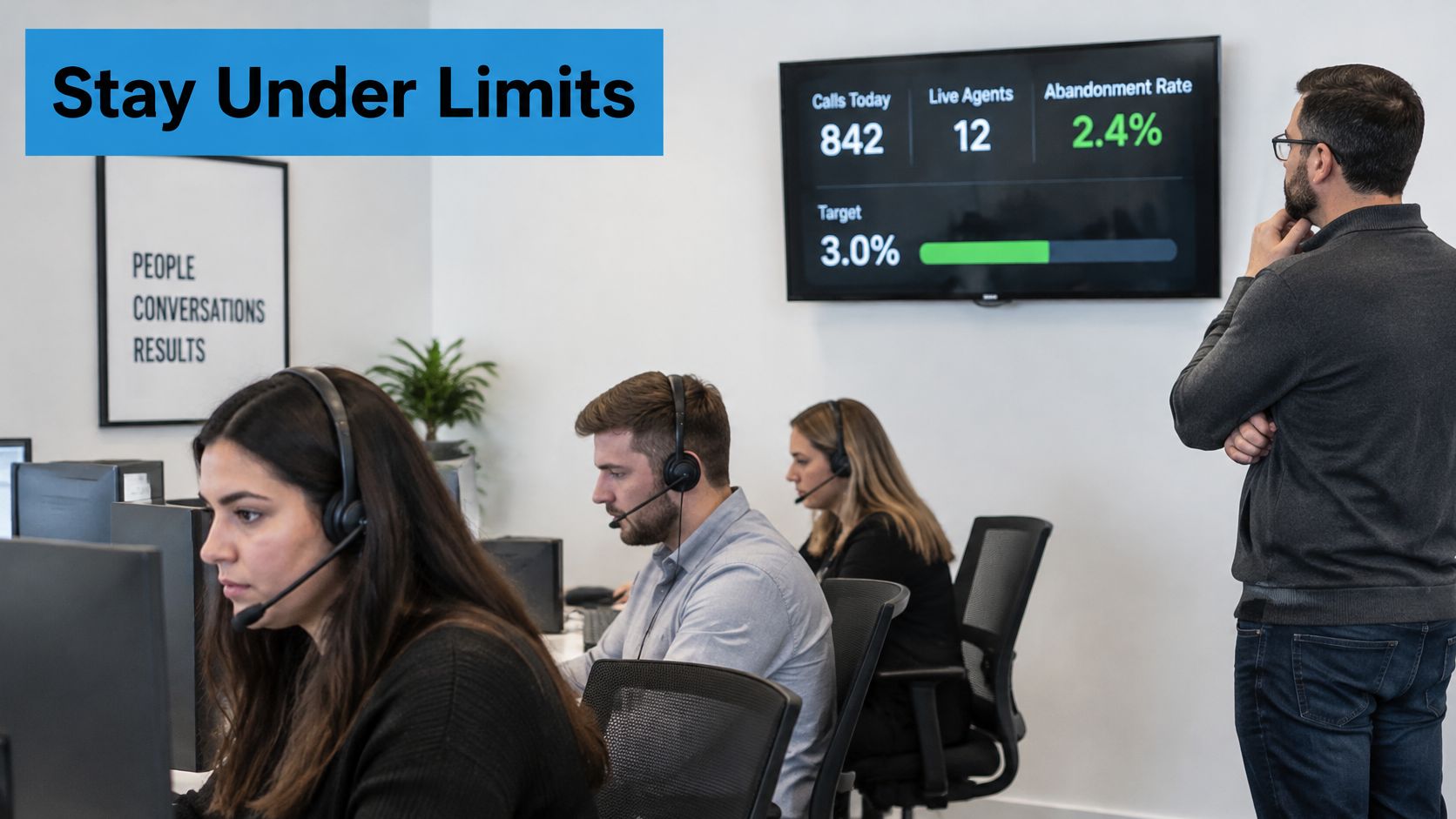
The FTC's Telemarketing Sales Rule compliance guide defines abandonment as failing to connect an answered outbound call to a sales representative within two seconds after the person finishes greeting; its safe-harbor conditions include abandonment at or below 3% of answered calls, measured per day and campaign, and ringing for at least 15 seconds or four rings. Meeting the percentage alone doesn't establish full compliance with every safe-harbor condition.
Staffing belongs in the campaign configuration. A dialer that creates more answered calls than representatives can handle is producing customer-facing failures, not useful efficiency.
Use the dashboard to manage available capacity, not just activity.
Match pacing to people
For an HVAC callback campaign, configure the ring duration to satisfy the applicable requirement and reserve staff for live answers. Then use this operating sequence:
- Count available representatives. Exclude people handling other queues, taking breaks, or finishing complex cases.
- Estimate recent answer rates. For a pilot, use the last three days where the audience and calling windows are comparable.
- Set a conservative pace. Account for conversation length and after-call work, not merely how many agents are logged in.
- Check early and repeatedly. Review abandonment after the first hour and each subsequent calling block.
- Throttle before the boundary. Reduce dialing when capacity tightens rather than allowing answered calls to wait in silence.
Review before increasing volume
A setting that works during a quiet afternoon may fail when the inbound queue fills during a busy morning. Give a named supervisor authority to pause the campaign without waiting for sales approval.
Keep abandonment reporting separate for each campaign. Before raising volume, review the daily report, staffing availability, and unresolved connection delays together.
Hand Off to a Human Before the Call Goes Wrong
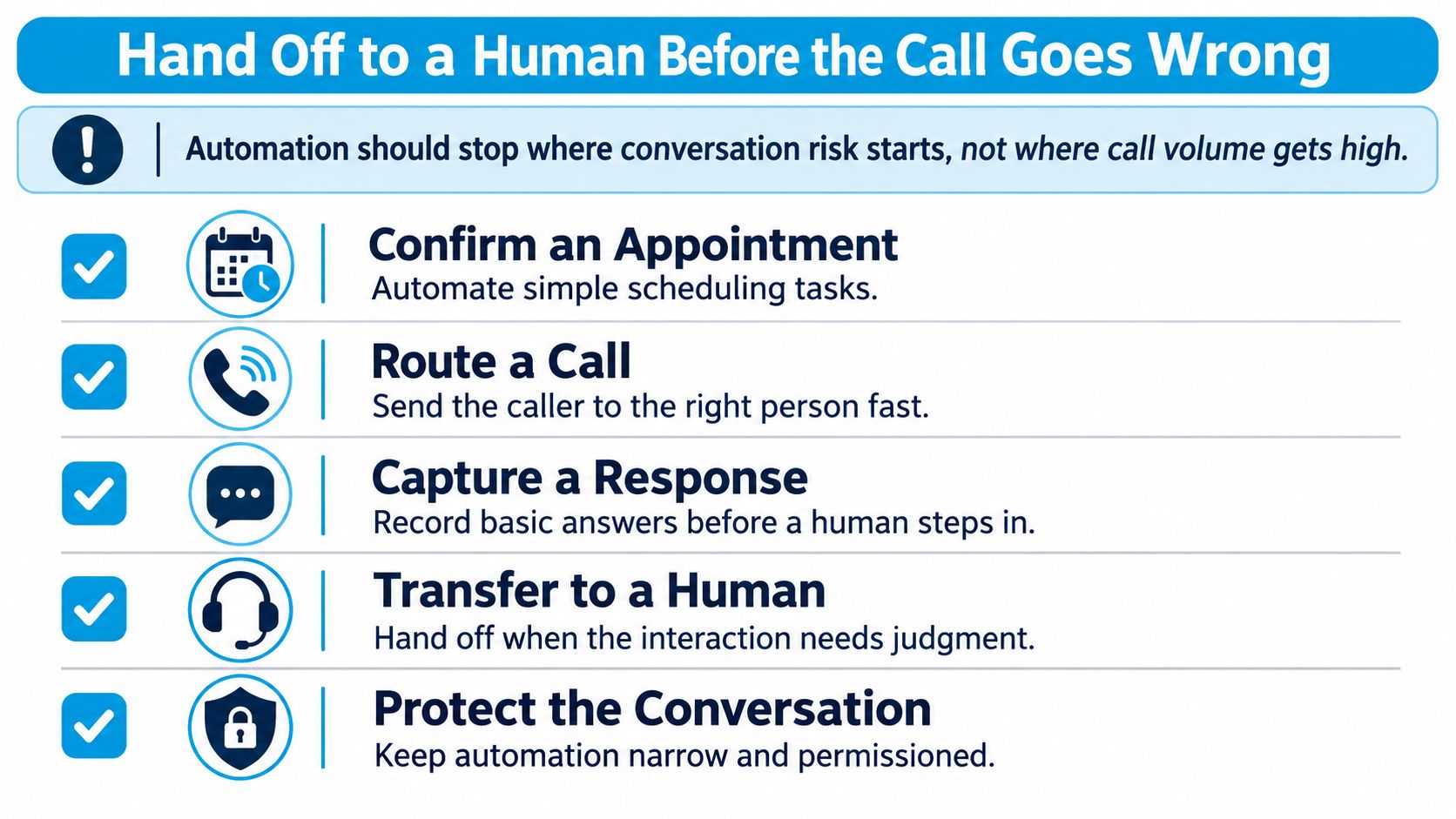
Automation should stop where conversation risk starts, not where call volume gets high. Confirming an appointment, routing a service request, or collecting a straightforward answer can fit a narrow, permissioned workflow. Interpreting symptoms, arguing about money, or assessing a legal claim does not.
The FTC's telemarketing guidance explains restrictions on most prerecorded telemarketing robocalls to consumers, required disclosures, and National Do Not Call protections. Automating a task doesn't remove those obligations.
Use this boundary when designing the conversation flow.
Write the handoff playbook
Each trigger needs an owner, a transfer target, and the information that person receives.
| Trigger | Human action | Transfer target | Context to pass |
|---|---|---|---|
| Distress | Listen and follow the appropriate safety procedure | Immediate priority routing | Stated concern and contact details |
| Disputed charge | Review the account without making unsupported promises | Billing team during the interaction | Charge identified and dispute summary |
| Medical or legal question | Route to an appropriately qualified professional | Prompt transfer or explicitly agreed callback | Exact question, without an automated judgment |
| Complaint | Acknowledge and investigate | Designated complaint owner | Requested resolution and prior actions |
| Complex purchase | Clarify requirements and explain options | Relevant specialist | Needs, constraints, and unanswered questions |
Say a law firm returns an intake request and the person describes a recent injury, then asks whether they have a case. Capture contact details, flag urgency, and transfer to intake, which can arrange an attorney's assessment. The automated workflow must not decide the case's merits.
Measure escalation as a designed outcome
Track transfer rate, unresolved-intent rate, opt-outs, complaints, booked outcomes, and revenue per connected conversation by segment. A higher transfer rate may mean the system is correctly recognizing difficult situations, not performing worse.
Our operating model connects every inbound call to a trained, professional human receptionist supported by advanced AI tools. When AI detects a need for something more nuanced, it hands off to a human receptionist following the business's playbook.
Pick Your First 30-Day Calling Test
Start with a scorecard that makes the launch decision auditable. Write each metric's definition, review frequency, and owner before the campaign begins.
The cold-calling reference points below are comparison aids, not promises for a requested-callback campaign. For the compliance threshold, configure an earlier internal warning so the team has time to reduce pacing.
Outbound calling scorecard
| Metric | What it measures | Check frequency | Benchmark |
|---|---|---|---|
| Dial-to-connect rate | Live connects divided by dials | Daily | 5.4% average, 13.3% top performers |
| Connect-to-meeting rate | Meetings divided by connected calls | Weekly | 4.6% average, 16.7% top performers |
| Abandonment rate | Abandoned calls divided by answered calls, per campaign | Daily | At or below 3% |
| Opt-out rate | Opt-outs divided by connected calls | Weekly | Set a segment baseline and investigate increases |
| Transfer rate | Calls handed to a human divided by AI-handled calls | Weekly | Set a target appropriate to conversation risk |
| Complaint rate | Complaints divided by total calls | Weekly | Review every complaint and investigate patterns |
Keep the first test narrow
Choose a vertical, a trigger, a script, and a cadence for a 30-day pilot. A web-form callback for a single service line is a useful starting point because the request timestamp gives you a clear speed-to-lead measure.
For a hypothetical HVAC pilot, define success before launch: acceptable booking performance, compliant abandonment, and no unresolved suppression failures. Review meetings weekly and connection problems daily, using call-detail reporting to connect outcomes to individual attempts.
Our inbound and outbound calls, messages, and configured actions may be logged for analytics, reporting, training, and quality control. Make sure the records needed for the test are included in the reporting configuration.
Write the decision before launch
On day 31, the owner should choose among expanding to another service line, changing a single variable such as the script or calling window, or stopping an unproductive campaign. Don't stop solely because a small callback sample falls below a cold-call benchmark; inspect qualification, bookings, and sample size together.
For launch logistics, each customer receives a dedicated local or toll-free number. Customers can forward existing calls to it or have their current business number ported to Recepta.ai completely free of charge.
Write down the decision criteria and the person authorized to act before the first dial.
Recepta.ai combines outbound appointment booking and follow-up with AI-supported human reception, configurable playbooks, and call reporting. Visit Recepta.ai to discuss a focused calling pilot built around your lead source, consent checks, booking goals, and human handoff triggers.