

Law Firm Receptionist: Duties, Skills and Hiring Options
The phone rings while your receptionist is checking in a client, an attorney wants a consultation moved, and someone on hold says they have court tomorrow. You need someone to keep the office moving, but you also need them to recognize which conversation can't stay at the front desk.
A law firm receptionist is the firm's first ethical triage point, not just its first friendly voice. The job is to capture enough information to arrange the right next step without collecting sensitive facts too early, disclosing client information, or drifting into legal advice. That distinction should shape the duties, training, and staffing model you choose.
Core Duties of a Law Firm Receptionist
Law firm receptionist duties and escalation points
| Duty | Typical example | Escalate to an attorney when |
|---|---|---|
| Call answering and routing | Greets the caller and transfers to the correct desk | Caller names an active matter or a court date |
| Message taking | Logs name, number, reason and best callback time | Message describes an arrest, injury or hearing |
| Scheduling | Books consultations and maintains attorney calendars | Consultation type or urgency is unclear |
| Client intake | Captures contact details, matter category and opposing parties | Caller asks for an opinion on liability or outcome |
| Document handling | Sends and receives forms, letters and filings | Document contains legal instructions or deadlines |
| Visitor services | Checks in clients, witnesses and couriers | Visitor raises a security or conflict concern |
| Records and billing support | Keeps case files organized and prepares invoices | Billing question involves a dispute or fee arrangement |
These duties reflect a broader administrative role than greeting visitors. O*NET's legal-secretarial task profile includes call handling, scheduling, correspondence, records, invoices, and assistance with legal documents and files.
The receptionist shouldn't interpret every document or interrupt an attorney for every existing-client call. Instead, give them a routing directory that distinguishes routine status requests, designated case-team messages, and matters requiring attorney attention. A court communication should never sit in an unassigned general inbox.
Why answering isn't enough
The U.S. Bureau of Labor Statistics places receptionists within a broad occupation encompassing approximately 947,500 U.S. jobs in 2025. Within a law firm, this person may be the first contact for prospective clients, courts, opposing counsel, and vendors, each requiring a different handling path.
In a 2024 Clio secret-shopper study of 500 law firms, only 40% answered phone inquiries and only 33% responded to email inquiries. Those findings make availability an obvious concern, but answering alone doesn't establish whether the caller reached the right person or received a usable next step.
A solo practice may combine reception, intake, billing support, and calendaring in one position. That can work, provided the attorney decides which task takes priority when calls and deadlines collide.
A mid-size firm may separate visitor services from prospective-client intake. A large firm may have a dedicated switchboard, reception team, and litigation support staff, making accurate transfers and handoff records more important than expecting everyone to do everything.
Practical rule: Write the handoff responsibility beside every duty. A task isn't covered until someone owns what happens next.
Before writing a job description, list the duties your firm needs covered, including the work currently landing on attorneys' desks.
Skills and Training That Make a Strong Receptionist
A high-school diploma or equivalent is the typical entry-level education baseline for receptionist work. For a legal office, hire first for communication, organization, discretion, and office-system proficiency, then train the firm's procedures.
Candidates don't need to arrive knowing how your practice manages every matter. They do need to listen accurately, follow boundaries, and ask for help before improvising.
What good performance sounds like
- Calm phone manner. An upset caller needs acknowledgment, not reassurance about the legal outcome. The receptionist can say they'll record the concern and contact the appropriate person without promising the attorney will accept the matter. Training in empathy in customer service helps distinguish understanding someone's distress from agreeing with their legal position.
- Accurate note-taking. Spell back names, repeat telephone numbers, and confirm dates. Record what the caller said rather than converting it into a legal conclusion.
- Calendar control. Check attorney availability, consultation type, time zone, and required preparation before booking. A visible opening isn't necessarily an approved consultation slot.
- Judgment about boundaries. A strong candidate recognizes when a question belongs with an attorney instead of filling silence with an answer.
- System confidence. Test whether the candidate can enter a structured note, transfer a call, send an approved e-signature request, and locate an appointment without exposing another client's information.
HiredBySkill's resource on customer-facing opportunities for nondegree talent is useful when broadening the candidate pool beyond applicants with legal-office credentials. Assess transferable service skills, then test legal-specific restraint separately.
The vocabulary requirement is recognition, not interpretation. A receptionist should recognize deposition, hearing, subpoena, and statute of limitations well enough to flag the issue, without explaining what the caller must do.
Run a practical hiring test
Use a 20-minute role play with three hypothetical calls: someone asking whether they have a case, someone saying a hearing is tomorrow, and someone asking for a partner who's out of the office. Give the candidate a short routing sheet and access to a sample calendar.
Score the notes, transfer choice, promises made, and next action. Don't reward confident improvisation when the correct response is a handoff.
The hardest skill isn't learning the greeting. It's knowing when to stop talking.
Teach confidentiality and conflict procedures from the start, then reinforce that stopping skill through reviewed practice calls.
Confidentiality and the Intake Procedure From First Call to Handoff
Treat every caller's information as potentially confidential, including inquiries from people the firm never represents. Don't assume that someone's willingness to tell a story makes it appropriate to collect, circulate, or retain every detail.
ABA Model Rule 1.6 protects information relating to a representation broadly, not only privileged communications, and requires reasonable efforts to prevent unauthorized access or inadvertent disclosure. Prospective-client information also requires careful handling, even when the firm ultimately declines the inquiry.
A private workspace and controlled records matter as much as the script.

Use a conflict-first intake sequence
GB Advisors' law-firm intake guidance recommends identifying the parties and checking conflicts before gathering detailed facts. Put that order into the form itself, rather than relying on a receptionist to remember it during a difficult call.
- Answer promptly and explain the boundary. Use an attorney-approved disclosure stating that this is administrative intake, not legal advice, and that speaking with reception doesn't establish representation.
- Verify identity and record consent. Apply the firm's verification procedure before sharing existing-client information. Explain the intended information collection and record the caller's consent; address recording separately under applicable rules if the call will be recorded.
- Capture basic contact information. Record the caller's name, organization, contact details, and preferred follow-up channel. Ask whether it's safe to leave a message and whether any contact method should be avoided.
- Identify the relevant parties. Collect opposing parties and other identifying names. For a construction dispute, that may include the employer, project owner, contractor, and entities named in the contract.
- Complete the conflict check. Use the firm's approved system and designated reviewer. If a potential conflict appears, stop substantive questioning and route the inquiry for review; don't announce a conclusion or reveal another client's identity.
- Collect a limited matter summary. Only after clearance to proceed, ask for a high-level description, location, and any stated deadlines. Don't invite a full chronology or document upload merely because the form has room.
- Recognize urgent triggers. A hearing tomorrow, arrest, eviction, custody emergency, domestic-violence risk, or active threat requires immediate routing to a trained person under the firm's policy. Record the caller's stated urgency without deciding the legal merits.
- Create and confirm the handoff. Save a timestamped record with the inquiry source, responsible recipient, and next action. Tell the caller what will happen next, through which channel, and within the approved callback window.
The stopping rule belongs beside the script: collecting contact and conflict details is appropriate; evaluating liability, predicting outcomes, interpreting deadlines, recommending strategy, or promising representation is not. When the caller asks for an opinion, stop the questionnaire and hand off.
Collect less before the firm can proceed
Gate narrative fields until conflict fields are complete, and require clearance before detailed fact collection. Merely entering opposing-party names shouldn't allow unrestricted questioning if the conflict review is still pending.
For a family-law practice, SimpleLab Digital's attorney intake process for family leads can help organize practice-specific questions. Have the supervising attorney approve their sequence, particularly where safe contact methods, children, or urgent hearings are involved.
Consider an injury caller who asks whether the firm already represents the opposing driver. The receptionist should record the question and route it to designated staff, neither confirming nor denying representation.
Don't discuss the inquiry across an open lobby, store details in personal text messages, or leave handwritten notes beside a public-facing monitor. Use approved systems and restrict the record to staff who need it.
Stop collecting when the next question needs legal judgment. A shorter, properly routed intake is better than a complete questionnaire the firm shouldn't have collected.
Build the handoff into the law-firm client intake workflow, including who accepts the record and what happens if that person is unavailable. A receptionist shouldn't have to choose between continuing an unsafe conversation and abandoning the caller.
Workflow Examples and Response Metrics by Practice Area
A useful reception workflow produces a visible next action, not just a pleasant call. These hypothetical examples show how timing and escalation should differ by matter.
The receptionist needs access to the approved queue while speaking with the caller.
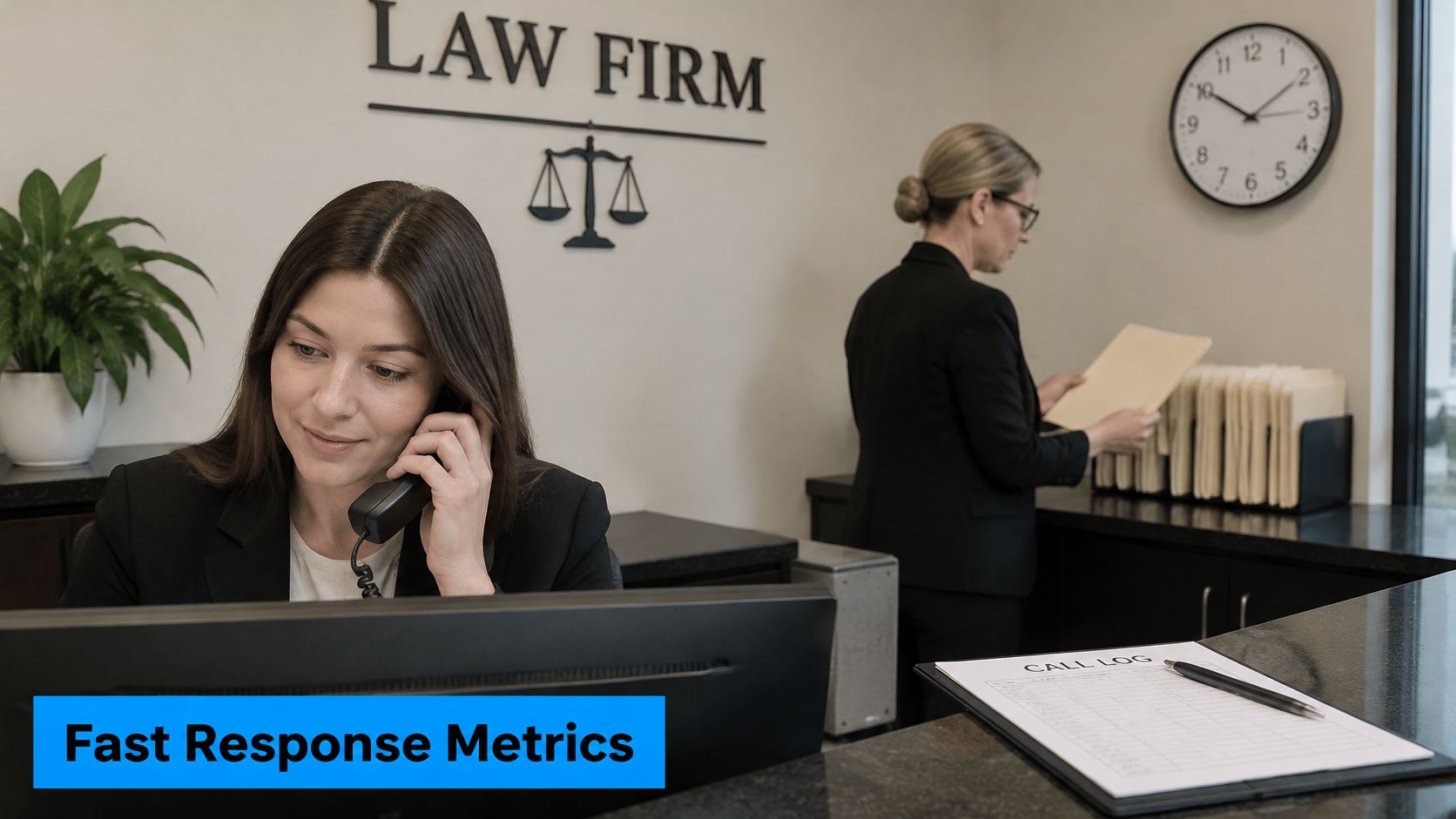
Two calls with different next actions
Personal injury, after hours. At 19:40, a caller reports an accident the previous day. In this scenario, the receptionist verifies identity, obtains the required clearance for the driver and insurer, and finds no stated emergency or deadline trigger under the approved script.
The receptionist books an authorized consultation for 09:00 the next morning and sends the approved document request by 19:55. They don't tell the caller that waiting is legally safe or that the firm will take the case.
Family law, late afternoon. At 16:10, a caller says a hearing starts tomorrow. The receptionist records the court and date and escalates to the on-call attorney within five minutes, without saying the firm will appear.
For a construction inquiry, apply the party-identification sequence before opening a substantive dispute narrative. The practice area changes the questions, not the need for controlled intake.
Measure follow-through, not just pickup
Prospective client response benchmarks
The following figures come from Clio's earlier Legal Trends findings on client inquiries.
| Benchmark | Share |
|---|---|
| Prospective clients expecting a response within 24 hours | 79% |
| Firms that answered phone calls | 56% |
| Firms that sent callers to voicemail | 39% |
| Voicemail messages not returned within 72 hours | 57% |
Track answer rate, abandonment rate, median first-response time, intake-field completion, appointment-booking rate, and callbacks completed within the promised window. Separate new inquiries from existing-client calls so routine service traffic doesn't obscure intake failures.
Use first-call resolution carefully: for reception, successful resolution may mean a correct transfer or confirmed callback, not answering the legal question.
Use this video alongside a review of your own routing procedure.
During a weekly review, pull call-log metrics, examine five escalated calls, and confirm each queue's callback deadline. Flag arrests, filing deadlines, injuries, evictions, and imminent hearings for same-day attorney review, with immediate routing where urgency demands it; place routine consultations in a defined callback queue.
Hiring In-House, Outsourcing or Adding AI Coverage
Staffing models for law firm reception
| Model | Cost basis | Hours covered | Confidentiality control | Best fit |
|---|---|---|---|---|
| In-house receptionist | Salary benchmark plus benefits and coverage costs | Business hours, with cover gaps | Direct supervision and training | Steady daytime call volume |
| Outsourced human receptionist | Request a written quote for contracted hours, usage, and extras | Extended hours, set by contract | Contract terms and access controls | Evening cover without new hires |
| AI receptionist platform | Request a written quote for platform, usage, and integrations | 24/7 when configured | Configured data handling and audit logs | Routine scheduling and after-hours lead capture |
| Hybrid AI with human escalation | Request a written quote including human handoff charges | 24/7, with human availability confirmed in the agreement | AI and trained agents follow the firm's playbook | High call volume with potentially urgent matters |
The legal-services median annual wage for receptionists and information clerks was $41,600 in May 2025, according to LawFirmHires' analysis of U.S. Bureau of Labor Statistics data. That's a wage benchmark, not the complete employment cost: budget separately for benefits, training, sick cover, and holiday cover.
An in-house employee can manage visitors and learn attorney preferences, but can't answer every simultaneous call or cover every absence. Outsourced reception extends availability, while introducing another team that needs controlled access and explicit instructions.
Match coverage to the calls
Choose using three inputs:
- After-hours demand. Count calls outside business hours, separating useful inquiries from spam and routine vendor traffic.
- Urgency mix. Identify how often callers need immediate human attention rather than scheduling.
- Conflict-checked intake volume. Count prospective matters requiring review, not just total calls.
AI can handle routine scheduling and lead capture, but unattended escalation failures remain the firm's problem. We offer Recepta.ai's Hybrid Receptionist service, with AI handling high-volume routine conversations and trained agents handling complex situations.
Compare alternatives using a lawyer answering-service evaluation that includes handoff tests, not just greeting quality. Request written quotes for every outsourced, AI, and hybrid option; don't invent per-call costs from a headline subscription.
Keep supervision in the contract
ABA Rule 5.3 requires supervision of nonlawyer assistance, and using technology doesn't remove the lawyer's professional obligations; the ABA's discussion of technology and legal ethics addresses those responsibilities.
Write data-retention terms, audit-log access, and deletion on termination into contracts. Use individual accounts, minimum necessary permissions, and prompt access removal, consistent with Legal 500's guidance on outsourced reception risks.
If exploring Sickle's give agent access to inbox capability, define the permitted mailbox and actions before connecting anything. Inbox access should never become unrestricted access to client files merely because integration is convenient.
Confirm Your Intake Plan Before You Hire
Turn the duties table into a working checklist. Mark each task routine, supervised administrative work, or attorney-only, then identify who currently owns it and where coverage breaks down.
Match staffing to the call pattern: in-house reception for steady daytime work, outsourced or AI coverage for after-hours gaps, and a hybrid model when urgent matters require human escalation outside office hours. Don't buy full-time replacement capacity if overflow is the actual problem.
Require evidence before signing
Before hiring or contracting, confirm:
- A written escalation policy naming the primary recipient, backup, and response deadline.
- A conflict-check checkpoint before substantive questions.
- An access-removal procedure for departing staff and vendors.
- A sample intake log showing timestamps, ownership, and next actions.
Test a provider against that checklist during a trial, including an unavailable attorney and an interrupted call. Obtain written quotes for the non-salary options before comparing total costs.
This week, pull two weeks of call logs and count after-hours and urgent calls. Use that count to decide which coverage gap to fix first, then test whether the proposed solution produces a safe, accountable handoff.
Recepta.ai provides confidential inbound and outbound call handling and client support for law firms, with AI handling routine conversations and trained agents handling complex situations. A receptionist can be created in 15 minutes and receive calls immediately after setup, but approve your intake boundaries and escalation policy before launch. Visit Recepta.ai to explore coverage against your firm's intake checklist.