
High Call Volumes: What They Cost and How to Handle Them

About 1.5 million NHS 111 calls went unanswered in March 2020, when the service received approximately 3 million calls, according to the HSSIB investigation into its pandemic response. That's more than a staffing statistic. It's a measure of people who tried to reach a service and couldn't, which is the most useful starting point for understanding high call volumes.
Why Peak Call Volume Costs More Than You Think
Say a plumbing firm's phones ring continuously after a Monday morning storm. The dispatcher is arranging emergency visits, technicians are calling for job details, and new customers are waiting behind routine invoice questions. Everyone is working, but some callers still get no help.
High call volume starts when incoming demand exceeds the people and systems available to handle it. It isn't a fixed number of calls. A small office can be overloaded while a larger operation handles substantially more traffic without difficulty.
When a manageable channel becomes a bottleneck
The NHS 111 investigation described weekly demand increasing from approximately 300,000–350,000 calls to about 800,000 in March 2020. Public uncertainty, urgent health questions and remote triage needs converged on the same telephone channel.
A local business shouldn't use a national healthcare crisis to forecast its own missed-call rate. The transferable lesson is narrower: normal coverage doesn't establish readiness for a sudden surge.
The costs show up in distinct ways:
- Longer waits: Callers spend more time trying to reach someone who can act.
- Abandoned calls: People leave before the business learns what they need.
- Staff pressure: Employees must choose between answering new calls and completing existing work.
For the plumbing firm, an unanswered emergency inquiry might become a competitor's job. A routine billing callback can wait; an active leak usually can't.
Operational priority: Protect time-sensitive access before trying to make every queue move equally fast.
A sensible call center cost reduction strategy therefore considers unresolved demand alongside payroll. Use reference values to identify warning signs, then examine response times, call outcomes and peak-period coverage before deciding whether to hire, change routing or add overflow intake.
Benchmarks That Show Your Phones Are Overloaded
Reference values for high call volume
Use these figures as diagnostic reference points, not universal service targets. For an internal audit, flag a benchmark when performance is worse for two or more hours in a day. That is a proposed operating trigger, not a published industry standard.
| Benchmark | Reference value | Source | What it signals |
|---|---|---|---|
| Mobile customer queue wait, UK 2022 | 2 min 23 s, up from 2 min 15 s in 2021 | Ofcom customer-service report | Waits lengthening year on year |
| Broadband and landline queue wait, UK 2022 | 2 min 37 s, up from 2 min 16 s in 2021 | Ofcom | Longer waits than mobile in this comparison |
| Calls answered within 30 seconds, reviewed VA centers, FY2024 | 57% | VA Office of Inspector General review | A substantial share didn't receive a response within the checkpoint |
| Calls not answered, VA facilities, FY2024 | About 10%, approximately 222,000 of 2.3 million | VA Office of Inspector General | Capacity gap at national scale |
| Scheduling abandonment, VA facilities | About 11% | VA Office of Inspector General | Callers leave the scheduling queue before reaching staff |
| Calls missed during business hours, medical practices | 42% | PerfectServe discussion of a study across 22 practices in 18 states | About 84 missed calls daily for a hypothetical practice taking 200 calls |
| Patients abandoning a call after 90 seconds | About 60% | Healthcare call-volume figures cited by Solutionreach | A useful checkpoint for examining caller departures |
Read these as warning signs, not service targets
The figures describe different populations: telecommunications customers, veterans seeking services and medical-practice callers. Their needs and call paths differ, so the benchmarks identify performance to investigate rather than acceptable service levels for every business.
The Ofcom comparison shows that queue waits increased year on year. An average, however, cannot show whether callers with urgent needs experienced the longest delays.
The VA review reports separate measures for response speed, unanswered calls and scheduling abandonment. Keep them distinct: a call answered after 30 seconds is not necessarily unanswered or abandoned. The patient-abandonment figure is secondary healthcare material, best used as a diagnostic prompt rather than a universal prediction.
Compare matching hours
Compare your busiest periods with the closest available reference, using the same type of call and outcome. A monthly average can conceal when demand peaks and callers struggle to reach someone.
For technical ideas to investigate alongside staffing, Faberwork LLC's telecom solution success stories offer examples of implementation approaches. They do not replace measuring your own queue.
If performance remains worse than a reference for several hours each week, investigate whether demand is exceeding available access or whether routing is keeping callers from the right response.
Key Metrics to Track Beyond Total Calls
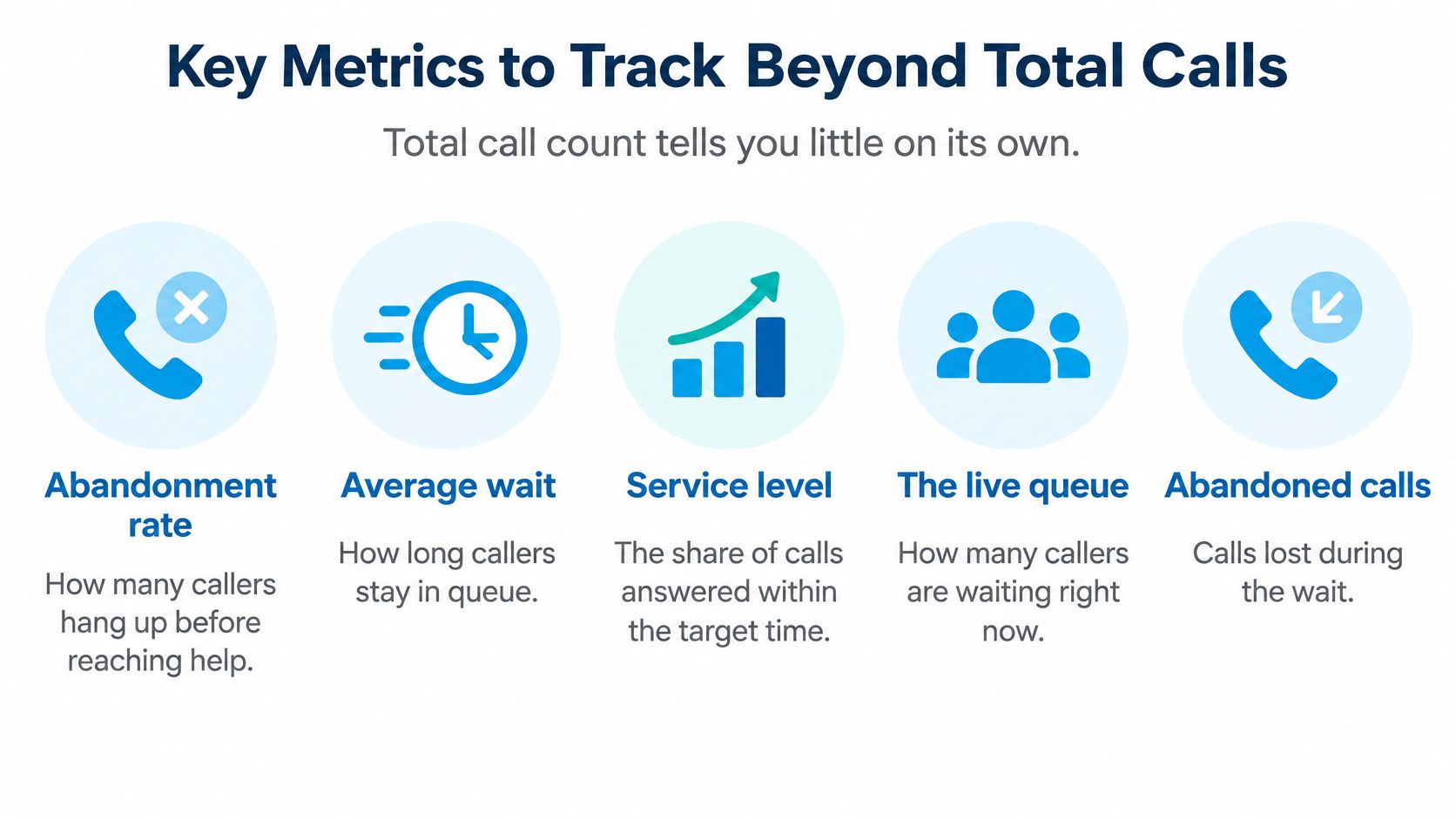
Total call count tells you little on its own. A manager needs to know whether callers reached help, how long that took and whether the interaction produced a useful result.
Call metrics, how to calculate them and how often to review
| Metric | How to calculate it | Why it matters | Review cadence |
|---|---|---|---|
| Abandonment rate | Abandoned calls divided by total calls offered | Shows callers lost while waiting | Daily, by hour |
| Average wait time | Total queue time for answered calls divided by calls answered | Averages can conceal long waits | Weekly |
| Service level | Calls answered within the staffing plan's written target divided by total calls offered | Tests responsiveness against a defined commitment | Daily |
| Live answer, voicemail and no-response split | Each outcome divided by total calls | Distinguishes staffing gaps from possible routing failures | Weekly |
| Occupancy | Handle time divided by logged-in time | Shows available buffer; use the staffing plan's below-85% ceiling | Weekly |
| Booked appointments or qualified leads per 100 calls | Outcomes divided by calls, multiplied by 100 | Connects handling activity with commercial outcomes | Monthly |
| Callback completion time | Time from missed call to return call | Measures how quickly staff attempt recovery | Daily |
Treat the occupancy ceiling as a planning choice supported by the staffing example below, not a universal legal or contractual limit. Also distinguish a return-call attempt from successful contact: a quick unanswered outbound call hasn't recovered the inquiry.
Separate the ways callers fail to reach help
A 2024 analysis published by Aira covering 85 businesses across 58 industries found 37.8% of incoming calls reached a live person, 37.8% went to voicemail and 24.3% received neither an answer nor a voicemail option. Applied to a hypothetical hundred-call period, that distribution leaves roughly sixty-two callers without a live answer, including about twenty-four unable to leave a message.
Those are different recovery problems. For an emergency plumbing inquiry, monitored voicemail at least creates a message to act on; no response may leave staff without the caller's reason for contacting them.
Build a usable event log
Log timestamps for arrival, queue entry, answer, departure, transfer and callback. Add reason, caller type, assigned owner and disposition, using appropriate access controls for sensitive information.
Every inbound and outbound call, message and configured action may be logged for analytics, reporting, training and quality control. Recording and transcription are separate choices, not prerequisites for basic event reporting.
Use consistent average handle time definitions so talk time and after-call work aren't confused. Review abandonment, service level and callbacks daily; occupancy and outcome splits weekly; bookings and qualified leads monthly. Alongside averages, inspect the share exceeding your written wait threshold.
Root Causes Behind Spikes and Abandoned Calls
Diagnose the mismatch before buying capacity. A schedule gap, slow workflow, poorly designed queue and inaccessible alternative channel require different remedies.
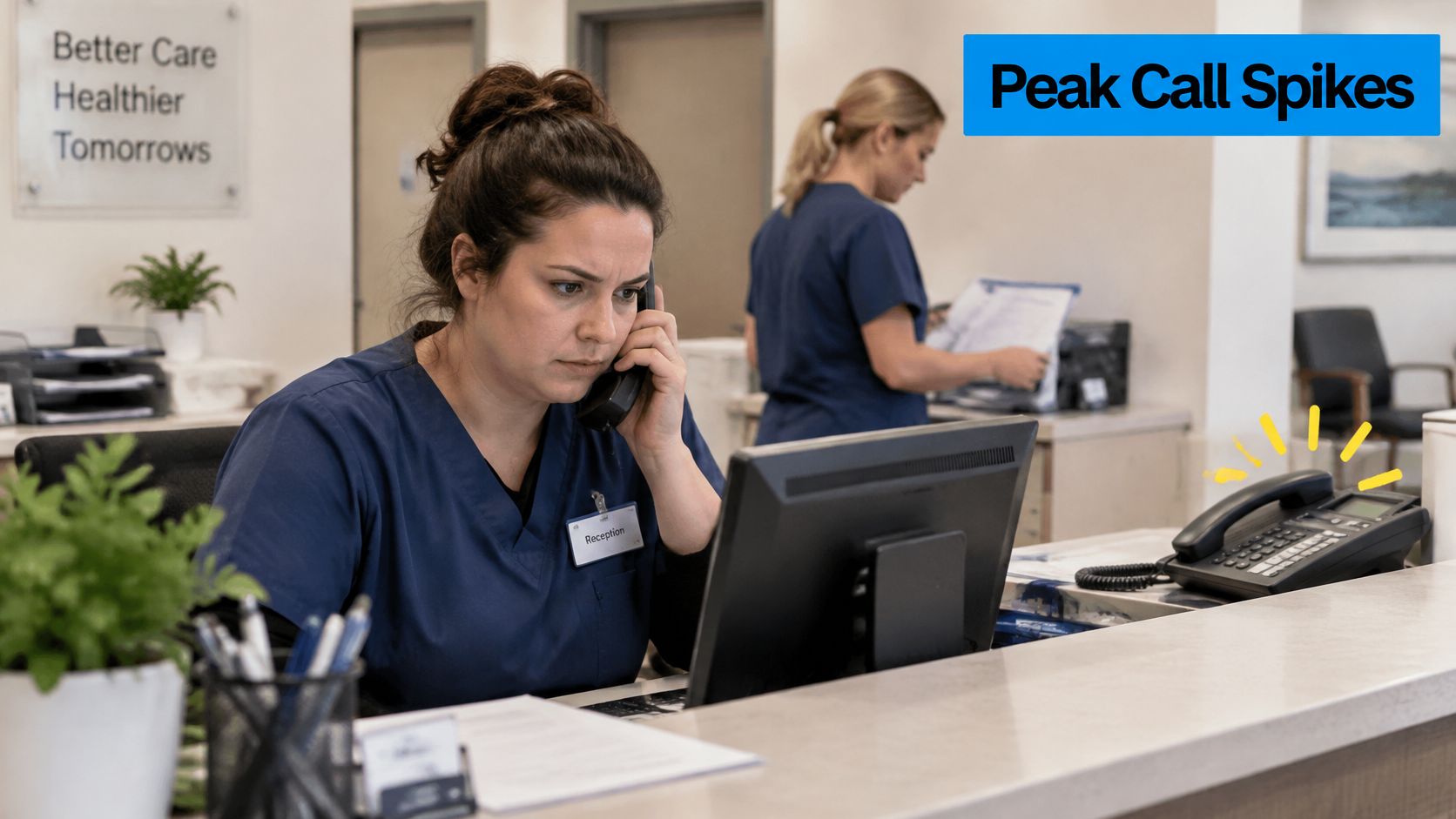
The front desk is where these problems meet.
Predictable peaks and handle-time creep
Time-based gaps occur when staffing hours don't match demand. Lunch coverage, late-day inquiries and the morning after a storm are sensible windows to investigate. Healthcare call-volume material also identifies late-afternoon and early-evening demand and calls outside normal office hours; those patterns are hypotheses to test against your own logs, not assumptions to impose on every business.
Ask: Do missed calls cluster when coverage drops? If they do, move breaks or add overflow during that window before expanding the entire schedule.
Process-based gaps arise when handling work takes longer than planned. Say a legal receptionist must search disconnected calendars before confirming a consultation. Adding phones won't remove that search.
Ask whether calls of the same type now require more talk, hold or administrative time. Examine the workflow before telling employees to finish conversations faster.
Routing gaps and unequal access
An unclear routing structure sends different needs through the same path. A symptom question, payment query and appointment request shouldn't automatically receive identical treatment. Clinical urgency rules must come from the practice's approved protocol, not a receptionist's improvised judgment.
An access barrier appears when the proposed alternative isn't usable. Someone who can't use a portal still needs a workable telephone route.
The Care Quality Commission's responsive-care findings include a practice reporting more than one in eight calls abandoned and another where 33% of patients said telephone contact was easy, against a 53% national average. These are separate practice examples, not measurements from a single population.
Use the video below as a discussion prompt when reviewing the caller journey with your team.
Ask whether the gap is routing-based or access-based. Review departures by time, reason, language needs and caller group where collecting that information is appropriate.
Fewer telephone calls aren't necessarily better access. Check whether people resolved their needs or simply stopped trying.
Offer self-service for avoidable administrative demand without making it the only route to essential human contact.
How to Staff and Route Calls for Peak Periods
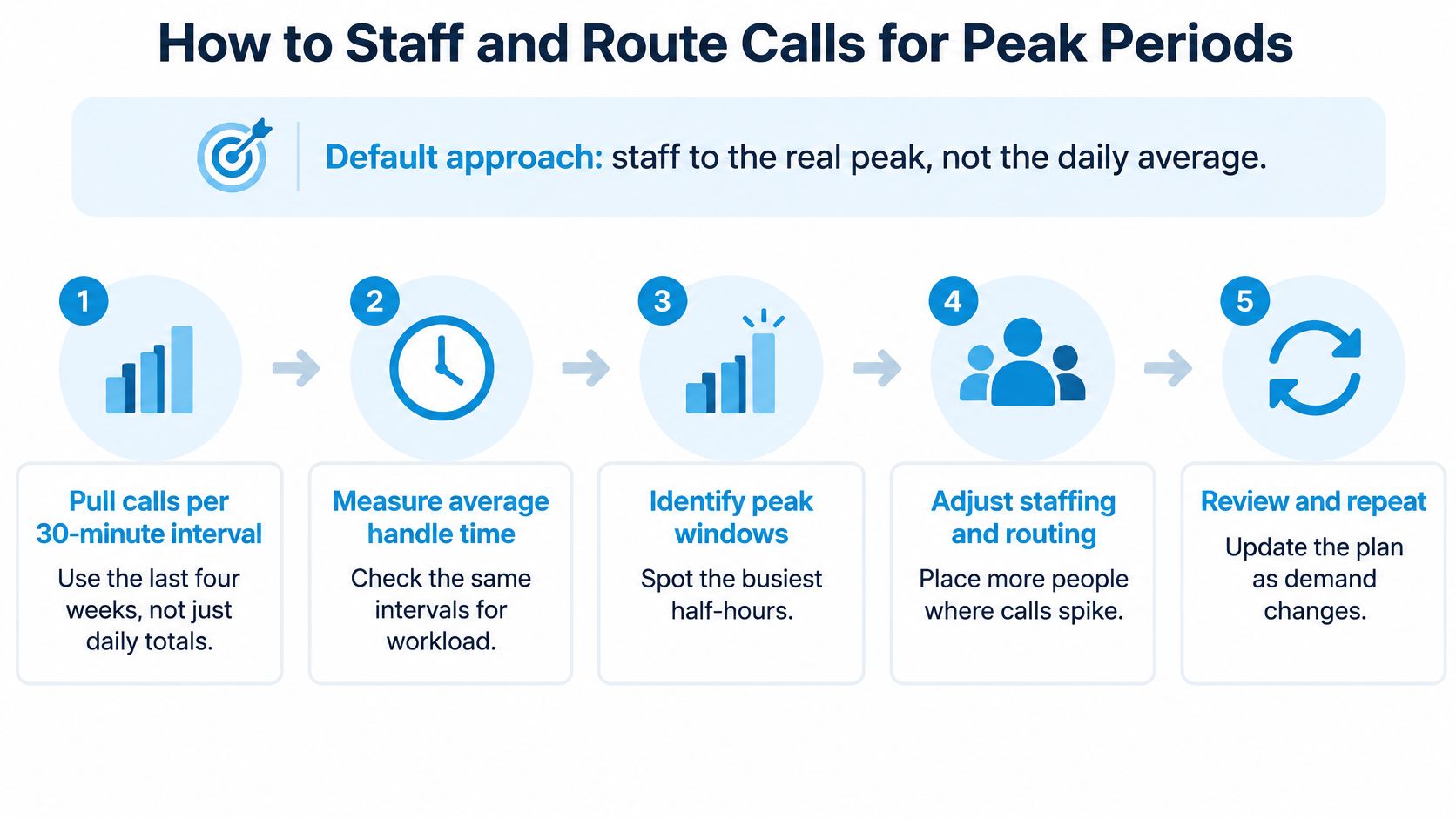
Staff to meet peak demand, not the daily average. Start with interval-level demand, then account for handling work, available people and the routing rules that determine who receives each call.
Build the staffing calculation
Pull interval demand. For a practical first exercise, export the last four weeks in half-hour blocks and flag storms, promotions, closures and outages. The common slip is dividing daily calls evenly across opening hours, which removes the peak you're trying to cover.
Measure average handle time for those same intervals, including after-call work. A booking isn't finished when the caller hangs up if the receptionist still needs to update the calendar; excluding that work understates workload.
Write the service target before calculating staffing. Specify both the proportion to answer and the allowed wait, plus what happens when the target is missed. A vague promise to answer quickly can't guide scheduling or escalation.
Calculate the busiest interval's requirement. In Lorikeet's high-volume staffing example, 400 calls in 30 minutes under an 80/20 target required 74 agents at 90% occupancy, while keeping occupancy below 85% required 79 agents. The target means answering eighty percent within twenty seconds; the example demonstrates the extra capacity needed for a buffer, not a headcount ratio a small office should copy.
A queueing calculator can support this exercise, but its assumptions matter. Account separately for breaks, training and other time when scheduled employees aren't available to answer.
Put coverage where callers need it
Add coverage to the overloaded windows. Move suitable administrative tasks away from those periods, stagger breaks or arrange defined overflow shifts. Hiring a full-time employee for a short recurring gap can leave you paying for unused quiet-period capacity.
Route by urgency first, then commercial priority. Give approved urgent categories and time-sensitive cancellations a live path, use routine intake for straightforward bookings, and assign callbacks according to need and agreed business rules. Intelligent call routing starts with explicit categories, not merely sending calls to whoever is free.
Recheck after a two-week trial. Compare abandonment and service level in matching windows, and inspect unresolved callbacks before expanding the change. Treat this as a proposed review cycle, not evidence that every intervention produces results within that period.
- Time-based: Coverage wasn't available when callers arrived.
- Process-based: Staff spent too long completing the necessary work.
- Routing-based: The caller reached the wrong queue or recipient.
- Access-based: The available route didn't meet the caller's communication needs.
For a rental operation assessing coverage outside local office hours, CS Outsource's remote customer support for rental hosts is a relevant service model to examine. Define who handles lockouts, maintenance reports and routine guest questions before assigning work externally.
Automated Reception and Human Handoff Options
Compare intake options against three questions: Can it receive peak demand, can it escalate urgent needs, and what happens when the first response doesn't resolve the request? Receiving a call and helping the caller are different capabilities.
Call intake options compared
| Option | Handles spikes | Escalates urgent calls | Main risk |
|---|---|---|---|
| Voicemail only | Yes, as message intake, but no live answer | No | Callers hang up or don't call back |
| Callback queue | Partly | Only if prioritized | Delayed response to high-intent leads |
| Extra in-house staff | Only during scheduled shifts | Yes, under approved procedures | Idle cost outside peak periods |
| AI answering with live handoff | Yes, around the clock when configured for that coverage | Yes, through the playbook | Misrouting if rules are thin |
Choose for the failure you need to prevent
Voicemail only suits nonurgent messages when someone owns the follow-up queue. It's the wrong primary route for emergencies because callers can't assume anyone will hear the message promptly.
A callback queue suits callers who can wait without losing access to the service they need. It's a poor choice when staff can't honor the promised window or when urgent and routine requests remain indistinguishable.
Extra in-house staff suit work requiring local knowledge, judgment or access to internal systems. A permanent hire is harder to justify for a brief daily spike unless the employee has useful work outside that window.
For businesses evaluating a remote human role instead, Virtustant's virtual receptionist description provides another staffing model to consider. Compare responsibilities and coverage rather than treating all reception services as equivalent.

Test the handoff before relying on automation
AI answering with live handoff suits repeatable intake where the business can define what the system should collect, resolve and escalate. It's the wrong choice if nobody has established who receives nuanced calls or what happens when that person is unavailable.
At Recepta.ai, our Hybrid Receptionist service uses AI for high-volume, routine conversations and trained agents for complex situations. Calls are answered within seconds at any hour, and when the AI detects a need for more nuanced assistance, it hands off to a human receptionist following the business's playbook.
Evaluate an AI answering service with realistic scenarios: an unclear request, an upset caller and an urgent issue arriving when the usual contact is unavailable.
Access test: After a transfer, the caller shouldn't have to repeat information already collected, and there should be a clear route to a person.
Check whether staff receive the reason, relevant details and actions already attempted. A quick greeting doesn't establish a successful handoff.
Run a Call Audit Before Your Next Peak
Audit your call handling before the next busy period, not after another queue failure. Use a proposed seven-day review to identify where callers lose access and who is responsible for recovering their requests.
Start with the call log rather than staff impressions. Calculate abandonment, service level, the live-answer split and occupancy for each hour, using consistent definitions. Keep callback attempts and successful contact separate so an outbound dial doesn't automatically count as a recovered inquiry.
Turn exceptions into decisions
Create a short exception sheet with the affected window, breached threshold, caller reason and assigned owner. Compare matching hours with the reference table, while keeping your own written service commitment as the operating target.
Classify each exception before selecting a response:
Choose one focused intervention for the worst recurring window. That might mean overflow coverage, a prioritized callback rule or routine automated intake with a live path for urgent requests. Avoid changing every variable at once, because you'll struggle to identify which change helped.
Make someone accountable for recovery
Assign a named owner to unresolved inquiries and set the next action before closing the daily review. Reassess after the trial period using comparable hours, call reasons and completed outcomes, not just a higher answer count.
If you have no spare staff, a short scoping conversation can establish the coverage gap. Our pricing process begins with a 15-minute call about your volume, hours and desired customer experience, and you hear the AI live during that conversation.
Measure the busiest hour first, then staff and route for it.
Recepta.ai combines routine AI call handling with human support for situations that need judgment, helping businesses cover peak periods without treating every inquiry alike. Visit Recepta.ai to discuss your busiest call windows and hear the AI live; plans are shaped around your call and chat volume so you don't pay for capacity you don't use.