
Outsourced Legal Intake Explained for Law Firms

It's 6:40 on a Tuesday evening and your office is dark. A woman who was rear-ended last week fills in the contact form on your website, hits send, and waits. Nobody sees the inquiry until Thursday morning, by which point she has spoken to two other firms and signed with one of them. You never learn her name, and nothing in your monthly report records that she ever existed.
That gap is what outsourced legal intake addresses. Not the calls you answer badly, but the ones nobody answers at all, plus the ones answered so slowly that the caller has already moved on. Treat it as a staffing shortcut and you'll buy an answering service and wonder why signed matters don't move. Treat it as a governance decision, about which tasks leave the firm, who supervises them and how you prove the return, and it becomes one of the few operational changes that shows up directly in revenue.
What Outsourced Legal Intake Covers and What It Cannot
An agent answers on the second ring. The caller says her collision happened last Tuesday, gives the other driver's name, and asks whether she is still allowed to claim. The agent records the date, the name, the matter type and the callback window. She does not answer the question about the deadline. She books a 9:15 call with the duty attorney and flags the file as time-sensitive.
That exchange shows the division of labour clearly. The provider owns first contact, data capture and routing. Your lawyers own judgment. Everything between those two points belongs in a written scope before you sign a contract, because outsourcing intake is a risk-allocation decision as much as a staffing decision. The right provider can capture missed opportunities and reduce leakage from unanswered calls. The wrong one creates exposure by letting non-lawyers drift into legal judgment.
Intake tasks by who performs them
| Intake task | Handled by | Outsourced? |
|---|---|---|
| Answer calls and web inquiries around the clock | Provider agent | Yes |
| Answer routine questions on hours, location and fees | Provider, from approved script | Yes |
| Collect contact details and matter basics | Provider | Yes |
| Book consultations on the attorney calendar | Provider | Yes |
| Answer substantive legal questions or deadlines | Attorney | No |
| Judge case value or recommend strategy | Attorney | No |
| Decide conflicts and accept or decline matters | Attorney | No |
The left column is administrative work a trained agent can complete from a script. The right column needs a licence, a conflict database and a decision the firm answers for. A provider that blurs that line, or a script that invites an agent to reassure a caller about her case, creates a problem you cannot fix once the call ends.
The design guidance behind the split is specific. Build intake as a controlled triage and data-capture process. Collect only what conflict screening and routing require, keep scripted boundaries around legal opinion, and leave an auditable trail of timestamps, disclosures, routing decisions and the final accept or decline. The BARBRI session on intake ethics, conflicts and confidentiality walks through the same three-part principle, and it is worth an hour before you write your own script.
Practical rule: if an agent would have to interpret the law to answer, the answer does not belong in the script.
One test settles most of the argument. List every task your intake team performs in a normal week, then mark which ones a trained agent could finish from a written script without interpreting the law. What remains unmarked is attorney work, and it should never appear in a vendor's scope document.
Firms weighing a law firm receptionist and a screening intake team should focus on the difference in function. A receptionist answers and routes. A screening intake team captures qualification data, asks business-specific questions, and sets up the firm's decision. Recepta.ai can support that first layer for law firms and professional service providers through confidential inbound and outbound call handling and client support, while humans handle escalations and edge cases.
If your practice turns away matters outside your jurisdiction or specialty, keep a referral route rather than leaving the caller with nothing. Make it a documented handoff: record the reason for referral, the destination category and the fact that the firm did not accept the matter. Some readers may also request free quotes from Singapore lawyers through a directory when a caller needs counsel elsewhere. The governance point stays the same. Decide who owns the referral, who records it and how it appears in the file.
Response Time Standards for Law Firm Leads
Response speed is an intake performance measure, not a courtesy. The Hennessey Digital 2023 law firm lead response study contacted 1,300 U.S. law firms through online lead forms and found a median of 20 minutes before a firm's first personal reply, down from 25 minutes in 2021. The same research reported that a firm failing to respond within 15 minutes was unlikely to respond at all, and its conversion history showed contact had to happen the same day for a prospect to convert.
That gives you a defensible service level in three parts. Acknowledge every inquiry immediately, attempt a live connection within 15 minutes, and create a same-day attorney callback task whenever the matter can't be qualified on first contact.
Response bands and required actions
| Response band | What the lead experiences | Required action |
|---|---|---|
| Under 5 minutes | Contact feels immediate and interest is high | Log the connection and complete qualification on the call |
| 5 to 15 minutes | Within the recommended live-contact target | Attempt live connection and record the attempt count |
| 16 to 60 minutes | Lead starts to cool, especially for web forms | Escalate to a supervisor and retry before the hour ends |
| Next day or later | Conversion chances drop sharply | Create a same-day attorney callback task and flag the lead |
A worked example makes the bands concrete. A form arrives at 4:40 on a Thursday afternoon. The provider agent acknowledges it at 4:41, reaches the caller at 4:52, takes the conflict details and books a Friday morning consultation. Nobody at the firm touched the file, and the lead never sat in an inbox overnight.
Where outsourcing earns its fee is the edges of the day: nights, weekends, holiday Mondays and the weeks when a marketing push outruns your front desk.
Coverage rule: staff the hours you can't cover in-house before you staff the hours you already cover well.
The market has moved. The 2024 Hennessey Digital response time study found that 28% of firms responded to online leads in under five minutes, up from 19% in 2023 and 12% in 2022, and the median fell to 13 minutes in 2024 from 21 minutes in 2023. Its 2025 round kept a 13-minute median, with 33% of firms responding within ten minutes and 56% within one hour. Those are the numbers a provider should be beating, not matching, because a firm that answers in three minutes looks fast next to a market where most firms take a quarter of an hour.
Track the log fields that let you compare conversion by band rather than by impression: submission time, first response time, number of attempts, connection status, qualification result and appointment outcome. Firms that want a working model for lifting qualified volume can review these tactics for increasing qualified leads and apply them to the response band that leaks worst.
How an Outsourced Intake Workflow Runs Step by Step
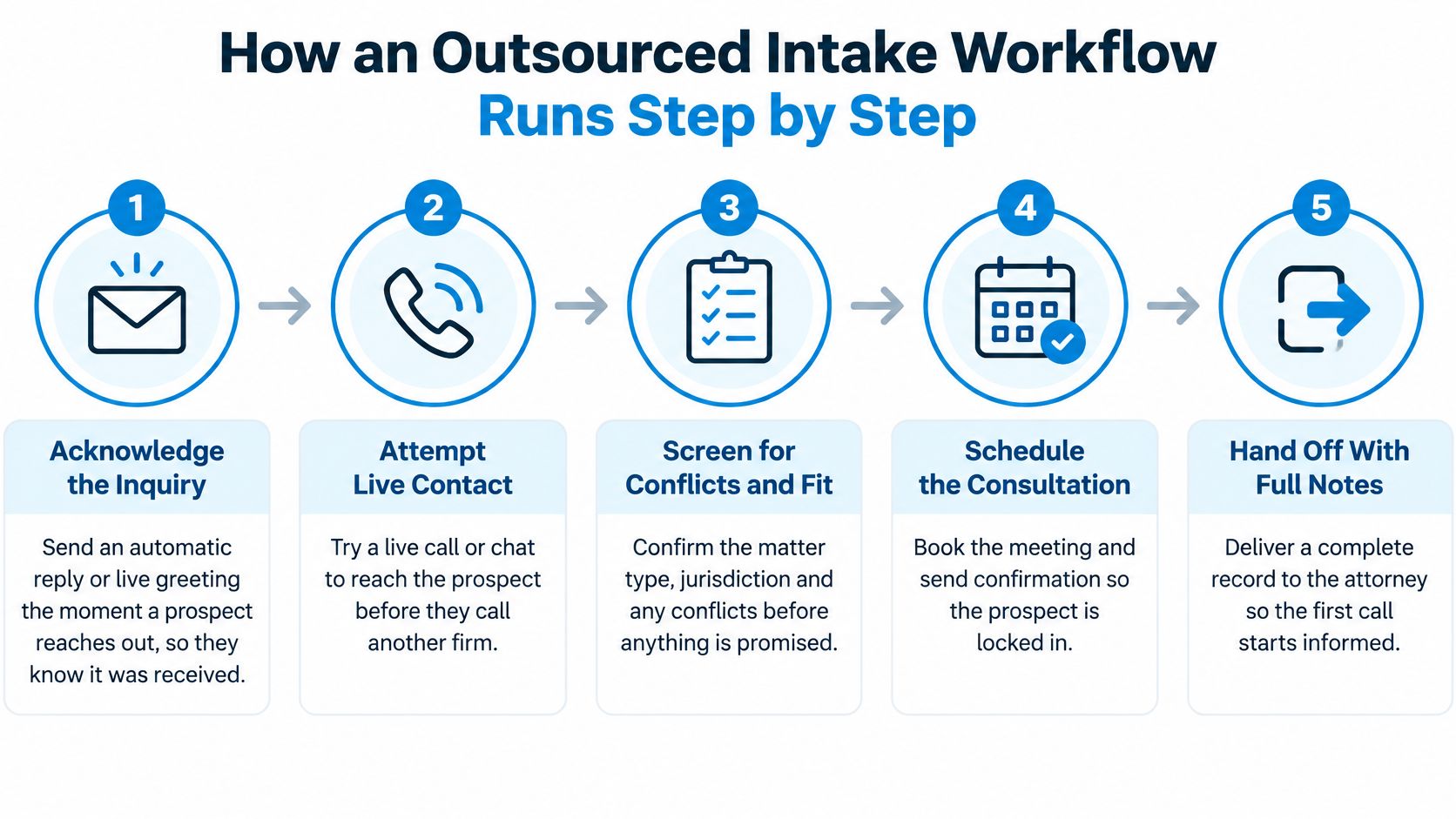
The workflow is a chain, and every link depends on the one before it. Skip a step and the failure shows up two steps later as a lost matter or a conflict you can't unwind.
Here is the sequence in one view.
Acknowledge the inquiry at once. An automatic reply or a live greeting tells the prospect the message landed. Silence reads as rejection, and a caller who gets no acknowledgement keeps dialling. The common slip is a generic auto-reply with no time promise and no next step in it.
Attempt a live connection within 15 minutes. Interest is highest in the first quarter hour, so this is the call most likely to be answered. The slip here is night and weekend traffic sitting until Monday morning, which is exactly the traffic you outsourced to catch.
Capture the approved intake fields. Name, preferred contact method, opposing parties, matter category, jurisdiction, the key date, urgency and callback window. Consistent fields are what make conflict screening and reporting possible. Agents who free-type narratives instead of filling fields give you a record nobody can search.
Run the conflict pre-screen before taking the story. Check opposing names against the firm's conflict database before the caller describes the dispute in detail. This is the step most often skipped, because callers want to tell a quick story and agents want to be helpful. Once you've heard the details, you own the disqualification risk.
Route the result. Qualified matters go to a named attorney with a same-day callback task. Emergencies, threats and substantive legal questions escalate immediately rather than queuing. The slip is routing to a shared inbox where "assigned" means nobody.
Log the outcome. Timestamps, attempt count, routing decision, consent and disclosure language, and the accept, decline or follow-up disposition. Without this, you can't prove anything to a partner, a client or a bar auditor.
The record that proves the work
A finished intake record should let any partner reconstruct the caller's experience in under two minutes without listening to the audio. If that isn't true, the fields are wrong or the agent is writing prose instead of data.
Treat this record as your governance instrument. The six steps above allocate risk between the provider and the firm: the provider owns speed, field discipline and logging, while the firm owns the conflict database, the routing rules and the final accept or decline call. When a matter is lost, the log tells you which side of that line the failure sat on. A missing timestamp points at the provider. A qualified lead that sat untouched after routing points at your own attorneys. That distinction is what turns intake from a cost you defend into leakage you can measure and recover.
Watch the handoff quality as closely as the speed. Providers that hire and train agents specifically for intake tend to produce better records than general answering services, and Ares intake team hiring tips set out what to screen for if you build the team in-house instead. Either way, the same evidence standard applies: every call ends in a searchable record with a named owner and a disposition, or the step didn't happen.
Protecting Confidential Information at First Contact
Design the first-call form before you interview a single vendor, because the form is where confidentiality is won or lost. A workable version has six fields: caller name, preferred contact method, opposing party names, matter category, the key date, and a callback window. Medical detail, financial figures and the long emotional narrative stay off that form and go straight into the firm's secure case-management system after an attorney decides whether to engage.
The duty starts earlier than most firms assume. ABA Model Rule 1.18 protects prospective clients who never sign anything, and Rule 1.6 requires reasonable efforts to prevent unauthorised disclosure of information relating to a representation. The ABA guidance on avoiding ethical landmines when outsourcing law office work recommends training outsourced personnel on the ethics rules, checking references, and having every worker who may touch client information sign a confidentiality agreement before access is granted, not after.
Controls to require in writing
- Signed agreement before access: no exceptions, including for supervisors and quality reviewers who only listen to recordings.
- Confidentiality training before the first live call: a signed acknowledgement is not training. Ask for the module and the pass mark.
- Role-based access limits: an agent handling personal injury intake has no reason to open an existing client's family law matter.
- Secure systems only: no sensitive narrative in shared spreadsheets, personal devices, email drafts or chat threads.
- A retention and deletion schedule: written down, with dates, not promised verbally at the sales meeting.
- Access revocation on exit: when someone leaves the provider's team, the firm confirms the removal rather than assuming it.
The everyday failure is dull rather than dramatic. An agent jots a caller's medication list into a shared inbox so the attorney will "have context," and that inbox is visible to twenty people across three time zones. Nothing bad happens for months, then a conflict or a data request turns the note into evidence.
Beyond the vendor agreement, keeping client communications secure is mostly access design: who can see which matter, on which device, for how long. If the provider records calls, check call recording compliance rules for your state before the first call is captured, and put the consent language in the script itself rather than in a policy document nobody reads mid-call.
Where Intake Staff Must Stop and Escalate
Outsourcing the work doesn't move the responsibility. The American Bar Association's Formal Opinion 08-451 on outsourcing legal support allows a lawyer to send legal or nonlegal support work outside the firm only while remaining ultimately responsible for competent representation under Model Rule 1.1, and it requires reasonable efforts to keep outside staff's conduct compatible with the firm's obligations under Rules 5.1 and 5.3.
Translated into a script, that means a written may-do and may-not-do list, an escalation ladder with named triggers, and a supervising attorney whose name appears on the document.
The supervising attorney is the person who signs off on the escalation rules, not a name on an org chart.

The three escalation tiers
- Tier 1, immediate transfer to an on-call attorney. Threats, emergencies, and callers describing violence or self-harm. No script, no queue, no message.
- Tier 2, same-day attorney callback. Deadlines, possible time bars, conflicts flagged in the pre-screen, and eligibility questions. The agent books the callback and logs the clock time.
- Tier 3, logged follow-up in the next business window. Questions outside the approved script, unusual matter types, and anything an agent isn't sure about. Uncertainty goes up, never sideways into a guess.
Take the deadline scenario. A caller says court papers arrived last Monday and asks how long she has to respond. The agent does not estimate. She transfers to the duty attorney if one is available, otherwise books a same-day callback, and records the time the question was raised. That record is what protects the firm if the caller later claims she was told she had weeks.
Supervision you can audit
A hybrid model works better than either extreme here. The AI handles FAQs, intake and qualification, and humans handle escalations and edge cases; when the AI detects that a caller needs something more nuanced, it hands off to a human receptionist working from the firm's playbook. The firm's job is to write that playbook and then check it is being followed.
Set a routine. Review a sample of call recordings every month against the script. Run scenario test calls each quarter using cases like the deadline example and score the response. Record every boundary breach with the corrective action taken, so a pattern becomes visible before it becomes a claim. The full escalation design, including trigger definitions and handoff ownership, is worth mapping before the first call, and this guide to building a call escalation process covers the mechanics.
Metrics That Show Whether Intake Is Working
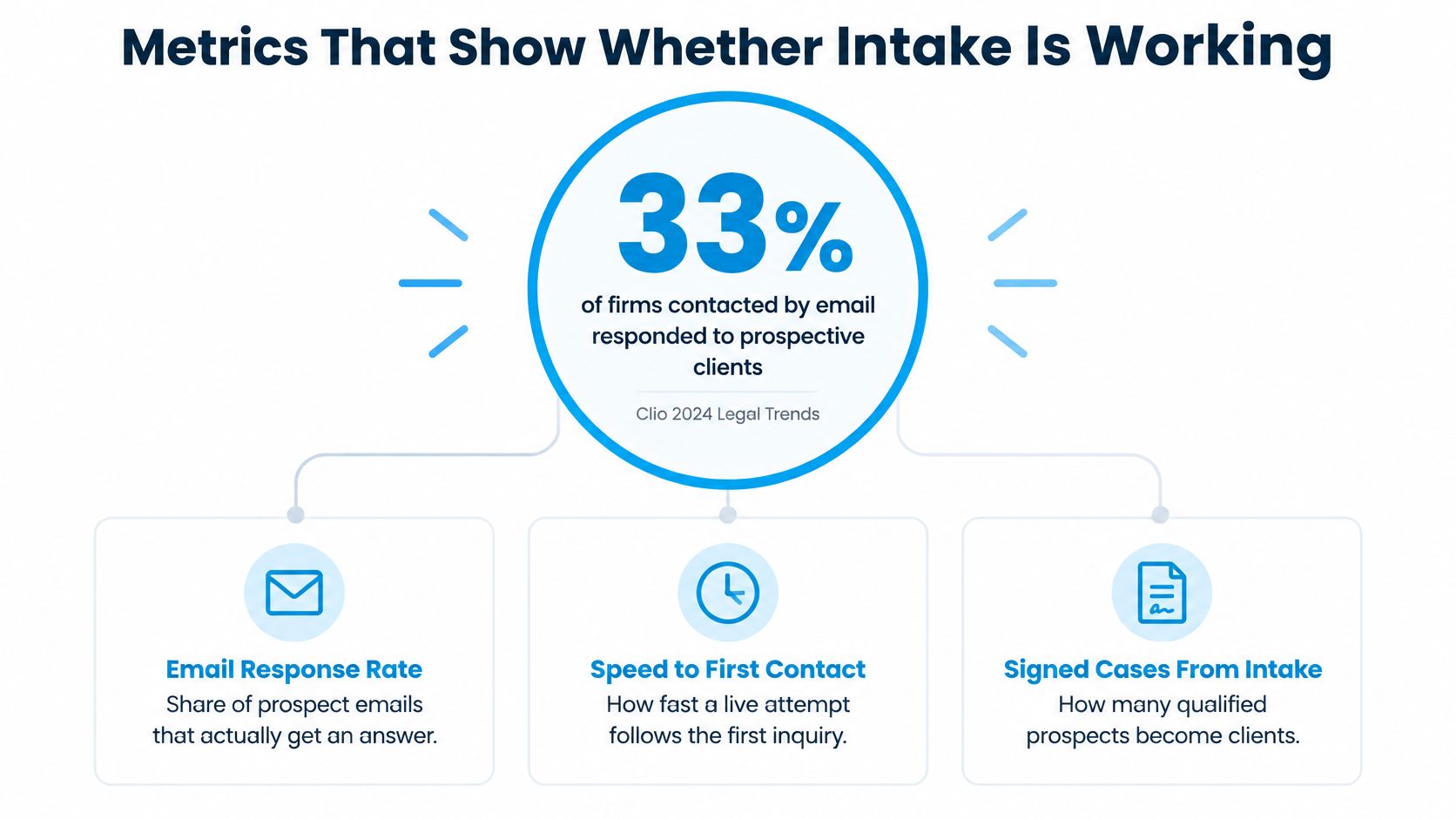
Intake is an acquisition channel with a measurable yield, and most firms never measure it. Clio's 2024 Legal Trends research on client intake found that only 33% of firms contacted by prospective clients through email responded at all, which is leakage at the very first step. The same research found that firms using client-facing technologies, including online intake, generated approximately 51% more leads and 52% higher revenue than firms without them.
Raw call volume tells you almost nothing. A provider can double your answered calls and still leave your signed-matter count flat, because answering is the cheapest part of the funnel to deliver.
Intake funnel metrics and warning signs
| Metric | What it tells you | Warning sign |
|---|---|---|
| Calls answered rate | Coverage across hours and channels | Gaps on nights, weekends or overflow periods |
| First response time | Speed of first contact for each lead | Median rising past the 15-minute target |
| Conflict-check completion | Whether screening happens before narrative | Matters reaching attorneys without a completed check |
| Qualified-lead rate | Quality of matters passed to the firm | Low rate despite high call volume |
| Consultation booking rate | Whether qualified leads reach a meeting | Qualified leads that never get booked |
| Retained-matter rate | Whether intake produces signed clients | Many consultations but few retained matters |
Here's how the funnel diagnoses itself. Say a provider books 40 consultations from 200 calls in a month, and only 4 of those consultations become retained matters. The answering rate looks excellent and the funnel is broken. Either the qualification script is letting non-viable matters through, or the handoff between booking and attendance is losing people. Fix the script or the handoff before you renegotiate the rate.
Compare cohorts, not totals
Split the data. After-hours calls against business-hours calls. Web forms against phone. One practice area against another. A provider that performs well on daytime personal injury calls may be weak on evening family law inquiries, and the blended number hides it.
Set your baseline before the provider's first shift: current response times by channel, qualified-lead rate, consultation attendance and retained matters for the previous two months. Without that baseline, every gain is arguable and every argument ends in anecdote.
Calculating the Value of Outsourced Intake
Build the business case from recovered leakage, not from call volume. Four inputs do most of the work.
- Count the baseline. Total monthly inquiries across calls, web forms and email, split into business hours and after hours.
- Estimate the leakage. A 2025 study of 1,333 U.S. law firm websites that submitted online lead inquiries during business hours found that 26% of firms did not respond at all within seven days, according to Pareto Legal's legal client intake statistics. Use that as a starting assumption, then add the abandoned calls, incomplete forms and duplicate leads your own logs never captured.
- Apply the pilot's rates. Take the qualified-lead rate and retained-matter rate from the provider's first two weeks rather than a vendor's marketing claim.
- Subtract the full cost. Provider fees, attorney time spent on handoffs, and the conflict-check time your staff still owns.
A hypothetical shows the method. A firm receives 120 leads a month and loses 25% of them, or 30 leads, to slow or missed replies. If 10% of recovered leads sign at an average fee of $5,000, that's 3 matters and $15,000 in monthly revenue. Against a $4,000 monthly provider fee and $1,000 of attorney handoff time, the net gain is $10,000 a month. Replace every input with your own figures before you decide anything.
One caution on the five-minute rule. The widely quoted target comes from benchmarks built on business-hours web forms, and the law firm intake benchmark analysis is right that this doesn't establish five minutes as a universal causal threshold. Track your own conversion by response band instead of adopting someone else's number as a service level you can't defend to a partner.
Choose a Provider Against These Criteria
Six tests separate a real intake operation from a call-answering service. Give each one a pass condition before you take a demo.
- Confidentiality: every worker signs an agreement before access, and the vendor hands over a written deletion schedule with dates.
- Ethics: a may-do and may-not-do list approved by your supervising attorney, with the Tier 1 and Tier 2 escalation triggers written into the script.
- Process: immediate acknowledgement, a 15-minute live-contact target, structured intake fields, and a same-day callback task for anything unqualified.
- Reporting: funnel metrics by source and response band, with call recordings available to the firm on request.
- Hybrid handling: scripted automation for routine questions and trained humans for complex calls, not one or the other.
- Integration: a live connection to your case-management system and your attorney calendar, not a nightly spreadsheet export.
Contract terms carry as much weight as capability. Insist on data ownership staying with the firm, disclosure of any subcontractors, breach notification inside a fixed window, and deletion of firm data at exit. The 2025 legal outsourcing analysis from Wolters Kluwer makes the useful point that compliance, data privacy and company-specific sensitive data are the areas most likely to need to stay internal, while execution-heavy work is the safer candidate for outsourcing. Apply that filter to intake: the collection and routing can move, the conflict decision and the advice cannot.
Recepta.ai is one provider to put through this test. For law firms and professional service providers it runs confidential inbound and outbound call handling and client support, asks business-specific intake questions for qualified leads, and invites prospects to book a consultation or request a quote, capturing, qualifying and routing each opportunity. Ask it, as you would ask any vendor, for call logs, access controls and written confidentiality terms.
Then run a two-week pilot on after-hours and overflow calls only, and compare response bands, qualified-lead rate and retained-matter rate against the baseline you set before the pilot began. A provider that won't agree to a measured pilot is telling you something.
Recepta.ai answers the calls your team can't reach at 6:40 on a Tuesday evening, blending conversational AI with trained human receptionists so every inquiry gets acknowledged, qualified and routed to the right attorney without sitting in an inbox. It handles intake questions specific to your practice, books consultations straight onto your calendar, and hands sensitive or complex calls to a person working from your playbook. If you want to see how that compares with your current response times, start a trial at Recepta.ai and measure it against your own baseline.