
Pest Control Lead Generation: A Complete Playbook for Growth
A pest control lead can be perfectly qualified and still be worthless if nobody answers the phone. In this business, growth doesn't come only from attracting more homeowners. It comes from making sure the right person answers, asks the right questions, routes the job correctly, and follows up before the customer moves on.
That distinction matters in a market built around repeat service. In the United States, structural pest control generated $12.654 billion in service revenue in 2024, and recurring revenue represented 85.2% of residential service revenue, according to the National Pest Management Association. A missed inquiry can therefore represent more than one treatment. It can mean the loss of an ongoing account, future referrals, and the chance to build a relationship with a homeowner who needs seasonal protection.
Why Most Leads Never Turn Into Contracts
A pest control campaign can generate qualified inquiries and still lose profitable jobs before the first inspection is booked. A homeowner spots termite activity near a window and calls ready to act. The owner is outside treating a wasp nest, the office line rolls to voicemail, and the caller has no clear response time. By the time someone returns the call, another company has already scheduled the inspection.
Independent home-services call data shows that businesses missed 14% of inbound calls. Platform studies also place missed-call rates between 14% and 27% and report that only 55% of home-service callers reach a person, according to home-services answering data from PestLineAI. A missed call is not automatically a qualified opportunity, but silence prevents the team from finding out.
The leak happens after acquisition
Campaign reports often stop at clicks, form fills, or new phone numbers. Those figures can look healthy while contracts remain scarce. A homeowner may submit a bed bug inspection form, call twice about rodents, and request a termite quote through a directory. If those interactions never connect to one customer record, the team sees separate activities instead of one active buying process.
The first response belongs inside the marketing workflow. The ad creates intent, the landing page sets expectations, and the phone system determines whether the caller reaches a person. The dispatcher then needs enough information to route the job, while the technician or office team must complete the follow-up.
Practical rule: A campaign ends only after the inquiry is answered, qualified, routed, and given a clear next step.
Use a short intake process that captures the service type, property location, urgency, access requirements, and preferred appointment window. Route the caller according to the job, not merely the order in which inquiries arrive. A routine ant issue can follow standard booking. A rodent inside a living area may need priority handling. A termite inquiry usually deserves a dedicated inspection appointment and a follow-up sequence built around that service. Bed bug emergencies require fast reassurance, clear availability, and direct scheduling.
Treat every lead as a service-line opportunity
The label “pest lead” conceals the decisions that affect conversion and profitability. Termites, bed bugs, rodents, wildlife, and recurring general pest service have different urgency, margins, appointment types, and customer concerns. One generic script sends them into the same queue and leaves staff guessing which questions matter.
Create separate CRM dispositions for each major job type. Record whether the lead was answered live, whether an appointment was booked, whether another contact attempt was made, and what happened afterward. Review those outcomes by service line so a strong call volume does not hide weak termite follow-up or missed bed bug bookings. Use these lead follow-up best practices to make post-inquiry contact consistent instead of dependent on memory.
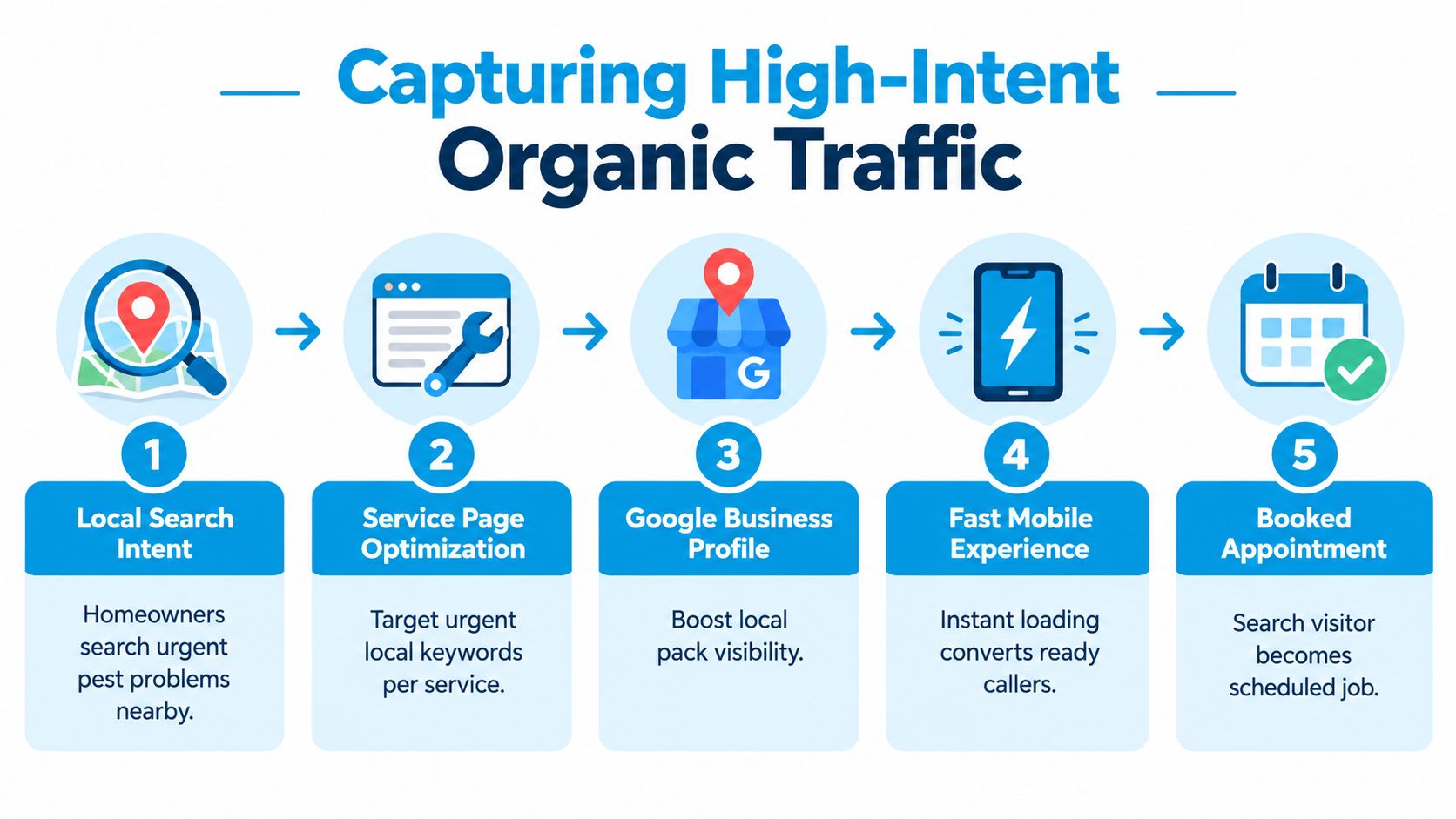
Capturing High-Intent Organic Traffic
Organic traffic is most valuable when it reflects a specific problem and a nearby service need. Someone searching for “termite exterminator near me” is different from someone reading a general article about insects. The first searcher may be ready to call, while the second may only be researching.
A 2026 analysis reported that 48% of pest control leads originate from organic search traffic, 68% originate specifically from local search results, and optimized pest control websites convert 3% to 8% of organic visitors into leads, according to Webtonic's pest control SEO analysis. Those figures point to a practical conclusion. Local SEO should be built around the services people need now, not just broad informational keywords.
Build pages around profitable problems
The first organic channel is service-specific landing pages. Create a dedicated page for termites, rodents, bed bugs, ants, wasps, and recurring general pest control. Each page should explain the symptoms, the next step, the service area, what the inspection includes, and how to call or book.
A termite page shouldn't send visitors to a generic homepage. It should show a clear inspection action, answer practical questions about visible damage, and make the service location obvious. A bed bug page should make it easy to understand whether the business handles urgent inspections, preparation, treatment, and follow-up visits.
The second channel is location relevance. Build useful service-area pages for the cities and neighborhoods you genuinely serve. “Rodent control in Madison” should contain local service information, not a city name inserted into a template. Include the company's service limits, office details, booking options, and examples of the property types handled in that area.
Make local discovery consistent
The third channel is the Google Business Profile and directory ecosystem. A local profile should show accurate hours, service categories, phone details, photographs, review activity, and descriptions that match the website. Keep the business name, address, and phone information consistent across directories such as Yelp, Bing, HomeAdvisor, and Angi. The FieldRoutes guide to pest control inbound marketing also highlights the importance of local discovery, including Google Maps and consistent business information.
Businesses that need a more detailed local search process can review this guide on how to attract local customers on Google Maps. The useful principle is simple: local visibility only helps when the profile, page, phone number, and booking process all lead to the same business.
Finally, test the mobile experience yourself. Open a service page on a phone, tap the call button, check whether the number is correct, and confirm that the first screen explains what happens next. A strong organic strategy brings the right visitor to the site. A clear mobile path turns that visitor into an inquiry. Businesses can also apply the workflow principles in this guide to lead generation for contractors, especially around form routing and response ownership.
Maximizing Returns from Paid Advertising
Paid advertising works quickly, but it also exposes weak operations quickly. If an ad sends a high-intent homeowner to a slow page, a generic form, or an unanswered phone, the business pays for the opportunity without controlling the outcome.
The most useful comparison is between Local Services Ads and conventional Search ads. Local Services Ads use a pay-per-lead model and can put a business in front of people looking for a nearby provider. Search ads use keyword bidding and charge for clicks, which gives the advertiser more control over search terms, landing pages, messaging, and negative keywords.
Choose the channel by buying intent
Use Local Services Ads when the objective is to capture immediate service demand, such as termite removal, rodent entry, or urgent pest inspection. Use conventional Search ads when you need tighter control over individual service terms and want to send each searcher to a page built for that service.
One industry guide lists Google Local Services Ads for pest control at approximately $250 to $1,000 per month, depending on local cost and lead volume, according to Jobber's pest control advertising guide. Treat that as a budgeting reference, not a guarantee. Local market competition, service coverage, and lead quality still determine whether the channel is profitable.
The available paid-search benchmarks show why alignment matters:
| Metric | Home Services Average | Pest Control Specific |
|---|---|---|
| Search ad click-through rate | 4.80% | 5.54% |
| Cost per lead | Not provided | $70.11 |
The figures come from home-services marketing benchmarks from Click Vision. The same dataset reports that the pest and rodent control search ads analyzed had a 1.51% conversion rate and $1.23 cost per click, so these figures should be read as dataset benchmarks rather than promises for every account.
Build campaigns around the call you want
A campaign for “pest control” is too broad to manage well. Separate campaigns by service and intent. Put termite inspection terms in one group, rodent control in another, and bed bug treatment in a third. Send each group to a matching page with one primary action, such as calling, requesting an inspection, or booking an appointment.
Add negative keywords to remove irrelevant searches, review search terms regularly, and pause phrases that generate information seekers without appointments. For a practical perspective on structuring campaigns and lead-focused landing pages, consult this Google Ads guide from Come Together Media LLC.
Don't judge paid advertising by clicks alone. Match each call and form to the campaign, record the service line, and connect the outcome to a booked job. If phone calls aren't tracked, the account can appear weak even when the ads are generating the majority of real inquiries.
Scripts and Workflows That Close More Jobs
The first few minutes after an inquiry determine whether the customer feels helped or abandoned. A good script shouldn't sound robotic. It should make the caller feel understood while collecting the information the dispatcher needs to make a correct decision.
Start with a direct opening:
“Thanks for calling [Business Name]. I can help you get this to the right technician. What are you seeing, and where is the problem located?”
That question does two jobs. It invites the customer to explain the situation, and it gives the employee a natural way to distinguish a termite inspection from a general pest visit or an urgent rodent intrusion.
Use a service-line intake sequence
Ask questions in an order that reflects urgency:
- Identify the pest. Ask what the customer has seen, heard, or found.
- Locate the activity. Clarify whether it's inside the living space, around the structure, in a crawl space, or outdoors.
- Establish severity. Ask whether the issue is active, recurring, spreading, or creating an immediate concern.
- Confirm the property. Record the address, property type, and access details.
- Offer the correct appointment. Explain the inspection or treatment rather than just asking whether the customer wants to book.
For a termite inquiry, use language such as: “We'll schedule the appropriate inspection so the technician can assess the activity and recommend the next step.” For bed bugs, ask whether the customer has seen live insects, bites, or activity in more than one room. For rodents, find out whether the customer is hearing movement inside the walls or seeing the animal in an occupied room.
Respond before competitors do
Exclusive general pest leads typically convert at 18% to 28% when contacted within 5 minutes, while shared leads convert at 40% to 60% lower rates, according to industry guidance on pest control lead conversion. Speed matters, but speed without qualification creates scheduling mistakes. The right workflow is fast and specific.
If the customer doesn't book on the first call, send a message immediately:
“Hi [Name], this is [Business Name]. We received your request about [service] at [address or neighborhood]. Reply with a good time to speak, or call us at [number]. We can help you arrange the next step.”
After booking, confirm the appointment and access instructions:
“Your [service or inspection] is scheduled for [day and time]. Please make sure the technician can access [relevant area]. Reply here if anything changes.”
The phone-answering script resource can help teams standardize these conversations without forcing every service line into identical wording. Review call recordings with staff, identify where customers hesitate, and update the script around real objections such as price, preparation, pets, tenants, or appointment availability.
Automating Capture with AI and CRM Tools
A pest control owner loses profitable jobs when calls arrive during a treatment, a vehicle run, or a crawl-space inspection. Automation should protect those opportunities while leaving diagnosis, exceptions, and customer judgment with trained staff. The practical goal is a complete intake record and a clear next action for every inquiry.
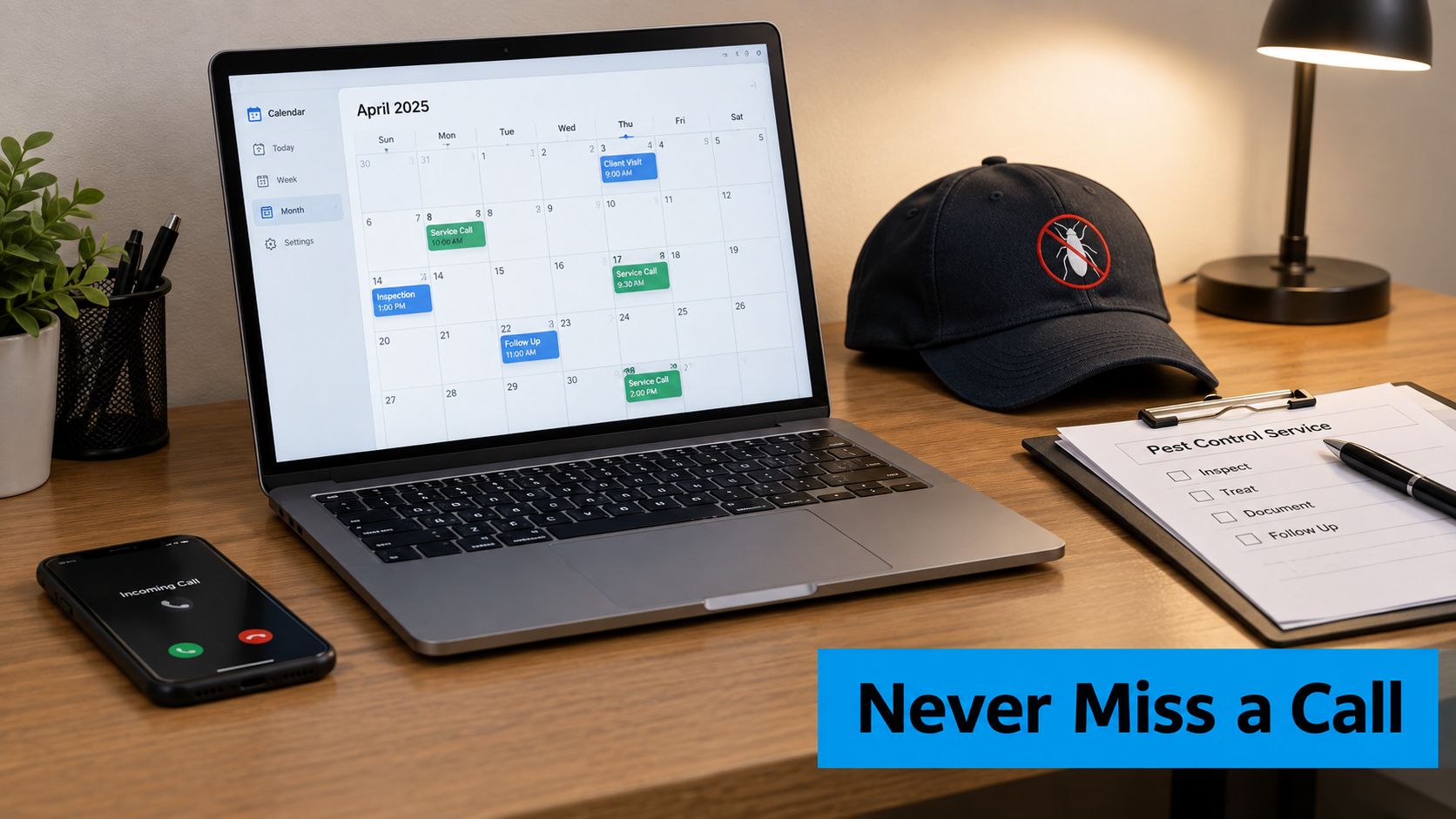
An AI receptionist can answer inbound calls, collect the pest type, urgency, property location, and access details, then route the inquiry using rules set by the business. A CRM connection can attach the call summary to the customer record, create a follow-up task, and send the correct booking information to the scheduling system.
Connect intake to the calendar
Routing rules should reflect the service, not just the caller's phone number. General pest inquiries can enter the standard appointment queue. Termite requests should create an inspection task, while bed bug emergencies can trigger preparation instructions and a review of the earliest suitable appointment. Rodent calls deserve priority when the customer reports activity inside the home.
The workflow must also separate a completed booking, a callback request, an unanswered attempt, and a disqualified lead. That prevents a captured number from being counted as revenue before anyone has confirmed the job.
An AI call answering service can work alongside existing calendars, CRMs, and pest control systems. The useful test is operational: after the call ends, does the right employee receive the service details, urgency, appointment status, and follow-up task? A missed handoff still leaks revenue, even if the software answered instantly.
Platform information published by Recepta.ai reports customer outcomes of up to 30% more qualified leads, 80% cost savings compared with in-house reception, and a 15× ROI, while also describing fewer opportunities lost to voicemail, according to Recepta.ai's published platform information. These figures describe reported customer outcomes, not a forecast for every pest control company.
Keep humans in the right places
Automation can handle predictable intake questions, but employees should take over cases that require judgment. Escalate urgent jobs, unclear symptoms, sensitive household situations, upset callers, pricing disputes, complicated commercial properties, and requests outside the service area.
Post-call follow-up matters as much as the first response. Send the summary to the assigned employee, mark the next action, and trigger a confirmation or callback task when the caller does not book. Review call summaries regularly. If termite inquiries keep entering general pest service, correct the questions, dispositions, or calendar rules until the workflow matches how technicians schedule and perform the work.
Tracking the Metrics That Drive Revenue
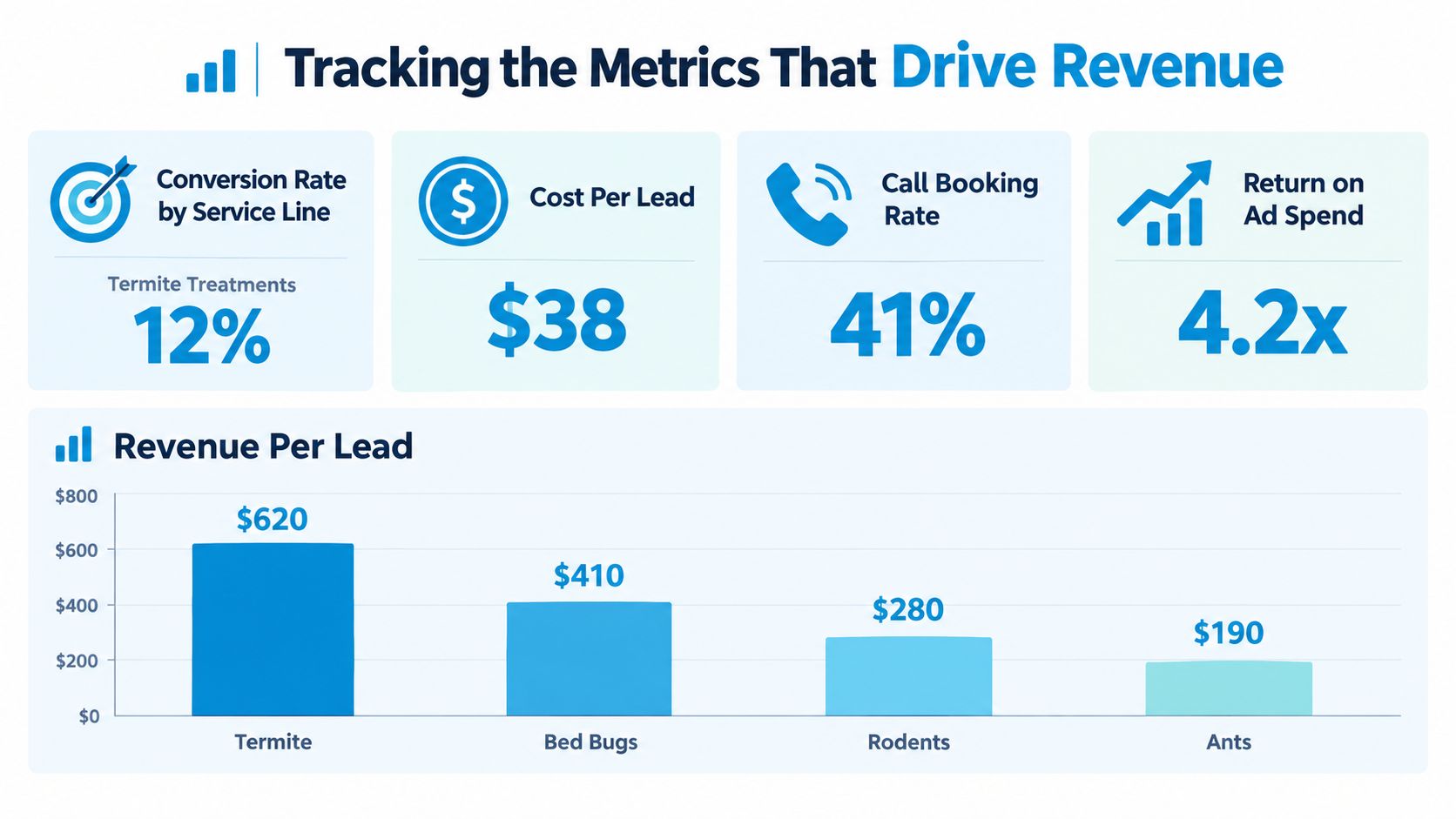
A lead-generation dashboard should show which source produces profitable jobs for each service line. Clicks and page views indicate visibility, but they cannot show whether termite inspections, bed bug treatments, or recurring general pest accounts cover acquisition costs. The useful record connects the first inquiry to the final outcome.
For every lead, capture the channel, campaign, search term when available, service type, answer status, booking status, appointment outcome, and revenue. Add the assigned route or employee when routing affects response time. Review results by service line instead of combining every call into one conversion rate. A bed bug caller may need an immediate response, while a termite inspection can require a more deliberate follow-up sequence.
Separate lead quality from lead volume
A high-volume campaign can generate plenty of general pest inquiries while producing few recurring accounts. A smaller termite campaign may bring fewer calls but create more valuable inspections and follow-on work. Report both volume and downstream value so budget decisions reflect the jobs your team can profitably serve.
Track these operational metrics:
- Answer rate: How often inbound calls reach a person or approved automated intake.
- Speed to lead: How quickly the business responds to calls, forms, chats, and missed-call alerts.
- Qualified lead rate: The share of inquiries that match the service area, property type, and available service.
- Booking rate: The share of qualified inquiries that receive an appointment.
- Show rate: The share of booked appointments that take place.
- Close rate: The share of completed inspections or visits that become paid work or recurring service.
- Cost per acquired customer: Advertising and intake costs divided by customers, not raw inquiries.
- Recurring revenue contribution: Revenue connected to accounts that continue beyond the first treatment.
The National Pest Management Association's industry update provides context for tracking customer value beyond the first visit. For an owner, that means a lead source should be judged by the accounts and follow-up work it creates, not just by its initial call count. The same report does not make every campaign profitable, so your own service-line records still decide where to spend.
Calculate the real acquisition cost
If a campaign generates calls but the team fails to record service type or booking outcome, the dashboard cannot identify the failure. The ad, landing page, dispatcher, routing rule, or follow-up may be responsible. Fix those fields before judging the source.
Review results by week and service line. Check missed calls after hours, slow callbacks during busy periods, unconfirmed appointments, and leads marked “not interested” without a reason. Route urgent bed bug inquiries separately from routine requests, and assign termite follow-ups to someone who can explain inspection steps. Those records show where recovered calls and better follow-up can raise revenue without increasing media spend.
Turning Strategy Into a Daily Routine
A lead-generation strategy only works when the team repeats it during ordinary busy days. Make lead handling part of the morning, midday, and end-of-day routine rather than something reviewed only after a disappointing advertising report.
Use a short daily audit:
- Check local listings: Confirm that Google Business Profile hours, phone details, service descriptions, and booking links are accurate.
- Test the phone path: Call the main number, verify the greeting, and confirm that missed calls create an assigned callback task.
- Review new inquiries: Sort open leads by service line and urgency.
- Inspect follow-up: Confirm that unbooked callers received a personal callback or approved automated message.
- Check the calendar: Look for appointments missing access notes, preparation instructions, or confirmation.
- Review outcomes: Record which visits became paid work, recurring accounts, or legitimate disqualifications.
Run a deeper review monthly. Compare organic, Local Services Ads, Search ads, referrals, and directory leads using the same definitions. Keep the sources that produce qualified appointments and profitable customers. Change the intake questions when technicians receive poor job information, and change the routing rules when urgent calls sit behind routine requests.
Speed and routing are the decisive parts of pest control lead generation. Audit your own business today by calling the main number when the office is busy, submitting a service form after hours, and checking whether a real next step appears in the calendar. If the answer is unclear, more traffic won't solve the leak.
Recepta.ai captures inbound calls, qualifies pest control inquiries, routes urgent requests, schedules appointments, and supports follow-ups so leads don't disappear into voicemail while your team is on a job. Visit Recepta.ai to see how its AI receptionist and human support workflows can fit into your lead-handling process.