
What Is Call Routing and How Calls Reach the Right Person
It's 7 pm, and a homeowner with a burst pipe calls your plumbing company. They need someone who can arrange help, not just a recording confirming that the office is closed. Whether that call reaches an on-call dispatcher or an unanswered voicemail box depends on the routing rules behind your business number.
What Call Routing Means and Why Callers Notice It
Call routing is the process of deciding where an incoming call should go next and connecting it, using the dialed number, caller context, time, availability, and the business's rules.
Think of a hotel switchboard operator. A guest asking for fresh towels needs housekeeping, while someone reporting a broken lock needs maintenance. The operator interprets the request before choosing a destination, then finds another person if the first desk doesn't answer.
A business phone system can follow the same logic. The important question isn't which phone should ring. It's who can finish the caller's request, and what should happen if that person is unavailable.
For the homeowner, that difference is immediate.
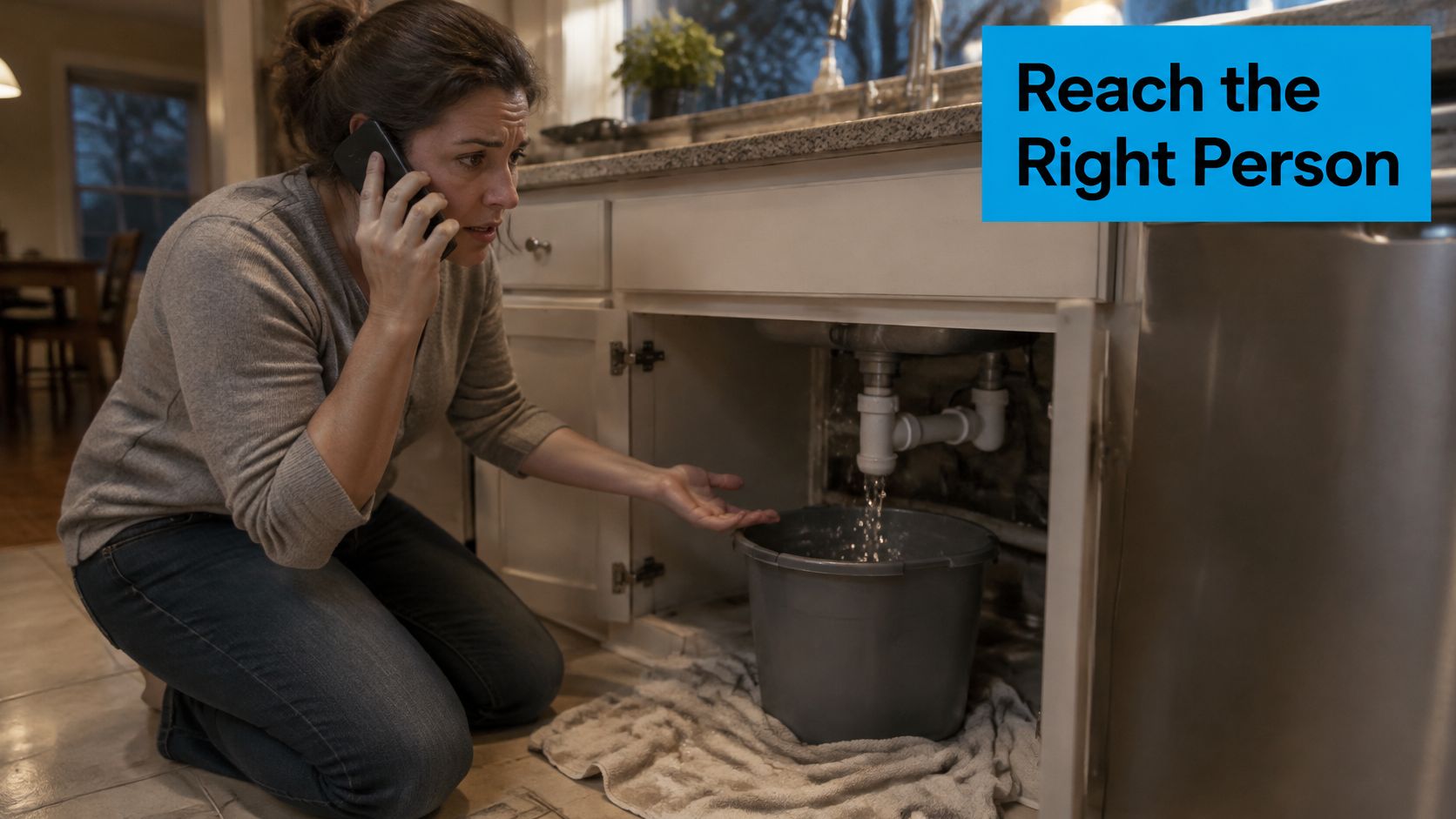
A connection isn't always a resolution
Forwarding a call to an office number doesn't help if nobody there can dispatch a technician. Good routing considers the caller's purpose, not just whether a destination exists.
Callers notice when that judgment is missing. In 2024, 60% of consumers reported being frequently transferred to another agent or department during voice-support calls, according to Zendesk's CX Trends research.
A transfer isn't automatically a mistake. A receptionist may need to connect a caller with a specialist, but that handoff should move the request forward rather than make the caller repeat it.
So, what is call routing in practical terms? It's a set of decisions that answers three questions: how should this call travel, which routing method fits the request, and what prevents the caller from getting stranded?
Routing Methods Compared Side by Side
Common call routing methods and when to use them
| Routing method | What it uses to choose | Best fit | Practical example |
|---|---|---|---|
| Static forwarding | One fixed number | Sole owner or single line | Owner's mobile receives every call |
| IVR menu | Caller's keypad choice | Multi-department office | Press 2 for billing, press 3 for scheduling |
| Skills-based routing | Request type and agent skill | Specialist teams | Legal intake goes to the lawyer for that practice area |
| Time-based routing | Clock and calendar | Businesses with set office hours | After-hours calls go to an on-call technician |
| Number-based routing | Dialed number | Multi-line or multi-branch setups | Each dialed number rings a different branch |
| Location-based routing | Caller or service address | Multi-location home services | Address picks the county's dispatch team |
| Queue with longest-idle selection | Agent idle time | High call volume | Next call goes to the agent free the longest |
Choose by the decision you need to make
Static forwarding suits an owner who handles every request personally. By itself, however, a fixed destination doesn't specify a backup when that phone is busy or unanswered.
An interactive voice response menu, or IVR, lets callers choose a department. Keep choices short and recognizable. Extra menu levels add work before the caller reaches someone, especially when the caller doesn't know whether their question belongs to billing, service, or scheduling.
Skills-based routing removes that departmental guesswork when intake can identify the request. A law firm might distinguish estate planning from family law, but someone must keep the staff skills list accurate. Don't route to a specialist who no longer handles that work.
Time-based routing solves a different problem: who is responsible right now? Office hours, holidays, lunch coverage, and on-call schedules all need an owner who updates them.
Combine methods without creating confusion
Number-based routing identifies the line someone called. Location-based routing identifies where service is needed. Those inputs aren't interchangeable, so confirm which one determines eligibility.
Longest-idle selection is useful when several eligible agents handle similar requests. It distributes work according to availability, but an agent marked available must be reachable.
For a single-location business, start with time-based routing and a fallback. Add skills-based decisions when different teams handle materially different work and you can maintain the assignments. An alternative to keypad menus is conversational intake: we replace automated phone menus with real people and AI routing that connects callers to the right information or person.
How a Routed Call Travels From Dial to Destination
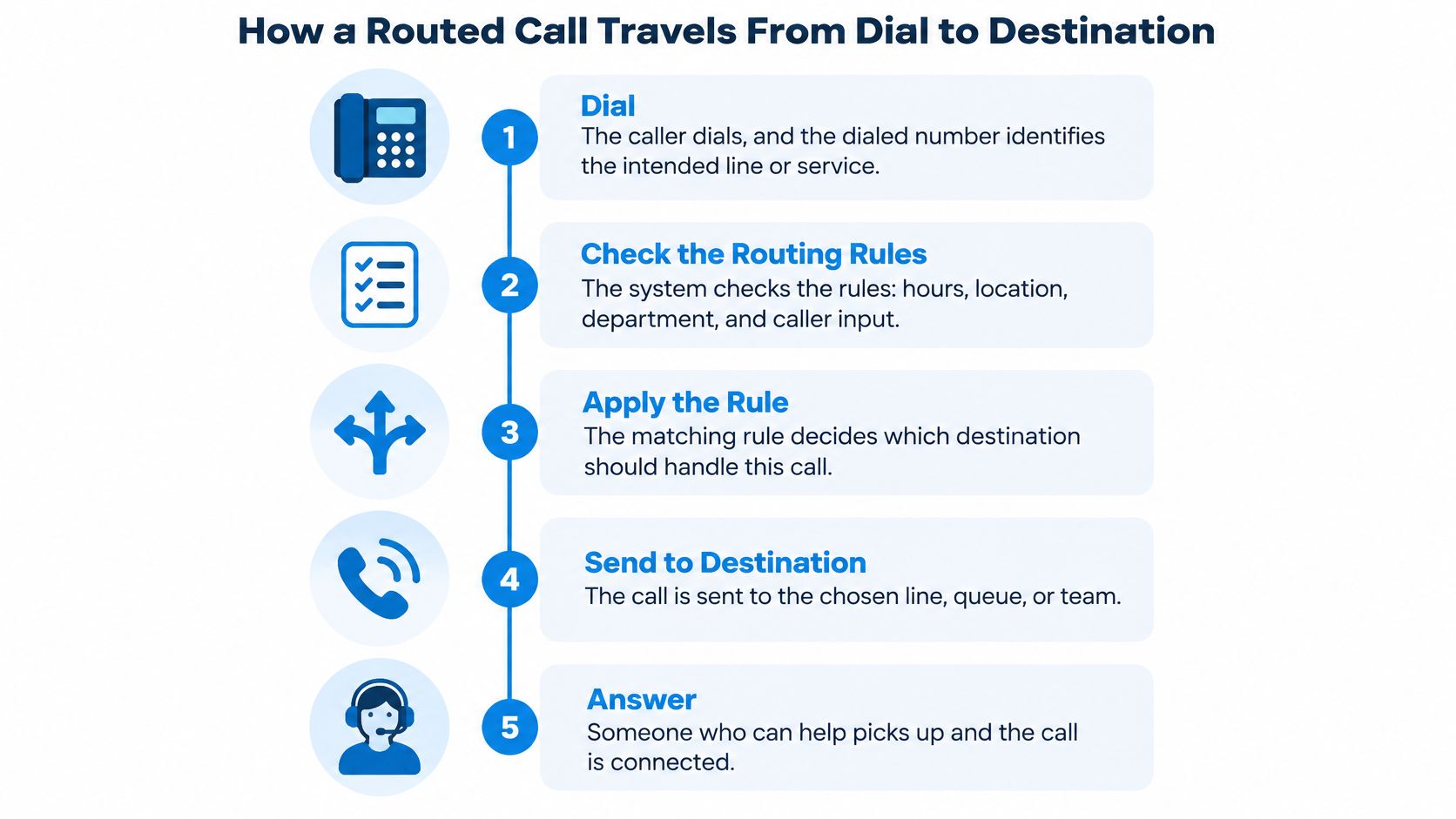
A caller experiences routing as a short pause, a ring, or a transfer. Behind that pause, the system is deciding which person or channel can finish the request. A line labeled “support” is only the entry point. The destination still has to be eligible, available, and able to act.
Follow the call through its decisions
The caller dials. The dialed number identifies the intended business line or service. A dedicated repair number can separate service requests from general office calls before anyone hears the caller's reason.
The system checks the rules. It evaluates inputs such as office hours, department, service location, and caller context. Rules need a clear priority so an after-hours instruction does not conflict with a department assignment.
The request is matched to a finisher. The useful question is “who can complete this task now,” not “who usually answers this line.” A billing question routed to a courteous person who cannot access invoices still fails the caller.
Availability determines the next action. An eligible, available agent can receive the call. Otherwise, the system can place the caller in a queue or choose an alternate destination.
Signaling reaches the selected destination. In SIP-based systems, the Request-URI identifies the intended user or service, and DNS resolution helps locate the destination's network address, port, and transport, as described in the SIP standard, RFC 3261. This is the technical connection process, separate from the business decision about who should help.
The voice session connects, or the fallback runs. The systems negotiate the media session so the participants can speak. A ringing destination and an established conversation are different events, which matters when reviewing call logs. For a hypothetical setup, ring the primary team for 20 seconds before trying the overflow team, then treat that duration as a setting to test rather than a universal recommendation.
Policy decides where the call should go, signaling determines how to reach it, and media carries the voice.
Make the handoff understandable
When someone answers before transferring, decide whether they should introduce the caller and explain the request. The distinction between a cold transfer and a warm transfer defines who owns that context. If the first destination fails, the next destination should receive the reason for the call, not force the caller to start over.
For legal intake, the intake workflow tips from Attorney Assistant offer a useful companion resource when documenting the conversation around a transfer.
Use this video as another way to visualize call handling.
Sketch your own path on paper: dialed line, matching rule, finisher check, availability check, destination, fallback. Mark any point where the caller could wait indefinitely, reach a person who cannot act, or be sent somewhere that cannot complete the request.
Queues, Fallbacks and Escalation When the First Route Fails
Track these routing states with a timestamp at every transition:
- Answered immediately: An eligible person accepts the call without a queue wait.
- Queued: The caller waits for an eligible agent.
- Overflowed: The system moves the call to an alternate destination.
- Abandoned: The caller leaves before reaching someone.
These states describe different operational problems. An overflowing queue may indicate insufficient coverage, while abandonment deserves investigation into waiting conditions and caller expectations.
Give every queue an exit
Cisco's Unified Communications Manager documentation describes controls including announcements, music or tone on hold, maximum wait timers, queue-size limits, alternate destinations, and longest-idle agent selection. These settings determine what callers experience when nobody can answer immediately.
For a hypothetical HVAC setup, cap the queue at five callers and set a 90-second maximum wait. A full queue or an expired wait sends the caller to the on-call dispatcher rather than restarting the hold cycle.
The greeting should explain what's happening and offer an appropriate alternative. Don't promise a callback unless someone owns the follow-up task and can see the captured request.
When managing high call volumes, inspect the timestamps before changing staffing. Look for whether callers arrive in bursts, wait behind the wrong request types, or overflow because agents aren't marked available.
Escalation needs a named recipient
Urgent symptom-related calls at a medical or dental office should follow a clinician-approved protocol to trained staff, not an ordinary voicemail route. Business call handling isn't a substitute for emergency services.
For after-hours routine requests, capture a callback with an owner and an expected response window. When an issue needs our customer's internal team, we route it, schedule a follow-up, or take a detailed message according to that business's rules. When AI detects a more nuanced need, it hands off to a human receptionist following the playbook.
Handoff rule: Pass the caller's identity, reason for calling, and callback number with the request, rather than making the next person reconstruct it.
For every branch, write down the timeout, backup destination, and information passed on. An empty field is an unfinished routing decision.
Practical Routing Examples for Service and Clinic Businesses
The same routing logic produces different configurations depending on who can finish the caller's request. These four worked scenarios apply the earlier principles to service and clinic settings. The destinations and response promises are example configurations, not industry standards.
Routing rules for four example businesses
| Scenario | Routing input | Default destination | Fallback | Passed to next person |
|---|---|---|---|---|
| HVAC company serving several counties | Service address captured at intake | Dispatcher for that county branch | Central queue | Address, job type, callback number |
| Dental group in New York, New Jersey and Connecticut | Appointment location stated by caller, CRM record | Clinic for that location | Scheduling queue at main office | Location, patient name, reason for call |
| Plumbing business after porting its number | Published number and forwarding tests | New IP phone routes | Previous forwarding rule kept until tests pass | Caller ID and emergency-service data checked |
| Law firm intake | Practice area chosen by caller during business hours | Lawyer for that practice area | Callback capture form with a hypothetical 30-minute response promise | Practice area, name, callback number |
Read each row as a short chain of decisions: what the system asks first, who receives the call, where it goes when that destination cannot take it, and what the next person needs in order to act. A dispatcher cannot assign work without the service location, so the HVAC row captures the address before anything else happens. The fallback column names a second channel that can finish the request, whether that is a central queue, a scheduling desk, or a callback form.
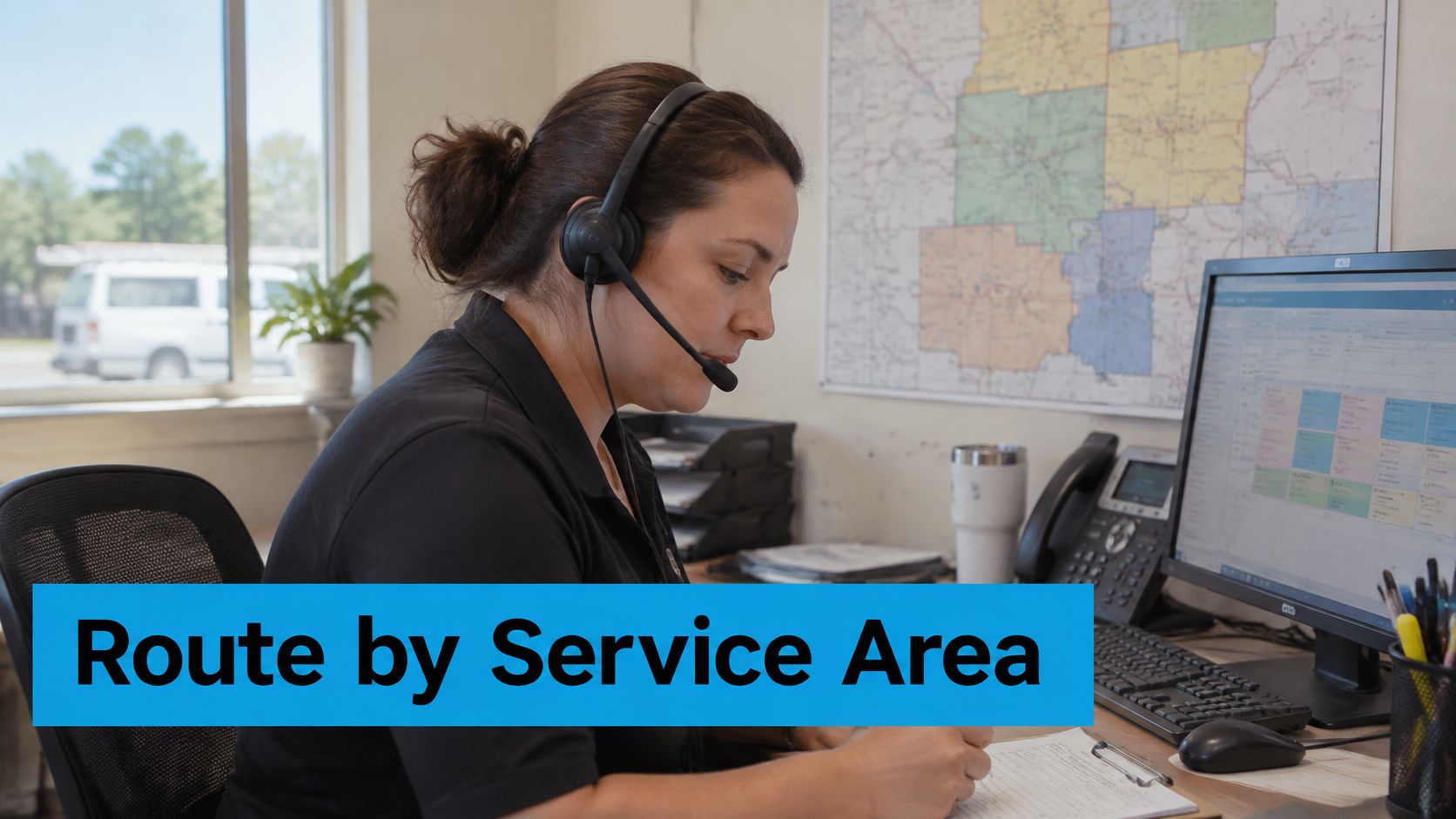
Apply the rule to the actual request
HVAC coverage: Capture and confirm the street address before selecting the county dispatcher. Send an unrecognized address to central intake for verification, rather than guessing which technician territory applies. Define who covers each territory through your on-call services arrangements.
Dental scheduling: Ask which clinic the patient wants, then compare that answer with the CRM record. A patient with a New York number may want a New Jersey appointment, while an existing patient may intentionally choose a different office.
Plumbing migration: Coordinate the cutover so the previous forwarding arrangement remains available until testing passes, where technically possible. The FCC's number-portability order explains the use of Location Routing Numbers to identify current destinations for ported numbers. Test inbound calls, forwarding behavior, and caller ID, and verify emergency-service information separately.
Legal intake: Identify the practice area before choosing a lawyer. Only offer the example response promise if a named person monitors the callback form and can meet it, including after hours.
Keep operational records separate from caller context
Caller ID and emergency-service configuration are migration checks, not details to recite to a dispatcher. The information accompanying a customer request should instead help the recipient act.
For phone-system planning, the CloudOrbis business VoIP systems guide provides additional context for evaluating the underlying setup.
Every inbound and outbound call, message, and configured action may be logged in our workflows for analytics, reporting, training, and quality control. Use those records to verify what happened on each call.
Before approving any scenario, identify its input, default destination, fallback, and handoff information, then name the person responsible for keeping it current.
Misconceptions and Limits of Number-Based Routing
A telephone identifier isn't the whole request
Routing is not forwarding. Forwarding is a connection mechanism that can sit inside a routing plan. A useful business call-forwarding setup still needs decisions about eligibility, unanswered calls, and responsibility for follow-up.
The area code doesn't reliably reveal where the caller is. The FCC's number-porting guide explains that customers can retain numbers when switching providers within the same geographic area, while moving to a new area may prevent retention. Don't treat a telephone prefix as confirmation of a current address or preferred clinic.
For the dental group, the useful question is which office the patient wants to visit. Combine the dialed number, caller identification, stated intent, and confirmed location rather than allowing an area-code assumption to override the answer.
A ported number doesn't mean nothing changed. Customers may dial the same digits while the underlying destination changes. Migration testing must cover the call's actual arrival and handling, not just whether the number appears on the account.
An answered call can still leave someone without help
A digital fallback isn't accessible to everyone. A healthcare study on digital access and telehealth attendance highlights barriers associated with limited connectivity. Don't assume a caller who couldn't finish by phone can complete a web form instead.
Offer an appropriate next action:
- Scheduled callback: Agree on a window when the caller can answer.
- SMS or email follow-up: Confirm permission and which channel they can use.
- Language support: Provide a multilingual option or an accessible human handoff.
- Context preservation: Carry the request forward without requiring a fresh explanation.
Measure completed bookings, resolved requests, and qualified leads, not answer rate alone. A fast answer followed by an unusable handoff hasn't finished the caller's task.
Map Your Routing Rules Before You Pick a System
List call and caller types. Include new leads, existing customers, urgent requests, billing questions, and after-hours calls. Separate requests that require different authority or expertise.
Choose the routing method for each type. Use the comparison table to distinguish decisions based on schedule, skill, location, and availability.
Complete every branch. Write its timeout, backup destination, and handoff information. Assign someone to maintain schedules and staff assignments.
Decide how your published number will reach the system. You may forward calls to another number or port the current business number.
Test the change. Call the forwarded or ported number, check caller ID, and verify emergency-service information. Test closed hours and unavailable destinations as well as the normal path.
Review call logs each week. Investigate routes where callers disconnect, transfer repeatedly, or leave without a completed request, then change the relevant rule.
At Recepta.ai, each customer receives a dedicated local or toll-free number, can forward existing calls or port their current business number completely free of charge, and configures routing rules with trained receptionists taking over when a human is needed.
Choose the system after you've mapped who should handle each request and what happens when they can't. The routing map comes first.
Recepta.ai combines AI-supported call handling with human receptionists to route requests, capture details, schedule appointments, and arrange follow-ups according to your rules. Visit Recepta.ai with your call types, coverage schedule, and fallback plan to explore how those decisions could work for your business.