
Phone Answering Service Pricing: 2026 Guide for Small

The phone rings while you're under a sink, walking into an exam room, reviewing a contract, or driving between jobs. You can answer it and interrupt the customer in front of you, or let it roll to voicemail and hope the caller waits. Most don't.
That's why small businesses start looking at phone answering service pricing in the first place. Not because they want another software bill, but because missed calls create real operating costs. The problem is that many quotes hide the true total. A plan that looks affordable on a pricing page can become expensive once you add overages, after-hours handling, appointment booking, transfers, or compliance needs.
Owners often get tripped up. They compare sticker prices instead of total cost of ownership. They look at the monthly fee and ignore what happens during a storm week, a marketing push, or a staffing gap. A smart buying decision comes from matching the service model to the way your calls behave.
Why Every Missed Call Has a Price Tag
A plumber is halfway through a kitchen repair. The customer is standing nearby, water is off, and the phone starts buzzing in his pocket. It could be a no-heat emergency. It could be a quote request. It could be a wrong number. He has no way to know without stopping the job in front of him.

That decision happens thousands of times a day across home services, dental offices, law firms, insurance agencies, and multi-location operators. The cost isn't just the missed call. It's the broken workflow, the slower response time, and the chance that the caller moves on.
What a missed call really costs
An unanswered call usually creates one of three outcomes:
- The caller hangs up: You lose the first impression and often the lead.
- The caller leaves a voicemail: Someone on your team now has follow-up work, and the delay lowers urgency.
- The caller calls a competitor: The market doesn't wait for your callback queue.
For service businesses, that pattern shows up fast. A cleaning company misses quote requests while crews are in the field. A dental clinic sends lunchtime overflow to voicemail. A small law firm gets intake calls while everyone is in meetings or court. In each case, the owner thinks they're saving money by avoiding a service fee, but they're often shifting cost into lost opportunities and admin cleanup.
Practical rule: If the phone is part of how you win business, answering coverage isn't overhead. It's part of lead handling.
That's also why cost analysis should start before you compare vendors. If you don't know the value of one captured inquiry, you can't tell whether a quote is expensive or cheap. A simple lead economics exercise like this guide to calculating cost per lead helps put answering coverage in the right frame.
The wrong way to shop for an answering service
The worst buying habit is choosing the lowest advertised monthly plan. Low sticker prices often assume light call volume, simple message taking, and no surprises. Real businesses rarely operate that neatly.
What works better is asking a harder question: what will this service cost in an average month, in a busy month, and in a chaotic month? That's the lens that separates a manageable bill from a budget problem.
Deconstructing Phone Answering Service Pricing Models
Most owners don't struggle with the idea of outsourcing calls. They struggle with the billing language. Providers use similar words for very different plans, which makes quotes hard to compare.
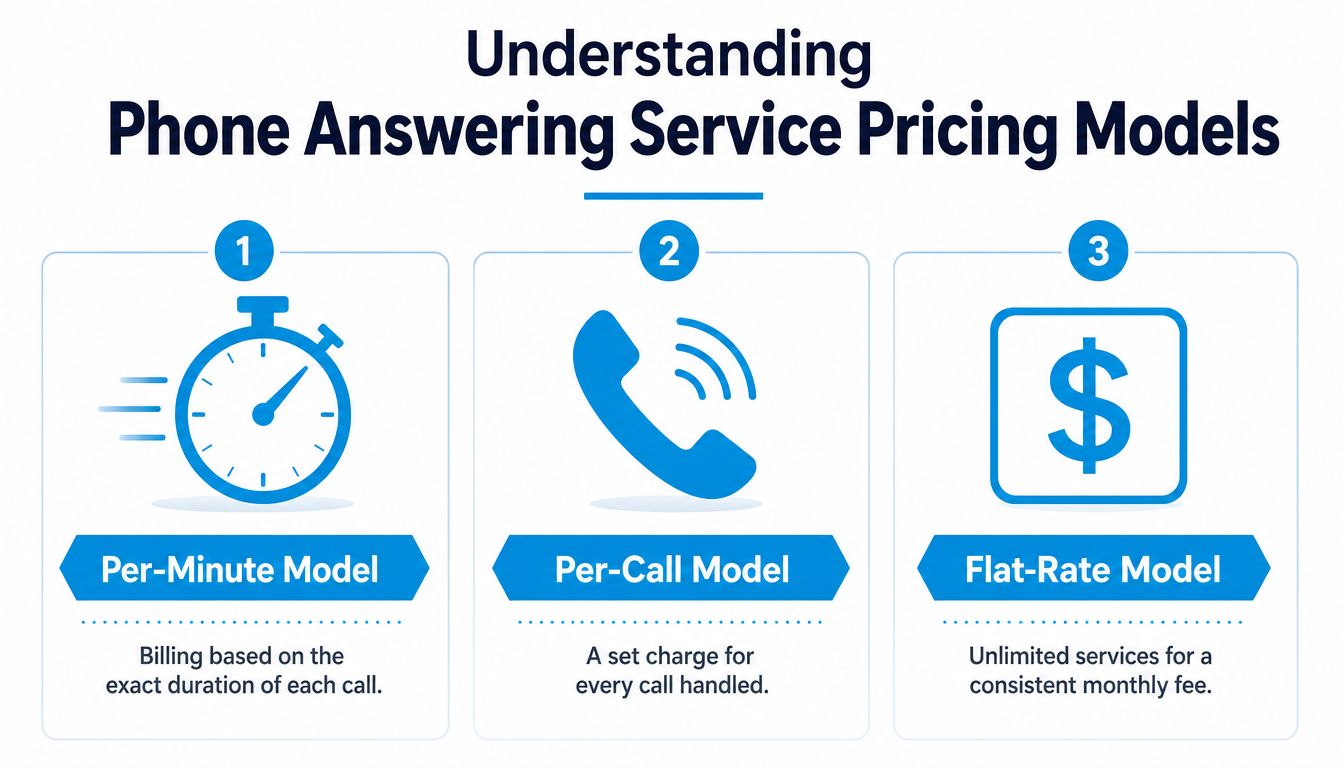
A better approach is to think in plain operating terms. Some models charge for time, some charge for events, and some charge for a usage bucket.
Per-minute pricing
Per-minute pricing is like a taxi meter. The longer the interaction runs, the higher the fare. That sounds fair, and in some cases it is. If your calls are short, predictable, and mostly involve message taking, this model can work.
A widely cited 2026 benchmark says that the average monthly cost for a traditional live phone answering service for small businesses in major markets like the United States ranges between $135 and $450, with the pricing model often relying on time-based billing ranging from $0.75 to $1.75 per minute for shared live agents, according to AMBS Call Center's 2026 pricing overview.
What goes wrong is simple. Long-winded callers, detailed intake, transfers, and hold time can turn a modest month into a much larger bill.
Here's when per-minute pricing tends to fit:
- Short routine calls: Message taking, basic dispatch notes, simple routing.
- Stable call patterns: Businesses that don't swing dramatically week to week.
- Tight script control: Teams that know exactly what the receptionist should and shouldn't do.
If you're comparing plans in this category, it helps to review a current breakdown of virtual receptionist pricing before you accept the provider's summary at face value.
A quick video can also help make the billing logic easier to spot in real quotes.
Per-call pricing
Per-call pricing is more like paying a toll each time a car passes through. Every answered call triggers a charge, whether the conversation is brief or involved.
This model is easier to forecast when you know your call count but not your call length. It can be useful for businesses that receive lots of short calls, especially if those calls don't require much work beyond intake and routing.
The catch is that not all calls have equal value. A one-minute wrong transfer and a serious new client inquiry can both count as a billable event. If your line gets spam, misdials, or repeat callback attempts, the economics can get ugly fast.
Flat-rate and hybrid structures
Flat-rate plans look attractive because they promise consistency. In practice, they usually mean a predictable monthly fee tied to a published cap, a fair-use threshold, or a defined service scope. It's similar to an all-you-can-eat buffet that still has rules in the fine print.
Hybrid structures mix elements together. You might pay a base fee for a bundle of usage, then add variable charges beyond it. Or you may use AI for front-line handling and reserve live agents for escalations. That's often a more rational structure because you're not paying human labor for every simple interaction.
Good pricing models don't just lower the monthly bill. They make the bill easier to predict.
Key Factors That Influence Your Monthly Bill
Two companies can buy what sounds like the same answering service and end up with very different invoices. The difference usually comes down to four levers: call volume, coverage hours, call complexity, and integrations.
Call volume
Volume is the obvious driver, but owners often underestimate how fast it compounds. It's not only how many calls come in. It's how many of them need handling outside your team's normal bandwidth.
For a straightforward benchmark, providing genuine coverage during business hours with booking needs typically costs between $500 and $900 per month, while full 24/7 coverage can push costs into the $700 to $1,200 range. A plumbing company receiving 150 calls monthly with booking needs would likely pay about $650 per month, according to Stakd Systems' 2026 answering service cost analysis.
That example matters because it reflects actual workflow, not brochure pricing. A plumbing company doesn't just need someone to say hello. It needs booking logic, dispatch awareness, and some triage.
Coverage hours
Coverage changes the labor model. Business-hours support is one thing. Nights, weekends, and holidays are another.
If you only need overflow handling while your front desk is busy, your costs will look very different from a business that wants every call answered around the clock. A pest control company with weekday support needs can often stay within a moderate spend. The same company adding after-hours emergency intake usually moves into a higher tier because someone, or something, must always be available.
A useful way to pressure-test this is to define coverage windows before you ask for pricing:
- Core hours: When your staff is already available, but calls still get missed.
- Extended hours: Early morning, evening, and lunch gaps.
- Full coverage: Nights, weekends, and holidays included.
Call complexity
Complexity is where cheap plans start to break. Basic message taking is low-friction. Appointment scheduling, lead qualification, insurance intake, and on-call dispatch all take longer and require more script discipline.
A dental office is a good example. A simple “please call us back” message doesn't take much. Confirming the patient's need, capturing contact details correctly, and booking into the right slot is a different service. Law firms run into the same issue when they need intake details instead of a generic callback note.
Operator mindset: Ask providers what the receptionist actually does on a live call, not just what the plan “includes.”
Integrations
Integrations decide whether the service removes work or creates more of it. If call notes land in the wrong inbox, appointments need to be re-entered manually, or lead details don't sync with your CRM, the monthly fee is only part of the cost.
The most useful setups connect with calendars, CRMs, practice software, and dispatch tools so your team doesn't have to rebuild every interaction by hand. This is also where service levels matter. If a vendor promises booking, transfer, or escalation workflows, make sure those promises are reflected in the operational terms. A practical checklist for that sits in this guide to service level agreements.
A simple way to score any quote is below.
| Cost driver | Lower-cost version | Higher-cost version | Practical example |
|---|---|---|---|
| Call volume | Limited overflow | Frequent inbound traffic | Seasonal HVAC spikes |
| Coverage hours | Business hours only | 24/7 coverage | After-hours plumbing dispatch |
| Call complexity | Message taking | Booking and qualification | Dental scheduling |
| Integrations | Email notes only | CRM and calendar sync | Law firm intake logging |
The True Cost of Live vs AI vs Hybrid Services
A small business can buy the cheapest plan on paper and still end up with the most expensive setup in practice. The deciding factor is not just monthly price. It is how often you pay human rates for low-value calls, how well the system contains routine traffic, and what happens when a call needs judgment.

Live services
Live answering earns its keep on calls where tone, context, and trust affect the outcome. Legal intake, emotionally charged healthcare calls, and urgent dispatch all fit that category. In those cases, a good agent does more than answer. They calm the caller, ask follow-up questions, and keep the interaction from turning into a missed opportunity.
The problem is utilization. If every inbound call goes to a person, you also pay live-agent rates for appointment changes, store hours, insurance questions, and wrong-number level noise. That is where traditional plans get expensive fast. The sticker price may look reasonable, but the true cost climbs when routine volume eats up minutes that did not need human attention in the first place.
AI services
AI shifts the cost structure by handling repetitive call types at a lower operating cost. It works well for booking requests, lead capture, after-hours screening, and common questions that follow a script. The value is not only lower monthly spend. It is consistency at high volume, especially outside business hours when live coverage is usually priced at a premium.
The limitation is just as important. AI is strongest in structured workflows. If callers ramble, switch topics, or need reassurance before they commit, containment rates can drop and transfers can rise. At that point, the savings on paper start to erode operationally because your team still has to step in and recover the call.
If you are comparing automation-first options, this breakdown of AI phone answering services is useful for understanding where they fit and where they do not.
Hybrid services
Hybrid usually gives small businesses the best cost control because it matches labor to call value. AI handles the predictable front end. Humans take the calls that are urgent, sensitive, or likely to convert better with a live handoff.
That model works particularly well in home services, multi-location clinics, and firms with uneven call complexity. A plumbing company does not need a person answering every request for business hours, but it may need one for burst pipes at 11 p.m. A dental office can let automation collect routine scheduling details, then escalate financing questions or anxious new-patient calls to staff.
Industry coverage from CMSWire's analysis of contact center AI adoption supports the broader point that companies are using AI to handle repetitive interactions while reserving human agents for higher-complexity conversations. This constitutes the hybrid advantage. It lowers the cost per routine call without stripping human judgment out of the moments that matter most.
How to compare the real cost
Use a simple question: what percentage of your call volume needs a person?
If the answer is high, live service may still be justified. If the answer is low, a live-only model often overpays for coverage. Hybrid sits in the middle and usually wins on total cost of ownership because it reduces paid human minutes, protects service quality on edge cases, and limits the operational drag of after-hours traffic.
The best choice is the one that keeps human attention on revenue, risk, and customer trust, instead of spending it on routine call handling.
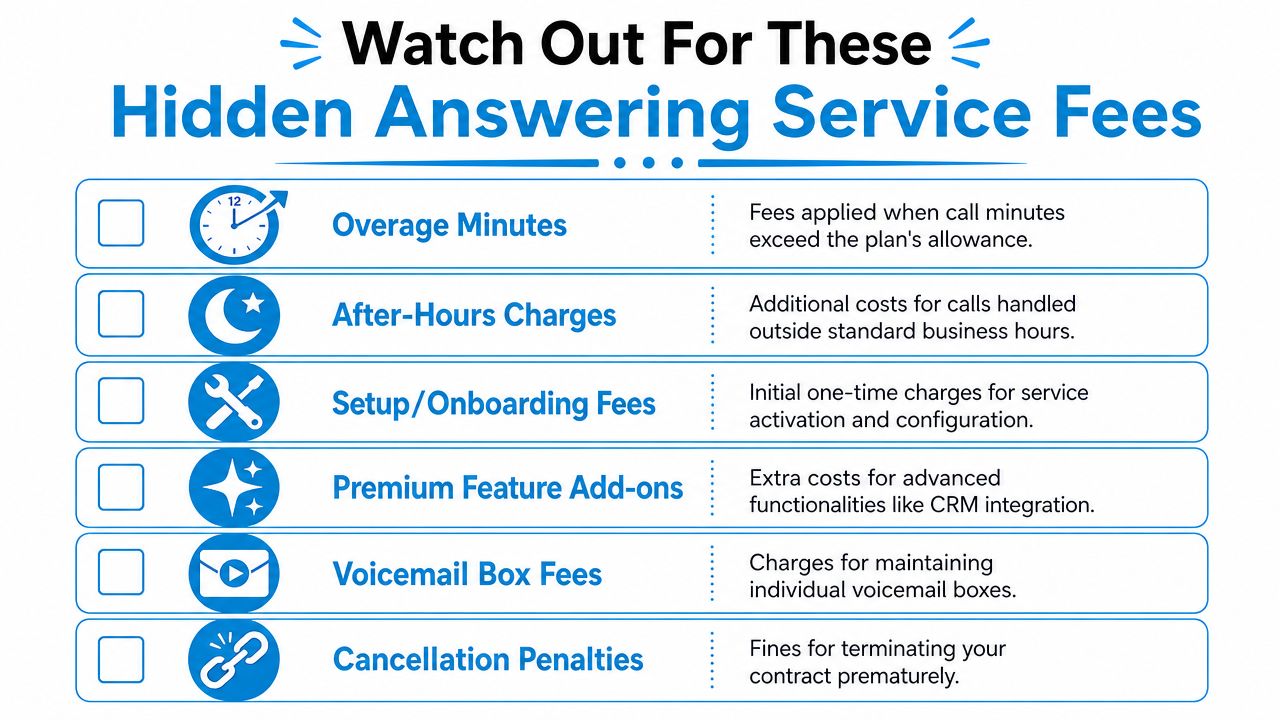
Watch Out For These Hidden Answering Service Fees
The advertised monthly fee is often the least important number in the quote. The primary risk sits in the line items, thresholds, and billing rules that only show up after onboarding.
Overage fees
This is the biggest trap. The industry lacks transparency on overage fees, where per-minute rates of $0.75 to $1.75 can double costs for unexpected spikes. For seasonal industries like HVAC, a base $200 plan could realistically cost $450+ during a storm emergency due to unannounced overage multipliers, according to Service Agent's pricing breakdown on hidden overage risk.
That scenario is realistic. A storm rolls through. Your team is already booked. Inbound calls jump. The service handles the overflow, which is what you wanted, but the monthly invoice now bears little resemblance to the advertised plan.
Setup, routing, and feature add-ons
Some fees aren't necessarily unfair. They're just easy to miss.
- Setup charges: Script building, onboarding, and workflow configuration can appear as separate fees.
- Transfer handling: Call patching or warm transfers may sit outside the base plan.
- After-hours premiums: Evening, weekend, and holiday handling may bill differently.
- Compliance features: Healthcare and legal workflows can require special handling and added cost.
- Integration add-ons: Calendar sync, CRM updates, or custom routing may not be included.
The issue isn't that these items exist. It's that some providers headline the base tier while leaving these operational essentials buried in the contract.
Questions that expose the real total
When I review answering service quotes, I want direct answers to billing mechanics before I care about brand promises.
Ask these questions in writing:
- What counts as a billable minute or call?
- How are overages billed, and when do they trigger?
- Do nights, weekends, or holidays price differently?
- Are transfers, appointment booking, or CRM notes included?
- Are there setup, cancellation, or script-change fees?
If a provider can't explain how your bill changes in a busy month, the quote isn't finished.
A good vendor doesn't just show a base price. They show how the plan behaves under pressure.
How to Estimate Your Spend and Maximize ROI
At 4:45 p.m. on a Friday, a missed call is rarely just a missed call. For a plumber, it may be a weekend emergency that goes to a competitor. For a clinic, it may be a new patient who never calls back. Estimating spend starts with that reality. The right budget is the one that protects revenue at a lower cost than handling calls poorly.
Start with your own call pattern, not a provider's sample package. Pull 30 to 90 days of phone records and look for three things: how many calls come in, when they cluster, and which ones produce revenue. Separate routine traffic from calls that need judgment. A price quote means very little until you know how much of your volume is simple scheduling, basic FAQs, lead intake, dispatch, or urgent escalation.
If you are opening a new location and lack call history, use the operating model behind the business. A gym, clinic, or service company can estimate likely call demand from class schedules, appointment volume, staffing hours, and lead sources. That is one reason broader startup planning matters. Owners reviewing fitness studio startup costs often budget carefully for rent, payroll, and equipment, yet underbudget front-desk call coverage that directly affects conversion.
Build the ROI math from your numbers
Use a simple worksheet:
(missed revenue opportunities recovered + labor time saved + after-hours coverage value) - total monthly service cost = ROI
That formula works because it includes more than lead capture. Many small businesses also save internal staff time when routine calls stop interrupting the front desk, dispatcher, or office manager. If your receptionist spends two hours a day answering repetitive questions, that labor has a cost. If after-hours calls currently hit voicemail, the revenue loss has a cost too.
Keep the estimate grounded in actual business value. Use average value per booked job, retained client, scheduled consultation, or qualified lead. Then test conservative assumptions. If the service only saves five strong leads a month, or frees up ten staff hours, does the contract still make sense?
Match the service model to the economics of the call
The best-fit option depends on what each call is worth and how often human judgment changes the outcome.
| Your call pattern | Usually the better fit | ROI logic |
|---|---|---|
| Mostly repetitive questions, scheduling, basic intake | AI | Lowest handling cost for high-volume, low-complexity calls |
| Sensitive intake, nuanced triage, high-ticket leads | Live | Higher cost, but worth it when conversion depends on a person |
| Mixed volume with clear escalation rules | Hybrid | Controls cost while reserving human time for high-value moments |
This is the practical trade-off many owners miss. Live answering can protect conversion on complex calls, but it gets expensive fast if half the volume is routine. AI can reduce cost per interaction, but it should not be handling emotionally sensitive, legally risky, or high-stakes calls without a clean handoff path. Hybrid models often produce the best total cost-of-ownership because they filter low-value traffic cheaply and apply human labor where it affects revenue.
A dental office is a good example. Appointment requests, hours, location questions, and simple reschedules can often be automated. Insurance disputes, anxious new patients, or urgent clinical concerns usually need staff or a trained live agent. If you pay live-agent rates for every routine call, ROI drops. If you automate everything, conversion and patient experience may suffer.
Stress-test the estimate before you sign
Run the quote through three scenarios: a normal month, a slow month, and a spike month. Then calculate your effective cost per handled call under each one.
That step catches bad-fit pricing faster than the headline rate does.
A service that looks affordable at baseline volume can become expensive during seasonal peaks, marketing campaigns, weather events, or staffing gaps. The right question is not “Can I afford the starter plan?” It is “What will this cost me in the months when I need it most, and what revenue does it protect when those calls hit?”
Owners who do this well usually end up with a clearer buying standard. They are not chasing the cheapest quote. They are choosing the model that gives them dependable coverage, predictable billing, and positive return after real operating costs are counted.
Frequently Asked Questions About Answering Service Pricing
Do answering services usually require long contracts
Some do, some don't. The practical issue isn't just contract length. It's what happens if you need to change usage, downgrade, or cancel after busy season. Ask for the term, renewal rules, and any exit penalties in writing before you sign.
Can I keep my current business phone number
Usually, yes. Many businesses keep their existing number and route calls through the answering service. Confirm how forwarding works, how after-hours routing changes are handled, and whether caller ID or tracking data is affected.
What if I need bilingual call handling
Many providers can support bilingual workflows, but you should test the experience. Ask how Spanish or other language calls are answered, whether the same script logic applies, and what happens if a caller needs escalation outside the default language path.
How should a provider handle sudden call spikes
The right answer is operational, not marketing language. A provider should explain what happens when volume jumps, how overflow is managed, whether service levels change, and how billing changes. If they can't walk you through a storm week, campaign launch, or staffing outage, assume the invoice and caller experience will both get messy.
If you're comparing options and want a model that blends AI call handling with human escalation, Recepta.ai is one option to evaluate. It handles inbound and outbound calls, appointment scheduling, lead capture, follow-ups, and integrations with business systems, then escalates when a live agent is needed. The useful question isn't whether any platform sounds impressive. It's whether the workflow, pricing structure, and escalation logic match how your business receives calls.