
Real Estate Lead Management How to Never Miss a Deal

A portal inquiry arrives while the agent is showing a property. A web form sits unread in a shared inbox. An open-house sign-in sheet never makes it into the CRM, and a promising Instagram message gets buried beneath routine notifications. By the time someone notices, the buyer has already spoken with another agent.
That isn't a lead-generation problem. It's an operational failure in real estate lead management. A reliable process captures every inquiry, identifies its intent, assigns clear ownership, responds quickly, and keeps working after the first unanswered call. The teams that close consistently don't just generate more names. They prevent good opportunities from disappearing between channels, inboxes, and handoffs.
Why Real Estate Lead Management Makes or Breaks Your Pipeline
A brokerage can have strong agents, attractive listings, and a healthy advertising budget, yet still lose transactions through a broken intake process. The usual pattern is familiar. A paid lead comes in, nobody owns it immediately, the first response happens hours later, and the contact is eventually placed in a generic CRM bucket with no next task.
The economics make that gap expensive. Multiple 2026 benchmarks place the national average lead-to-close rate at about 2% to 5% across all sources, while raw internet and portal leads often convert at only 0.4% to 1.2% according to the 2026 conversion benchmark report. Depending on source quality and follow-up discipline, a team may need roughly 20 to 250 leads for one closed transaction. That means every inquiry deserves a defined path, even when it doesn't look ready to transact today.
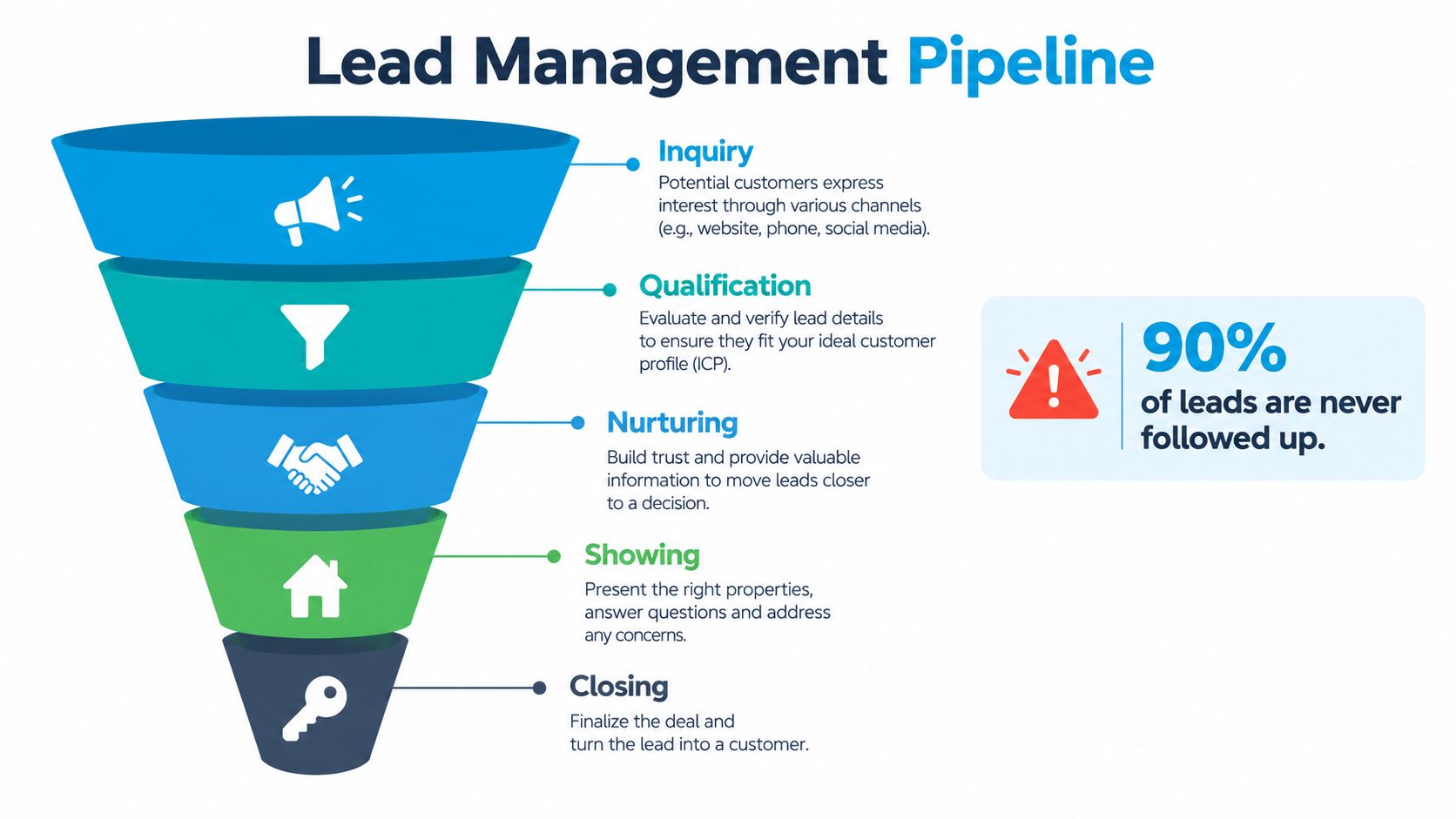
The funnel is small at the bottom
Top operators don't necessarily win by buying the most leads. Structured teams with dedicated intake processes can reach 5% to 10% conversion, while top individual agents with optimized systems report 8% to 15% close rates, as reported in the same conversion research benchmark. The difference usually comes from routing, speed, qualification, and persistence.
Consider a team paying for internet leads. The blended industry cost per lead is estimated at $448, with paid leads averaging $480 and organic leads $416, according to real estate lead-generation benchmarks for 2026. If the team closes only a small share, a missed call isn't a minor administrative issue. It consumes acquisition cost without giving the team a fair chance to qualify the opportunity.
A pipeline is more than a list of contacts. A useful explanation of pipeline sales definition helps clarify the operational point: every lead needs a current stage, an owner, and a next action. Without those fields, managers can't tell whether the team has a volume problem or a conversion leak.
Practical rule: Treat every inquiry as perishable inventory. If nobody captures, routes, and follows up on it, its value declines whether the lead is paid, organic, referred, or generated at an open house.
The answer isn't random persistence. It's disciplined channel management, including prospecting tactics that work, paired with an intake process that makes the first response automatic and the later follow-up visible.
Capturing and Qualifying Every Lead Without Letting One Slip
Start by listing every place a prospect can contact the business. Don't limit the map to the CRM's lead-source dropdown. Include portal inquiries, Google PPC forms, website valuation requests, open-house registrations, phone calls, text messages, social DMs, referral introductions, email, and leads handed over by another agent.
For each channel, document four things:
- Capture point: Where does the inquiry first appear?
- Required fields: What must be collected before assignment?
- Owner: Which person or queue receives it?
- Next action: What happens if the lead doesn't answer?
This inventory exposes the common blind spots. An agent may have a polished portal integration but no process for a Facebook message or a handwritten open-house note. Those contacts aren't less valuable because they arrived outside the main funnel.

Use one record and a simple qualification model
Every interaction should land on one CRM contact timeline. Log the original source, property or neighborhood of interest, buyer or seller intent, stated timing, budget or price range, preferred contact method, and the last action taken. This gives the next agent enough context to continue the conversation instead of asking the prospect to repeat everything.
A simple hot, warm, and cold model works when the criteria are explicit:
- Hot: The person has a near-term move, a defined property need, a workable budget, or a request for a showing or consultation. Assign immediate human follow-up.
- Warm: The person has a real need but an uncertain timeline, incomplete financing, or early research behavior. Use a personal touch followed by a relevant nurture sequence.
- Cold: The person has offered limited information or shown weak engagement. Keep the record, set a measured cadence, and avoid allowing it to compete with active opportunities.
A website inquiry asking for a valuation might be tagged seller, warm, valuation, and six-to-twelve-month timeline. After the first conversation, it can move into a market-update sequence with a task for a personal check-in. An open-house visitor who says they're already preapproved and want to buy locally should be tagged hot and assigned to an agent immediately, not left in a general event list.
The same principle applies to listing content. If an agent uses a highlight reel workflow for agents, the resulting engagement should still connect to the contact record, property, and next task. A compelling asset can create interest, but it doesn't qualify or route the person by itself.
Use a real estate virtual receptionist workflow when the team can't reliably answer calls during showings, evenings, or weekends. The technology matters less than the rule behind it: every source must produce a complete record and a visible next step.
Building Instant Routing and Response Workflows That Win First Contact
Speed-to-lead fails when a brokerage treats it as a personal virtue. A busy agent can't be the only control point. The workflow has to start the moment an inquiry arrives, identify the appropriate owner, and escalate when that owner doesn't act.
Responding within 5 minutes makes qualification about 21 times more likely than waiting 30 minutes, according to real estate lead response benchmarks. The same source reports that contacting within 1 minute has been associated with a 26% conversion-to-appointment rate, compared with 7% after 1 hour. Those figures don't mean every lead will become an appointment. They show why a queue that waits for someone to notice an alert is structurally unsafe.
Build the first-minute sequence
A practical workflow looks like this:
- Lead arrives: The form, portal, phone system, or DM creates a record.
- Auto-route: Rules assign the lead by geography, property type, language, round-robin ownership, or team specialization.
- SLA timer starts: The CRM records the arrival timestamp and begins the response window.
- Acknowledgment goes out: Send a concise SMS or email confirming receipt, then place a live call.
- Backup coverage activates: If the owner misses the required action, notify a backup agent or intake queue.
The acknowledgment should sound human and set a clear expectation: “Hi Sam, this is Jordan with Northside Realty. I received your request about the Oak Street home. I'm calling now, and you can reply here with the best time to talk.” It should not pretend that an agent has reviewed details they haven't seen.
Remove the silent failure points
Duplicate suppression prevents the same prospect from being assigned to several agents after submitting multiple forms. CRM timestamps let managers distinguish an unresponsive lead from a lead that was contacted but not documented. Calendar integration prevents an appointment from living only in a text thread.
Run the workflow across every channel, not just website forms. Industry coverage has reported median response times of 4 hours 47 minutes for brokerages, 2.3 hours for portal leads, and 3.1 hours for Google PPC leads, with none of the ten sources studied achieving a sub-5-minute industry median, according to the 2026 state of real estate lead generation report. That gap is where always-on intake earns its place.
The image above is required, but the workflow itself should also be tested in production. A Recepta.ai-style setup can handle inbound calls and lead capture around the clock, connect with 2,500+ tools, and pass qualified conversations into CRM and calendar workflows. For brokerages evaluating routing design, intelligent call routing provides a useful framework for separating ownership from availability.
Follow Up Cadences and Templates That Turn Cold Leads Warm
The first response only protects the opportunity. It doesn't create a relationship by itself. Many prospects are driving, at work, comparing agents, or still deciding whether to move, so the follow-up system must remain useful without becoming noisy.
A published real estate follow-up sequence recommends 8 to 12 touches over the first 30 days, followed by monthly contact for up to 12 months, according to lead follow-up strategies for 2026. Use that as a planning range, not a script that ignores intent. A referred seller deserves a different experience from an anonymous portal inquiry.
A workable multi-channel sequence
On the first day, call immediately, leave a short voicemail if needed, and send a text that identifies the property or request. Try again later at a different time rather than repeating the same attempt within minutes. The second attempt might be: “Hi Taylor, I tried you earlier about the condo inquiry. Are you looking for a place to move into soon, or are you still comparing neighborhoods?”
Use email when the lead needs context. A useful message might include the requested listing, a brief answer to the stated question, and one low-friction question about timing. Don't send a generic market newsletter as a substitute for responding to the actual inquiry.
After several unanswered calls, shift the channel mix. Text can ask for a preferred time, while email can offer a useful property update or buying resource. Every touch should add a reason to reply. “Just checking in” gives the prospect no clear reason to engage.
Match persistence to source and intent
Referrals and sphere contacts should receive near-immediate human attention because the relationship already carries context. Open-house leads need a prompt personal follow-up while the property and conversation are still fresh. Colder web leads need tight response controls, clear timestamps, and repeated attempts inside the first hour, followed by nurture if they don't engage.
A team without enough internal coverage can evaluate whether to hire cold callers for specific outbound work. That only helps when callers use approved scripts, record outcomes, and hand qualified conversations back to the same CRM process. Outsourcing activity without ownership creates another disconnected inbox.
Keep each outcome explicit: reached and qualified, reached and nurturing, wrong number, not interested, duplicate, do-not-contact, or awaiting a specific future date. When a lead says, “Call me after I speak with the lender,” schedule that task instead of relying on memory. Persistence works when the system knows why the next contact exists.
Tracking KPIs and Dashboards to Optimize Performance
A dashboard should answer operational questions, not decorate a monthly meeting. Which source produces qualified conversations? Which source consumes agent time without appointments? Where does response time expand, and which owner or shift is responsible?
Track the funnel by source. At minimum, managers need lead volume, response time, contact rate, appointment-set rate, qualified-lead rate, lead-to-close rate, and cost per lead. Keep paid, organic, referral, portal, open-house, PPC, and social leads separate. A blended average can hide a failing channel behind a productive one.
The available benchmark data shows why source segmentation matters. Expired listings had a 44% list rate and 20.7% sold rate, making them the highest-converting traditional source in that data set, while referrals ranked first overall, with 66% of sellers saying they found their agent through a referral or past relationship, according to real estate lead-generation statistics for 2026. Treating those contacts exactly like cold portal inquiries wastes the advantage of intent and trust.
Use a decision table, not one blended score
| Lead Source | Avg Conversion Rate | Avg Cost Per Lead | Recommended Action |
|---|---|---|---|
| Referrals and past relationships | Source-specific, typically stronger than cold inquiry sources | Organic benchmark, $416 | Assign immediate human follow-up and protect the relationship |
| Paid portal and internet leads | 0.4% to 1.2% for raw internet or portal leads | Paid benchmark, $480 | Enforce instant routing, duplicate suppression, and a documented cadence |
| All-source industry funnel | 2% to 5% national average | Blended benchmark, $448 | Review source mix, ownership, response time, and stage leakage |
| Expired listings | 20.7% sold rate and 44% list rate in the cited data set | Not specified in the benchmark | Prioritize trained callers and source-specific seller scripts |
| Organic leads | Source-specific | Organic benchmark, $416 | Measure by channel and nurture quality rather than blending all organic activity |
Use the performance dashboard framework to make the view actionable. A manager should be able to filter by source, agent, daypart, property type, and pipeline stage, then open the underlying contact records.
Diagnose the bottleneck before buying more leads
Suppose paid leads cost $480 each and the team converts at 2%. If disciplined qualification and follow-up move the team toward 5%, the same acquisition cost is supporting more transactions, even before the team changes its advertising. The point isn't to promise a specific return. It's to show why improving conversion can matter more than increasing volume.
First-responder advantage often beats total outreach volume. A team that contacts fewer leads quickly and documents the work can outperform a larger team that responds late.
Also track the failure metrics that teams tend to avoid. One benchmark reports an average agent response time of 917 minutes, with 49% of email leads receiving no response and 29% of phone inquiries receiving no callback, according to real estate lead response time reporting. Those aren't coaching anecdotes. They're signals to inspect routing, backup coverage, notifications, and CRM compliance.
Your Launch Checklist and Fixes for Common Breakdowns
A lead-management system is ready when a new inquiry can move from arrival to ownership without a person manually coordinating every step. Launch it in a controlled sequence rather than turning on disconnected automations all at once.
Set the operating foundation
- Map every source: Record the capture point, required fields, owner, and fallback action for portals, PPC, forms, calls, open houses, referrals, and DMs.
- Define CRM fields: Require source, intent, stage, readiness, engagement, timeline, budget or price range, and next action.
- Write response templates: Prepare the first SMS, email acknowledgment, voicemail, missed-call text, and appointment confirmation.
- Set routing rules: Assign by geography, property type, language, availability, or round-robin logic.
- Create escalation: Notify a backup owner when the primary agent misses the response window.
- Connect calendars: Ensure appointments create records, reminders, and ownership in the same system.
- Build nurture paths: Separate hot, warm, and cold leads, then tailor the cadence to source and intent.
- Add reporting: Make response time, contact rate, appointments, conversion, and cost visible by source.
Test the leaks deliberately
Submit a live website inquiry using a test identity. Call the main number outside normal office hours. Send a direct message from a personal account. Add a duplicate inquiry with the same contact details. Confirm that each test creates one record, routes correctly, triggers the expected acknowledgment, and escalates when the assigned owner doesn't act.
Common failures usually have straightforward fixes:
- Generic new-lead bucket: Add mandatory source, stage, readiness, and next-action fields.
- No backup owner: Create a rotating intake queue or on-call assignment.
- Unreturned inquiry: Trigger a second channel and manager alert after the missed response window.
- Duplicate records: Match on phone number and email before creating a new contact.
- Unclear handoff: Require the current owner to document status, context, and next task before reassignment.
- Dashboard without action: Tie every weak metric to a named owner and a specific process change.
One 2025 brokerage test found 41% of 74 top U.S. brokerages never responded, while only 9% replied within 5 minutes, according to real estate agent lead response statistics. Your first audit should therefore test response reliability, not just CRM appearance.
Consistency beats intensity: A modest workflow that captures, routes, records, and follows up every day will outperform a sophisticated process that the team uses only when someone remembers.
Review the dashboard regularly, fix the largest leakage point, and rerun the live inquiry test after every major workflow change. That's how real estate lead management becomes an operating system instead of another list of tasks.
Recepta.ai combines 24/7 conversational AI with human escalation for inbound calls, lead capture, qualification, appointment scheduling, and CRM updates, connecting with 2,500+ tools to keep fragmented brokerage workflows aligned. Visit Recepta.ai to see how an always-on intake and routing process can help your team stop losing opportunities between the first inquiry and the next action.