
Plumber Answering Service Setup Guide That Books More Jobs

A customer calls at 9 p.m. with water spreading across the floor. You're under a sink, driving between jobs, or already on another line. The call rings, reaches voicemail, and the homeowner immediately tries the next plumber. By the time you see the missed call, the job is gone.
That's the operating problem a plumber answering service should solve. It isn't merely a receptionist that records messages. Properly configured, it becomes an emergency intake and dispatch layer that answers promptly, identifies risk, collects the right information, and sends the job to the person who can act.
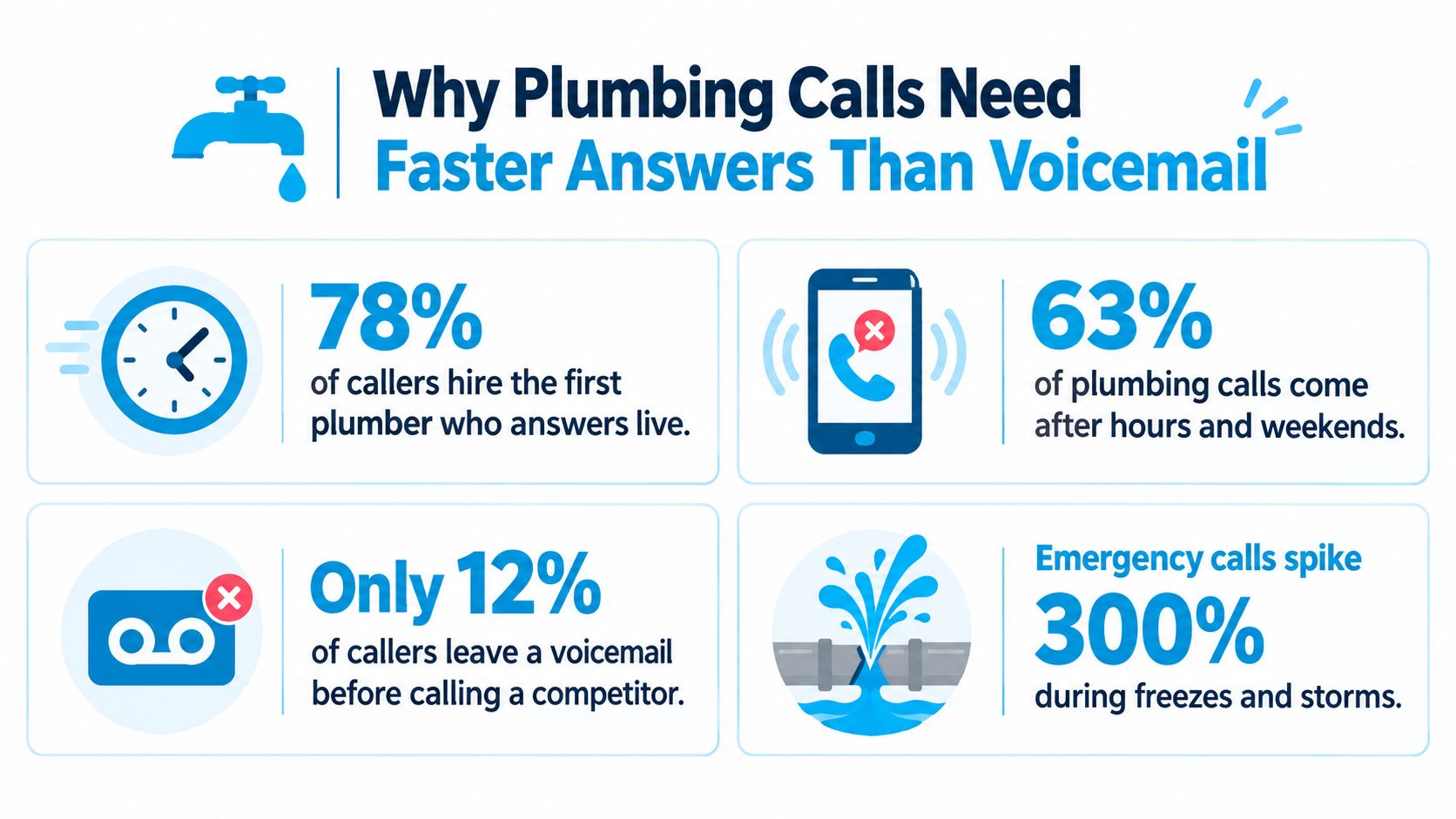
Why Plumbing Calls Need Faster Answers Than Voicemail
A burst-pipe call at 9 p.m. has a different buying pattern from a request for a faucet replacement. The caller isn't researching providers for next week. They need someone to stop damage now, and they'll usually keep calling until a real person responds.
The same pressure appears when a water heater fails on a weekend or a drain backs up after business hours. Industry coverage reports that 61% of plumbing calls can be missed after hours and on weekends, which explains why night and weekend coverage has become an operational requirement for many plumbing shops, not a courtesy feature. See the 2026 home-service missed-call benchmark for that after-hours context.
A 2026 contractor benchmark reports that only 44% of plumbing calls are answered live, while 10% are answered after hours, with an average of 4.1 rings to answer. Those figures point to two separate problems: availability and delay. A caller who waits through several rings may already be deciding whether to try another listing. The benchmark is documented in contractor phone-response data.
Treat every ring as a booking window
Voicemail fails most often when the caller's problem is urgent. One home-services analysis says 85% of customers who reach voicemail hang up and call the next provider, so a callback process can't be treated as equivalent to live intake. The analysis of voicemail behavior among home-service callers supports a simple operational rule: answer first, document second.
Before comparing vendors, audit your current performance:
- Measure by time block: Separate business hours, evenings, weekends, and overnight calls.
- Count silent losses: Include callers who hang up without leaving a message.
- Review ring duration: Identify when calls ring longest, especially while technicians are working.
- Mark job outcomes: Separate booked jobs, callbacks, information requests, and lost opportunities.
A missed-call recovery workflow can help organize that audit and return to callers who disappear before leaving a message. Use a missed-call recovery system as a complement to live answering, not as a substitute for it. Recovery is useful after a failure, but emergency triage works best when the customer reaches a capable person immediately.
How to Choose the Right Plumber Answering Service Model
The right model depends on how much judgment your calls require. A solo plumber who receives 8 to 15 inbound calls per day needs dependable coverage without paying for a full-time dispatcher who may sit idle during quiet periods. A larger team may need deeper scheduling logic, multiple on-call rotations, and direct dispatch-board updates.
The first filter is live pickup. Recent data says about 85% of callers don't leave a voicemail, while many businesses answer only 38% of calls on average, according to this plumber missed-call and revenue analysis. A service that collects messages may improve recordkeeping without improving booked work.
Compare the operating models
| Service Model | Best For | Triage Strength | Cost vs Dispatcher |
|---|---|---|---|
| AI receptionist | Small shops needing continuous first response and structured intake | Strong for defined emergency rules, service questions, and routine booking | Usually lower operational burden than hiring a dispatcher, depending on provider and usage |
| Human-only answering service | Owners who prioritize live empathy and flexible conversations | Strong for unusual situations, distressed callers, and nuanced explanations | Can be more economical than internal staffing for coverage, but pricing varies by call volume and service level |
| Hybrid receptionist | Teams needing automation for routine calls and human judgment for exceptions | Strongest when emergency calls, complaints, or complex scheduling require escalation | Can reduce dispatcher workload while preserving human support for calls that need it |
AI works well when your service area, job categories, hours, pricing guidance, and transfer rules are documented. Human agents are valuable when callers need reassurance, when the situation falls outside the script, or when a customer is upset. A hybrid model combines those strengths, but only if the handoff is immediate and the receiving person has the caller's details.
Screen providers for operational fit
Ask each provider to demonstrate a live emergency flow, not just read a feature list. The agent should identify the job type, determine whether water is actively flowing or property is at risk, capture the service address, and follow your escalation instructions.
Check the following before signing:
- Booking control: Can the service book only approved slots, or will it create conflicts?
- Dispatch access: Can it update your existing board, or will staff re-enter every call?
- Escalation flexibility: Can rules change by hour, technician, service area, or weather event?
- Call records: Do summaries contain the issue, address, access notes, and promised next step?
- Human fallback: Can a complex call move to a trained person without forcing the caller to start over?
For shops that need round-the-clock coverage, review what 24/7 call answering service coverage includes. “24/7” should describe live handling and defined action, not a message box that happens to accept calls overnight.
Building Call Scripts That Qualify and Convert Plumbing Leads
A good script sounds like a calm dispatcher, not a questionnaire. The caller should feel heard while the agent gathers the information your technician needs to make a safe decision.
Start with a direct greeting: “Thanks for calling [Company]. This is [Name]. Are you calling about an active plumbing problem, a scheduled visit, or a new estimate?” That opening gives the caller room to explain while immediately separating emergency intake from routine requests.

Ask emergency questions in the right order
For a burst pipe, the script should move quickly:
- “Is water actively flowing now?”
- “Have you been able to shut off the fixture or main water supply?”
- “Is water near electrical equipment, ceilings, or another area that creates immediate danger?”
- “What's the service address, and how can the technician access the property?”
- “What's the best number for the plumber to use?”
The agent shouldn't give unsafe technical instructions beyond your approved guidance. It should acknowledge the stress, confirm what happens next, and escalate according to your rules.
For a backed-up drain, ask whether sewage is present, which fixtures are affected, whether the issue is spreading, and whether the property is occupied. For a water-heater failure, ask whether there's active leaking, whether the unit is producing hot water, and whether the caller has noticed gas or electrical danger. Those questions help the dispatcher distinguish urgency without pretending to diagnose the repair remotely.
Use a separate flow for routine work
Routine calls need a cleaner booking close:
“Thanks, we can help with that. I'll collect the address, confirm the service area, and look for the next approved appointment. Is there anything about parking, gates, pets, or access that the technician should know?”
The final step is a commitment, not a vague promise: “Your appointment request is recorded for [time window]. You'll receive confirmation through [approved channel], and our team will contact you if the technician's route changes.”
A useful script doesn't just capture a message. It tells the caller what happens next, records the information your technician needs, and assigns ownership to a real person or workflow.
Keep the language natural and avoid stacking questions. Callers in distress may answer out of order, so the agent should confirm rather than repeatedly restart the intake. These phone-answering scripts for service businesses can help structure greetings, qualification, and booking language.
Here's a short example of a complete emergency exchange:
“I'm sorry you're dealing with that. I'll get the key details and alert the on-call plumber now. Is water still flowing, and is it near any electrical equipment?”
A script is only useful if the team can hear how it should sound in practice. Use the following media as a review prompt for tone, pacing, and note-taking standards.
Setting Up Escalation Rules and Dispatch Integration
An answering service becomes a dispatch engine only when every call has a defined destination. “Emergency” can't mean “send a message to the office.” It should trigger a known sequence, with a backup if the first person doesn't respond.
Home-service businesses miss roughly 40% to 60% of incoming calls, while plumbing answer rates are often cited around 38%, with after-hours answer rates near 12%, according to plumbing industry call-answering data. Those figures make escalation design more important than a polished greeting. A live answer that ends without action still leaves the emergency exposed.

Write the urgency map before configuring software
Use plain categories that agents and technicians can apply consistently:
- Emergency: Active flooding, sewage exposure, a burst line, or a hazard involving electrical equipment. Alert the primary on-call plumber immediately by the approved channels.
- Urgent: Loss of essential service, a serious leak that's contained, or a problem likely to worsen soon. Book the earliest suitable slot and notify the assigned team.
- Routine: Estimates, fixture replacements, maintenance, and non-urgent repairs. Capture details, answer approved questions, and schedule normally.
Set a fallback for every alert. If the primary on-call plumber doesn't acknowledge the emergency, the system should notify the backup or dispatcher. Don't leave this as an informal expectation. Write the order, response requirement, and final escalation destination into the operating procedure.
Weather events need a separate surge plan. When freezes or storms increase demand, temporarily widen the emergency team, shorten the alert path, and pause low-priority outbound follow-ups if they distract from active incidents. The answering team should know which services are unavailable before customers start calling.
Connect records, calendars, and dispatch boards
Integration checks should verify the whole handoff, not just whether an app has a connector. Test that the caller's name, phone number, address, issue, urgency, access notes, and appointment status move into the correct record without duplicate entry.
Common destinations include your CRM, shared calendar, and dispatch board. If your operation uses Housecall Pro or ServiceTitan, confirm whether the integration creates a job, adds a note, assigns a technician, and updates the customer-facing status. Reliable synchronization can also support efforts to improve SLA compliance with dispatch software, especially when the team tracks response ownership in one place.
Run test calls for a burst pipe, an urgent water-heater issue, a routine quote, a caller outside your service area, and a caller who refuses to provide access information. Confirm that real-time data sync preserves the same status across the answering platform and your operational tools. A failed test is cheaper to fix before launch than during a nighttime emergency.
Measuring Success and Optimizing Your Answering Service
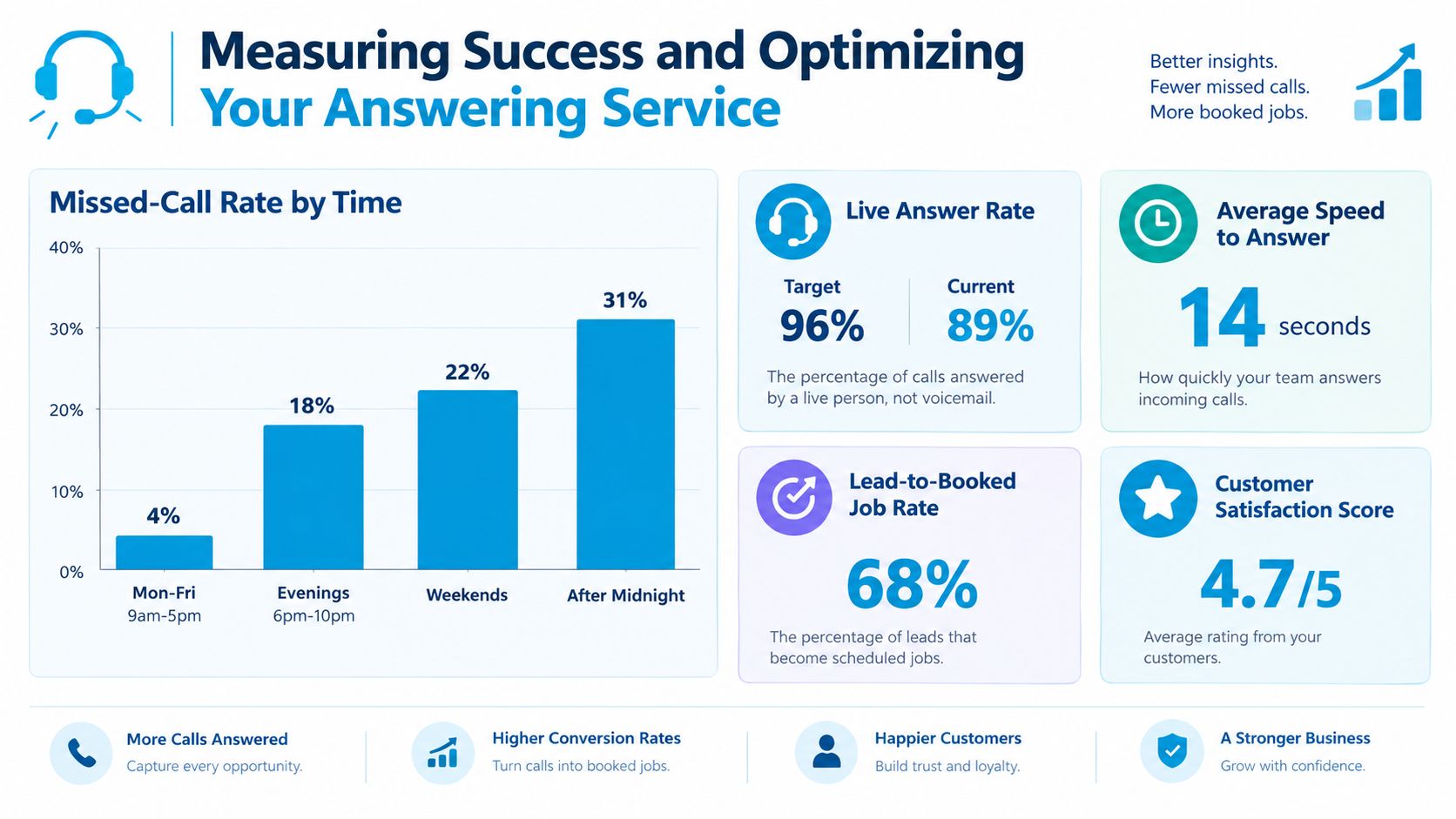
A phone system can report activity without telling you whether it booked profitable work. Track the path from ringing phone to completed handoff, then inspect where callers fall out.
Start with missed-call rate by hour and day. A practical benchmark reports that plumbing businesses miss roughly 22% of incoming calls on average, with peak periods pushing misses above 35%. Other industry tracking places plumbing missed-call rates closer to 58% to 61%, particularly after hours and on weekends, as documented in this plumbing phone-statistics methodology. The variation likely reflects different measurement methods, so use the figures as a reason to establish your own baseline rather than treating one benchmark as universal.
Review the metrics that change decisions
A weekly review should answer practical questions:
- Live answer rate: Which hours still send callers to voicemail or abandoned calls?
- Missed-call rate: Are losses concentrated during active jobs, evenings, weekends, or weather events?
- Booking conversion: Of calls that were qualified, how many became scheduled jobs?
- Speed to callback: When a live transfer fails, how quickly does the assigned person respond?
- Escalation completion: Did the on-call plumber acknowledge each emergency alert?
- Data quality: Are addresses, access notes, and job descriptions complete enough for dispatch?
Use call summaries and recordings, where permitted by your policies, to spot script failures. If callers routinely repeat their address, simplify that part of the flow. If routine callers reach emergency staff, tighten the classification questions. If emergency calls are answered but not acknowledged, fix the alert chain instead of rewriting the greeting.
Make one targeted change at a time
Avoid changing scripts, staffing rules, booking windows, and integrations simultaneously. You won't know which adjustment helped or created a new problem.
A useful weekly process is simple. Review a sample of emergency calls, compare missed calls by time block, inspect unbooked qualified leads, and choose one corrective action. That action might be adding a backup on-call contact, changing a booking rule, or requiring the agent to repeat the service address before ending the call.
For owners who need a more complete measurement routine, this guide to how to track business calls offers a practical foundation. Keep the reporting close to revenue and dispatch outcomes. A high answer rate that produces incomplete tickets isn't success, and a modest recovery rate that books the right emergency jobs may deserve more attention than raw call volume.
Your Launch Plan for a Plumber Answering Service That Pays Off
A workable launch doesn't require rebuilding your entire office. It requires a controlled handoff, clear ownership, and enough testing to expose failures before a real customer finds them.
Use the first month to prove the workflow
Days one through five: Export recent call records and establish your baseline. Mark missed calls, silent hang-ups, after-hours demand, emergency categories, and jobs that eventually booked. Write the service area, approved services, hours, booking windows, and on-call order in one document.
Days six through ten: Approve the scripts. Have the answering team practice a burst pipe, backed-up drain, water-heater leak, routine installation, price question, and out-of-area call. Remove any question that doesn't change routing, safety, scheduling, or technician preparation.
Days eleven through fifteen: Connect the calendar, CRM, and dispatch board. Run test calls from start to finish. Verify that alerts reach the right person, backups activate when needed, and the customer receives only promises your team can keep.
Days sixteen through twenty: Launch with close monitoring. Review every emergency handoff, every failed transfer, and every booking that lacks an address or access note. Let technicians report whether the intake helped them arrive prepared.
Days twenty-one through thirty: Hold the first optimization review. Compare missed-call patterns, live pickup, booking outcomes, callback speed, and escalation acknowledgments against your baseline. Make one change, document it, and repeat the review cadence.
Avoid the shortcuts that recreate missed-call chaos
Letting calls ring while technicians are working is the obvious failure. The quieter problem is undercounting callers who hang up without leaving a message, then assuming the voicemail queue represents all lost demand. A third mistake is sending every after-hours call to the same person without a backup path.
The central test is practical: if a burst-pipe caller reaches you at 9 p.m., does the system qualify the emergency, capture the address, alert the on-call plumber, and give the customer a credible next step? Industry coverage reports that plumbing misses can reach 61% after hours and on weekends, so that scenario deserves a live test, not a policy statement.
For a small shop, outsourcing intake can make more sense than hiring a dispatcher when coverage is uneven and the owner or technicians are already losing calls during jobs. The service still needs your rules, your voice, and your accountability. Treat it as part of dispatch operations, review it like any other workflow, and improve the handoff whenever the evidence shows a caller is getting stuck.
Recepta.ai provides 24/7 AI receptionist coverage for inbound and outbound calls, lead qualification, appointment scheduling, follow-ups, call summaries, and escalation to trained human agents when a situation needs empathy or expertise. Visit Recepta.ai to evaluate whether its answering and dispatch workflow fits your plumbing operation.