
First Call Resolution Best Practices for Business Impact

A customer calls your office on Monday about a billing mistake. Your team gives a partial answer, promises a callback, and moves on. On Tuesday, the same customer calls again because nothing changed. On Wednesday, they leave a voicemail because no one picked up. By Thursday, your staff has handled the same issue three times, and the customer is telling others your service is hard to deal with.
That pattern shows up in HVAC shops, dental practices, law firms, insurance offices, and multi-location service businesses every day. Repeated callbacks don't just frustrate customers. They eat agent time, crowd your phone lines, and make it harder to answer new inquiries that could turn into revenue.
Introduction to First Call Resolution
First call resolution is the discipline of solving a customer's issue completely during the first interaction, so they don't need to call back about the same problem. For small and mid-sized businesses, it's one of the clearest ways to improve service quality and control operating costs at the same time.
When first call resolution is low, teams feel busy but don't feel productive. Agents repeat work. Managers chase status updates. Customers retell the same story to different people. That's where service quality starts slipping even when the team is working hard.
A strong first call resolution approach changes the operating model. Instead of optimizing only for speed, businesses start optimizing for closure. That means cleaner handoffs, better scripts, stronger knowledge access, and clearer rules for what counts as “resolved.”
Practical rule: If the customer still needs to follow up, the issue wasn't resolved. It was delayed.
For business owners and operations leaders, that shift matters because first call resolution connects directly to customer loyalty, cost control, and capacity. When more issues get finished in one interaction, your team spends less time on preventable repeat work and more time on high-value conversations.
Understanding First Call Resolution Concepts
Think of first call resolution like a door repair visit. If the technician arrives, fixes the hinge, tests the latch, and leaves the door working properly, that's a one-visit success. If the technician tightens one screw but says someone else will come tomorrow to finish the job, the issue wasn't really resolved.
That's how first call resolution works in customer support. The customer's problem must be fully solved in the first interaction. No callback. No transfer. No escalation. No second conversation about the same issue.
What counts and what doesn't
A lot of teams confuse first call resolution with related service metrics.
- Average handle time asks how long the interaction took.
- Customer effort reflects how hard the experience felt.
- First call resolution asks a different question. Did the business fully close the issue the first time?
A short call can still fail. A longer call can still succeed if it ends with a true solution.
The standard formula is (Issues Resolved on First Contact ÷ Total Customer Issues) × 100 according to this FCR guide from Metropolis. The numerator must exclude any case that needed follow-up, transfers, or escalations.
Why strict definitions matter
Loose definitions create fake confidence. If an agent marks a case “closed” because they sent an email or logged a note, the dashboard may look healthy while customers keep calling back. That's one reason some teams report strong numbers while frontline staff still feel buried.
There's also a measurement trap around what some teams call resolution confidence. Internal systems may say the matter is done, but the customer may leave the call unsure, unconvinced, or still waiting on a real outcome. The gap between “closed in CRM” and “solved” is where many repeat calls begin, as discussed in Voice.ai's analysis of false closures and resolution confidence.
A useful test is simple. If you listened to the call recording without looking at the ticket status, would you believe the customer's problem was actually finished?
Business Impact and Key Performance Indicators
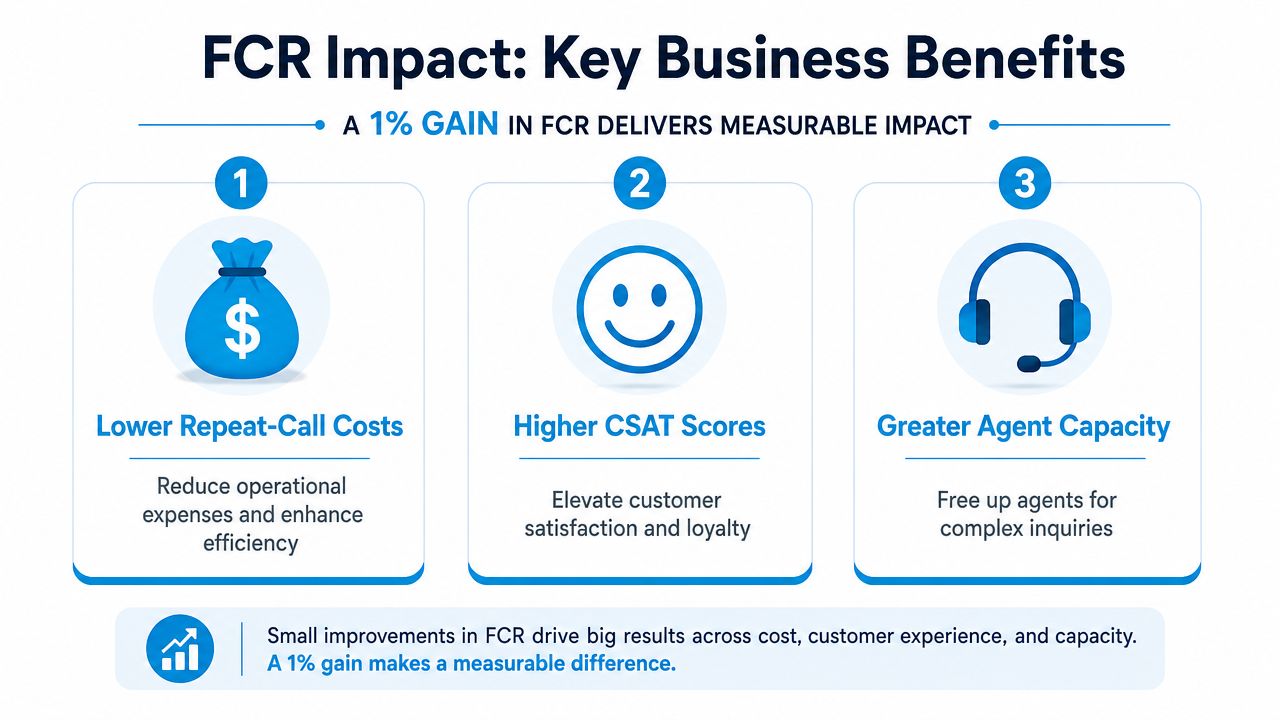
First call resolution matters because it changes both service quality and operating economics. When fewer customers need to call back, your team handles less duplicate work. That gives agents more room to focus on complex cases, new leads, and conversations that require judgment.
According to Ringly's first call resolution statistics, a 1% improvement in FCR saves a midsize call center approximately $286,000 annually and reduces repeat contact costs by 5% to 7%. That same source also notes that repeat handling can become far more expensive than solving the issue correctly the first time.
What leaders should track besides FCR
A single percentage never tells the whole story. Finance leaders, support managers, and owners should pair FCR with a few companion indicators.
- Customer satisfaction trends: Better resolution quality tends to improve customer sentiment. The same verified data set notes that a 1% improvement in FCR correlates with a 1% improvement in customer satisfaction scores.
- Cost per resolved issue: This shows whether your team is spending less to finish the same kind of work.
- Agent utilization: If repeat calls fall, agents can spend more time on fresh issues instead of reopening old ones.
- Repeat contact reasons: These reveal whether the issue lies in training, routing, policy, or missing system access.
If you're comparing tools to support this kind of measurement, this roundup of Best customer support platforms for SMBs gives a useful starting point for evaluating systems that centralize conversations and reporting.
Turning metrics into action
Numbers only help if managers can trace them back to behavior. A dashboard should answer questions like these:
- Which issue types fail most often
- Which agents need coaching on diagnosis
- Which handoffs create avoidable repeats
- Which workflows leave customers waiting
Teams that want cleaner visibility into those patterns should use reporting that ties outcomes to call reasons, agent behavior, and follow-up activity. A structured call detail reporting approach makes it easier to spot hidden repeat-contact loops before they become normal.
Manager's lens: Don't ask only “How many calls did we answer?” Ask “How many problems did we finish?”
Effective Measurement and Benchmarking
A 20-person plumbing company and a 200-agent support center can both report a 75% FCR rate and mean very different things. One may be counting only simple scheduling calls. The other may be counting billing disputes, reschedules, and technician follow-ups under one label. Measurement has to come before comparison.
FCR works like a store return policy. If every location defines “return” differently, the chain-level number becomes useless. The same problem shows up in customer service. If your team has not agreed on what counts as resolved, your benchmark is only a rough guess.
How to calculate FCR correctly
Start with the standard formula:
(Issues Resolved on First Contact ÷ Total Customer Issues) × 100
For a plain example, if your team handled 1,000 customer issues in a month and 740 were fully resolved during that first interaction, your FCR would be 74%. TechTarget's definition of first call resolution uses the same core idea. Count the total issues. Count how many were resolved without a repeat contact. Then divide and convert to a percentage.
The hard part is not the math. The hard part is deciding what “fully resolved” means in daily operations.
For a small or mid-sized business, that definition should be tied to actual workflows. If a caller asks to reschedule an appointment and the agent confirms the new slot during the call, that is resolved. If the agent says someone will call back after checking a calendar, that is not resolved yet. If a conversational AI assistant collects the request, checks availability, updates the schedule, and sends a confirmation before the interaction ends, that should count as resolved too. SMB teams often miss AI-assisted resolutions because they only measure human agent outcomes.
Set rules before you benchmark
Write the rules down first. Then train managers, agents, and anyone reviewing reports to use the same rules every time.
- Choose a repeat-contact window. Many teams use a fixed period such as a few days or a week for the same issue type. What matters is using one standard across the whole team.
- Define how transfers count. If a customer is passed to another person during the same interaction, decide whether that still counts as first contact resolution or only if the issue is fully closed before the customer leaves.
- Separate phone, chat, and AI-assisted conversations. A virtual receptionist that captures caller intent and routes correctly can improve outcomes, but you will not see that effect if all channels are blended together.
- Check internal tags against customer reality. An agent can mark a call “resolved” even when the customer still has to call back. Quality review helps catch that gap.
For ongoing quality control, many teams pair FCR tracking with call reviews and QA scoring. A practical call monitoring software setup helps managers compare what was marked in the system with what happened in the conversation.
Benchmark against peers with similar complexity
Industry averages are useful, but they are a starting point, not a target you copy blindly. A medical office, a legal intake team, and a home services dispatcher answer very different kinds of questions. Their FCR rates should not be judged the same way.
ICMI explains that FCR is commonly measured through both internal tracking and post-contact customer feedback, which is a helpful reminder for SMB operators who rely heavily on CRM tags alone. You can review that approach in ICMI's guide to first contact resolution. Internal logs show process compliance. Customer follow-up shows whether the issue stayed solved.
A more useful SMB benchmark table often includes business model and contact type, not just industry label:
| SMB context | What to compare |
|---|---|
| Appointment-based services | Resolved bookings, reschedules, cancellations |
| Technical support teams | Simple fixes vs. advanced troubleshooting |
| Multi-location businesses | FCR by location, shift, and routing path |
| AI-assisted front desk teams | Human-only FCR vs. AI-contained or AI-routed FCR |
That last row matters more each year. If your conversational AI answers after-hours calls, verifies intent, and completes routine tasks, your benchmark should show how often AI contains the issue without a repeat call and how often AI routing helps a live agent close it on the first interaction. Businesses exploring optimizing FCR with AI should track those paths separately, because they reveal whether automation is reducing repeat work or shifting it.
Tactics and Workflows for Higher FCR
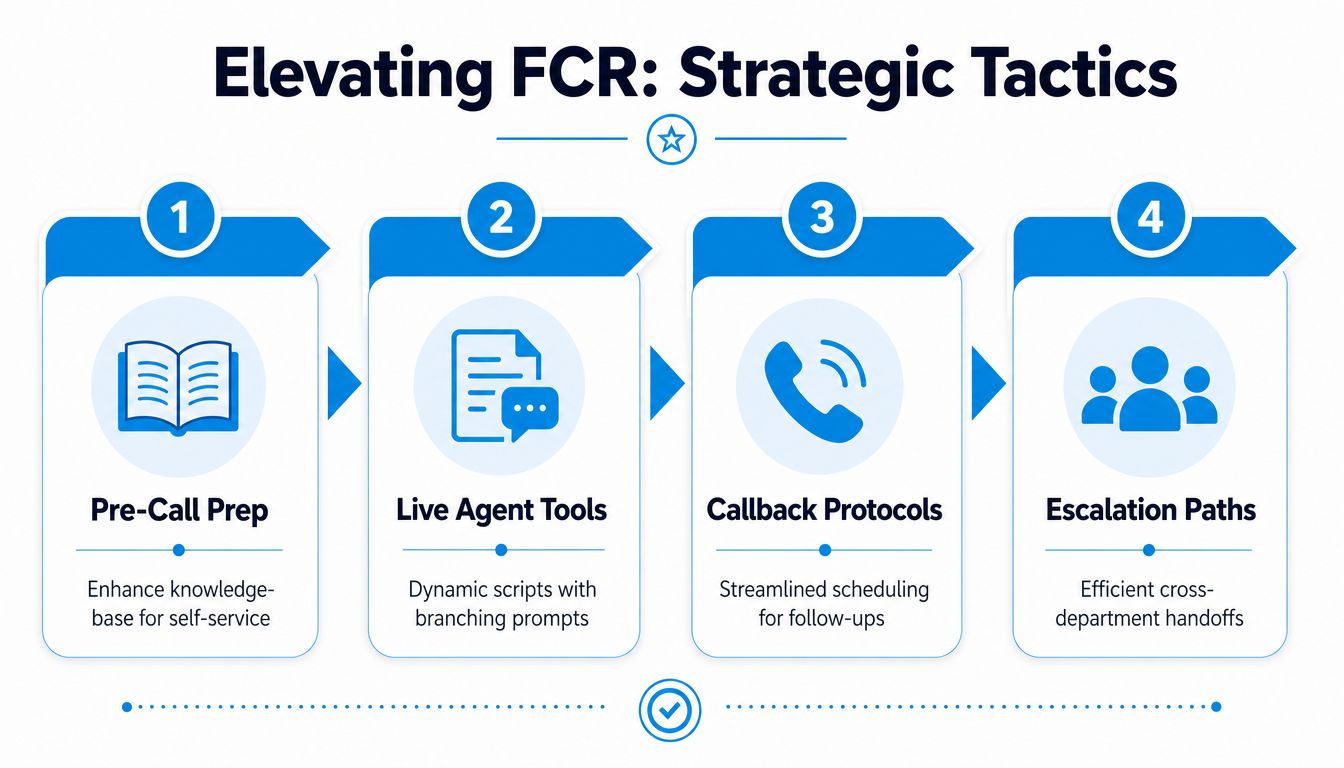
Improving first call resolution usually doesn't require one dramatic change. It comes from removing friction at each stage of the conversation. The strongest workflows make it easier for the first person who answers the call to finish the work.
Before the phone rings
Many failures happen before the call starts.
- Clean up the knowledge base: If agents can't find answers quickly, they stall, guess, or defer. An HVAC office, for example, should keep clear call guides for thermostat issues, warranty questions, maintenance plan details, and appointment availability.
- Map top call drivers: Billing questions, scheduling changes, intake forms, and service-area checks each need their own path.
- Give agents system access: They can't resolve what they can't see. If staff need to switch between calendars, CRMs, and notes just to answer a basic question, FCR will suffer.
During the live interaction
The goal is to diagnose well before solving fast. Rushing to answer the wrong question creates repeat calls.
A simple live-call workflow often works better than a complicated script:
- Confirm the primary issue
- Check related constraints, such as appointment rules or account status
- Offer the next complete action, not a partial one
- Verify customer understanding before ending the call
A plumbing company can apply this immediately. If a customer says, “My water heater stopped working,” the agent shouldn't only book a visit. They should also confirm urgency, property type, access details, technician availability, and any prep instructions so the customer doesn't need to call back later.
Solve the issue the customer actually has, not just the question they asked first.
For teams building those paths, this guide on optimizing FCR with AI is useful because it focuses on routing, context, and live guidance rather than only generic scripting advice.
After-call protocols that prevent repeat work
Not every issue can be closed instantly. But even when a task continues after the call, the customer shouldn't feel abandoned.
Use a tight follow-through checklist:
- Set one owner: One person or team should own the next step.
- State the timeline clearly: Tell the customer what happens next and when.
- Document commitments: Put the promised action in the system immediately.
- Trigger reminders: Don't rely on memory.
Call-handling discipline holds significant importance. Teams looking to tighten these moments can borrow ideas from structured call handling best practices to reduce dropped details and vague promises.
Build smarter escalation paths
Escalation isn't the enemy. Bad escalation is.
A good escalation path answers three questions fast:
- When should the frontline agent escalate
- Who receives the case
- What context travels with it
A legal intake team, for instance, might let staff handle consultation scheduling and basic eligibility questions, but send conflict-sensitive or emotionally charged matters directly to a trained specialist. That protects both the client experience and the FCR rate because the customer reaches the right person sooner.
Leveraging Conversational AI and Virtual Receptionists
Many small and mid-sized businesses lose first call resolution in the same places. After-hours calls go to voicemail. Routine questions wait for staff. Agents waste time copying notes into multiple systems. Customers call back because the first interaction produced a promise, not an outcome.
That's where conversational AI can help, especially when it's tied to real business workflows instead of acting like a standalone answering tool.

According to Nextiva's first call resolution analysis, AI receptionist platforms can maintain FCR above 75% by integrating CRM triggers, eliminating manual admin, and preventing lost opportunities from voicemail. That's especially relevant for offices that handle repetitive intake, scheduling, status updates, and routing questions.
Where AI fits best
AI is strongest when the issue is common, structured, and rules-based.
Examples include:
- Appointment scheduling: A dental office can let AI book, confirm, or reschedule visits without waiting for front-desk staff.
- Lead capture: A law firm can collect caller details, practice area, urgency, and preferred callback information on the first touch.
- Basic service triage: A home service company can classify the problem, verify location, and route emergencies correctly.
Value comes from the hybrid model. AI handles routine intent capture and repetitive tasks at all hours. Humans step in when the customer needs judgment, reassurance, or a more nuanced answer. That mix reduces the odds of false resolution, where the system technically finishes a task but the customer still feels stuck.
For teams exploring how these workflows support customer service, this overview of conversational AI for customer support is a practical place to start.
A short demo helps make that model more concrete:
The caution is simple. AI shouldn't be judged only by how many calls it contains. It should be judged by whether the customer got to a correct and confident outcome without needing to start over later.
Real World Examples and Success Metrics
A customer calls a plumbing company at 4:45 p.m. to report a leaking water heater. The office books the visit, but the caller never hears the arrival window, and the technician never sees the note about the shutoff valve location. The customer calls back twenty minutes later to repeat the problem and ask what happens next. That second call is the cost of poor first call resolution in its simplest form.
Real examples matter because FCR can sound abstract until you map it to one missed step in a real workflow. For a small or mid-sized business, the point is not to chase a pretty percentage. The point is to spot where the first conversation broke, then fix that point so the next customer does not need to call again.
A simple service-business example
Take a home service office that handles a month of inbound scheduling and dispatch calls. Some customers finish the call with a confirmed appointment, clear next steps, and notes that follow the job into the field. Others call back because something was left incomplete.
That split gives owners a usable picture of performance. One pile is resolved on first contact. The other pile is repeat contact about the same issue.
Once the calls are sorted, the review gets practical fast. In many service businesses, repeat calls come from a short list of causes:
- The appointment was not fully confirmed
- The technician notes were missing or hard to find
- The caller did not understand the next step
- The issue was routed to the wrong person
- The first agent lacked authority to finish the task
This works like inspecting failed handoffs on an assembly line. You are not guessing why output dropped. You are checking the exact station where work stopped moving.
How this looks in SMB teams using conversational AI
The pattern becomes even clearer when conversational AI is part of the call flow.
A virtual receptionist or voice AI can answer after hours, capture the service address, identify the problem type, confirm urgency, and place the request into the right queue. If that workflow ends with incomplete notes or a weak handoff, the live agent starts from scratch the next morning. The business may count the first interaction as handled, but the customer experiences it as unfinished.
That is why small and mid-sized businesses should track AI-assisted FCR separately from agent-only FCR. The question is not just whether AI answered the call. The question is whether the customer reached a correct outcome without repeating details later.
A dental practice offers a good example. If an AI receptionist reschedules an appointment, verifies the patient record, and sends a confirmation, that interaction has a strong case for first contact resolution. If the patient has to call back because insurance verification was not flagged correctly, the workflow failed at the handoff point, not at the greeting.
The same logic applies to legal intake. If the first conversation collects the matter type, urgency, opposing party conflicts, and callback preferences, the intake team can route the lead cleanly. If the prospect calls again to restate the basics, the first interaction created work instead of finishing it.
Success metrics that owners can use this week
Smaller teams need metrics that point to a fix, not metrics that just decorate a dashboard.
- Repeat contact reason by category. This shows which workflow is breaking most often.
- FCR by call type. Scheduling, billing, intake, and service updates usually perform differently. Looking at one blended score hides the problem areas.
- AI-contained and customer-confirmed resolution rate. This measures how often AI completed the task and the customer did not need to reopen it.
- Transfer rate by intent. High transfers often mean the script, routing logic, or staff permissions need work.
- Note completion rate. Missing notes create avoidable second calls.
- Callback within 24 to 72 hours for the same issue. This is one of the clearest signals that the first interaction did not finish the job.
For SMBs, these metrics are easier to manage when tied to a few high-volume call reasons instead of every possible scenario.
A practical review exercise
Pick ten repeat calls from last week. Listen to the first interaction and ask: what should the first agent or AI workflow have captured, explained, confirmed, or routed differently to prevent the second call?
That review often leads to specific fixes. You may need a better closing script. You may need one more required field in the intake form. You may need the AI workflow to confirm the appointment window before ending the call. You may need agents to see technician notes in one screen instead of three.
Those are the changes that improve FCR. They are small, concrete, and measurable. For small and mid-sized businesses, that is where success shows up first.
Conclusion and Next Steps
First call resolution improves when businesses define it tightly, measure it accurately, and redesign the moments that create avoidable callbacks. The pattern is consistent. Clearer workflows lead to fewer repeat contacts. Better measurement leads to better coaching. Smarter routing and AI support help routine issues get finished faster, while humans stay focused on judgment-heavy conversations.
Start with a short audit:
- Define what “resolved” means
- Calculate your current FCR
- Review repeat-contact reasons
- Fix one high-volume workflow first
- Test a hybrid AI process for routine calls
If you want to put those ideas into practice, Recepta.ai offers an AI receptionist model built for businesses that need better call handling, cleaner handoffs, and fewer missed opportunities. It's a practical option for piloting after-hours coverage, appointment workflows, lead capture, and CRM-connected follow-up without overloading your staff.