
What Is an Inbound Call and Why Is It a Goldmine

So, what exactly is an inbound call?
It’s pretty simple on the surface: an inbound call is any call that a customer or potential customer makes to your business. But the real magic is in the intent behind it. Think of it less like a random phone call and more like a customer walking directly into your storefront. They've already decided they need something, and they’ve chosen to come to you for it.
The Foundation Of Customer-Driven Communication
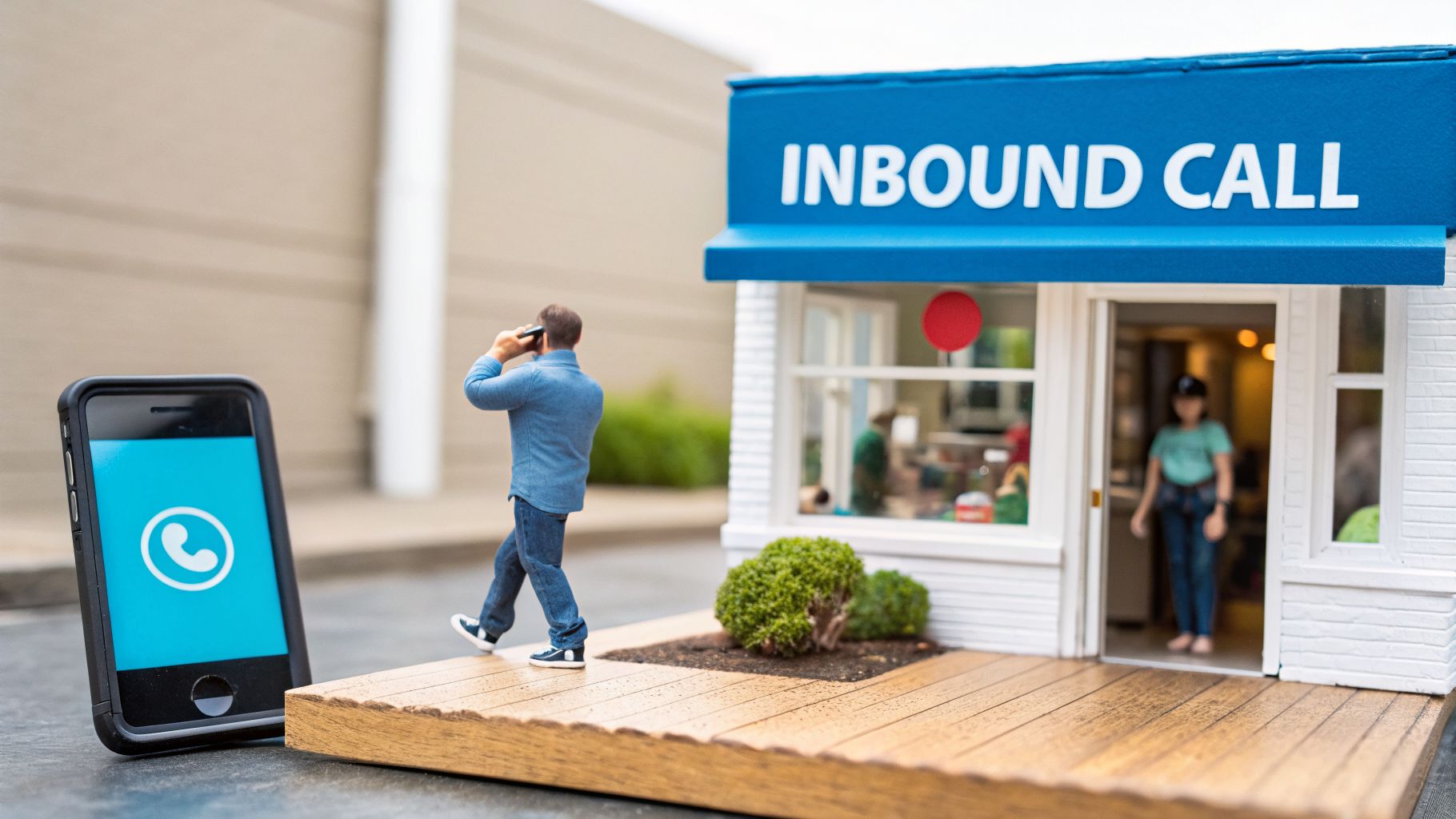
Unlike outbound calls where your team is doing the dialing, inbound calls are entirely reactive. Someone has a question, a problem, or a need, and they're reaching out to you for the answer. This simple flip—the customer coming to you—is what transforms a phone call into a powerful opportunity for sales, top-notch service, and building real customer loyalty.
These aren't interruptions to your day; they are high-value moments. The person on the other end has already done the legwork of finding your number and deciding to connect. That shows genuine interest. For a deeper look at this concept, check out this complete guide to inbound calls.
What Inbound Calls Look Like In The Real World
To make this crystal clear, let's paint a picture with a few common scenarios:
- A homeowner calls a local plumbing company because a pipe just burst and their basement is starting to flood. This is an urgent, high-intent call where the caller is ready to hire someone immediately.
- A potential client reaches out to a law firm to book a consultation after seeing a "Free Consultation" button on their website. They've already seen your offer and are taking the next step.
- An existing patient rings up a dental office to schedule their next six-month check-up and cleaning. This call is crucial for maintaining recurring revenue and patient relationships.
In every one of these examples, the customer started the conversation to solve an immediate problem or meet a specific need. These moments happen all the time. On average, a call center handles around 4,400 calls per month, and with 61% of business leaders seeing call volumes rise since 2020, their importance is only growing.
An inbound call is a direct line to customer needs and revenue opportunities. It signals that your marketing is working and a potential or existing customer trusts you enough to reach out for a solution.
Inbound vs. Outbound Calls: What's The Difference?
It’s crucial to understand how inbound calls differ from their counterpart, outbound calls. While one is about receiving, the other is about reaching out.
Let’s break down the core distinctions in a simple table.
| Attribute | Inbound Call | Outbound Call |
|---|---|---|
| Initiator | Customer or prospect | Business or agent |
| Primary Goal | Resolve issues, answer questions, close sales | Generate leads, conduct surveys, make sales |
| Caller Intent | High (they have a specific need) | Low (often an interruption) |
| Nature | Reactive (responding to a request) | Proactive (initiating contact) |
As you can see, the direction of the call completely changes its nature and purpose. To get the full picture, you can explore the nuances in our detailed comparison of inbound vs. outbound calls. Grasping this is the first step to building a smart strategy that makes the most of every time your phone rings.
The Four Main Types of Inbound Calls You Receive

Think of your business phone like a physical front door. People don't all knock for the same reason. Some are ready to buy, some need help with a past purchase, and others are just looking for information. To handle each person effectively, you first need to anticipate why they're calling.
When you can categorize the different types of inbound calls, you can equip your team to handle each one with confidence. It's the key to turning every conversation into a positive experience. Most calls you get will fall into one of these four common categories.
Sales Inquiries
These are your money calls. A sales inquiry comes from a potential customer who has already done some research. They've seen your marketing, heard about you from a friend, or found you online, and now they're reaching out to take the next step.
For instance, imagine a homeowner whose air conditioner just died on a 90-degree day. When they call your HVAC company for a quote, they aren't just casually browsing—they have a pressing need and are ready to make a decision. Or, picture a marketing director phoning your agency after reading a case study on your site. They're already sold on the results and want to know if you can do the same for them.
These callers have high intent. They've essentially qualified themselves, making them far more valuable than a name on a cold-calling list.
Customer Service and Support
On the flip side, you have calls from your existing customers. These folks already have a relationship with you, but they need help with a product, have a question about their bill, or need to solve a problem.
Here are a few classic examples:
- A long-time client of your cleaning service calls because a spot was missed during the last visit. How you respond—with an apology and a quick offer to fix it—determines if they remain a client.
- A patient phones their dental clinic to clarify a charge on their recent invoice. A clear, patient explanation can prevent a negative online review.
- A user of your software is stuck and needs help navigating a new feature. A quick, helpful walkthrough can turn them into a power user who advocates for your product.
How you handle these calls is a make-or-break moment for customer loyalty. It’s not about making a new sale, but about preserving the relationship you’ve already built.
Great support can turn a frustrated customer into your biggest fan. When you solve a problem efficiently and with empathy, you’re not just fixing an issue; you’re building trust that leads to repeat business and glowing reviews.
Appointment Bookings and Scheduling
For any service-based business—from medical clinics and law firms to home repair services—these calls are the operational backbone. They are straightforward and transactional, but absolutely essential. The caller has a simple goal: book, change, or cancel an appointment.
This might be a new patient scheduling their first chiropractic adjustment or a loyal customer booking their car for its annual tune-up. The key here is efficiency. A clunky, confusing booking process can easily send a potential customer straight to your competitor.
A smooth scheduling experience sets a professional tone for your entire business. Handling these calls well isn't just about being friendly; it's about quickly directing the request to the right place. Learning how to improve your process by screening phone calls can make a huge difference in ensuring every appointment is handled perfectly.
General Questions and Information Requests
Finally, don't underestimate the "quick question" call. These general inquiries might seem minor, but they represent a critical first impression.
Someone might call your restaurant to ask about parking options, or a potential attendee might phone to check the dress code for an event you're hosting. Maybe someone just wants to know if your shop carries a specific brand. A practical, helpful answer—like "Yes, there's a free public lot right behind our building"—shows you're customer-focused.
Each one of these questions is a touchpoint. It’s your chance to be helpful, professional, and memorable, turning a simple query into the beginning of a new customer relationship.
Why Every Inbound Call Is a Business Goldmine
It's easy to look at your phone bill and see it as just another operational cost—a necessary expense for keeping the lights on. But what if I told you that’s a fundamentally flawed way to look at it? Your phone line isn’t a cost center. When it rings, it’s not an interruption; it's a potential goldmine.
An inbound call is a direct line to someone who has already decided they need help and has actively picked your business to provide it. This isn't a cold lead you have to chase. It's a high-intent prospect or a current customer reaching out on their own terms. Every ring is a chance to make a sale, save a relationship, or get invaluable feedback straight from the source.
The True Cost of a Missed Call
When a caller with an urgent problem gets your voicemail, they don't patiently wait for a callback. They hang up and dial the next name on their list—your competitor. A missed call is so much more than a missed conversation; it's revenue you've just handed over. For any service business, where one appointment can lead to a major project, this is a critical, growth-stunting mistake.
Even with all the chat and email options available, people still pick up the phone for what matters most. Inbound calls are the lifeblood for industries like HVAC, law, and insurance. In fact, even with the rise of digital tools, over half of retail customers still prefer calling for urgent issues, and 61% of business leaders have seen their call volumes go up since 2020.
Think of it this way: if a potential client with a $10,000 project calls and can't get through, you haven’t just missed a call. You’ve likely just sent that $10,000 directly to the next business that answers their phone.
Turning a Single Call into a Major Win
Let me tell you about a local HVAC company we know. One afternoon, a frantic facilities manager called them out of the blue. The AC in an entire commercial building had just died, and he was scrambling to find anyone who could respond immediately and professionally.
Because the HVAC company answered right away with a knowledgeable person on the line, they had a technician on-site for an emergency assessment within the hour. That single, well-handled call didn't just result in a one-time repair job. It evolved into a lucrative, multi-year maintenance contract for the entire building, securing a foundational client for years to come.
That's the kind of ROI one phone call can deliver. The ability to handle every call, even with an after-hours answering service, is what separates businesses that are just getting by from those that truly thrive.
Why You Need to Measure Inbound Call Success (And How to Do It Right)
You've probably heard the old saying, "If you can't measure it, you can't improve it." When it comes to inbound calls, that's the absolute truth. Just counting how many times your phone rings is like trying to gauge your company's health by only checking if the lights are on. To really see what's going on, you have to dig into the right Key Performance Indicators (KPIs).
These aren't just abstract numbers on a spreadsheet. Tracking the right metrics tells you a story about your business—what's working, what's falling flat, and where your biggest opportunities are hiding in plain sight.
Every time your phone rings, it's a high-stakes moment. That caller has intent, and that intent often translates directly into revenue.
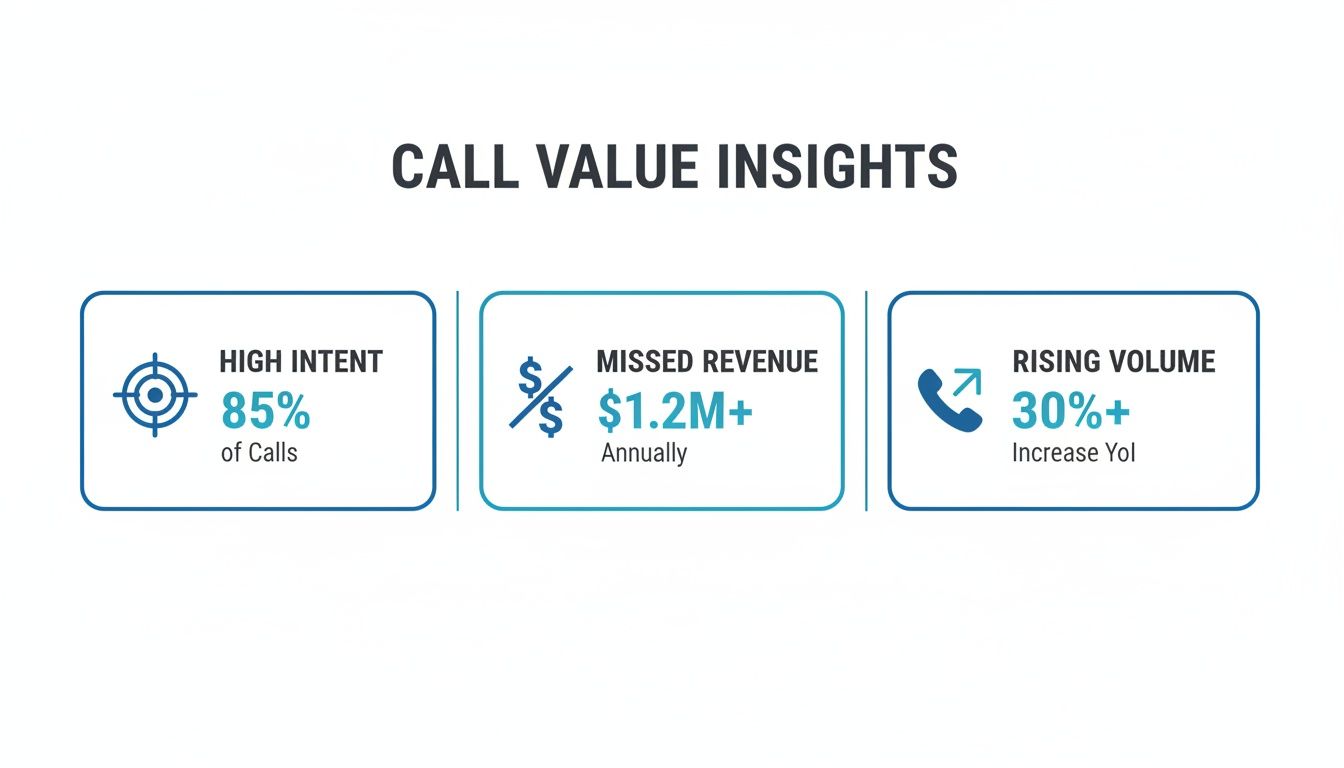
As this data shows, as your call volume goes up, so does the risk of leaving money on the table. That’s why it’s so critical to get a handle on these calls. Let's break down the metrics that matter most.
From First Ring to Final Outcome: The KPIs You Can't Ignore
To get a complete picture of your inbound call performance, you need to track the entire customer journey—from the moment they decide to call until their issue is resolved or an appointment is booked. A few core metrics provide a powerful snapshot of your team's effectiveness and the overall customer experience.
The table below breaks down the essential KPIs every business should be watching.
| KPI | What It Measures | Why It's Important |
|---|---|---|
| Call Abandonment Rate | The percentage of callers who hang up before reaching an agent. | A high rate is a red flag for long wait times or a confusing phone menu, signaling lost opportunities and customer frustration. |
| First Call Resolution (FCR) | The percentage of issues resolved completely on the first call. | High FCR means your team is efficient and knowledgeable, leading to happier customers and lower operational costs. |
| Conversion Rate | The percentage of calls that result in a desired outcome (e.g., sale, appointment). | This is your ultimate ROI metric. It directly measures how effectively your team turns inquiries into actual business. |
| Average Handle Time (AHT) | The average duration of a call, from start to finish, including any hold time and after-call work. | While you want to be efficient, a very low AHT could mean agents are rushing customers. It's about finding the balance. |
| Customer Satisfaction (CSAT) | A direct measure of caller happiness, often collected through a post-call survey. | This gives you direct feedback on the customer's experience, helping you pinpoint specific agents or processes that need improvement. |
Understanding what these numbers mean in practice is the key to turning data into action. Let's look at the three most critical ones in more detail.
Call Abandonment Rate
The Call Abandonment Rate is the percentage of people who give up and hang up before ever speaking to a human. This is one of the most vital signs for the health of your customer-facing process. If this number is high, you are actively losing business.
Imagine this: a potential client needs urgent legal advice and calls your firm. They're met with a confusing phone menu and then put on hold for two minutes. They hang up. They immediately call the next firm on their Google search. You didn't just miss a phone call; you lost a client, and all the revenue that came with them.
A high call abandonment rate screams that something is wrong. It's a clear signal that your wait times are too long, your IVR is a maze, or you just don't have enough people ready to answer the phone.
First Call Resolution (FCR)
First Call Resolution (FCR) measures how often your team can completely solve a customer's problem during their very first phone call. No follow-up needed, no "let me call you back." It's done. A high FCR is a hallmark of an efficient, well-trained team. It leads to delighted customers and frees up your staff from playing phone tag.
For instance, a patient calls your dental clinic to check if their insurance covers a specific procedure. If your receptionist can pull up the information and give them a clear "yes" or "no" right then and there, that’s a win. But if they have to take a message, check with the office manager, and call back hours later, the experience feels clunky and leaves the patient waiting.
Boosting your FCR is all about empowering your team with the information and authority they need to handle issues on the spot. You can see how in-depth data helps drive this by exploring our guide to call detail reporting.
Conversion Rate
At the end of the day, it's all about results. Your Conversion Rate is the ultimate bottom-line metric. It tells you exactly what percentage of your inbound calls lead to a real business outcome—a booked appointment, a new client, or a completed sale.
It looks different for every industry, but the goal is the same:
- For an HVAC company: How many calls about a broken AC unit turn into a scheduled service visit?
- For a real estate agent: How many inquiries about a listing become a scheduled property tour?
Let's say your marketing agency gets 100 calls from potential leads in a month. If 20 of those callers sign a contract, your conversion rate is 20%. This number is the most direct measure of your ROI, showing you how well your team transforms a simple phone call into tangible revenue.
How to Master Your Inbound Calls: A Practical Playbook
Knowing an inbound call is valuable is one thing. Actually capturing that value every single time the phone rings is another game entirely. Turning each call into a positive, productive experience isn’t about luck; it’s about having a clear playbook. A well-thought-out call flow doesn't just make customers happier—it directly boosts your booking rates and protects your hard-earned reputation.
It all starts the moment you pick up the phone. A warm, professional greeting instantly sets a positive tone, letting the caller know they’ve made the right choice. From there, the real work begins: actively listening to understand what the customer truly needs, rather than just waiting for a pause to jump in and talk.
Create a Simple and Effective Call Flow
You don’t need a rigid, multi-page script. All you need is a simple, consistent guide that empowers your team to handle calls with confidence, knowing they’re hitting all the right notes.
A great call flow really only has four key parts:
A Professional Greeting: Kick things off with a warm and consistent opening. Something like, "Thank you for calling Apex Plumbing, this is Sarah. How can I help you today?" works perfectly. It confirms they've reached the right business and immediately introduces a helpful human.
Active Listening and Empathy: This is where you train your team to listen more than they speak. When a customer is explaining a frantic situation, repeating it back shows you're locked in. "Okay, so just to confirm, your upstairs toilet is leaking water through to the ceiling below?" That simple sentence tells them you get it and you understand the urgency.
Offer a Clear Solution: Once you grasp the problem, give them a straightforward path forward. For a plumbing leak, that's: "I can have a technician at your house within the next 90 minutes. Is that okay?" For a less urgent call: "The first available appointment is tomorrow at 2 PM. Does that time work for you?"
Confirm Next Steps: Never hang up without making sure everyone is on the same page. A quick summary like, "Alright, I have you scheduled for Thursday at 10 AM with our technician, Mark. You'll get a text confirmation in just a moment," removes all doubt and leaves the caller feeling cared for.
Practical Tips for Building Real Rapport
The little things you do on a call make a huge difference in how a customer feels about your business. Using the caller's name once or twice during the conversation makes the interaction feel personal, not transactional. It’s a small signal that you see them as a person, not just a ticket number.
The most fundamental rule of handling any inbound call is to make the caller feel heard and valued. When someone believes you genuinely care about their problem, you're not just solving an issue—you're building a loyal customer.
One of the biggest hurdles for any service business is handling calls that come in after hours. Let’s be honest, voicemail is where hot leads go to die. A customer with an urgent need isn't going to leave a message; they're just going to call the next name on the list. A modern approach ensures every call gets a response, even at midnight on a Saturday, so you stop losing customers to your competitors.
How AI Receptionists Change the Game for Inbound Calls
Even with the best team, a fundamental problem persists: your customers don’t just call between nine and five. The old headaches of missed calls after hours, inconsistent service during busy periods, and the high cost of staffing are all too real. This is exactly where AI receptionists, like Recepta.ai, step in to fundamentally shift how you manage inbound calls.
What if you never had to send a motivated caller to voicemail again? That’s the idea. An AI receptionist is on the clock 24/7/365, making sure every call gets an instant, professional answer—whether it's peak business hours or the middle of the night on a holiday.
That immediate response is absolutely critical for capturing leads that would otherwise evaporate. For any business that runs on appointments, from dental clinics to home service companies, it's the difference between a booked job and a caller simply dialing your competitor next on the list.
Capture Every Single Lead and Opportunity
A human receptionist can only be in one place, answering one call at a time. AI receptionists don't have that limitation. They blend intelligent automation with the option for human oversight, giving you a system that scales instantly.
The AI is built to handle the routine—but vital—tasks with flawless consistency. It can qualify new leads by asking the right questions, answer common queries, and book appointments directly into your calendar, all without a single click from your team.
Think about this real-world scenario:
A potential client finds your law firm through an online ad and calls at 8 PM. Instead of hitting a voicemail box, they're greeted by a polished AI assistant. It asks a few qualifying questions ("Are you a new or existing client? What type of legal matter is this regarding?"), checks your firm's calendar, and books a consultation for the next day. Instantly, the appointment and client notes are pushed to your CRM, and a confirmation text is on its way to the client.
By combining conversational AI with human agents for more complex conversations, this hybrid approach gives you the best of both worlds. You get incredible efficiency for routine calls and an expert human touch exactly when it’s needed most.
This is why businesses that adopt this model often see a 30% increase in qualified leads. You’re simply converting the opportunities you were previously missing.
Automate Workflows and Slash Costs
Perhaps the biggest advantage of an AI receptionist is its ability to plug right into the tools you’re already using. By connecting with over 2,500 applications, a platform like Recepta.ai doesn't just answer the phone; it triggers entire workflows.
- CRM Integration: A new lead calls, and their contact info and a call summary are automatically created in your CRM. Manual data entry becomes a thing of the past.
- Calendar Sync: Appointments scheduled by the AI appear directly on your team's calendar, eliminating any chance of a double-booking.
- Instant Notifications: Your team gets immediate alerts for high-priority leads or urgent support issues, enabling quick follow-up when it counts.
This level of automation leads to serious cost savings. Many businesses report an 80% reduction in overhead compared to hiring a full-time, in-house receptionist. You get complete call coverage without the associated salary, benefits, and training costs, effectively turning your phone line from a cost center into a reliable revenue driver.
Frequently Asked Questions About Inbound Calls
Now that we've covered the fundamentals of inbound calls and their importance, let's dig into the questions I hear most often. These are the practical, real-world concerns that come up when you start thinking about how to manage your phone lines more effectively.
Can I Use Automated Systems For My Inbound Calls?
Absolutely, but you have to be smart about it. An automated system like an Interactive Voice Response (IVR) menu can be a lifesaver for routing calls efficiently—think "Press 1 for Sales, Press 2 for Support."
The trick is to keep it simple. If a caller has to navigate a maze of options ("Press 7 for billing inquiries related to services performed in the last 30 days..."), they'll get frustrated and hang up. This contributes to a high call abandonment rate, which is just another term for lost business. Always, always give them a clear and easy way to reach a real person, like "Press 0 at any time to speak with a representative."
How Does Inbound Calling Differ From Outbound Sales?
It all comes down to who initiates the conversation. An inbound call is reactive; a customer has a need, and they are calling you for a solution. An outbound sales call, by contrast, is proactive. Your team is making the first move, reaching out to a potential customer who might not even know they have a need yet.
An inbound caller has high intent; they've already identified a need and chosen to contact you. An outbound call, on the other hand, often has to generate that interest from scratch.
Think of it this way: an inbound call is like a customer walking into your store. An outbound call is like your salesperson knocking on their door. The mindset and approach for each are completely different.
What Is The Best Way To Handle After-Hours Calls?
Letting your calls go to a standard voicemail after hours is one of the costliest mistakes you can make. A potential customer with an urgent problem isn't going to leave a message and hope for a callback. They're just going to call your competitor.
Instead of losing that business, consider these far better options:
- A Professional Answering Service: This guarantees a trained, live person answers the phone, no matter the time of day or night, and can dispatch emergency calls to an on-call technician.
- AI Receptionists: A modern solution that can handle common questions, book appointments into your calendar, and capture vital lead information 24/7.
- Clear Voicemail Instructions: If you absolutely must use voicemail, be crystal clear about when the caller can expect a response. For example: "You've reached us after hours. Please leave a message and we will return your call within the first hour of the next business day."
As technology continues to evolve, the tools available for customer engagement are becoming incredibly powerful. For a closer look at how AI is shaping these interactions, many businesses are turning to resources on Conversational AI for Sales.
Ready to capture every opportunity and turn your inbound calls into a predictable source of revenue? Recepta.ai provides a 24/7 AI-powered receptionist backed by human expertise, ensuring you never miss another lead. See how we can help you grow by visiting https://recepta.ai.