
What Is Call Forwarding and How Can It Grow Your Business
At its core, call forwarding is a simple idea: it makes sure your calls find you, no matter where you are. Think of it like a personal mail forwarding service you set up at the post office, but for your phone calls. It’s a feature that automatically redirects incoming calls from one number to another, ensuring you never miss a critical conversation.
What Is Call Forwarding and How Does It Work?
Let's put this into a real-world scenario. Imagine you run a busy plumbing service. A potential new customer has a burst pipe and is frantically searching for help. They call your main office number, but you’re out on-site at another job.
Without call forwarding, that call would probably go to a frustrating voicemail box, and that panicked customer would just hang up and call the next plumber on the list. But with call forwarding, the call is instantly—and silently—rerouted straight to your mobile phone. You answer, book the emergency job, and capture thousands in revenue. All because the call reached you, right when it mattered most.
This is the real power of call forwarding. It's a simple but incredibly effective rule that bridges the gap between your primary business number and wherever you or your team happen to be.
The Basic Mechanics of Rerouting Calls
So, what happens behind the scenes? When a customer dials your business number, the phone system doesn't just ring the phone on your desk. First, it quickly checks for any forwarding rules you’ve set up. If a rule is active, the system immediately sends the call to its new destination before your caller even knows anything has happened.
For the person on the other end of the line, the experience is completely seamless. They just hear a normal ringtone and then get connected. This maintains a polished, professional image for your business. That rerouted call can be sent to all sorts of places, like:
- Practical Example: A solo real estate agent is showing a property. They forward their office line to their personal cell phone so they can answer urgent calls from buyers without having to run back to their desk.
- A colleague’s direct line if you’re in a meeting.
- An on-call technician's phone for after-hours support.
- An automated system or an AI receptionist to handle initial queries.
Key Takeaway: Call forwarding is more than just a convenience. It's a core business strategy that ensures every single call has the best possible chance of being answered by the right person, preventing lost leads and frustrated customers.
To get the most out of modern call forwarding, you really have to understand the technology that powers it: VoIP for Small Business. Unlike old-school landlines that were physically tied to one location, VoIP (Voice over Internet Protocol) has turned basic call routing into an intelligent and flexible business tool. It's what allows for the complex rules and instant rerouting that modern businesses rely on. These capabilities are the foundation of any good small business phone system today.
Exploring the Different Types of Call Forwarding
So, we've covered the basics of call forwarding. But it isn't just a simple on-or-off switch; it’s more like a toolkit with different tools for different jobs. The best setup for you really boils down to how your business operates day-to-day. Getting this right is the key to boosting your efficiency and making sure no opportunity slips through the cracks.
Not all call forwarding is the same. The different options give you fine-tuned control over when and where your calls go, transforming a basic feature into a seriously powerful business asset. Let's look at the main types you'll come across.
Unconditional Call Forwarding
Unconditional Call Forwarding is the most direct of the bunch. Think of it as a permanent detour. When you switch this on, 100% of your incoming calls are immediately sent to another number. Your primary phone won’t even ring. It’s an "all or nothing" approach.
This is the perfect move when you want every single call to be handled by a specific person or service, without exception.
- Practical Example: A freelance graphic designer is going on a two-week vacation. They set up unconditional forwarding from their business line to their partner's number to handle any urgent client requests while they are completely unplugged.
Conditional Call Forwarding
Unlike the all-in nature of unconditional forwarding, Conditional Call Forwarding is much more flexible. It acts like a safety net, rerouting calls only when certain conditions are met. This is what you want for backup coverage when you’re just not available to pick up.
You can set rules for common situations:
- When Busy: If you're already on a call, the new caller gets forwarded instantly instead of hitting a frustrating busy signal. Actionable Tip: Forward busy calls to a colleague or a receptionist who can take a message or help the caller immediately.
- When Unanswered: If the phone rings a few times with no answer, the call is automatically sent to the next number in line. Actionable Tip: Set unanswered calls to forward to your mobile after 4 rings, so you have a chance to answer at your desk first.
- When Unreachable: If your phone is off, out of service, or in airplane mode, calls are immediately rerouted so they don't just vanish into a void. Actionable Tip: If you work in an area with spotty reception, set unreachable calls to forward to a landline or an AI answering service.
Real-World Scenario: A plumbing company relies on conditional forwarding for their after-hours emergencies. If a call comes in at 2 AM and the main office line rings three times unanswered, it automatically forwards to the on-call technician’s cell. This simple rule ensures they never miss an urgent, high-value job.
Time-Based Call Forwarding
This is where things get even smarter. Time-Based Forwarding, sometimes called time-of-day routing, directs calls to different places based on the clock or the calendar. It’s all about making your call flow match your actual business hours.
- Practical Example: A retail franchise uses time-based forwarding to manage calls across its locations. From 9 AM to 5 PM, calls to the main number are routed to their downtown store. But after 5 PM and on weekends, all calls automatically go to their 24/7 location at the mall. Customers always reach a live person, no matter when they call.
This decision tree gives you a visual for how these forwarding rules work. The system takes a call, checks your settings, and then sends it down the right path.
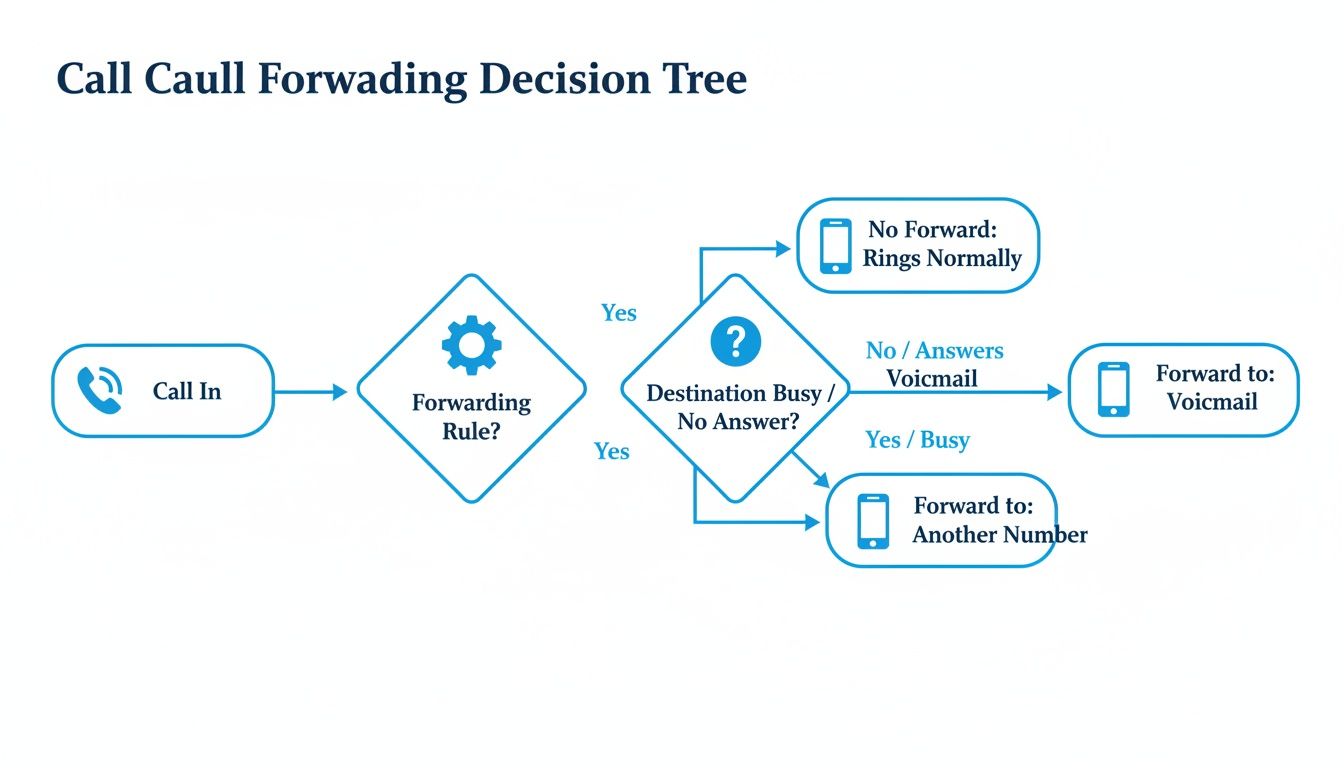
Ultimately, the goal is to build a system that does more than just reroute calls—it should manage them intelligently. To see how this can be put into practice, take a look at our guide on using an automated phone answering service.
Call Forwarding vs. Call Transfer vs. Voicemail
It's easy to get call forwarding, call transfer, and voicemail mixed up—they all manage calls you can't take immediately. But in practice, they do very different jobs. Using the right tool for the right situation is the key to creating a great caller experience and making sure you never miss a valuable lead.
Think of call forwarding as your automatic receptionist. It works behind the scenes, following a set of rules you create. Before a call is even answered, the system checks your rules—is the line busy? Is it after 5 PM?—and instantly reroutes the call to a different number. It’s a proactive strategy for handling calls when you know you won't be available.
A call transfer, on the other hand, is a manual handoff. This happens during a live call. It’s the classic, “You need to speak with our sales team, let me put you through.” Someone has to physically press a button to send the caller to another person or department.
Clarifying the Key Differences
The real difference comes down to timing and control. Call forwarding is automatic and happens before anyone picks up. A transfer is a manual action that happens after a call is already in progress. One helps manage your availability, while the other gets a caller to the right expert.
And then there's voicemail. Let's be honest: in today's world, voicemail has become a black hole for business opportunities. We've all been there—you get sent to a generic mailbox and just hang up. In fact, studies show that over 80% of callers won't bother leaving a message. They'll just call your competitor instead.
Voicemail should be the absolute last resort, not your primary backup. A smart communication system uses call forwarding and transfers to keep callers engaged with a live person or an intelligent alternative, actively preventing them from ever hitting a dead-end mailbox.
As you build out your call management strategy, it’s also helpful to be aware of other tools like what is ringless voicemail, which provides another way to deliver messages without the call itself.
To help you see the differences at a glance, we've put together a simple comparison.
Comparing Call Forwarding, Call Transfer, and Voicemail
Here's a straightforward look at these three common phone features, what they do, and when you should use them.
| Feature | What It Does | Best Use Case |
|---|---|---|
| Call Forwarding | Automatically redirects all or some calls to another number based on preset rules (e.g., busy, no answer, time of day). | Actionable Example: An e-commerce business closes its office at 6 PM. It uses time-based forwarding to route all evening calls to an AI receptionist that can answer common questions about order status. |
| Call Transfer | Manually sends a live call from one person or department to another during the conversation. | Actionable Example: A receptionist answers a call from a customer with a technical issue. After greeting them, the receptionist transfers the call to the IT support department by dialing their extension. |
| Voicemail | Records a message from a caller when no one is available to answer the phone and the call is not forwarded or transferred. | A final safety net for non-urgent messages, to be used only when a live connection isn't possible. |
Ultimately, by focusing on active tools like call forwarding and transfers, you build a system that prioritizes real-time connections and quick solutions. This keeps your business responsive and ensures every call is an opportunity captured, not lost.
How Different Industries Use Call Forwarding to Win
Call forwarding isn't just a nifty feature on your phone—it's a fundamental tool for winning and keeping customers. For any business that relies on phone calls, a missed ring often means a lost job. Let's break down how some specific industries are using smart call routing to turn every call into a real opportunity.
It’s one thing to understand what is call forwarding, but it's another thing entirely to use it as a competitive advantage. That's where the magic happens.
Home Services: Capturing Every Single Lead
Think about home service pros like plumbers, electricians, or HVAC technicians. Their workday doesn't neatly end at 5:00 PM. Emergencies happen at all hours, and let's be honest, the first company to actually answer the phone is almost always the one that gets the job. This is where call forwarding becomes a game-changer.
Instead of letting after-hours calls go to a cold, impersonal voicemail, the smartest contractors forward their main line to an on-call technician or a 24/7 answering service. That simple move can be the difference between a missed opportunity and a scheduled appointment.
Actionable Example: An HVAC company sets up conditional call forwarding. If a call comes in after hours and rings three times without an answer, it automatically forwards to the lead tech’s cell. That means a frantic customer with a dead AC unit in the middle of July talks to a real person right away, securing a profitable emergency repair.
Healthcare: Ensuring Patient Trust and Constant Access
In the medical world, every call carries weight. A patient could be calling to schedule an urgent follow-up, ask about a new prescription, or confirm pre-op instructions. A missed call here isn't just bad customer service; it can cause real patient anxiety and even put a practice at risk with privacy rules like HIPAA.
Actionable Example: A dental office is open Monday to Friday, 9 AM to 5 PM, but closes for lunch from 12 PM to 1 PM. They use time-based forwarding to route calls to a HIPAA-compliant answering service during their lunch hour and after 5 PM. This ensures every patient inquiry is handled professionally and confidentially, even when the office is closed.
By 2026, a massive 57.7% of global call centers will still depend on phone calls for support. This isn't surprising when you see the results: home service companies using call forwarding have reported capturing up to 40% more leads, and dental clinics often see a 25% jump in appointment bookings.
Legal Services: Securing Every Potential Client
For law firms, that first conversation is everything. When a potential client is dealing with a stressful situation—like a car accident or a tense family issue—they need to talk to someone now. If they hit your voicemail, they won't leave a message. They'll just hang up and call the next lawyer on the list.
Attorneys use call forwarding to make sure no potential client ever slips through the cracks. By routing their main office number to a mobile phone, a paralegal, or a legal intake service, they can capture the critical details of a new case from the very first ring.
Actionable Example:
- During Business Hours: If the main line is busy, the call automatically forwards to the lead paralegal's desk so it doesn't ring endlessly.
- After Business Hours: All calls are routed directly to a specialized legal intake service that can screen new callers and book initial consultations.
This kind of strategic routing ensures high-value leads are captured and cared for from the moment they decide to call. By pairing this with a dedicated call answering service for small business, these firms build a powerful system that does more than just forward calls—it actively manages and grows their entire client base.
A Practical Guide to Setting Up Call Forwarding

Alright, so you’re ready to put call forwarding into action. The good news is that setting it up is usually much simpler than people think. Whether you're a one-person shop or a business with multiple locations, you can get a basic system running in just a few minutes.
Let's walk through the most common ways to do it, from the simple settings on your phone to more powerful business platforms. Knowing your options is the first step to building a call management process that actually captures leads instead of losing them to a competitor’s voicemail.
Setting Up With Your Mobile Carrier
The most direct route is right through your mobile provider, like Verizon or AT&T. This method is perfect for straightforward, unconditional forwarding—sending all incoming calls to another number without any special rules. It’s typically done using simple dial codes, often called "star codes."
Here’s a common example: To forward all calls from your work cell to your personal phone, you’d dial *72 immediately followed by the 10-digit number you want calls sent to (like *72-555-123-4567). When you want to stop forwarding, you just dial *73.
While it's incredibly fast and easy, this approach has its limits. You don't get much flexibility for things like conditional rules or routing calls based on the time of day. For a more detailed look at these codes, check out our guide on how to forward calls on a cell phone.
Configuring Rules in a VoIP System
This is where things get more interesting. Modern VoIP (Voice over Internet Protocol) systems give you a ton more control over your calls. Instead of punching in star codes, you log into a web dashboard to create sophisticated rules. This is where you can finally set up the conditional and time-based forwarding that matches your business hours and team availability.
Actionable Example: Using a VoIP dashboard, a small marketing agency sets up a "ring group." When a client calls the main business number, it simultaneously rings the phones of all three account managers. The first one to pick up takes the call. This ensures faster response times and shares the workload.
The move to internet-based phone systems is a massive trend for a reason. The global VoIP market is expected to reach $264.27 billion by 2029, and smart forwarding is a huge part of its appeal. Businesses are jumping on board because VoIP can slash telephony costs by up to 60% compared to old-school phone lines. You can find more VoIP trends at Tragofone.com.
Simplified Setup with Recepta.ai
Then you have platforms like Recepta.ai, which are designed to make the whole process even easier while adding powerful new capabilities. The goal here is a setup so straightforward you can connect your existing business number in a few clicks, usually without calling in an IT expert.
It's about more than just redirecting a call; it’s about managing the entire interaction.
With a tool like this, you can:
- Answer every call instantly with a smart AI receptionist.
- Automatically capture lead information and book appointments.
- Only escalate calls to a live person when absolutely necessary.
This approach stops you from just forwarding problems and starts actively solving them, ensuring no opportunity is missed and your team's time is protected.
Common Questions About Call Forwarding
Even after you get the hang of what call forwarding is, some practical questions always pop up when you start thinking about how it would work for your business. That’s completely normal. Let's walk through some of the most common ones we hear.
Getting these details ironed out will help you see how this seemingly simple feature can become a surprisingly powerful tool, especially when you pair it with modern technology.
Can I Forward Calls From My Landline to a Cell Phone?
You bet. In fact, this is one of the most common and valuable ways business owners use call forwarding. It’s what lets you break free from your desk without ever missing a client's call.
Actionable Example: The owner of a small bakery forwards their shop's landline to their cell phone after closing time. This way, they can take catering orders and answer questions from evening customers without having to stay late at the shop.
It gives you total location independence while maintaining that single, professional business number.
Will Callers Know Their Call Is Being Forwarded?
Nope, and that’s the magic of it. For the person calling you, the entire process is completely invisible. They dial your business number, hear the standard ringing, and then you pick up—wherever you happen to be.
The experience is totally seamless for your caller. There are no weird beeps, no robotic messages like, "Please wait while we forward your call," and no awkward delays. This helps you maintain a polished, professional image, making it feel like they’ve made a direct connection every time.
This seamlessness is key. It ensures you look established and professional, no matter if you're taking the call from an office or your truck.
Is Call Forwarding Secure for My Business?
For everyday calls, the standard call forwarding you get from your phone carrier is generally secure enough. But when you’re dealing with sensitive client information, professional services offer a major step up in security. This is non-negotiable in fields like healthcare or law.
Modern VoIP providers or specialized platforms like Recepta.ai build security right into their systems. They often use encrypted channels to protect call data and are designed to meet strict compliance standards, such as being HIPAA-compliant for healthcare. This gives you real peace of mind that your conversations and client data are locked down.
How Is an AI Receptionist Different From Basic Call Forwarding?
This is a fantastic and important question. Think of it this way: basic call forwarding is a simple, one-way street. A call comes to point A, and it gets immediately sent to point B. That's it.
An AI receptionist, however, treats call forwarding as just one small tool in a much bigger, smarter toolbox. Instead of blindly sending every call to another phone that might not get answered anyway, an AI receptionist intelligently manages the entire interaction first.
Here’s what that looks like in the real world:
- Basic Forwarding: A call comes in from a new sales lead and gets sent to your cell. If you're in a meeting and miss it, the lead goes to voicemail and you've likely lost them for good.
- AI Receptionist: The AI answers instantly, qualifies the lead by asking if they're a new or existing customer, books a discovery call directly on your calendar, and sends you a text with the new lead's details. It only forwards the call to you if the caller says it's an emergency.
It’s the difference between merely redirecting a call and actually handling the business behind it. An AI system ensures every call is a productive one, turning a simple ring into a fully captured lead.
Ready to stop forwarding calls to voicemail and start capturing every opportunity? Recepta.ai combines intelligent call routing with a 24/7 AI Receptionist that answers calls, books appointments, and captures lead details so you never miss a beat. Discover how it works.