
AI Voice Agent for Healthcare: A Practical Guide
At 8:47 a.m., the front desk is already behind. Three phones are ringing, a patient is waiting to check in, and a referral fax has just arrived. One staff member answers a scheduling question, another searches for an insurance detail, and the third tries to keep the waiting room moving. By midmorning, some callers have abandoned the queue, while after-hours voicemails remain untouched.
That pattern is why an AI voice agent for healthcare has become an operational decision, not merely a technology experiment. The useful question isn't whether software can hold a conversation. It's whether the system can complete real patient-access work, update the right records, recognize risk, and transfer difficult calls without forcing patients to start over.
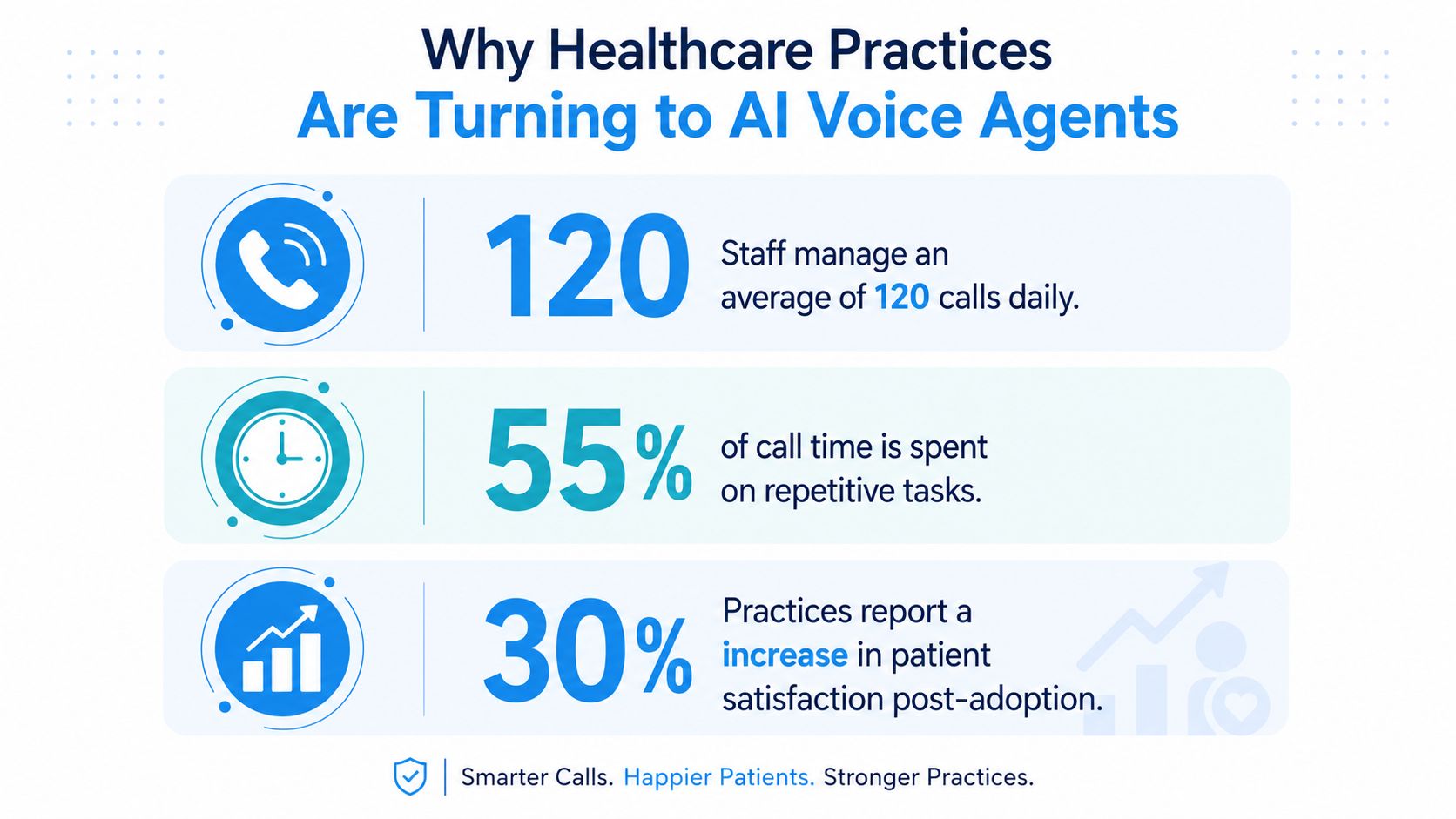
Why Healthcare Practices Are Turning to AI Voice Agents
Front-desk congestion creates a chain reaction. A missed call can become a missed appointment, an unreturned voicemail can become a lost referral, and a staff member pulled into repetitive phone work has less time for a patient standing in front of them. Healthcare teams are also dealing with persistent administrative staffing pressure while patients increasingly expect immediate access outside traditional office hours.
An AI voice agent can absorb routine conversations such as appointment requests, cancellations, rescheduling, directions, and office-hours questions. It can answer consistently when the clinic is closed and manage simultaneous conversations without adding another full-time employee. That doesn't mean removing people from the workflow. It means giving staff fewer repetitive calls and more time for cases requiring judgment, empathy, or coordination.
The category has moved beyond a speculative niche. One industry market estimate values global healthcare AI voice agents at USD 468.0 million in 2024 and projects USD 3.1759 billion by 2030, implying a 37.79% CAGR from 2025 to 2030. The same estimate places North America's 2024 revenue share at 54.17%, cloud deployment at 85%, and clinical documentation as the largest application at 17.54% of revenue.
The operational case is stronger than the novelty case
The most defensible deployments start with a narrow problem. A dermatology clinic might let the agent manage appointment changes after hours. A primary-care group might use it to confirm visits and route symptoms to a nurse line. A specialty practice might begin with referral follow-up rather than open-ended clinical conversations.
Patient access also depends on the quality of every interaction, not just the number of calls answered. Practices evaluating patient communication can use this patient experience resource alongside their call recordings and abandonment data to identify where automation would remove friction without weakening the human experience.
Practical rule: Automate the predictable path first. Keep clinical judgment, emotionally charged conversations, and exceptions visibly connected to trained staff.
The strongest business case comes from measurable workflow outcomes. A summary of healthcare voice research cites automated calls added to SMS reminders reducing no-shows from 11.3% to 9.6% across more than 244,000 patients, while a 22-hospital discharge-call program reduced 7-day readmissions from 4.73% to 2.91% among contacted patients. Those results don't justify automating every call, but they show why appointment access and post-discharge continuity are credible starting points. (CloudTalk's healthcare AI voice agent summary)
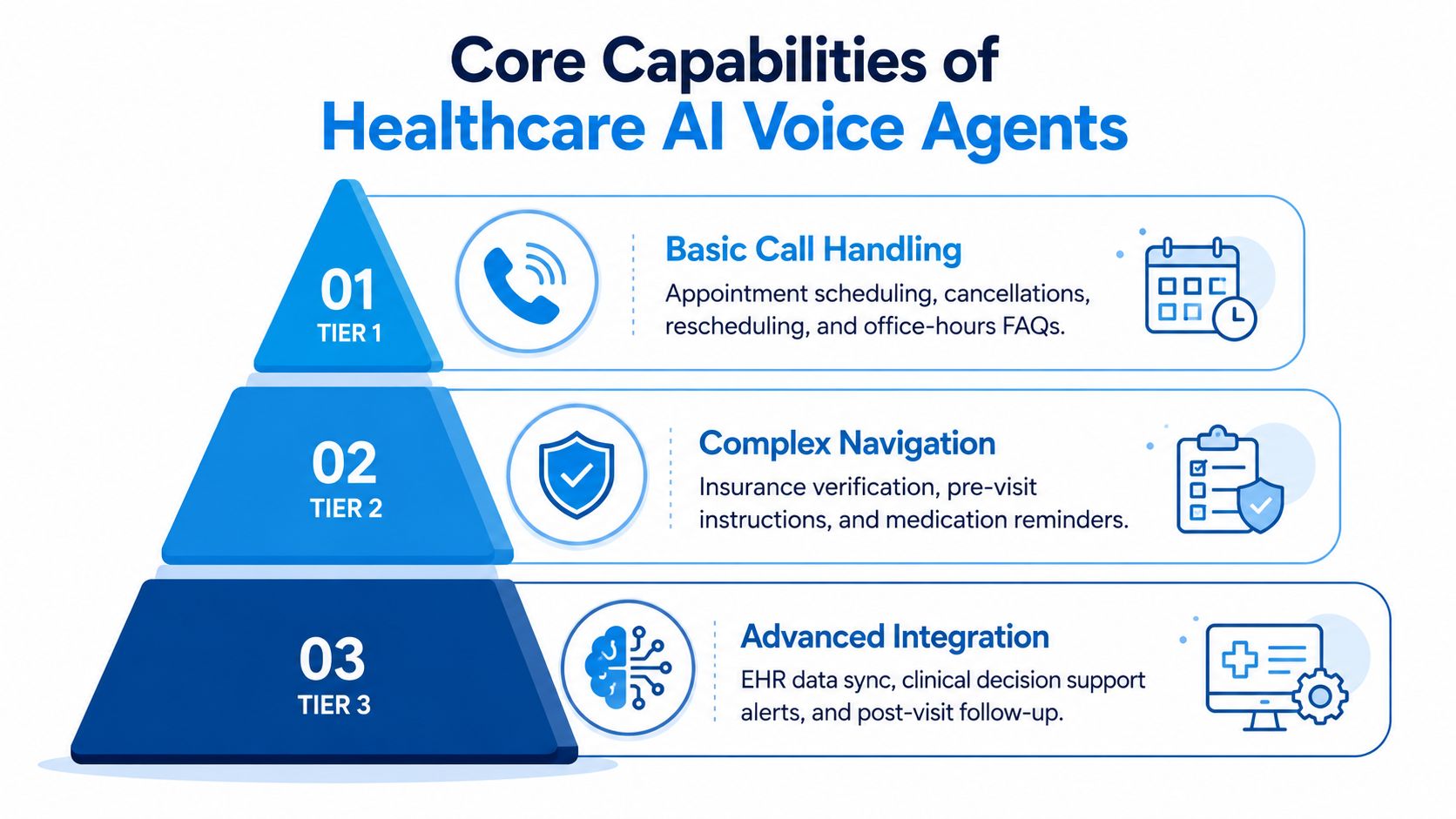
Core Capabilities of Healthcare AI Voice Agents
The safest way to deploy an AI voice agent is progressively. Start with workflows where the desired outcome is clear, the data requirement is limited, and an incorrect response can be contained. Expand only after the practice can measure completion quality and escalation behavior.
Tier one handles the administrative queue
The first tier covers appointment scheduling, cancellations, rescheduling, and office-hours FAQs. A patient calling at 11 p.m. to move a follow-up visit shouldn't need to leave a voicemail if the agent can authenticate the caller, check permitted availability, book the appointment, and send confirmation.
This tier also includes location details, parking instructions, provider availability, accepted insurance prompts, and preparation reminders. The agent should read from approved knowledge sources rather than improvise. If it can't verify an answer, it should route the question to staff or create a documented callback request.
Tier two navigates clinical-adjacent work
The second tier can collect refill requests, notify patients about approved lab-result workflows, gather pre-appointment information, and prompt callers for insurance details. These tasks sit close to care delivery, so the agent needs explicit rules about what it may say, what it may record, and when it must stop.
For example, the agent can collect a medication refill request and send it to the appropriate queue. It shouldn't independently approve a refill or interpret a lab value unless the workflow and clinical governance specifically authorize that function. Pre-visit intake should distinguish between collecting a chief complaint for staff review and giving medical advice.
Tier three requires constrained triage
Advanced triage should use validated decision trees, narrowly defined intents, and immediate escalation triggers. If a caller says they have chest pain, the system shouldn't continue a routine scheduling dialogue. It should deliver the approved urgent instruction and connect the caller to the designated emergency or nurse pathway.
A randomized crossover trial of an AI-enabled voice assistant for SARS-CoV-2 screening achieved 97.7% agreement with human staff, and 87% of participants rated it good or outstanding. (npj Digital Medicine trial) That result supports constrained screening, not unrestricted diagnosis. Speech recognition, natural-language understanding, dialogue management, and text-to-speech now support more natural multi-turn conversations, but medical terminology, accents, background noise, and caller distress still require testing against the practice's real population.
Watch the implementation video for a practical view of how voice automation can support customer-facing workflows:
Practices usually get better results by proving Tier 1 completion and escalation performance before adding clinical-adjacent or triage functions. The AI voice agent customer service guide offers useful general workflow context, but healthcare deployments still need stricter permissions and clinical oversight.
High-Impact Use Cases With Measurable Results
A clinic's first voice AI deployment should target a busy workflow with a clear endpoint, reliable system data, and a defined human fallback. Appointment access, reminders, intake, and structured follow-up generally meet those conditions. Billing disputes and emotionally sensitive calls usually do not.
Four workflows worth testing first
After-hours scheduling captures demand outside staff coverage. The agent can offer approved slots, complete basic identity checks, confirm the booking, and route urgent concerns to the designated pathway. It should not treat every caller as a scheduling request.
Pre-visit intake performs well when the practice has defined fields, validation rules, and a review queue. The agent can collect demographics, insurance details, and the caller's reason for visiting, then write structured data into the appropriate system. Staff need an exception queue, not an unprioritized transcript.
Reminder and rescheduling outreach can reduce no-shows only when the call gives patients a usable action. The cited NEJM Catalyst summary reports a reduction from 11.3% to 9.6% after automated calls were added to SMS reminders across more than 244,000 patients. (CloudTalk's cited healthcare outcomes) The operational lesson is direct: letting a patient reschedule is more useful than repeating the appointment time.
Post-discharge calls can ask structured questions, confirm instructions, and flag responses for clinical review. A program spanning 22 hospitals reduced 7-day readmissions from 4.73% to 2.91% among contacted patients, according to the same summary. The result should be treated as a program outcome, not a guaranteed voice-agent effect. The workflow still depends on timely review, accurate contact records, and a clear escalation queue.
The table separates observed outcomes from planning assumptions. Revenue depends on local reimbursement and capacity, so the figures below show how to model it rather than claiming a universal return.
| Use Case | Primary Metric | Observed or Expected Result | Revenue Model |
|---|---|---|---|
| After-hours scheduling | Completed bookings outside office hours | More demand captured when staff are unavailable | Recovered visits × average collected value per visit |
| Pre-visit intake | Staff time spent collecting information | Faster, more structured intake | Staff hours released × loaded hourly cost |
| Reminder and rescheduling calls | No-show rate | 11.3% to 9.6% in the cited large-scale outcome | Recovered visits × average collected value per visit |
| Post-discharge follow-up | Seven-day readmissions among contacted patients | 4.73% to 2.91% in the cited hospital program | Avoided readmissions × locally verified cost or reimbursement impact |
Teams operating across privacy regimes can consult CloudOrbis Inc.’s PHIPA-compliant telehealth guidance when reviewing patient communication and data-handling requirements.
Integration depth determines whether these workflows produce measurable results. A booking agent that cannot write back to the scheduling system creates manual re-entry. An intake agent that cannot map fields to the EHR produces another review burden. Before launch, test slot rules, duplicate-patient handling, write-back failures, and escalation context with real clinic scenarios.
Voice automation underperforms when callers need negotiation, emotional reassurance, or coordination among several parties. Complex billing disputes, distressed patients, family-member coordination, and calls involving multiple providers should transfer early, carrying the reason for escalation and collected context to the human agent.
HIPAA Compliance and Regulatory Scoping
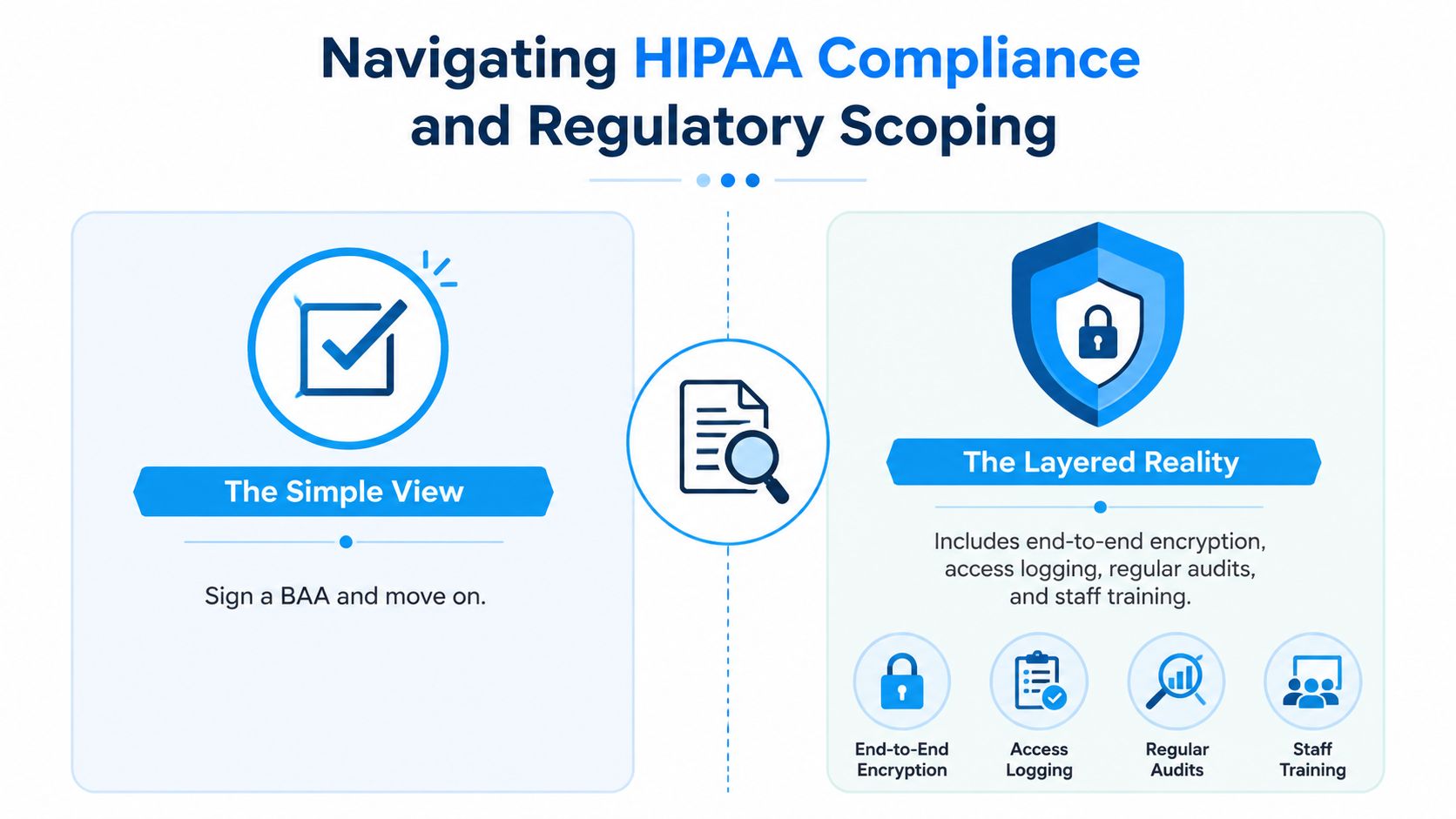
A signed BAA does not establish a complete compliance strategy. Patient calls, recordings, transcripts, prompt logs, and scheduling updates can all contain protected health information. Before deployment, document where each data type travels, who can access it, how long it remains stored, and which actions the agent may perform.
A HIPAA-ready deployment requires a signed Business Associate Agreement, encryption for protected health information in transit and at rest, and audit logs covering every PHI access, as outlined in Cetrai's HIPAA voice-agent guidance. A dental office using an AI receptionist to reschedule patients should be able to trace transcript views and calendar changes during a compliance review or breach investigation. Prosper's healthcare voice AI guidance also addresses the controls needed around healthcare voice systems.
Scope the workflow before selecting the model
A scheduler that reads availability and books an approved slot has a different regulatory profile from an agent that interprets symptoms or recommends treatment. Recent MHRA regulatory clarification states that NHS ambient voice tools limited to transcription, summarization, draft letters, or coding suggestions are not medical devices. Systems supporting diagnosis, treatment, or prevention, or taking automated actions such as placing orders without clinician review, may fall within medical-device regulation.
In the EU, healthcare voice systems classified as high-risk under the AI Act must have conformity-assessment readiness as of August 2, 2026. Relevant uses include triage, eligibility decisions, biometric identification, and emotion recognition. Classification depends on the system's function and deployment context, so compliance teams should assess the actual workflow rather than accept a broad vendor label.
Scope before you automate: Define permitted actions, prohibited advice, escalation triggers, retention periods, and human-review points in writing.
Ask vendors for current security evidence, audit documentation, and relevant certifications such as SOC 2 or HITRUST where applicable. Confirm their subprocessors, processing locations, deletion process, and state-specific consent requirements for call recording. A HIPAA-compliant answering service guide can help teams compare patient-facing safeguards with their proposed design.
Teams building evidence collection and monitoring processes can also review HIPAA automation for MSSPs. The operational test remains straightforward: every automated action needs a defined permission, an audit trail, and a human path for exceptions.
Integration and Workflow Design That Works
A voice agent that cannot read or write to the scheduling system only adds a conversational layer to an answering service. Patients may receive a pleasant response, while staff still repeat the work manually. The operational gain remains limited.
Production architecture typically includes telephony, secure middleware, identity and permission controls, the EHR or practice-management connection, scheduling rules, and an audit trail. Epic, Cerner, and athenahealth environments require separate validation because APIs, appointment types, scheduling constraints, and permission models vary by organization. Confirm the actual read and write scope before promising automation.
Build the transaction, not just the conversation
For a scheduling call, test the complete workflow:
- Identify the caller: Apply the practice's approved verification method before exposing or changing information.
- Read availability: Enforce provider, location, visit type, insurance, and appointment-duration rules.
- Reserve the slot: Use real-time calendar synchronization to prevent double-booking.
- Write the outcome: Store the appointment, disposition, and relevant summary in the correct record.
- Confirm the next action: Send the approved confirmation and explain how the caller can reach staff if details change.
EHR connectivity is often the hidden constraint. A connection that only retrieves availability may support a limited intake experience, but it cannot complete rescheduling, cancellation, documentation, or follow-up tasks without additional workflow support. Review the API connectivity guide when mapping conversational systems to operational software, then test permissions and audit logging in the target environment.
If an API times out, the agent must not guess or claim that a transaction succeeded. It should explain that the system is temporarily unavailable, create a callback task, or transfer the caller. Test that fallback under outages, partial writes, and delayed responses, not only during a successful demonstration.
Escalation design determines whether automation helps or obstructs staff. Route clinical urgency, repeated misunderstandings, explicit requests for a person, frustration, and unsupported requests to the correct queue. Pass the conversation summary, verified identifiers, attempted action, and escalation reason so the patient does not repeat the entire story.
A failed handoff is a workflow defect, not merely a conversation defect. Measure what the receiving staff member sees, including context and next action, rather than only whether the transfer technically completed.
Choosing the Right Vendor and Avoiding Common Pitfalls
Vendor demos tend to emphasize a smooth conversation. Healthcare operations leaders should spend more time testing the uncomfortable moments: unavailable appointment slots, ambiguous identity, urgent symptoms, angry callers, API failures, and transfer requests.
A useful evaluation scorecard weights production reliability over feature count. The vendor should show how it protects PHI, connects to the actual EHR and scheduling environment, records decisions, and supports post-launch tuning. A general-purpose voice platform may sound natural, but retrofitting healthcare controls and escalation logic can create more work than selecting a healthcare-ready system.
| Evaluation Criteria | What to Look For | Red Flags |
|---|---|---|
| HIPAA infrastructure | BAA process, encryption, access controls, audit logs, security evidence | Compliance claims without documentation |
| EHR integration depth | Read and write capability, supported workflows, clear custom-integration plan | Manual re-entry after every call |
| Voice quality | Clear speech, medical terminology handling, accent testing, acceptable latency | Demo-only testing with scripted callers |
| Escalation handling | Context, intent, collected data, and reason passed to staff | Caller must repeat the conversation |
| Support model | Named implementation support, monitoring, retraining, and incident process | Handoff after contract signature |
Contract terms matter as much as features
Require clear data ownership, retention and deletion terms, subprocessors, incident notification obligations, uptime expectations, and limits on model training with your data. Ask who investigates a bad interaction and how quickly the vendor can disable a workflow.
Per-minute pricing also deserves scrutiny. High-volume practices can pay more as adoption succeeds, so model the cost against completed interactions, transferred calls, and staff time avoided rather than looking only at the headline rate.
A real-world virtual specialty-care outreach evaluation found that AI calls produced significantly higher appointment completion, with the strongest effect among patients who had accounts but hadn't scheduled. The deployment achieved a nine-fold increase in outbound call volume, outperformed industry benchmarks on answer and opt-out rates, and reported zero safety escalations. (Springer evaluation of AI voice outreach) That example is valuable because it evaluates throughput and safety together, rather than treating call volume as the only success measure.
Your Implementation Roadmap and Success Metrics
A practical rollout begins with a workflow audit, not a vendor contract. Pull call reasons, transfer patterns, missed opportunities, scheduling rules, and escalation destinations from the systems you already use. Choose one narrow workflow with a clear endpoint, such as after-hours scheduling or reminder-driven rescheduling.
A 30-60-90 day operating plan
First 30 days, define and test the boundary. Select the pilot workflow, document permitted and prohibited actions, establish the BAA and security review, and capture baseline measures. Include front-desk staff in conversation design because they know which caller phrases signal confusion, urgency, or a hidden task.
By 60 days, validate the transaction. Test EHR read and write behavior, calendar conflicts, identity verification, transfer context, API timeouts, recording consent, and data retention. Run staff simulations using accents, background noise, incomplete information, and callers who change their request mid-conversation.
By 90 days, expand only on evidence. Review call samples, escalation reasons, abandoned interactions, incorrect dispositions, and staff corrections. Expand to another department only when the first workflow is stable and the receiving team can handle the new queue.
Measure operational outcomes
Track call containment, average handle time, completed transactions, transfer rate, misrouted calls, patient abandonment, no-show outcomes, patient satisfaction, and cost per interaction. Don't treat containment as success if the patient still calls back or staff must reconstruct the interaction manually.
Create a weekly dashboard that separates automation quality from business impact. A high completion rate with poor patient satisfaction needs a conversation redesign. A low transfer rate with unsafe edge cases needs stricter escalation. A scheduling agent that books efficiently but creates appointment errors needs permission and rules testing, not more persuasive language.
Use corrections as training data for the workflow, not as isolated complaints. Tag misunderstood phrases, missing intents, incorrect routing, and failed integrations. Update approved prompts, decision trees, knowledge sources, and test cases through a controlled review process.
Recepta.ai offers healthcare and wellness communication support for inbound calls, caller-detail collection, scheduling, configurable routing, and escalation to human support. If your practice is ready to assess a focused workflow rather than automate the entire front desk at once, visit Recepta.ai to review how its platform could fit your call-handling and integration requirements.