
7 Best AI Receptionist Solutions for 2026
A prospective patient calls while the front desk is helping someone check in. A homeowner reaches out while the technician is on a job. A legal client calls after hours and reaches voicemail. In each case, the business may lose the opportunity before anyone can respond. Missed calls are a measurable operational problem. In a 30-day study of 85 businesses across 58 industries, 62% of calls went unanswered in some form, including calls sent to voicemail or receiving no response at all, according to CallRail's missed-call analysis.
This roundup compares seven of the best AI receptionist solutions by core capabilities, pricing transparency, integrations, industry fit, human support, and implementation demands. The practical question isn't which platform has the longest feature list. It's which one fits your call volume, scheduling process, routing complexity, compliance needs, and growth plans. If you're also reviewing operational efficiencies, you may want to explore ways to cut payroll costs with geofencing.
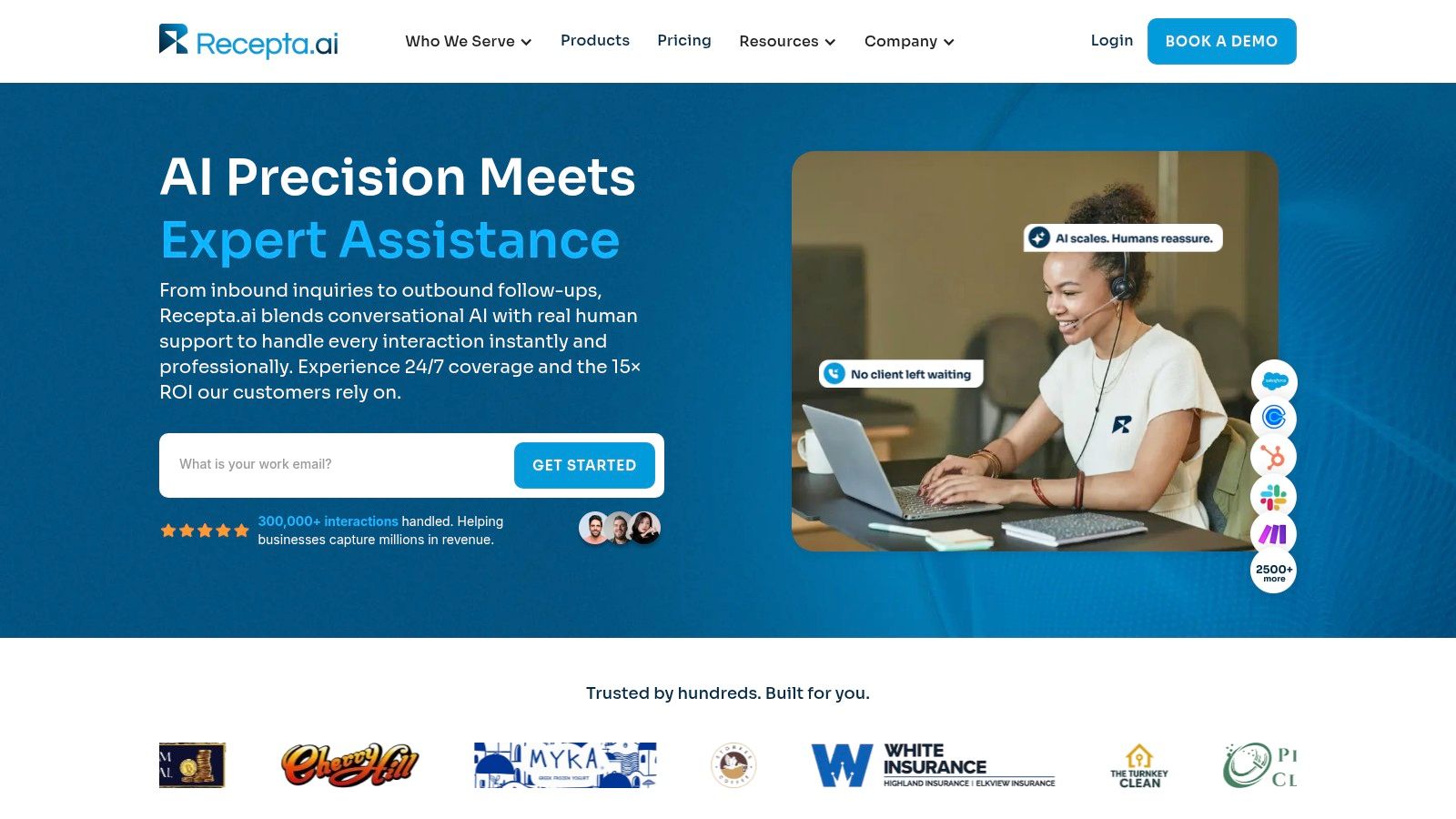
1. Recepta.ai
Recepta.ai is the strongest fit for service businesses that want automation without abandoning human judgment. Its model combines conversational AI with white-glove human support, so the system can answer routine calls, collect lead details, book appointments, and follow up, then escalate when a caller needs empathy, expertise, or a decision the AI shouldn't make.
That distinction matters because the human handoff problem has become a central buying issue. Recent trend coverage identifies warm human handoff as the number one evaluation criterion for buyers in 2026, while hybrid AI and human models are gaining preference over promises of complete automation, particularly in healthcare, legal, insurance, and finance, where compliance and edge cases carry more weight than maximum call containment, according to GetLeadExpo's AI receptionist trends coverage.
Recepta.ai supports inbound and outbound calls, appointment scheduling, lead capture, and follow-ups. It syncs with 2,500+ tools, including CRMs, calendars, and industry systems, while automatically logging interactions and providing call summaries, real-time analytics, and workflow guidance. Customers report up to 30% more qualified leads, 80% cost savings compared with in-house reception, and a 15× ROI, based on the platform's stated customer-reported results. Those figures are reports, not guarantees, so buyers should validate them against their own call mix.
Where Recepta.ai fits best
A plumbing company could have the AI qualify an emergency call, collect the property address, identify the service needed, and book an available slot. A dental practice could capture patient details and schedule appointments while transferring sensitive or complicated questions to a trained person. A franchise group could standardize call handling across locations while keeping records synchronized.
Pros
- Hybrid escalation: AI handles repetitive interactions, while trained human agents step in when judgment or empathy is needed.
- Broad workflow connectivity: Integrations with 2,500+ tools can reduce manual CRM and calendar updates.
- Fast evaluation: Businesses can reportedly create a receptionist in about 15 minutes and use a 30-day money-back trial.
- Operational visibility: Call summaries, analytics, and automatic logging help managers identify missed follow-ups and bottlenecks.
The trade-off is pricing transparency. Recepta.ai doesn't publish a simple per-seat or per-month price on its website, so a buyer will need a custom quote. Very small single-operator businesses may also find the platform's service-business and multi-location capabilities broader than necessary. For a closer look at the setup experience, review this AI receptionist demo from Recepta.ai, then compare the workflow against real calls rather than a scripted test.
2. Smith.ai
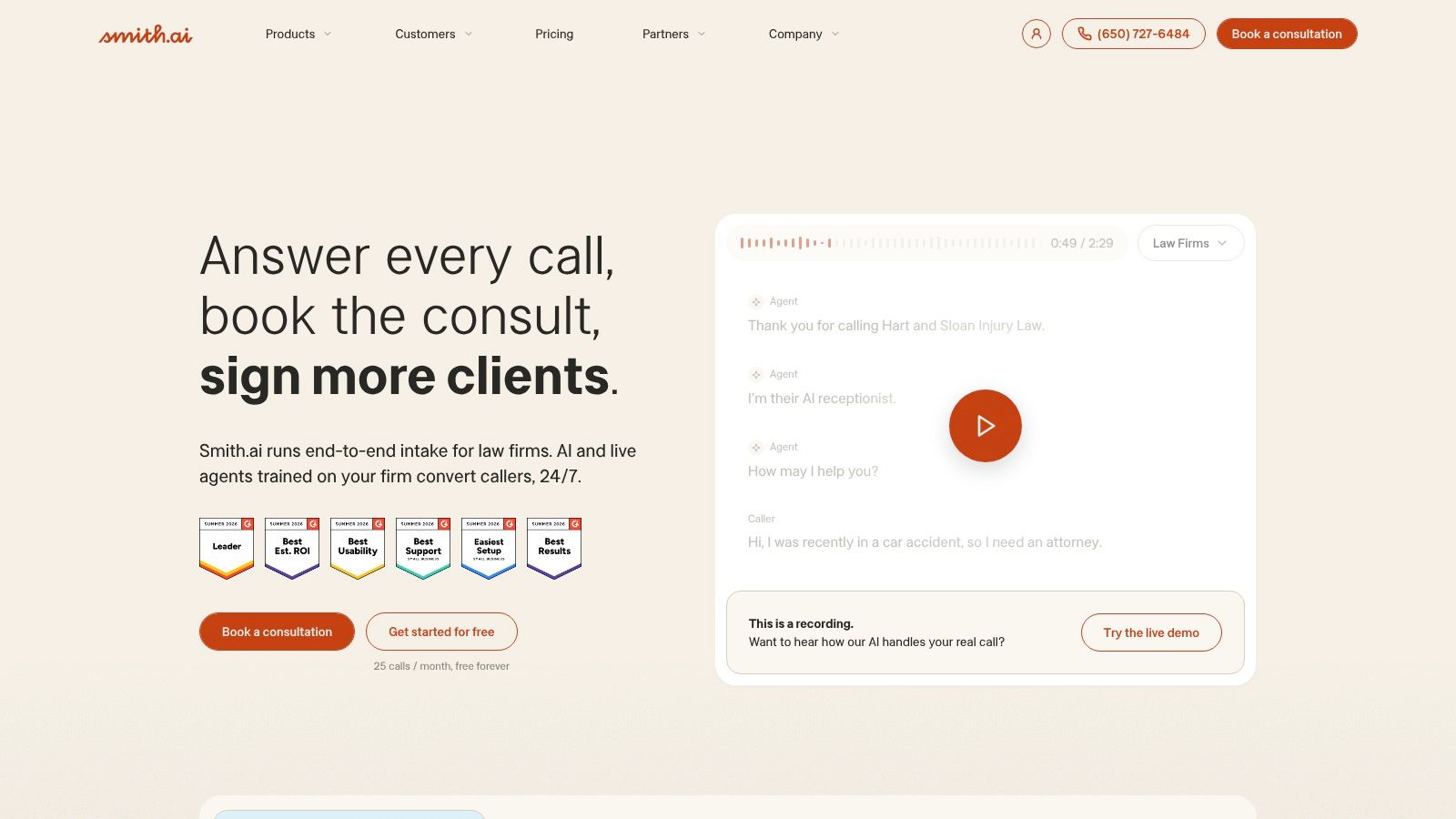
Smith.ai suits businesses that want an AI-first receptionist with a clear path to live-agent support. The platform provides 24/7 AI call answering, lead qualification, routing, summaries, appointment scheduling, and CRM connections. When a call becomes complex or sensitive, businesses can use Smith.ai's live agents for escalation.
That structure works well for law firms, home-service companies, healthcare practices, and other businesses where a missed lead can be more expensive than a routine call. It also gives managers a practical way to separate low-value calls from conversations that deserve a person. Spam filtering and a spam-call allowance can help prevent junk calls from consuming the same budget as genuine prospects.
Pricing and call economics
Smith.ai's per-call model is easy to understand, but it changes the buying calculation. A business with many short calls may spend more than it would with a flat plan based on minutes, while a business with uneven demand may appreciate paying in line with actual call activity. The right comparison isn't only the advertised monthly fee. Count calls by type, estimate how many require live handoff, and identify whether appointment scheduling or CRM logging is included at the tier you need.
Practical rule: If your operation receives many brief inquiries, model the cost per handled call before choosing a per-call receptionist.
The platform's established use among U.S. law firms and service providers is relevant for buyers who need familiar escalation practices. However, deeper custom prompting and integrations require higher pricing tiers, and businesses should confirm exactly which CRM actions, scheduling tools, and transfer rules are available under the proposed plan. For broader context on how virtual reception companies differ in their operating models, see this comparison of virtual receptionist companies.
3. RingCentral AI Receptionist AIR
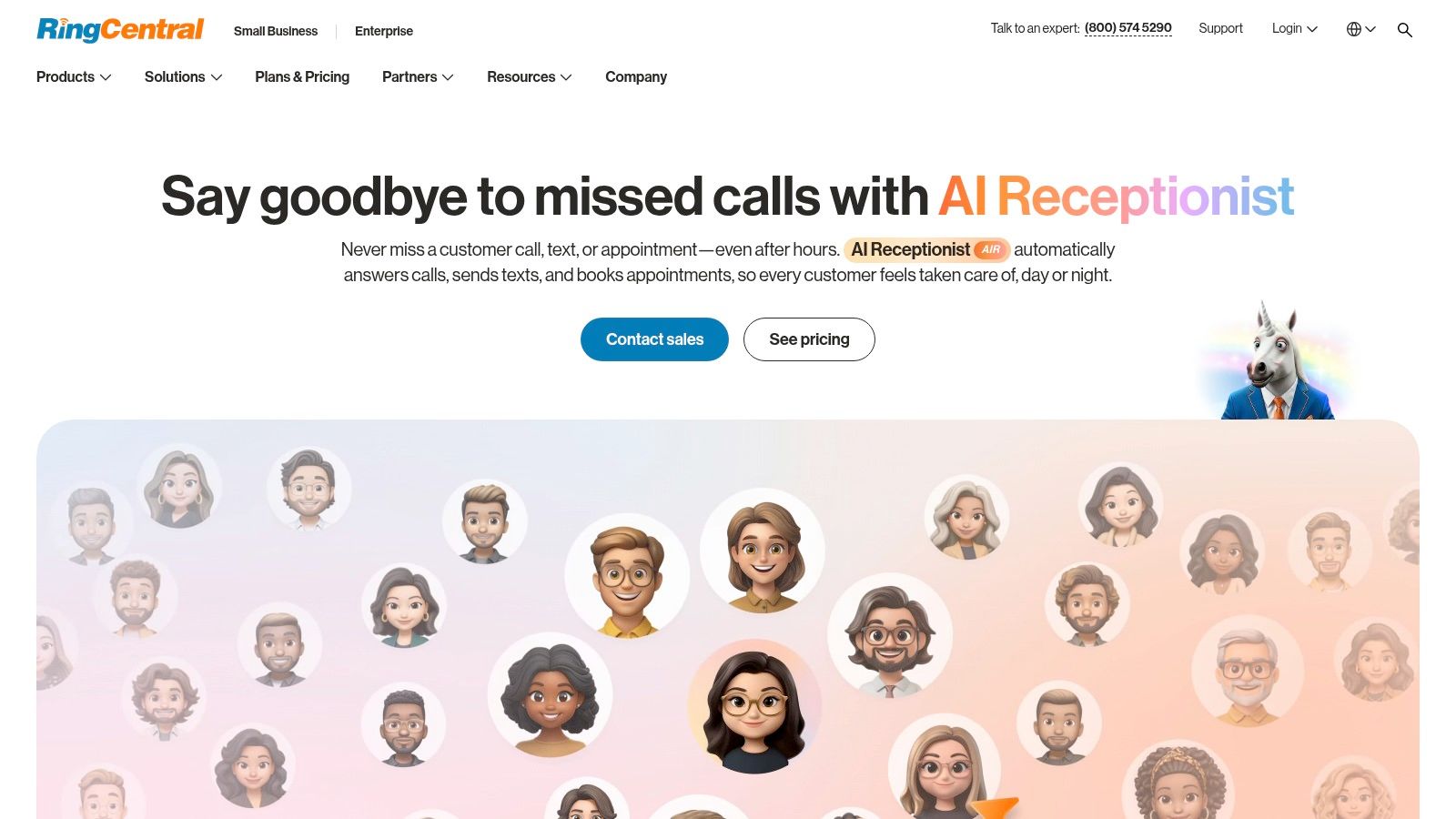
RingCentral AI Receptionist, or AIR, makes the most sense when RingCentral already runs the business phone system. Instead of adding a separate voice layer, AIR works within the existing RingCentral environment, using the company directory, call queues, phone settings, and routing structure.
The platform handles natural-language conversations, call routing, appointment scheduling, SMS follow-ups, and multilingual auto-detection. Its controls also support organizations evaluating HIPAA-related requirements. That doesn't remove the need for a formal compliance review. Buyers still need to confirm configuration, data handling, contracts, retention practices, and escalation behavior for their specific use case.
The integration trade-off
A single-vendor stack can reduce the number of connections a team has to maintain. It may also simplify troubleshooting because the phone platform and AI receptionist share the same operating environment. For a multi-location organization, that consistency can matter more than having the cheapest standalone receptionist.
AIR is less attractive if the business is committed to another phone provider. Migrating numbers, rebuilding call queues, and changing staff habits can create more disruption than the AI feature itself is worth. Pricing is add-on and plan dependent, and the public information doesn't provide a fully itemized cost structure, so request a quote that separates phone service, AIR access, usage, implementation, and support.
If RingCentral is already your phone backbone, evaluate AIR as a platform extension. If it isn't, compare the migration cost against the benefit of consolidating vendors.
A medical group could use AIR to route callers by department, send appointment-related texts, and preserve existing queue logic. A growing franchise could apply common call rules across locations while retaining a centralized directory. Teams with complex routing should test transfers using real department names, after-hours rules, and overflow conditions. This AI phone receptionist guide for business provides useful context for that evaluation.
4. Goodcall
Goodcall is designed around a small-business pricing logic that charges by unique customers served per month, rather than by minutes. That structure can be useful for trades, clinics, salons, retail businesses, and other operations where call duration varies but the number of distinct callers is easier to forecast.
The platform offers unlimited minutes within its pricing model, fast pickup, FAQ handling, lead capture, appointment booking, and verticalized workflows such as telehealth and real estate. Businesses can keep their existing number through conditional call forwarding, which lowers the friction of testing the service without replacing the current phone setup.
Best use case for variable demand
Consider a pest-control company that receives a burst of calls after a local problem is reported. A minute-based tool may become harder to forecast if callers ask detailed questions. Goodcall's caller-based approach makes the cost model more predictable when the business has a clear sense of how many customers contact it, even if some conversations run longer than others.
- Predictable budgeting: The caller-based model avoids the surprise of a long conversation consuming additional minutes.
- Quick implementation: A business can forward its existing number instead of rebuilding its phone system.
- Workflow automation: Zapier connections can send captured lead details to calendars, CRMs, spreadsheets, or other business tools.
- Vertical relevance: Preconfigured workflows can reduce the work required for common service-business scenarios.
The limitations appear when the operation outgrows lightweight routing. Integrations often depend on Zapier, so a team may need to maintain middleware steps rather than use deeper native connections. Complex multi-department call flows may also be better served by a full phone platform. Goodcall commonly offers a 14-day trial, but confirm current terms before planning a full rollout.
5. PolyAI
PolyAI is built for enterprise voice operations, not casual experimentation. Its conversational agents support routing, authentication, reservations, booking, billing, and order management across industries such as hospitality, healthcare, financial services, and utilities.
The operational fit is strongest when the phone line is a critical customer channel and the business needs more than basic message capture. PolyAI offers a security and support posture that includes monitoring, 24/7 emergency support, and a stated 99.9% phone-line uptime SLA, according to the platform's published positioning. Those commitments should be reviewed in the contract, including exclusions, service credits, escalation procedures, and the precise meaning of phone-line availability.
Enterprise complexity has a cost
PolyAI's per-minute commercial model is structured differently than a simple self-serve plan. That makes sense for organizations with complex integrations and high call volumes, but it creates more work during procurement. A utility provider may need authentication and account-specific routing. A hotel group may need reservations and consistent brand language across properties. A healthcare organization may need carefully controlled escalation and audit processes.
- Scale: Suitable for large inbound operations with varied call intents.
- Compliance posture: Better aligned with buyers that need formal security review and documented controls.
- Integration depth: Designed for complex enterprise systems rather than basic calendar connections.
- Support model: Dedicated monitoring and emergency support matter when phone availability affects core operations.
Small businesses should be cautious about selecting PolyAI for prestige rather than need. If the workflow is limited to answering FAQs, collecting a message, and booking a standard appointment, an enterprise implementation may introduce unnecessary procurement and configuration overhead. For teams comparing advanced voice automation models, this guide to an AI voice agent for customer service offers a useful operational lens.
6. Quo, formerly OpenPhone, Sona AI Voice Agent
Quo's Sona AI voice agent is a sensible option for small teams that want a modern phone system, SMS, shared inbox, and basic AI receptionist functions in one application. Sona can replace voicemail, answer frequently asked questions, capture structured information, qualify leads, and route callers through a call-flow builder.
The advantage is consolidation. A small real-estate team, for example, could use one shared business number, let Sona collect property inquiry details after hours, and give staff AI summaries and tags when they return. A contractor could use call-flow rules to separate new estimates from existing-customer questions without adding a separate answering service.
Where Sona needs validation
Quo supports IVR and auto-attendant flows, routing, after-hours coverage, U.S. number porting, and a multi-user shared inbox. That combination is attractive for teams that have outgrown personal mobile numbers but don't need an enterprise contact center. AI call summaries and tags can also help staff prioritize follow-up without replaying every conversation.
Sona is newer than legacy IVR systems, so businesses with advanced industry workflows should test setup requirements carefully. A regulated practice shouldn't assume that a general-purpose call-flow builder satisfies its obligations. Confirm consent, data handling, retention, transfer rules, and any required contractual protections before deployment.
Published pricing for Sona bundles is limited, and plan or add-on costs should be confirmed directly. That uncertainty matters for a small team because the apparent simplicity of an all-in-one platform can change once additional users, numbers, messaging, or AI usage are added.
7. SoundHound Smart Answering
SoundHound Smart Answering is a knowledge-base-driven voice service for businesses that need consistent answers across a large volume of inbound questions. The system can use business information such as hours, policies, menus, and services to answer callers in natural language, handle overflow and after-hours calls, and send SMS follow-ups for reservations, appointments, and confirmations.
Restaurants are an obvious fit. A caller can ask about hours, menu information, reservations, or policies while staff focus on guests in the dining room. Appointment-heavy businesses can use the same model to answer recurring questions and provide confirmation messages without requiring every location to staff its phone line continuously.
Evaluate the knowledge base, not just the voice
The central buying question is whether the business can keep its source information accurate. A restaurant with multiple locations should test holiday hours, reservation rules, menu changes, and location-specific details. A clinic should test service descriptions, appointment instructions, and questions that require a person rather than a general answer.
SoundHound has a strong speech-technology background and is positioned to answer 100% of inbound calls, according to its product description. That should be treated as a design objective to validate in a trial, not as a promise that every caller will receive a perfect automated resolution. Coverage and resolution are different outcomes. A system may answer every call yet still need effective transfer rules for unusual or sensitive requests.
- Best fit: Restaurants, appointment-heavy SMBs, and multi-location businesses.
- Workflow strength: FAQs, reservations, confirmations, and consistent location information.
- Main limitation: Pricing isn't listed publicly, so commercial terms require a direct conversation.
- Deployment caution: Availability and terms can vary by region, so confirm U.S. availability and the intended deployment scope.
Top 7 AI Receptionists: Feature Comparison
| Solution | Implementation complexity 🔄 | Resource requirements & speed ⚡ | Expected outcomes ⭐ / impact 📊 | Ideal use cases 💡 | Key advantages ⭐ |
|---|---|---|---|---|---|
| Recepta.ai | 🔄 Low–Medium, fast setup (~15 min) + guided onboarding; hybrid AI→human escalation | ⚡ Tailored pricing (contact sales); 30‑day trial; designed to reduce staffing overhead | ⭐📊 Proven impact: up to 30% more qualified leads, 80% cost savings vs in‑house, ~15× ROI reported | 💡 Service businesses, multi‑location teams, healthcare, legal, franchises | ⭐ Hybrid AI + trained human agents; 2,500+ integrations; real‑time analytics |
| Smith.ai | 🔄 Medium, AI‑first with optional human handoff; straightforward deployment | ⚡ Per‑call pricing (clear); can be costlier for many short calls; scalable live agents | ⭐📊 Reliable coverage and lead qualification; established in law and services | 💡 Law firms, SMBs, home services needing dependable 24/7 coverage | ⭐ Practical AI‑first model, clear per‑call billing, spam filtering |
| RingCentral AIR | 🔄 Medium, native within RingCentral phone platform; simpler if already on RingCentral | ⚡ Add‑on / plan‑dependent pricing; single‑vendor stack reduces integration work | ⭐📊 Integrated VoIP + AI routing, SMS and appointment features; scales enterprise→SMB | 💡 Teams standardizing on RingCentral; regulated industries needing controls | ⭐ Single‑vendor reliability, multi‑language support, platform controls |
| Goodcall | 🔄 Low, SMB‑focused, quick setup and vertical workflows | ⚡ Predictable pricing by unique callers/month; unlimited minutes model | ⭐📊 Cost predictability for variable call volumes; fast pickup and booking | 💡 Trades, clinics, salons, retail with high call variance | ⭐ SMB‑friendly pricing, easy onboarding, 14‑day trial |
| PolyAI | 🔄 High, enterprise integrations, custom scoping and deployment | ⚡ Per‑minute operational pricing; 99.9% SLA and 24/7 support; higher resource needs | ⭐📊 Enterprise reliability at scale; strong compliance, uptime, and brand consistency | 💡 Hotels, finance, healthcare, utilities with high volume and regulation | ⭐ Enterprise posture: security, SLAs, dedicated monitoring/support |
| Quo (Sona) | 🔄 Low–Medium, built into Quo phone system; add AI agent to call flows | ⚡ Bundled with VoIP/SMS; pricing for Sona may be plan‑dependent | ⭐📊 Basic AI receptionist features: message capture, FAQs, call summaries | 💡 Small teams wanting unified VoIP + SMS + AI in one app | ⭐ One vendor for phone+AI, easy to add Sona to existing menus |
| SoundHound Smart Answering | 🔄 Medium, builds business‑specific knowledge base; tailored onboarding | ⚡ Commercial terms via sales; designed to answer 100% of inbound calls | ⭐📊 Consistent full‑coverage answering, reservations, SMS confirmations | 💡 Restaurants, appointment‑heavy SMBs, multi‑location businesses | ⭐ Strong speech tech and KB‑driven voice answers; SMS follow‑ups |
Choose by Call Volume, Complexity, and Industry
The best AI receptionist isn't automatically the product with the most features. It's the system that turns the calls your business receives into the right next action, whether that action is an answer, a booked appointment, a CRM record, a transfer, or a human callback.
Choose Recepta.ai when your business needs hybrid AI and human support, broad integrations, lead follow-ups, appointment booking, and workflows designed for home services, healthcare, legal, insurance, finance, franchises, or multi-location operations. Its white-glove escalation model is especially relevant when a caller may need empathy or expertise rather than a scripted response.
Choose Smith.ai when per-call pricing matches your demand pattern and live escalation is important. It's a practical option for law firms and service providers that want AI to handle routine conversations while live agents remain available for complex or sensitive calls.
Choose RingCentral AIR when RingCentral already powers your phone system. The value comes from keeping directories, queues, routing rules, SMS, and AI in one environment. Switching platforms solely to access AIR may not make sense if another phone system already fits the organization.
Choose Goodcall for a small business that wants predictable pricing based on unique callers rather than minutes. It fits trades, clinics, salons, and retail operations with variable call duration but relatively clear caller patterns.
Choose PolyAI for enterprise-scale, regulated, or high-complexity voice operations that require security review, monitoring, support commitments, and complex integrations. It's less suitable for a small business that only needs basic FAQ answering and message capture.
Choose Quo when your small team wants phone, SMS, shared inbox functionality, routing, and AI in one modern system. Choose SoundHound when the core challenge is consistent, knowledge-base-driven answering for restaurants, reservations, appointments, or multi-location customer questions.
Before committing, test representative calls rather than ideal demonstrations. Include a new lead, an existing customer, an after-hours caller, a caller who asks an unsupported question, a transfer request, and a scheduling change. Confirm current pricing, regional availability, CRM and calendar actions, data handling, and escalation rules. During a trial, measure unanswered calls, booked appointments, qualified leads, follow-up completion, and escalation quality. A scheduling survey reports that 30% of businesses using scheduling software book appointments in less than an hour, according to Zoho Bookings' appointment scheduling survey, so speed from conversation to calendar entry deserves its own test.
Recepta.ai combines 24/7 conversational AI with trained human support for calls, appointment scheduling, lead capture, follow-ups, and complex escalations. If your business needs reliable coverage across service, healthcare, legal, insurance, or multi-location workflows, visit Recepta.ai to explore the platform and start evaluating it against your real calls.