
Get a Business Phone Number Free: A 2026 Guide

Most advice on getting a business phone number free starts and ends with a provider list. That's the wrong place to start.
A free number can be useful. It can separate your personal calls from work calls, give a new business a local presence, and help you test whether phone leads matter in your market. But a free number is rarely a complete business phone system. In practice, it's a temporary setup with limits that show up fast once customers start calling.
I've seen this pattern with plumbers, solo attorneys, cleaning companies, dental startups, and insurance agents. The quick free option works for a short window. Then the cracks appear. Calls land on one device, voicemail gets messy, nobody knows who returned which lead, and the business starts sounding smaller than it is.
The Truth About a Free Business Phone Number
The phrase business phone number free sounds simpler than reality. The biggest misconception is that “free” means a professional phone line with no real downside. It usually means you can claim a number without paying upfront, while accepting limits on routing, features, or long-term control.
One of the clearest reality checks comes from industry analysis noting that free VoIP numbers for responsive business operations are effectively non-existent in 2026 due to hidden costs like SMS fees, international call charges, and lack of toll-free support. That same analysis points out the gray area of using personal-tier Google Voice for business traffic, which leaves many owners exposed when inbound calls become mission-critical, as covered in this business phone options analysis.
What free usually means in practice
For most small operators, a free number is one of these:
- A local VoIP number tied to one user. Good for a solo consultant, mobile notary, or one-truck HVAC startup.
- A trial number. Useful if you want to test call flow before paying.
- A bundled number inside a low-cost account. The number feels free, but the service around it isn't.
That's why I tell clients to think in stages. Stage one is getting a separate business line fast. Stage two is deciding whether the phone line needs to function like a real front desk.
Practical rule: If missing one call could mean losing a booked job, consultation, or intake, you're no longer shopping for “free.” You're shopping for reliability.
A simple example helps. A self-employed electrician might do fine with a free local number for a few weeks if calls route straight to their cell. A two-person plumbing company won't. Once one technician is under a sink and the other is driving, someone needs to answer, route, log, or follow up.
If you're considering Google Voice specifically, this breakdown of Google Voice for a business number is worth reading before you attach it to your website, Google Business Profile, and yard signs. It's also smart to review broader guidance on understanding free number risks, especially if you're comparing virtual number options that blur the line between personal and business use.
How to Get a Free Business Number in 10 Minutes
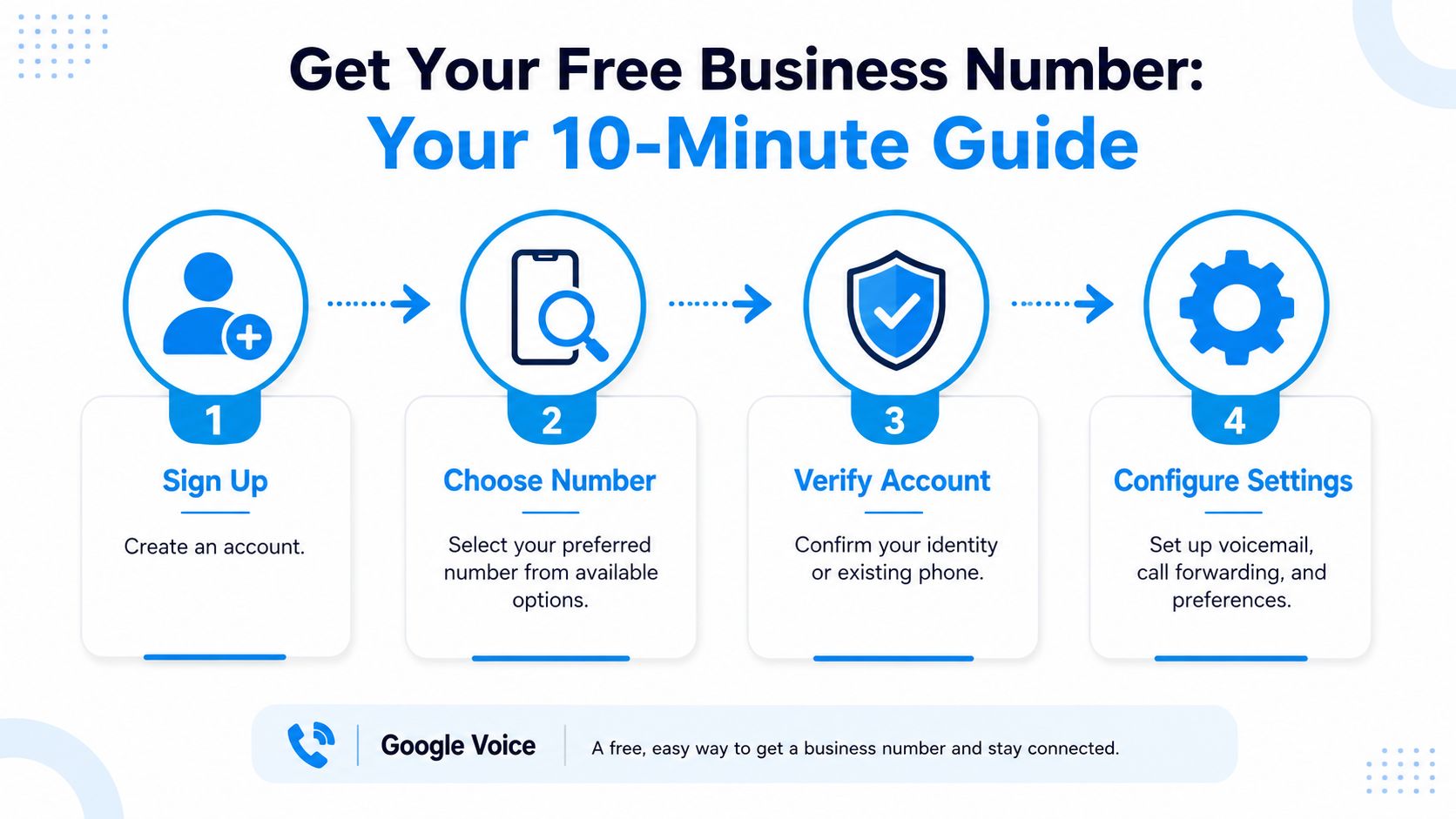
If you want the fastest path, use a mainstream VoIP option such as Google Voice. For a solo operator, setup is usually straightforward. The basic process typically takes 5 to 10 minutes, but free tiers exclude toll-free numbers and often support only one device, without auto-attendant or call recording. For critical business use cases, those limitations contribute to a documented 30% to 40% failure rate according to this free business phone number setup guide.
The quick setup path
Create or use a Google account
Use a business-owned Google account, not your personal one. If you later hand off admin access, this matters.Choose an available local number
Search by city or area code. If you're a plumber in Phoenix, pick a local number customers recognize. Local familiarity often helps more than a random number from another region.Verify with an existing phone
Most setups require linking or verifying against an existing phone line. Consequently, many owners realize the free system still depends on personal infrastructure.Install the app and test inbound calls
Put it on the device you'll answer. Then call it from another phone. Test voicemail, missed-call alerts, and text behavior.
Configure it like a business line
Don't stop after claiming the number. Set these basics before you publish it anywhere:
- Record a proper voicemail greeting. Say your business name, service area, and what callers should do if it's urgent.
- Set business hours. If the app supports timing preferences, use them.
- Turn on email notifications. You need missed-call visibility when you're on a jobsite.
- Run a live test. Ask a friend to call, leave a voicemail, and send a text.
A practical example: a carpet cleaning company can use this setup for local inquiries while still forwarding calls to the owner's cell. That works if one person handles sales and scheduling. It breaks down once office staff, field staff, and after-hours overflow all need different handling.
A free number is easy to claim. The hard part is making it behave like a front desk.
If you need a local or virtual number strategy beyond the basic free route, this guide to virtual US phone numbers is a useful next step.
The Hidden Costs and Limitations of Free Numbers
Free phone setups don't usually fail on day one. They fail on busy days.
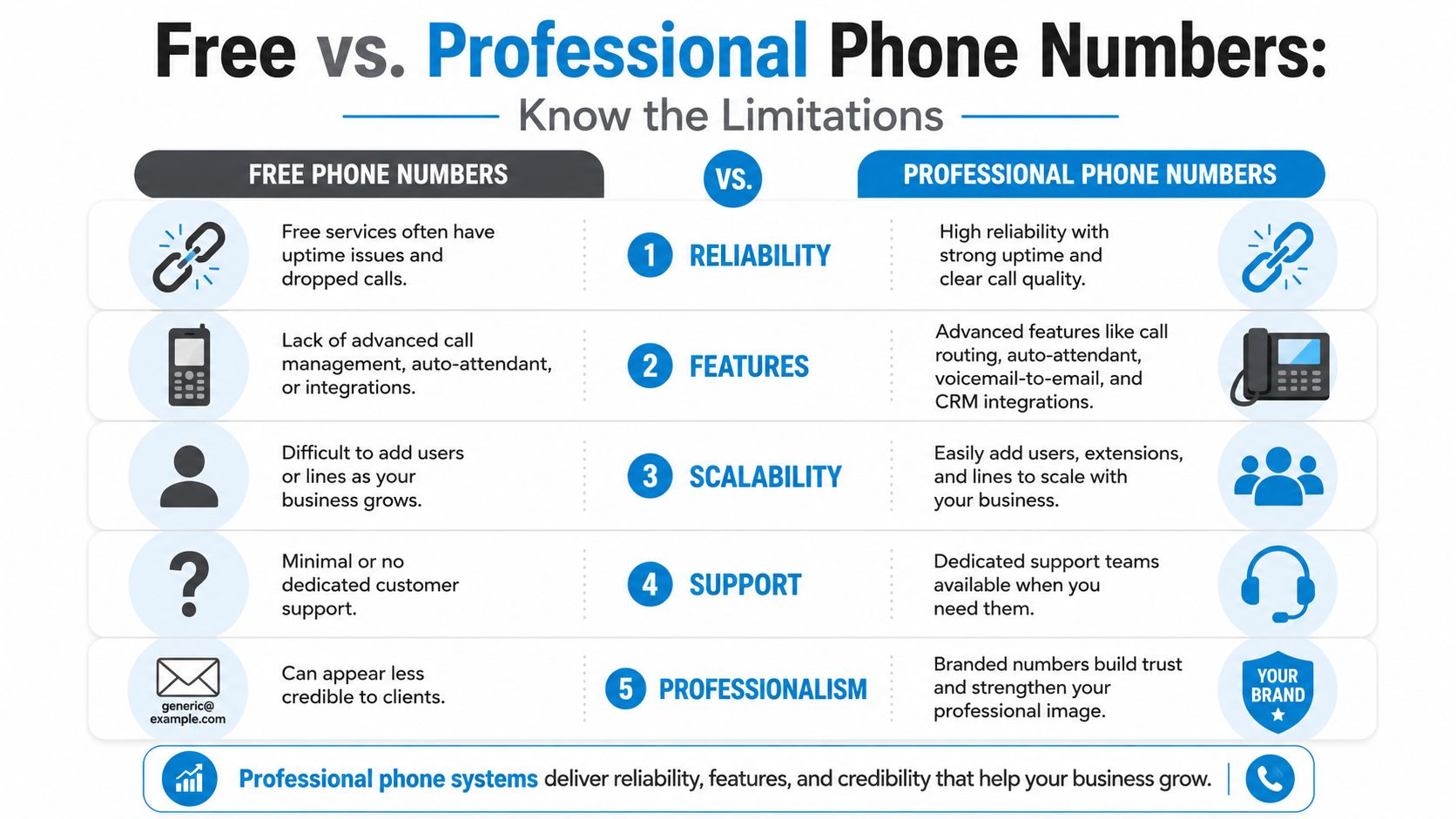
A missed call at the wrong time hurts more than the monthly cost of a starter phone plan. That's why so many businesses move on quickly. Approximately 73% of small businesses that start with free business phone number plans upgrade to paid services within 12 months, and the true cost can exceed $200 annually in lost productivity and missed calls, according to this analysis of free business number plans.
Where free numbers break first
Here's what I see most often in the field:
| Issue | What happens on a free setup | Real-world example |
|---|---|---|
| Single-user design | Calls depend on one person being available | A roofer misses a storm-related inquiry while on another estimate |
| Weak routing | No proper menu or team handoff | A dental office can't send billing calls to admin and emergencies to the front desk |
| Thin records | No reliable call logs or recordings | A law office can't confirm what a prospect asked on the first call |
| No clean escalation path | Voicemail becomes the backup for everything | A pest control company loses an urgent weekend lead |
The cost isn't just money
Free systems create decision fatigue. Someone has to remember who called back, who texted, which voicemail mattered, and whether the number is still the right public line.
That admin drag is why owners often feel the phone setup is “fine” while the business is small, then suddenly realize it's costing them time every single day. If you want to compare that against the economics of a staffed or structured answering setup, this overview of business answering service cost helps frame the trade-off.
Field note: The cheapest phone setup becomes expensive the moment your team starts building manual workarounds around it.
A home services example makes this obvious. If a water damage caller reaches generic voicemail instead of a routed after-hours response, you don't just lose a call. You lose the urgency that makes the call valuable in the first place.
Smart Call Routing and Integration Workarounds
If you're staying with a free number for now, you can make it less fragile. The goal isn't perfection. The goal is reducing obvious failure points until you're ready for a real system.
Small fixes that help immediately
- Write a voicemail that directs action. Don't say, “Leave a message and I'll get back to you.” Say, “For same-day service, include your address and issue. For scheduling, text this number with your preferred time.”
- Use call forwarding intentionally. Forward daytime calls to the office manager or owner, and after-hours calls to the on-call cell. Test it from outside your network.
- Create a shared response routine. If your number only rings one device, use a simple shared inbox or team chat where missed calls get posted and assigned manually.
- Separate ad traffic from repeat clients. If you can't do advanced routing, at least direct web leads to a form and reserve the phone line for high-intent callers.
Manual integrations that are good enough for now
A lot of owners ask how to mimic call routing without paying for a full phone platform. The answer is patchwork.
A cleaning company can put booking links in voicemail. A solo CPA can send missed-call alerts into email and then log follow-ups in a spreadsheet or CRM manually. A med spa can publish one number but route appointment changes to text and new consultations to a website form.
None of this is elegant, but it can steady the operation short term.
Update your voicemail any time your availability changes. If you're booked out for a week, say so. That alone cuts down frustrated callbacks.
When patching stops making sense
The moment you're maintaining scripts, forwarding rules, calendars, and manual follow-up notes across multiple people, you've built a fragile phone workflow. At that point, automation usually costs less than confusion.
Tools in this category range from simple paid VoIP to AI-assisted front-desk systems. For example, Recepta.ai handles inbound calls, lead capture, scheduling, follow-ups, and handoff when a human needs to step in. That's the kind of setup that replaces the daily workarounds instead of adding more of them.
Security and Compliance Risks You Cannot Ignore
Operational inconvenience is one problem. Compliance exposure is another.
Free numbers are risky for any business that handles protected health information, client case details, financial discussions, insurance data, or recorded verbal consent. The issue isn't only whether calls go through. It's whether call records are retained properly, whether access is controlled, and whether the business owns the number relationship well enough to move later.

The number portability trap
One of the biggest technical risks is simple and painful. Free local numbers often can't be ported to professional carriers without a paid upgrade, which creates the “number portability trap.” The same source also notes that free tiers explicitly fail to meet requirements for industries such as healthcare and finance that need HIPAA-compliant call logging and data retention, as explained in this business phone number portability and compliance review.
A practical example: a small counseling practice starts with a free local number because setup is fast. Six months later, the office wants recorded call handling, staff routing, audit trails, and secure retention. Then they learn the published number on their website, intake forms, and directory listings may not move cleanly without changing plans or changing numbers. That's not a marketing inconvenience. It's an operations problem.
What regulated businesses should check
Before you use any free number publicly, verify these points:
- Data retention. Can you keep the records you're required to keep?
- Access control. Can former staff lose access immediately?
- Call logging. Is there a dependable record of inbound and outbound activity?
- Portability. Can the number move when your business outgrows the platform?
- Consent rules. If calls are recorded, do your workflows match applicable disclosure rules?
If your team records calls or plans to, this primer on call recording compliance is a practical place to start.
In regulated industries, a free phone number isn't just a lightweight tool. It can become a recordkeeping and liability problem.
Law firms, clinics, insurance agencies, and mortgage teams usually shouldn't build client communications on a personal-grade phone product. The margin for error is too small.
When to Upgrade to a Professional Phone System
Most businesses don't need a complex phone platform on day one. They do need to recognize the moment a free number stops being harmless.
One strong benchmark comes from the enterprise world. 74.8% of Fortune 500 companies use toll-free business phone numbers, and 50.9% use a true 800 prefix, which shows that professional communication lines are a standard credibility signal, according to these Fortune 500 toll-free number statistics.
The upgrade checklist
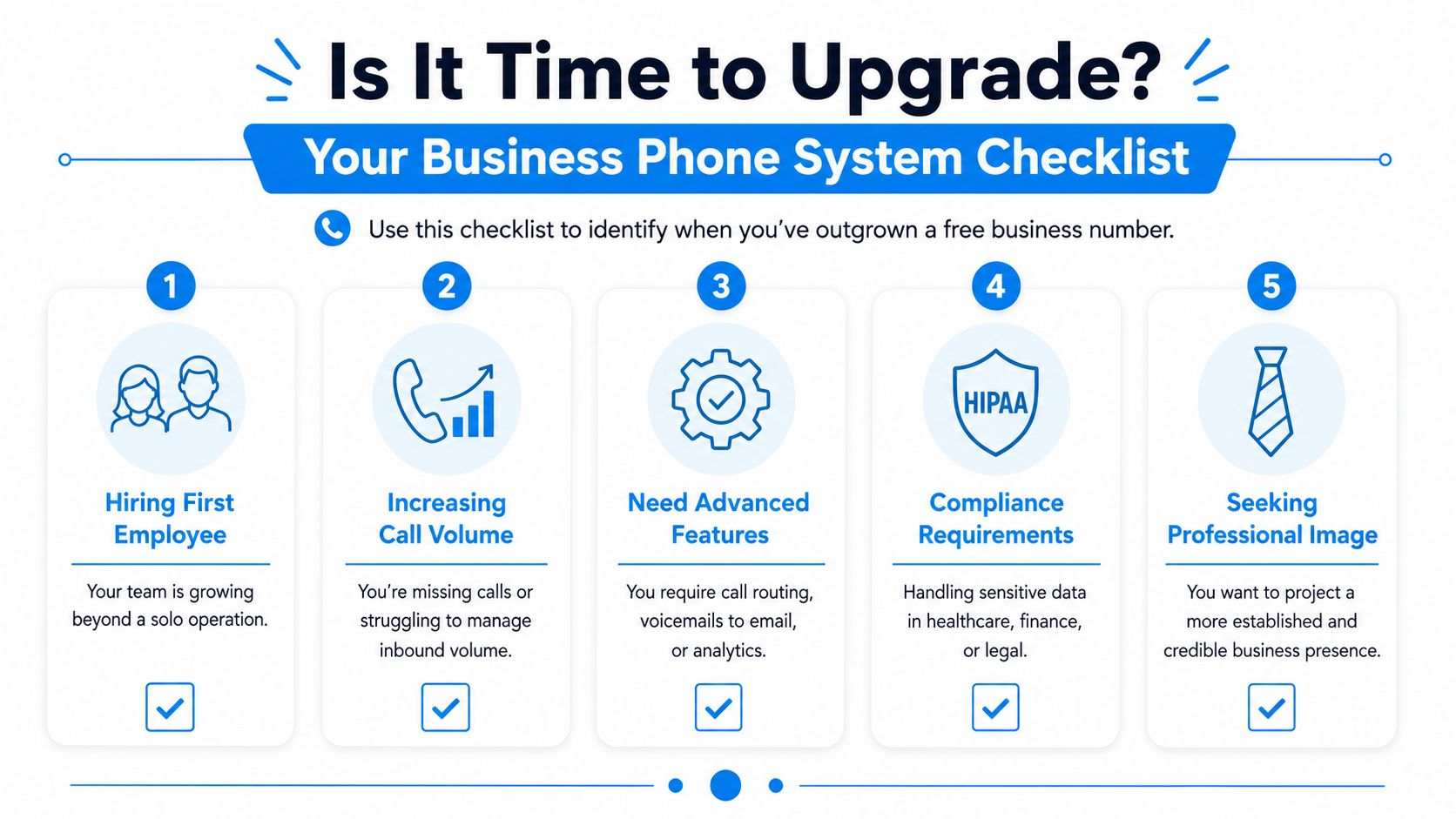
You've likely outgrown a free setup if any of these sound familiar:
- You hired your first employee. Calls can't live on one person's phone anymore.
- You're missing callbacks. Prospects call, nobody's sure who owns the follow-up, and leads cool off.
- You need routing. New leads, existing customers, billing questions, and emergencies shouldn't hit the same voicemail box.
- You need records. Healthcare, legal, finance, and insurance teams need cleaner documentation and stronger controls.
- You want a more established presence. A toll-free or properly managed business line tells callers they've reached a real operation.
What a better next step looks like
For a solo operator, the right move may be a basic paid VoIP line with voicemail, call forwarding, and multiple user access. For a growing office, it may be a receptionist model, AI-assisted answering, or a hybrid setup that routes, logs, and books automatically.
If you operate in the UK or want a broader view of cloud calling options for smaller firms, this ultimate guide for small UK businesses gives useful context on what a more mature setup should include.
A free number is fine as a stepping stone. It's a poor long-term foundation for a business that depends on inbound calls.
If your current number is only “working” because you're manually covering the gaps, it's time to look at a system built for real business traffic. Recepta.ai gives teams a practical next step with AI receptionist coverage, scheduling, lead capture, follow-ups, and human escalation when needed, so you can stop treating missed calls like an unavoidable cost of doing business.