
Business Answering Service Cost: Your True Spend in 2026

TL;DR: Business answering service cost for most SMBs usually lands between $300 and $925 per month for traditional live services handling roughly 125 to 250 calls, while AI-powered options often sit around $50 to $400 per month depending on volume and features. Per-minute rates commonly fall around $1.30 to $1.75, but that number can be misleading because rounding, overages, and feature add-ons can push the final bill much higher.
Most owners ask the wrong first question.
They ask, “What does an answering service cost?” when they should ask, “What will this cost me once my phones get busy, my staff gets stretched, and my call volume spikes?”
That difference is where people get ripped off.
A low advertised monthly price can turn into an expensive operating problem if the plan bills by the minute, rounds every short call up, or charges extra the moment you need scheduling, intake, or after-hours coverage. A higher flat monthly fee can end up cheaper if it protects you from surprise overages and keeps leads from going to voicemail.
The practical way to evaluate business answering service cost is to look at your Total Cost of Communication. That means the service fee, the billing model, the hidden usage math, and the revenue you lose when calls go unanswered.
The High Cost of a Missed Call
Most small businesses don't have a phone problem. They have a revenue leak.
According to missed business call statistics from AIRA, 62% of all business calls go unanswered. Because 85% of those callers won't call back, the average SMB loses about $126,000 in annual revenue from missed opportunities.

If you run an HVAC company, dental clinic, law office, insurance agency, or multi-location service business, you already know how this happens. Your team is on jobs, with patients, in meetings, or handling one caller while the next one gets sent to voicemail.
That missed call isn't just an inconvenience. It's often a new patient, an urgent repair, a legal intake, or a policy question from a prospect who will call the next business on the list.
Cheap isn't cheap if it misses calls
Owners often try to solve this with the lowest monthly plan they can find. That's understandable. But if the service only covers part of the day, can't handle volume swings, or charges so much for overages that you start limiting usage, you've bought a partial fix.
A business answering service should be judged on two things:
- Capture rate: Does it reliably answer when your staff can't?
- Cost predictability: Can you budget for it without worrying about seasonal spikes?
Practical rule: The most expensive phone setup is the one that looks affordable on paper but still lets good calls slip through.
The point isn't to spend more. The point is to stop losing money in a place most owners stop measuring once the call goes unanswered.
Think in terms of avoided loss
When owners review software, they usually focus on subscription price. Phone coverage is different. Here, the better comparison is what your current system fails to catch.
A service that answers overflow, after-hours, and weekend calls can pay for itself long before you notice the line item on the P&L. That's why evaluating business answering service cost as a pure expense leads to bad decisions. It isn't just overhead. It's part of your front desk, sales response, and customer experience.
Decoding Answering Service Pricing Models
Before you compare vendors, you need to understand how they bill. The pricing model shapes the final cost more than the headline price does.
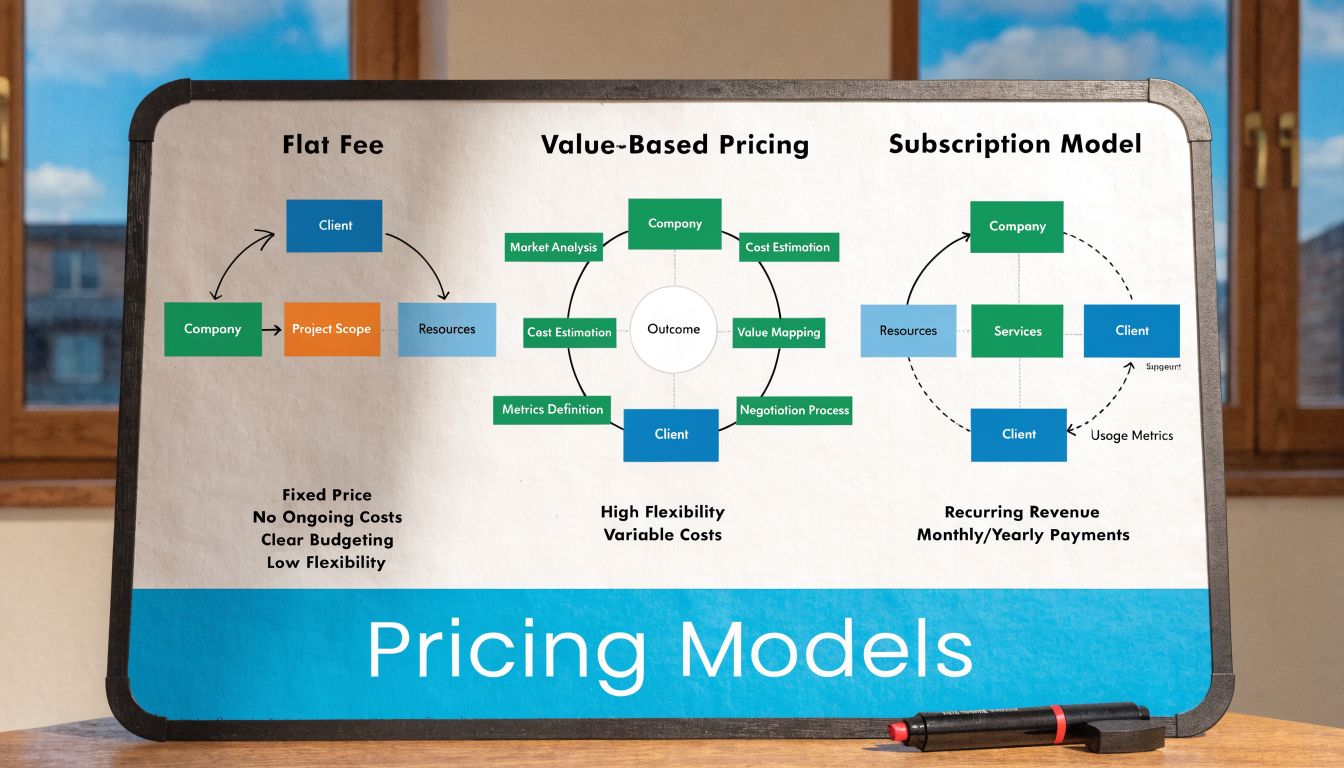
I explain it to clients like this.
- Per-minute pricing is a taxi meter. The clock runs, and small delays add up.
- Per-call pricing is like buying a ticket for each ride. Easier to understand, but still tied to volume.
- Flat-rate pricing is closer to an unlimited pass. You pay for access and predictability.
If you're also comparing other service businesses and trying to understand how agencies package work, looking at various pricing models outside the answering-service world can help you spot the same pattern. The cheapest-looking structure often isn't the lowest total cost.
Per-minute pricing
Many businesses often fall into this trap.
A provider gives you a plan with a minute bucket. Once you go past it, you pay overages. On paper, that can look efficient if your volume is low and steady. In practice, many small businesses don't have low and steady call patterns.
Home services get weather spikes. Medical offices get busy periods. Law firms get bursts around campaigns, referrals, or events. When the phones surge, the bill surges too.
Worse, AnswerConnect's breakdown of call answering service cost notes that providers often round to 30-second or full-minute increments, which can inflate bills by 20% to 30%. The same source gives a sharp example: 200 two-minute calls on a 50-minute base plan can push a bill from $319 to more than $2,655 in a peak month.
That one example tells you what matters. Minute billing doesn't just track usage. It can magnify it.
Per-call pricing
Per-call pricing is easier to read. You know each answered call has a cost attached to it.
This model can work if your calls vary a lot in length and you want simpler forecasting. It's often easier for owners to audit because they can compare invoice counts with phone logs. But it can still punish growth. Every new inquiry adds cost immediately, even if the calls are brief and highly repetitive.
Per-call pricing also deserves a closer look if the provider treats transfers, repeated attempts, or certain intake flows as separate billable events. Vendors don't always make that obvious in the sales conversation.
A good question to ask is simple: What exactly counts as one billable call?
Here’s a quick way to think about the three models:
| Pricing model | What it feels like in real life | Best fit | Biggest risk |
|---|---|---|---|
| Per-minute | Meter keeps running | Very stable, lower-volume usage | Rounding and overages |
| Per-call | Pay each time the phone is handled | Short, predictable call flows | Volume growth raises cost fast |
| Flat-rate | Budgeted operating expense | Seasonal or variable businesses | Feature limits hidden in plan tiers |
A short explainer is useful here if you want to see how vendors talk through setup and plan structure:
Flat-rate pricing
Flat-rate plans are usually the easiest to manage operationally. Your finance person knows the expected spend. Your office manager isn't trying to keep calls short to protect the budget. Your staff doesn't hesitate to route overflow because every transfer means another charge.
That matters more than people think.
When a billing model creates anxiety around usage, teams start making bad operational decisions. They let calls roll to voicemail. They stop forwarding after hours. They avoid using scheduling or intake features because they're trying to keep the invoice down.
If your plan makes your staff ration answered calls, the plan is controlling your business instead of supporting it.
Flat-rate isn't always the right choice for every company. But for businesses with uneven call volume, it usually produces the cleanest math and the fewest billing surprises.
The Hidden Factors That Drive Up Your Bill
Base pricing is only the start. The actual business answering service cost shows up in the fine print and in your operating pattern.
A provider might quote a reasonable monthly number, but your actual bill changes once you add after-hours coverage, appointment booking, intake scripts, bilingual support, CRM syncing, or overflow handling during busy periods. None of those are exotic features. For many businesses, they're the whole reason to buy the service.
Overage risk is the real budget killer
The biggest pricing trap is still overage exposure.
According to GetNextPhone's answering service comparison, a business that reaches 600 minutes of call time on a mid-tier plan with only 100 to 200 included minutes can see a $250 base cost climb to more than $600 to $2,000 per month. AI flat-rate options in that same comparison stay at a predictable $99 to $300.
That's the difference between a service you can budget and a service you have to brace for.
This is why I tell owners to stop comparing plan names like “starter,” “growth,” or “professional.” Those names don't matter. What matters is how the invoice behaves when your phones get busy.
Operational complexity changes the price
Simple message taking is cheaper than actual front-desk work. The more the service does, the more carefully you need to review the cost structure.
Watch for these practical cost drivers:
- Scheduling workflows: Booking appointments, reschedules, and confirmations takes more handling than basic message capture.
- Lead qualification: Intake questions, screening, and routing usually require more scripting and process design.
- Integrations: CRM and calendar syncing can change both setup effort and monthly cost.
- Coverage windows: Business-hours-only coverage is a different product from overflow plus nights and weekends.
- Industry requirements: Medical and legal calls tend to cost more because intake and compliance expectations are more demanding.
If your business relies on forwarded calls from mobile lines, branch offices, or rotating staff, your call-routing setup matters too. Clean routing reduces duplicates, missed handoffs, and unnecessary billable handling. This guide to call forwarding options is useful if you want to tighten the system before you buy more coverage.
Short calls can cost more than you expect
Owners often assume short calls mean low cost. That's only true on plans that bill fairly.
On minute-based plans, short calls can become expensive if the provider rounds aggressively or bills for more than talk time. A burst of quick appointment requests, service inquiries, or “Are you open?” calls may look harmless in the log and still produce a surprisingly high invoice.
Here's the practical test I use with clients:
- Pull a recent busy month.
- Count total inbound calls, not just answered ones.
- Note average duration.
- Ask the vendor to model that exact month on their billing rules.
- Ask for the same exercise using a peak month.
If a provider won't do that math clearly, that's a warning sign.
A transparent vendor should be able to show you what your busy month would cost before you sign, not after.
Price stability matters more in seasonal businesses
An HVAC company in a heat wave and a medical office during a rush of appointment calls don't need the same thing as a firm with even call volume every week. Variable-volume businesses should value predictability almost as much as coverage.
A stable monthly fee doesn't just help cash flow. It changes behavior. Teams forward more calls, extend coverage more confidently, and stop treating customer contact as something they need to meter.
That's why hidden usage charges matter so much. They don't only inflate your bill. They distort how your business answers the phone.
Cost Scenarios In-House vs Outsourced vs AI
A single pricing quote rarely tells you what phone coverage will really cost over a year. The actual number is your total cost of communication: base fees, labor, missed-call recovery, after-hours coverage, overages, and the revenue impact of calls that never get handled properly.
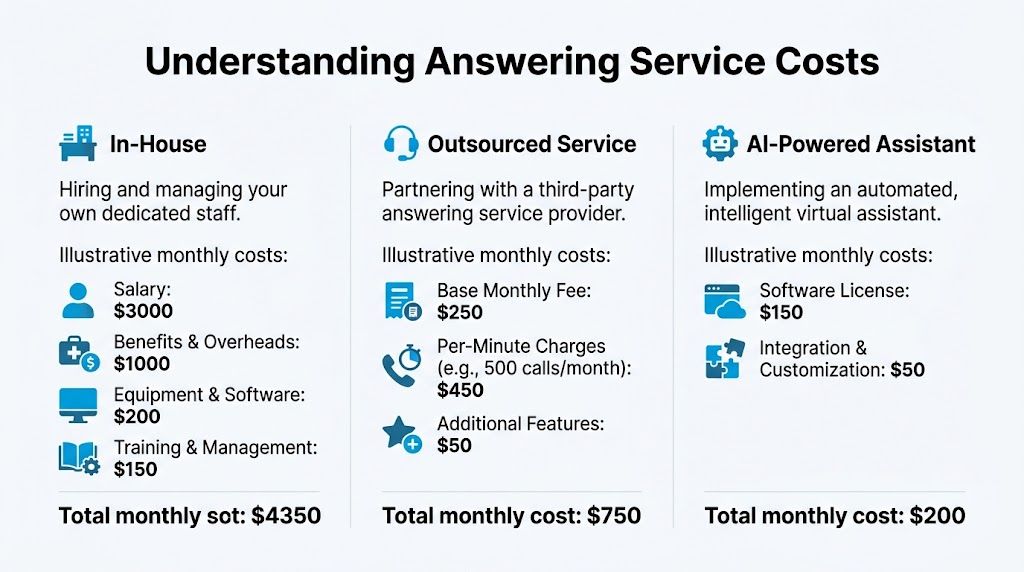
Take a common case. A plumbing or HVAC company gets steady weekday calls, after-hours emergencies, and short seasonal surges. It needs message capture, basic scheduling, lead intake, and overflow coverage when the office is already busy.
Three models usually make the shortlist. They solve different problems, and they fail in different ways.
In-house receptionist
An in-house receptionist gives you direct control over call quality, routing decisions, and customer tone. If your front desk person also handles dispatch support, billing questions, or office coordination, the role can carry real operational value beyond answering the phone.
The problem is the cost floor. Salary is only part of it. You also carry payroll taxes, benefits, coverage for breaks and time off, recruiting risk, training time, and the fact that one person can only handle one live interaction at a time. If your phones need coverage after hours, weekends, or during lunch rushes, one full-time hire still does not close the gap.
This model usually fits businesses with complex calls, frequent judgment calls, or a strong need for one person who knows the business inside and out.
Traditional live answering service
A traditional answering service lowers the staffing burden and extends coverage without adding another employee. For many small businesses, that is the first obvious improvement.
It can also produce a strong return if it captures calls your team was missing. The mistake is assuming the quoted monthly price is the whole cost. In practice, traditional services often bill in ways that rise faster than owners expect. Minutes, call handling time, transfers, after-hours use, holiday coverage, script changes, and bilingual support can all push the bill up. A busy month can look efficient operationally and still wreck your budget.
That volatility matters more than many owners realize. If your volume swings with weather, ad campaigns, or referral bursts, a human-only service often gets more expensive at exactly the moment you need coverage most.
AI-hybrid service
AI-hybrid models handle the repetitive front end of call traffic and send exceptions to a person. That changes the math.
Routine calls such as appointment requests, basic FAQs, message capture, lead qualification, and simple scheduling can be handled at a more predictable cost than paying human rates for every interaction. A service built around an AI phone answering service for inbound call workflows can give variable-volume businesses broader coverage while reserving human time for escalations, sensitive conversations, or complex intake.
The trade-off is straightforward. AI-hybrid works best when a meaningful share of calls follow repeatable patterns. It works poorly if nearly every call requires nuanced judgment, emotional handling, or deep back-and-forth with your internal team.
Annual comparison table
Use this comparison to evaluate total operating impact, not just headline price.
| Metric | In-House Receptionist | Traditional Live Service | AI-Hybrid Service (e.g., Recepta.ai) |
|---|---|---|---|
| Annual cost structure | High fixed labor cost | Moderate base fee with variable monthly charges | Lower, more predictable subscription-style cost |
| Coverage | Usually limited to staffed hours | Broad coverage, including overflow and after-hours | Broad coverage with easier scaling for routine calls |
| Peak season handling | Constrained by staffing capacity | Capacity improves, but usage-based billing can spike | Handles routine volume increases with less billing volatility |
| Management burden | Hiring, training, scheduling, backfill | Vendor-managed staffing, internal script oversight still needed | Setup, testing, escalation design, and periodic tuning |
| Risk of surprise charges | Lower invoice volatility, higher labor commitment | Highest risk if billing includes overages and add-ons | Lower risk if pricing is flat, tiered clearly, or capped |
| Best fit | High-touch offices where phone work overlaps with admin operations | Businesses that want a live human on every call and have stable volume | Home services, healthcare, and other variable-volume teams that need cost predictability |
Where each option usually wins
- In-house works when the phone role is tied to front-desk operations, internal coordination, and customer issues that need context.
- Traditional live service works when callers strongly prefer a human voice and your volume is steady enough that usage charges stay controlled.
- AI-hybrid works when call patterns repeat, after-hours coverage matters, and cost predictability is part of the buying decision.
Where owners get burned
- Hiring in-house to solve a narrow overflow problem.
- Buying a low-entry traditional plan without modeling a busy month.
- Choosing AI with no clear human escalation path for urgent or sensitive calls.
I usually give clients one rule here: price the model that survives your busiest month without creating a second problem. Cheap coverage that collapses under peak volume, or gets expensive the moment volume rises, is not cheap.
How to Accurately Estimate Your Answering Service Spend
Most bad vendor decisions start with bad internal math.
If you want a realistic number before you talk to providers, build a simple estimate from your own call patterns. Not guesswork. Not a sales rep's generic recommendation. Your numbers.
Step 1 is audit what comes in
Start with your phone system logs, call reports, or carrier records. Pull at least a representative period that includes both normal activity and a busier stretch if you have one.
Focus on:
- Total inbound calls: Count all incoming calls, including the ones your team missed.
- Call timing: Note when calls cluster. Early morning, lunch, after-hours, weekends, and dispatch periods matter.
- Overflow patterns: Mark where calls arrive while your staff is already busy.
If you're spending money to generate leads, connect this with your acquisition math too. This article on how to calculate cost per lead is useful because it forces the right question: what does it cost you to create a lead that no one answers?
Step 2 is calculate average handling reality
Don't just look at average call duration in isolation. Look at call types.
A two-minute appointment request and a five-minute new-client intake don't belong in the same mental bucket if one of them triggers scheduling, routing, or follow-up work. Write down your common call categories and estimate how often each one happens.
A practical worksheet might look like this:
| Call type | What happens on the call | Cost impact |
|---|---|---|
| Basic inquiry | Hours, location, simple questions | Usually lowest handling burden |
| Appointment request | Booking or rescheduling | Higher workflow value |
| New lead intake | Qualification and data capture | Higher value and often longer |
| Urgent issue | Fast routing or escalation | Operationally critical |
Step 3 is separate must-haves from nice-to-haves
Budgets often go off track when owners ask for “pricing” before defining what the service needs to do.
Write down your essential requirements. Keep it short and operational.
- Coverage requirement. Do you need business-hours backup, after-hours, weekends, or all of the above?
- Workflow requirement. Are you only taking messages, or do you need appointment booking, lead screening, and routing?
- System requirement. Does the service need to sync with calendars, CRM, or line-of-business software?
If you don't define these first, you'll compare plans that aren't solving the same problem.
Step 4 is model your spend under pressure
Now apply your call volume and handling needs to each pricing model.
For a minute-based vendor, ask them to price your normal month and your busy month. For a per-call vendor, ask what counts as a billable call. For a flat-rate vendor, ask which features are excluded at the quoted tier.
Then build a simple planning range:
- Low month: Your normal usage
- Busy month: Your spike usage
- Tolerance point: The highest monthly bill you're comfortable carrying
Your estimate is only useful if it includes the month when the phones won't stop ringing.
That one step changes the entire buying conversation. You stop asking, “What's your cheapest plan?” and start asking, “What does this cost when my business is under load?”
Your Vendor Evaluation Checklist
Most answering service sales conversations are designed to keep you focused on the monthly starting price. That's not where the actual decision lives.
The key decision lives in the billing rules, the feature boundaries, and the provider's willingness to answer direct operational questions without dancing around them.
The market is large enough that you have options. According to Ringly's answering service pricing overview, the global answering service market reached over $6 billion in 2025, and average SMB plans for 250 to 500 minutes cost $330 to $925 per month. The same source notes industry-specific averages such as $1.60 per medical call and $1.55 per legal call, which reflects the extra complexity in those workflows.
That range is exactly why a checklist matters. Two providers can both say they serve SMBs and still deliver very different economics.
Questions that expose hidden cost
Use these in every vendor conversation.
- How do you bill overages? Ask for the exact unit, the exact trigger, and whether rounding applies.
- What counts as billable time or a billable call? You want their definition, not your assumption.
- Which features cost extra? Specifically ask about scheduling, intake, transfers, bilingual handling, CRM sync, and reporting.
- What happens during a spike? Ask them to price a busy month using your real call volume.
- What are the contract terms? Month-to-month and annual agreements behave very differently when the fit is wrong.
Questions that expose operational fit
Price only matters if the service can run your front desk well.
Ask things like:
- How do you handle escalation?
- Can you follow a custom intake script?
- How do you route urgent calls?
- What do call summaries and reports look like?
- Who updates the workflow when our process changes?
If you're comparing live and hybrid providers, it's also smart to review broader outsourced call center solutions so you're not evaluating each vendor in a vacuum. Many owners end up buying the wrong category before they even compare providers inside that category.
Red flags that should slow you down
Some answers should make you cautious immediately.
| Red flag | Why it matters |
|---|---|
| “It depends” with no written example | Usually means billing is more variable than advertised |
| No sample invoice | Hard to verify what you'll really pay |
| No peak-volume scenario | They may be selling you a calm-month price |
| Vague integration answers | Add-on fees or manual work often appear later |
| Long contract before proof of fit | You carry too much risk early |
If a vendor can't explain the invoice in plain English, they probably won't make it easier after you sign.
The shortlist test
When you narrow to two or three vendors, ask each one for the same thing: price my recent month, price my busy month, list every included feature, and show me where extra charges can appear.
That simple request strips away most of the fluff.
A transparent vendor will answer directly. A slippery one will shift back to broad promises, generic benefits, and “custom” language that hides the math.
Conclusion The Smartest Spend Is Capturing Every Opportunity
The right business answering service cost isn't the lowest monthly number. It's the number that holds up when your business gets busy and keeps good calls from disappearing.
That's the core mistake I see most often. Owners compare list prices instead of comparing invoice behavior and revenue protection. They buy a plan for a normal month, then get punished in a busy one. Or they stay understaffed on the phones because paying nothing feels safer than buying the wrong service.
The practical answer is straightforward.
If your call volume is stable and low, a usage-based model may work. If your phones swing with seasonality, campaigns, emergencies, or after-hours demand, predictable pricing usually gives you better control. If your calls need a mix of automation and human judgment, hybrid coverage often makes more operational sense than either extreme on its own.
The point isn't to avoid spending. It's to avoid spending blindly.
Calculate your current missed-call exposure. Model your busy month, not just your quiet one. Ask vendors to show their math. Treat overages like a real risk, not a footnote. And judge every option against one standard: does it help you capture more opportunities without turning your communications budget into a monthly surprise?
That's the smartest spend. The service that answers when your team can't, fits the way your business runs, and keeps revenue from leaking out through voicemail.
If you want a practical way to compare predictable coverage against traditional answering service costs, Recepta.ai offers an AI receptionist model with human escalation for businesses that need call handling, scheduling, lead capture, and after-hours coverage without relying on a fully in-house front desk.