
Conversational AI in Healthcare
A patient calls at 8:12 on a Monday morning to reschedule, another wants to know whether a symptom needs urgent attention, and a third is waiting for an insurance answer before booking. The front desk is already handling arrivals, ringing phones, portal messages, and a clinician asking for yesterday's paperwork. By lunchtime, some calls have gone to voicemail, and the team is working through a queue that keeps growing.
That's the operational problem conversational AI in healthcare is now being asked to solve. The useful systems aren't positioned as autonomous doctors. They collect information, coordinate routine actions, explain next steps, and bring a trained person into the conversation when judgment, empathy, or clinical authority is required. The distinction matters because a healthcare deployment succeeds or fails in the handoff between automation and accountable human care.
The New Frontline of Patient Engagement
At a busy outpatient clinic, the first patient interaction often has nothing to do with diagnosis. It may be a request to move an appointment, a question about preparation instructions, or a voicemail from someone who called after office hours. Those interactions still shape whether the patient feels supported and whether the practice captures the work it has already invested in attracting and serving that person.
A conversational AI receptionist can answer inbound calls and messages around the clock, collect the caller's details, offer approved information, and route the interaction according to defined rules. It can also make outbound calls for reminders, follow-ups, intake questions, or missing information. The practical benefit is not that every conversation becomes automated. It's that routine requests stop competing with situations that genuinely need a receptionist, nurse, or clinician.
Operational rule: Automate the predictable action, not the responsibility for the patient's outcome.
Consider a dermatology practice receiving a call from a patient who wants to reschedule. The assistant can confirm identity through the approved workflow, check available appointments, offer suitable times, and record the change in the practice management system. If the same patient reports rapidly worsening symptoms, the assistant should stop treating the exchange as a scheduling task and follow the escalation protocol. That may mean transferring the call, creating a priority task, or directing the patient to an urgent pathway approved by the practice.
Human support remains part of the design
White-glove support is not a contradiction in an automated model. It's the safety layer that makes automation usable in a regulated setting. A patient dealing with a complex insurance issue, a frightening symptom, or a sensitive behavioral health concern may need a person even when the initial request looks routine.
The conversation design should make that transition clear. The patient should know when they're interacting with an AI assistant, what it can and can't do, and how to reach staff. Staff should receive a concise summary rather than asking the patient to repeat the entire story. Practices that want to improve the broader experience can also review guidance on improving patient experience, especially where communication delays create unnecessary friction.
Consent is another practical moment where clarity matters. For recorded or transcribed encounters, staff can use resources such as capture consent explanations live to help explain what is being collected and why. The same principle applies to conversational AI: patients deserve an understandable explanation before sensitive information enters the workflow.
The strongest front desk model is therefore blended. AI absorbs volume and keeps communication available outside office hours. Staff handle exceptions, emotional conversations, and decisions that require professional accountability. Patients get faster access without being pushed into an opaque system that pretends every situation is interchangeable.
High-Impact Use Cases for Medical Practices
The gap between a basic FAQ bot and a useful clinical operations assistant appears in what happens after the patient asks a question. A basic bot may return office hours. A stronger system can identify intent, gather relevant details, take an authorized action, update a record, and escalate when the conversation crosses a safety boundary.
Scheduling that reflects real clinic capacity
Appointment scheduling creates value only when the assistant understands the practice's actual rules. It needs access to provider calendars, appointment types, visit duration, location, eligibility conditions, and buffers. Otherwise, it moves administrative work from the phone queue to the scheduling team.
For example, a physical therapy practice may allow an evaluation with one provider, follow-up sessions with another, and virtual visits only for certain appointment types. The assistant should ask the minimum necessary questions, present only valid slots, confirm the selected appointment, and send the approved preparation information. A cancellation should release the correct slot, not create a duplicate or leave the calendar out of sync.
Follow-ups that close the loop
After a visit, the practice may need to confirm that a patient received instructions, completed a form, scheduled a test, or wants help with a next appointment. An automated follow-up can ask a narrow question and route the response. “I'm having trouble with the medication” should not receive the same treatment as “I'd like to book my review.”
This workflow is more useful when the assistant records the result in a structured way. Staff can then see which patients completed the requested action, which need a callback, and which response triggered escalation. The system should never imply that a follow-up message replaces clinical advice unless the practice has explicitly approved that use.
Pre-visit history gathering
A pre-visit interview can ask patients about symptoms, relevant history, medications, allergies, and the reason for the appointment. The system can organize the answers into a reviewable summary, while the clinician remains responsible for validating the information and making decisions. A prospective, single-arm feasibility study in an ambulatory primary care clinic evaluated this kind of pre-visit history collection in a regulated clinical setting, demonstrating a practical workflow for gathering information before a new-patient visit (Google Research describes the clinical feasibility design).
Conversational AI can reduce repetition without pretending to perform the visit. The clinician enters the room with a structured starting point, then verifies what matters.
Elective practices can use a related workflow for lead capture. A prospective patient asking about a cosmetic procedure or hearing service can receive approved information, answer qualification questions, and request a consultation. If the person asks about financing, has a complicated insurance situation, or expresses uncertainty that requires empathy, the assistant should hand the exchange to a trained human agent.
The implementation details matter more than the chatbot label. An AI receptionist for a medical office should be judged by its scheduling actions, record updates, escalation behavior, and staff workflow, not by how naturally it answers a generic question.
Navigating HIPAA Compliance and PHI Security
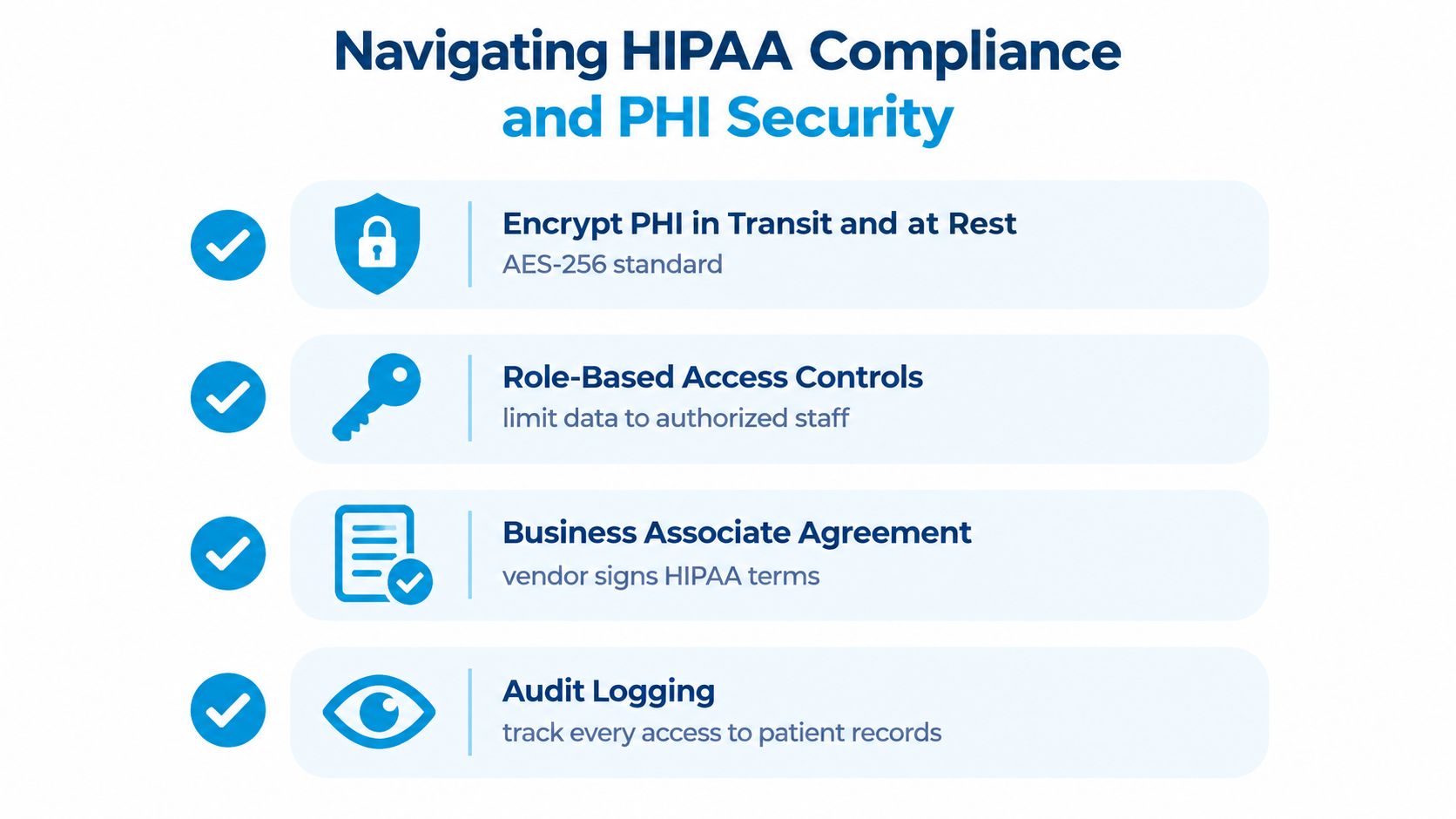
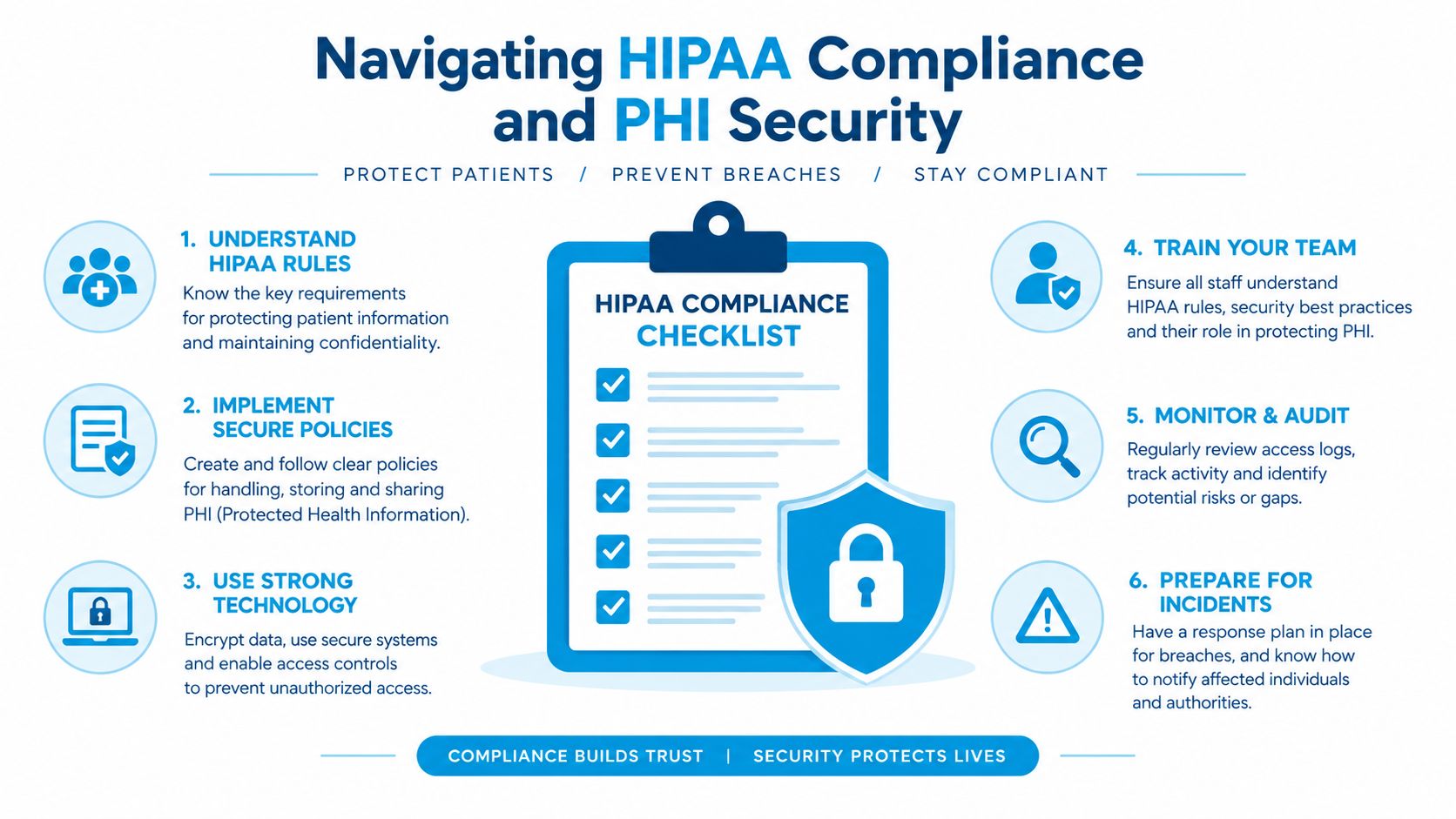
Healthcare conversational AI should be designed around Protected Health Information, not retrofitted with security controls after deployment. A conversation that includes a name, symptom, appointment detail, insurance issue, or clinical history can create compliance obligations. The organization remains responsible for understanding where that data goes, who can access it, how long it remains available, and what the vendor is contractually permitted to do with it.
The first review should happen before a vendor demonstration. Ask for the security architecture, data-flow documentation, retention policy, access model, incident process, and Business Associate Agreement terms. A vendor that can't explain how patient data moves from a phone call or chat into storage and then into the EHR isn't ready for a production clinical workflow.
Build controls into every interaction
Encryption protects information while it moves between systems and while it's stored. Access controls should limit staff visibility according to job responsibilities. A scheduling employee may need appointment details but not the full clinical transcript. A nurse reviewing an escalation may need more context, but that access should still be authenticated and recorded.
Audit logging serves two purposes. It supports compliance review, and it helps operations leaders investigate a failed handoff. If a patient says they already provided an allergy during intake, the practice should be able to determine whether the information was captured, transformed, transmitted, and viewed by the appropriate person.
Treat vendors and data boundaries as operational decisions
A Business Associate Agreement is necessary when the vendor performs covered services involving PHI, but the signed document isn't the whole compliance program. The practice still needs defined user roles, approved workflows, staff training, incident escalation, and periodic access reviews. Data residency and subprocessors also deserve direct questions, particularly when the platform relies on several external services.
Avoid sending more information than the task requires. A scheduling workflow may need patient identity and appointment context, not an unrestricted clinical record. A symptom-intake workflow may need more detail, but the practice should define which fields are retained, which are passed to staff, and which are excluded from downstream tools.
Security test: If the practice can't explain the data path in plain language, it can't reliably explain the system to its patients or auditors.
A compliance-ready answering workflow should also distinguish between information, advice, and action. The assistant may provide approved preparation instructions, but it shouldn't improvise a diagnosis. It may identify a response that meets an escalation condition, but it shouldn't make the escalation invisible. Teams evaluating vendors can compare these requirements with a practical overview of a HIPAA-compliant answering service, then validate the details against their own legal, privacy, and security obligations.
Integrating AI with EHRs and Practice Management
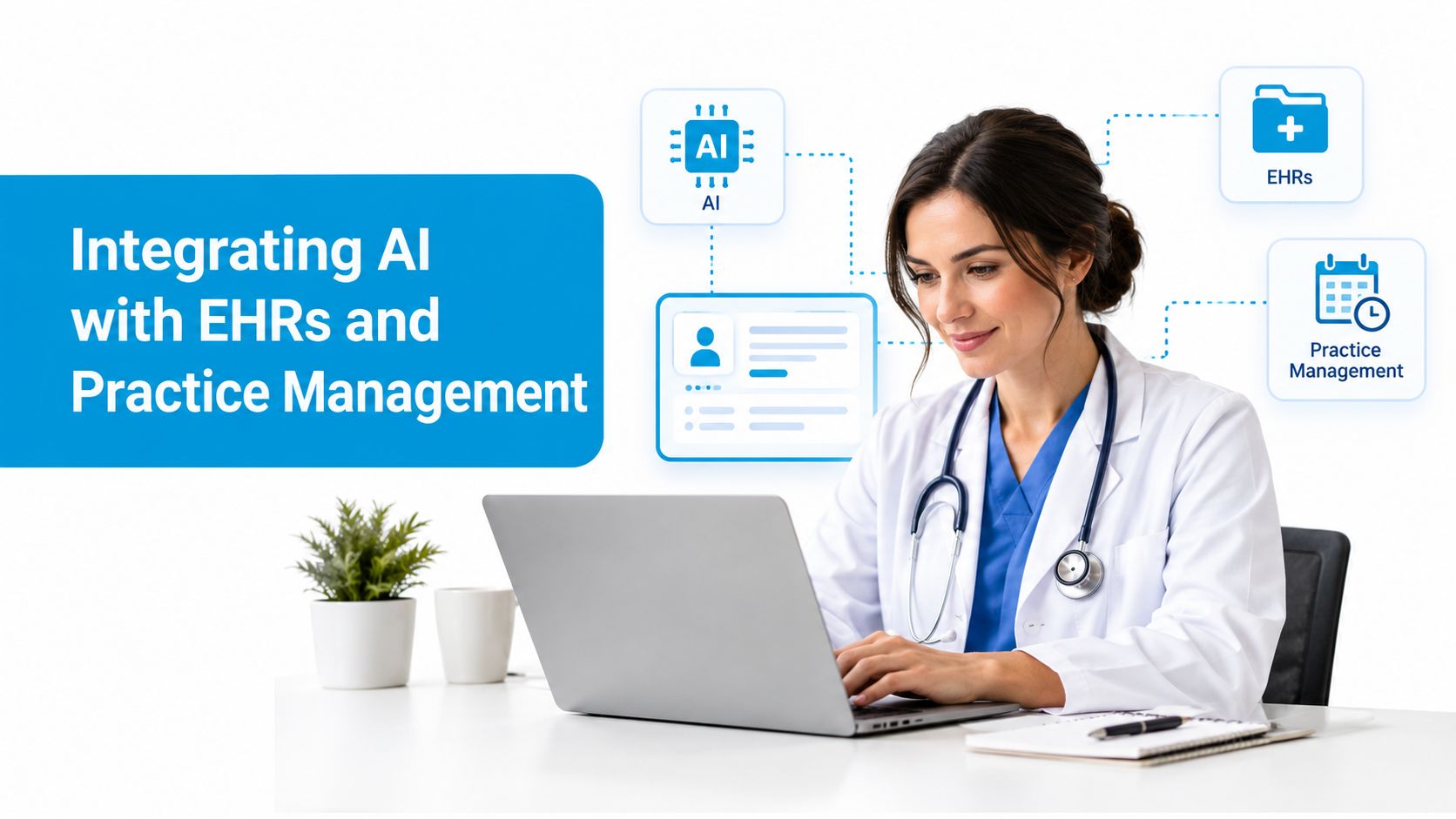
An assistant that talks well but leaves staff to re-enter every detail is an expensive messaging layer. The operational target is a closed-loop interaction. The patient's request should produce an authorized outcome in the system where the clinic already manages appointments, contacts, tasks, and clinical context.
Start with field mapping. Define how the assistant's “reason for visit” maps to the EHR intake field, how a confirmed appointment maps to the scheduling record, and where the conversation summary belongs. Don't allow every free-text response to flow directly into a clinical note. Use structured fields for actions and a clearly labeled summary for information that requires clinician review.
Design the data path before the script
A useful mapping exercise asks four questions:
- What enters the workflow? Identify the minimum patient and request data needed to begin.
- What action is authorized? Separate booking, cancellation, message creation, and clinical escalation.
- Where is the result stored? Choose the system of record for each outcome.
- Who owns the exception? Assign a staff queue, role, or clinician for unresolved cases.
Duplicate records are a common failure mode. Matching should use the practice's approved identifiers and verification process rather than creating a new patient profile whenever a caller uses a different phone number. If the system can't confidently match a patient, it should create a review task or collect information for staff instead of guessing.
Trigger the right response at the right time
A symptom that meets a high-acuity rule should create more than a transcript. It should trigger a visible alert, route to the appropriate team, and preserve the relevant context. The rule must also define what happens when nobody responds within the practice's service window. “Escalated” isn't a sufficient outcome if the case sits in an unmonitored inbox.
The same architecture supports nonclinical operations. A completed intake can trigger a reminder. A cancelled appointment can notify a waitlist process. An unanswered lead can create a follow-up task. These automations are valuable only when each trigger has an owner and an exception path.
Before launch, test the integration with realistic scenarios: a new patient with no matching record, an existing patient with duplicate contact details, a rescheduled appointment, a failed calendar write, and a high-acuity response during an unstaffed period. The outcome should be visible in the correct queue without requiring manual reconstruction. Teams can use real-time data sync as a conceptual reference, but the final design must reflect the clinic's actual EHR, scheduling platform, permissions, and operating hours.
Real-World Clinical Feasibility and Patient Trust
Clinical benchmarks answer a narrow question. They may show how a system performs on curated cases, but they don't prove that it will recognize an ambiguous patient message, retain context across a long exchange, or escalate appropriately when the patient's wording is incomplete. Those are different operational capabilities.
A 2023 evaluation using 36 published clinical vignettes from the MSD Clinical Manual reported 71.7% overall accuracy for ChatGPT. Performance was stronger for final diagnosis at 76.9% and weaker for initial differential diagnosis at 60.3% (the JMIR evaluation reports the results and methodology). That pattern is important for clinic leaders. A system that can synthesize a likely endpoint may still be unreliable at the first stage, where broad possibilities influence triage and testing.
A newer evaluation approach recognizes that a healthcare conversation is not a single question. HealthBench contains 5,000 multi-turn clinical conversations and 48,562 clinician-written assessment criteria, developed by 262 physicians across 60 countries (the HealthBench paper describes the benchmark). Multi-turn testing can reveal whether a system retains context, follows instructions, recognizes escalation conditions, and behaves consistently after the patient adds new information.
Patient experience can improve with supervision
The practical comparison isn't “AI versus doctors.” It's usually standard service versus a workflow in which AI assists a physician or trained staff member. In a randomized controlled experiment involving 926 cases over three weeks, a physician-supervised LLM conversational agent produced higher patient experience scores than standard care. The reported differences were strongest in clarity and overall satisfaction, while trust and perceived empathy remained comparable (the randomized experiment details the patient experience measures).
| Metric | Standard Care | AI-Assisted Care |
|---|---|---|
| Clarity of information | 3.62 out of 4 | 3.73 out of 4 |
| Overall satisfaction | 4.42 out of 5 | 4.58 out of 5 |
| Trust | Comparable | Comparable |
| Perceived empathy | Comparable | Comparable |
Those results support a supervised model, not an unsupervised clinical chatbot. AI can structure an exchange, surface the next administrative step, and help a physician communicate clearly. It shouldn't be allowed to conceal uncertainty or determine that a patient's concern is low risk without a defensible escalation policy.
Triage remains the hard boundary
A 2026 Nature analysis of public health queries found that health intent includes symptom assessment, condition management, emotional well-being, and caregiving, rather than only self-care (the Nature analysis examines real-world health-query scope and triage limitations). That breadth makes scripted intent categories brittle. A patient may begin with a scheduling request and then disclose a symptom. Another may ask for general information while seeking reassurance about an urgent condition.
The safest deployment defines when the system must defer. It uses conservative routing, displays clear urgent-care guidance where appropriate, and gives staff enough context to act. A benchmark can inform vendor selection, but only monitored workflow performance can establish whether the deployment is safe for that practice.
Measuring Success with Healthcare-Specific Metrics
“Messages per session” is rarely a useful executive metric in a clinic. A patient who ends a conversation quickly because the assistant failed to understand them may look efficient in a dashboard. The better question is whether the interaction produced the right outcome without creating hidden work or clinical risk.
Measure the operational result
Track the volume of calls and messages answered, the share completed without staff intervention, and the number routed to the correct queue. Review voicemail abandonment qualitatively and operationally by examining which request types are most likely to go unanswered. For scheduling, measure completed bookings, cancellations recorded correctly, failed calendar actions, and appointments requiring manual repair.
Financial analysis should include the full workflow cost. Compare staff time spent on routine interactions with staff time spent reviewing summaries, correcting records, and handling escalations. A system that reduces call handling but creates unreliable records hasn't reduced cost. It has moved cost downstream.
For elective services, track whether the assistant captures the required qualification details and whether a qualified inquiry reaches a human promptly. Don't count every collected phone number as a lead. Define what makes an inquiry actionable for that service line.
Add safety and quality measures
Clinical operations require a separate scorecard:
- Escalation quality: Review whether high-risk conversations reached the correct human pathway and whether low-risk requests avoided unnecessary escalation.
- Triage reliability: Compare the assistant's routing decision with clinician or nurse review. Record false reassurance and unnecessary urgency separately.
- Summary fidelity: Check whether the handoff preserves the patient's stated symptoms, timing, medications, and requested action without adding unsupported details.
- Instruction adherence: Monitor whether patients completed pre-visit forms, preparation steps, or follow-up actions after receiving the message.
- Staff correction rate: Count how often employees must edit an appointment, patient match, summary, or routing decision.
A dashboard should allow leaders to inspect the conversation behind an exception, with access restricted according to role. Aggregate metrics identify bottlenecks, but sampled reviews explain why they occur. One clinic may have a scheduling integration problem. Another may have a confusing intake question. Those require different fixes.
The most useful reports combine call summaries, escalation reasons, integration errors, staff feedback, and patient feedback. Review them on a defined cadence, update approved responses, and retire workflows that create more ambiguity than value. Healthcare AI should be managed like an operational service with quality assurance, not like a marketing widget judged by engagement alone.
Your Implementation Roadmap for Clinical AI
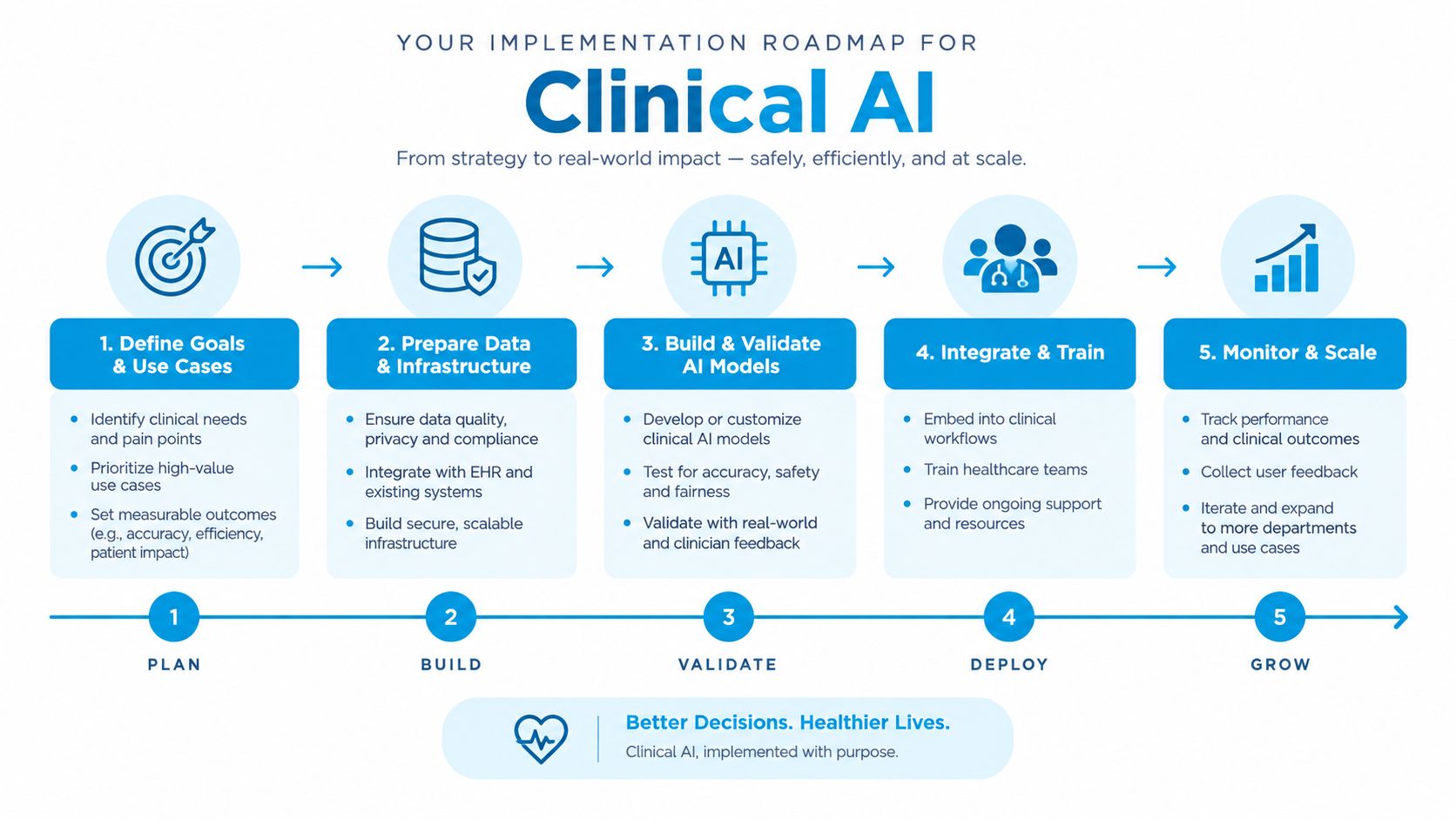
A safe launch starts with a narrow operational problem. Don't begin by asking an AI system to handle every patient conversation. Select a workflow with clear inputs, authorized actions, measurable outcomes, and an available human owner.
Start with an evidence-based pilot
Map the current patient journey from first contact to resolution. Record where calls wait, where staff re-enter information, where patients repeat themselves, and where escalations disappear into shared inboxes. Then choose one use case, such as appointment rescheduling, pre-visit intake, or post-visit follow-up.
Write the rules before writing the personality. The design should specify approved answers, prohibited advice, identity checks, data fields, escalation triggers, emergency routing, and the exact handoff message staff receive. Include practice terminology, provider names, locations, insurance verification procedures, and appointment types. A friendly voice can't compensate for missing rules.
Test failure before expanding scope
Run staff-led tests using realistic variations. Include incomplete answers, angry callers, conflicting records, insurance questions, requests for clinical advice, and messages that arrive outside operating hours. Have clinical and compliance reviewers approve the escalation language. Verify that every automated action appears correctly in the EHR or practice management system.
A small pilot should have a go-live owner, a daily review process, and a documented rollback plan. Collect feedback from receptionists, clinicians, and patients. Staff often identify problems that technical testing misses, such as an assistant asking a clinically irrelevant question, placing a task in the wrong queue, or using language that makes a patient think a clinician has already reviewed the message.
Scale by governance, not enthusiasm
Once the initial workflow is stable, add adjacent use cases one at a time. Maintain a change log for prompts, rules, integrations, approved content, and escalation destinations. Recheck permissions when staff roles change, and review vendor updates before they affect patient-facing behavior.
For multi-location groups, keep core safety rules consistent while allowing each clinic to manage local hours, providers, locations, and scheduling constraints. A practice evaluating broader generative AI for SMBs should apply the same discipline: start with a defined process, assign ownership, protect sensitive data, and measure the business outcome rather than novelty.
Recepta.ai can fit the administrative layer of this roadmap by handling inbound and outbound communication, appointment scheduling, caller-detail collection, follow-ups, and escalation to human support, with integrations for calendars, CRMs, and industry systems. Validate any platform against your own HIPAA review, EHR requirements, escalation rules, and clinical governance before expanding its role.
If your clinic is losing time to appointment calls, intake repetition, and unanswered follow-ups, start by mapping one workflow and defining its human handoff. Recepta.ai offers an AI receptionist workflow for healthcare communication, and you can review the platform and request a focused implementation conversation at Recepta.ai.