
How to Forward Calls to Another Number The Complete Guide

Looking at a long list of missed calls feels like leaving money on the table. It's a universal pain for business owners, but the fix is surprisingly simple. You can forward calls to another number directly from your phone, use old-school carrier codes like *72, or set up a proper business phone system. The goal is to make sure you never miss that one important call, whether you’re on a job site, taking a rare vacation, or just stepped away from your desk.
Why You Can't Afford to Ignore Call Forwarding

Call forwarding used to be a simple convenience. Now, it’s one of the most fundamental tools for protecting your revenue and reputation. A missed call isn't just a missed conversation—it’s a potential customer immediately calling your competitor who actually picked up. If you want a deeper dive into the mechanics, you can read our full guide on https://www.recepta.ai/blog/what-is-call-forwarding.
I saw this happen firsthand with a plumbing company I worked with. The owner was a one-man operation, constantly losing out on high-value emergency jobs. If he was in the middle of a complex repair, he simply couldn't answer his phone. By the time he called back, the homeowner had already found someone else. This isn't just a plumber's problem; it's a story I hear all the time from contractors, real estate agents, and other service pros.
The Real Cost of Sending a Caller to Voicemail
The damage from a missed call goes far beyond one lost job. When a new lead hits your voicemail, their first impression is that you’re either unavailable or just too busy to care. That immediately erodes trust before you've even said hello.
This is where a smart call forwarding strategy changes the game. It turns your phone line from a point of weakness into a reliable tool that works for you.
- You're always available. Calls get answered by a real person, whether that's you on your cell, a business partner, a virtual receptionist, or an AI assistant.
- You look more professional. Seamlessly routing calls makes your business feel bigger and more organized, even if it's just you.
- You capture more leads. By ensuring every call connects with someone, your odds of converting that caller into a customer skyrocket.
In an age of distributed teams and mobile work, a solid remote work phone system with intelligent call forwarding isn't a perk—it's essential. It's the glue that holds your customer communications together, no matter where you or your team happen to be.
Finding the Right Forwarding Method for You
The best way to forward calls depends entirely on how you operate. A solo freelancer just needs something simple, while a growing business with multiple locations needs a more powerful solution. Let's break down the options so you can figure out what makes sense for your specific situation.
To help you quickly compare your options, here’s a look at the most common ways to forward calls and who they’re best for.
Call Forwarding Methods at a Glance
| Method | Best For | Key Feature | Typical Use Case |
|---|---|---|---|
| Mobile Carrier Forwarding | Solo operators and temporary needs | Simple setup via phone settings or dial codes | A contractor forwarding calls to their partner while on vacation. |
| Google Voice | Freelancers and small teams | Free number with basic routing and voicemail transcription | A consultant using a separate number for business that rings their personal phone. |
| VoIP Systems | Growing businesses needing flexibility | Advanced rules, simultaneous ringing, and analytics | A real estate agency routing calls to multiple agents at once. |
| AI Receptionist (like Recepta.ai) | Service-based businesses focused on growth | Automated lead qualification, scheduling, and CRM integration | A dental clinic capturing new patient details and booking appointments 24/7. |
Ultimately, picking the right method gives you peace of mind. You can stop worrying about what happens when you can't get to the phone and trust that every caller—whether a brand-new lead or a loyal client—is being handled professionally and efficiently.
How to Forward Calls on Your iPhone and Android
When you absolutely can't miss a call, fumbling through your phone’s settings is the last thing you need. Thankfully, both iPhone and Android have built-in call forwarding options that let you reroute calls to another number in just a few taps.
Think about a clinic manager who needs to send after-hours emergencies to the on-call doctor's personal cell. Using the phone's native settings is a simple, immediate fix for that kind of temporary coverage. Let's walk through exactly how to get it done on both platforms.
Setting Up Call Forwarding on Your iPhone
Getting call forwarding running on an iPhone is refreshingly simple, as long as your mobile carrier supports the feature (most do). The key thing to know is that this is an unconditional forward—it sends every single call to your designated number, without exception.
Here’s how to set it up:
- First, open your Settings app and scroll down to tap on Phone.
- From there, find and select Call Forwarding.
- You'll see a single toggle. Flip it to the on position.
- An option will appear labeled Forward To. Tap it and type in the full phone number you want your calls sent to.
That's it. The setting saves automatically. From now on, any call to your iPhone will ring on the other number instead. To turn it off, just come back to this same screen and flick the toggle back to off.
How to Forward Calls on Android Devices
Android phones give you a bit more control, letting you decide when calls should be forwarded. This is a game-changer for business owners who only want to reroute calls if they're busy or can't pick up.
The exact menu path can differ slightly between manufacturers like Samsung or Google, but the core process is nearly identical.
Start by opening your Phone app (the dialer) and look for the settings menu, which is usually a three-dot icon in the corner. You're looking for an option called "Call forwarding" or sometimes "Supplementary services."
Inside, you'll find a few choices:
- Always forward: This works just like the iPhone setting, sending all incoming calls to another number.
- Forward when busy: Perfect for when you're already on a call. It sends new incoming calls straight to your other number.
- Forward when unanswered: If you don't pick up after a few rings, the call gets rerouted.
- Forward when unreachable: If your phone is off, in airplane mode, or has no signal, this sends the call to a number that works.
This kind of granular control is incredibly practical. A real estate agent could set calls to forward to their assistant, but only when they're unanswered. This way, they get the first chance to answer, but no lead is ever truly missed.
Using Carrier Codes for a Quick Setup
If you want an even faster way to forward calls to another number, you can use special dialer codes, often called MMI or star codes. These shortcuts talk directly to your carrier’s network, bypassing your phone's settings entirely.
The codes themselves can vary from one carrier to the next, but here are the ones for the major U.S. providers.
| Carrier | To Activate Call Forwarding | To Deactivate Call Forwarding |
|---|---|---|
| Verizon | Dial *72 + the 10-digit number, then press Call. | Dial *73, then press Call. |
| AT&T | Dial *21* + the 10-digit number + #, then press Call. | Dial #21#, then press Call. |
| T-Mobile | Dial **21* + the 10-digit number + #, then press Call. | Dial ##21#, then press Call. |
Pro Tip: I use these codes all the time. Before heading out for a weekend, I’ll forward my business line to a colleague. It takes about five seconds to dial
*72plus their number. When I’m back on Monday, a quick dial of*73sets everything back to normal. Just be sure to double-check your carrier’s support website, as these codes can occasionally change.
Using VoIP and Google Voice for Advanced Call Routing
Basic call forwarding on your mobile phone is a decent starting point, but it's a pretty blunt instrument. As your business grows, you'll quickly find that sending every single call to one other number just doesn't cut it.
When you need more intelligent control, that's where systems like Voice over IP (VoIP) and Google Voice really shine. These tools let you move beyond simple redirects and start building smart, automated rules for how your calls are handled. You stop reacting to calls and start proactively managing them.
Never Miss a Call with Find Me/Follow Me
One of the most powerful features you’ll find in these systems is called “Find Me/Follow Me.” It’s a game-changer. This technology lets you create a list of numbers that ring in a specific order or even all at once, hunting for someone to answer. Think of it as your own virtual receptionist, working 24/7.
Here’s how it could work in practice: an important call comes in, and the system can be set up to:
- Try your office desk phone for 15 seconds.
- No answer? It then rings your mobile and home office line at the same time.
- Still no one? The call automatically forwards to your business partner or a dedicated answering service.
This kind of sequential or simultaneous ringing makes your business dramatically more responsive. A potential client won't go to voicemail just because you stepped away from your desk. The system does the work, following the exact path you created to find an available person.
A Real-World Example of Smart Routing
I recently worked with a growing HVAC company that was struggling with this exact problem. The office manager was getting swamped, and any calls that came in after hours—often emergencies—went straight to a generic voicemail box. They were losing leads and leaving customers with burst pipes waiting until morning.
We set up their VoIP system with a much smarter call flow:
- First Stop: Incoming calls rang the main office line for 15 seconds.
- Next in Line: If unanswered, the system automatically forwarded the call to the lead technician's cell phone.
- After-Hours & Backup: If the tech couldn't pick up (or if the call was outside business hours), it was instantly routed to a specialized answering service that could dispatch a crew for emergencies.
The change was immediate. Their call answer rate shot up to nearly 100%, and they booked significantly more after-hours emergency jobs. That simple, automated forwarding strategy put money directly back into their business by making sure every opportunity was captured.
Google Voice: A Flexible and Free Starting Point
For freelancers, solo entrepreneurs, or small businesses just getting started, Google Voice is a fantastic entry point into advanced call management. While it’s not a full-blown VoIP system, it gives you a separate business number that can ring multiple phones at once.
You can easily have it ring your cell and a landline simultaneously, and the first person to pick up gets the call. If you're curious about how to make it work for your business, our guide to using a Google Voice for business number breaks it all down.
Ultimately, both dedicated VoIP services and Google Voice offer the kind of flexibility that grows with you. You can start simple and layer on more complex rules as your needs change, often without buying new hardware.
For those who need even more firepower, looking into dedicated inbound call center software solutions is the next logical step. These platforms are built from the ground up to manage high call volumes and complex customer service workflows with incredible precision.
Strategic Call Forwarding for Real Business Growth
Once you get past the technical setup, the real power of call forwarding is in how you use it strategically. It's much more than an IT function; it's a direct line to business growth. We're talking about building a system that ties every single inbound call to a positive result, whether that’s a new client appointment, a hot lead, or a problem solved.
This means you have to think beyond just sending a call from one phone to another. You need to map out the customer’s journey from the moment they dial. Who is the best person to answer? When should they answer? What's the backup plan if that person is busy? Answering these questions turns your phone system into one of your most valuable business assets.
Turning Inbound Calls into Revenue
A missed call is a missed opportunity. It’s a classic saying for a reason. But an intelligently routed call? That’s a real competitive advantage. I worked with a multi-location dental franchise that used location-based forwarding to send all incoming calls to a central booking hub during their busiest hours. It was a simple change that had a huge impact.
The result? This strategic decision to forward calls to another number—in this case, to a specialized hub—took the pressure off their front-desk staff, who could then focus on the patients right in front of them. This streamlined their entire workflow and led to a remarkable 18% increase in new appointment bookings within the first quarter.
They didn't need some complex, expensive technology. They just identified a bottleneck and used a simple forwarding rule to fix it. This same thinking can be applied almost anywhere.
- Construction Firms: Imagine forwarding after-hours emergency calls straight to the on-call project manager’s cell. That’s how you land a profitable emergency job instead of losing it to the competitor who answered their phone.
- Insurance Agencies: Routing calls based on the policy type (auto vs. home) gets the client to the right agent instantly. It saves everyone time and makes the customer feel like you’re already on top of things.
This kind of smart routing is no longer a "nice-to-have." For call centers, it's the core of their operation. With average call volumes hitting 4,400 per month for each center and 61% of leaders seeing those numbers climb since 2020, you can't afford to have calls go to the wrong place—or nowhere at all.
Enhancing the Client Experience
The benefits go far beyond just capturing new business. Thoughtful call forwarding can completely change your customer experience for the better. I once advised a law firm that was getting complaints about communication. Clients were being bounced between assistants and lawyers, having to repeat their story over and over. It was frustrating for everyone.
We set up a system where calls about specific case types were forwarded directly to the paralegal managing that caseload. If a client called about their personal injury claim, the phone rang on the desk of the exact person who knew the file inside and out.
The change was immediate. Clients felt heard because they were connected with the right person on the first try. It built a level of trust and confidence that solidified the firm's reputation for excellent service. You can dive deeper into the various call forwarding options that help you achieve these kinds of results.
Ultimately, the goal is to make your business more responsive and professional. Every call that gets answered quickly by the right person is a win that strengthens your business and drives real, measurable growth.
Automating Your Call Flow with Intelligent Systems
Basic call forwarding is a start, but if you want your phone system to actually help grow your business, you need to think beyond just sending calls from point A to point B. This is where intelligent systems, like an AI receptionist, come into play. Instead of just redirecting a ring, they first figure out who is calling and what they need, then decide on the best person or system to handle it.
Think of it this way: simple forwarding is like a doorbell. Anyone can ring it. An intelligent system is more like a virtual concierge who greets every visitor, understands what they’re there for, and directs them to the right place. It’s a shift from a passive phone line to an active, automated process.
From Simple Forwarding to Automated Workflows
Let’s say a potential customer calls your home services company after seeing an ad. In a typical setup, that call goes to one phone, and if you’re on another line or out on a job, you've likely lost that lead for good.
Now, imagine that same call handled by an intelligent system. The experience is completely different:
- The AI answers instantly, no matter the time of day.
- It asks a few qualifying questions, like, "Are you a new or existing customer?" or "What service are you interested in?"
- It captures the caller's details and automatically logs a new lead in your CRM.
- It can even sync with your calendar to book a consultation right on the spot.
This isn't just about making sure someone answers. It's an entire automated workflow that captures valuable leads and gathers critical data without you having to lift a finger. You can get a much deeper dive into how this all works in our guide on the benefits of an automated phone answering service.
Practical Scenarios of Intelligent Routing
Here’s a real-world example I see all the time. A plumbing business gets an emergency call at 10 PM. With standard forwarding, it might go straight to a full voicemail box. But an intelligent system is smart enough to recognize the urgency.
When the AI hears keywords like "burst pipe" or "emergency leak," it doesn't just take a message. It immediately routes the call to the on-call plumber's cell phone and sends a text with a summary of the problem and the customer's address. That’s how you make sure your most critical jobs get a fast, human response.
This kind of strategic call handling is becoming non-negotiable. Businesses from legal firms to multi-location franchises are dealing with call volumes expected to jump 20% for 57% of service leaders. Simply setting up a basic forward calls to another number rule isn't enough to keep up.
Visualizing the Path from Call to Revenue
This isn't just theory. You can see exactly how a strategically handled call leads directly to business growth.
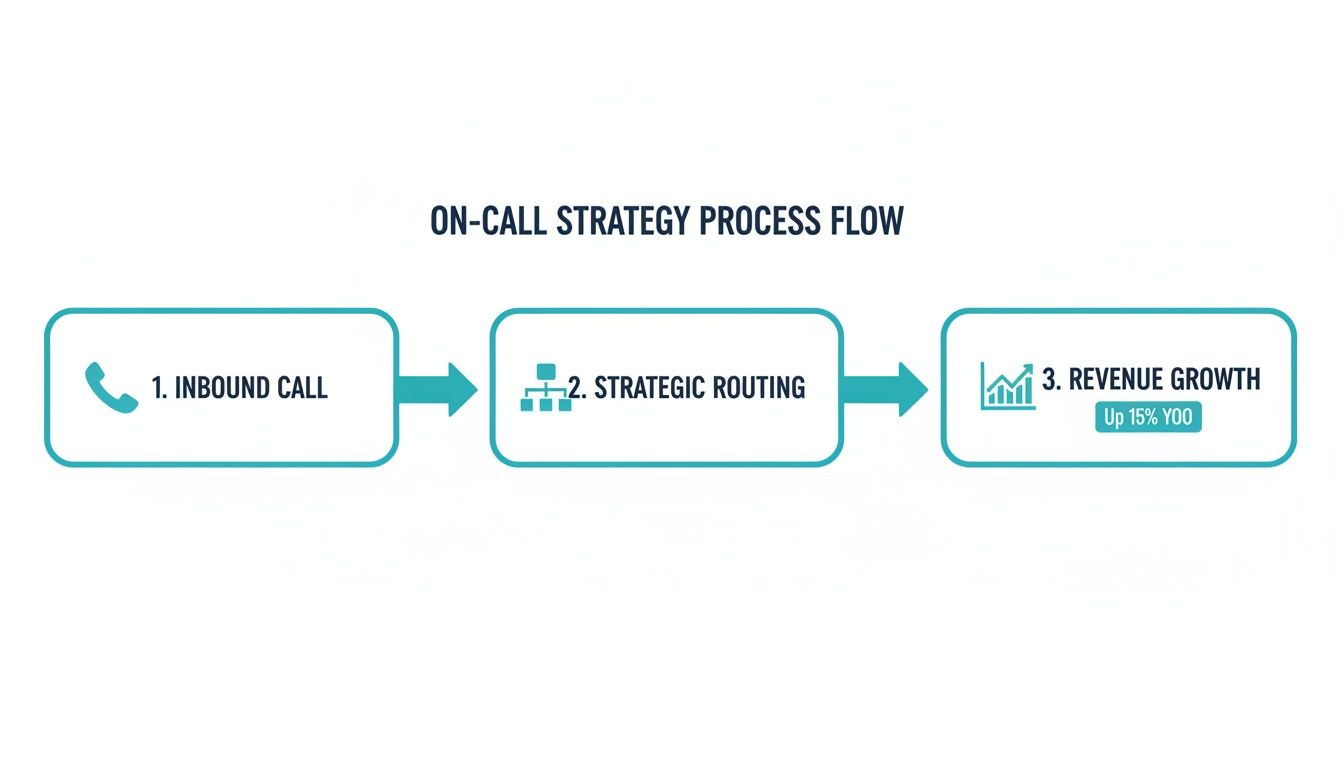
As the flow shows, that "strategic routing" step is what turns an everyday phone call into a measurable business outcome. It’s the bridge between a ringing phone and new revenue.
The Power of Integration and Automation
What truly makes these systems so effective is their ability to talk to the other software you rely on. For example, an AI receptionist like Recepta.ai can connect with over 2,500 different applications.
So, when a new patient calls your dental clinic, the AI can do all of this in a single interaction:
- Answer the call and gather their information.
- Check your practice management software for open appointment times.
- Book the appointment directly into the schedule.
- Automatically send a confirmation email along with new patient intake forms.
Your front desk staff never even touched the phone, but a new, fully documented patient is on the books. This eliminates tedious data entry, cuts down on admin work, and frees up your team to focus on what they do best—providing amazing care to the patients right in front of them. You’re not just forwarding calls anymore; you’re running an efficient, lead-generating machine that works 24/7.
Your Questions on Call Forwarding Answered
Once you get the hang of how call forwarding works, the "what if" questions start popping up. I get it. Business owners always want to know how these setups play out in the real world. Let's tackle some of the most common questions I hear all the time.
Will Callers Know Their Call Is Being Forwarded?
This is probably the number one concern, and for good reason—you want to appear professional. The short answer is no. Call forwarding is designed to be completely invisible to the person calling you.
They dial your main business number, and the call simply rings on whatever device you’ve chosen, whether that’s your personal cell, a colleague's phone, or an answering service. There’s no weird tone, no special announcement, nothing to give it away. To them, it feels like a direct call that was answered promptly.
The whole point is to make your business feel accessible and responsive. A caller who gets connected to a real person quickly won't know or care if their call bounced between three different numbers. They'll just remember that you picked up.
Does Call Forwarding Cost Extra?
It depends, but it's often more affordable than you might guess. For most personal cell phone plans from major carriers like Verizon or AT&T, basic call forwarding is just a built-in feature, usually with no extra fee.
Where you'll see a cost is with more powerful business tools like a VoIP system or an AI receptionist. In these cases, forwarding is part of a paid subscription. I always advise clients not to see this as an "extra cost," but as an investment. The ability to guarantee every single call gets answered stops leads from slipping through the cracks, which usually pays for the service many times over.
Can I Forward Calls to an International Number?
You absolutely can, and this is where modern phone systems really shine. Trying to forward to an international number through your standard mobile carrier can get expensive fast due to hefty long-distance fees.
However, services built for this, like VoIP or even Google Voice, make it surprisingly simple and cost-effective. They route calls over the internet, neatly sidestepping a lot of those traditional carrier charges. This is a huge advantage for businesses with global customers or remote team members in other countries. In fact, the market for these international call services is expected to jump from $1.73 billion in 2025 to $2.45 billion by 2029, showing just how essential this has become. A recent market report digs into this trend, which allows a small US business to easily forward calls to another number for a virtual assistant halfway around the world.
What Is the Difference Between Call Forwarding and a Virtual Number?
People often use these terms interchangeably, but they refer to two different things that work together. Here's a simple way to think about it:
- Call Forwarding is the action. It’s the behind-the-scenes process of redirecting a call from one number to another.
- A Virtual Number is the tool. It’s a phone number that isn't hard-wired to a single phone line or device.
You use call forwarding to control where calls coming into your virtual number go. For instance, a consultant might get a virtual number for her business. She can then set up forwarding rules to send calls to her personal cell during business hours and route them straight to voicemail after 5 PM. The virtual number gives her that professional presence, while call forwarding does the smart work of routing everything correctly.
Ready to stop worrying about missed calls and start capturing every lead? Recepta.ai combines intelligent AI with 24/7 human support to ensure your business is always responsive. See how our automated scheduling, lead qualification, and seamless integrations can help you grow by visiting https://recepta.ai to start your 30-day risk-free trial.