
Lead Management Call Center: Workflows, Tech, and Conversion
A lead contacted within five minutes is about 21 times more likely to qualify than one contacted after 30 minutes, while contact odds are about 100 times higher, according to the foundational Lead Response Management research summarized by Prospeo's speed-to-lead analysis. That statistic explains why companies invest in lead management call centers, but it doesn't explain why many still lose opportunities after the first conversation.
The first call is only the opening event. Revenue depends on whether the lead is identified correctly, qualified consistently, routed to the right person, documented in the CRM, and followed until somebody takes the next action. A fast call followed by a blank disposition field is just a faster way to create leakage.
What a Lead Management Call Center Actually Does
A lead management call center is an operating system for turning inbound interest into a sales opportunity. It captures leads from phone calls, web forms, chat, and SMS, responds quickly, asks the questions that determine fit, and moves each prospect into a defined pipeline stage.
The five-minute response window is the first control point. The original research found that contacting a web lead within five minutes made qualification about 21 times more likely than waiting 30 minutes, while contact was about 100 times more likely in the same comparison, as detailed in research on lead response time. The study measured contact and qualification, not closed revenue, but the operational implication is clear. Speed gives the agent a better chance to have a useful conversation.
The operating model
A capable team handles four connected jobs:
- Respond immediately: A webhook or contact-center queue should alert the next available agent as soon as a form, chat, or missed call arrives.
- Qualify with discipline: Agents use BANT or a similar framework to establish need, authority, budget, timing, property details, and urgency.
- Record every interaction: The CRM should retain the source, transcript or recording, questions answered, objections, disposition, and next action.
- Continue the conversation: SMS, email, voicemail, and callback tasks keep viable leads moving until they book, buy, become sales-ready, or are disqualified.
That makes the operation different from a switchboard, a cold-calling team, or a tier-one support queue. A support desk may resolve an existing customer's issue. A lead desk must protect the commercial context of a new inquiry and transfer it without losing intent.
For smaller teams, the distinction is useful when choosing between general reception and a specialized small business contact center. The right question isn't whether someone answers the phone. Ask whether the operation creates a complete, actionable record after every contact.
Practical rule: A response isn't complete until the lead has a disposition, an owner, and a next action.
The Five Stages of a Lead Management Workflow
A lead workflow breaks when teams treat capture, qualification, distribution, nurturing, and handoff as separate departments. Each stage should pass both the prospect and the context forward.
Capture starts before the first call
The first failure usually happens between the form and the queue. A web form, paid campaign, chat widget, and inbound phone line may feed different inboxes, creating duplicate records or leaving one source unattended. Preserve UTM data, consent status, phone number, service area, and original landing page when the record enters the CRM.
Set a clear ownership rule. A lead should receive one canonical record, one source attribution, and one queue assignment. If an HVAC prospect submits a form and then calls, the second event should enrich the existing record instead of creating a competing task.
Qualification needs a fixed decision path
Qualification should confirm need, budget or purchasing authority, location, timeline, and urgency. The exact questions vary by industry, but the scoring logic shouldn't change from agent to agent.
The five-minute benchmark matters here, but qualification can't remain open-ended. InsideSales reported that only 0.1% of inbound leads were engaged within five minutes, while 57.1% of first call attempts happened after more than a week, based on its review of more than 55 million sales activities across 5.7 million inbound leads, as shown in its Lead Response Management infographic. A script gives agents a practical way to make the first conversation useful rather than merely fast.
Distribution determines who owns the opportunity
Round-robin routing is simple, but it isn't always fair to the customer. Geographic rules may matter for home services, while specialty or language skills may matter in healthcare. Weighted routing can send high-fit leads to agents with the right experience, but managers must monitor whether the rules create hidden SLA breaches.
Nurturing starts when the lead doesn't book immediately. Build a sequence across SMS, email, and voicemail, with source attribution preserved at every touch. The cadence should reflect the buying cycle, not an arbitrary automation template.
Handoff is an atomic transfer
A lead becomes useful to a closer when the CRM contains the qualification score, call recording or transcript, customer need, objections, appointment status, and next action. If those fields don't transfer together, the closer must repeat the discovery conversation, and trust suffers.
A clear pipeline sales definition helps teams agree on the point where a qualified lead becomes an opportunity. For franchise operators, a resource on lead generation for franchises can also help connect local acquisition sources with centralized routing and follow-up rules.
Tech Stack and CRM Integrations That Hold It Together
Technology should map to workflow outcomes, not sit in a list of disconnected subscriptions. I use four layers when evaluating a lead management call center.
Layer one captures and connects
Cloud contact-center platforms such as Talkdesk, Five9, and Genesys handle queues, recordings, routing, and agent availability. Web tracking and form-capture tools should push a new inquiry into that queue within seconds. If the lead waits in a marketing inbox before reaching telephony, the team has already lost control of the response window.
Layer two creates the record of truth
Salesforce, HubSpot, and Zoho can serve as the CRM of record, provided calls, recordings, transcripts, dispositions, and tasks land there automatically. Native connectors are usually preferable, while Zapier or Make can bridge systems that lack a direct integration.
Manual entry is the weak point. An agent who must copy a phone number, summarize a call, select a status, and create a callback task is likely to skip at least one step during a busy period. A practical CRM telephony integration guide offers useful context on connecting call activity with customer records.
Layer three turns events into action
Automation applies routing rules, starts SMS and email sequences, creates callback tasks, and writes AI-generated call summaries into the CRM. The automation should also stop messages when a lead books, opts out, or reaches a human owner.
Layer four closes the feedback loop
Analytics should show response time, source, call outcome, qualification quality, appointments, and downstream pipeline contribution. Marketing can then compare lead sources by what they produce, not merely by form volume.
| Layer | Core components | Workflow outcome |
|---|---|---|
| Capture and telephony | Talkdesk, Five9, Genesys, forms, tracking | New inquiries enter the right queue quickly |
| CRM | Salesforce, HubSpot, Zoho, native connectors | Every interaction has one accountable record |
| Automation | Routing, dialers, SMS, email, AI summaries | Follow-up and status changes happen consistently |
| Analytics | BI dashboards, attribution, call reporting | Spend and staffing decisions use pipeline evidence |
The important test is continuity. A capable dialer doesn't repair a CRM that lacks dispositions, and a polished dashboard can't recover a lead whose call outcome never entered the system. Teams evaluating the CRM integration fundamentals should trace one lead from source to booked appointment and inspect every handoff.
AI, Human Agents, or Both
The AI-versus-human debate is less useful than a routing decision. The right model depends on cost per qualified lead, after-hours coverage, qualification depth, and caller trust.
AI-only handling fits high-volume, lower-stakes intake such as gutter cleaning, pest control, or broadband upsells. It can collect location, service type, urgency, and availability without tying up an agent. The trade-off is shallow judgment. An automated conversation may recognize a standard request but struggle with ambiguity, emotion, or an unusual commercial need.
Human-only desks remain valuable when the call itself is the qualification event. Healthcare, complex B2B, and high-ticket home services often require empathy, explanation, and judgment. The cost is coverage and consistency. A human team may deliver a better conversation but still miss calls during peaks, evenings, or staffing gaps.
A hybrid model assigns routine intake to AI, then escalates when the script detects complexity. Use AI for the first 30 to 90 seconds of every call to identify intent and collect structured data. Route to a human when the caller needs judgment, expresses distress, asks for an exception, or crosses a high-value threshold defined by the business. That threshold should be set from job economics, not copied from another company.
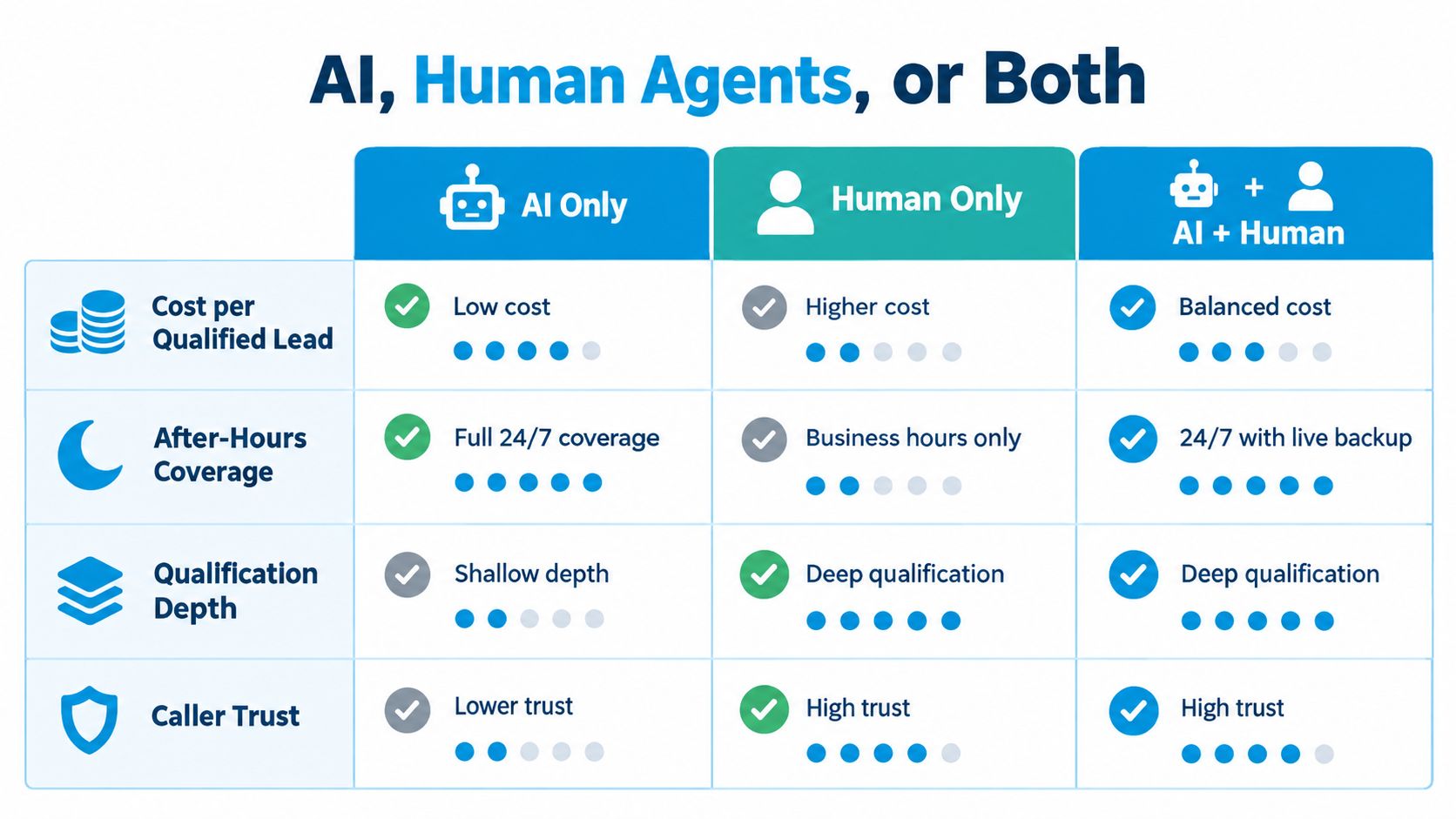
| Operating model | Cost and coverage | Qualification and trust |
|---|---|---|
| AI only | Lower operating cost, continuous coverage | Efficient for routine intake, limited judgment |
| Human only | Higher staffing cost, coverage tied to schedules | Stronger nuance, empathy, and objection handling |
| AI plus human | Balanced economics with escalation | Structured intake with expert intervention |
The handoff must preserve context. The agent should see the transcript, collected answers, lead source, and reason for escalation before speaking. Otherwise, the customer repeats the story and the hybrid model becomes a transfer maze.
Tools such as an AI answering service can support this pattern by handling inbound intake and passing complex interactions to people. Review the split quarterly against qualification, booking, show, and revenue outcomes. If AI reduces call cost but lowers booked appointments, it isn't improving the operation.
KPIs That Measure Conversion, Not Just Activity
A busy queue can conceal a weak pipeline. I group the dashboard into speed, quality, and pipeline because each category answers a different management question.
Speed metrics show whether the team gives a new prospect a timely chance to speak with someone. Track first response time, the share of leads contacted within five minutes, and average speed of answer. For inbound service, the commonly used 80/20 benchmark means answering 80% of calls within 20 seconds, according to call-center best practices from CloudTalk. That benchmark helps staffing decisions, but it doesn't prove that the conversations produce qualified opportunities.
Quality metrics show whether agents collect usable information. Qualification completeness, script adherence, post-call note accuracy, caller satisfaction, and correct disposition reveal whether the desk is creating a reliable sales record. A short call with complete qualification can be more valuable than a long call with no next step.
Pipeline metrics expose the commercial result. Track lead-to-quote conversion, qualified-to-booked rate, show rate, cost per qualified lead, and revenue per lead by source. Use a weekly dashboard with exactly seven metrics:
- First response time: How quickly the team attempts contact.
- Five-minute contact rate: Whether urgent inbound leads receive prompt attention.
- Qualification completeness: Whether required fields are populated.
- Qualified-to-booked rate: Whether good leads become scheduled outcomes.
- Show rate: Whether scheduled appointments become attended conversations.
- Cost per qualified lead: What the operation spends to create sales-ready demand.
- Revenue per lead by source: Which acquisition channels contribute financially.
Review pipeline contribution monthly. Total call volume, talk time, and wrap time can flatter activity while quote rates fall. A manager who rewards call count may encourage rushed qualification, premature disqualification, or unnecessary follow-up attempts.
Measure the record that reaches sales, not the motion that happens before it.
A Real-World Walkthrough for a Home Services Business
Consider a regional HVAC company receiving a form submission at 6:47 PM. The homeowner requests replacement information, and the webhook sends the lead into the CRM within nine seconds. The system assigns the record to the after-hours intake queue, preserves the campaign source, and triggers an AI call at 6:48 PM.
The opening should be direct and transparent:
“Hi, this is the HVAC scheduling team calling about your request. I can collect a few details and help arrange the next step. Is now a good time?”
The fixed script then asks:
- “Is this for a repair, maintenance visit, or system replacement?”
- “Is the system currently working?”
- “Is the property your home, a rental, or a commercial location?”
- “What timing are you working with?”
- “Would you like the next available diagnostic appointment?”
The CRM receives the job type, urgency, ownership status, service address, appointment preference, consent status, and call outcome. The AI scores the lead against the company's defined criteria, books a diagnostic slot when appropriate, and creates a task if the caller isn't ready.
Routing rules protect the cases that need judgment. Commercial properties, insurance claims, and replacement quotes over $15,000 receive a warm-transfer flag to a human closer. The closer sees the collected answers and transcript before joining, then uses a focused follow-up:
“I have the details about the replacement request and the property type. I'd like to confirm the current system, your preferred timing, and what you need from the estimate.”
If the caller books, the CRM changes the status, the calendar receives the appointment, and confirmation messages go out. If the caller declines, the agent records the objection rather than selecting a vague “not interested” outcome. An unbooked lead enters a follow-up sequence across SMS, email, and voicemail, with a stop rule when the customer replies or schedules.
Leakage is visible at each point. If the webhook fails, the lead never enters the queue. If the AI call isn't recorded, the closer lacks context. If the appointment doesn't sync, the calendar becomes unreliable. If the agent skips the disposition, no nurture sequence starts. The workflow works because every event creates the next event automatically.
Decisions That Move Conversion in the Next 90 Days
The next quarter should produce a smaller number of tested operating decisions, not another pile of software. Start with the post-call workflow, because buying a faster dialer won't fix missing dispositions, inconsistent qualification, or unassigned follow-up.
First decision
The operations lead should map one lead from source through appointment and identify every manual handoff. IT owns the integration fixes, while QA checks whether agents complete the required fields. The trigger is missing or contradictory CRM data. At 30 days, look for fewer incomplete records. At 60 days, inspect follow-up execution. At 90 days, compare qualified and booked outcomes by source.
Second decision
Set a five-minute speed-to-lead SLA and measure leakage at capture, routing, first attempt, and callback. The operations lead owns the SLA, and workforce management owns staffing and queue coverage. Use the lead response research as the rationale for prioritizing the first attempt, while judging success through contact and qualification rather than assuming a direct revenue lift.
Third decision
Add CRM status updates and qualification completeness to the agent scorecard. QA should sample records and compare call content with dispositions. If agents sound thorough but records remain incomplete, the scorecard is measuring conversation quality without measuring workflow quality.
Fourth decision
Pilot hybrid routing on one inbound queue. Let AI handle routine intake, while humans receive complex, emotional, regulated, or high-value cases with context attached. Review the pilot at 30, 60, and 90 days against booked outcomes, show rate, escalation quality, and caller feedback.
Don't invest heavily in voice automation while disposition data still lives in spreadsheets. Commit to one decision per month and write an exit criterion before launch. If the pilot doesn't improve the chosen pipeline signal without damaging trust or compliance, stop it, change the routing rule, and test again rather than expanding a weak process.
Recepta.ai combines conversational AI with human escalation for inbound and outbound calls, lead capture, qualification, appointment booking, and follow-up across phone, SMS, and email. Visit Recepta.ai to see how its CRM and calendar integrations can keep post-call workflows complete instead of leaving qualified opportunities in voicemail or spreadsheets.