
Lead Management System: Complete Guide to Convert
91% of prospects will buy from a competitor if you don't respond within five minutes. A lead management system fixes that by automating instant first-response, 24/7 lead capture, and structured handoff so no inquiry sits idle.
If you've ever heard a voicemail pick up while you were on a job site, in a patient consult, or in a sales meeting, you already know the problem. The lead wasn't lost because the offer was weak, it was lost because the follow-up window closed before anyone answered.
The Hidden Cost of Missed Leads
A plumbing owner gets a web form at 6:42 p.m. while the crew is finishing a water-heater install. The office is closed, the inbox alert gets buried, and by the time someone returns the call the next morning, the homeowner has already booked a competitor who answered first. That is the cost of a missed lead, a lost job, a lost review, and sometimes a lost referral chain that would have brought in more work later.
Response speed has a direct effect on what happens next. Industry research consistently shows that fast follow-up improves the odds of qualification and conversion, and the gap gets wider when a team waits for manual callbacks instead of handling inquiries as they arrive. If your process depends on someone remembering to check voicemail, you are already leaving revenue exposed.
What usually breaks first
Practical rule: if a lead can sit in an inbox, it eventually will.
The failure usually is not one dramatic mistake. It is a chain of small gaps, a missed alert, an unassigned form submission, a weekend inquiry, a rep who assumes someone else called back. A lead management system exists to remove that chain by turning each inquiry into a captured, scored, routed, and nurtured workflow that keeps moving even when your team is busy.
For smaller operators, that shift can feel like moving from reactive cleanup to predictable revenue control. The plain-English guide from Growth 4 Trades lead management explains the concept in practical terms, and it matches what I have seen in the field, the better systems do not just store contacts, they force response discipline.
If your business answers calls after hours, the first response problem is bigger than CRM hygiene. It is a coverage problem.
That is why after-hours handling matters so much. A lead that comes in at night does not care that your team is off the clock, and the simplest way to protect that inquiry is to connect the front-end capture process to an after-hours response workflow like after-hours answering services.
What Is a Lead Management System
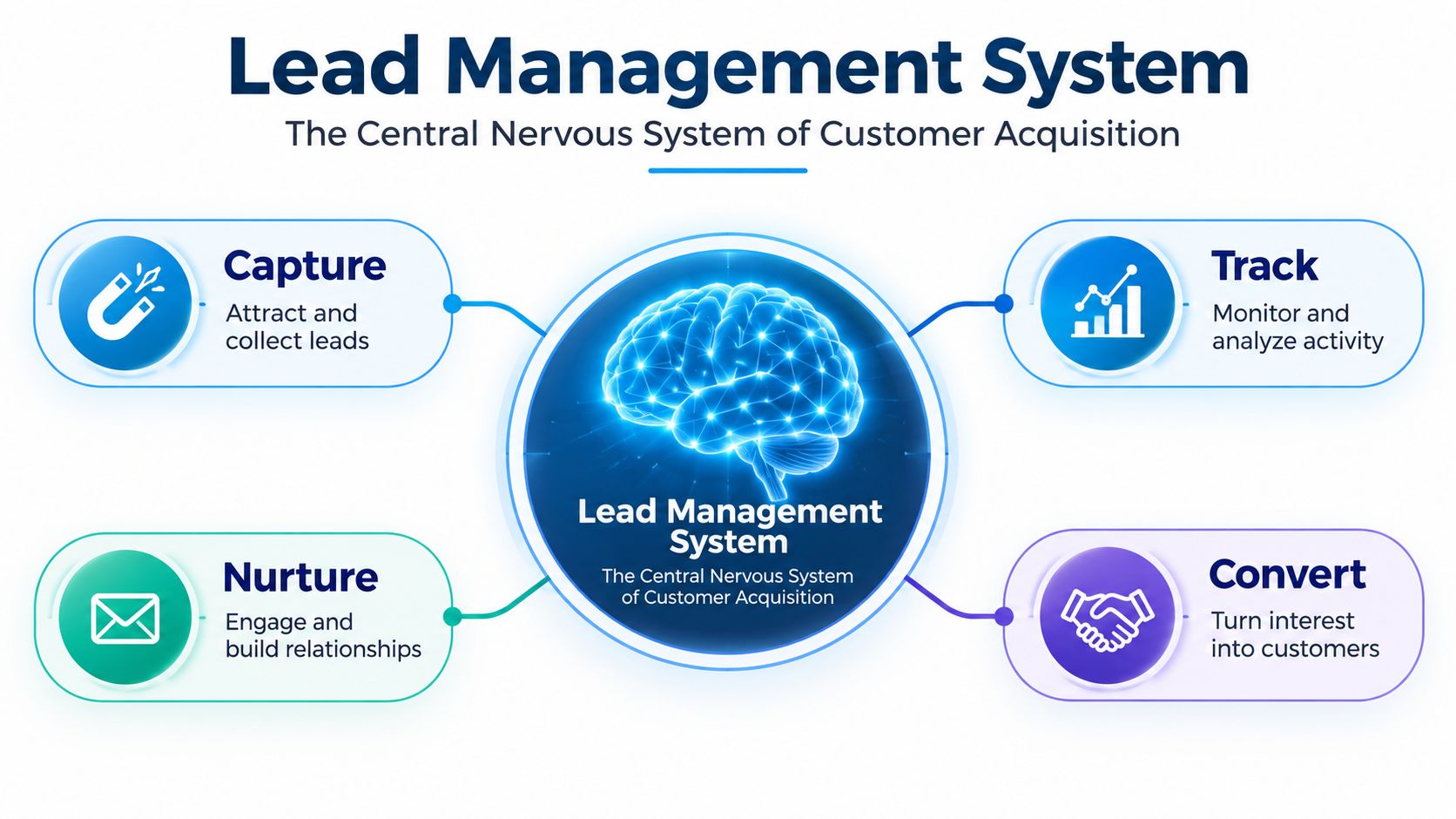
A lead management system is the central nervous system for customer acquisition. It takes every inbound inquiry, from web forms, calls, chats, referrals, or social messages, and moves it through a defined sequence so the right person sees the right lead at the right time.
That's a different job from a contact database. A database stores names, a lead management system decides what happens next, and that decision is where revenue is won or lost. The distinction matters because speed, ownership, and follow-up consistency are what keep opportunities from going stale.
The structure behind the system
A useful way to think about it is signal routing. Your body doesn't collect information, it processes it and sends a response, and a good lead management system does the same thing for incoming demand. It captures the lead, qualifies it, nurtures it if needed, and hands it off when it's ready for sales or service.
One study of 108 sales professionals found that lead management system use in inside sales explained 55% of the variance in sales performance through better adaptive selling, follow-up intensity, and sales-technical skills (Journal of Business Research study on inside sales performance). That matters because it shows this isn't just software convenience, it changes how consistently a team can execute.
A useful internal mental model is simple:
- Capture gets the lead into the system fast.
- Qualification filters out the wrong-fit inquiries.
- Nurturing keeps not-yet-ready leads warm.
- Handoff puts the lead in front of the right human or workflow.
For a small business, that might mean a missed call becomes a logged record, a callback task, and an automated text within seconds. For a larger team, it means every source is traceable and every rep knows what owns the next step. For a practical overview of how these stages fit inside a CRM workflow, the lead management software guide for small business is a clean companion read.
How Lead Management Systems Work Inside the Pipeline
A lead management system works best when it runs as one connected pipeline, not as a stack of separate tools pretending to share a process. The sequence is still capture, qualify, nurture, and convert, but each stage depends on the one before it. If intake is slow or the data is messy, the rest of the workflow carries that problem forward.
A lead that arrives cleanly gives sales a real chance to act on it.
Capture and qualify without delay
Capture is the point where the system pulls in leads from web forms, phone calls, chat, social channels, and event registrations. The value is not only volume, it is consolidation, because a fragmented intake process forces people to search across inboxes and dashboards before they can even decide what to do next. Once a lead is in the system, qualification applies your criteria, budget, service area, urgency, case type, or whatever your team uses to separate real opportunities from noise.
Practical rule: if the qualification rules are not written down, they will be interpreted differently by every rep.
The next step is nurturing, and automation earns its place here. Marketing automation research consistently shows that structured follow-up can lift qualified lead flow and improve sales productivity, while also reducing the manual work that slows down response. The exact results vary by study and by team, but the direction is consistent. Leads that get timely, relevant follow-up move further, and teams that do not rely on memory or inbox triage keep more opportunities from going stale.
Distribute, nurture, convert
A plumbing company gives the process a clear shape. A Facebook ad lead enters the system, gets scored for urgency, is assigned to the nearest rep, receives a text confirmation, and then gets scheduled for an on-site estimate. That is the practical difference between a pipeline and a pile of contacts.
Pipeline language matters because it shows where work is happening, and where it is getting stuck. The pipeline sales definition guide is useful here because a clean pipeline view makes lead movement, stall points, and handoff failures easier to spot.
The hard part is real-world timing. A good pipeline still fails if the office is closed, the rep is in a noisy truck, or the call lands after hours. Many teams now pair routing rules with an always-on response layer, because a lead that arrives outside business hours needs immediate acknowledgment, not a promise to call back tomorrow.
Lead Management Systems in Real Business Settings
A lead management system looks different in every industry, but the core job stays the same, capture quickly, qualify consistently, and route without confusion. The details matter because the wrong workflow in a service business creates wasted dispatch time, while the wrong workflow in a clinic creates scheduling gaps and missed appointments.
Home services, healthcare, and legal work each need different rules
A pest-control company usually wants instant routing by geography and service type. A web inquiry can go straight into the dispatch queue, trigger a confirmation text, and then get a follow-up sequence if the prospect doesn't book right away. The system should know the difference between a routine quote request and an urgent infestation call, because those leads shouldn't sit in the same bucket.
A dental clinic needs a tighter intake path. Every appointment request should trigger immediate contact, insurance and history verification should happen before the visit, and missed-appointment leads should be flagged so a manager can intervene the same day. The point isn't just speed, it's reducing avoidable friction before a patient ever walks in.
A law firm works off a different set of variables. Case type, venue, urgency, and potential value all affect who should respond, so inbound consultation requests should be scored and routed to the right practice-area attorney. Personalized follow-up matters here because a generic reply can make a serious inquiry feel unhandled.
The governance problem most teams ignore
Franchises and multi-location operators hit a separate wall. The same inbound inquiry may need to move across brands, territories, or teams, and if lifecycle stages aren't standardized, the reporting becomes unreliable. Leads don't technically disappear, but they vanish into different definitions, different handoff rules, and different dashboards.
That's the dark hole most generic lead-management guides skip. If one branch calls a lead “new,” another calls it “working,” and a third treats it as “pending,” the funnel looks healthy while the underlying governance is fragmented. The fix is boring but necessary, standard definitions, standard routing logic, and clear ownership at every handoff.
In multi-location operations, reporting is only as good as the language your teams share.
A strong system makes those definitions visible to everyone who touches the lead. Without that discipline, your weekly pipeline meeting becomes a debate over terminology instead of a review of actual revenue movement.
Integrating AI Receptionist Platforms Into Lead Management
A lead can be routed perfectly in a CRM and still disappear if nobody answers the phone after hours. That gap is where AI receptionist platforms fit, because lead management does not end at capture and routing. It also has to cover the first real conversation, especially when the business cannot staff every call window.
The first-response layer that CRMs don't cover well
A workable stack is more than a CRM plus an inbox. The lead enters the system, an AI receptionist answers right away, the key details get captured while the caller is still engaged, and the record is pushed back into the pipeline for follow-up. Recepta.ai is one example of that layer, with 24/7 inbound and outbound call handling, appointment scheduling, and escalation to a human agent when the conversation needs it.
Response-time benchmarks consistently show that fast follow-up improves conversion, which makes after-hours coverage hard to ignore. A dynamic first reply matters more than a generic auto-message, because the lead still needs to feel heard when no person is available to pick up.
A practical deployment usually follows this sequence:
- Connect intake sources so calls, forms, and chats all land in the same record.
- Define handoff rules so the AI escalates when the inquiry needs empathy, nuance, or approval.
- Log every interaction into the CRM so follow-up does not depend on memory.
- Use dynamic templates so the first response reflects the channel and context, not a canned greeting.
- Review missed-lead alerts every day so silent failures do not build up.
What to watch for in multi-brand environments
The more complex the organization, the more important the governance layer becomes. Multi-location teams need consistent stage definitions, but they also need routing that respects territory, brand, or service line differences. AI reception helps by enforcing the first touch fast enough that the lead does not go stale before a human gets involved.
Practical rule: the first response should confirm receipt, qualify intent, and create a clean handoff path.
A missed call can become a booked appointment instead of a voicemail for a small business. In a larger operation, the same first-response layer absorbs nights, weekends, and overflow without turning the CRM into a dead end.
The AI receptionist guide for small business is useful if you are mapping this into your current stack. Recepta.ai customers report up to 30% more qualified leads, 80% cost savings versus in-house reception, and 15× ROI according to the same marketing automation research cited earlier, which is why this category keeps coming up in serious lead-handling conversations.
Comparing Lead Management System Selection Criteria
Choosing a system gets easier when you evaluate it against the actual bottleneck, not the shiny feature list. A home-services company usually cares most about capture speed and first-response automation, while a franchise operator should care more about governance, routing, and reporting consistency.
| Selection Criterion | What to Look For | Red Flag | Ideal Benchmark |
|---|---|---|---|
| Lead capture methods | Web forms, phone, chat, SMS, social, and calendar booking in one flow | Only one or two channels supported, or leads live in separate tools | Every inbound source lands in a single pipeline record |
| Automation depth | Lead scoring, dynamic routing, task creation, and follow-up sequences | Manual assignment and manual reminders | Rules that move leads without human intervention |
| Integration breadth | CRM, calendar, phone, messaging, and reporting tools that sync cleanly | Third-party syncs that create lag or duplicate records | Native or well-supported connections across core systems |
| AI readiness | Support for AI receptionist, voice handling, or escalation workflows | No option for 24/7 first response | Always-on response for after-hours and overflow lead capture |
| Cost model | Clear pricing for seats, usage, and communication volume | Hidden fees for calls, seats, or basic automation | Pricing that matches your lead volume and contact pattern |
| Data quality controls | Duplicate detection, field validation, role-based access, and session governance | Dirty records, open access, or no validation | Structured fields and controlled access from day one |
The data-quality row deserves more attention than most demos give it. Requirements documents for lead systems commonly call for duplicate detection, field validation, role-based access, and session timeout controls, which tells you those aren't extras, they're part of keeping the data usable.
If you're a small service business, don't overbuy complexity you won't use. If you're a multi-location brand, don't settle for a pretty dashboard that can't explain where the lead came from, who owns it, or why it stalled.
Your Lead Management System Decision Checklist
Start with the gaps in front of you, not the features in a sales deck. If leads are sitting in voicemail, if follow-up is inconsistent, or if multi-location visibility is fragmented, the system you need has to solve those problems before it solves anything else.
Assess your current gaps
- Missed-response risk: Are inquiries arriving after hours or during busy periods and waiting for a human callback?
- Ownership drift: Do leads ever sit unassigned because nobody knows who should take them?
- Reporting confusion: Do different teams use different stage names for the same lifecycle step?
Define your requirements
- Capture coverage: Which channels must feed the system, phone, web, chat, SMS, or social?
- Automation depth: Do you need basic routing, or do you need scoring, escalation, and follow-up sequences?
- Governance controls: If you run multiple locations or brands, who defines the stage names and routing rules?
Pilot and iterate
- Short trial window: Start with one line of business or one location before rolling it out everywhere.
- Response-time review: Track how fast a new inquiry gets a real response, not just a logged task.
- Qualification review: Check whether the team is spending more time on better-fit leads or just processing more noise.
The best system is the one that gets every inquiry to the right person fast, with enough context to act.
That's the standard to use when you compare platforms. If the process still depends on someone remembering to check voicemail, refresh inboxes, or manually pass leads across teams, the system isn't strong enough yet. The numbers behind response speed and inside-sales performance make the case clear, and the operational details are where the revenue shows up.
If you're ready to replace missed calls, slow callbacks, and messy handoffs with a cleaner workflow, Recepta.ai gives you 24/7 lead capture, AI receptionist coverage, appointment scheduling, and automatic logging into your existing stack. Visit Recepta.ai to see how it fits into a lead management system that keeps every inquiry moving.