
Sales Lead Management: The Complete Guide for 2026
A missed call at 7:10 p.m. can still feel like a small operational blip, right up until the homeowner has already booked the competitor by breakfast. In service businesses, that's often where revenue leaks out, not in a broken report or a messy pipeline view, but in the gap between intent and first response. Sales lead management exists to close that gap, and the job starts the moment a real person calls, not when a form lands neatly in the CRM.
If your team is still treating every inbound as a record to be cleaned up later, reality keeps winning. The phone rings after hours, a rep misses the callback, a manager assumes the lead is “in the system,” and the opportunity disappears. A practical framework has to cover the whole chain, from capture to qualification to routing to follow-up, and it has to work when no one is at their desk. For a useful comparison of how service teams think about intake and student workflows, the structure in Tutorbase CRM is a helpful reference point, especially if you're trying to visualize how lead data needs to move cleanly from first contact into action. For a deeper look at how routing decisions affect response time, this breakdown on call routing for small business is worth reading once.
The Moment a Lead Almost Disappears
A plumbing company gets a call at 7:10 p.m. about a leaking water heater. The front desk is closed, the call rolls to voicemail, and the homeowner doesn't wait around for a callback that may or may not come. By morning, the job is gone, and the team is left talking about “lead quality” when the actual failure was lead recovery.
Why the phone call matters first
That kind of loss is exactly why sales lead management can't be reduced to CRM hygiene. Lead response timing is operationally decisive, and the foundational speed-to-lead benchmark is blunt, when contact happens within the first minute, conversion rates are reported to rise by 391%; when contact slips to 30 minutes, qualification and conversion odds fall sharply, according to the lead-generation research stream summarized by Warmly's lead generation statistics. The point isn't just speed for speed's sake, it's that the lead may vanish before a rep ever speaks to the buyer.
Practical rule: if a lead comes in by phone, treat voicemail as a leak, not a holding pattern.
That mindset changes the operating model. Instead of asking whether the CRM has the record, ask whether someone has acknowledged the caller, captured the context, and moved the conversation forward. In a service business, that often means the first useful workflow is missed-call recovery, not a nurture sequence.
The real failure mode
Teams don't lose the lead because the offer was weak. They lose it because no one owned the moment. A lead can be technically “captured” and still be functionally dead if the call never gets answered, if the callback lands too late, or if the handoff lands with the wrong person.
That's why the best systems start with the inbound channel and work backward. The record matters, but only after the conversation is preserved, routed, and followed up while intent is still hot. In practice, that means the lead-management process has to sit between the phone, the CRM, and the rep's next action, not as an afterthought when admin work gets around to it.
What Sales Lead Management Actually Covers
Sales lead management is the end-to-end process of capturing, tracking, qualifying, nurturing, and converting prospects. Salesforce frames it as understanding the sales cycle first, then breaking it into stages, identifying decision points, and reviewing the process using performance data and team feedback, which is the right way to think about it because the workflow has to match how your buyers move. A stage map that requires reps to record why a lead moved from “new” to “qualified” before a follow-up sequence starts is far more useful than a loose list of tasks.
The five stages in plain language
Capture is the first intake point. That includes website forms, phone calls, chat, inbound texts, and any place a prospect signals intent. The job is to collect the lead once, cleanly, and get it into a single operating record.
Tracking means every interaction stays visible. The CRM shouldn't just store contact details, it should show where the lead came from, what happened next, and who owns the next step.
Qualification separates casual interest from real buying intent. Teams often use frameworks like BANT or MEDDIC here, but the practical test is simpler, does the lead match your ideal customer profile and have enough urgency to justify a seller's time?
Nurturing keeps good-but-not-ready leads warm. That's where follow-up emails, call backs, reminders, and content sequences keep the conversation alive without forcing a premature close.
Conversion is where the process becomes revenue. The handoff from interest to opportunity has to be clear, documented, and timed well enough that momentum doesn't die in the gap between teams.
The tools that actually map to the stages
A good operating stack usually has one place for intake, one place for ownership, and one place for history. CRM records, intake forms, scheduling tools, and call logs all matter, but only if they support a shared process. If a lead exists in five tools and no one knows which one is authoritative, the process is already broken.
This is also where software selection gets practical. If you're comparing systems, this guide to lead management software for small business is useful because it keeps the focus on workflow, not feature noise. The question isn't which platform looks fuller in a demo, it's which one helps a rep know what happened, what's next, and who owns the next move.
Lead Scoring and Routing That Actually Work
Lead scoring fails when teams score only fit or only activity. Fit tells you whether the lead looks like your customer, and behavior tells you whether the lead is engaged right now. Put those together, and the score starts reflecting both likelihood to buy and readiness to talk, which is what your reps need when demand spikes.
Explicit data and behavioral data
Explicit data is the stable stuff, role, company size, geography, industry, and similar attributes. Behavioral data is what the lead is doing, page visits, form fills, email engagement, repeat visits, and intent signals. A fit-only model can push the right-looking account that isn't really buying. A behavior-only model can push an enthusiastic but poor-fit lead ahead of a better opportunity.
The fix is simple in theory and messy in practice. Use historical closed-won and closed-lost analysis to weight the attributes that correlate with conversion, then compare that against how the lead behaves. That's the core logic behind modern prioritization, and it's also why manual sorting breaks down so fast at scale.
For teams that distribute demand across territories or locations, especially in multi-unit or distributed models, the same logic shows up in lead generation for franchises. The point is consistent assignment, not just volume.
Route for speed, but qualify for relevance. If either one is weak, the handoff becomes the bottleneck.
Routing by who should respond
Lead routing should not be administrative housekeeping. Apollo describes distribution as a core stage of lead management, where qualified leads are assigned by territory, expertise, or capacity, and that matches the way service businesses work. A plumbing lead in one region should go to the rep who covers that territory, while a commercial construction inquiry should go to someone who understands the technical context.
That sounds basic, but misassignment is expensive. If the right rep receives the wrong lead, or the right lead sits with the wrong queue, the delay becomes the leak. The best routing rules are boring on purpose, they reduce judgment calls, shorten handoff time, and keep response delay from becoming the reason a hot lead cools off.
If you need a practical reference for the qualification side of that handoff, this guide on how to qualify sales leads is a good companion because scoring only matters if the qualification standard is shared.
The KPI Scorecard That Keeps the Funnel Honest
A lead program gets noisy fast if every dashboard is trying to tell the whole story. The more useful approach is to group metrics into four classes, then keep the core set tight, usually about 8 to 12 KPIs, so the team can see leakage without drowning in noise. Pedowitz Group's guidance is clear on the structure, volume, velocity, quality and conversion, and revenue impact are the KPI classes that keep the funnel honest, and they're the ones worth defending in a working operating review.
Four KPI classes that belong on one scorecard
Volume covers new leads, MQLs, and SALs. This tells you whether the top of the funnel is healthy enough to support the sales team.
Velocity covers time-to-first-touch and time-in-stage. Response speed and deal movement become visible here, which matters because speed-to-lead is often the difference between a conversation and a lost opportunity.
Quality and conversion include MQL to SQL, SQL to opportunity, and opportunity to win. These are the handoff metrics that show whether the process is selecting good leads or just moving names around.
Revenue impact includes pipeline sourced, closed-won revenue, and cost per opportunity. These metrics connect lead handling to business outcomes, which is the only reason the rest of the scorecard exists.
The same source also warns against a common failure mode, optimizing one metric in isolation. Faster response can improve early conversion, but if routing or qualification is weak, low-intent records flood the pipeline and downstream win rates suffer. That trade-off is real, and every sales ops lead has seen it happen.
Ownership beats reporting
Each KPI should have one owner, one hypothesis, and one change. If time-to-first-touch is slipping, someone owns it. If MQL to SQL is weak, someone has to state why and change a rule, a routing path, or a qualification checkpoint. The scorecard should behave like a product, not a monthly ritual.
If a metric doesn't trigger a decision, it doesn't belong in the core set.
That's why the best teams don't just pull reports, they inspect leakage by segment, source, and motion. The issue might be one lead source, one location, or one rep motion. Once the team sees that clearly, the next action is obvious.
For teams that want the operations layer behind those numbers, this discussion of performance monitoring systems is relevant because lead management only improves when the metrics drive actual process changes.
The Hidden Bottleneck Most Lead Programs Miss
A service lead can disappear before it ever reaches the CRM. A missed inbound call, a voicemail left after hours, or a slow callback can wipe out interest before a rep has a chance to qualify it. Most lead-management content stops at the handoff into software, but service businesses lose revenue earlier, at the point where the first call is answered, returned, or ignored. Nutshell's guidance points directly at that gap, teams should watch the five-minute rule for first response and treat response-time buckets, within 24 hours, 24 to 72 hours, and after 72 hours, as the way to measure leakage. That is where the missing revenue usually hides.
After-hours is where the system breaks
Teams often care about lead management, but they only watch business-hours activity, then assume the rest will sort itself out. It won't. A lead that arrives at night, on a weekend, or while staff are busy needs a real capture path, a real acknowledgment, and a real next step.
After-hours response is a trade-off between speed and completeness. A fast callback can save the lead, but if the team has no context, the follow-up turns into another round of questions and delays. That is why the first touch has to do two jobs, confirm the inquiry and preserve enough detail for the next person to act without starting over.
What to measure instead of guessing
Response-time buckets tell a more honest story than a single average. A team can look fine on paper and still be losing most of its leads because the lag is concentrated in one slice of the day. Once you segment by bucket, you can see whether the issue is immediate response, same-day follow-up, or neglected older leads.
The operational takeaway is straightforward. Do not fix after-hours leakage by adding more manual reminders. Build a path that handles calls, captures context, escalates complex cases, and logs the result without depending on somebody remembering to check voicemail at 8 a.m.
Real Workflows From Service Businesses
A dental clinic usually has to separate new-patient calls from general questions before anyone books time on the calendar. The front desk can use automated intake to ask the screening questions first, which helps avoid filling the schedule with incomplete or mismatched appointments. That workflow protects both staff time and patient fit.
Three examples from the field
A home-services company has a different problem. Emergency calls need to be scored and routed fast, often by region and service type, so a real need does not sit in the wrong queue while the customer waits for help. The rep who can solve the issue should get the lead first, not the person who happens to be free.
A multi-location franchise has another constraint, consistency. A platform such as Recepta.ai can fit into that workflow because it combines conversational AI with white-glove human support to handle inbound and outbound calls 24/7, captures and qualifies leads, integrates with 2,500+ tools, and escalates to trained agents when human judgment is needed, with customers reporting up to 30% more qualified leads and 80% cost savings versus an in-house receptionist. For franchises, that matters because call handling, logging, and escalation all need to happen the same way across locations.

The useful part is the workflow, not the logo on the dashboard. A caller is answered, the details are captured, the interaction is summarized, and a trained agent steps in only when the conversation needs a human judgment call. That is cleaner than forcing every call through the same manual front desk motion, and it gives operations a record they can review later.
These examples point to the same operating rule. Good lead management does not just move names through a funnel, it protects the first live interaction, preserves context, and gets the lead to the right next step before interest fades.
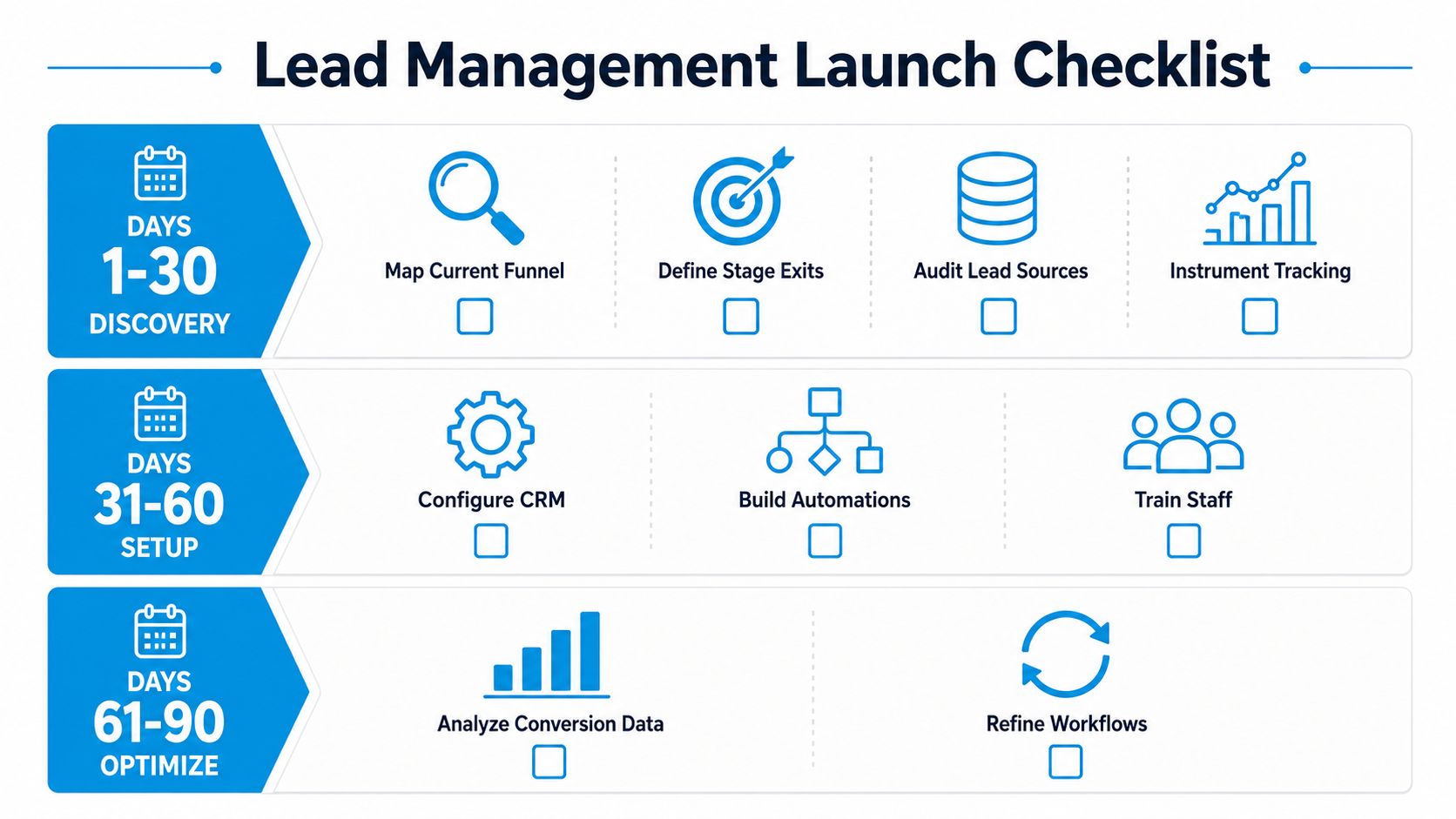
Your 30-60-90 Day Implementation Checklist
Days 1 to 30 are for discovery at the point where the lead first enters the business, often the phone call before anything touches the CRM. Map the current funnel, define clear stage exit criteria, audit every lead source, and add response-time tracking so delays are visible instead of guessed at. If the team cannot describe the current state in plain language, the process is not ready for tuning.
Days 31 to 60 are the build window. Configure scoring with explicit and behavioral data, set routing rules by territory or expertise, connect CRM and calendar integrations, and put after-hours capture in place so missed calls do not die in voicemail. If call handling is part of the revenue motion, this is also the point to decide how live calls are answered, qualified, and handed off when no one is at the desk.
Days 61 to 90 are for lock-in and correction. Assign KPI owners, run weekly leakage reviews by response-time bucket, and adjust routing based on closed-won analysis. The goal is to stop treating the workflow like a temporary project and start running it as operating discipline.
Start with one stage, one source, and one routing rule. Clean wins beat a full rewrite every time.
At each phase, the check is the same. Does the lead move faster, get qualified more cleanly, and reach the next owner with enough context to act without three follow-up questions? If yes, the system is improving. If not, the problem is usually a missing rule, a weak handoff, or a response delay that nobody has measured closely enough.
Bringing It All Together
The biggest mistake in sales lead management is treating it like a CRM project. It is an operations discipline that starts with the inbound phone call, keeps moving through qualification and routing, and ends only when the lead is converted or recovered. The speed-to-lead pattern is hard to ignore, fast contact tends to produce far better results than a slow callback, as noted earlier in Warmly's lead response research.
That is why the opening scenario matters. A voicemail at 7:10 p.m. is a missed revenue event, and it should show up in your metrics, your routing logic, and your follow-up design. Teams that hold up under pressure do not rely on memory or heroics. They build a system where capture is instant, qualification is disciplined, routing is clear, and missed-call recovery is treated like part of the revenue motion.
The practical test is simple. Does the lead move faster, get qualified more cleanly, and reach the next owner with enough context to act without extra back-and-forth? If the answer is yes, the system is working. If not, the cause is usually a missing rule, a weak handoff, or a response delay that nobody has measured closely enough.
Pick one KPI, one owner, and one change you can ship this week. If that stays consistent, the funnel gets easier to read, the handoffs get faster, and lead flow stops depending on whether somebody happened to answer the phone.
A CTA for Recepta.ai.