
Sales Outsourcing B2B: Drive Growth & AI Integration
Sales teams usually start looking at outsourcing when the same pattern repeats for too long. Closers spend their mornings building lists instead of running deals. New territories sit untouched because hiring takes too long. Marketing produces leads, but follow-up is inconsistent, especially after hours or during busy stretches. Pipeline doesn't collapse all at once. It leaks through small operational failures.
That's why sales outsourcing B2B is less a staffing decision and more an operating model decision. The companies that get value from it don't just ask, “Can someone else do outreach cheaper?” They ask better questions. Which parts of the funnel are repetitive enough to standardize? Where do handoffs break? Which tasks require deep product judgment, and which need disciplined execution every day?
The answers determine whether outsourcing creates advantage or creates noise.
When to Consider B2B Sales Outsourcing
A common scenario looks like this. A service business or B2B company has a few strong account executives or owner-led sellers. Revenue grew on referrals, founder relationships, and a handful of repeatable outbound plays. Then growth flattens. Nobody has enough time to prospect consistently, but nobody wants to hire a full internal SDR function before they know the motion will work.
That's the point where outsourcing becomes worth serious consideration.
The market itself shows this is no longer a niche move. The global B2B sales outsourcing services market was valued at approximately USD 4.8 billion in 2023 and is projected to reach USD 10.5 billion by 2032 according to Dataintelo's B2B sales outsourcing market report. That matters because it reflects a broader shift toward externalized revenue operations, not just temporary cost cutting.
Signs the in-house model is becoming a bottleneck
You should start exploring outsourced support when the issue is operational capacity, not just motivation.
- Your closers are doing prospecting work: If experienced reps spend hours researching accounts, cleaning lists, or sending first-touch emails, high-value selling time gets pushed aside.
- You need speed before you need permanence: Launching a new geography, vertical, or offer often requires fast testing before you commit to hiring internally.
- Hiring is slowing expansion: If you can define the outreach process but can't recruit, onboard, and manage SDR talent quickly, an external team can close that gap.
- Lead follow-up is inconsistent: This is common in home services, clinics, law firms, insurance teams, and multi-location operators where inbound and outbound activity compete for attention.
Situations where outsourcing fits well
The best use cases are usually specific.
A SaaS company entering a new vertical might outsource list building, first-touch outreach, and meeting qualification while its internal team handles demos and proposals. A regional HVAC company might use an external team to qualify commercial maintenance opportunities while office staff focus on dispatch and customer service. A legal practice may want someone screening inquiries and booking consultations, but keep case strategy internal.
Practical rule: Outsource when you need repeatable execution at the top of the funnel. Keep decision-heavy selling close to the business.
If you're still clarifying how these arrangements are structured, it helps to understand B2B outsourcing models before talking to vendors. The scope matters more than the label. A partner that's right for lead generation may be wrong for account management.
Common Models of Sales Outsourcing
Think of outsourced sales the way you'd think about hiring specialists for a renovation. You don't bring in the same contractor to design the plan, pour the foundation, wire the house, and install the cabinets unless they have those capabilities. Sales outsourcing works the same way. Different models solve different problems.
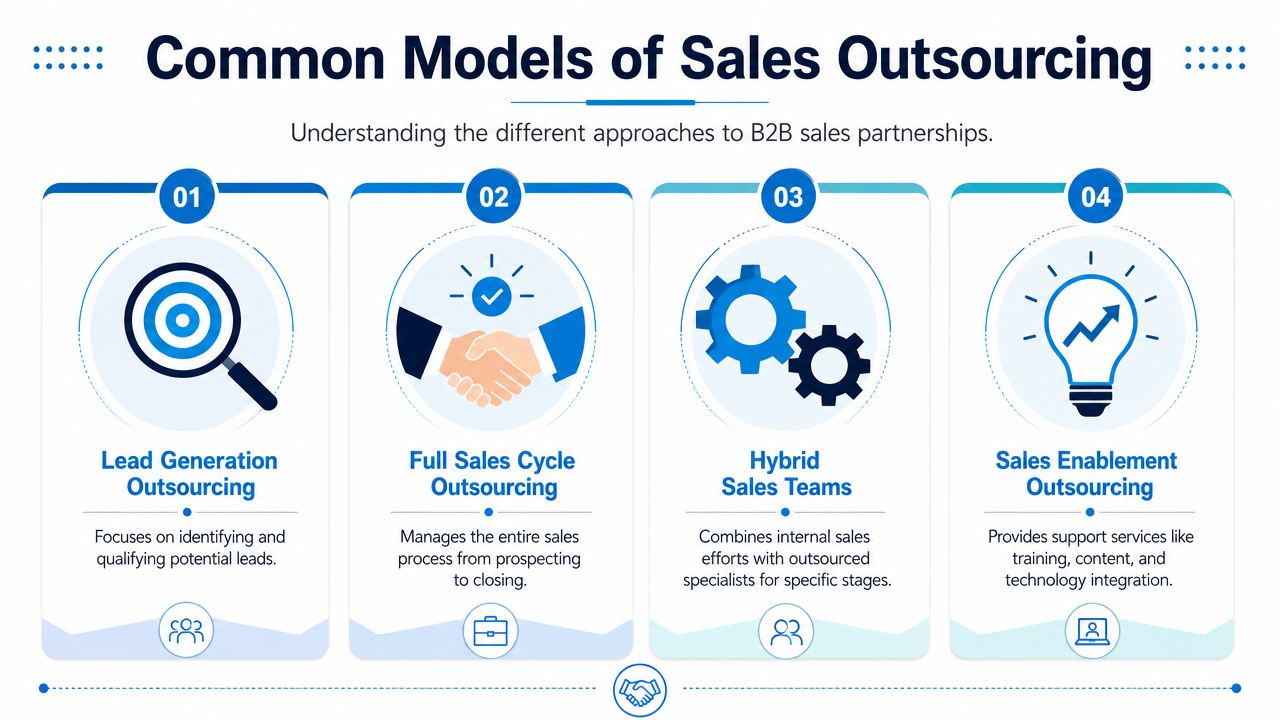
One reason this category has expanded is simple: 59% of companies outsource at least some part of their lead generation, according to SalesHive's B2B outsourcing overview. That puts outsourced top-of-funnel work firmly in the mainstream.
Lead generation outsourcing
This is the narrowest model. The partner identifies target accounts, builds prospect lists, enriches contact data, and sometimes runs initial outreach.
Use this when your sales team knows how to sell but lacks research bandwidth. For example, a B2B software company with one strong AE may need a partner to deliver clean account lists by industry, role, and territory. The AE can then personalize outreach or run demos without spending half the week in spreadsheets.
This model works when you already have internal sales discipline. It fails when you expect list building alone to create pipeline.
Outsourced SDR teams
An outsourced SDR team goes further. They prospect, execute outreach across channels, qualify responses, and route interested buyers to your internal closers.
This is often the best fit for companies that need a full top-of-funnel engine without building one from scratch. A manufacturer selling into distributors, for instance, might use an outsourced SDR team to contact operations leaders, qualify demand, and schedule discovery calls for internal sales managers.
If you're comparing this model with broader support functions, this overview of outsourced call center solutions is useful because many businesses need both outbound pipeline creation and consistent inbound handling.
Appointment setting services
Some firms specialize almost entirely in booked meetings. Their job is not to own your prospecting strategy end to end. Their job is to fill calendars with prospects who meet agreed qualification criteria.
This model fits well when a new account executive needs volume quickly. A practical example is a cybersecurity startup that already has messaging, CRM workflows, and ICP definitions in place. Instead of hiring another rep immediately, it hires appointment setters to create a steady flow of first meetings while leadership validates the market.
The catch is quality control. If booked meetings become the only metric, the calendar may fill while conversion drops.
Meetings booked are an activity output. Meetings held, accepted by sales, and advanced to the next stage are performance outputs.
Full-cycle sales outsourcing
This is the broadest model. The external team handles prospecting, qualification, presentations, proposals, and sometimes closing.
It can work in simpler sales motions with standardized offers and short decision cycles. It's riskier when pricing, packaging, or deal strategy require deep internal judgment. If your differentiation depends on custom scoping, legal nuance, technical credibility, or executive relationships, full-cycle outsourcing can create friction fast.
Hybrid sales teams and enablement support
Many companies land in a hybrid setup. Internal leaders own messaging, key accounts, pricing, and late-stage sales. External specialists handle defined stages such as outbound prospecting, reactivation campaigns, list operations, or meeting qualification.
Some businesses also outsource enablement functions, including call scripting, playbook creation, tool setup, and reporting design. Those services matter because weak process usually hurts more than weak effort.
A good model doesn't just assign work. It matches the work to the level of judgment required.
Calculating the True ROI of Outsourced Sales
A weak ROI analysis compares one outsourced fee to one internal salary and stops there. That's not enough. Sales outsourcing B2B should be evaluated against the full operating cost of building and maintaining the function yourself, plus the cost of moving too slowly.
The harder question is this: what happens to pipeline if you wait six months to hire, train, and stabilize an internal team?
What should stay in-house
The cleanest way to avoid bad ROI is to choose the right scope at the start. Business Research Insights' market coverage makes the key point well: top-of-funnel work is often outsourced for speed, while strategic account management and complex pricing negotiations are better retained internally.
That distinction matters because outsourced activity only pays off if the work sits in the right part of the funnel.
Here's a simple decision table:
| Function | Usually a strong outsourcing fit | Usually better kept in-house |
|---|---|---|
| Prospect research | Yes | Rarely |
| Data enrichment | Yes | Rarely |
| Cold outreach execution | Often | Sometimes |
| Appointment setting | Often | Sometimes |
| Discovery for complex deals | Sometimes | Often |
| Pricing and proposal strategy | Rarely | Yes |
| Strategic account management | Rarely | Yes |
The real cost inputs
When evaluating return, include more than vendor fees.
- Internal build costs: Recruiting, onboarding, manager time, rep ramp, list sourcing, sequencing tools, CRM setup, QA, and replacement hiring when someone leaves.
- Speed value: An external partner may let you test an offer or territory immediately instead of waiting for headcount approval and hiring cycles.
- Opportunity cost: If your best seller spends time on early-funnel admin, you're paying a hidden tax on every late-stage opportunity they could have advanced instead.
- Quality risk: Bad outsourcing creates low-intent meetings, sloppy messaging, and brand inconsistency. Those costs are real even if they don't show up neatly in a budget line.
If you want a tighter financial baseline before choosing a partner, build your own benchmark using a clear cost per lead calculation framework. That forces discipline around what you are buying.
A practical ROI formula
Use a working model like this:
ROI = pipeline value created + speed gained + internal time reclaimed - vendor cost - management overhead - quality leakage
That formula isn't perfect, but it's honest. It captures what usually gets ignored.
For example, an outsourced SDR team may look expensive compared with one internal hire. But if the external team launches faster, works inside your existing ICP, and frees senior reps to focus on demos and proposals, the economics can still make sense. If they create meetings that sales rejects, the program is failing even if activity looks high.
For teams trying to tighten conversion after handoff, LinkedFuse insights on conversions are a useful companion read because outsourcing ROI often rises or falls on what happens after the first booked conversation.
Don't judge outsourced sales by volume alone. Judge it by accepted opportunities, cleaner rep focus, and whether the sales team would choose to keep the meetings on their calendar.
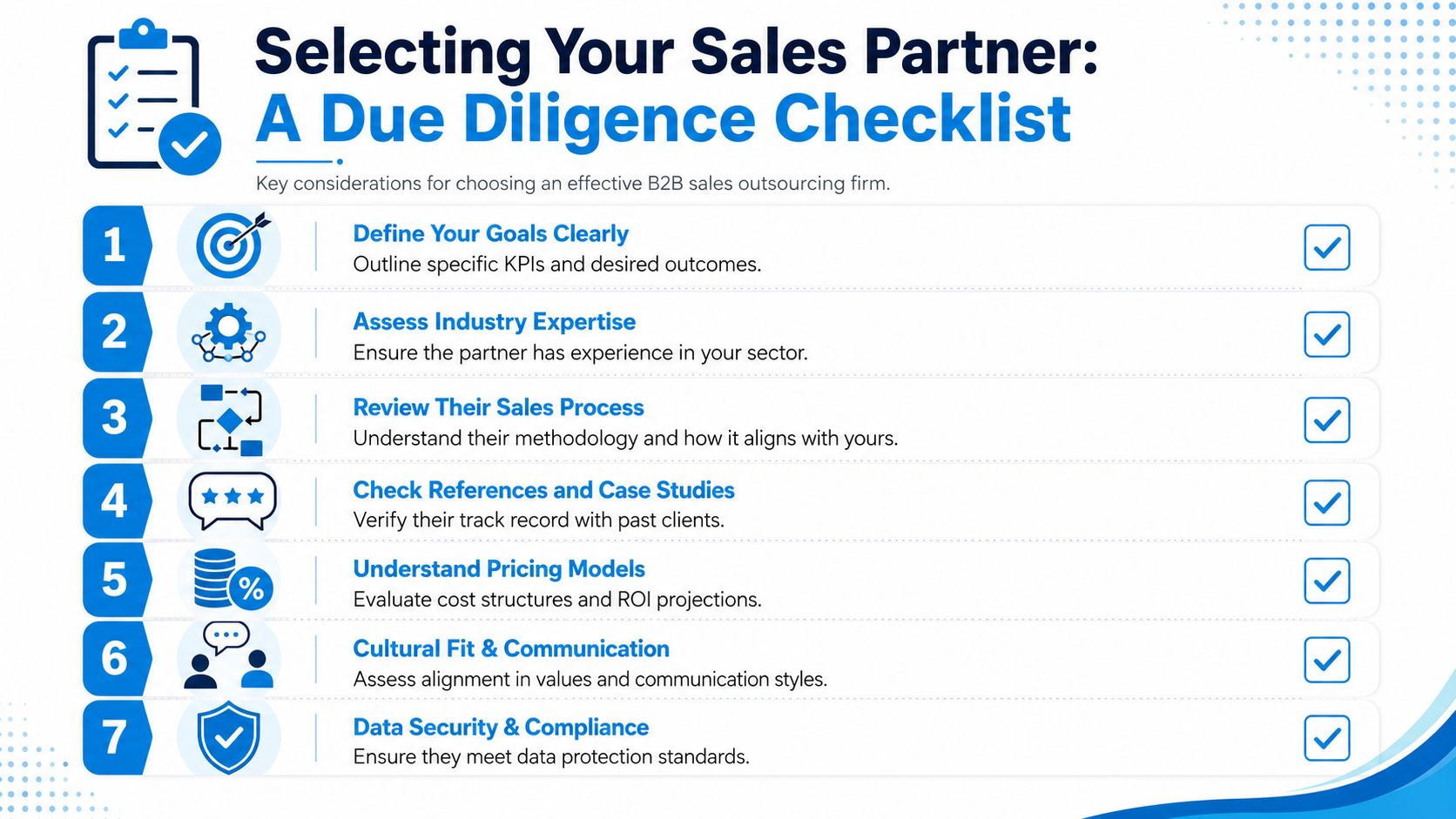
A Checklist for Selecting the Right Sales Partner
Most vendors sound competent in a discovery call. The good ones prove it in their process, tooling, and operating discipline. The wrong ones hide behind activity reports, vague qualification language, and polished talk tracks.
Use this checklist the way you'd use a procurement scorecard. If a partner can't answer these questions clearly, assume implementation will be messy.
Questions that reveal real capability
- Scope control: Ask exactly which tasks they own. List building? Outreach copy? Inbox management? Qualification? Reschedules? CRM updates?
- ICP discipline: Ask how they translate your ideal customer profile into account selection rules and exclusion rules.
- Message governance: Request examples of how they approve scripts, emails, and objection responses before launch.
- Tech stack clarity: Ask what tools they use for sourcing, enrichment, dialing, sequencing, QA, and reporting, and whether those tools integrate with yours.
- Training method: Ask to see onboarding materials, certification steps, and how they train reps on a new industry.
- Reporting granularity: Ask what gets logged in the CRM, how quickly, and in what format.
- Escalation path: Ask what happens when a prospect asks a technical, legal, or pricing question the outsourced rep can't answer.
Red flags that show up early
A vendor usually exposes weak execution before the contract is signed.
| Red flag | Why it matters |
|---|---|
| They sell meetings, not qualification logic | You'll get volume without decision quality |
| They can't explain CRM field mapping | Handoffs will break |
| They rely on generic scripts | Brand tone and relevance will slip |
| They won't define rejection reasons | Sales feedback won't improve the program |
| They avoid discussing compliance | Risk rises in regulated sectors |
What good partners do differently
Good partners usually ask uncomfortable but necessary questions. They want access to lost-deal reasons, call recordings, ICP edge cases, no-go industries, and sales objections that kill momentum. That's a strong sign. They're trying to build a real operating motion, not just launch outreach.
A serious partner wants your disqualification criteria as much as your target account list.
Ask for a sample weekly review agenda. Ask how they classify a lead accepted by sales versus a lead rejected by sales. Ask how they retrain reps after repeated quality misses. Vendors that have done this well before will answer without improvising.
How to Implement and Integrate an Outsourced Team
Most outsourced sales programs don't fail because the partner lacked effort. They fail because integration was shallow. The partner worked in one system, the internal team worked in another, qualification criteria stayed vague, and nobody fixed the handoff.
The strongest model is the split-funnel approach. In that setup, the outsourced team handles top-of-funnel execution and passes qualified opportunities to internal sellers for closure, as described in AI Bees' guide to B2B sales outsourcing. That handoff is where value gets preserved or lost.
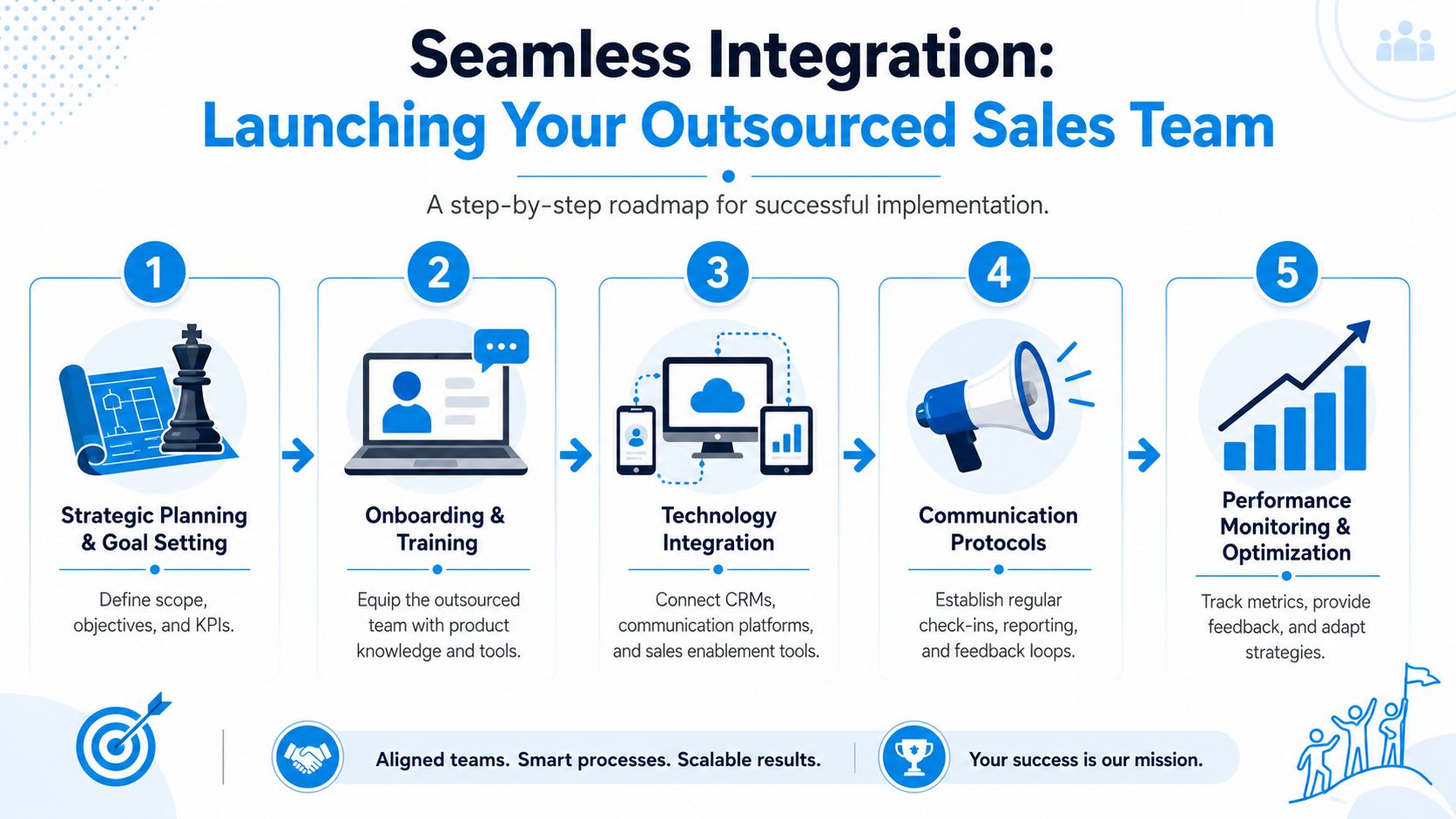
Build the system before you launch outreach
Start with shared definitions. Your team and the vendor need the same view of ICP, disqualification reasons, meeting standards, stage definitions, and routing rules. If those aren't documented, reps will fill the gaps with personal judgment.
A basic launch package should include:
- Account rules for target industries, company profiles, geographies, and exclusions.
- Contact rules for titles, seniority, and buying influence.
- Messaging rules for positioning, approved claims, and prohibited language.
- Qualification rules for what counts as sales-ready.
- Routing rules for who receives which meeting, when, and how.
For the technical side, map your systems early. This primer on CRM integration is worth reviewing because outsourced teams only work well when records, activities, notes, and outcomes sync cleanly.
Set handoff rules that sales can trust
The handoff shouldn't depend on goodwill or memory. It should follow a documented protocol.
Use a structure like this:
- Meeting acceptance criteria: Define the minimum information required before a meeting lands on an AE calendar.
- Pre-meeting notes: Require problem context, source of interest, relevant pain points, and any known blockers.
- Timing standard: Decide how quickly accepted meetings must be confirmed and how no-shows get recycled.
- Ownership transfer: Specify the exact moment an opportunity moves from outsourced rep to internal rep.
Here's a practical example. If an outsourced rep books a call with a multi-location plumbing business, the internal rep should already know whether the buyer has authority, whether the discussion is for one branch or several, what systems they currently use, and why they took the meeting now. Without that context, the internal seller has to restart discovery and trust erodes.
A short training asset can help align both teams. This walkthrough is useful for teams evaluating workflow setup:
Use SLAs that measure quality, not just activity
A weak SLA says the partner will send outreach and book meetings. A strong SLA defines expected behaviors and quality thresholds.
Include measures such as:
- Activity compliance: Are reps completing agreed outreach and logging it correctly?
- Data quality: Are records complete and usable?
- Meeting quality: Are internal reps accepting the opportunities?
- Conversion feedback: Which meetings advance, stall, or get rejected, and why?
- Follow-up discipline: Are reschedules, no-shows, and nurture paths handled consistently?
If your sales team keeps rejecting meetings for the same reason, the issue isn't rep effort. The issue is a broken qualification rule.
Hold weekly operating reviews
Weekly reviews should be operational, not ceremonial. Inspect call notes, rejected meetings, CRM hygiene, talk tracks, and objection patterns. Look for friction. Did the vendor target the wrong account type? Did internal reps ignore accepted meetings? Did a script create confusion?
The point isn't to monitor people. It's to tighten the system until the outsourced and internal teams operate like one revenue unit.
Sales Outsourcing Examples for Your Industry
The model changes by industry because the handoff changes by industry. A booked meeting in software isn't the same as a booked consultation in legal or an intake call in healthcare. Good outsourcing programs respect that difference.
Home services
A commercial HVAC or plumbing company often has a simple problem. Office staff are busy handling dispatch, scheduling, and customer issues. That leaves little time for consistent outbound prospecting or after-hours lead capture.
A practical setup is outsourced appointment setting for commercial property managers, facility teams, or general contractors. The external team handles prospecting and books estimate calls. Internal staff take over once the buyer shows clear interest and the opportunity needs scheduling, scoping, or technical review.
Healthcare and wellness
In healthcare, outsourced support usually works best at the intake and qualification layer, not at the point where clinical judgment is required.
A dental group or specialty clinic might use an external team to respond to inquiries, verify whether the person fits the practice's service criteria, gather intake details, and schedule the next step. The practice keeps treatment planning, medical discussions, and sensitive care decisions internal. That separation protects both patient experience and operational clarity.
Legal services
Law firms often face lead volume with uneven quality. Intake can become chaotic when attorneys review every new inquiry themselves.
A better setup is external screening against clear practice-area criteria. The outsourced team asks approved questions, filters out poor-fit matters, and routes viable consultations to the right attorney or intake specialist. The firm retains case evaluation, legal strategy, and fee conversations.
Insurance, finance, and franchises
These businesses usually need consistency across agents, advisors, or locations. That's where outsourcing can help standardize top-of-funnel execution.
An insurance agency can centralize outbound appointment setting while agents focus on licensed conversations and policy advice. A franchise network can use one external partner to support location-level lead capture, qualification, and booking with shared scripts and reporting rules. The key is central governance with local routing, not a loose collection of disconnected campaigns.
The common thread is simple. Outsource structured intake, qualification, and scheduling. Keep expert judgment where customers expect direct expertise.
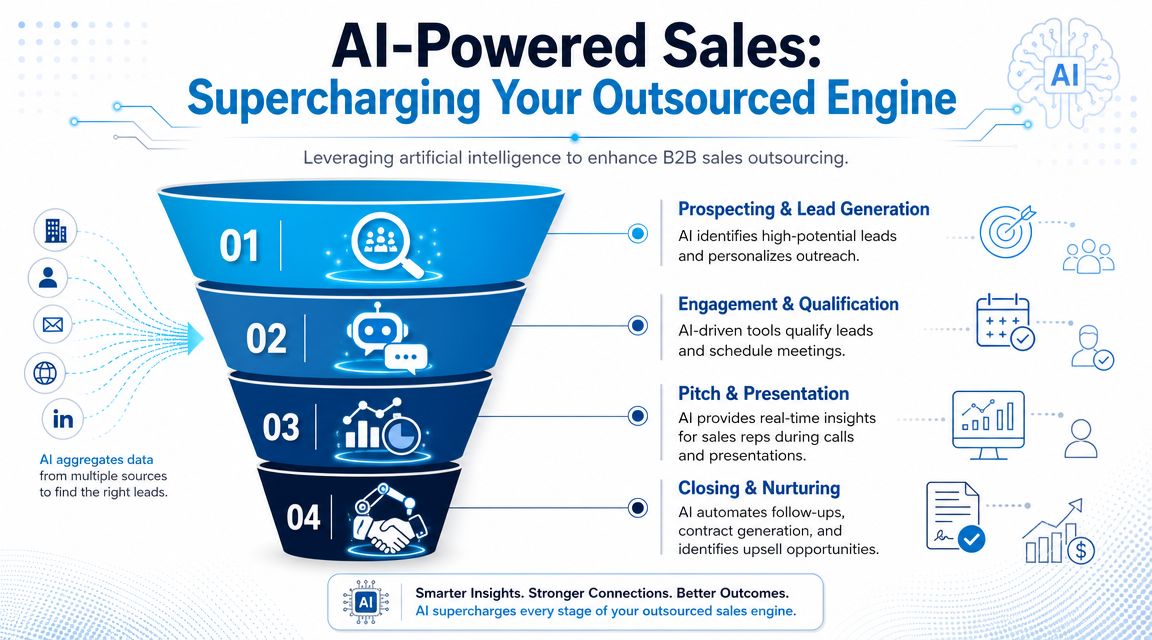
How AI Supercharges Your Outsourced Sales Engine
AI changes outsourced sales when it improves execution between stages, not when it adds automation for its own sake. The category is moving in that direction. Bandalier's review of B2B sales outsourcing companies notes that the market is shifting from labor arbitrage toward a hybrid human-plus-AI model where buyers care about pragmatic AI use, CRM visibility, and real-time data sync.
That shift matters because the biggest operational losses usually happen in the gaps. A prospect replies after business hours. A booked lead hits voicemail. Notes never reach the CRM. A qualified buyer waits too long for confirmation and goes cold.
Where AI actually helps
The strongest use cases are operational.
- Lead capture: AI can answer calls, chats, and messages when internal staff or outsourced reps aren't immediately available.
- Qualification consistency: Structured intake flows reduce missed questions and uneven screening.
- Routing speed: Qualified leads can be pushed to the right rep or location without manual triage.
- Calendar coordination: Scheduling gets faster when systems check availability and book directly.
- CRM hygiene: Summaries, dispositions, and contact records can sync automatically instead of relying on manual updates.
For businesses evaluating this layer, the broader concept of a unified platform for AI employees is useful because it frames AI as workflow infrastructure rather than a standalone chatbot.
The handoff problem AI can solve
In many programs, the outsourced team does its job, but the business still loses opportunities after the handoff. That's where an AI-enabled intake layer can act as connective tissue.
For example, a partner books a lead for a home services company late in the workday. If nobody confirms quickly, that buyer may keep calling competitors. A tool such as Recepta.ai's overview of AI in customer service shows how AI-assisted workflows can capture the inquiry, qualify it, route it, and trigger the next step without waiting for office hours. In practical terms, that reduces lag between interest and action.
The outsourced team creates demand. AI protects it from getting lost between systems, schedules, and people.
Used well, AI doesn't replace the outsourced SDR, setter, or intake specialist. It removes the dead time around them. That's what improves throughput.
If you're evaluating sales outsourcing B2B and want tighter intake, faster routing, and fewer missed opportunities after the handoff, Recepta.ai can support that layer with AI reception, appointment scheduling, lead capture, and human escalation tied into your existing systems. It fits best when you already have demand generation in motion and need the operational glue that keeps prospects from slipping through.